Global Journal of Advance Engineering Technologies and Sciences
Performance of PAPR Reduction on OICF with QPSK Modulation
Pritesh Solanki
1, Prof. Sunil Kumar Bhatt
2M. Tech. Scholar
1, Asst. Prof. & HOD
2Department of Electrical & Electronics Engineering
CENTRAL INDIA INSTITUTE OF TECHNOLOGY
,
INDORE (M.P.) India
ABSTRACT
The communication network of an electric power system has the important role of conveying information for ensuring a stable supply of electricity. The new techniques for digital transmission have developed to meet the increasing demand for higher data rates in communications which can be used in both wired and wireless environments. To meet out the high spectral efficiency and high data rate, an efficient modulation scheme is to be employed. The Iterative Clipping and Filtering (ICF) is a well-known technique to reduce the peak-to-average power ratio (PAPR) of orthogonal frequency division multiplexing signals. It is more advantageous over other technologies. This Proposed technique shows better performance for reduction in PAPR any technique can be used according to performance. The simulation results show that our proposed power reduction techniques OICF, in this paper, a technique OICF was proposed to reduce the high Peak to Average Power Ratio (PAPR) values. The Simulations are performed using OICF technique with QPSK modulation technique under Additive White Gaussion Noise channel. The simulation result shows the relationship between Complementary Cumulative Distribution Function (CCDF) versus PAPR. The whole simulation is done by a software tool known as MATLAB R2013a.
Keyword: OICF, PAPR, OFDM, Power System, CCDF.
I. INTRODUCTION
Generally the power system network is divided into Transmission and distribution networks. The transmission network involves the stepping up of the generated voltage in the generating station and transmits power to the substations through high voltage over head transmission lines. On the other hand the distribution network involves the step-down of voltages into different levels and distributed to different consumers through low voltage power lines. The transmission and distribution lines are the back bones of power system network. Therefore monitoring and protection of lines is very important.
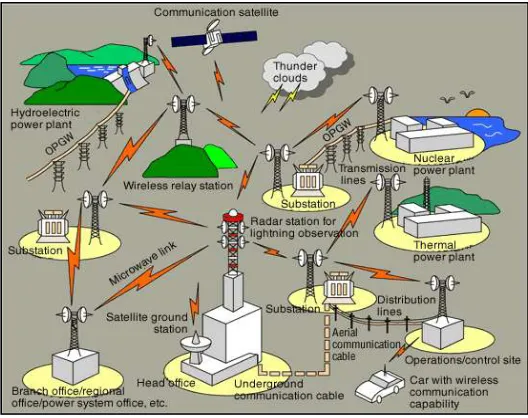
The complex power system network is shown in Figure 1. It is divided into two infrastructures based on protection and monitoring.
I. Information infrastructure, II. Power infrastructure. III. Power reduction techniques
The idea of adjacent channel emissions filtering after clipping has been presented in. As the filtering of clipped signals results in new peaks creation, the method of repeated clipping and filtering has been subsequently proposed in. This method is based on the zero padding of the signal in the frequency domain and frequency domain filtering of clipped signal at the output of IFFT. The process of clipping and filtering is repeated several times – according to the author's experiments 4 or 5 times. These repetitions result in huge signal processing - for each frequency domain filtering the pair of FFT and IFFT operation is necessary. Its PAPR reduction performance is approaching the PAPR of repeated clipping and filtering method with arbitrary number of repetitions.
A. OPTIMIZED-ITERATION-CLIPPING-FILTERING (OICF) SCHEME
As mentioned earlier, iterative clipping and filtering (ICF) of 2K+1 IFFT/FFT operations, where K is the number of iterations, is necessary to obtain the desired clipped signal. Proposed an efficient and fast algorithm for ICF. In target clipped signal was produced through one iteration (of 4 IFFT/FFT operations) with some additional processing (two vector subtractions). They assumed the clipped peaks as a series of parabolic pulses, which is true for large clipping threshold. The processing overhead might still be considerable due to the oversampling (by a factor ≥4) of original OFDM data block. In this section, a new scheme one iteration of clipping and filtering (OICF) is presented. As the name implies, this approach produces the desired clipped signal through one iteration with almost no additional processing. The OICF scheme employs a scaling of the original clipping threshold. We have derived an empirical expression based on re-growth of clipped-filtered pulses, which relates the original clipping threshold to new scaled one. The simulation results show that the performance of OICF is comparable to the conventional method for large clipping threshold.
II. QUADRATURE PHASE SHIFT KEYING (QPSK)
This is also known as four-level PSK where each element represents more than one bit. Each symbol contains two bits and it uses the phase shift of π/2, means 90º instead of shifting the phase 180º. In this mechanism, the constellation consists of four points but the decision is always made in two bits.
S(t) =
{
𝐴𝑐𝑜𝑠 (2𝜋𝑓𝑐𝑡 +𝜋4) , 𝑓𝑜𝑟 𝑏𝑖𝑛𝑎𝑟𝑦 11
𝐴𝑐𝑜𝑠 (2𝜋𝑓𝑐𝑡 +4𝜋4) , 𝑓𝑜𝑟 𝑏𝑖𝑛𝑎𝑟𝑦 01
𝐴𝑐𝑜𝑠 (2𝜋𝑓𝑐𝑡 −4𝜋4) , 𝑓𝑜𝑟 𝑏𝑖𝑛𝑎𝑟𝑦 00
𝐴𝑐𝑜𝑠 (2𝜋𝑓𝑐𝑡 −𝜋4) , 𝑓𝑜𝑟 𝑏𝑖𝑛𝑎𝑟𝑦 10
(1)
This mechanism can ensure the efficient use of bandwidth and higher spectral efficiency. The principle equation (3.5)[9][10] of QPSK Modulation of the technique is.
III. COMMUNICATION CHANNEL
IV. SIMULATION RESULTS
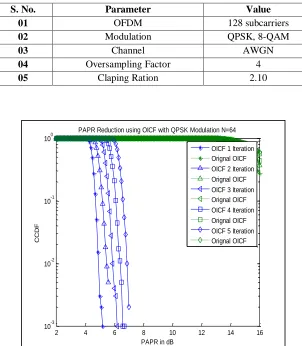
To simulate the above OFDM system for PAPR reduction we used MATLAB R2013a, to compare the performance of the original and proposed algorithms, we consider an OFDM system with 128 subcarriers with QPSK modulation. The studies have suggested that the oversampling factor L = 4 can provide sufficiently accurate PAPR results. Our algorithm will be compared first with the original OICF algorithm and then with several existing clipping and filtering techniques and another PTS algorithm considered. During our simulation we used cyclic prefix to minimize the Inter Symbol Interference (ISI) on the basis of Quadrature Phase Shift Keying modulation techniques and AWGN and multipath fading channel communication channel. With the help of modulation techniques we got the parameters PAPR versus CCDF and Bit Error Rate (BER) versus Signal to Noise Ratio (SNR). We are considered following analysis parameter in reduction of pick to average poer ration or power reduction as shown in the table 1.
A. PAPR Reduction performance for QPSK
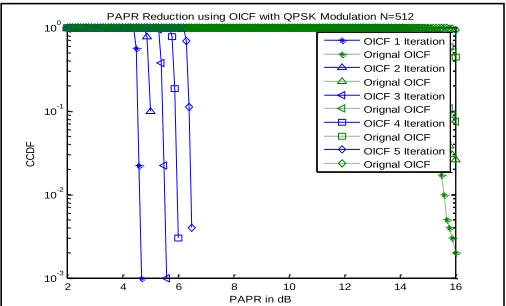
In this performace we are used different-different subcarriers (N=64, 128, 256 and 512) with QPSK-Modulation, also consdered claping ration (CR) ϒ is still set to 2.11, L=4, PAPR with OFDM signal. Figure 5.1 for N=64, figure 5.2 for N=128, figure 5.3 for N=256 and figure 5.4 for N=512 shows the PAPR, CCDF curves for the signals processed by using the orignal and simplified OICF algorothms, respectively.
Table 1 Analysis parameter in PAPR Reduction
S. No. Parameter Value
01 OFDM 128 subcarriers
02 Modulation QPSK, 8-QAM
03 Channel AWGN
04 Oversampling Factor 4
05 Claping Ration 2.10
Fig. 2: PAPR Reduction performance oforignal and simplified OICF algorithms, QPSK, N=64 subcarriers, L=4 and ϒ=2.11
2 4 6 8 10 12 14 16
10-3
10-2
10-1
100
PAPR Reduction using OICF with QPSK Modulation N=64
PAPR in dB
CCDF
Fig. 3: PAPR Reduction performance oforignal and simplified OICF algorithms, QPSK, N=128 subcarriers, L=4 and ϒ=2.11
Fig. 4: PAPR Reduction performance oforignal and simplified OICF algorithms, QPSK, N=256 subcarriers, L=4 and ϒ=2.11
Fig. 5: PAPR Reduction performance oforignal and simplified OICF algorithms, QPSK, N=512 subcarriers, L=4 and ϒ=2.11
2 3 4 5 6 7 8 9 10 11
10-3 10-2 10-1 100
PAPR Reduction using OICF with QPSK Modulation N=128
PAPR in dB
CCDF
OICF 1 Iteration Orignal OICF OICF 2 Iteration Orignal OICF OICF 3 Iteration Orignal OICF OICF 4 Iteration Orignal OICF OICF 5 Iteration Orignal OICF
2 4 6 8 10 12 14 16
10-3 10-2 10-1 100
PAPR Reduction using OICF with QPSK Modulation N=256
PAPR in dB
CCDF
OICF 1 Iteration Orignal OICF OICF 2 Iteration Orignal OICF OICF 3 Iteration Orignal OICF OICF 4 Iteration Orignal OICF OICF 5 Iteration Orignal OICF
2 4 6 8 10 12 14 16
10-3
10-2
10-1
100
PAPR Reduction using OICF with QPSK Modulation N=512
PAPR in dB
CCDF
Table 2: Analysis of PAPR Reduction Parameters for QPSK Modulation
Used Parameter
Modul ation
CCD F
Subcarri ers N
CR (ϒ)
PA PR Original OICF
Iteration
QPSK 10-2
64
2.11 NA
Simplified OICF Iteration
5.2
Original OICF
Iteration 128
15.4
Simplified OICF Iteration
4.6
Original OICF
Iteration 256
15.2
Simplified OICF Iteration
NA
Original OICF
Iteration 512
15.2
Simplified OICF Iteration
4.8
RESULT ANALYSIS
In the above graph shows the original OICF 1st iteration and Simplified OICF 1st iteration. The performance at the 10-2 clipping probability in simplified OICF, 1st iteration the PAPR 4.6dB for N=128, and another simplified OICF, 1st iteration the PAPR 4.8dB for N=512. The iteration performance PAPR reduce by 0.2dB batter at 1st iteration in N=128.
B. Relation Between BER versus SNR in QPSK
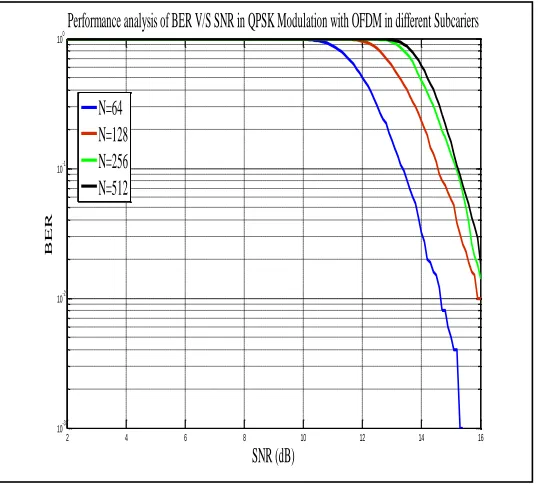
Fig. 6 Performance analysis of BER versus SNR in Different Modulation with OFDM in different subcarriers
2 4 6 8 10 12 14 16
10-3 10-2 10-1 100
SNR (dB)
BE
R
Performance analysis of BER V/S SNR in QPSK Modulation with OFDM in different Subcariers
V. CONCLUSION
OFDM is a very attractive technique for multicarrier transmission and has become one of the standard choices for high – speed data transmission over a communication channel. It has various advantages; but also has one major drawback it has a very high PAPR. In this performace we are used different-different subcarriers (N=64, 128, 256 and 512) with QPSK-Modulation, also consdered claping ration (CR) ϒ is still set to 2.11, L=4, PAPR with OFDM signal. Figure 5.1 for N=64, figure 5.2 for N=128, figure 5.3 for N=256 and figure 5.4 for N=512 shows the PAPR, CCDF curves for the signals processed by using the orignal and simplified OICF algorothms, respectively. In the above results shows the original OICF 1st iteration and Simplified OICF 1st iteration. The performance at the 10-2 clipping probability in simplified OICF, 1st iteration the PAPR 4.6dB for N=128, and another simplified OICF, 1st iteration the PAPR 4.8dB for N=512. The iteration performance PAPR reduce by 0.2dB batter at 1st iteration in N=128.
REFERENCES
[1] ARMSTRONG, J., Peak-to-average power reduction for OFDM by repeated clipping and frequency domain filtering, Electronics Letters 28th February 2002, Vol.48, No. 5, pp. 246-247.
[2] Md. Ibrahim Abdullah, Md. Zulfiker Mahmud “Comparative Study of PAPR Reduction Techniques in OFDM” ARPN Journal of Systems and Software, VOL. 1, NO. 8, November 2011.
[3] Koffman I., Roman, V., “Broadband wireless access solutions based on OFDM access in IEEE 802.16” Communications Magazine, IEEE, Vol.40, Issue. 4-4-02, Pages 96-103.
[4] X.LiandL.J.Cimini, Jr., “Effects of Clipping and Filtering on the Performance of OFDM,” IEEE Communications Letters, vol. 2, no. 5, pp. 141-144, May 1998.
[5] Muhammad Nadeem Khan, Sabir Ghauri, “The WiMAX 802.16e Physical Layer Model”, University of the West of England, United Kingdom, ndm62 1 @hotmail.com.
[6] L. Yand, K. K. Soo, S. Q. Li, and Y. M. Siu “PAPR Reduction Using Low Complexity PTS to Construct of OFDM signals Without Side Information” IEEE Transaction on Broadcasting, Vol. 57, No.2, June 2011.
[7] Seung Hee Han, Jae Hong Lee “An Overview Of Peak-To-Average Power Ratio Reduction Techniques For Multicarrier Transmission” IEEE Wireless Communications • April 2005.
[8]Tao Jiang, Member, IEEE, and Yiyan Wu, Fellow, IEEE “An Overview: Peak-to-Average Power Ratio Reduction Techniques for OFDM Signals” IEEE TRANSACTIONS ON BROADCASTING, VOL. 54, NO. 2, JUNE 2008. [9] S. H. Mller and J. B. Huber, “A Novel Peak Power Reduction Scheme for OFDM,” in Proceedings IEEE PIMRC ’97, Helsinki, Finland,vol.4, pp. 1090-94, September 1997.
[16] Md. Ibrahim Abdullah, Md. Zulfiker Mahmud “Comparative Study of PAPR Reduction Techniques in OFDM” ARPN Journal of Systems and Software”, VOL. 1, NO. 8, November 2011.
[10] A. D. S. Jayalath and C. Tellambura, “Reducing the peak-to-average power ratio of orthogonal frequency division multiplexing signal through bit or symbol interleaving”, Electron. Lett., vol. 36, no. 13, pp. 1161–1163, June 2000.
[11] ARMSTRONG, J., “Peak-to-average power reduction for OFDM by repeated clipping and frequency domain filtering”, Electronics Letters 28th February 2002, Vol.48, No. 5, pp. 246-247.
[12] Md. Ibrahim Abdullah, Md. Zulfiker Mahmud “Comparative Study of PAPR Reduction Techniques in OFDM” ARPN Journal of Systems and Software, VOL. 1, NO. 8, November 2011.
[13] Krishna Kumar Pandey “Effective Performance Analysis of Peak Power Reduction in Orthogonal Frequency Division Multiplexing System” International Journal of Scientific Engineering and Technology, Volume No.1, Issue No.4, pg : 161-168.
[14] R. Bauml, R. Fischer, and J. Huber, “Reducing the Peak-to- Average Power Ra- tio of Multicarrier Modulation by Selected Mapping,” Electronics Letters, vol.42, no.22, pp.2056-2057, October 1996.