Symbolic Synthesis of Knowledge-based Program
Implementations with Synchronous Semantics
X. Huang
[email protected]
R. van der Meyden
[email protected]
ABSTRACT
This paper deals with the automated synthesis of implementations of knowledge-based programs with respect to two synchronous se-mantics (clock and synchronous perfect recall). An approach to the synthesis problem based on the use of symbolic representa-tions is described. The method has been implemented as an ex-tension to the model checker MCK. Two applications of the imple-mented synthesis system are presented: the muddy children puzzle (where performance is compared to an explicit state method for a related problem implemented in the model checker DEMO), and a knowledge-based program for a dynamic leader election problem in a ring of processes.
Categories and Subject Descriptors
D.2.4 [Software Engineering]: Software/Program Verification; F.4.1 [Mathematical Logic]: Modal Logic
General Terms
Theory, Verification
Keywords
Synthesis, Logic of Knowledge, Knowledge-based Programs
1.
INTRODUCTION
One of the main motivations for the application of epistemic logic in computer science has been the observation that it provides a beneficial level of abstraction through which to view distributed systems. A range of problems in distributed computing have been studied from this perspective, including protocols for agreement [17, 8, 9, 27], message transmission [19], atomic commitment [15, 25], clock synchronization [26, 28], leader election [18], and secure communication [35, 1, 2, 24, 36].
Many of these analyses are based on first expressing the solution to a problem in terms of the relation between an agent’s actions and its knowledge, and then seeking to understand the conditions under which the agent has the requisite knowledge. A first codifica-tion of the approach was the semantic nocodifica-tion ofknowledge-based
protocolsof [16], and the idea was refined and given a syntactic
basis in theknowledge-based programsof [11, 10]. The latter pro-vide a simple guarded command programming notation (in the style of Unity [7]), in which the guards in conditional statements are not just expressions over the agent’s local variables, but may also
TARK 2013, Chennai, India.
Copyright 2013 by the authors.
contain formulas of epistemic logic asserting some property of the agent’s knowledge.
Knowledge-based programs resemble standard proagrams, but they do not have a straightforward operational semantics. Instead, they are semantically more like a specification, in that they stand in animplementationrelation to standard programs. To obtain an implementation, one must replace the knowledge conditions in the program by expressions in the agents’ local variables that are equiv-alent, when running the resulting standard program. Because of
thefixpointnature of this semantics, in general, a knowledge-based
program could have no, one, or many behaviourally distinct imple-mentations. There are, however, some syntactic and semantic con-ditions under which implementations are guaranteed to be unique [11]. One of these is that the formulas appearing in the knowledge conditions are free of temporal operators and that the semantics of the knowledge operators issynchronous, in the sense that agents always know the current time.
The early literature on knowledge in distributed computing and knowledge-based programs is confined to “pencil and paper" anal-yses. In recent years, automated tool support for knowledge-based analysis has begun to be developed, in the form ofepistemic model
checkers[13, 23, 30, 20, 37], which are able to automatically verify
whether standard programs satisfy epistemic specifications. These model checkers have been applied to a number of case studies in which it is verified that a proposed implementation of a knowledge-based program is indeed an implementation [3, 2, 24]. However, the approach applied in these studies still requires that the proposed implementation be derived manually. Since the implementations may make use of subtle sources of information, this can be a highly nontrivial task, although the examples automatically constructed by the model checker when checking an incorrect implementation can provide useful information to guide the search [3, 1].
Our contribution in this paper is to develop the first practical tool for automated synthesis of knowledge-based program implementa-tions, by extending methods from epistemic model checking. The main contributions of the paper are as follows:
1. We develop a practical syntax for knowledge-based programs that extends the Unity style programs of [11] to encompass use of knowledge in assignment statements, as well as se-quential structure.
2. We show how existing symbolic techniques for epistemic model checking may be extended to yield an approach to au-tomated synthesis of knowledge-based program implemen-tations. Our techniques work for the special case of atempo-ral knowledge-based programs with respect to two distinct synchronous semantics for knowledge, the clockand
syn-chronous perfect recall semantics, in which, as noted above,
3. We have implemented these algorithms as an extension of the epistemic model checker MCK. One benefit of building on the existing model checking technology is that properties of the implementation derived can directly be verified, with many of the computational steps required for verification al-ready performed by the synthesis procedure.
4. We conduct a number of validation case studies of knowledge-based program implementation using the resulting tool, con-sidering two types of examples. In the first, the muddy chil-dren puzzle, we compare the performance of our symbolic synthesis approach to the performance of the model checker DEMO. DEMO does not synthesize implementations of know-ledge-based programs, but solves a closely related model checking problem using an explicit state rather than symbolic technique. The second example we consider is a knowledge-based program for a leader election protocol in a ring of pro-cesses.
The structure of the paper is as follows. In Section 2, we review the basics of epistemic model checking and a symbolic technique used in the implementation of such systems. We develop a syntax and semantics for knowledge-based programs in Section 3. Sec-tion 4 describes the basis for a symbolically implementable proce-dure for synthesis of knowledge-based program implementations. The application of this procedure to a number of examples is dis-cussed in Section 5. Section 6 discusses related work, and we make some concluding remarks in Section 7.
2.
EPISTEMIC MODEL CHECKING
In this section, we recall the background we require from epis-temic logic (following [10]) and episepis-temic model checking (follow-ing [34]).
LetPropbe a set of atomic proposition and letAgsbe a finite set of agents. The temporal-epistemic logic that we work with has the syntax
φ::=p| ¬φ|φ1∧φ2|Xφ|Kiφ
wherep ∈ Propandi ∈ Ags. Intuitively, formulaXφexpresses thatφholds at the next time, andKiφexpresses that agentiknows thatφholds. A formula isatemporalif it does not make use of the temporal operatorX.
At all times, each agentiis assumed to be in some local state that records all the information that it can access at that time. The en-vironmenterecords “everything else that is relevant”. LetSbe the set of environment states and letLibe the set of local states of agent
i. Aglobal state sof a multi-agent system is a tuple (se,s1, ...,sn)
such thatse∈Sandsi∈Lifor alli∈Ags.
Arun r is a function from time to global states, i.e.,r : N→
S×L1×...×Ln. A pair (r,m) consisting of a runrand a timemis
called a point. AsystemRis a set of runs. We callR ×Nthe set of points ofR. Ifr(m)=(se,s1, ..,sn) then forx∈Ags∪ {e}we write
rx(m) forsxandrx(0..m) forrx(0)...rx(m). Relative to a systemR, we define the setKi(r,m)={(r0,
m0
)∈ R ×N|ri(m)=r0
i(m
0
)}to be the set of points that are indistinguishable from the point (r,m) for agenti.
An interpreted systemIis a tuple (R, π) such thatRis a system andπ:R ×N→ P(Prop) is an assignment giving an interpreta-tion to the atomic proposiinterpreta-tions at each point. Given an interpreted systemI, a point (r,m), and a formulaφ, we define the relation
I,(r,m)|=φinductively by
• I,(r,m)|=pifp∈π(r,m)
• I,(r,m)|=¬φif notI,(r,m)|=φ
• I,(r,m)|=φ1∧φ2ifI,(r,m)|=φ1andI,(r,m)|=φ2 • I,(r,m)|=XφifI,(r,m+1)|=φ
• I,(r,m) |= Kiφ ifI,(r0,
m0) |= φ for all points ( r0,
m0) ∈ Ki(r,m)
Since interpreted systems are infinite structures and for model checking we require a finite input, we generate interpreted systems from finite structures. A(finite state) transition model Mfor agents
Agsis a tupleM =(S,I,{Oi}i∈Ags,→, π), whereS is a (finite) set
of states, I ⊆ S is the set of initial states, eachOi : S → Ois a function representing the observation that agentimakes at each state, →⊆ S2 is a serial transition relation over states in S, and
π:S → P(Prop) is a propositional assignment. Letki(s)={s
0 ∈
S |Oi(s) = Oi(s0)}be the set of states that are indistinguishable from statesfor agenti, based on its observation.
Apathρfrom a statesofMis a finite or infinite sequence of statess0s1..., such that s0 = sandsk → sk+1 for allk <|ρ| −1,
where|ρ|is the total number of states inρ. Given such a pathρ, we useρ(m) to denote the statesm. Afullpathfrom a statesis an infinite path froms. Apathρis initialized ifρ(0)∈I.
To obtain a system from a finite state transition modelM, we treat the states of Mas the states of the environment, and obtain runs from paths by adding local states at each point. This can be done in a variety of ways, representing different levels to which agents recall their observations. We call the level of recall aview
and deal with the viewsobs,clkandsprrepresenting recall only of the current observation, recall of the current observation and the time and synchronous perfect recall, respectively.
For each initialized fullpathρand viewV ∈ {obs,clk,spr}, we define a runρV
. The state of the environment at timemis given by ρV
e(m)=ρ(m) in each case, and the agents’ local states are assigned as follows:
• V =obs: the local state of agentiat timemisρobs i (m) =
Oi(ρ(m));
• V =clk: the local state of agentiat timemisρclk i (m) = (m,Oi(ρ(m)));
• V =spr: the local state of agentiat timemisρspri (m) =
Oi(ρ(0))...Oi(ρ(m)).
Given a systemMand a viewV, we writeRV
(M) for the set of runs ρV
whereρis an initialized full-path ofM. The interpretationπof
Mlifts to an interpretationπV
on the global states inRV
(M), de-fined byπV((
s,l1, . . . ,ln))=π(s). We define the interpreted system obtained fromMusing viewVbyIV
(M)=(RV
(M), πV
). Given a finite modelM, a viewV, and a formulaφ, we writeM|=V φ
if
IV
(M),(r,0)|=φfor allr∈ RV
(M).
Themodel checking problemis to determine, given a finite state
transition modelM, a viewVand a temporal epistemic formulaφ, whetherIV
(M)|=φ. Epistemic model checkersare software
sys-tems that solve this problem. A number of such syssys-tems have been implemented. MCK [13] supports all three views, MCMAS [23], Verics [20] and MCTK [30] work with the observational view. These systems use a variety of temporal logics for the temporal expres-siveness in formulas. MCK supports a superset of the language defined above.
Before concluding this section, we define a presentation of stan-dard S5n Kripke-structures that will be used later. Anepistemic modelis a tupleM=(S,{Oi}i∈Ags, π), where the components are of
a a
b b
0 1 1 0 0 1
b b
0
0 0
0
0 0
1
1
1 1 1
1
(Decision Tree) (Reduced OBDD)
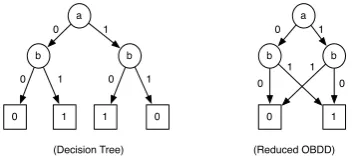
Figure 1: A decision tree and its reduced OBDD
• M,s|=pifp∈π(s)
• M,s|=¬φif notM,s|=φ
• M,s|=φ1∧φ2ifM,s|=φ1andM,s|=φ2
• M,s |= KiφifM,s0 |= φfor all statess0such thatOi(s) =
Oi(s0
)
It is easily seen that for atemporal formulasψthat are boolean com-binations of formulas of the formKiφ(for a fixedi), for alls,s0∈
S
withOi(s) =Oi(s0
) we haveM,s |= ψiffM,s0 |=ψ, i.e., the truth
value ofψdepends only onOi(s). Foro∈Oi(S), we may therefore define the relationM,o |=i ψifM,s |=ψfor some (equivalently, all)s∈SwithOi(s)=o.
2.1
Symbolic Data Structures
MCK supports a number of different algorithmic approaches to solving the epistemic model checking problem. One of these is based on symbolic model checking using (reduced) ordered binary decision diagrams (BDD) [6]. These are data structures defined as follows.
LetV be a set of variables. AV-assignmentis a function s :
V → {0,1}. WriteAssgts(V) for the set of allV-assignments, and
s[v7→ x] for the function that is identical tosexcept that it takes valuexon inputv. AV-indexed boolean functionis a mapping
f :Assgts(V)→ {0,1}. Note that such functions are able to repre-sent setsX ⊆Assgts(V) by their characteristic functionsfX, map-pingsto 1 just in cases∈X. One way to represent such a function
fis using abinary treeof heightn, with each level corresponding to one of the variables inV, and leaves labelled from{0,1}. This tree can in turn be thought of as a finite state automaton on alphabet
{0,1}. Reduced ordered binary decision diagrams (BDD’s in the se-quel) more compactly represent such a function as adagof height
n, with binary branching, by applying the usual finite state automa-ton minimization algorithm. A very simple example of this for the function f(a,b,c) = axorbis illustrated in Figure 1. In some cases, the degree of compaction obtained in the minimal dag repre-sentation is considerable. We note that the amount of compaction obtained is sensitive to the variable ordering used, and finding a variable ordering that minimizes the result is NP-hard, though there exist good heuristics, such assifting[29].
Given this minimal representation ofV-indexed boolean func-tions, it is moreover possible to compute (in practice, often in rea-sonable time) some operations on these functions, by means of al-gorithms that take as input the BDD representation of the input functions and returns the BDD representation of the result. The operations for which this can be done include the following:
• Boolean operations∧,¬, defined pointwise on functions. E.g., if f,g:Assgts(V)→ {0,1}, then f∧g:Assgts(V)→ {0,1}
is defined by (f∧g)(s)= f(s)∧g(s).
• Boolean quantification∃,∀, e.g., if f :Assgts(V) → {0,1}
andv∈ V then∃v(f) :Assgts(V\ {v}) → {0,1}maps s ∈
Assgts(V\ {v}) tof(s[v7→0])∨f(s[v7→1]).
• variable substitution: if f :Assgts(V) → {0,1}andU ⊆V
andU0
are sets withU0∩
(V\U)=∅, andσ:U→U0
is a bijection, then fσ :Assgts((V\U)∪U0
)→ {0,1}mapss:
Assgts((V\U)∪U0
) tos0
, wheres0
(v) iss(v) whenv∈V\U
ands(σ−1(v)) whenv∈U0
.
Symbolicmodel checking, as implemented in MCK, then
pro-ceeds using BDD representations of sets and relations relevant to model checking. For example, the setI of initial states of a sys-tem can be represented as a BDD-encoded boolean function fI in-dexed by the state variablesV. Relations can be represented using “primed" versions of the state variablesV, defined byV0=
{v0|
v∈
V}. A relation such as the transition relation→of a model can then be represented as a function f→indexed by variablesV∪V0
, such that ifsandtare assignments toV, we haves→tifff→(s∪t0
)=1, wheret0
is obtained fromtby renaming each variablevto its primed counterpartv0
. Operations such as the composition of a relation and a set can then be performed at the level of the BDD represen-tation, e.g. {t∈S |s∈ I∧s→t}is represented by the function
∃V(fI×1V0 ∧f→)σonV, where fI ×1V0 trivially extends fI by
adding (irrelevant) variablesV0
, andσrenames the variablesV0
to the variablesVby removing the prime symbol.
3.
KNOWLEDGE-BASED PROGRAMS
Knowledge-based analyses of systems typically concern the in-teraction between agents’ knowledge and their actions.
Knowledge-based programs[11, 10] have been proposed to capture such
rela-tionships in a program-like notation, with actions chosen according to conditions expressed in epistemic logic.
The original presentation of knowledge-based programs used a very simplified (Unity style [7]) programming notation, consisting of a single infinitely repeated do loop containing a set of guarded statements of the formφ→awhereφis an epistemic formula anda
an action. We develop here a slightly richer and more structured no-tation, using sequential composition and an epistemic assignment statement. The notation is based on the modelling notation already employed by MCK. We focus onatemporalprograms with a syn-chronous semantics for knowledge (either the clock or synsyn-chronous perfect recall semantics), since this is a case in which unique im-plementations are guaranteed to exist.
Since, in general, even atemporal knowledge-based programs may not have finite state implementations under the perfect recall semantics, we also limit ourselves to terminating programs, so omit looping from the language. Our handling of parallelism and ac-tions (signals) is somewhat in the spirit of synchronous languages such as Esterel [5]. To give the semantics of knowledge-based pro-grams, we use a formulation based on [32], which allows flexibility in choice of view based on a notion ofenvironmentthat replaces the notion ofcontextof [11, 10].
3.1
Standard Programs: Syntax
Define astandard programover a setV of variables and a set
Aof atomic statements to be either the terminated program or a sequencePof the formstat1;. . .;statk, where thestatiare sim-ple statements and ‘;’ denotes sequential composition. Each simsim-ple statementstatiis either an atomic statement inAor a nondetermin-istic branching statement of the form
where eachai is an atomic statement inAand thegi are boolean expressions overV calledguards. Intuitively, a nondeterministic branching statement executes by performing one of the assignments
ai for which the corresponding guardgi is true. If several guards hold simultaneously, one of the corresponding actions is selected nondeterministically. We treatPas identical toP;. Thelengthof a program is the number of simple statements it contains. We use standard programs to describe both the behavior of agents and the environment in which they operate. The type of atomic statements used in these two cases is different.
Environment models are used to represent how states of the envi-ronment are affected by actions of the agents. Formally, we define
anenvironment modelto be a tupleMe=(Ags,Acts,Vare,Inite, τ)
whereAgsis a set of agents,Actsis a set of actions available to the agents,Vareis a set of (boolean) environment variables1,Initeis an initial condition, in the form of a boolean formula overVare, andτ
is atransitions clausefor the environmente, expressed in the form
of a standard program.
In addition to the environment variablesVare, an additional set
ActVar(Me) ={i.a|i∈ Ags, a ∈Acts}of (boolean)action
vari-ablesare generated for each modelMe. Intuitively,i.arepresents
that agentiperforms actiona. The transitions clause is a standard program over the set of variables inVare∪ActVar(Me) and the set of atomic actions of the formx :=expr, wherex ∈ Vareand
expris a boolean expresssion overVare∪ActVar(Me). The state-mentx:=exprrepresents that the value of the expressionexpr, is assigned to the variablex.
Protocols are used to describe the behaviour of the agents. A
pro-tocol for agent i in environment modelMe(of length m)is a tuple
Proti=(PVari,LVari,OVari,Initi,Actsi,Progi) wherePVari⊆Vare is a set ofparameter variables2,LVar
i is a set oflocal variables,
OVari ⊆PVari∪LVari is a set ofobservable variables,Initi is an initial condition, in the form of a formula overLVari, andProgiis standard program of lengthm. The guards inProgiare over the set of variablesPVari∪LVari. The atomic statements inPhave the form
a|x1:=expr1, ...,xm:=exprm
wherea∈Acts∪ {nil}and eachx1:=eiis an assignment statement withxiinLVariandeian expression overPVari∪LVari. Intuitively, such an atomic statement is executed by emitting actionaas a sig-nal to the environment: when agentiperforms the action, the vari-ablei.ais set to be true (and all other action variablesi.bset to be false.) The environment transition clause then runs to update the environment variables. Concurrently, the statement performs the
simultaneous assignment x1 :=expr1, ...,xm := exprm in a single
step of computation. That is, the expressionseiare first evaluated in the state from which the atomic statement is performed, and their values are then simultaneously assigned to the variablesxi. We ab-breviate an atomic statement of the form nil|x := exprto
x:=expr, and also abbreviatenil| toskip.
Ajoint protocol (of length m)is a tupleProtassociating a
proto-colProti(of length at mostm) with eachi∈Ags. Asystem model
is a pairS=(Me,Prot) consisting of an environment modelMe and a joint protocolProtforMe. This represents a set of agents running particular protocols in the context of a given environment.
1To simplify the presentation we assume here that all variables are
boolean; our implementation also allows variables to have a de-clared finite type.
2In the concrete MCK syntax these may be given using new
ables in a parameter declaration as aliases for environment vari-ables. This allows sharing of protocol code between agents run-ning similar programs but with different parameter bindings; see the examples below.
3.2
Standard Programs: Semantics
We now show how a system model generates a finite state tran-sition model. To do so, we first convert the system model into a simple form of parallel program and provide these programs with an operational semantics.
We assume we are given a system modelS=(Me,Prot), where
Me=(Ags,Acts,Vare,Inite, τ) and
Proti=(PVari,LVari,OVari,Initi,Actsi,Progi)
fori∈Ags. We define global states with respect to this model to be boolean assignmentssover the set of variablesVare∪Si∈AgsLVari. We also define theparallel program
Prog(S)=τ||i∈AgsProgi.
This is an expression representing|Ags|+1 components, i.e., the specially identified environment componentτ, a program over en-vironment variables, and the|Ags|componentsProgi, representing programs associated to the agents.
Intuitively, the operational semantics of these parallel statements defines a transition relation on global states. The definition of the transition relation is given in three stages, captured in the following rule:
V
i∈Ags (s,Pi) ,→ ai|αi;P
0
i, (s∪a, τ)−→
∗
(s0∪a, ),
θ={x7→e(s)|“x:=e”∈αi, i∈Ags}
(s, τ||i∈AgsPi)→(s0θ, τ||iP0i)
The explanation of this statement is as follows: in the first stage, given a global states, with its remaining computation represented by program Pi, each agent ifirst generates an atomic statement
a=ai|αias well as a programP0
i, to be run after this atomic statement has executed. This is represented formally by a relation (s,Pi) ,→ a;P0
i. In the second stage, the actions in these state-ments are then combined into a joint atomic actiona, viewed as an assignment making the action variablesi.ai true fori ∈ Ags, and all other action variables false. This assignment is added to the current global state, and the environment programτ then causes a transition of the environment state, expressed by the statement (τ,s∪a)−→∗
(s0∪a, ) that represents that the environment
pro-gramτ, when executed with respect to joint actiona, runs to termi-nation having caused the global state to change fromstos0
(only the environment variables change during the running ofτ). Finally, the local states are updated, by executing the assignmentsαilocally at each agent. This is captured by first defining the substitutionθ that defines the update to be performed, based on the valuese(s) of expressionsein the states, and then applying that substitution to the global states0
(represented bys0θ).
The relations used above are defined by the following rules:
(s, ) ,→ skip; (s,a;P) ,→ a;P
s|=gi
(s,ifg1→a1[]. . .[]gm→amfi;P) ,→ ai;P
s|=V
i∈Ags¬gi
(s,ifg1→a1[]. . .[]gm→amfi;P) ,→ skip;P (s,P) ,→ x:=e;P0, θ=
[x7→e(s)] (s,P)→(sθ,P0
)
(The rules for ,→ apply to both the environment program and the agent protocols; the last rule applies only to steps of the envi-ronment computation.)
We can now define a modelM(S) = (S,I,{Oi}I∈Ags,→, π) for
the set of pairs (s, τ||i∈AgsPi), wheresis a global state ofSand each
Piis a protocol for agenti, the setIis the set of pairs (s,Prog(S)) such that s |= Inite∧Vi∈AgsIniti, the functionOi is defined by
Oi((s, τ||i∈AgsPi))=sOVari, the transition relation→is as defined above, andπassociates each variable with its value, i.e.v∈π(s) iff
s(v)=1.
Note that, given a viewV, we obtain fromM(S) an interpreted systemIV
(M(S)). We use this construction of interpreted systems to give semantics to knowledge based programs.
3.3
Knowledge-based protocols
The syntax of knowledge-based protocols is given as a general-ization of the definitions above. Aknowledge-based protocol for
agent i in environmentMe, is a tuple
Pi=(PVari,LVari,OVari,Initi,Actsi,Progi),
where the components are exactly as for a protocol for agentiin environmentMe, except that in the programProgi, both the guards
gin conditional statements and the expressionsein the assignments in atomic statements may be formulas of the logic of knowledge. Figure 2(a) gives an example of such a program, (corresponding to a stage of the well-known “Muddy Children" problem, which we discuss in more detail in Section 5). Ajoint knowledge-based
protocolis a tupleP = {Pi}i∈Agsconsisting of a knowledge-based
protocolPifor each agenti.
To give semantics to knowledge-based protocols, we define a re-lation ofimplementationbetween knowledge-based protocols and standard protocols. Intuitively, an implementation is a standard protocol that is structurally similar to the knowledge-based proto-col, except that knowledge formulas have been replaced by expres-sions in the local variables, where such expresexpres-sions are equivalent to the knowledge formulas. To make sense of this equivalence we need to evaluate the knowledge formulas in an interpreted system: for this we take the system generated by the standard protocol.
We first give the semantics with respect to the clock view. Note that since programs are sequencesstat1;. . .;statmof simple state-ments, each such simple statement can be associated with a time of occurrence, viz.,statioccurs at timei−1. In casestatiis a condi-tional statementifg1→a1[]. . .[]gk→akfiwe also say that each of the atomic statementsajoccur at timei−1. (Intuitively, it takes no time to evaluate the guardgj.) Given a knowledge-based pro-gramProgi, we transform it into itsskeleton, denotedskell(Progi), by replacing each knowledge formulaφin a guardgor assigned expressione, occurring at timet, by a new variablevt
φ, whose name
indicates both the timetand the formula being replaced. (More pre-cisely, we replace the maximal subformulasφthat contain knowl-edge operators but do not contain “non-observable" variables in
PVari\OVari.) LetskellVar(Progi) be the set of such new vari-ables inskell(Progi). We defineskell(P) = {skell(Progi)}i∈Agsand
skellVar(P)=∪i∈AgsskellVar(Progi).
Next, letθbe a substitution mapping each skeleton variablevt
φ∈
skellVar(Progi), fori∈Ags, to a boolean expression on the
observ-able variobserv-ables of agenti’s protocolPi. If we apply this substitution
toskell(Progi), we obtain a standard programskell(Progi)θ. We
writePiθfor the result of replacing the knowledge-based program ProgiinPibyProgiθ. This is a standard protocol for agenti.
Similarly, ifP = {Pi}i∈Agsis ajoint knowledge-based protocol, andθis a substitution satisfying the condition above for all agentsi, we writePθfor the joint standard protocol{Piθ}i∈Ags. We now define
Pθto be animplementationof the joint knowledge-based protocol Pwith respect to the viewclkifIclk
(M(Me,Pθ))|=Xt(φ⇔θ(vt
φ))
for allvt
φ∈skellVar(P). That is, in the system obtained with respect
to the viewclkby running the standard protocolPθin the
envi-ronmentMe, each knowledge formulaφinPis equivalent to the concrete expressionθ(vt
φ) on the local state variables that replaces
it in the standard protocol (at the timetthat this formula is relevant to the behaviour of the program).
Since the definition of implementation of a knowledge-based program is stated as a constraint on substitutions, it is not clear whether there exist any substitutions satisfying this constraint, or whether such substitutions are unique. The following theorem states that in fact, given our assumptions, there is essentially a unique im-plementation.
THEOREM 1. IfPis a joint atemporal knowledge-based
pro-tocol for environmentMe, then there exists a substitutionθsuch
that skell(P)θis an implementation ofPinMewith respect toclk.
Moreover, for all substitutionsθ, θ0
such that skell(P)θand skell(P)θ0
are implementations ofPinMewith respect toclk, we have that
Iclk
(M(Me,Pθ))|=Xt(θ(vt
φ)⇔θ0(vtφ))for all vtφ∈skellVar(P).
The result is similar to a result of [11]. Note that althoughθ(vt
φ)
and θ0
(vt
φ) may be distinct formulas, they are equivalent, in the
context of any implementation, at the time of their relevance to the behaviour of the implementation. It follows that the systems
Iclk
(M(Me,Pθ)) andIclk
(M(Me,Pθ0
)) are isomorphic with respect to the variables ofMeandP.
We now consider the synchronous perfect recall semantics. In this case, an agent’s knowledge is semantically defined using not just the agent’s current observation, but also using its past observa-tions. Implementations of knowledge-based programs with respect to this semantics are therefore permitted to refer to these past ob-servations. To enable this, we first introduce some new “history" variables to represent the past observations, and then state the per-fect recall semantics as an application of the clock semantics.
Given a joint knowledge-based programPof lengthm, letPhbe the knowledge based program obtained after making the following modifications toP:
1. ifOVariis the set of observable variables for agenti, replace this by the setOVarh
i =OVari∪{v@k|v∈OVari,0≤k<m};
2. replaceLVaribyLVari∪ {v@k|v∈OVari, 0≤k<m};
3. replace each atomic statementa|αat timekinProgi by the statementa|α, β , whereβis the collection of assignmentsv@k:=vforv∈OVari.3
Intuitively, each variablev@kis a new local observable variable that records the value of the original observable variablevof agent
iat timek. We now define an implementation ofPin Me with respect to the synchronous perfect recall semantics to be an im-plementation ofPhinM
ewith respect to the clock semantics. By Theorem 1, such implementations are also guaranteed to exist and are behaviourally unique.
4.
SYNTHESIS
The semantics for knowledge-based programs requires that the (semantically unique) implementing substitutionθfor all knowl-edge conditions be given, and then verified for correctness. We now describe an incremental construction of this substitution that serves as the basis for our symbolic synthesis procedure. For the remainder of this section we fix an environment modelMeand a joint knowledge-based programP. LetNbe the maximal time of
3Our implementation optimizes this by sharing history of observed
(a) if Kimuddyi∨Ki¬muddyi→SayYes|
[] ¬(Kimuddyi∨Ki¬muddyi)→SayNo| fi
(b) if v
0
Kimuddyi∨Ki¬muddyi→SayYes| [] v0
¬(Kimuddyi∨Ki¬muddyi)→SayNo| fi Figure 2: A knowledge-based program (a) and its skeleton (b)
occurrence of any knowledge condition inP. Letskell(Progi) =
stati
1;. . .stat
i m.
For the clock semantics, we work with epistemic Kripke struc-turesM(S)=(S,{Oi}, π), whereSis a set of assignments toVare∪
S
i∈AgsLVari, the observation functions are just restrictions to the observable variables, i.e.,Oi(s) =sOVari, and andπis just the trivial interpretation onS, i.e.,v∈π(s) iffs(v)=1.
In particular, fork=0. . .Nwe define structuresMk=M(Sk) by defining the setsSk. At the same time, we define the substitutionθ. These definitions proceed inductively, as follows. First, we define
S0to be the set of assignmentsssuch thats|=Inite∧Vi∈AgsIniti. This determinesM0.
Assuming thatMkhas been constructed, we next define the im-plementationθ(vk
φ) of each knowledge conditionφinProgiat time
k. This implementation is required to be a boolean expression over the setOVariof observable variables for agenti. Rather than give this formula explicitly, we characterize it by describing the assign-mentsoto these variables on which the formula is satisfied. For
vk
φ∈skellVar(Progi), we letθ(vkφ) be any formula such that for all o=Oi(s) withs∈Sk, we haveo|=θ(vk
φ) iffMk,o|=iφ. (This does
not necessarily uniquely defineθ(vk
φ) on all possible observations,
but leaves some flexibility to optimize the size of the formula by choosing its value appropriately on the “don’t-care” observations, applying ideas familiar from digital circuit design theory [21].)
Next, we define
Sk+1={t| ∃s∈Sk((s, τ||i∈Agsstatikθ)−→(t, τ||i∈Ags))}. That is, we run thek-th step of the knowledge-based programs us-ing the implementations of the knowledge conditions as just de-fined fromMk, using the operational semantics−→ for standard programs. (Note that the substitutionθhas not yet been completely defined, but it has already been sufficiently defined to provide a value for eachvk
φinstatik, so thatstat i
kθis a standard program not containing any skeleton variablesvψj.) This now gives the structure
Mk+1=M(Sk+1).
The following result states that the substitution obtained by this process provides an implementation ofP.
THEOREM 2. Letθbe the substitution defined above. ThenPθ
implementsPinMewith respect to the viewclk.
The iteration using the epistemic structuresMkin this construc-tion is a generalizaconstruc-tion of an algorithm already in use in MCK for model checking standard programs with respect to specifications of the formXkφ, withφan atemporal formula, interpreted with respect to the clock semantics. In the case of standard programs, the substi-tutionθis the empty substitution, and the construction simplifies to the existing algorithm in that case. The existing algorithm was al-ready implemented symbolically using BDD’s (see section 2.1) to represent the structuresMk, and the implementation is easily gen-eralized to cover the extensions above. The main change is that it is now required at each stage to evaluate the applicable knowl-edge formulasφ in the structuresMk. This is done using an ex-isting algorithm that computes a BDD representation of the set of states ofMksatisfyingφ, given the BDD representation ofMk. The concrete conditionθ(vk
φ) is then extracted as a boolean expression
over observable variables that holds inMkat the same assignments
to observable variables as the formulaφ. (Note that sinceφis a boolean combination of observable variables and formulasKiψ, its
satisfaction depends only on observable variables.)
Since the semantics of knowledge-based programs with respect to the synchronous perfect recall semantics has been introduced above by means of a reduction to the clock case, we note that we also obtain a procedure for synthesis of implementations with re-spect to the synchronous perfect recall semantics. The only change required is the introduction of history variables as described above.
5.
EXAMPLES
In this section we discuss the performance of the symbolic syn-thesis approach on a number of simple examples, and compare it to an explicit state approach to a closely related problem.
The explicit state approach is essentially that implemented in DEMO [37], which is the only other model epistemic checker that presently has the expressive power to handle a problem close to the knowledge-based program synthesis problem that our system is able to handle. However, compared to our formulation, DEMO does not include knowledge-based programs as an explicit con-struct, it does not attempt to synthesize a concrete implementation of such a programs, and it can handle only situations where the atomic propositions do not change value over time.
DEMO deals with the evaluation of statements (M,S)|=[U,T]φ,
whereMis an epistemic model,S is a set of states of that model,
Uis an epistemic update andT is a set of states ofU. More pre-cisely, M = (W,{∼i}i∈Ags, π) whereW is a set of worlds, each∼i is an equivalence relation onW, andπ : W → Propis an inter-pretation of the atomic propositions. The update structureUhas the form (E,{∼E
i}i∈Ags,pre), whereE is a set ofevents, each∼Ei is
an equivalence relation onErepresenting events that agentiis not able to distinguish, andpremapsEto formulas (since it is all we will need, we assume here that these formulas are atemporal but possibly epistemic formulas in our language). Intuitively,pre(e) is a pre-condition for the occurrence of evente. Theupdate of M by U
is then defined to be the epistemic structureM◦U=(W0,{∼0
i}, π
0
) whereW0 = {
(w,e) ∈ W×E |M,w |= pre(e)}, the relation∼0
i is defined by (w1,e1) ∼0i (w2,e2) ifw1 ∼i w2and e1 ∼Ei e2, and
π0
(w,e) =π(w). The statement (M,S) |=[U,T]φ, whereS ⊆W
andT ⊆ E, holds just whenM◦U,(w,e) |=φfor allw ∈S and
e∈Twithw|=pre(e).
In the special case where actions do not change the values of propositions (one example where this holds is the Muddy Chil-dren problem, discussed below) we can encode each stage of a knowledge-based program as an update. Suppose that each agent
i=1. . .nhas atomic statement
ifgi
1 →a
i
1[]. . .[]g
i ki →a
i kifi
where thegi
j are atemporal epistemic formulas. Then the parallel composition of these statements corresponds to a setE= Πn
i=1{1. . .ki} withpre(j1, . . .jn)=Vi=1...ngiji. If the effect of the actionsa
i jon ob-servable variables (as described in the environment model) can be captured by indistinguishability relations onE, then we can encode the stage of the knowledge-based program as an update.
One difference is immediately apparent however: in DEMO, the epistemic modelM, the update structureU, and the structureM◦U
Be-muddy: Bool[Agent] info: Bool[Agent]
init_cond = (Exists x:Agent() (muddy[x])) /\ Forall x:Agent() (info[x] == muddy[x])
agent Child0 "child" ( info[Child1], info[Child2], info[Child3] ) agent Child1 "child" ( info[Child2], info[Child3], info[Child0] ) agent Child2 "child" ( info[Child3], info[Child0], info[Child1] ) agent Child3 "child" ( info[Child0], info[Child1], info[Child2] )
transitions begin
info[Child0] := Child0.SayYes; info[Child1] := Child1.SayYes; info[Child2] := Child2.SayYes; info[Child3] := Child3.SayYes end
protocol "child" ( info1: observable Bool, info2: observable Bool, info3: observable Bool ) begin
if (Knows Self muddy[Self]) \/ (Knows Self neg muddy[Self]) -> << SayYes >>
[] otherwise -> skip fi;
if (Knows Self muddy[Self]) \/ (Knows Self neg muddy[Self]) -> << SayYes >>
[] otherwise -> skip fi;
if (Knows Self muddy[Self]) \/ (Knows Self neg muddy[Self]) -> << SayYes >>
[] otherwise -> skip fi;
if (Knows Self muddy[Self]) \/ (Knows Self neg muddy[Self]) -> << SayYes >>
[] otherwise -> skip fi
end
Figure 3: A knowledge-based program for muddy children (perfect recall version)
cause of the cartesian products in the definition, the size of these state spaces potentially grows exponentially in the number of agents (and the number of updates applied to an initial structure), although DEMO applies a quotient under a maximal bisimulation that may reduce the size of these spaces in some cases. Our symbolic rep-resentation, on the other hand, has the potential to avoid this expo-nential blow-up. (The benefit is only potential because BDD repre-sentations, though they often prove to be small in practice, are also not guaranteed to be small in all cases.) It is therefore interesting to investigate whether this potential benefit is realized in interesting cases. We now explore this question for the well-known Muddy children problem.
5.1
Muddy children
The muddy children puzzle [10] can be stated as follows:
A group ofnchildren have been playing outside, and some have mud on their foreheads. Each child can see the forehead of the others but cannot see his or her own forehead. Father says to group, “At least one of you has mud on your forehead". He then repeated asks following question: “Do you know whether or not you have mud on your forehead?" The children give their answers (‘Yes" or “No" ) simultaneously each time the question is asked, and each child observes the answers given by the other children.
Assuming that the children are perfect reasoners, have perfect re-call and are honest, the expected behaviour is that ifkout ofnof the children are muddy, then all children will answer “No" until round
k, in which all the muddy children answer “Yes” and the clean chil-dren answer “No". We note also that from roundk+1 all children answer “Yes".
The puzzle can be represented as a knowledge-based program. Figure 3 gives the representation of the environment and the chil-dren’s protocol in the concrete syntax of our MCK implementa-tion, for the perfect recall case withn=4. Father’s statement is captured by means of the statementinit_cond, which defines
the set of initial states. Since these are common knowledge, it is initially common knowledge that there is at least one muddy child. (The existential/universal quantifiers are restricted to finite types and are just a syntactic sugar for disjunction/conjunction.) An agent’s observable variablesOVariare declared using the keyword observable. Each observable variable adds complexity to the BDD computation and, in the perfect recall semantics, is moreover replicated at each moment of time. To minimize these costs, we use a variableinfo[x]that represents the new information concern-ing agentxat each step. Initially this variable is used to represent whether agentxis muddy, and at later steps it represents whether agentxhas just said “Yes". Each agent observes all the variables info[x] for theotheragents (it can always deduce whether it would itself have said “Yes" at the previous step).
Symmetry of the children’s behaviour is handled by giving a general description, the knowledge-based protocol"child". The knowledge-based program consists of a repeated sequence ofif statements, in which the keywordotherwiserepresents the nega-tion of the disjuncnega-tion of all the preceding guards. The agent statements create fresh instances of the general protocol, in which the the parameters of the instance are aliased to the correspond-ing environment variables, and the keywordSelfin the protocol is interpreted as the agent being defined. In particular, each such statement says that a child can observe (via the observable variables seei) the new information about the other children. The environ-ment’s transitions clause simply stores the childrens’ answers to the boolean variablesinfo[x]forx∈Ags.
The representation we use for a clock semantics version is slightly different. Here, we cannot rely on agents to remember whether they initially observed other children to be muddy, or whether they said “Yes" in the previous step. We therefore make observable to all agents an arraysaid, representing the previous statements of all the agents, and also include an observable variable for the muddi-ness of each other child. Interpreting this version with respect to the clock semantics yields exactly the same behaviour of the children in the implementation as the perfect recall version, viz., if there are
To represent the puzzle in DEMO, each step of the knowledge based program needs to be represented as an update structureU=
(E,{∼i}i∈Ags,pre), in which the eventsEcorrespond to possible
ob-servations that are made by the children after they reply to father’s question. Thus, fornagents, the set of events E = {0,1}n, with
e∼i e0iffe=e0, and for each tuplee=(e1, . . . ,en)∈Ewe have thatpre(e)=Vn
i=1φiwhereφi =(Kimuddy[i])∨(Ki¬muddy[i]) if
ei=1 andφi=¬((Kimuddy[i])∨(Ki¬muddy[i])) ifei=0. Since DEMO runs in the Haskell interpreter, it is possible to representU
succinctly as a Haskell program, but to perform the update calcu-lation DEMO needs to construct the setEexplicitly, so necessarily performs an exponential amount of work.
The experimental results4comparing the performance of our
sym-bolic approach to the DEMO modelling are shown in Table 1. In addition to synthesis, we check, for the MCK program, the for-mulaXnφwhereφ = V
i∈Ags(Kimuddy[i]∨Ki¬muddy[i]) which expresses that afternrounds, all the children know whether they are muddy. For the DEMO program, we checkφafter updatingn
times.
Note that fornmuddy children, we are dealing with an initial state space of 2n−1 states and a deterministic solution protocol that runs fornsteps, givingn·(2n−1) points in the relevant part of the interpreted system. The results demonstrate that our symbolic ap-proach does in practice scale significantly better when dealing with this exponentially growing problem, particularly in the case of the clock semantics version. (Recall that the synthesized behaviour is exactly the same as for the perfect recall interpretation.) DEMO’s performance rapidly degrades as the number of agents increases, whereas our symbolic approach to the clock semantics is able to very efficiently handle problems of larger scale. On the other hand, DEMO is implicitly computing the perfect recall solution, so an ar-guably the fairer comparison is with the MCK perfect recall model. Here too our approach scales better, e.g., handling 10 agents in time comparable to DEMO’s time for 7 agents. However, after initially lagging DEMO’s explicit state approach, the total running time for the larger cases that can be handled becomes more than two orders of magnitude better.
5.2
Leader Election
The second example we consider concerns maintaining knowl-edge of the leader on a ring of agents. We suppose that there aren
agents numberedi=1. . .n, with agentiable to send messages to agent (i modn)+1. Each agent has an observable input buffer that is able to store one message. The agent also observes its own agent number. An agent can crash at any time, and once crashed, remains crashed. The leader at timetis defined as the highest numbered agent that has not crashed by timet(and otherwise 0).
In each round, the environment first crashes a subset of the agents. All uncrashed agents may send a message. The network delivers any message that an agent is trying to send to the intended recipi-ent, provided that the sender has not crashed. If agentihas crashed, then the network detects this, and in place of the message that agent
iwould have sent, the network delivers the message that was in agenti’s buffer to agent (i modn)+1. (Intuitively, if the network cannot deliver a message to an agent it sends it to the next agent in the ring.) Each message is reliably marked with a “from" field, so that the recipient can determine the original sender of the message. (Note that this means also that when it receives a message that is marked as from an agent other than the ("lower" numbered) agent to its left, an agent can deduce that all agents between itself and the
4Our experiments were conducted on a Ubuntu Linux system
(3.06GHz Intel Core i3 with 4G memory). Each process is allo-cated up to 500M memory.
original sender of the message have crashed.)
Note that the definition of the leader is a global property. Since it takes at leastnrounds of communication for any information about a node to reach all other nodes, if the leader crashes then another distant non-crashed agent cannot know about the crash for several steps: agents distant from the leader therefore cannot know whether the actual leader is still alive, so cannot know who is the leader. We therefore focus on a weaker property than knowledge of who is the leader. We say that agenti’s presumed leader is the largest agent numbermi for which agenticonsiders it possible thatmiis the leader. To help acquire and spread this knowledge, the agents inform each other about their presumed leader: in each round, each (noncrashed) agentisends its neighbour a message “from i: j" stating that its presumed leader isj.
Figure 4 shows our MCK representation of the knowledge-based protocol. (For space reasons we omit the program for the environ-ment.) To help identify crashes in the first step, we set the message in agenti’s buffer at time 0 to befrom i:0. The atomic statement
Sendj|presumed:=j, performed by agenti, has the effect (encoded in the program for the environment) of causing the mes-sage “from i: j" to be delivered to the right neighbour of agenti
provided that the agent has not crashed. The assignment to local variablepresumedstores the current presumed value.
It can be seen that the state space for this problem grows rapidly: since a run is determined by the time at which each agent crashes, if at all, for n agents there are (k+1)n runs of length k. Ta-ble 2 shows the performance of our symbolic synthesis procedure as we increase the number of steps of the protocol. (We do not give a comparison to DEMO. This problem is beyond the scope of DEMO, because it handles only static propositions, whereas in this problem the propositions change value over time.)
We have confirmed by model checking a manual solution for the 3 agent case that that under both the clock and perfect recall semantics, at each step, an agent knows that the leader is notA3 just when one of the following holds:
1. it knew this already in the previous step, because it already hadpresumed<3,
2. it receives a message from another agent that must have passed through a chain of failures including A3, or
3. it receives a message “from j:y" withy<3, which implies that agentjknows thatA3 is not the leader, or
4. it receives the message “from 3: 0", which implies that A3 failed in the first step.
Essentially the same predicate (with 2 in place of 3) captures the circumstances under which an agent knows that the leader is not 2, provided it also knows that the leader is not 3.
Manually verifying a nonterminating protocol that uses the above predicates at each step to determine the current presumed leader, we can verify that the following properties holds in the resulting protocol (for the case of 3 agents): at all times all noncrashed agents are greater than or equal to the actual leader, and if there are no more crashes after timet, then within 2 steps all non-crashed agent’s presumed leaders are the same as the actual leader.
6.
RELATED WORK
protocol "elect" (crashed : Bool, my_num: observable LeaderNum,
from_field: observable LeaderNum, message: observable LeaderNum)
presumed: LeaderNum
init_cond = presumed == 3
begin
if (neg crashed) /\ neg Knows Self neg leader == 3 -> <<Send3 | presumed := 3 >>
[] (neg crashed) /\ (Knows Self neg leader == 3 )
/\ neg Knows Self neg leader == 2 -> <<Send2 | presumed := 2 >>
[] (neg crashed) /\ (Knows Self neg leader == 3 )
/\ (Knows Self neg leader == 2 )
/\ neg Knows Self neg leader == 1 -> <<Send1 | presumed := 1 >>
[] otherwise -> skip fi; (repeat if statement) end
Figure 4: A knowledge-based protocol for leader election
No. of Children 4 5 6 7 8 9 10
DEMO 0.54 5.79 71.11 897.28 9,995.10 >36,000
MCKclk 0.32 0.88 2.03 6.32 9.09 20.23 57.30
MCKspr 1.14 5.96 13.13 58.92 96.12 484.22 1,239.60
Table 1: Running Times (seconds) of Muddy Children
No. of Agents, Length of Run
Semantics 2 3 4 5 6 7 8 9 10
3, MCK clk 2.35 4.42 8.58 9.95 21.42 29.56 28.39 33.92 35.58
3, MCK spr 11.26 10.43 63.01 170.16 1,607.82 5,971.44 26,624.59 >36,000
Table 2: Performance of synthesis on election protocol (seconds)
of constructing implementations from a more theoretical perspec-tive.
Besides identifying the synchronous atemporal case, that we have treated here, as one in which unique implementations exist, in [11] it is shown that deciding the existence of an implementation with respect to the observational view in a finite state environment is PSPACE complete, even when the knowledge conditions are ex-pressed using linear time temporal logic operators. Since model checking LTL is also PSPACE complete but is still considered prac-tical, this might suggest that this knowledge-based program imple-mentation problem should also be tractable; unfortunately the al-gorithm in question requires guessing an implementation from an exponentially large set and then verifying it, so it is not clear that this is the case.
We have focussed on programs of bounded length. It is shown in [32] that the problem of determining whether an atemporal for-mula of the formKiφwhereφis propositional, holds at a given view of lengthnin the implementation of a knowledge-based program with respect to the synchronous perfect recall view can be as hard as PSPACE-complete. Besides indicating that we cannot expect to always obtain tractable implementations in the perfect recall case even for programs of bounded length, this result also has impli-cations for nonterminating knowledge-based programs: it implies that implementations of such programs are not finite state encod-able in general. However, this does not preclude the practicality of synthesis in particular cases.
For example, it is shown in [31] that finite state implementa-tions of nonterminating knowledge-based programs are guaranteed to exist in the case of the clock view, as well as broadcast envi-ronments and envienvi-ronments with a single agent with synchronous perfect recall. A formal verification of these results is described in [12]. The implementation approach we have considered in the
present paper can in principle be extended to construct such imple-mentations, but we have not yet experimented with this.
A general scheme that constructs a finite state implementation with respect to the perfect recall semantics in the (undecidable) sit-uation that one exists is described in [33]. The construction exploits a quotient by the maximal bisimulation on temporal slices, that is similar to the optimization used in the DEMO implementation. We refer to Section 5 for a comparison of our approach to the epistemic update logic problem considered in DEMO.
A number of papers have also applied model checking of knowl-edge properties to synthesize distributed control strategies [4, 14, 22]. However, the approach taken in these works is weaker than that in knowledge-based programs. Roughly, it corresponds to tak-ing just one iteration of the fixpoint operator for a knowledge-based program, so that it is not guaranteed that the implementing condi-tion is equivalent to the desired knowledge property in the protocol synthesized.
7.
CONCLUSION
Our contribution in this paper has been to take the first step to-wards the goal of a practical tool, based on symbolic methods, for knowledge-based program implementation. We have demonstrated that the approach works on two modest scale examples. In future work, we plan to undertake further application case studies. We also intend to develop optimizations of our initial implementation: we believe that many avenues remain open for improvement of the performance of our system. We also plan to extend it in directions such as handling non-termination and probabilistic knowledge.
8.
REFERENCES
application to anonymous broadcast. InSecureComm’10, 6th Int. ICST Conf. on Security and Privacy in Communication
Networks, 2010.
[2] O. A. Bataineh and R. van der Meyden. Abstraction for epistemic model checking of dining-cryptographers based protocols. InProc. Conf. on Theoretical Aspects of
Knowledge and Rationality, 2011.
[3] K. Baukus and R. van der Meyden. A knowledge based analysis of cache coherence. InProc. 6th Int. Conf. on
Formal Engineering Methods, pages 99–114, 2004.
[4] S. Bensalem, D. Peled, and J. Sifakis. Knowledge based scheduling of distributed systems. InTime for Verification,
Essays in Memory of Amir Pnueli, volume 6200 ofLecture
Notes in Computer Science, pages 26–41. Springer, 2010.
[5] G. Berry and G. Gonthier. The esterel synchronous
programming language: Design, semantics, implementation.
Sci. Comput. Program., 19(2):87–152, 1992.
[6] R. Bryant. Graph-based algorithms for boolean function manipulation.IEEE Transactions on Computers, C-35(8):677–691, 1986.
[7] K. M. Chandy and J. Misra.Parallel Program Design: A
Foundation.Addison-Wesley, 1988.
[8] C. Dwork and Y. Moses. Knowledge and common knowledge in a Byzantine environment : crash failures. In
Proc. Conf. on Theoretical Aspects of Reasoning about
Knowledge, pages 149–169, 1986.
[9] C. Dwork and Y. Moses. Knowledge and common knowledge in a Byzantine environment: crash failures.
Information and Computation, 88(2):156–186, 1990.
[10] R. Fagin, J. Y. Halpern, Y. Moses, and M. Y. Vardi.
Reasoning about Knowledge. MIT Press, Cambridge, Mass.,
1995.
[11] R. Fagin, J. Y. Halpern, Y. Moses, and M. Y. Vardi. Knowledge-based programs.Distributed Computing, 10(4):199–225, 1997.
[12] P. Gammie. Verified synthesis of knowledge-based programs in finite synchronous environments. InProc. 2nd Int. Conf on
Interactive Theorem Proving, pages 87–102, 2011.
[13] P. Gammie and R. van der Meyden. MCK: Model checking the logic of knowledge. InProc. 16th Int. Conf. on Computer
Aided Verification (CAV’04), pages 479–483, 2004.
[14] S. Graf, D. Peled, and S. Quinton. Achieving distributed control through model checking.Formal Methods in System
Design, 40(2):263–281, 2012.
[15] V. Hadzilacos. A knowledge-theoretic analysis of atomic commitment protocols. InPODS ’87: Proc. 6th ACM Symp.
on Principles of Database Systems, pages 129–134, 1987.
[16] J. Y. Halpern and R. Fagin. Modelling knowledge and action in distributed systems.Distributed Computing,
3(4):159–177, 1989.
[17] J. Y. Halpern and Y. Moses. Knowledge and common knowledge in a distributed environment.J. ACM, 37(3):549–587, 1990.
[18] J. Y. Halpern and S. Petride. A knowledge-based analysis of global function computation.Distributed Computing, 23(3):197–224, 2010.
[19] J. Y. Halpern and L. D. Zuck. A little knowledge goes a long way: knowledge-based derivations and correctness proofs for a family of protocols.J. ACM, 39(3):449–478, 1992. [20] M. Kacprzak, W. Nabialek, A. Niewiadomski, W. Penczek,
A. Pólrola, M. Szreter, B. Wozna, and A. Zbrzezny. Verics
2007 - a model checker for knowledge and real-time.
Fundam. Inform., 85(1-4):313–328, 2008.
[21] M. Karnaugh. The map method for synthesis of
combinational logic circuits.Trans. of the American Institute
of Electrical Engineers, part I, 72(9):593â ˘A ¸S599, 1953.
[22] G. Katz, D. Peled, and S. Schewe. Synthesis of distributed control through knowledge accumulation. InProc. Int. Conf
on Computer Aided Verification, pages 510–525, 2011.
[23] A. Lomuscio, H. Qu, and F. Raimondi. MCMAS: A model checker for the verification of multi-agent systems. InProc.
Conf. on Computer Aided Verification, pages 682–688, 2009.
[24] X. Luo, K. Su, M. Gu, L. Wu, and J. Yang. Symbolic model checking the knowledge in Herbivore protocol. InProc.
Workshop on Model Checking and Artificial Intelligence,
2010.
[25] M. S. Mazer. A knowledge theoretic account of recovery in distributed systems: The case of negotiated commitment. In
Proc. Conf. on Theoretical Aspects of Rationality and
Knowledge,, pages 309–323, 1988.
[26] Y. Moses and B. Bloom. Knowledge, timed precedence and clocks (preliminary report). InProc. IEEE Symp. on
Principles of Distributed Computing, pages 294–303, 1994.
[27] Y. Moses and M. R. Tuttle. Programming simultaneous actions using common knowledge.Algorithmica, 3:121–169, 1988.
[28] G. Neiger and S. Toueg. Simulating synchronized clocks and common knowledge in distributed systems.J. ACM, 40(2):334–367, 1993.
[29] R. Rudell. Dynamic variable ordering for ordered binary decision diagrams. InProc. IEEE/ACM Int. Conf. on
Computer-aided design, 1993.
[30] K. Su, G. Lv, and Y. Zhang. Model checking time and knowledge(mctk).
http://www.cs.sysu.edu.cn/∼skl/emck.html. [31] R. van der Meyden. Finite state implementations of
knowledge-based programs. InProc. Conf. on Foundations
of Software Technology and Theoretical Computer Science,
pages 262–273, 1996.
[32] R. van der Meyden. Knowledge based programs: On the complexity of perfect recall in finite environments. InProc.
Conf. on Theoretical Aspects of Rationality and Knowledge,,
pages 31–49, 1996.
[33] R. van der Meyden. Constructing finite state implementations of knowledge-based programs with perfect recall. InPRICAI
Workshop on Intelligent Agent Systems (1996), volume 1209
ofLNCS, pages 135–151. Springer, 1997.
[34] R. van der Meyden and N. V. Shilov. Model checking knowledge and time in systems with perfect recall (extended abstract). InProc. Conf. on Foundations of Software
Technology and Theoretical Computer Science, pages
432–445, 1999.
[35] R. van der Meyden and K. Su. Symbolic model checking the knowledge of the dining cryptographers. InProc. 17th IEEE
Computer Security Foundations Workshop, pages 280–291,
2004.
[36] R. van der Meyden and T. Wilke. Preservation of epistemic properties in security protocol implementations. InProc.
Conf. on Theoretical Aspects of Rationality and Knowledge,
pages 212–221, 2007.