6344
A Special Type Of Solving Transportation
Problems Using Generalized Quadratic Fuzzy
Number
M.Venkatachalapathy, R.Pandiarajan, S.Ganeshkumar
Abstract: The transportation model is a special case of the linear programming problem. It deals with the situation in which commodity is shipped from sources to destinations. The objective is to minimize the total shipping cost while satisfying both the supply limit and the demand requirements are quadratic fuzzy number. In this paper, a special type of solving initial basic feasible solution for using NWCM and LCM for a generalized quadratic fuzzy transportation problem. The most attractive feature of this method is that it requires very simple arithmetical and logical calculation for generalized quadratic fuzzy number.
Index Terms: Generalized Quadratic Fuzzy Number; Initial Basic Feasible Solution(IBFS); Quadratic Fuzzy Transportation Problem(QFTP); North West Corner Method(NWCM); Least Cost Method(LCM).
—————————— ——————————
1.
INTRODUCTION
IN life, for the most part, data retrieved for decision making are only relatively known. In 1965, Zadeh[17] has brought in the theory of a fuzzy set theory to deal with such problems. In 1987, Dubois &Prade[5] represented a fuzzy number as a fuzzy subset of the actual line. Fuzzy numbers grant us to produce the mathematical model of a linguistic variable or a fuzzy environment. or… mathematical models of linguistic variables or fuzzy environments. Bortolan &Degani[3] analyzed some of these ranking methods that rank fuzzy subsets. Abbasbandy & Hajjari[1] made known a novel approach for ranking trapezoidal fuzzy numbers, based on the left and right spreads, at certain a-levels of trapezoidal fuzzy numbers, while Venkatachalapathy & A. Edward Samuel[15] evaluated An alternative method for solving fuzzy transportation problem using ranking functions. Interesting approaches to ranking trapezoidal fuzzy numbers can be constructed in the literature surveyed. Amit Kumar[2] proposed a fuzzy least squares regression model based on the weighted distance between fuzzy numbers. In real life, unexpected situations crop up, given the uncertainty involved in making judgments and a lack of evidence, among others In some cases, it is not always possible to get relevant and precise data for the cost parameter, and such imprecise data is not represented by a random variable selected from a probability distribution. Zimmermann [18] showed that solutions obtained by the fuzzy linear programming method are invariably efficient. Subsequently, Zimmermann’s fuzzy
Linear programming developed into several fuzzy optimization methods for solving transportation problems. Samuel & Venkatachalapathy[6] advanced a new procedure for solving generalized trapezoidal fuzzy transportation problems. Samuel & Venkatachalapathy [6] showed that solutions could be obtained by the improved zero point method for solving fuzzy
transportation problems using ranking functions.
Venkatachalapathy, A.Jayaraja & A. Edward Samuel [16] developed a study on solving orthogonal the fuzzy numbers using the Modified Vogel’s Approximation Method, which is an algorithm for obtaining the optimal solution. This paper focuses on modifying the given balanced generalized quadratic fuzzy transportation problem to obtain an initial basic feasible solution.This paper gives a new approach that is plain, easily comprehensible, and solves balanced generalized quadratic fuzzy transportation problems. Suitable numerical instances are given details through the approach of algorithm. This paper is organized as follows: In section2, preliminaries and basic definitions. In section3, proposed by algorithms of North West corner method and least cost method a mathematical formulation of transportation problems and basic definitions are presented. In section3, a proposed algorithm is presented to find an optimal solution. In section 4, a numerical example is solved. The conclusion is discussed in section 5.
2
PRELIMINARIES
2.1 DEFINITION: PIECEWISE QUADRATIC FUZZY NUMBERS
A Piecewise quadratic fuzzy number A is basically a fuzzy number denoted as A ( ,l l1 2,l l3, 4,l5)and is denoted by the membership function as
————————————————
Dr.M.Venkatachalapathy, Professor of Mathematics, is currently working in K. Ramakrishnan College of Engineering, Trichy, Tamilnadu-India. E-mail: [email protected], [email protected].
R.Pandiarjan, Assistant Professor, Department of Mathematics, K.Ramakrishnan College of Engineering, Trichy, Tamilnadu-India. E-mail: [email protected], [email protected]
S.Ganeshkumar, Assistant Professor, Department of Mathematics, K.Ramakrishnan College of Engineering, Trichy, Tamilnadu-India. E-mail: [email protected], [email protected]
2
1 1 2
2
2 1
2
3 2 3
2
3 2
2
3 3 4
2
4 3
2
5 4 5
2
5 4
1
( )
2 ( )
1
( ) 1
2 ( )
1
( ) ( ) 1
2 ( )
1
( )
2 ( )
0 A
x l f o r l x l
l l
x l f o r l x l
l l
x x l f o r l x l
l l
x l f o r l x l
l l
o t h e r w i s e
The piecewise quadratic fuzzy number is a bell shaped curve
symmetric about the line x l3, possess a supporting interval
l l1, 5
.Moreover, 3 1 51
( )
2
l l l and l3 l2 l4 l3. The
-cut for 1
2
between the points (l2,l4)and they are called cross over points. The interval of confidence at level is
given to beA
l1(l3 l1),l5 (l5 l3)
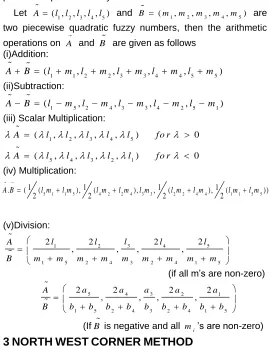
. 2.2 ARITHEMATIC OPERATIONSIn this part, differentiation between arithmetic operations of two triangular fuzzy numbers which defined on the universal set of real numbers are given in arithmetic operations related to piecewise quadratic fuzzy numbers are furnished below. Let A ( ,l l1 2,l3,l4,l5) and B (m1,m2,m3,m4,m5) are two piecewise quadratic fuzzy numbers, then the arithmetic
operations on A and B are given as follows
(i)Addition:
1 1 2 2 3 3 4 4 5 5
( , , , , )
AB l m l m l m l m l m
(ii)Subtraction:
1 5 2 4 3 3 4 2 5 1
( , , , , )
AB l m l m l m l m l m
(iii) Scalar Multiplication:
1 2 3 4 5
5 4 3 2 1
( , , , , ) 0
( , , , , ) 0
A l l l l l f o r A l l l l l f o r
(iv) Multiplication:
(v)Division:
3 5
1 2 4
1 5 2 4 3 2 4 1 5
2
2 2 2
, , l , , l
l l l
A
B m m m m m m m m m
(if allm’sare non-zero)
5 4 3 2 1
1 5 2 4 3 2 4 1 5
2 2 2 2
, , , ,
a a a a a A
B b b b b b b b b b
(IfB is negative and all mi’s are non-zero)
3
NORTH
WEST
CORNER
METHOD
3.1Algorithm for North West Corner Method (NWCM) The Northwest corner method starts in the cell (route) corresponding to the northeast corner, or the upper left, of the table (Variablex).Below is a description of the steps
STEP 1: The first assignment made in the cell occupying the upper left hand (North – West) corner of the transportation table. The minimum possible amount is allocated there. That is
x1 1m in
l l1, 2,l3,l4,l5) ,
m1,m2,m3,m4,m5
CASE (i): If minimum
l1,l2,l3,l4,l5
, m1,m2,m3,m4,m5
=
l l1, 2,l3,l4,l5
then put x1 1
l1,l2,l3,l4,l5
decrease
m1,m2,m3,m4,m5
by
l l1, 2,l3,l4,l5
and morevertically to the second row that is delete the first row. CASE (ii): If minimum
l l1, 2,l3,l4,l5 , m1,m2,m3,m4,m5
=
m1,m2,m3,m4,m5
then Put x1 1
m1,m2,m3,m4,m5
and decrease
l l1, 2,l3,l4,l5
by
m1,m2,m3,m4,m5
and more horizontally right that is delete the first columnCASE (iii): If minimum
l1,l2,l3,l4,l5 , m1,m2,m3,m4,m5
=
l l1, 2,l3,l4,l5
=
m1,m2,m3,m4,m5
then put x1 1
l l1, 2,l3,l4,l5
=
m1,m2,m3,m4,m5
and more diagonally to the cell crossout the first row and first column
STEP 2: Repeat the procedure until all the requirements are satisfied
STEP 3: If exactly one row or column is left that is not crossed out the process should be stopped. Otherwise advance to the cell to the right if a column has just been crossed out, or to the cell below if a row was crossed out the process will continue with STEP 1
3.2 LEAST COST METHOD (MATRIX MINIMA MEHOD)
STEP 1: Identify the cell with smallest and allocate
m in , ij
x A B
CASE (i): If m i n
A B,
A then putxij A; delete thet h
i row and decrease B by A , go to step (2).
CASE (ii): If m in
A B,
B then putxij B ; delete thet h
j row and decrease A by B , go to step (2).
CASE (iii): If m in
A B,
AB then putxij AB ; cross out either it hrow or jt h column but not both, go to step (2). STEP 2: Repeat the Step(1) for the resulting reduced transformation table until all the requirements are satisfiedSTEP 3: the row/column can be deleted as it is exhausted. For future allocation the deleted row/column should not be considered.
STEP 4 : Again select the smallest cost cell in the existing table and allocate. (Note: In case, if there are more than one smallest costs, select the cells where maximum allocation can be made) STEP 5: Obtain the initial basic feasible solution.
4
N
UMERICAL EXAMPLEIf A diary firm has three plants located throughout a state. Daily milk production at each plant is as follows. Plant1… plant2… plant3…. The firm of three distribution centres must be fulfilled each day. Milk requirement at each center is as follows. Distribution centre1 … Distribution centre2….
5 1 1 5 4 2 2 4 3 3 2 2 4 4 1 1 5 5
1 1 1 1
. ( ( ), ( ), , ( ), ( ))
2 2 2 2
6346
Distribution centre3…. The following table has the details of cost f a million litres of milk from each point to each centre of distribution in the value of hundred rupees. The dairy firm wishes to determine as to how much should be the shipment from which milk plant to which Distribution centre so that the total cost of generalized quadratic fuzzy numbers of shipment is the minimum. Determine the IBFS.
North-West Corner Method:
STEP 1
An unbalanced problem is given. Because the sum of the supply values is not equivalent to the sum values of demand. The maximum of these two sums is (147,149,150,151,153).
Total Supply = (147,149,150,151,153)
Total demand = (122,124,125,126,128) Since, Total Supply ≠ Total demand
The sum of the supplies is more than the sum of the demands by (22,24,25,26,28) units. So, a dummy column is to be introduced with a demand of (22,24,25,26,28) units to absorb the excess supply.
Since, Total supply=Total demand, that is balanced fuzzy transportation problem.
STEP 2
The north-west or extreme left corner of the matrix is selected, the supply and the demand values correspondingly are (27,29,30,31,33) and (47,49,50,51,53). The minimum of these values is (27,29,30,31,33). Hence, we should allocate (27,29,30,31,33) units to the left corner of the matrix and subtract the same from the supply and demand values of the north-west cell. Repeat the process from step 2 and step 3, Check for Degeneracy, There must be (m+n-1) number of allocations in the initial solution table.
i.e. (m + n - 1) = 3 + 4 – 1 = 6
The Total cost of the solution is obtained by adding the products of the cost of transportation per unit given in each and every basic cell and the corresponding number of units allocated to it.
Least Cost Method:
STEP 1
An unbalanced problem is given. Because the sum of the supply values is not equivalent to the sum of the demand
values. The maximum of these two sums is
(147,149,150,151,153) .
Total Supply=(147,149,150,151,153) Total demand=(122,124,125,126,128) Since, Total Supply ≠ Total demand
The sum of the supplies is more than the sum of the demands by (22,24,25,26,28) units. So, a dummy column is to be introduced with a demand of (22,24,25,26,28) units to absorb the excess supply.
Since, Total Supply= Total demand, the problem is balanced.,
Plant 1 Plant 2 Plant 3 Supply Centre 1 (3,5,6,7,9) (7,9,10,11,13) (11,13,14,15,17) (47,49,50,51,53) Centre 2 (9,11,12,13,15) (16,18,19,20,22) (18,20,21,22,24) (47,49,50,51,53) Centre 3 (12,14,15,16,18) (11,13,14,15,17) (14,16,17,18,20) (47,49,50,51,53) Demand (27,29,30,31,33) (37,39,40,41,43) (52,54,55,56,58)
Plant 1 Plant 2 Plant 3 Plant 4 Supply
Centre 1 (3,5,6,7,9) (7,9,10,11,13) (11,13,14,15,17) (0,0,0,0,0) (47,49,50,51,53)
Centre 2 (9,11,12,13,15) (16,18,19,20,22) (18,20,21,22,24) (0,0,0,0,0) (47,49,50,51,53)
Centre 3 (12,14,15,16,18) (11,13,14,15,17) (14,16,17,18,20) (0,0,0,0,0) (47,49,50,51,53)
D
em
and (27,29,30,31,33) (37,39,40,41,43) (52,54,55,56,58) (22,24,25,26,28)
Plant 1 Plant 2 Plant 3 Plant 4 Supply
Centre 1
Centre 2
(27,29,30,31,33)
(7,9,10,11,13) (11,13,14,15,17) (0,0,0,0,0) (47,49,50,51,53) (3,5,6,7,9)
Centre 3 (9,11,12,13,15) (16,18,19,20,22) (18,20,21,22,24) (0,0,0,0,0) (47,49,50,51,53)
Centre 1 (12,14,15,16,18) (11,13,14,15,17) (14,16,17,18,20) (0,0,0,0,0) (47,49,50,51,53)
D
em
and (27,29,30,31,33) (37,39,40,41,43) (52,54,55,56,58) (22,24,25,26,28)
Plant 1 Plant 2 Plant 3 Plant 4
Centre1 (27,29,30,31,33) (14,18,20,22,26)
(7,9,10,11,13)
(11,13,14,15,17) (0,0,0,0,0) (3,5,6,7,9)
Centre2
(9,11,12,13,15) (11,17,20,22,26) (16,18,19,20,22)
(18,26,30,34,42)
(18,20,21,22,24)
(0,0,0,0,0)
Centre3
(12,14,15,16,18) (11,13,14,15,17) (10,20,25,30,40) (14,16,17,18,20)
(7,19,25,31,43)
(0,0,0,0,0)
= (27,29,30,31,33)(3,5,6,7,9) + (14,18,20,22,26)(7,9,10,11,13)+
(11,17,20,22,26)(16,18,19,20,22) + (18,26,30,34,42)(18,20,21,22,24)+
(10,20,25,30,40)(14,16,17,18,20) + (7,19,25,31,43)(0,0,0,0,0)
= (1680,1800,1815,1830,1950)
Plant 1 Plant 2 Plant 3 Supply Centre1 (3,5,6,7,9) (7,9,10,11,13) (11,13,14,15,17) (47,49,50,51,53) Centre2 (9,11,12,13,15) (16,18,19,20,22) (18,20,21,22,24) (47,49,50,51,53) Centre3 (12,14,15,16,18) (11,13,14,15,17) (14,16,17,18,20) (47,49,50,51,53) Demand (27,29,30,31,33) (37,39,40,41,43) (52,54,55,56,58)
Plant 1 Plant 2 Plant 3 Plant 4 Supply
Centre1 (3,5,6,7,9) (7,9,10,11,13) (11,13,14,15,17) (0,0,0,0,0) (47,49,50,51,53)
Centre2 (9,11,12,13,15) (16,18,19,20,22) (18,20,21,22,24) (0,0,0,0,0) (47,49,50,51,53)
Centre3 (12,14,15,16,18) (11,13,14,15,17) (14,16,17,18,20) (0,0,0,0,0) (47,49,50,51,53)
STEP 2
The cell having the least cost is selected and allocation is made to that cell. In the table the least cost is zero (0,0,0,0,0) corresponding three zeros in the table. Any one of these cells can be selected for appropriation or allocation. The values of supply and demand are consequently (47,49,50,51,53) and (22,24,25,26,28). Hence, we should allocate (22,24,25,26,28) units to this cell. Subtract the same values from the supply and demand values of the allocated cell. Since the capacity of column is zero cancel the column to get the reduced table.
STEP 2
Now the least cost is (3,5,6,7,9). Hence allocate that cell with supply and demand values as (19,23,25,27,31) and (27,29,30,31,33).Hence , we should, allocate (19,23,25,27,31) units to this cell. Subtract the same values from the supply and demand values of the allocated cell. Since capacity of row is zero, delete the row to get the reduced table.
Check for Degeneracy, There must be (m+n-1) number of allocations in the initial solution table.
i.e. (m + n - 1) = 3 + 4 – 1 = 6
The Total cost of the solution is obtained by adding the products of the cost of transportation per unit given in each and every basic cell and the corresponding number of units allocated to it
5.
CONCLUSION
This paper focused on fully solved generalized quadratic fuzzy transportation problems under fuzzy environment. The structure of transportation problem involves a large number of shipping routes from several supply origins to several demand destinations. Our proposed method is solving to get initial basic feasible solution.
REFERENCES
[1] Abbasbandy, S. &Hajjari, T., A new approach for the ranking of trapezoidal fuzzy numbers, Computers and Mathematics with Applications, 57, (2009), 413-419.
[2] Amarpreet Kaur & Amit Kumar, A new approach for
solving fuzzy transportation problems using generalized trapezoidal fuzzy numbers, Applied Soft Computing (2011), 1-34.
[3] Bortolan. G. and Degani. R, A review of some methods for
ranking fuzzy subsets,Fuzzy Sets and Systems, 15 (1985), 1–19.
[4] Dantzig, G.B. & M.N. Thapa, Springer: Linear
Programming: 2: Theory and Extensions, Princeton University Press, New Jersey, 1963.
[5] Dubois, D. & Prade, H., Fuzzy set and systems theory and
application. New York, NY: Academic Press (1980).
[6] Edward Samuel, A. &Venkatachalapathy, M, A new
procedure for solving the generalized trapezoidal fuzzy transportation problem, Advances in Fuzzy Sets and Systems, 12(2) (2012),111-125.
[7] M. Edwin Antony Raj, Geetha Sivaraman ,Vishnukumar.
P, Ranking of Trapezoidal Intuitionistic Fuzzy Sets based on Improved Accuracy Function and solving Fuzzy MCDM Problems Using TOPSIS method, International Journal of Pure and Applied Mathematics Volume 119 NO.16 Pages 189-195, 2018
[8] Geetha Sivaraman ,M. Edwin Antony Raj, Vishnukumar.
P, Trapezoidal Intuitionistic Fuzzy TOPSIS Method Based on an Improved Score Function International Journal for Research in Engineering Application & Management (IJREAM)Volume 4 Issue 8 Pages 141-145
[9] Hitchcock,F.L., The distribution of a product from several sources to Numerous localities, Journal of Mathematical Physics, 20 (1941) 224-230.
[10]A.Kaufmann, M.M. Gupta, Fuzzy Mathematical Models in
Engineering and Management Science, Amsterdam, The Netherland : Elsevier, (1988).
[11]F.T. Lin, Solving the Transportation Problem with Fuzzy Coefficients using Genetic Algorithms, Proceedings IEEE International Conference on Fuzzy Systems, (2009) 20-24.
[12]T.S. Liou, M.J. Wang, Ranking fuzzy number with integral
values, Fuzzy Sets and Systems 50 (1992) 247-255. [13] Muthuperumal,S., P. Titus & M. Venkatachalapathy, On
solving generalized exponential trapezoidal fuzzy numbers using ranking functions, International Journal of Pure and Applied Mathematics, Volume 118, No. 6, 2018, 193-199.
[14] S.Muthuperumal, T.Titus, M.Venkatachalapathy A Study
Plant 1 Plant 2 Plant 3 Plant 4 Supply
Centre1
(3,5,6,7,9) (7,9,10,11,13) (11,13,14,15,17)
(22,24,25,26,28)
(47,49,50,51,53)
(0,0,0,0,0)
Centre2 (9,11,12,13,15) (16,18,19,20,22) (18,20,21,22,24) (0,0,0,0,0) (47,49,50,51,53)
Centre3 (12,14,15,16,18) (11,13,14,15,17) (14,16,17,18,20) (0,0,0,0,0) (47,49,50,51,53)
De
m
an
d
(27,29,30,31,33) (37,39,40,41,43) (52,54,55,56,58) (22,24,25,26,28)
Plant 1 Plant 2 Plant 3 Supply
Centre1
(19,23,25,27,31)
(7,9,10,11,13) (11,13,14,15,17) (19,23,25,27,31) (3,5,6,7,9)
Centre2 (9,11,12,13,15) (16,18,19,20,22) (18,20,21,22,24) (47,49,50,51,53)
Centre3 (12,14,15,16,18) (11,13,14,15,17) (14,16,17,18,20) (47,49,50,51,53)
Demand (27,29,30,31,33) (37,39,40,41,43) (52,54,55,56,58)
(19,23,25,27,31)
(3,5,6,7,9) (7,9,10,11,13) (11,13,14,15,17)
(22,24,25,26,28) (0,0,0,0,0) (-4,2,5,8,14)
(9,11,12,13,15) (16,18,19,20,22)
(33,41,45,49,57)
(18,20,21,22,24) (0,0,0,0,0)
(12,14,15,16,18) (37,39,40,41,43) (11,13,14,15,17)
(4,8,10,12,16)
(14,16,17,18,20) (0,0,0,0,0)
= (22,24,25,26,28)(0,0,0,0,0)+(19,23,25,27,31)(3,5,6,7,9)+(-4,2,5,8,14)(9,11,12,13,15)+
(37,39,40,41,43)(11,13,14,15,17)+(4,8,10,12,16)(14,16,17,18,20)+(33,41,45,49,57)
(18,20,21,22,24)
6348
On Solving Generalized Trapezoidal Fuzzy Transportation Problem With Mixed Constraints Using Ranking Function, ,TAGA JOURNAL VOL. 14,2018
[15]Venkatachalapathy. M. &Edward Samuel,A , An
alternative method for solving fuzzy transportation problems using ranking functions, International Journal of Applied Mathematical Sciences, Volume 9, Number 1 (2016), pp. 61-68.
[16]Venkatachalapathy.M, Jayaraja.A & A.E. Samuel,A study
on solving octagonal fuzzy numbers using the modified Vogel’s approximation method, International Journal of Pure and Applied Mathematics, Volume 118, No. 6, 2018, 201-207.
[17]Zadeh,L.A., Fuzzy sets, Information and Control, 8 (1965),
338-353.
[18] Zimmermann, H.J., Fuzzy programming and linear