Available online at http://www.ijabbr.com
ISSN: 2322 - 4827, Volume 6, Issue 4, 2018, 258-265
258 | Page Research Article
Study qualities and quantities tree parameters in the protected
and non-protected areas in the Dena Biosphere Reserve
Dorna Rezaei *1, Mohamad Hossein Irannezhad Parizi2, Azizollah Jafari Kokhdan3,Roghaye Zolfaghari4
1M.Sc. Student of forestry, University of Yazd, Yazd, Iran,
2Department of Forestry, University of Yazd, Yazd, Iran,
3Department of Biology, University of Yasouj, Yasouj, Iran,
4Department of Forestry, University of Yasouj, Yasouj, Iran.
*Corresponding AuthorE-mail: [email protected] Received: 8 October 2018, Revised: 20 October 2018, Accepted: 5 November 2018
ABSTRACT
Dena Biosphere Reserve located in Iran and is a 550 Biosphere Reserve in the worlds. This research was investigated in the two protected and non-protected areas, in a Dena Biosphere Reserve, Kohkeloye va Boyrahmad province, and central zagros forest, southwest of Iran. Inventory methods designed by systemetic-randomaiz method by use the rectangular plots that were 15×30 meters in the 100×100 m Net. In each plots information include qualities and quantities tree parameter measured. T-test was used to analysis of mean quantities tree parameter differences between protected and non-protected area. Data analyzing was done by Excel and SPSS16 software’s. Results showed that the DBH distribution in the reduced uneven- aged stand in protected area and reduced even aged in the non-protected area. Results showed that the mean of forest characteristics including DBH, height, canopy cover and, and density in the protected area are 38.5 (±5.5), 6.51 (± 0.9), 38 (±5.5) and 530 (±35) and this quantities parameters in protected area higher the non-protected area. Overall results showed that the qualities and quantities tree parameters in the non-grazed area higher the grazed area, and grazing has a negative effect on the qualities and quantities tree parameters.
Keywords: Qualities and quantities parameters, Dena Biosphere Reserve, Protected area, Kohkeloye va Boyrahmad province, DBH distribution.
INTRODUCTION
259 | Page Oliv. And Q.persica J. & Sp. (Q.brantii Lindl.) (Haidari et al, 2012c). Species are found in this part. However, the southern Zagros is included Q.persica site which it extended to Fars province (Bazyar et al, 2013b; Parma and Shataee, 2013; Haidari et al, 2013c). Increasing population, low level of development and high dependence of local communities on forests for their primary livelihood needs, are the main reasons of this destruction (Fatahii, 1994). The researcher study of Forest Stand Quantitative Factors in Protected and No protected Areas in Arasbaran Forests and results showed that the number of trees and basal area in protected area was significantly higher than that in no protected forest stands. (Alijanpour et al, 2004). The Comparison of tree species diversity in two protected and non-protected area in protected regions of Oshtorankooh in Lorestan province, west of Iran. Indicated trees and shrubs living in the protected regions have species significantly higher diversity, richness, evenness and better living conditions than they are living in non-protected region (Abasi et al, 2009). The researcher studied results the most important factors affecting oak regeneration in this region are livestock grazing, fire, acorn collecting by villagers for domestic fodder, summer drought, pests and diseases on acorns and seedlings (Shakeri et al, 2009). The researcher study of plant biodiversity in grazed and non-grazed areas in the Iran-o-Turanian ecological zones and results showed that the So the grazed and non-grazed increase tree, shrub and herbaceous diversity in Irano-Turanian forest, and complete protection (non-grazed) area have higher plant diversity compered the grazed region. Therefore, prevention of livestock grazing and irregular tree cutting in the degraded forest stands can be suggested as a suitable approach for natural restoration and increasing plant diversity (Haidari et al, 2012a). The researcher studied of tree regeneration in the grazed and non-grazed areas in the Iran-o- Turanian Ecological Zones and results showed Regeneration in non-grazed region was less than grazed region. T-test indicated significant difference between non-grazed and grazed region for sound and height seedlings. Overall results showed that the grazing have a negative effects on regeneration. To manage of this forest authors suggested that continue preservative plans (non-grazed area) and provide foliage for cattle (Haidari et al, 2013b). The researcher study of vertical and horizontal forest structure in Northern Zagros Forest and results showed that Overall results showed Blake forest was two forest story and Quercus libani Oliv and Quercus infectoria Oliv were the most dominant woody plants and located in over story (Haidari et al, 2013a).The aim of our study was comparing of qualities and quantities tree parameters in the protected and non-protected area in the Dena Biosphere Reserve, Kohkeloye va Boyrahmad province, central zagros forest, southwest of Iran.
MATERIALS AND METHODS
Site description
260 | Page
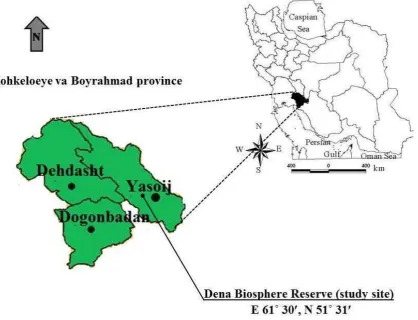
Figure 1. Study site location in the Kohkeloye va Boyrahmad province, central zagros forest, and southwest of Iran.
Field measurements
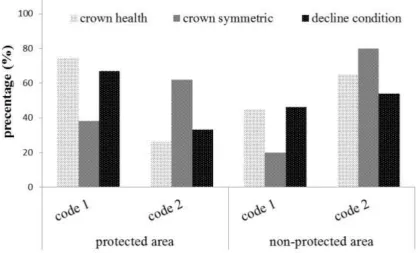
Inventory methods designed by systemetic-randomaiz method by use the rectangular plots that were 15×30 meters in the 100×100 m Net. In each plots information include qualities (health, crown symmetric and decline condition) quantities (Diameter at breath height, height and crown diameter) tree parameter measured (table 1). T-test was used to analysis of mean quantities tree parameter differences between protected and non-protected area. Data analyzing was done by Excel and SPSS16 software’s.
Table 1: qualities class in the study area
Code Crown health crown symmetric decline condition Code 1 Health symmetric decline
Code 2 Non-health Non- symmetric Non- decline
RESULT AND DISCUSSION
261 | Page
Table 2. List of plant species (Tree and Shrub) in the studied areas
Non-protected area Protected area Family name Scientific name * * Fagaceae Qurecus brantii Oliv.
1 * * Anacardiaceae Pistacia atlantica 2 * * Aceraceae Acer monspessulanum L.
3 * * Rosaceae Cratagus atlantica 4 * * Rosaceae Amygdalus scoparia 5 * * Caprifoliaceae Loniceroa nummularifolia 6 * * Rosaceae Amygdalus nummularifolia 7 * * Rosaceae Cotonaster integerrima 8 * Rosaceae Cerasus microcarpa 9
The tree and shrub species belonged to five families and 5 tree species were identified in the study area (Table 2). Thus for the classes of Rosacea, Fagaceae, Caprifoliaceae, Aceraceae, and Anacardiaceae, five, one, one, one and one species were existed, respectively.
0 10 20 30 40 50 60 70 80 90 100
10 15 20 25 30 35 40 45 50 55 60 65 70 75
tree/
h
ect
are
diameter classes (5 cm)
protected area non-rotected area
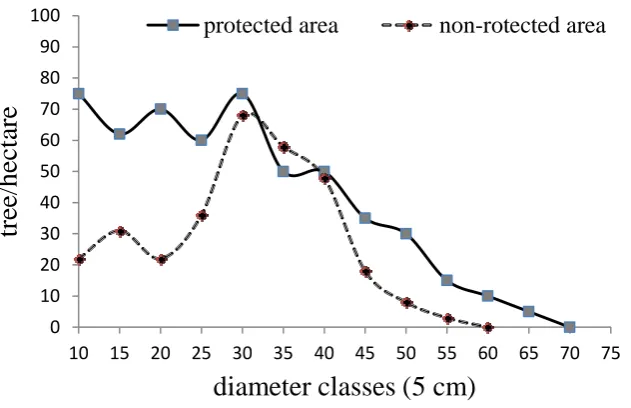
262 | Page indicate the reduced uneven- aged stand in protected area and reduced even aged in the non-protected area, respectively.
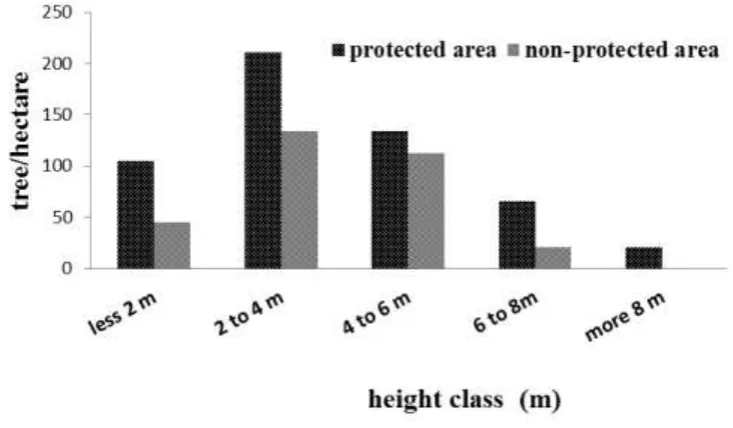
Figure 3: The number of trees in height classes in the protected and non-protected area. showed that in protected area 2 to 4 meter height class has a maximum N/hectare, in in protected area more trees has more 4 meter height.
Table 3: Comparison of tree parameter in the protected and non-protected area. t-test (Sig.) non-protected area
protected area Tree parameters
Standard deviation mean
Standard deviation mean
0.000 4.5
31.2 5.5
38.5 Diameter at breath
height (DBH) (cm)
0.004 0.76
5.5 0.90
6.51 Height (m)
0.000 3
21 5.5
38 Crown cover (%)
0.000 23
312 35
530 Tree/hectare
*Different letters indicate significant differences in 5% level ** Different letters indicate significant differences in 1% level
263 | Page
264 | Page
CONCLUSION
Grazing affects plant communities and associated fauna, with implications for biodiversity and ecosystem processes (Huntly, 1991; Rooney, 2003). Overall results showed that the qualities and quantities tree parameters in the non-grazed area higher the grazed area, and grazing has a negative effect on the forest regeneration.
Acknowledgements
We thank Mr. Rahmat Namdari and Sasan Vaffaei for their help in the field and we thank Mr. Maziar Haidari n for his help in the analysis of data.
REFERENCES
Alijanpour. A., Zobeiri. M., Marvi Mohajer. M.R., Zargham. N., Feghhi. J. (2004). A Comparison of Forest Stand Quantitative Factors in Protected and No protected Areas in Arasbaran Forests. Iranian J. Natural Res, 57(3):447-453.
Askari. Y., Parsapour. M.K., hosseni. Z. (2013). Modeling of Suitability Iranian Oak site for establish of coppice regeneration in Zagros forest. International journal of Advanced Biological and Biomedical Research (IJABBR), 1(1):61-70.
Bazyar. M., Bonyad. A., Babaie Kafaki. S. (2013a). Study of most element of forest destruction by used the IRS-1C and LANDSAT image in the southern zagros forest (Case study: Kohkeloeye and Boveirahmad province). International journal of Advanced Biological and Biomedical Research (IJABBR), 1(1):35-44.
Bazyar. M., Haidari. M., Shabanian. N., Haidari. R.H., (2013b). Impact of physiographical factors on the plant species diversity in the Northern Zagros Forest (Case study, Kurdistan Province, Marivan region). Annals of Biological Research, 4(1):317-324.
Dastmalchi. M. (1998). Investigation compatibility experimental of tree species Ardabil province. Jangal and Senoubar J. Inst, For, Ranglands Res, 203:168p.
Haidari. M., Jalilvand. H., Haidari. R.H., Shabanian. N. (2012 a). Study of Plant Biodiversity in Grazed and Non-grazed Areas in the Iran-o-Turanian Ecological Zones (Case Study: Yazd Province, IRAN). Annals of Biological Research, 3 (11):5019-5027.
Haidari. M., Namiranian. M., Gahramani. L., Zobeiri. M., Shabanian. N. (2013a). Study of vertical and horizontal forest structure in Northern Zagros Forest (Case study: West of Iran, Oak forest). European Journal of Experimental Biology, 3(1):268-278.
Haidari. M., Etemad. V., Khosropour. E. (2013b). Study of tree regeneration in the grazed and non-grazed areas in the Iran-o- Turanian Ecological Zones. International journal of Advanced Biological and Biomedical Research (IJABBR), 1(1):18-24.
Haidari. M., Rezaei. D. (2013c). Study of plant diversity in the Northern Zagros forest (Case study: Marivan region). International journal of Advanced Biological and Biomedical Research (IJABBR), 1(1):1-10.
265 | Page Haidari. M. (2013e). Study of herb diversity in the zagros forest (Case study: Kurdistan province). International journal of Advanced Biological and Biomedical Research (IJABBR), 1(1):25-34.
Haidrai. M., Bazyar. M., Hosseini. S.A., Haidari. R.H., Shabanian. N. ( 2013f), Study of forest destruction by used the diversity index in the Northern Zagros Forest (Case study: Oak forest). International Journal of Biological & Medical Research, 4(1):2720- 2725.
Huntly. N. (1991). Herbivores and the dynamics of communities and ecosystems. Annu RevEcol Syst, 22:477–503.
Hosseini. S.A. O., Haidari. M., Shabanian. N., Haidari. R.H., Fathizadeh. O. (2012). The impact of single selection method logging on the tree and shrub diversity in the Hyrcanian forests. European Journal of Experimental Biology, 2(6):2229-2237.
Marvi-Mohajer. MM. (2005). Silviculture, Tehran University Press, Tehran, 380p.
Parma. R., Shataee. S. (2013). Estimation of species diversity of trees and shrubs using ETM+ sensor data (Case study of forests in Qalajeh Kermanshah province). International journal of Advanced Biological and Biomedical Research (IJABBR), 1(1):71-78.
Rooney. T.P., Waller. D.M. (2003). Direct and indirect effects of white-tailed deer in forest ecosystems. Forest Ecol. Manage, 181:165–176.
Shakeri. Z., Marvi Mohajer. M.R., Namiranin. M., Etemad. V. (2009). Comparison of seedling and coppice regeneration in pruned and undisturbed oak forests of Northern Zagros (Case study: Baneh, Kurdistan province. Iranian Journal of Forest and Poplar Research, 17(1):72-84.
How to cite this article: Dorna Rezaei, Mohamad Hossein Irannezhad Parizi, Azizollah Jafari Kokhdan, Roghaye Zolfaghari, Study qualities and quantities tree parameters in the
protected and non-protected areas in the Dena Biosphere Reserve. International Journal of Advanced Biological and Biomedical Research, 2018, 6(4), 258-265.