Genetics and Molecular Research 16 (4): gmr16039819
BmICE-2
interference vector construction and its silencing
effect in the
BmN-SWU1
cells
Hua-Shan Yi and Xianping Ma
College of Animal Science, Southwest University, Chongqing 402460, China
Corresponding author: Huashan Yi
E-mail: [email protected]
Genet. Mol. Res. 16 (4): gmr16039819
Received September 2, 2017
Accepted September 28, 2017
Published October 5, 2017
DOI http://dx.doi.org/10.4238/gmr16039819
Copyright © 2017 The Authors. This is an open-access article distributed under the terms of the Creative Commons Attribution ShareAlike (CC BY-SA) 4.0 License.
ABSTRACT. Investigate the function of BmICE-2 gene in silkworm cells by constructing a BmICE-2 interference vector and analysing its interference effect. Online RNAi design software was used to predict the interference target sequence of Bmice-2. An optimized sequence was selected and inserted into the backbone of interference microRNA. The backbone of interference vector, microRNA-siBmICE-2, and a control vector, microRNA-siBmICE-2-control were designed. The synthesized gene segment was digested by Asc I and Sac II, and inserted into a dsRed vector. The interference vector miRNA-dsRed and control vector PIZ/V5-BmICE-2-Control-miRNA-dsRed were designed and validated through digestion and sequencing. The interference and control vectors were then transfected into silkworm cells BmN-SWU1. qRT-PCR and Western blots were used to evaluate the effect of gene interference. Interference microRNA vector PIZ/V5-BmICE-2-miRNA-dsRed targeting BmICE-2 was successfully constructed and transiently expressed in silkworm cells. The interference vector significantly inhibited the expression of BmICE-2 at mRNA and protein levels. The constructed interfering vector significantly interfered with the expression of BmICE-2 in silkworm cells BmNSWU1.
INTRODUCTION
RNA interference (RNAi) includes gene silencing on translational or transcriptional levels induced by a double-stranded RNA (dsRNA) that specifically and efficiently degrades the homologous mRNA of the target gene. It inhibits gene expression by inhibiting the transcription or translation of the specific gene (Fire 1998). When cells are treated with a double-stranded RNA homologous to the endogenous mRNA coding region, the targeted mRNA is degraded and the gene expression is silenced (Zamore 2000). Many studies show that dsRNA can work as an effective tool to interfere with specific gene expression in insects and to study gene function (Shabalina et al. 2008, Yamaguchi et al. 2011). Because of the high specificity, high efficiency, and high stability of RNAi and its ability to transfer across cells, it is widely applied to study the function of specific genes (Kim 2005, Winston et al.2002, Yamaguchi et al. 2011).
The silkworm is a holometabolous Lepidopteran insect that has significant economic importance (Chen et al. 2015, Xia et al. 2004). The silkworm BmICE-2 gene is a pro-apoptotic gene recently identified from the silkworm cell apoptosis associated genes. It promotes apoptosis of the silkworm cell BmN-SWU1 and BmE-SWU1 (Yi et al. 2014). In silkworm BmN-SWU1 cells, endogenous BmICE-2 accumulates in the nucleus in the form of a proenzyme of cysteinyl aspartate-specific proteinase (Caspase). In apoptotic cells, BmICE-2 demonsrated the features of nuclear matrix translocation and mitochondrial repositioning (Yi 2014). The purpose of this study was to discover the molecular mechanism of BmICE-2 in Caspase-dependent cell apoptosis in silkworm. We used RNAi techniques to design a RNA interference backbone, construct an interference vector, transfect silkworm BmN-SWU1 cells, and detect the efficiency of interference using qRT-PCR.
MATERIALS AND METHODS
Plasmid and cells
PIZ/V5-dsRed plasmid was maintained by our laboratory; The silkworm embryo cell line: BmN-SWU1 was cultured in a 27°C incubator using TC-100 insect cell culture medium containing fetal bovine serum (PAA), with the volume fraction of 10% (Pan et al.2007, Pan et al.2010).
Reagents and equipment
Liposomes were from Roche (USA); TC-100 insect cell culture medium was from Invitrogen in USA; 24-well circular cover clips were from Fisher (USA); fluorescent quantitative PCR kit (RR037A) and Asc I and Sac II enzymes were from Takara Engineering (Dalian, China); Rabbit BmICE-2 protein polypeptide antibody (anti-BmICE-2, primary antibody) was from ZoonBio Biotechnology (Nanjing, China); Rabbit Tubulin antibody, goat anti-rabbit horseradish peroxidase secondary antibody, Western primary antibody dilution buffer (p0023a) and secondary antibody dilution buffer (P0023D), BeyoECL Star (super-sensitive ECL chemiluminescence kit) and PMSF (ST506) were from Beyotime Biotechnology (Hangzhou, China); the ultra-pure plasmid extraction kit (Qiagen, 12145), protein marker (DM201) and TransT 1 competent cells were from Transgene Biotech (China). All cell culture flasks, cell culture plates were from Corning (USA); fluorescence microscope (BX-51) was from Olympus (Japan); Vilber ultra high-sensitivity chemiluminescence imaging system (fusion FX6-XT) was used for immunoblotting membrane imaging analysis (Vilber Lourmat, France).
Design and synthesis of the microRNA interference backbone
Genetics and Molecular Research 16 (4): gmr16039819
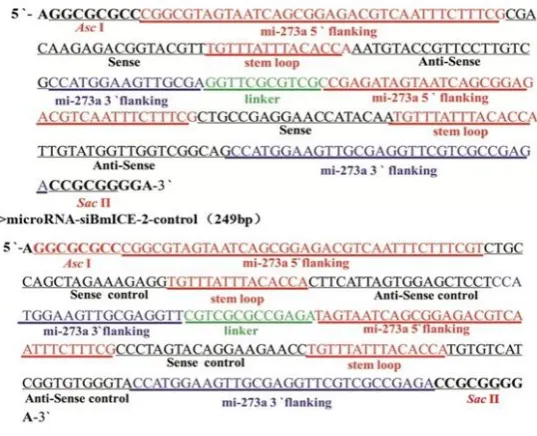
synthesis was performed by Gen Script (Nanjing, Jiangsu, China). The synthetic gene sequence is shown in Figure 1.
Figure 1. Interference vector sequence siBmICE-2) and the interference control vector sequence (microRNA-siBmICE-2-control).
Construction of miRNA interference vector
The synthesized plasmids microRNA-siBmICE-2, microRNA-siBmICE-2-control and PIZ/V5-dsRedicroRNA-sibmice-2 were digested using AscI and SacII, followed by DNA extraction, overnight ligation using T4 DNA ligase, TransT1 competent cell transformation, and zeocin selection. Positive plasmid colonies of microRNA-siBmICE-2, microRNA-siBmICE-2-control and PIZ/V5-dsRedicroRNA-sibmice-2 were validated by enzyme digestion using Asc I and Sac II. The undigested plasmid was used as the control. Sequencing was performed after enzyme digestion.
Interference plasmid transfecting silkworm cell
Silkworm BmN-SWU1 cells were cultured to 90% confluence and transferred to a 24-well tissue culture slide with circular cover clip. A 800 ng amount of miRNA-dsRed and PIZ/V5-BmICE-2-Control-miRNA-dsRed and 2 μL of liposome were incubated in 100 µL TC-100 medium for 30 minutes before transfection to BmN-SWU1 cell. Cells were observed using a fluorescence microscope 36 h and 48 h after transfection (Yi et al. 2014).
qRT-PCR detection of
BmICE-2
interference
Primer name Primer sequence 5’→3’ Annealing temperature Amplification size
BmiCE-2-F TCTGTTGACGGTTATCTTTC 60 o
c 180bp
BmiCE-2-R TATTGTTGGTCTCCTGACAT
SW22934-F TTCGTACTGGCTCTTCTCGT 60 o
c 180bp
SW22934-R CAAAGTTGATAGCAATTCCCT
Western blotting detecting the interference of
BmICE-2
Healthy BmN-SWU1 cells were plated in 12-well cell culture plates and transfected with PIZ/V5-BmICE-2-miRNA-dsRed and PIZ/V5-BmICE-2-Control-PIZ/V5-BmICE-2-miRNA-dsRed, respectively. At 48, 72, 96, and 120 h after transfection, the supernatant was removed and protein samples were prepared according the procedure in reference (Yi et al. 2014). An equal amount of total cell proteins from interference group and control group at the different time points were analyzed using 12% SDS-PAGE gel electrophoresis. Proteins were transferred to the PVDF membrane using the semi-dry transferring method. The membrane was blocked in 50 g/L of skim milk powder solution for 2 h at room temperature. Anti-BmICE-2 polypeptide antibody was diluted 1:1000 using Western antibody dilution solution containing 50 g/L of skim milk powder. Reference tubulin antibody was diluted 1:3000. The membrane was incubated overnight with antibody at 4°C. The membrane was then washed 5 times on a horizontal shaker with TBST, 5 mins per wash. Horseradish peroxidase (HRP)-labeled goat anti-rabbit secondary antibody was diluted 1:5000 and incubated at room temperature for 1 h. The membrane was then washed 3 times on a horizontal shaker with TBST, 10 mins per wash. Chemiluminescence development was performed according to the protocol of BeyoECL Star (Hypersensitive ECL chemiluminescent kit) (Beyotime Biotechnology, China). A chemiluminescence detector was used for film analysis.
Data analysis
The expression level of silkworm BmICE-2 in BmN-SWU1 cells was set as the control. The interference effects of the interfering vector PIZ/V5-BmICE-2-miRNA-dsRed and the control vector PIZ/V5-BmICE-2-Control-miRNA-dsRed in BmN-SWU1 cells were analyzed using the 2-△△CT method. The data was further analyzed and graphed using GraphPad 5.
RESULTS
Constructing the RNAi plasmid Targeting
BmICE
-2
The designed microRNA-siBmICE-2 and microRNA-siBmICE-2-control sequences were synthesized by Gene script (Nanjing, China). Synthesized microRNA-siBmICE-2, microRNA-siBmICE-2-control and PIZ/V5-dsRed plasmids were digested using Asc I and Sac II, followed by DNA extraction, ligation, and TransT1 competent cell transformation. Zeocin resistant colonies on LB agar plates were selected for harvesting recombinant plasmids. Plasmids were validated through enzyme digestion using Asc I and Sac II. As shown in Figure 1, an expected 250 bp segment was observed. Sequencing data showed that the sequences of synthesized microRNA-siBmICE-2 and microRNA-siBmICE-2-control successfully integrated into the PIZ/V5-dsRed eukaryotic expression vector. The sequencing result was identical to the designed sequence and no insertions, deletions or mutations were found.
Genetics and Molecular Research 16 (4): gmr16039819
Figure 1. Identification of the PIZ/V5-BmICE-2-miRNA-dsRed and PIZ/V5-BmICE-2-Control-miRNA-dsRed recombinant plasmids by digestion with Asc I and Sac Π.
M. Marker DL 5 000; 1. RNAi vector of PIZ/V5-BmICE-2-miRNA-dsRed; 2. Production digested with Asc I and Sac Π enzyme of miRNA-dsRed vector; 3. RNAi control vector of PIZ/V5-BmICE-2-Control-miRNA-dsRed; 4. Production digested with Asc I and Sac Π enzyme of PIZ/V5-BmICE-2-Control-miRNA-dsRed
Transient expression of the interference vector
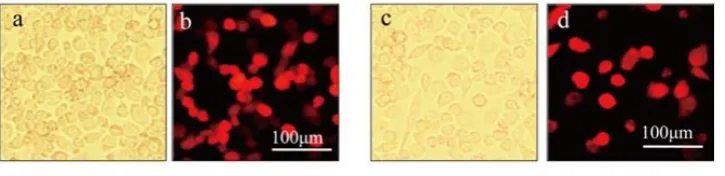
Thirty-six h after BmN-SWU1 cells were transfected with BmICE-2-miRNA-dsRed and PIZ/V5-BmICE-2-Control-miRNA-dsRed plasmids respectively, strong red fluorescence signals were observed in both groups. Red fluorescence signals indicated the existence of BmICE-2-miRNA-dsRed protein (Figures 2a and 2b) and BmICE-2-Control-miRNA-dsRed protein (Figures 2c and 2d). Cells transfected with PIZ/V5-BmICE-2-Control-miRNA-dsRed plasmid were taken as control.
Figure 2. BmN-SWU1 cells transfected with PIZ/V5-BmICE-2-miRNA-dsRed vector after 36 h.
Transfection with PIZ/V5-BmICE-2-miRNA-dsRed in BmN-SWU1 cells (a and b); transfection with PIZ/V5-BmICE-2-control-miRNA-dsRed in BmN-SWU1 cells (c and d); white photos a and c; fluorescence images b and d. Scale bars = 100 μm.
qRT-PCR Analyzing the Interference of BmICE-2
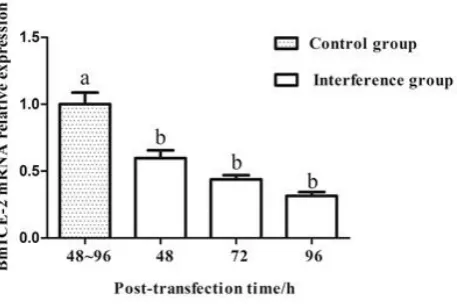
Figure 3. Silence efficiency detection of BmICE-2 gene inducing by PIZ/V5-BmICE-2-miRNA-dsred in BmN-SWU1 cells by qRT-PCR
Western blot analysis of BmICE-2 interference
Silkworm cells BmN-SWU1 were transfected with PIZ/V5-BmICE-2-miRNA-dsRed and PIZ/V5-Control-miRNA-dsRed respectively. Protein samples were prepared at 48, 72, 96, and 120 h after transfection for Western blotting. With increased interference time, cells transfected with PIZ/V5-BmICE-2-miRNA-dsRed exhibited down-regulated BmICE-2 levels compared to the control (Figure 4).
Figure 4. Silence efficiency detection of BmICE-2 gene inducing by PIZ/V5-BmICE-2-miRNA-dsred in BmN-SWU1 cells by Western blotting
DISCUSSION
Genetics and Molecular Research 16 (4): gmr16039819
The miRNA expression vector in this study used the silkworm miRNA bmo-mir-273a as the basic backbone structure and PIZ/V5-BmICE-2-miRNA-dsRed as the interference vector. This expression vector effectively silenced the target gene BmICE-2 in silkworm cells. Our data showed that a pair of oligonucleotide sequences targeting BmICE-2 was correctly inserted into the bmo-mir-273a backbone sequence. The PIZ/V5-BmICE-2-miRNA-dsRed interfering vector could be transfected into silkworm BmN-SWU1 cells. With low transfection efficiency, transfected cells could be selected by zeocin and cultured for analysis of BmICE-2 silencing. Results of qRT-PCR and Western blotting showed that PIZ/V5-BmICE-2-miRNA-dsRed could significantly down-regulate the expression of BmICE-2 at mRNA and protein levels. This suggests that the construction of gene silencing vector was stable and effective. This same vector could be used for other studies.
Yi et al. (2014) showed that BmICE-2 was a pro-apoptosis caspase gene in the silkworm and played an important role in silkworm cell apoptosis.
CONCLUSION
Future studies might focus on the regulation of BmICE-2-dependent pathways and identification of the activation mechanism of BmICE-2 in cells and its associated regulators. Our study provides information on the mechanism by which BmICE-2 regulates silkworm cells apoptosis.
ACKNOWLEDGEMENT
We thank Dr. Cheng Lu of the Institute of Sericulture and Systems Biology, Southwest University, China, for providing insect cells. This work was supported by grants from the Fundamental Research Funds for the Central Universities (No. XDJK2015C032) and China Agriculture Research System (CARS-22).
REFERENCES
Andermatt I, Wilson N, Stoeckli ET (2014). In Ovo Electroporation of miRNA-Based-Plasmids to Investigate Gene Function in the Developing Neural Tube. Methods in Molecular Biology. 1101:353-368. https://doi.org/10.1007/978-1-62703-721-1_17
Chen P, Hu YF, Wang L (2015). Mitochondrial Apoptotic Pathway Is Activated by H2O2-Mediated Oxidative Stress in BmN-SWU1 Cells from Bombyx mori Ovary.Plos One. 10(7): e0134694. https://doi.org/10.1371/journal.pone.0134694
Fire A, Xu S, Montgomery MK (1998). Potent and specific genetic interference by double-stranded RNA in Caenorhabditis elegans. Nature. 391: 806-811.
Haley B, Hendrix D, Trang V (2008). A simplified miRNA-based gene silencing method for Drosophila melanogaster. Deve lopmental Biolog. 321(2):482-490. https://doi.org/10.1016/j.ydbio.2008.06.015
Haley B and Levine M (2010). Vectors and parameters that enhance the efficacy of RNAi-mediated gene disruption in transgenic Drosophila. Proceedings of the National Academy of Sciences, 107(25): 11435-11440. https://doi.org/10.1073/pnas.1006689107
Kim JY (2005). Regulation of short-distance transport of RNA and protein. Current Opinion in Plant Biology. 8(1): 45-52.
https://doi.org/10.1016/j.pbi.2004.11.005
Naidu S, Magee P, Garofalo M (2014). MiRNA-based therapeutic intervention of cancer. Journal of Hematology & Oncology. 8(1):1-8.
https://doi.org/10.1186/s13045-015-0162-0
Pan MH, Cai XJ, Liu M (2010). Establishment and characterization of an ovarian cell line of the silkworm, Bombyx mori. Tissue and Cell. 42(1): 42-46. https://doi.org/10.1016/j.tice.2009.07.002
Pan MH, Xiao SQ, Chen M (2007). Establishment and characterization of two embryonic cell lines of Bombyx mori. Vitro Cellular & Developmental Biology Animal. 43(2): 101-104. https://doi.org/10.1007/s11626-006-9009-x
Kamthan A, Chaudhuri A, Kamthan M (2015). Small RNAs in plants: recent development and application for crop improvement. Front Plant Sci, 208(06): 1-17. https://doi.org/10.3389/fpls.2015.00208
Shabalina S A, Koonin E V (2008). Origins and evolution of eukaryotic RNA interference.Trends in Ecology & Evolution. 23(10): 578-587. https://doi.org/10.1016/j.tree.2008.06.005
Xia Q, Zhou Z, Lu C (2004). A Draft Sequence for the Genome of the Domesticated Silkworm (Bombyx mori). Science. 306(5703): 1937-1940. https://doi.org/10.1126/science.1102210
Yamaguchi J, Mizoguchi T, Fujiwara H (2011). siRNAs Induce Efficient RNAi Response in Bombyx mori Embryos.Plos One. 6(9): 25469-25476. https://doi.org/10.1371/journal.pone.0025469
Yi HS, Pan CX, Pan C (2014). BmICE-2, is a novel pro-apoptotic caspase involved in apoptosis in the silkworm, Bombyx mori. Biochemical & Biophysical Research Communications. 445(1): 100-106. https://doi.org/10.1016/j.bbrc.2014.01.139
Yi HS (2014). Clone and functionalanalysis of BmICE-2 gene in silkworm,Bombxy mori[D]. Chongqing:Southwest University. Zamore PD, Tuschl T, Sharp PA (2000). RNAi:Double-Stranded RNA Directs the ATP-Dependent Cleavage of mRNA at 21 to 23 Nucleotide Intervals. Cell. 101(1): 25-33.
Zhang CD (2012). Clone and functional identification of BmGeminin gene in silkworm,Bombxy mori Chongqing:Southwest University. Zhang T, Cai Y, Zhai BZ (2015). Progress on RNA interference. Mod Diagn Treat (6): 1254-1256.