http://www.ijcmph.com pISSN 2394-6032 | eISSN 2394-6040
Original Research Article
An epidemiological study on ocular morbidities among school students
in an urban area of South 24 Parganas, West Bengal
Munu Mohanta
1, Aparajita Dasgupta
1, Tania Pan
1*, Bobby Paul
1,
Lina Bandyopadhyay
2, Shamita Mandal
2INTRODUCTION
Visual impairment is a worldwide challenge that affects all age groups and has a major socio-economic impact. In 2010, an estimated 285 million people worldwide suffered from visual impairment, out of which about 39 million were blind and 246 million were had low vision, with a sumptuous figure of nearly 90 percent of them residing in developing countries.1 Estimated prevalence of childhood blindness/low vision in India was 0.8 per
1000.2 According to 2006-07 National Survey on Blindness, the common causes of blindness in India are cataract (62.6%), refractive error (19.7%), glaucoma (5.8%), followed by posterior segment pathology, corneal opacity, surgical complications and posterior capsular opacification.2 Among the preventable causes of blindness, the priority goes to uncorrected refractive errors which could be easily diagnosed and corrected and xerophthalmia which is largely under control with vitamin A distribution in immunization programmes.
ABSTRACT
Background: The estimated national prevalence of childhood blindness was 0.8 per 1000. Childhood blindness is a priority area because of the number of years of blindness in the life-time of a child. About one-third of India's blind lose their eye-sight before the age of 20 years making early detection and treatment of ocular morbidity very crucial. This study aimed at estimating the proportion of ocular morbidities among school students in a secondary school in an urban area of West Bengal.
Methods: It was a cross-sectional institution-based observational study conducted in August 2017 among 151 school students of 7th to 9th standard in an urban area of West Bengal. Data was obtained using a structured questionnaire followed by checking of visual acuity by Snellen’s chart. Visual acuity of 6/9 or more in any one eye was taken as a sign of visual impairment. Data was analysed using SPSS version 16.0.
Results: Out of 151 students, 51.0% were found to have refractive error. The most frequently reported was difficulty in seeing among 43.7% of the students followed by headache while studying (36.4%) and pain in eyes (35.1%). Also, 9.9% of the students reported difficulty in seeing at night. Tests of association revealed that posture and screen time were significantly associated with presence of refractive error.
Conclusions: The study revealed that high prevalence of refractive error among school students. Periodic screening of school children and spreading of awareness regarding correct posture and screen time are very essential to improve the quality of eye sight.
Keywords: Ocular morbidities, School students, Refractive error, Ocular complaints
1
Department ofPSM, AIIHPH, Kolkata, West Bengal, India
2
AIIHPH, Kolkata, West Bengal, India
Received: 08 May 2018
Accepted: 13 June 2018
*Correspondence:
Dr. Tania Pan,
E-mail: [email protected]
Copyright: © the author(s), publisher and licensee Medip Academy. This is an open-access article distributed under the terms of the Creative Commons Attribution Non-Commercial License, which permits unrestricted non-commercial use, distribution, and reproduction in any medium, provided the original work is properly cited.
Childhood blindness is a priority area because of the number of years of blindness that succeeds in the lifetime of a child who has lost vision at a tender age. It is estimated that the cumulative number of blind-person-years worldwide due to childhood blindness ranks second only after the cumulative number of blind-person-years due to cataract blindness.3 Early detection and treatment of ocular morbidity and visual impairment among young children is very important because 30% of India's blind lose their eyesight before the age of 20 years and many of them are under five when they become blind.4 Most children with refractive error remain asymptomatic and may not be even aware of their problem. They try to adjust to the poor eyesight by sitting near the blackboard, holding the books closer to their eyes, squeezing the eyes and even avoiding work requiring visual concentration.5 This calls for an early detection and treatment to prevent permanent disability. Screening of vision by Snellen’s chart in school children is effective and useful in detecting decreased vision, especially refractive errors which can be corrected and thus minimizing long-term visual disability.
Children in the school-going age group (6-16 years) represent 25% of the population in the developing countries.5 Since they belong to the age group where blindness can be prevented and are easily accessible through schools, it is the best forum for imparting health education to the children and also one of the best centres for effectively implementing the comprehensive eye health care program. The “Vision 2020, the right to sight” which envisages to reduce avoidable (preventable and curable) blindness by 2020 has also emphasised on school eye screening programmes at the primary eye care level to meet its aim.6
Thus, with this background, the present study on the pattern of ocular diseases among school children was planned since some eye conditions are just causes of ocular morbidity while others invariably lead to blindness. The objective of this study was to assess the proportion of ocular morbidities and identify its associates among school going adolescents studying from 7th to 9th standard in a secondary school in an urban area of South 24 parganas district of West Bengal.
METHODS
This was a cross-sectional institution based observational study conducted in the month of August 2017 in a private secondary school located in an urban area of South 24 parganas district of West Bengal. The study population included students of 7th, 8th and 9th standards of the school. A health camp was organized on 12th of August 2017 in the school premises. Prior notice was given to all the parents of the concerned students by the school authority about the schedule for the day and consent was obtained. Students attending the health camp on were included in the study. Parents of the students who did not give consent and those students who did not give assent were excluded from the study. A total of 177 students
were enrolled in school in these three classes. Out of these, 151 students from whom consent and assent was obtained were finally included in the study.
Data was obtained using a pre-designed, pre-tested, structured, questionnaire containing questions regarding socio-demographic profile, personal habits and self-identified ocular problems. Face validity of the instrument was checked by the experts of All India Institute of Hygiene & Public Health (AIIH&PH), Kolkata. The questionnaire was translated into Bengali and back translated into English. The Bengali version was administered to the students. Visual acuity was tested by Snellen’s chart for distant vision-keeping it at 6 meters distance from the subject. Visual acuity of 6/9 or more in any one eye was taken as a sign of visual impairment. Students with refractive error were thus screened. Battery torch was used for examination of the eyes.
On the particular day, all the students were first briefed by the researcher and given instructions to fill up the anonymized questionnaire. Data was obtained regarding socio-demographics and personal habits comprising of social site use which included smart phone use and screen time- hours of watching television, using computers or laptops on both holiday and working day. Self-reported ocular morbidities like refractive error, difficulty in seeing, headache, watering, pain in eyes, unable to clearly see the blackboard from the last bench, difficulty seeing at night was also noted. After submission of the filled questionnaire, visual acuity was recorded following standard operating procedures and inspection of the anterior segment of the eye was done by torch light for any obvious deformity or disease of the eye. Ocular morbidities detected by the researcher during the clinical examination were either treated or referred whenever necessary. At the end, an interactive session on proper maintenance of ocular health and hygiene was held with the students.
The data entry and statistical analysis was performed using SPSS version 16.0. Data were expressed as mean (standard deviation) for continuous variables and as frequencies and percentages for categorical variables. Test of association was used to observe the association of ocular morbidity with respect to the various independent variables. Results were considered significant at p<0.05 level. Ethical clearance for all aspects of data collection was obtained from Institutional Ethics Committee of AIIH&PH, Kolkata.
RESULTS
Table 1: Distribution of the study participants according to their self-reported ocular complaints
(n=151).
Complaints * n (%)
1. Difficulty in seeing 66 (43.7)
2. Headache while studying 55 (36.4)
3. Watering from eyes 47 (31.1)
4. Pain in eyes 53 (35.1)
5. Could not see blackboard clearly
from last bench 47 (31.1) 6. Difficulty seeing at night 15 (9.9)
* Multiple response.
Among the students, 52.3% actively accessed social sites, while 26.5% used smart phones and 37.7% had high screen time exposure (≥3 hours/day) i.e. hours of watching television, using computers or laptops on both holiday and working day. Also, 62.9% of the students had correct sitting posture while studying at school i.e. they sat straight, while the others had incorrect posture i.e. they bent forward or lifted books close to their eyes. 31.1% were already using spectacles for some reason or the other.
Figure 1: Distribution of study participants according to their refraction status (n=151).
From Table 1, it was evident that students had varied ocular problems. The most frequently reported was difficulty in seeing among 43.7% of the students followed by headache while studying (36.4%) and pain in eyes (35.1%). Also, 9.9% of the students reported difficulty in seeing at night.
Refractive error was the only ocular morbidity detected among the students. The proportion of students with refractive error was 51.0% (Figure 1).
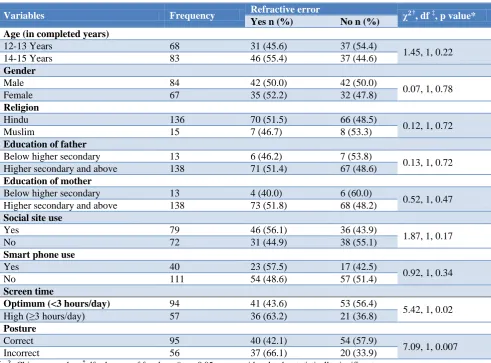
Table 2: Association of various factors and refractive error (n=151).
Variables Frequency Refractive error †, df ‡, p value*
Yes n (%) No n (%) Age (in completed years)
12-13 Years 68 31 (45.6) 37 (54.4)
1.45, 1, 0.22
14-15 Years 83 46 (55.4) 37 (44.6)
Gender
Male 84 42 (50.0) 42 (50.0)
0.07, 1, 0.78
Female 67 35 (52.2) 32 (47.8)
Religion
Hindu 136 70 (51.5) 66 (48.5)
0.12, 1, 0.72
Muslim 15 7 (46.7) 8 (53.3)
Education of father
Below higher secondary 13 6 (46.2) 7 (53.8)
0.13, 1, 0.72
Higher secondary and above 138 71 (51.4) 67 (48.6)
Education of mother
Below higher secondary 13 4 (40.0) 6 (60.0)
0.52, 1, 0.47
Higher secondary and above 138 73 (51.8) 68 (48.2)
Social site use
Yes 79 46 (56.1) 36 (43.9)
1.87, 1, 0.17
No 72 31 (44.9) 38 (55.1)
Smart phone use
Yes 40 23 (57.5) 17 (42.5)
0.92, 1, 0.34
No 111 54 (48.6) 57 (51.4)
Screen time
Optimum (<3 hours/day) 94 41 (43.6) 53 (56.4)
5.42, 1, 0.02
High (≥3 hours/day) 57 36 (63.2) 21 (36.8)
Posture
Correct 95 40 (42.1) 54 (57.9)
7.09, 1, 0.007
Incorrect 56 37 (66.1) 20 (33.9)
†
- Chi-square value; ‡df - degrees of freedom; * p < 0.05 was considered to be statistically significant.
43, 28%
34, 23% 74, 49%
Newly diagnosed refractive error
Under-corrected refractive error
From Table 2, it was seen that high screen time (≥3 hours/day) and incorrect posture were significantly associated with presence of refractive error among the school students.
DISCUSSION
Our study found that 51.0% of the school students had refractive error. Of them, 28.5% were newly diagnosed while 22.5% were under-corrected previously. This is much higher than studies conducted in rural Bangalore (10.5%), Goa (18.0%),Mangalore (14.2%) and Shimla (31.6%).3,7-9 In another study on ocular morbidity and its associates among Madrasah students of Kolkata, the overall prevalence of ocular morbidity was 12.67% with refractive error being the commonest (9.40%).10 These differences may be attributed to the difference in sample size, wider age groups covered and setting of these studies as compared with our study. Also, the variation in prevalence of refractive can arise due to differences in the lifestyle of the school children between the urban and rural populations.
The most commonly reported ocular complaints were difficulty in seeing (43.7%) followed by headache (36.4%) and pain in eyes (35.1%). This was slightly higher than that reported by other studies in South India.8,11
Tests of association revealed that high screen time (≥3 hours/day) and incorrect posture were significantly associated with presence of refractive error. There is evidence that extensive viewing of the computer or TV or cell phone screen can lead to eye strain.12 Poor lighting and glare may accelerate the situation.
As refractive error ensues, children try to adjust to the poor vision by holding books close to the eyes and bending over the study table and going closer to the television or computer screen and blackboard. This aggravates the situation as additional eye strain and frequent rubbing of eyes to improve vision lead to other ocular infections and increase in the magnitude of error at a faster pace. This was also reflected in our study where refractive errors were significantly more in students with improper posture which is similar to the findings of another study by Matta et al in which posture of 61.2% adolescents was found to be incorrect.13
CONCLUSION
Refractive error among children is a common problem. This being a preventable and correctable cause of visual impairment demands early detection and prompt treatment. Early diagnosis of refractive errors through screening for vision at the time of school admission and periodic eye screening of the students is essential to provide early correction of impaired vision. Training of school teachers to conduct eye screening programmes
and educating the students about ocular hygiene and early symptoms of refractive error would help early detection and prevention of long term visual disability at large.
ACKNOWLEDGEMENTS
We acknowledge the Principal, Sri Ramakrishna Aashrama Institute, Harinavi for giving us permission to conduct the research work. We also acknowledge the students of the same institute and their parents for co-operating with us during data collection.
Funding: No funding sources Conflict of interest: None declared
Ethical approval: The study was approved by the
Institutional Ethics Committee of All India Institute of
Hygiene and Public Health, Kolkata
REFERENCES
1. Park K. Epidemiology of chronic
non-communicable diseases and conditions. In: Park’s Textbook of Preventive and Social Medicine. 24th ed. Jabalpur: Bhanot Publishers; 2017: 420.
2. Govt. of India, Annual Report 2011-2012, Ministry
of Health and Family Welfare, New Delhi, 2012.
3. Gupta M, Gupta BP, Chauhan A, Bhardwaj A.
Ocular morbidity prevalence among school children in Shimla, Himachal, North India. Indian J Ophthalmol. 2009;57(2):133-8.
4. Deshpande JD, Malathi K. Prevalence of ocular morbidities among school children in rural area of north Maharashtra in India. National J Community Med. 2011;2: 249-54.
5. Dey AK, Nath AB. Prevalence of ocular morbidities
among school children in a rural block of Cachar,
Assam. J Evolution Med Dent Sci.
2017;6(55):4124-7.
6. National Programme for Control of Blindness in India. Ministry of Health and Family Welfare, New Delhi; 2004.
7. Vidusha KSS, Damayanthi MN. Prevalence of
refractive errors among school children in the rural field practice area of a tertiary care hospital, Bengaluru. Int J Community Med Public Health. 2018;5:1471-6.
8. Cacodcar JA, Bicholkar AU, Wagle N, Oliveira A. Ocular morbidity and its relation to classroom
lighting among middle-school students of
government high schools in Goa. Int J Community Med Public Health. 2018;5:161-4.
9. Vidya R, Kiran KG. Prevalence of ocular
morbidities of children in higher primary schools in rural areas of Mangalore. Int J Community Med Public Health. 2017;4:2859-63.
11. Joseph N, Maria N, Rekha T.P., Mallikarjuna M, Rai S, Kotain M. Proportion of Refractive Error and its associated factors among High School Students in South India. Br J Med Med Res. 2016;11:1-9. 12. Kozeis N. Impact of computer use on children’s
vision. Hippokratia. 2009;13(4):230-1.
13. Matta S, Matta P, Gupta V, Dev A. Refractive errors among adolescents attending Ophthalmic OPD. Ind Joun Comm Med. 2006-04-2005-06;31(2):21.
Cite this article as: Mohanta M, Dasgupta A, Pan T,
Paul B, Bandyopadhyay L, Mandal S.An
epidemiological study on ocular morbidities among school students in an urban area of South 24