Asian J. Med. Biol. Res. 2016, 2 (2), 177-182; doi: 10.3329/ajmbr.v2i2.29008
Asian Journal of
Medical and Biological Research
ISSN 2411-4472 (Print) 2412-5571 (Online)www.ebupress.com/journal/ajmbr
Article
Molecular detection of cattle and buffalo species meat origin using mitochondrial
cytochrome b (
Cyt b
) gene
Sirazum Munira, Fatema Tuz Jahura, Md. Munir Hossain and Mohammad Shamsul Alam Bhuiyan*
Department of Animal Breeding and Genetics, Bangladesh Agricultural University, Mymensingh-2202, Bangladesh
*Corresponding author: Professor Dr. Mohammad Shamsul Alam Bhuiyan, Department of Animal Breeding and Genetics, Bangladesh Agricultural University, Mymensingh-2202, Bangladesh. Tel.: +88 01745748849; Fax: +88-091-61510; E-mail: [email protected]
Received: 17 May 2016/Accepted: 02 June 2016/ Published: 30 June 2016
Abstract: The study was conducted to adopt PCR based technique for identification of species origin from meat
samples of cattle and buffalo using mitochondrial cytochrome b (Cyt b) gene fragment. A total of 42 ear tissue and meat samples were collected from different slaughterhouses and farms of Mymensingh, Bogra and Rangpur districts and stored in 96% ethanol at room temperature. Genomic DNA was extracted from all samples using GeNet Bio genomic DNA isolation kit. The average DNA yield of considered samples was found 204.57 ng/µl where the purity ranged from 1.82–1.99. Two (2) pair species-specific primers were used to amplify Cyt b gene fragments of 472 bp and 124 bp for cattle and buffalo, respectively. The PCR results revealed different species specific amplified fragments which could discriminate between cattle (472 bp) and buffalo (124 bp) species precisely from pure and mixed samples of those species. This study suggests an accurate molecular technique for identification of cattle and buffalo species meat origin and differentiates species present in adulterated meat samples. In conclusion, this DNA based technique could be utilized for prevention of malpractice in slaughterhouse and chain shops and thereby to protect consumer’s right.
Keywords: beef; buffalo meat; genomic DNA; mitochondrial Cyt b gene; PCR
1. Introduction
Adulteration of food products has become a considerable problem in many countries as well as in Bangladesh by the fraudulent incorporation. Adulteration of meat may take the form of substitution of one cheaper meat with a costly expected species (Yman and Emanuelsson, 1998), for example buffalo meat (buffen) mixed with beef, which is a very old and common practice in Bangladesh. Beef is the most popular red meat in the world preferred for its taste, flavor and texture. Therefore, it is most expensive meat and consumers are ready to pay more prices for its delicacy. Whereas buffalo meat is relatively coarse and less popular compare to beef. Currently, there are about 1.46 million buffalo in Bangladesh (BER, 2015). Although a considerable number of buffalo population is available in Bangladesh and transportation of these species to the metropolitan cities is a common scenario of our country, but it is hard to find butcher shop or slaughterhouse in the market who sells buffalo meat and we found beef only. Under this circumstance, identifying the species origin of meat became a burning issue these days in Bangladesh.
Different DNA-based techniques used for animal species identification which include DNA hybridization of meat samples (Lenstra et al., 2001), PCR and its variants (Matsunaga et al., 1999a and b), PCR-RFLP (Girish et al., 2005), polymerase chain reaction-single strand conformation polymorphism (PCR-SSCP) (Weder et al.,
2001) and PCR-sequencing (Bartlett and Davidson, 1992). The high copy number and sequence diversity favor the utilization of mitochondrial genes over nuclear genes for species identification purposes (Kocher et al.,
2003), the 12S and 16S rRNA (Fajardo et al., 2006), and the displacement loop (D-loop) (Lopez et al., 1996) have been targeted for species identification. Since last two decades, mitochondrial Cyt b gene sequence analysis has been using for identifying animal species origin of closely related taxa (Satish et al., 2009; Zarringhabaie et al., 2011; Farag et al., 2015) and has been widely used for authentication of meat species in all kind of fresh and precooked products and the method is simple, cheap, efficient and highly specific (Zarringhabaie et al., 2011).
In Bangladesh, adulteration in food and food products has reached maximum height during the recent years where meat industry not untouched. PCR based techniques which have been widely used in developed worlds even in the neighboring countries to trace adulteration in slaughterhouse and supermarkets but molecular technique based detection is totally absent in Bangladesh. Moreover, so far we know, there is no published scientific report on authentication of meat animal species origin in Bangladesh using PCR based approach. Therefore, the present study was carried out to adopt PCR based technique in detection of cattle and buffalo species and to develop DNA based molecular marker from Cyt b gene fragment for identification of meat origin and detection of adulteration in mixed samples.
2. Materials and Methods
2.1. Sample collection and processing
A total of 42 ear tissue and meat samples of cattle and buffaloes were collected from different slaughterhouses of Bogra, Rangpur and Mymensingh District of Bangladesh. Collected samples were stored in 96% ethanol at room temperature. The samples of ear tissues for each species were separately prepared by cleaning of all hair roots and crushed with surgical blade and forceps. The tissue was cleaned off extraneous fat, connective tissue and blood vessels.
2.2. DNA extraction and quantification
Genomic DNA was extracted from all samples using GeNet Bio genomic DNA isolation kit (GeNet Bio, South Korea) according to the manufacturer’s instructions. Extracted DNA was stored at -200C with appropriate labeling for further use. Concentration and purity of the extracted DNA was assessed by agarose gel electrophoresis and using NanoDrop spectrophotometer (Model ND2000).
2.3. Polymerase chain reaction (PCR)
The primer sequence information was selected from a published paper by Zarringhabaie et al. (2011) which is shown in Table 1. The Cyt b gene sequence information of indigenous cattle (472 bp) and buffalo (124 bp) were retrieved from NCBI gene bank data base having of accession number (Bubalus bubalis, AB529514.1 and Bos taurus, EF693798.1) and were aligned by CLUSTALW software (EMBL lab) to check the suitability of primers in indigenous cattle and buffalo species of Bangladesh.
PCR amplification was carried out in 20 µl reaction volume comprising 2 µl and 3 µl of genomic DNA in conventional and duplex PCR, respectively. The concentration of PCR ingredients in master mix contained 1x buffer (GeNet Bio Inc., South Korea), 1.5 mM MgCl2, 0.2 mM dNTP (GeNet Bio Inc., South Korea), 1.0 µM of
each primer (Integrated DNA Technologies, South Korea), and 0.3 U Taq DNA polymerase (GeNet Bio Inc., South Korea) for each reaction. For duplex PCR, master mix contained 1x buffer, 1.5 mM MgCl2, 0.3 mM
dNTP, 1.5 µM of each primer and 0.5 U Taq DNA polymerase used for each reaction. The gene amplification by duplex PCR was tested on DNA samples from each species as well as equally mixed DNA samples of two species. The thermal profile was comprised of initial denaturation for 10 min at 94°C, followed by 35 cycles of denaturation at 94°C for 30 s, annealing at 62°C for 60 s and extension at 72°C for 45 s, a final extension at 72°C for 10 min and holding temperature at 12°C for an indefinite time. The PCR products were visualized by 2.0% agarose gel electrophoresis in 0.5x TBE buffer at 120 V for 30 minutes, which stained with 5 μl (10 μg/μl) of ethidium bromide (Bio NEER, South Korea) and images of gel were captured by UVsolo TS imaging system (Biometra, Germany).
3. Results and Discussion 3.1. DNA yield and purity
the purity of buffalo DNA samples were 1.84–1.99. Ali et al. (2012) reported the average purity of DNA samples, using A260/A280 optical density, were 1.82–1.99 which is exactly similar to the current study. A ratio of ~1.8 is generally accepted as “pure” for DNA as “rules of thumb” where extracted protein and DNA absorb maximum light at 260 and 280 wavelengths, respectively. Mahajan et al. (2011) reported the DNA concentration ranged between 200–2600 μg/ml with the purity of 1.6 to 1.9 of cattle and buffalo meat using the method described by Cronin et al. (1991).It was reported that DNA extraction methodology must be resulted in DNA purities and concentrations between 1.6-2.0 and 25-1000 ng/μl, respectively (Di Pinto et al., 2005). Farag
et al. (2015) found the average yield of DNA of 90.77 ng/µl and the purity was 1.8 in average, from buffalo blood samples. These results also support the present findings. In general, the concentration of extracted DNA was relatively low from meat samples which indicated that the processing of meat tissues were not perfectly done and 20 µl Proteinase K is not sufficient for complete tissue lysis. Shahriar et al. (2011) also stated the same problem while using proteinase K for DNA extraction. The yield of extracted DNA also varies greatly on sample source, personal skills and DNA extraction methods. However, the amount of extracted DNA would be sufficient for PCR amplification and standardization of all samples were performed before going further amplification process.
3.2. Cyt b gene fragment amplification by conventional and duplex PCR for detection of species origin
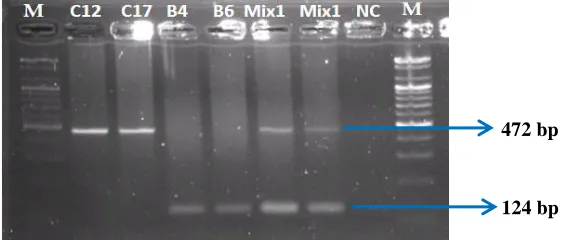
In recent years, many investigators applied various molecular methods including PCR amplification (Tanabe et al., 2007) to identify species in meat and adulteration in meat and meat products. In this study, the specificity of the primer sets selected was performed initially in a conventional (single) PCR reaction using two species-specific primer sets. Having confirmed species species-specificity of each primer independently, a duplex PCR was standardized by mixing two primer sets in a single reaction targeting DNA of two different species for detection of species meat origin using mitochondrial Cyt b gene fragments. The results of conventional PCR revealed different expected specific amplified PCR products sizes of 124 and 472 bp for Cyt b gene of buffalo and cattle species respectively (Figure 1). The duplex PCR was tested on DNA samples from each species as well as DNA mixture of the mixed two species and the results showed expected different specific amplified PCR products sizes of 124 and 472 bp for Cyt b gene of buffalo and cattle species, respectively (Figure 2) for pure and mixed samples of those species. The result of this study also shows that selected primers are highly conserved across the breed/population within a species and equally worked well in duplex manner using samples of indigenous cattle and buffalo. In duplex PCR two different fragments were observed in case of mixed sample which is exactly similar with conventional PCR amplicon. This method was sensitive and it was possible to trace each species meat when its portion in the mixture was less than 10% (Zarringhabaie et al., 2011). The responsive size for each animal species from either tissue or meat was detected in this study to correspond to each animal species without cross-contamination. The identification of animal species from inter-species DNA mixed from tissue and meat in duplex PCR approach was adopted and performed efficiently. The result indicated that DNAs from all species were specifically detected (Figure 2).
Table 1. List of primers used for conventional and duplex PCR.
Species Type Primer sequence (5'-3') Reference
Cattle Forward TCCTTCCATTTATCATCATAGCAA
Zarringhabaie et al.
(2011)
Reverse TGTCCTCCAATTCATGTGAGTGT
Buffalo Forward TCCTCATTCTCATGCCCCTG
Reverse TGTCCTCCAATTCATGTGAGTGT
Table 2. Summary of concentration and purity of extracted DNA.
Species Type of sample DNA concentration (ng/µl) Purity of extracted DNA
Min Max Average Min Max Average
Total sample 18.2 913.6 204.57 1.82 1.99 1.87
Cattle Ear tissue 69.0 596.1 208.73 1.82 1.89 1.86
Meat sample 61.6 118.0 97.08 1.89 1.94 1.92
Buffalo Ear tissue 116 913.6 272.86 1.84 1.92 1.87
Meat sample 18.2 69.4 36.2 1.85 1.99 1.92
Legends: ng= nanogram; µl= microliter.
Figure 1. PCR products shown in 2.0% agarose gel. This figure represents, M= 100 bp DNA size marker, C5~C8 represent cattle samples and B10~B13=represent buffalo samples, NC=Negative control.
Figure 2. Duplex PCR products shown in 2.0% agarose gel. This figure represents, M= 100 bp DNA size marker, C12~C17=represent cattle samples and B4~B6=represent buffalo samples, Mix=Mixture of sample of cattle and buffalo with equal proportion, NC=negative control.
Buffalo, cattle, goat and sheep species also detected on mitochondrial Cyt b based on PCR-RFLP methods using restriction enzymes AluI and HaeIII for cleavage of amplified products resulting 2 fragments for buffalo and cattle species and 3 fragments for the species of sheep and goat (Ahmed et al., 2005). Notably, the advantage of the present molecular methods is that there is no need to use restriction enzymes and RFLP methods to distinguish specific electrophoresis fragment on agarose gel. The optimized duplex PCR protocol enabled to discriminate meat species between cattle and buffalo. This protocol would be enough to detect adulteration in pure and mixed meat of those species. Moreover, the sensitivity, high specificity and reliability of the duplex PCR assay suggested this method could be a feasible and ideal for rapid analysis on industrial meat and meat products or in foodstuff.
124 bp 472 bp
472 bp
4. Conclusions
Mitochondrial Cyt b gene could be used as excellent molecular marker for detecting species origin of meat as the conventional and duplex PCR revealed expected different specific amplified PCR products, sizes of 124 and 472 bp for Cyt b gene of buffalo and cattle species respectively, for pure and mixed sample of those species. This adopted highly specific and reliable technique has commercial impact that could be utilized as a laboratory tool for detecting species origin of meat and control fraudulent practices in slaughterhouse and chain shop.
Acknowledgements
The authors are grateful to University Grants Commission (UGC), Bangladesh, for the financial support and Department of Animal Breeding and Genetics and Department of Microbiology and Hygiene, Bangladesh Agricultural University, Mymensingh-2202, for providing research facilities.
Conflict of interest
None to declare.
References
Ahmed M and EA Mezawy, 2005. Detection of species-specific genetic markers in farm animals by RFLP analysis of cytochrome b gene. Biotechnol. in Anim. Hus., 21: 1-11
Ali ME, M Kashif, K Uddin, U Hashim, S Mustafa and YBC Man, 2012. Species Authentication Methods in Foods and Feeds: the Present, Past and Future of Halal Forensics. Food Anal. Met., 5: 935–955.
Bangladesh Economic Review, 2015. Finance Division, Ministry of Finance Government of the People’s Republic of Bangladesh. P: 93.
Bartlett SE and WS Davidson, 1992. FINS (forensically informative nucleotide sequencing): a procedure for identifying the animal origin of biological specimens. Biotechnol., 12: 408-411.
Cronin MA, DA Palmisciano, ER Vyse and DG Cameron, 1991. Mitochondrial DNA in Wildlife Forensic Science; Species Identification of tissues. Wildl. Soc. Bullet., 19: 94–105.
Di Pinto A, VT Fort, MC Conversano and GM Tantillo, 2005. Duplex polymerage chain reaction for detection of meat in horse meat fresh sausages from Italian retail source. Food control, 16: 391-394.
Fajardo V, I Gonzalez, IL Calleja, I Martin, PE Hernandex, T Garcia and R Martın, 2006. PCR-RFLP authentication of meats from Red Deer (Cervus elaphus), Fallow Deer (Dama dama), Roe Deer (Capreolus capreolus), cattle (Bos taurus), sheep (Ovis aries), and goat (Capra hircus). J. of Agric. and Food Chem., 54: 1144-1150.
Farag MR, TS Imam and K Dhama, 2015. Identification of some Domestic Animal Species (Camel, Buffalo and Sheep) by PCR-RFLP Analysis of the Mitochondrial Cytochrome b Gene. Adv. Anim. Vet. Sci., 3: 136-142. Girish PS, ASR Anjaneyulu, KN Viswas, BM Shivakumar, M Anand, M Patel and B Sharma, 2005. Meat
species identification by polymerase chain reaction-restriction fragment length polymorphism (PCR-RFLP) of mitochondrial 12S rRNA. Gene Sci., 70: 107–112.
Gupta R, DN Rank and CG Joshi, 2012. Identification and differentiation of cattle and buffalo processed meat by duplex-PCR. Buffalo Bulletin, 31: 6-11.
Jain S, MN Brahmbhait, DN Rank, CG Joshi and JV Solank, 2007. Use of cytochrome b gene variability in detecting meat species by multiplex PCR assay. Indian J. of Anim. Sci., 77: 880-881.
Kocher TD, WK Thomas, A Meyer, SV Edwards, S Paabo, FX Villablanca and AC Wilson, 1989. Dynamics of mitochondrial DNA evolution in animals: amplification and sequencing with conserved primers. Proc. Natl. Acad. Sci. USA., 86: 6196-200.
Lenstra JA, JB Buntjer and FW Janssen, 2001. On the origin of meat-DNA techniques for species identification in meat products. Vet. Sci. Tomorrow,1-15.
Lopez JV, S Cervarlo and S Brien, 1996. Complete nucleotide sequence of domestic cat (Felis catus) mitochondrial genome and a transposed mtDNA tandem repeat (NUMT) in the nuclear genome. Genomics, 33: 229- 246.
Mahajan M. V, YP Gadekar, VD Dighe, RD Kokane and AS Bannalikar, 2011. Molecular detection of meat animal species targeting MT 12S rRNA gene. Meat Sci., 88: 23–27.
Matsunaga T, K Chikuni, R Tanabe, S Muroya, K Shibata, J Yamada and Y Shinmura1999a. A quick and simple method for the identification of meat species and meat products by PCR assay. Meat Sci., 51: 143- 148.
Randi E, V Lucchini, A Hennache, RT Kimball, EL Braun and JD Ligon, 2001. Evolution of the mitochondrial DNA control-region and cytochrome b genes, and the inference of phylogenetic relationships in the avian genus Lophura (Galliformes). Mol. Phylo. Evol., 19: 187–201.
Satish, A Kumar, Y Singh, Minakshi and G Prasad, 2009. Cytochrome- b gene based PCR for identification and differentiation of cooked meat of sheep, goat, cattle, pig and poultry. Haryana Vet., 48: 53-57.
Sebastio P, P Zanelli and TM Neri 2001. Identification of anchovy (Engraulis encrasicholus L.) and gilt sardine (Sardinella aurita) by polymerase chain reaction, sequence of their mitochondrial cytochrome b gene, and restriction analysis of polymerase chain reaction products in semipreserves. J. Agric. Food Chem., 49: 1194-1199.
Shahriar M, MR Haque, S Kabir, I Dewan and MA Bhuyian, 2011. Effect of Proteinase-K on Genomic DNA Extraction from Gram-positive Strains. Stamf. J. of Pharma. Sci., 4: 53-57.
Tanabe E, A Miyauchi, K Muneshige, MC Sato and M Sato, 2007. PCR method of detecting pork in foods for verifying allergen labeling and for identifying hidden pork ingredients in processed foods. Biosci. Biotechnol. Biochem., 71: 1663-1667.
Verma SK and L Singh, 2003. Novel universal primers establish identity of enormous number of animal species for forensic application. Mol. Ecol. Notes., 3: 28-31.
Weder JK, H Rehbein and J Kaiser, 2001. On the specificity of tuna directed primers in PCR-SSCP analysis of fish and meat. Eur. Food Res. Technol., 213: 139-144.
Yman IM and R Emanuelsson, 1998. New technology for faster disclosure of meat adulteration. Var Fada (in Swedish), 3: 6-7.