Original Research Article
Management of patients with obstructive lung disease in South
India: a retrospective study of spirometry and bronchodilator
use in an urban health centre
Niger David
1, Sajitha M. F. Rahman
2*, Ruby Angeline Pricilla
3,
Sunil Abraham
2, Kirubah V. David
2INTRODUCTION
Burden and risk factors of obstructive lung disease in India
According to World Health Organization (WHO), chronic obstructive pulmonary disease (COPD) is an
under-diagnosed life-threatening lung disease that interferes with normal breathing and is not fully reversible.1 Based on the burden of obstructive lung diseases (BOLD) program, the number of individuals with COPD was 384 million in 2010 with a global prevalence of 11.7% and three million deaths annually.2 Around 90% of these deaths occur in low- and
middle-ABSTRACT
Background: Based on the burden of obstructive lung diseases program (BOLD), the global prevalence of chronic obstructive pulmonary disease (COPD) was 11.7% in which 90% of the deaths occur in low- and middle-income countries. India and China are estimated to account for 66% of total global COPD mortality. The Indian Chest Society (ICS) recommends spirometry to document irreversible airflow limitation in patients suspected of having COPD. However, the reported usage of spirometry among primary care physicians in India is only 10-20% as primary health care centers in India are not equipped with spirometry or inhaler devices.
Methods: A retrospective study was done on patients treated for respiratory symptoms with bronchodilators at an urban health centre to document the practice pattern of primary care physicians with regards to use of spirometry in patients on bronchodilators.
Results: Of the 1196 patients on bronchodilators, spirometry was documented in 15.5%. Patients on inhalers, using more than one therapy and males less than 55 years were more likely to undergo spirometry. About 52.4% of patients who underwent spirometry were found to have post bronchodilator forced expiratory volume at first second (FEV1)/ forced vital capacity (FVC) less than 0.7 of which 43% had severe disease and 44% had poor post-broncho-dilator reversibility.
Conclusions: Besides diagnostic spirometry, management guidelines for COPD should be complemented by health education to change patients’ perception of respiratory symptoms, increase awareness of COPD in those with risk factors and change their health seeking behaviour along with continuous professional development activities for primary care physicians.
Keywords: Spirometry, Primary care, Secondary care, Urban health centre
1
Low Cost-Effective Care Unit, 2Department of Family Medicine, 3Department of Community Medicine, Christian Medical College, Vellore, Tamil Nadu, India
Received: 23 April 2019
Revised: 05 June 2019
Accepted: 07 June 2019
*Correspondence:
Dr. Sajitha M. F. Rahman, E-mail: [email protected]
Copyright: © the author(s), publisher and licensee Medip Academy. This is an open-access article distributed under the terms of the Creative Commons Attribution Non-Commercial License, which permits unrestricted non-commercial use, distribution, and reproduction in any medium, provided the original work is properly cited.
income countries with India and China estimated to account for 66% of total global COPD mortality.3 The number is expected to rise with the increasing prevalence of smoking in developing countries that may result in 4.5 million deaths annually by 2030. An estimated prevalence of more than 57, 000, 000 people were living with obstructive airway disease in India by the end of 2016. The estimated economic burden of COPD in India is around eight billion dollars in 2016.4
The most significant risk factor for COPD is smoking. In India, 70% smokers smoke “beedis” which has five times more tar than cigarettes making it a far greater risk factor for COPD. Further, the use of biomass fuel for domestic purposes, increased prevalence of child hood respiratory
infections, post-pulmonary tuberculosis, poorly
controlled asthma, poor socioeconomic status and geriatric population significantly contribute towards the increase in prevalence of COPD in India.4,5 According to the recommendations of Indian Chest Society (ICS) 2014, patients suspected of having COPD should undergo spirometry to document irreversible airflow limitation. This raises a challenge in health care systems where spirometry is not available. In such situations, the guidelines mention referral to a centre with provisions for spirometry.6
Management of respiratory symptoms in primary health care system in India
A nationwide study on the morbidity profile of patients in India found respiratory symptoms as the most common cause of a visit to a physician and obstructive lung disease as the second most common diagnosis by primary care physicians.7 About 44% of primary care physicians are reported to have diagnosed COPD clinically among smokers in late stages due to inadequate knowledge and training about diagnosis of COPD. Major barriers identified by primary care physicians include difficulty in communicating the diagnosis to patients, inadequate access to spirometry and patients’ resistance to perform spirometry and use of inhalers.8
Spirometry and bronchodilators in primary health care system in India
India has a complex system of tax-financed public health care system that provide health care services to all citizens and private health care system covered by out-of-pocket payments. The public health care system is a three-tier structure with subcenters, primary health care centers and community health centers providing primary health care services in rural areas. Community health centers are the first referral units followed by district hospitals and medical schools. The private health care system has trained physicians and untrained health care workers working in solo practices to small nursing homes and multispecialty clinics and hospitals.9 Primary health care centers are not equipped with spirometry or inhaler devices for appropriate management of obstructive lung diseases. People living in rural areas seek treatment from practitioners of alternative systems of medicine who do
not identify the disease or initiate preventive interventions like smoking cessation.4
Spirometry provides an objective measurement of the severity of airflow obstruction. The international guideline for spirometry use in primary care recommends spirometry for patients presenting with undiagnosed respiratory symptoms like dyspnoea, wheeze, and cough”.10
However, the reported usage of spirometry among primary care physicians in India is only 10-20%.11 Multiple causes reported to preclude the widespread use of spirometry by primary care physicians in India include lack of training in performing and interpreting spirometry results, unavailability of facilities to perform spirometry, unreliability of private diagnostic laboratories and costs associated with doing spirometry.
Patients with one or more respiratory symptoms are initially treated by primary care practitioners. They continue to self-medicate with over the counter prescriptions of bronchodilators and steroids.9 While some of these patients may not have obstructive lung disease, many patients with obstructive lung disease do not receive bronchodilators. This delays early diagnosis and treatment of COPD and favours unnecessary use of over the counter bronchodilators that is expensive with deleterious effects to patients. Inhaled steroids widely used for treatment of COPD in India is not beneficial to all patients with COPD. While earlier studies in India have reported on spirometry testing in patients with symptoms suggestive of obstructive lung disease, there is sparse literature on the use of diagnostic spirometry among patients using bronchodilators in primary care. This study was planned to document the practice of primary care physicians in an urban health centre with
regards to use of spirometry in patients on
bronchodilators.
Objectives
To document the use and results of diagnostic spirometry in patients on long-term bronchodilators during a one-year period in an urban health centre in South India
To determine the most common type of
bronchodilator used in the urban health centre and the extent of use of metered dose inhalers (MDI)
To determine the association between age, gender, the use of MDI and the number of therapies initiated with the use of spirometry in the urban health centre
To determine the association between the use of MDI and the use of antibiotics, systemic steroids and hospitalizations in the urban health centre.
METHODS
Setting and design
The study was designed as a retrospective study on
patients treated for respiratory symptoms with
included adults >18 years of age who received bronchodilators between the period 1 July 2015 to 30 June 2016.
The health care system at the urban health centre
The study was conducted at the urban health centre called low cost effective care unit, a community-based secondary level care hospital of Christian Medical College in Tamil Nadu, South India. The health centre provides primary and secondary level health care services to the underserved urban population of 200,000. It is managed by a team of family physicians, community medicine physicians, junior medical officers, post-graduate trainees in family medicine, community medicine and interns.
During the study period at the health centre, patients were clinically diagnosed to have COPD based on respiratory symptoms, exposure to tobacco smoke, domestic fuel and chest radiograph. Spirometry is not available at the urban health centre. Physicians at the health centre referred patients to the tertiary care centre for diagnostic spirometry to confirm the clinical diagnosis and to document the need for inhalers which are expensive. It is done and interpreted by trained respiratory therapists at the pulmonary laboratory of the tertiary care unit and the results are uploaded in the hospital information system.
Spirometry data used were postbronchodilator forced expiratory volume at first second (FEV1)/ forced vital capacity (FVC), pre-bronchodilator value of FEV1 and the change in pre and post-bronchodilator value of FEV1. FEV1/FVC <0.7 was considered to be diagnostic of obstructive lung disease and pre-bronchodilator FEV1 >80% was considered as mild, 50-79 as moderate, 30-49 as severe and <30 as very severe obstruction. Pre and post-bronchodilator FEV1 variability of 12% was considered to be diagnostic of bronchial asthma.13
The bronchodilators available in the urban health center include oral beta-agonists, steroids, dry powder inhalers (DPI) in the form of rota- caps and metered dose inhalers (MDI). The types of MDIs are long-acting anti-muscarinic agents (LAMA), short-acting beta agonists (SABA) and a combination of long-acting beta agonists (LABA) and inhaled corticosteroids (ICS). The preferred antibiotics for secondary infections are beta-lactam drugs,
macrolides and 3rd generation cephalosporins.
Prednisolone is the oral steroid and hydrocortisone is the parenteral steroid commonly used.
Data source and management
Hospital information system at the health centre
Patients registered to the health centre receive a unique identification number that links all their data on name, gender, age, residential address, investigations and prescriptions. The prescription record in the hospital
information system includes the type of drug and the date dispensed. A different colour code is used for drugs dispensed during hospitalization.
Details of patients who received bronchodilators and the results of the spirometry during the study period were extracted from the hospital information system. Repeat redemption of bronchodilators was defined as the redemption of more than one prescription of the same bronchodilator beyond 30-day interval within the one-year period. Redemption of antibiotics, steroids and number of hospitalizations were also extracted. All data were entered in excel file and exported to SPSS.
Sampling procedure
The hospital information system was used to identify all adults >18 years who were dispensed bronchodilators during the study period.
Statistical analysis
All statistical analysis was calculated using SPSS version 23. Descriptive frequencies were used for patient demographics, types of bronchodilators, frequency of
redemptions, use of steroids, antibiotics and
hospitalizations. Spirometry results, the type and the severity of obstruction and the use of inhalers in patients with the spirometry diagnosis of obstructive lung disease was derived. Spirometry use in relation to age, gender, use of inhalers and number of therapies was calculated. Chi-square test was used to find the association between the above variables and use of spirometry and the association between use of inhalers and the use of steroids, antibiotics and hospitalizations. P value < 0.05 was considered as statistically significant.
Ethics
The study was discussed with the institutional review board and as it was based on data from the hospital information system without involving patients or the review of charts, the study was deemed as exempt.
RESULTS
months. The remaining 27 (24.3%) patients were on MDI prior to spirometry with the mean (SD) number of months of MDI use before spirometry being 17.7 (15.7) with range of 1-57 months.
Table 1: Likelihood of spirometry testing with age / sex / MDI use / no. of therapies initiated.
Variables
Spirometry
X2 P value
Yes No
N (%) N (%) Age in years
≤54 104 (16.6) 522 (83.4)
1.3 0.5
>54 81 (14.2) 489 (85.8)
Sex
Male 81 (18.7) 353 (81.3)
12.7 0.002
Female 104 (13.6) 658 (86.4)
MDI use
Yes 111 (46.7) 127 (53.3)
221.8 <0.001
No 74 (7.7) 884 (92.3)
No. of therapies Initiated
=1 63 (7.2) 815 (92.8)
173.7 <0.001
>1 112 (38.4) 196 (61.6)
Table 2: Distribution of treatments given.
Treatment options Number
N (%) Oral bronchodilators 1184 (99.0)
Rota halers 79 (6.6)
MDI 238 (19.9)
Steroids + LABA 62 (26.2)
Steroids + LABA + SABA 60 (25.2)
Steroids + LABA + LAMA 44 (18.5)
Steroids + LABA + LAMA + SABA 37 (15.5)
SABA 17 (7.1)
LAMA 12 (5.0)
SABA + LAMA 6 (2.5)
Table 3: Diagnosis based on spirometry and MDI use among the diagnosed.
Diagnosis
MDI Use
Yes No Total
N (%) N (%) N (%) Bronchial
Asthma 38 (71.7) 15 (38.3) 53 (28.6) COPD 49 (71.0) 20 (29.0) 69 (37.3)
Restrictive
lung disease 12 (32.4) 25 (67.6) 37 (20.0) Inconclusive 6 (35.3) 11 (64.7) 17 (9.2)
Normal 1 (11.1) 8 (88.9) 9 (4.9)
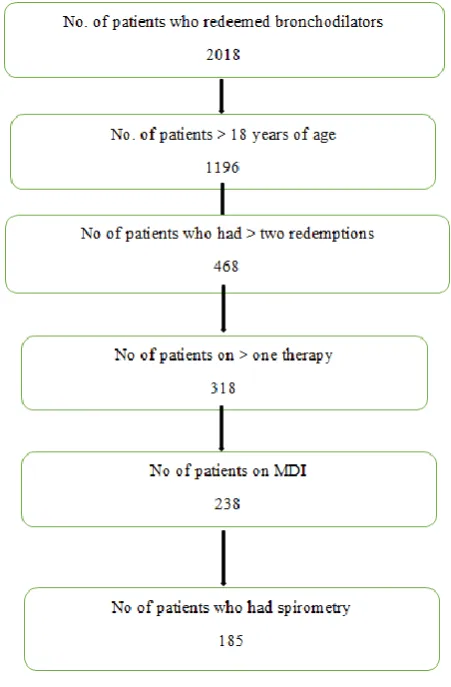
Around 400 patients redeemed bronchodilators more than twice, 318 patients were on more than one type of bronchodilator and 238 of the study population were on inhalers (Figure 1). The most common age group of the
study population was 46–60 years and the most common age group who had spirometry was 31–45 years (Figure 2). There was no significant association between spirometry and age group.
Figure 1: Patients on bronchodilators who underwent spirometry.
Figure 2: Age distribution of the study population.
About 19% of the study population was on inhalers while oral bronchodilators were used by 99% of them. The most common type of inhaler used was the combination of LABA and steroid (26.2%) (Table 2). The most common diagnosis based on spirometry was chronic obstructive pulmonary disease (37.3%). Among patients
112
281
399
344
60
0 100 200 300 400 500
15-30 31-45 46-60 61-75 > 75
with the diagnosis of obstructive lung disease, 71% of them were on inhalers (Table 3). Patients who had more antibiotic redemptions, systemic steroid use and
hospitalizations were more likely to be on inhalers in a significant way (Table 4).
Table 4: Association between use of MDI and antibiotics, systemic steroids and hospitalization.
Variables
MDI Use
X2 P value
Yes No
N (%) N (%)
No. of antibiotic redemptions
Nil 89 (14.7) 517 (85.3)
20.9 <0.01
≥ 1 149 (25.3) 441 (74.7)
No. of systemic steriod use
Nil 139 (13.8) 868 (86.2)
148.6 <0.001
≥ 1 99 (52.4) 90 (47.6)
No. of hospital admissions
Nil 186 (17.1) 902 (82.9)
59.4 <0.01
≥ 1 52 (48.1) 56 (51.9)
DISCUSSION
The use of diagnostic spirometry among patients on long-term bronchodilators was low at the urban health centre. Spirometry was likely to be done in patients younger than 45 years and among males. This may relate to the additional risk factor of smoking and availability of financial resources among males compared to females in our study.
Our results are similar to the use of spirometry by general practitioners in the national survey in India and in Western countries.14,15 Besides the reasons reported in earlier studies, the low rate of spirometry testing in a primary care setting in India can be attributed to the health care system in our country.4 Unlike the urban health centre where spirometry was accessible though not available, primary health centres and secondary care hospitals in the public sector health system in India are not equipped with a spirometry or a system for accessing and interpreting the results of spirometry. Moreover, ICS guidelines for diagnosis of spirometry has not been widely disseminated or targeted to primary care physicians.
Most patients on bronchodilators in our study did not undergo diagnostic spirometry. The underdiagnosis of COPD in primary care as is widely reported in literature is found to improve with frequent patient visits for respiratory complaints as the diagnostic process is based on chronicity of symptoms and signs in primary care.16 In our study also, spirometry was likely to be done for patients on more than one bronchodilator who needed frequent follow-up due to severity of symptoms. Moreover, patients in primary care do not always present for minor complaints unless it is severe to cause persistent symptoms. This underrepresentation of symptoms could contribute to delay in the diagnosis of COPD in primary care.
Almost 47% of patients who underwent spirometry had FEV1/FVC greater than 0.7 indicative of absence of obstructive lung disease. Our study results are supported by similar findings in studies investigating the diagnosis of COPD by spirometry in primary care.17 Similarly, half of our patients who underwent spirometry had more than 12% reversibility suggestive of the overlap of chronic respiratory symptoms in patient with COPD and asthma. Early classification of COPD and bronchial asthma in primary care can facilitate appropriate therapeutic strategies and avoid overuse of steroids. However, asthma is considered to be an independent risk factor for developing irreversible airflow limitation and clinically differentiating asthma from COPD is reported be difficult.18
Based on the over-diagnosis of COPD and misdiagnosis of asthma and COPD in our study, there is dire need to guide physicians to use spirometry judiciously in patients with chronic respiratory symptoms in primary and secondary care health systems in India. This is supported by the systematic review of the United States Preventive Services Task Force (USPSTF) on screening for COPD which concluded that there are no definite studies to link primary care screening for COPD to improved health outcomes.19
The widespread use of oral bronchodilators for chronic respiratory symptoms in our study may reflect several factors including patient preferences and costs of
inhalers. In Indian health care systems, oral
disease.21 A study in Taiwan investigating the pattern of use of bronchodilators in patients with COPD also documented excessive use of oral bronchodilators in general practice advocating the need for optimizing inhaler use.22
CONCLUSION
Our study supports the appropriate use of spirometry in primary care on patients with chronic respiratory symptoms for early diagnosis of obstructive lung disease. However, diagnostic guidelines should be complemented by health education to change patients’ perception of respiratory symptoms, increase public awareness of possible COPD in those with risk factors and change their health seeking behavior. Further significant steps are needed to regulate the practice of primary care physicians through continuous professional development activities to empower physicians at the first contact level to implement standard guidelines for early diagnosis of this serious and irreversible disease. Besides the availability of spirometry, it is essential to equip the primary and secondary level health care systems with inhalers, the system for continuity of care to ensure compliance and a referral system for a specialist consult if needed.
Strengths and limitations
To our knowledge, this is the first study to report on the use of spirometry among patients on bronchodilators in a secondary level health care system in India. The major strength of the study is the exclusive use of data based on the hospital information system that excludes the possibility of recall bias, questionnaire-based data or selection bias.
However, there are limitations in using the data from the hospital information system. Only patients who redeemed their prescriptions for bronchodilators and had spirometry done were analyzed in the study. Due to the lower socio-economic category of patients attending the health centre or due to non-compliance, many patients who were prescribed inhalers but did not redeem it and patients on bronchodilators who were informed to do spirometry but did not get it done were excluded from the study population. This is likely to underdiagnosed obstructive lung disease in the practice population.
The study is restricted to a single urban health centre of a private academic institution with opportunities for subsidized care for chronic conditions. The health system in public-sector hospitals and most other private institutions are different. It influences the long-term management of chronic conditions like COPD that requires spirometry along with periodic follow-up and regular medications.
Funding: No funding sources Conflict of interest: None declared Ethical approval: Not required
REFERENCES
1. Chronic Obstructive Pulmonary Disease Fact Sheet.
2017 Available at: http://www.who.int/media
centre/factsheets/fs315/en/ Accessed on 19 February 2019.
2. Adeloye D, Chua S, Lee C, Basquill C, Papana A, Theodoratou E, et al. Global and Regional Estimates of COPD Prevalence: Systematic Review and Meta-analysis. J Glob Health. 2015;5(2):020415.
3. Lopez AD, Shibuya K, Rao C, Mathers CD, Hansell
AL, Held LS, et al. Chronic obstructive pulmonary disease: current burden and future projections. Eur Respir J. 2006;27:397-412.
4. Kalkana T, Moitra S, Jindal SK. Increasing burden of COPD in rural India: an example why India warrants primary healthcare reforms. ERJ. Open Res. 2016;2(2):00032.
5. Bhome AB. COPD in India: Iceberg or Volcano? J Thorac Dis. 2012;4(3):298-309.
6. Gupta D, Agarwal R, Aggarwal AN, Maturu VN, Dhooria S, Prasad KT, et al. Guidelines for diagnosis and management of chronic obstructive pulmonary disease: joint recommendations of Indian Chest Society and National College of Chest Physicians (India). Indian J Chest Dis Allied Sci. 2014;56:5-54.
7. Salvi S, Apte K, Madas S, Barne M, Chhowala S, Sathi T, et al. Symptoms and medical conditions in 204 912 patients visiting primary health-care practitioners in India: a 1-day point prevalence study (the POSEIDON study). Lancet Glob Health. 2015;3(12):e776-84.
8. Kaur I, Aggarwal B, Gogtay J. Understanding perception of chronic obstructive pulmonary disease among general practitioners, physicians and pulmonologists in India: Results from a face-to-face survey. Perspect Clin Res. 2016;7(2):100–5. 9. The Commonwealth Fund. International Profiles of
Health Care Systems 2015. Available at:
http://www.commonwealthfund.org/~/media/files/p ublications/fund-report/2016/jan/1857_mossialos_ ntl_profiles_2015_v7.pdf. Accessed on 9 February 2019.
10. Levy ML, Quanjer PH, Booker R, Cooper BG, Holmes S, Small I. Diagnostic spirometry in primary care: Proposed standards for general practice compliant with American Thoracic Society
and European Respiratory Society
recommendations. Prim Care Respir J.
2009;18(3):130-47.
11. Vanjare N, Chhowala S, Madas S, Kodgule R, Gogtay J, Salvi S. Use of spirometry among chest physicians and primary care physicians in India. NPJ Prim Care Respir Med. 2016;26:16036. 12. Kotwani A. Access to essential medicines and
standard treatment for chronic diseases. Indian. J. Pharm. 2010;42(3):127-8.
Disease 2018 Report. Available at: https://goldcopd. org/wp-content/uploads/2017/11/GOLD-2018-v6.0-FINAL-revised-20-Nov_WMS.pdf Accessed on 8 March 2019.
14. Koefoed MM. Spirometry utilisation among Danish
adults initiating medication targeting obstructive lung disease. Dan Med J. 2015;62(2):B5004. 15. Nielsen LO, Olsen S, Jarbol DE, Pederson ML.
Spirometry in Greenland: a cross-sectional study on
patients treated with medication targeting
obstructive pulmonary disease. Int J Circumpolar Health. 2016;75:33258.
16. Albers M, Schermer T, Molema J, Kloek C,
Akkermans R, Heijdra Y, et al. Do family physicians’ records fit guideline diagnosed COPD? Fam Pract. 2009;26(2):81-7.
17. Arne M, Lisspers K, Stallberg B, Boman G, Hedenstrom H, Janson C, et al. How often is diagnosis of COPD confirmed with spirometry? Respir Med. 2010;104(4):550-6.
18. Mc Geachie MJ, Yates KP, Zhou X, Guo F,
Sternberg AL, Van Natta ML, et al. Patterns of Growth and Decline in Lung Function in Persistent
Childhood Asthma. N Engl J Med.
2016;374(19):1842-52.
19. Guirguis-Blake JM, Senger CA, Webber EW,
Mularski RA, Whitlock EP. Evidence Report for the USPSTF. Screening for Chronic Obstructive Pulmonary Disease. JAMA. 2016;315(13):1378-93. 20. Kotwani A. Availability, price and affordability of
asthma medicines in five Indian states. Int J Tuberc Lung Dis. 2009;13(5):574-9.
21. Das A, Uppe A, Sinha K, Jayalakshmi TK, Nair G,
Nagpal A. The adequacy of inhaler technique in patients with chronic obstructive pulmonary disease and asthma attending a tertiary care hospital in Navi Mumbai. Indian J Allergy Asthma Immunol. 2016;30:95-8.
22. Dong YH, Hsu CL, Li YY, Chang CH, Lai MS. Bronchodilators use in patients with COPD. Int J Chron Obstruct Pulmon Dis. 2015;10:1769–79.
Cite this article as: David N, Rahman SMF, Pricilla
RA, Abraham S, David KV.Management of patients