GSJ© 2019 www.globalscientificjournal.com
GSJ: Volume 7, Issue 6, June 2019, Online: ISSN 2320-9186
www.globalscientificjournal.com
E
VALUATING THE
R
OLES OF
B
IOCHAR IN
C
LIMATE
C
HANGE
M
ITIGATIONS AND
S
OIL
A
MENDMENTS
;
A
R
EVIEW
Lamaro Gloria Peace and Nwani D. Christopher2
1. College of Dryland Agriculture and Natural Resources, Mekelle University, P. O. Box 231,
Mekelle, Tigray, Ethiopia.
2. Molecular biology and Biotechnology Division, Department of Zoology and Environmental
Biology, University of Nigeria Nsukka, Nigeria.
Corresponding Author: [email protected]
Abstract
Highly degraded semi-arid regions could be potential crop production areas to meet the ever
increasing food and beverages demands of the growing population. The major production
challenges this region faces are water scarcity, soils and biodiversity loss due to prolonged
drought, erosions and leaching. These make farmers to depend on supplementary irrigation and
commercial fertilizers for crop production and the conditions are even worsened with change in
climate. In the past, organic amendments and polymers such as polyacrylamides (PAM) were
used to improve soil physiochemical properties and protect soils from erosion but to no avail.
GSJ© 2019 www.globalscientificjournal.com
Biochar in green house gas sequestration, and Soil Amendment in particular in sites under
serious degradation. Many scientific findings (170) published in brochures; journals, abstract,
and thesis on biochar potentials on soil nutrient cycling, green house gas sequestration, and
soil/land rehabilitation with methodology that can be reproduced were reviewed and
synthesized. We found out that Biochar has proven potentials to improve soil physical, biological
and chemical properties hence boosting soil fertility and productivity and as well as sequester
carbon dioxide from the atmosphere-biosphere pool and transferred it to soil. Biochar also
remained a promising solution to energy. With good extension service packaging, biochar can be
effectively adopted as solutions to soil degradation and pollution.
Key words: biochar, climate change mitigation, green house gases (GHG) sequestration,
soil properties, Carbon.
1 Introduction
GSJ© 2019 www.globalscientificjournal.com
variability has greatly influences evapotranspiration, relative humidity and genetic erosion (Conway and Schipper, 2011).
2 Climate change: Is the long-term statistical deviation of climate overtime atmospheric conditions from its long-term average conditions naturally or induced by human activities. While Climate on the other hand represents average weather and the range of extremes compiled over many years (more than 30 years) (IPCC, 2007). Climate is a factor in the natural environment which directly or indirectly affects the lives and livelihoods of people globally. The IPCC (2014) reported global total GHG emission increase of about 10% between the years 2000-2010. Human influence directly or indirectly was ascribed to be a major contributor of climate Change through increased emissions of greenhouse gas (GHG) like carbon dioxide (CO2), methane
(CH4), nitrous oxide (N2O) and Fluorinated gases (F-gases); changes in the ability of terrestrial
ecosystems to serve as carbon sinks, damage on biodiversity as well as reduction in water quality and global mean sea level rise (IPCC, 2014). According to the IPCC (2014), CO2 emission is the
main anthropogenic GHG emission with 76% and other GHG contributed only 24% with CH4
(16%), N20 (6.2%), F-gases (1.6%) to the total GHG emissions; Industrial processes and fossil
fuel combustion contributed 78% of the total CO2 emissions to the overall GHG. The global
economic sectors evaluation report showed high contribution of CO2 from Energy sector (47%)
followed by industry (30%) as direct human influence, meanwhile the indirect contributions were still through energy sector (35%), agriculture forests and other land uses (24%), industries (21%). And it was concluded that economic and population growth increase amplifies the CO2
GSJ© 2019 www.globalscientificjournal.com
action and impacts that can be realized at scale (IPCC, 2014). Despite, the need to increase in agricultural yield production, there is need to adapt practices and technologies that are self-sustaining, energy efficient and make use of natural renewable energy sources other than depending on external inputs that is by employing the principles of smart sustainability production. Biochar has a great potential to mitigate climate change and enhance increase sustainable food and beverage production than conventional methods of production (Zheng et al, 2010).
3 Biochar
Biochar is a carbon-rich product obtained by heating biomass in a closed system under limited supply of oxygen (Zheng, et al, 2010).Biomass materials like livestock manures, sewage sludge, crop residues and composts are subjected to slow thermo-chemical pyrolysis which convert them to charcoal-like materials (biochars) applied to soils as an amendment (Busscher et al., 2011). Biochar represents a stable form of carbon and thus provides an intriguing potential carbon storage strategy as a soil amendment and its value as such would likely increase as social and regulatory interest in carbon dioxide sequestration increases because of the longevity of carbon in the soil (Suzette,et al, 2010). The Biochar majorly differs from charcoal (or char) in that; Charcoal is produced with the purpose for fuel use while biochar is produced with the intent to be added to soil as a means of sequestering carbon dioxide and enhancing soil quality (Seassey, 2013). In production of charcoal some of the gases may be lost to the atmosphere together with oils and tar as smoke, which may contain the greenhouse gas (GHG) nitrous oxide (N2O) as well
as methane. Meanwhile in controlled pyrolysis in biochar production, oil can be condensed or combusted with tar in the vapour form, to utilize its energy value (Peter et al, 2010).
3.1 The origin of biochar
GSJ© 2019 www.globalscientificjournal.com
capacity (CEC) and a neutral pH in comparison to the oxisol soils neighbouring the Terra Preta soils (Lehmann et al, 2006). The modified chemical properties of the Terra Preta soils resulted in fruitful arable land where it naturally did not exist; they are further prolific than adjacent soils and have been productive close to hundreds of years (Glaser et al., 2001; Lehmann, 2007).
3.2 Biochar production
According to Zheng et al (2010), Biochar production goes through several thermo-chemical changes like; pyrolysis, gasification, and hydrothermal conversion to make biochar.
Pyrolysis engages the heating of biomass in the absence of oxygen and the end products are;
a) Biochar,
b) Bio-oil,
c) Syngas.
Modern pyrolyzers have the ability to utilize volatiles for the production of bio-oil and syngas.
Gasification is a thermochemical process in which organic matter is burnt with limited oxygen to produce Syngas as a main product and biochar as a byproduct.
Hydrothermal conversion primarily focuses on using wet biomass to generate bio-oil and biochar as a byproduct. This process makes Biochar to be used directly to make a replacement for pulverized coal as a fuel (Zheng et al, 2010).
There has been a noticeable variation in the carbon content of biochar produced from different organic material used. Collins (2008), showed carbon content (from slow pyrolysis) ranging from 61% to 80%, the highest being from wood pellets. Woody feedstocks (bark, wood pellets) have superior carbon content than herbaceous feedstocks. In relation to this, roughly 0.61 to 0.80 metric tons of carbon (or 2.2 to 2.93 metric tons of CO2) is sequestered for every ton of biochar
GSJ© 2019 www.globalscientificjournal.com
Table 1: Selected characteristics of six biochars (slow pyrolysis at 500oC) analysis. Source of biochar % Biochar Characteristics
C N S C:N C:S pH
Switch grass 60.5 2.06 0.20 30 350 9.4
Digested fiber 66.7 2.23 0.30 30 228 9.3
Peanut hull 70.6 1.74 0.04 41 1203 9.6
Bark (UGA) 74.5 0.34 0.03 220 2833 7.6
Softwood bark 77.8 0.44 0.06 176 1482 8.4
Wood Pellets 80.0 0.14 0.04 588 1855 7.4
Activated 87.3 0.47 0.80 186 114 9.1
GSJ© 2019 www.globalscientificjournal.com
3.3 Factors affecting the Quality of Biochar for Soil Amendment and Carbon dioxide
Sequestration
• The pyrolysis process affects the qualities of the biochar produced and its potential value to
agriculture in terms of soil performance or in carbon dioxide sequestration (David and John, 2013). When the pyrolysis process is done rapidly within short time, more bio-oil is produced than biochar and vice versa (David and John, 2013).
• Temperature and time the biomass takes in the pyrolysis kiln; Additional increase in
temperature of 100oC results in corresponding 41gC kg-1 of biomass used (Cheng et al. 2006). As pyrolysis temperature increases from 350 to 600oC, feedstocks lost 60 - 70% of total N. Usually, low pyrolysis temperatures below 400°C yield acidic biochar, while increasing pyrolysis temperatures of between 450°C and 850oC produce alkaline biochar (Cheng et al. 2006). Temperature also influence the CEC potentials of Biochar produced in that low pyrolysis temperature increases the anion exchange potentials meanwhile high temperature increases the Cation exchange (Lehmann 2007).
• Feedstocks and Biomass types used determines the nature of the product; High nutrient rich
biomass generate high quality biochar very rich in available plant element nitrogen, phosphorus, potassium, and other nutrients similar to that of commercial fertilizer (Covell et. al, 2011).
3.4 Methods of Application of Biochar into the Soil
Biochar placement in the soils is influenced by the production form; they are produced in powdered or pellets form (Blackwell et al, 2007). The following methods of placements have been used;
• Top soil assimilation
GSJ© 2019 www.globalscientificjournal.com • Depth application
Depth application of biochar has been described mostly as ‘deep-banded’ application Deep mould board ploughing essentially results in temporary ‘depth application’, although horizontally continuously subsequent mould board ploughing and cultivation will then further homogenize the biochar distribution through the topsoil (Blackwell et al., 2007).
• Top-dressing
Here thin layer of fine powdered biochar is evenly spread on top of the soil surface and left unturned. This form of application is being considered mainly for those situations where mechanical incorporation is not possible for instance, no-till systems, forests, and pastures (Blackwell et al, 2007). An obvious drawback is the risk of erosion by water and wind, as well as human health (inhalation) and impacts on other ecosystem components (surface water, leaf surfaces, to mention but a few). Both topsoil assimilation and top-dressing can be applied frequently depending on the farmers wish yearly or after some few years. For specific effects on soil, for example nutrient availability (from a feedstock like poultry manure) or liming effect, a more frequent application may be more beneficial to the soil and/or less detrimental to the environment (nitrate leaching) (Blackwell et al, 2007).
3.5 Role of Biochar in Climate Change Mitigation
Biochar is one potential strategy amongst many actions that need to be taken concurrently to address climate change impacts globally (Guant and Cowie, 2009). Biochar was rated as the best geo-engineering option to reduce Carbon dioxide (Lenton and Vaughan, 2009). Biochar slow down the carbon cycle with significant carbon management. Carbon dating of charcoal has shown some Carbon material to be over 1500 years old, fairly stable, and a permanent form of carbon dioxide sequestration (Lenton and Vaughan, 2009).
According to Spokas et al (2009), the use of biochar in soils not only leads to a net sequestration of Carbon dioxide, but as well decrease emissions of other greenhouse gases like N2O and CH4.
The emissions of CO2, CH4 and N2O from soil are controlled by soil physical properties such as
GSJ© 2019 www.globalscientificjournal.com
(microbial response) or abiotic (mineralization or decomposition of SOM) (Laird et al, 2010). The existence of Terra Preta proved that soil organic carbon (SOC) improvement further than the maximum capacity (determined by environmental factors) is possible if done with intractable carbon form like biochar. The CO2 respiration was comparatively lower than the neighbouring
soils (Steiner et al. 2004). Carbon stabilized in biochar represents approximately 75% of C in the feedstock, stable over 100 years; these volume composition enables 1ton of biochar application to sequester 2.06 tons of carbon dioxide of total annual CO2 (David and John, 2013). Therefore,
the transformation of labile plant organic matter into biochar through pyrolysis not only reduce CO2 emissions from energy production, but biochar additions to the soil constitutes a net
withdrawal of carbon dioxide from the atmosphere (David and John, 2013).
According to Guant and Lehmann (2008), the three main products of pyrolysis: liquid (bio-oil), solid (biochar), and gas (syngas), can influence the global carbon (C) cycle in two ways that is to say;
• All three pyrolysis products (syngas, bio-oil and biochar) may be used as an energy source
that can displace fossil energy use.
• The biochar amended soils can become a durable sink of soil organic carbon
Gaunt and Cowie (2009), projected that diverting 1% of annual net plant uptake of CO2 into
biochar would mitigate nearly 10% of current anthropogenic CO2 emissions.
Lehmann et al. (2006) estimated that low-temperature pyrolysis of biomass combined with the capture of gas and liquid products for bio-energy production and soil application of biochar could sequester the equivalent of about 10% of the annual fossil-fuel emissions. Bio-oil and syngas may displace 25% of the fossil fuel use annually and biochar C sequestration of about 10% of the average annual CO2 emissions (Laird, 2008).
Increased N2O emissions have been identified following the application of nitrogen fertilizers,
incorporation of crop residue and application of liquid organic wastes and bio-solids in reclaimed lands (Palumbo et al. 2004). A 50% reduction in N2O emissions was observed from soybean
plots and almost complete suppression of CH4 emissions from biochar amended (20 Mg ha-1)
GSJ© 2019 www.globalscientificjournal.com
Yanai, et al (2007), observed an 89% reduction in N2O production of rewetted clay loamy soils
up to 78% water filled space containing 10% biochar compared to soils without biochar. Case et al (2012), observed a 98% reduction of N2O emission on sandy loam soils amended with biochar
from hardy wood and concluded that it can be useful in mitigating global warming. A significant reduction in N2O production was also found by Spokas et al. (2009) in a Minnesota agricultural
soil.
3.6 Contributions of Biochar in Soil Amendment
Agricultural land use acts as a source and/or sink of Carbon depending on its effect on soil and plant processes (IPPC, 2007; Stavi and Lal, 2013). Photosynthesis by plants partly offset the impact of carbon dioxide emissions resulting from continuous commercial fertilizers use in nutrient supplementation for crop production. Biochar may be use to correct the imbalances in soil nutrient thus it’s of particular interest to agronomists and farmers (Pratt and Moran 2010). Biochar may be blended with composts, mycorrhyzae, digestates, urine and other cultures to make it richer in nutrients and provide food for the already existing microbes in the soil (Sai, 2014). Biochar blend is given different names such as Biochar compost, Biochar, Geochar, Terra preta but a few to mention. The combination of Biochar and Fertilizers gave significant yield increase of up to 250% yield (Van et al, 2007; Sai, 2014). Biochar is an acid-neutralizing material for highly weathered soils. Experimental evidence shows that wood biochar not only improved the chemical and biological properties of the soil, including increasing soil pH, CEC, BS, and microbial activity, but also improved the physical properties of the soil, such as Bd, Ksat, aggregate stability, and erosion resistance.
• Water Holding Capacity (WHC)
GSJ© 2019 www.globalscientificjournal.com • Soil Nutrients
Biederman and Harpole (2013) analyzed the results of 371 independent studies. This meta-analysis showed that the addition of biochar to soils resulted in increased aboveground productivity, crop yield, plant potassium (K) tissue concentration, soil phosphorus (P), soil potassium (K), total soil nitrogen (N), and total soil carbon (C) compared with control conditions. However, the variability in crop production increased with application rates. Biochar surfaces adsorb plant elements hence minimizing nutrient loss by leaching. This enhances fertilizers use efficiency (Laird et al, 2010). Application of biochar accelerates nutrients uptake by plants (Major et al., 2009). Minimum fertilizers application rate is required with band application of biochar (Blackwell et al, 2009). This lowers production costs in sustaining high crop yield.
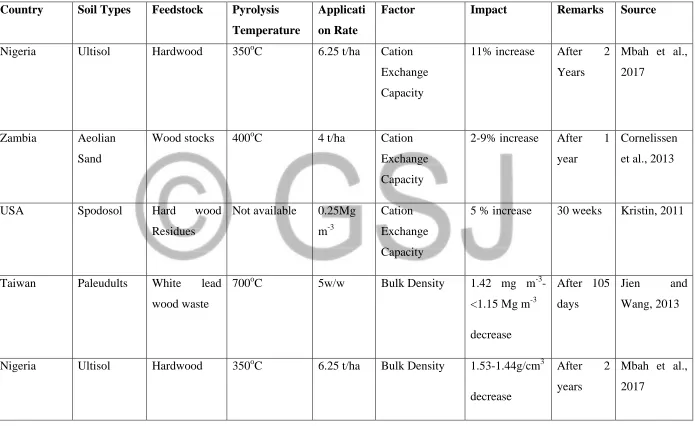
• Cation Exchange Capacity (CEC).
Significant increase in the CEC has been reported with increase in the amount of exchangeable cations in biochar amended soils mostly for elements like Calcium, Potassium, Magnesium and Phosphorus. According to Lehmann (2007), CEC of soils amended with biochar increases with time increment; the longer the time given for abiotic oxidation the higher the CEC of that soil and vise verses. Biochar has a greater ability to absorb and retain cations in an exchangeable form than other forms of soil organic matter due to its greater surface area, and negative surface charge. Increased CEC was highly observed in sandy soils (Liang et al. 2006). This implies ability to hold essential nutrients and release it slowly as required by plants for over long time. This quality reduces fertilizers application rate.
• Soil biodiversity and microbial activities
GSJ© 2019 www.globalscientificjournal.com • Soil pH
There is significantly positive linear correlation between biochar-treated soil pH and biochar pH (r2 = 0.46, p < 0.05). Mineralisation of biochar over time produces carboxylic groups on the edges of the aromatic core, increases the reactivity of black carbon in soil. This can be a good tool to improve nutrients use efficiency and moisture in drastically disturbs soils in Arid and semi Arid areas (Glaser et al. 2001).
• Surface area and porosity
A long-term soil column incubation study indicated increase in specific SA of an amended clayey soil from 130 to 150 m2g−1 when biochar derived from mixed hardwoods was applied at
rates of 0 to 20 g kg−1 (Laird et al,2010). The higher the total porosity (micro- and macro-pores) the higher is the soil physical quality since micro-pores are involved in molecular adsorption and transport while macro-pores affect aeration and hydrology (Atkinson et al, 2010).
• Bulk Density (BD)
In a 3-year field study, application of biochar amendment decreased the BD of 0–7.5 cm soil layer by 4.5 and 6.0% for 0.23 kg m−2 and 0.45 kg m−2 application rate, respectively (Chen.et al, 2011). Zhang.,et al, (2012), also observed a decrease in BD rate of 9.4 (± 2.2%) in a 2-year field study of soils amended with biochar.
• Soil Structure
GSJ© 2019 www.globalscientificjournal.com • Sorption of Heavy Metal
According to Cao et al. (2009), biochar because of the high content of Ash, is able to adsorb at least 85% of the Lead (Pb) , 50% of Arsenic (As), 70% of Cadmium (Cd) from solution at pH range (5-7) reacting with ash present in the biochar, and also to direct surface sorption AC 15% on biochar surface. The metal adsorptions are possible because of high ion exchange capacity. Presence of biochar in the soil cause breakdown of phenanthrene to a form less toxic (Zhang et al., 2012).
• Water Purification
GSJ© 2019 www.globalscientificjournal.com
Table 2: Effects of biochar from different feedstocks on soil properties
Country Soil Types Feedstock Pyrolysis
Temperature
Applicati
on Rate
Factor Impact Remarks Source
Nigeria Ultisol Hardwood 350oC 6.25 t/ha Cation Exchange Capacity
11% increase After 2 Years
Mbah et al., 2017
Zambia Aeolian Sand
Wood stocks 400oC 4 t/ha Cation Exchange Capacity
2-9% increase After 1 year
Cornelissen et al., 2013
USA Spodosol Hard wood Residues
Not available 0.25Mg m-3
Cation Exchange Capacity
5 % increase 30 weeks Kristin, 2011
Taiwan Paleudults White lead wood waste
700oC 5w/w Bulk Density 1.42 mg m-3 -<1.15 Mg m-3
decrease
After 105 days
Jien and Wang, 2013
Nigeria Ultisol Hardwood 350oC 6.25 t/ha Bulk Density 1.53-1.44g/cm3
decrease
After 2 years
GSJ© 2019 www.globalscientificjournal.com
USA Sandy loam Hardwood (Red oak)
500oC 6% w/w Bulk Density 1.43g/cm3 -1.30g/cm3 decrease After 91 days Andress et al., 2013
Taiwan Paleudults White lead wood waste
700oC 5w/w Stability Structure
64% reduction in soil loss
After 105 days
Jien and Wang, 2013
Finland Silty loam Birch (hardwood)
400oC 9 t/ha Soil water Holding
capacity
11% increase After 8 weeks
Karhu et al., 2011
Zambia Aeolian Sand
Maize Cob 400oC 4 t/ha Plat Available Water
17- 21% increase
After 1 year
Cornelissen et al., 2013 India Loamy sand Rice Husk 900-1100oC 1 t/ha CO2 0.9-1%
Sequestration
After 4 years
APN, 2009.
Canada Sandy 800oC 50 g/kg-1 CO2 77% increase
Sequestration
After 84 days
Bekele et al., 2015
China Not available
Maize cob 500oC 200.34 Mt CO2 441.31Mt
Sequestration
After 2 months
Stoyle, 2011
Japan Typic Hapludand
Municipal Biowaste
700oC 10 wt% N2O 89% decrease
emission
After 120 hours
Yania et al., 2007
Minnesota Waukegan silt loam
Mixed Saw dust
500oC 60 w/w N2O 74% reduction
in production
After 5 days
GSJ© 2019 www.globalscientificjournal.com
Minnesota Waukegan silt loam
Mixed Saw dust
500oC 10 w/w CH4 60% reduction
in production
After 5days
Spokas et al., 2009
Finland Silty loam Birch (hardwood)
400oC 9 t/ha CH4 96% decrease
emission
After 8 weeks
Karhu et al., 2011
Columbia Oxisol wood Data Not available
20 t/ha Soil pH pH 3.80-4.27 Increased
After 4 years
Major et al., 2010
USA Spodosol Hard wood Residues
Not available 0.25Mg m-3
Soil pH pH3.9-6.8 increase
30 weeks Kristin, 2011
USA Waukegan Silt loam
Macadamia nutshell
550oC 22 t/ha Soil pH pH 5.9-7.0 increase
Within 2 Years
Nooker, 2014
Switzerland Sandy Swine manure 800-900oC 2 t/ha Soil Carbon 17.6-68.8% increase
After 500 days
Rogovska, 2011
USA Spodosol Hard wood Residues
Not available 0.25Mg m-3
Soil Carbon 79 % increase 30 weeks Kristin, 2011
Columbia Oxisol wood Data Not available
20 t/ha Soil available plant nutrients Increased; Ca=101-320%, Mg=64-217%, Mn=136-342%, Mo= 573-860% After 4 years
GSJ© 2019 www.globalscientificjournal.com
3.7 Biochar Loss from the Soils
Wind loss
Biochar in fine powdered form is easily blown away by wind during application time. In the biochar field trial in Québec, Canada; it was estimated that 2% of the material was lost loading the spreader, 3% was lost during transport, and 25% was lost during spreading, leading to a total loss of approximately 30% (Blackwell et al, 2009).
Minimizing wind loss
According toBlackwell et al (2009), biochar loss by wind can be minimized in the following 3 ways;
a. Do not apply biochar in strong wind; wait when the weather conditions is favourable. Very fine powdered form of biochar should be applied when the soils moisture is averagely high for good bonding.
b. Very fine powdered biochar should be evenly mixed with water or manure before application to avoid it being carried away by wind.
c. Use biochar formulation like pellets, prills or mix biochar with compost or manure.
Water erosion
The factors such as very high rainfall intensity, steep terrain encourages biochar loss (Major et al. 2010)
Minimize biochar loss by water
GSJ© 2019 www.globalscientificjournal.com
3.8 Possible Risks of Associated with Using Biochar
Despite all the above positive unique qualities of biochar which can be exploited for carbon sequestration and soil amendments, there are some challenging risks that are associated with its use that needs further investigations and remedy. These challenging risks may include the followings among others;
• Damage to soils: Bulk application of powdered biochar in fields beyond the recommended
quantity could cause soil compaction. Confidence in the evidence base: low (Peter et al, 2010).
• Contaminants: If the organic materials used contain heavy metals it may be retained in the
ash after pyrolysis. Pyrolysis process may as well induce production of organic compounds called polycyclic aromatic hydrocarbons (PAHs) example benzo (a) pyrene which are carcinogenic and their content in food substances is strictly regulated (Lerda, 2009).
• A possible ‘priming effect’: Biochar may increase mineralization processes making it
difficult to use organic mulch once applied (Wardle et al., 2008).
• Effect of over liming with Biochar: Altering agronomic soil pH through the addition of
biochar may result in unfavorable shifts in above- and below ground flora.
4 Conclusion
GSJ© 2019 www.globalscientificjournal.com
oxides. Thus using biochar in climate mitigation since it can suit all farming systems (Organic, conventional, conservative). Since Biochar augment water and fertilizers use efficiency, supplementary fertilizers use would be of paramount in increasing crop yield however, soil analysis has to be done before application to determine the pyrolysis temperature for production, application rate, and supplementary fertilizers rate. There was a dearth of information on the duration Biochar integration takes into the soil before expressing its quality. Further study has to be done on the time biochar takes from the application to disintegrate into the soil to yield impact.
Acknowledgement
This work was supported in part by grant from OWSD and SIDA
Cited Literature;
Ammal, S. C., Heyden, A., (2014). Water-Gas Shift Catalysis at Corner Atoms of Pt Clusters in Contact with a TiO2(110) Support Surface, ACS Catalysis, 4.Pg. 3654-3662.
Andres S .B, Fernando E. M, David A. L, Robert H. and Mark W (2013). Assessing potential of biochar for increasing water holding capacity of sandy soils. GCB Bioenergy Vol 5. Pg. 132-143
Atkinson, C.J., Fitzgerald, J.D., Hipps, N.A. 2010). Potential mechanisms for achieving agricultural benefits from biochar application to temperate soils: A review. Plant Soil (337)Pg 1–18.
Beddington, J., Asaduzzaman, M., Fernandez, A., Clark, M., Guillou, M., Jahn, M., Erda, L., Mamo, T., Van Bo, N., Nobre, C.A., Scholes, R., Sharma, R. and Wakhungu, J. (2011). Achieving food security in the face of climate change: Summary for policy makers from the Commission on Sustainable Agriculture and Climate Change. Copenhagen, Denmark: CGIAR Research Program on Climate Change, Agriculture and Food Security (CCAFS).
Bekele, A., Roy, J. L. and Young, M. A. 2015. Use of biochar and oxidized lignite for reconstructing
functioning agronomic topsoil: Effects on soil properties in a greenhouse study. Can. J. Soil
GSJ© 2019 www.globalscientificjournal.com
Biazin, B. and Sterk, G. (2013) ‘Drought vulnerability drives landuse and land cover changes in the Rift Valley dry lands of Ethiopia’, Agriculture, Ecosystems and Environment, 164.Pg. 100–113.
Biederman, L.A.; Harpole, W.S. (2013). Biochar and its effects on plant productivity and nutrient cycling: A meta-analysis. GCB Bioenergy( 5).Pg 202–214.
Blackwell P, Riethmuller G, Collins M (2009). Biochar Application to Soil. in: J. Lehmann and S. Joseph (Eds.), Biochar for Environmental Management: Science and Technology, Earthscan, London, UK. Pg. 207.
Blackwell P, Shea S, Storer P, Kerkmans M, Stanley I (2007). Improving wheat production with deep banded oil mallee charcoal in Western Australia. Talk given at the International Agrichar Conference, April 27-May 2, 2007, Terrigal, NSW Australia.
Brown, D.R., Dettmann, P., Rinaudo, T., Tefera, H. and Tofu, A. (2011) ‘Poverty alleviation and environmental restoration using the clean development mechanism: A case study from Humbo, Ethiopia’, Environmental Management, 48. Pg. 322–333.
Busscher, W., Novak, J.M., Ahmedna, M., (2011). Physical effects of organic matter amendment of a southeastern US coastal loamy sand. Soil Science (176), Pg 661–667.
Cantón, Y., Sole-Benet, A., Asensio, C., Chamizo, S., Puigdefabregas, J.,(2009). Aggregate stability in range sandy loam soils relationships with runoff and erosion. Catena (77), Pg 192–199.
Cao Q., Hu Q.H., Baisch C., Khan S., ZhuY.G (2009). Arsenate toxicity for wheat and lettuce in six Chinese with different properties. Environ. Toxicol. Chem., 28 (9). Pg. 1946-1950
Case, S.D.C.; McNamara, N.P.; Reay, D.S.; Whitaker, J. (2012)The effect of biochar addition on N2O
and CO2 emissions from a sandy loam soil—The role of soil aeration. Soil Biol. Biochem,
(51).Pg 125–134.
GSJ© 2019 www.globalscientificjournal.com
Cheng, C.H., and Lehmann, J. (2009). Ageing of black carbon along a temperature gradient.Chemosphere, (75).Pg 1021–1027.
Cheng, C.H.; Lehmann, J.; Thies, J.E.; Burton, S.D.; Engelhard, M.H. . (2006). Oxidation of black carbon by biotic and abiotic processes. Org. Geochem, 37. Pg. 1477–1488.
Collins, H., (2008). Use of biochar from the pyrolysis of waste organic material as a soil amendment: laboratory and greenhouse analyses.” A quarterly progress report prepared for the Biochar Project
Conway, D., Schipper ELF (2011) ‘Adaptation to climate change in Africa: Challenges and opportunities identified from Ethiopia’, Global Environmental Change,21.Pg. 227-237.
Covell, P.; Gammie, G.; Hunt, S.; Brunjes, L.; Ng, F.; Nees, D. (2011). Advancing Biochar in the Chesapeake: A Strategy to Reduce Pollution from Poultry Litter—Forest Trends/Katoomba
David MF, and John LG (2013). Practicality of Biochar Additions to Enhance Soil and Crop Productivity(3).Pg 715-725
Demeke, A.B., Keil, A. and Zeller, M. (2011) ‘Using panel data to estimate the effect of rainfall shocks on smallholders food security and vulnerability in rural Ethiopia’, Climate Change,108. Pg.185-206.
FDRE (2011). Ethiopia’s climate-resilient green economy: Green economy strategy, Federal Democratic Republic of Ethiopia, Addis Ababa
Gaunt, J L., and Lehmann J. (2008). Energy balance and emissions associated with biochar sequestration and pyrolysis bioenergy production. Environmental Science & Technology 42 (11): Pg 4152-4158.
GSJ© 2019 www.globalscientificjournal.com
Glaser, B., L. Haumaier, G. Guggenberger and Zech W (2001). The ‘Terra Preta’phenomenon: A model for sustainable agriculture in the humid tropics. Naturwissenschaften (88). Pg 37–41.
IPCC (Intergovernmental Panel on Climate Change) (2014). Climate Change Synthesis Report. Contribution of Working Groups I, II and III to the Fifth Assessment Report of the Intergovernmental Panel on Climate Change (eds) Pachauri R.K. and Meyer L.A. IPCC, Geneva, Switzerland. Pg. 151
IPCC (Intergovernmental Panel on Climate Change) (2007). Changes in atmospheric constituents and in radiative forcing. In: Solomon S,Qin D, Manning M, Chen Z, Marquis M, Averyt KB, Tignor M,Miller HL (eds) Climate change 2007: the physical science basis,Contribution of Working Group into the Fourth Assessment Report of the Intergovernmental Panel on Climate Change. Cambridge University Press, Cambridge. Pg 498–540
Jien S. and Wang C. (2013). ‘Effects of biochar on soil properties and erosion potential in a highly weathered soil’.Elsevier B.V Journal Catena (110). Pg. 225–233.
Karhu, K.; Mattila, T.; Bergström, I.; Regina, K. (2011). Biochar addition to agricultural soil increased CH4 uptake and water holding capacity—Results from a short-term pilot field study.Agric. Ecosyst. Environ. (140), Pg. 309–313.
Kristine M.M (2011). Biochar Amendments to Forest Soils: Effects on Soil Properties and Tree Growth. A Thesis Presented in Partial Fulfillment of the Requirements for the Degree of Master of Science with a Major in Natural Resources in the College of Graduate StudiesUniversity of Idaho
Laird, D.A., (2008). The charcoal vision: A win-win-win scenario for simultaneously producing bioenergy, permanently sequestering carbon, while improving soil and water quality. Agronomy Journal 100(1), Pg 178-181.
GSJ© 2019 www.globalscientificjournal.com
Lehmann J (2007) A handful of carbon. Nature 447.Pg. 143–144
Lehmann, J., Gaunt, J., Rondon, M., (2006). Bio-char sequestration in terrestrial ecosystems- a review. Mitigation and Adaptation Strategies for Global Change 11, Pg 403-427.
Lehmann, J., Kern, D.C., Glaser, B., Woods, W.I. (eds.), (2004). Amazonian Dark Earths: Origin, Properties, Management. Kluwer Academic Publishers, New York, (523).Pg 18
Lenton TM and Vaughan NE (2009). The radioactive potential of different climate geoengineering options. Atmos. Chem.. phys. 9.Pg. 5539-5561.
Lerda, D. (2009). Mycotoxins factsheet, 2nd edition. Joint Research Centre, European Commision, Technical notes (JRC 53699)
Liang, B.; Lehmann, J.; Solomon, D.; Kinyangi, J.; Grossman, J.; O’Neill, B.; Skjemstad, J.O.;Thies, J.; Luizao, F.J.; Petersen, J.; et al. (2006). Black carbon increases cation exchange capacity insoils.
Soil Sci. Soc. Am. J., (70).Pg 1719–1730.
Liu, X.H., Han, F.P., Zhang, X.C. (2012). Effects of biochar on soil aggregates in the LoessPlateau: results from incubation experiments. International Journal of Agriculture and Biology (14). Pg975–979.
Major J, Rondon M, Molina D, Riha SJ, Lehmann J (2010). Maize yield and nutrition after 4 years of doing biochar application to a Colombian savanna oxisol. Plant Soil 333.Pg. 117-128.
Major, J., Steiner, C., Downie, A., Lehmann, J., (2009). Biochar Effects on Nutrient Leaching. In: Lehmann, J., Joseph, S. (Eds.), Biochar for Environmental Management: Science and Technology. Earthscan, London, UK, pg. 271.
Mbah C N., Njoku C., Okolo C.C., Attoe E.E., Osakwe U.C (2017). Amelioration of a degraded ultisol with hardwood biochar: Effects on soil physico-chemical properties and yield of
cucumber (Cucumis sativus L). African Journal of Agricultural Research 12 (21).Pg. 1781-1792.
GSJ© 2019 www.globalscientificjournal.com
Nelson, G. C., Rosegrant, M. W., Palazzo, A., Gray, I., Ingersoll, C., Robertson, R., et al. (2010). Food Security, Farming, and Climate Change to 2050: Scenarios, Results, and Policy Options. Washington, DC: International Food Policy Research Institute.
Nooker P.E (2014). Impact of Management Practices on Minnesota’s Specialty Crop Production: From
Biochar to Tillage Practices. A thesis submitted to the faculty of university of Minnesota in partial fulfillment of the requirements for the degree of Master of Science
Novak, J.M., Busscher, W.J., Laird, D.L., Ahmedna, M., Watts, D.W., Niandou, M.A.S., (2009). Impact of Biochar Amendment on Fertility of a Southeastern Coastal Plain Soil. Soil Science 174,Pg 105-112.
Omondi, P.A. (2014). ‘Change in temperature and precipitation extremes over the greater Horn of Africa region from 1961 to 2010’, International Journal of Climatology, 34.Pg.1262-1277
Oxfam (2012) “A Dangerous Delay: The cost of late response to early warnings in the 2011 drought in the horn of Africa”. Joint agency Briefing Paper. Oxfam and Save the Children. 18. revtrievable from: https://www.oxfam.org/sites/www.oxfam.org/files/file_attachments/story/bp-angerous-elay-horn-frica-drought-180112-en_4.pdf
Palumbo AV, J.F. M, Amonette JE, Fisher LS, Wullshleger SD, Daniels WL (2004) Prospects for enhancing carbon sequestration and reclamation of degraded lands with fossil-fuel combustion by-products. Advances inEnvironmental Research( 8). Pg 425-438.
Peter B., Sarah C., Jason C., Colin C., John G., James H., Rodrigo I., Ond_ej M., Kirsten S. and Patricia T. (2010). An Assessment of The Benefits And Issues AssociatedWith The Application Of Biochar To Soil. Ed: Simon Shackley and Saran Sohi. A report commissioned by the United Kingdom Department for Environment, Food and Rural Affairs, and Department of Energy and Climate Change. Pg 30-108.
GSJ© 2019 www.globalscientificjournal.com
Rondon, M., Ramirez J. A., and Lehmann J. (2005). Charcoal additions reduce net emissions of greenhouse gases to the atmosphere. Paper read at Proceedings of the 3rd USDA Symposium on Greenhouse Gases and Carbon Sequestration, March 21-24 2005, at Baltimore, USA.
Sai B. R. (2014). Adaptation to Climate Change - Water Use Efficiency at Water And Land Management Training and Research Institute (WALAMTARI). ClimaAdapt Project and Canal Network Flow Monitoring System Workshop. ClimaAdapt
Sai B. R. (2010). Biocharculture in Cotton Crop for Sustainable Cultivation and Carbon Sequestration. National Workshop on Innovations and Better Management Practices for Climate Resilient and Sustsinable Cotton Production
Sessay R. (2013). Slow Pyrolysis of Maize Stover for Biochar Production. Thesis submitted to Kwame Nkrumah University of Science and Technology in Partial fulfillment of the award of MSc. Chemical engineering, department of Chemical engineering. Pg.7-71.
Sistani, K.R., Torbert, H.A., Way, T.R., Bolster, C.H., Pote, D.H., Warren, J.G., (2009). Broiler Litter Application Method and Runoff Timing Effects on Nutrient and Escherichia coli Losses from Tall Fescue Pasture. Journal of Environmental Quality 38, Pg 1216-1223.
Spokas, K. A., W. C. Koskinen, J. M. Baker, and D. C. Reicosky. (2009). Impacts of woodchip biochar additions on greenhouse gas production and sorption/degradation of two herbicides in Minnesota soil. Chemosphere (77) Pg 574-581.
Stavi I and Lal R (2013). Agroforestry and biochar to offset climate change: A review. Agron Sustain Dev (33). Pg.81–96
GSJ© 2019 www.globalscientificjournal.com
Stoyle A. (2011). Biochar Production for Carbon Sequestration. A Major Qualifying Project Submitted to the faculty of Worcester Polytechnic Institute in partial fulfillment of the requirements for the Degree of Bachelor of Science in Chemical Engineering
Suzette PG, Jonathan K.Y, and David G (2010). The Economic Value of Biochar in Crop Production and Carbon Sequestration
UNDP (United Nations Development Program) (2014). Ethiopia: Country Economic Brief, United Nations Development Programme, Washington DC.
Asia-Pacific Network for Global Change Research(2009).Biochar for Carbon Reduction, Sustainable Agriculture and Soil Management (BIOCHARM) A report for APN Project-ARCP2009-12NSY-Karve. A Final Report submitted to APN.
Van Zwieten, L., Kimber, S., Downie, A., Chan, K.Y., Cowie, A., Wainberg, R. & Morris, S (2007). ‘Papermill char: Benefits to soil health and plant production’ in Proceedings of the Conference of the International Agrichar Initiative, 30 April – 2 May 2007, Terrigal, NSW, Australia.
Wardle J, Carnell S, Haworth CM, Plomin R. (2008). Evidence for a strong genetic influence on childhood adiposity despite the force of the obesogenic environment. Am J Clin Nutr. 87(2). Pg. 398-404.
World Bank (2013) Country profiles of Ethiopia. Retrieved from: http://data.worldbank.org/
Yanai Y., Koki T., and Masanori O. (2007). Effects of charcoal addition on N2O emissions from soil
resulting from rewetting air-dried soil in short-term laboratory experiments. Soil Science & Plant Nutrition 53 (2), Pg 181-188.
GSJ© 2019 www.globalscientificjournal.com
Zheng W, Sharma B.K., Rajagopalan N. (2010). Using Biochar as a Soil Amendment for Sustainable Agriculture. A final report submitted to Sustainable Agriculture Grant’s Programs, Illinois Department of Agriculture. Pg 1-42.
Cornelissen G., Martinsen V.,Shitumbanuma V., Alling V., Breedveld G.D. Rutherford DW., Sparrevik M., Hale S. E., Obia A. and Mulder J. (2013). Biochar Effect on Maize Yield and Soil
Characteristics in Five Conservation Farming Sites in Zambia.Journalof Agronomy Vol 3. Pg.