Volume 16, 2009 66
COMPUTER-BASED TECHNOLOGIES IN
THE PROCESS Of TEACHING/LEARNING
SCIENCES IN COMPREHENSIVE SCHOOL:
SOCIO-EDUCATIONAL ASPECTS
Vincentas Lamanauskas, Violeta Šlekienė, Loreta Ragulienė
Šiauliai University, Lithuania E-mail: [email protected], [email protected], [email protected]
Abstract
The role of ICT in education in whole and particularly in science education is very important topic. It is worth emphasizing that in recent years, a general degree of integrating ICT in the process of teaching has increased in Lit huania as well as in other countries. The growth is characteristic not only at university level but also at other levels of the education system. It is accepted that ICT makes the process of teaching/learning more effective and beneficial whereas the education system starts functioning faster. The development of ICT and the process of globalization de termine alteration in the education system as well as in the whole society. The implementation of new technologies in the educational process raises new possibilities for both teacher and learner, enhances education quality and makes the educational process more versatile.
On the other hand it is necessary to devote all our efforts to monitor the process of using ICT in general schools. It is necessary to conduct regularly researches of different scale for better understanding of a situation of use ICT in the teaching /learning process.
Pilot research Student and ComputerBased Technologies was conducted in October – November, 2009. To collect the required data, an anonymous questionnaire was prepared. Research sample consisted of 211 respondents who were 1st year university students (freshmen).
In the majority of cases, the students learn to use computer independently, whereas next comes help provided by friends and family members. It has been established that computerbased technologies are very rarely used during the lessons of other subjects. The respondents think that using computerbased technologies in the classroom during the lessons of sciences has the highest impact on cognitive abilities (knowledge acquisition, self-sufficient studies etc.).
Keywords: general schools, computerbased technologies, pilot research, science education.
Introduction
Recently, common interest in using computer-based technologies for the purpose of
IN THE 21CENTURY Volume 16, 2009 67
investigations are conducted in Lithuania. The report of the international Software and Information In
dustry Association of the year 2000 summarizes more than 3500 studies on applying ICT for educational
purposes and presents conclusions indicating that the use of ICT in the educational process can improve teaching/learning as well as may have a positive impact on the final results, attitudes and communication with teachers and other students. On the other hand, applying only the latest training aids cannot guaran tee better results of teaching/learning. ICT is an absolutely effective instrument for teaching sciences. For instance, the possibilities of multimedia create conditions for establishing ‘virtual school laborato ries’ and doing different imitations (for example, complex natural phenomena, expensive and complica ted instruments). Computerbased technologies are widely applied to find connections between real and virtual laboratories and can be incorporated into more and more involved educational technologies. In
this case, the application of Augmented Reality Technologies in educational practice can be mentioned
as one of the examples. The international project ARiSE (http://www.ariseproject.org) has revealed in
teresting results. Research on pedagogical effectiveness has disclosed that these technologies can be an effective instrument for improving the quality of teaching in general (Lamanauskas, Pribeanu, Vilkonis, Balog, Iordache, Klangauskas, 2007). The later performed indepth research on pedagogical evaluation has also demonstrated positive results (Lamanauskas, Bilbokaitė, 2009). On the other hand, the problem is a choice between virtual and real teaching/learning environment. Real experimentation, examination etc. is crucially important for learning sciences. The researchers notice that both children and adults are strongly motivated by experimenting, discovering and understanding things in their own way (Bilek, Krumina, 2008). Thus, the basic problem is the coordination of real experimentation in the classroom with the experiments conducted in the virtual environment. Chemistry is one of the examples showing that sciences are based on experiments. The examiners find that strong emphasis on ‘pure’ elearning only cannot be the only choice as most frequently this is a combination of elearning and face to face or mobile process (Cedere, Priksane, 2006; Lovatt, Finlayson, James, 2007).
Moreover, computerbased technologies as such cannot increase the efficiency of the teaching/lear ning process and therefore must be appropriately applied in the educational process.
Research plays a fundamental role despite the fact that regardless of a growing number of compu ters in comprehensive school, the immediate use of those in the process of teaching/learning is insuffi cient due to different reasons. The teacher should be able to take into account and involve in their daily work rapidly changing technologies and new approaches and standards in the education field, which re quires a higher performance both for students and teachers (Dudareva, Bruneniece, 2008). Teaching and learning are mainly based on the interaction between a teacher and a student. The before mentioned inte raction is also determined by the use of computerbased technologies. Therefore, an important point is constant supervision and evaluation of using these technologies. The received information can help with identifying the existing shortcomings and finding adequate decisions on overcoming the encountered weaknesses which is relevant in terms of managing the educational process. First of all, this is due to the
fact that arranging a lesson in the classroom and the methods of teaching/learning using computer
hard-ware differ from that based on a traditional approach. Differently, the carried out sociological research on expanding the use of IT in Lithuanian schools shows that a position on applying IT in the educational establishments is rather limited and a wider application of computers usually ends outside informatics
classroom (Bedulskis, 2005). Hence, the object of research is the use of computer-based technologies
in the process of teaching/learning sciences. Research is aimed at establishing the positions of 1st year
students on applying computerbased technologies in comprehensive school learning sciences and at disclosing the frequency of using these technologies in the classroom during the lessons on sciences.
Research Methodology
General Characteristics of Research
Volume 16, 2009
68 The Applied Instrument
To collect the required data, an anonymous questionnaire including four main blocks was prepa red.
1. The level of ability to use computer (in total, 30 parameters were included, for example, ability to use programs and documents, ability to operate fail search system etc.).
2. The methods of using computers (5 parameters were included, for example, learned during infor matics classes; during classes in other subjects; during extracurricular activities; helped family members, friends etc.; individual learning).
3. The evaluation of the frequency of applying computerbased technologies during the classes of sciences (5 parameters were included, for example, the frequency of using a computer projector by the teacher; the frequency of demonstrations done by the teacher, the frequency of applying computerbased technologies by the students for the purpose of practical experimentation; the frequency of communication between students and teachers outside the classroom etc.).
4. Opinions on applying computerbased technologies during the classes of sciences at school. 20 closed type questions were addressed, for example, using computerbased technologies to make lessons more interesting, to increase motivation, for communication purposes etc.
All four blocks were made of closed type statements, the questions to which are given applying a ranking scale from 1 to 5. Every statement was given the calculated popularity index (0 ≤ PI ≤ 1). The closer is PI value to 1, the more important is the statement to the respondent.
The questionnaire also included a demographical part and some other additional variables (for example, the time the respondent uses computer; the daily average of time the respondent spends on le arning using computerbased technologies).
Research sample
Research sample consisted of 211 respondents who were 1st year students.
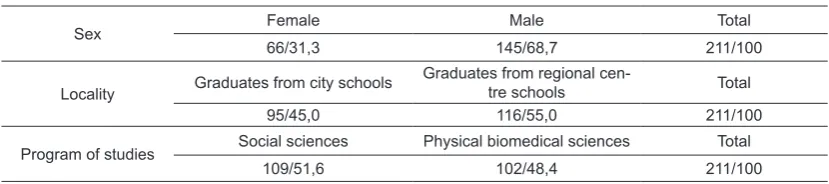
Table 1. Characteristics of the surveyed respondents. (N/%).
Sex Female Male Total
66/31,3 145/68,7 211/100
Locality Graduates from city schools Graduates from regional centre schools Total
95/45,0 116/55,0 211/100
Program of studies Social sciences Physical biomedical sciences Total
109/51,6 102/48,4 211/100
The field of social sciences was represented by the students of educology, economics, business ad ministration and management. The field of physical and biomedical sciences involved the students of physics, optometry, mathematics, informatics, biology and ecology. The sample of research consisted of students from four departments of the same university. Though it is not strictly a random sample, howe ver, it is supposed to be partly random due to the precondition that the respondents randomly represent comprehensive schools located at different parts of Lithuania and that the major part of the surveyed participants graduated from these schools in 2009. From this point of view, the respondents’ opinion on using computerbased technologies for the purposes of teaching/learning sciences in comprehensive school is accepted as very important and objective.
Statistical data analysis
IN THE 21CENTURY Volume 16, 2009 69
have been applied. To establish deviations between the variables, nonparametric chisquare (χ2) criterion
is used. The SSPS statistics batch is used as an instrument for data processing.
Research Results
The respondents‘knowledge of using computer was assessed. The obtained results are presented in Table 2. The popularity index and standard deviation (0 ≤ PI ≤ 1) were calculated.
Table 2 shows that individual knowledge (PI = 0.84, standard deviation SD = 0.21) as well as friends, family members etc. (PI = 0.72, SD = 0.27) most frequently helped the students with using computer. A part of students found important knowledge and skills gained during informatics lessons (PI = 0.63, SD = 0.28). However, only a minor part of the respondents improved their knowledge and skills during the lessons of other subjects and extracurricular activities.
Forming two groups of respondents considering their specialities revealed (social sciences, SS and physical/biomedical sciences, FBS) that taking into account all 5 parameters, no statistical significant deviation between the opinions of the students representing these groups was noticed (Table 2).
Table 2. Gained knowledge of using computer.
Ways of learning N PI SD
1. Independently 211 0.84 0.21
2. Helped friends, family members etc. 211 0.72 0.27
3. During informatics lessons 211 0.63 0.28
4. During the lessons of other subjects 211 0.40 0.26 5. During extracurricular activities
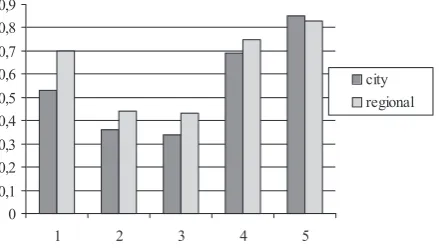
A statistically significant deviation between the opinions of the graduates from city and regional
centre schools was established in view of the impact of informatics lessons on improving knowledge
about using computer (Picture 1). The null hypothesis about equal averages is rejected conside ring the level of significance which is p < 0.001. Informatics lessons had a higher impact on knowled ge of the students from regional centres (PI = 0.70) rather than on those from the city (PI = 0.53).
0 0,1 0,2 0,3 0,4 0,5
0,6 0,7
0,8
0,9
1 2 3 4 5
city regional
I have learnt how to use computer: 1 – during informatics lessons; 2 – during the lessons of other subjects; 3 – during extracurricular activities; 4 – others help; 5 – independently
Figure 1. Ways of using computer in terms of schools.
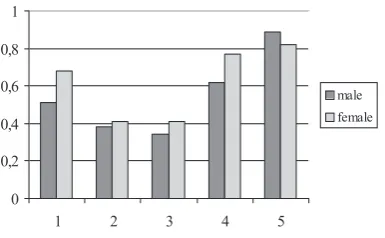
An assessment in terms of the sex (Figure 2) indicates that female students learn better during
Volume 16, 2009 70
0 0,2 0,4
0,6
0,8 1
1 2 3 4 5
male female
I have learnt how to use computer: 1 – during informatics lessons; 2 – during the lessons of other subjects; 3 – during extracurricular activities; 4 – others help; 5 – independently
Figure 2. Ways of using computer in terms of the sex.
An assessment of the frequency of applying computerbased technologies during the classes of sciences (physics, biology, chemistry, geography) disclosed they had been used very rarely. The teachers relatively frequently used computer presenting new material during physics (PI = 0.30) and biology (PI = 0.23) lessons. Also interactive demonstrations were organized during physics (PI = 0.31) and biology (PI = 0.22) lessons. At times, the students selfsufficiently did homework and tasks on biology (PI = 0.23) and physics (PI = 0.20). Computerbased technologies were hardly applied during chemistry and geography lessons. It should be noticed that the teachers of sciences have a contact with students very rarely outside the classroom, i.e. give advice and prepare different tasks using appropriate software. No statistical deviation has been established between the answers of male and female students from the city and regional centre about the frequency of using computerbased technologies in the classroom.
An assessment of opinions on applying computer-based technologies during the classes of sciences
at school and the impact of computerbased technologies on personal development has been undertaken. The following statements can be regarded as the most relevant:
• Using appropriate software made the process of learning more interesting during lessons (PI =
0.79);
• Computerbased technologies used by teachers made the lesson more engaging (PI = 0.76);
• Using computerbased technologies helped with a better understanding of a new topic
(PI = 0.70).
However, the respondents have doubts about:
• Using computerbased technologies in the classroom for the purpose of raising individual motiva tion (PI = 0.50);
• Using computer-based technologies in the classroom for the purpose of raising interest in
scien-ces (PI = 0.47).
It is supposed that the respondents do not relate computerbased technologies to learning motiva
tion and deeper interest in sciences as in comparison the teachers of sciences rarely apply
computer-ba-sed technologies in the process of teaching. However, sciences in particular open up strong possibilities of using these technologies for educational purposes.
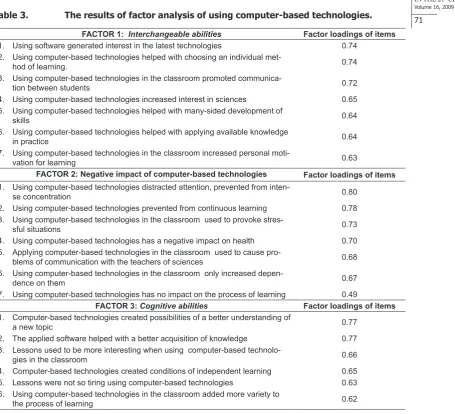
Factor analysis was carried out employing the method of the main components with Varimax rota tion. 20 answers to 1 question were grouped considering three factors (Table 3). 67 statements describe
each statement. Taking into account general features these factors were given the names Interchangeable
IN THE 21CENTURY Volume 16, 2009 71
Table 3. The results of factor analysis of using computer-based technologies.
FACTOR 1: Interchangeable abilities Factor loadings of items
1. Using software generated interest in the latest technologies 0.74 2. Using computerbased technologies helped with choosing an individual met
hod of learning. 0.74
3. Using computerbased technologies in the classroom promoted communica
tion between students 0.72
4. Using computerbased technologies increased interest in sciences 0.65 5. Using computerbased technologies helped with manysided development of
skills 0.64
6. Using computerbased technologies helped with applying available knowledge
in practice 0.64
7. Using computerbased technologies in the classroom increased personal moti
vation for learning 0.63
FACTOR 2: Negative impact of computer-based technologies Factor loadings of items
1. Using computerbased technologies distracted attention, prevented from inten
se concentration 0.80
2. Using computerbased technologies prevented from continuous learning 0.78 3. Using computerbased technologies in the classroom used to provoke stres
sful situations 0.73
4. Using computerbased technologies has a negative impact on health 0.70 5. Applying computerbased technologies in the classroom used to cause pro
blems of communication with the teachers of sciences 0.68 6. Using computerbased technologies in the classroom only increased depen
dence on them 0.67
7. Using computerbased technologies has no impact on the process of learning 0.49
FACTOR 3: Cognitive abilities Factor loadings of items
1. Computerbased technologies created possibilities of a better understanding of
a new topic 0.77
2. The applied software helped with a better acquisition of knowledge 0.77 3. Lessons used to be more interesting when using computerbased technolo
gies in the classroom 0.66
4. Computerbased technologies created conditions of independent learning 0.65 5. Lessons were not so tiring using computerbased technologies 0.63 6. Using computerbased technologies in the classroom added more variety to
the process of learning 0.62
The first factor Interchangeable abilities covered 7 statements describing the impact of IT on in terest in sciences, technologies, motivation for learning, practical use as well as communication and collaboration between students. The second factor Negative impact of computerbased technologies
emb-raced another 7 statements characterizing the impact of IT on concentration, consistent studying, stress removing etc. The third factor Cognitive abilities consists of 6 statements giving an account the impact of IT on learning a new topic, acquiring knowledge and making the process of learning more interesting. Every factor was given the popularity index (PI) (Table 4).
Table 4. The popularity indexes of factors.
N PI SD
Factor 1 211 0.57 0.18
Factor 2 211 0.31 0.17
Factor 3 211 0.71 0.15
Volume 16, 2009
72 ze the impact of computerbased technologies on motivation for learning, practical use as well as on com
munication and collaboration between students. A statistically significant deviation between the opinions
of the respondents from the city and regional centre and the impact of computer-based technologies on
the first factor Interchangeable abilities has been noticed. The null hypothesis about equal averages is
rejected at the level of significance and makes p < 0.001. In terms of this aspect, the position of the sur veyed participants from regional centres is more positive (PI = 0.60) rather than of those from the city and makes (PI = 0.52). Therefore, it is supposed that the respondents from regional centres still want to use computerbased technologies more frequently than those from the city and therefore are more active in communicating and collaborating with their colleagues or are more engaged in sciences when using computerbased technologies.
Considering the opinions of the examined respondents in all factors, no statistical deviations bet ween male and female students as well as between social and physical, biomedical sciences have been noticed.
Conclusions
The results of the carried out research Student and ComputerBased Technologies has shown that:
• In the majority of cases, the students learn to use computer independently, whereas next comes
help provided by friends and family members. The lessons of informatics have a higher impact on the learners from regional centres and female students. The classes on other subjects and extra curricular activities have no significant impact on increasing knowledge of work at computer.
• It has been established that computerbased technologies are very rarely used during the lessons
of other subjects. The teachers relatively frequently used computer during the lessons of physics and biology, les frequently during the classes of chemistry and physics. The teachers of scien ces very rarely use computerbased technologies outside the classroom, i.e. for tutoring, giving advice, performing different tasks.
• The respondents think that using computerbased technologies in the classroom during the les
sons of sciences has the highest impact on cognitive abilities (knowledge acquisition, selfsuffi cient studies etc.). However, they do not find important the impact of technologies on motivation for learning, practical use, communication and collaboration between students. Moreover, ap plying computerbased technologies in the classroom helps with concentration, prevents from distracting attention and does not lead to stressful situations, i.e. has no negative impact on the state of health and personal development.
References
Bedulskis, D. (2005). Kompiuteriu pamokose bent kartą per savaitę pasinaudoja 18 proc. Lietuvos mokytojų. Priei
ga per internetą: http://www.microsoft.com/lietuva/press/2005/1128.mspx (žiūr. 2009.11.06).
Bilek, M., Krumina, A. (2008). Dilemmas of Computer Supported Chemistry Education: Virtual or Real? In.: Che
mistry Education – 2008 (Proceedings of international scientificpractical conference, 1415 November 2008). Riga: LU, p. 1621.
Cedere, D., Priksane, A. (2006). Using ELearning Elements at the University Course of Organic Chemistry. In.: In
formacinės komunikacinės technologijos gamtamoksliniame ugdyme – 2006 / Information & Communication Tech-nology in Natural Science Education – 2006 (Tarptautinės mokslinės praktinės konferencijos straipsnių rinkinys, 2006 m. gruodžio 12 d.). Šiauliai: Šiaulių universiteto leidykla, p. 148151.
Dudareva, I., Bruneniece, A. (2008). Some Aspects of Using ICT in Physics Teaching / Learning Process. In.: Infor
mation and Communication Technology in Natural Science Education2008 (Proceedings of International Scientific Conference, 2829 November 2008). Siauliai: Siauliai University Press, p. 4247.
Lamanauskas, V., Pribeanu, C., Vilkonis, R., Balog, A., Iordache, D., Klangauskas, A. (2007). Evaluating the Educa tional Value and Usability of an Augmented Reality Platform for School Environments: Some Preliminary Results.
Proceedings of 4th WSEAS/IASME International Conference on Engineering Education (Agios Nikolaos, Crete
Island, Greece, 2426 July, 2007). Mathematics and Computers in Science and Engineering, Published by World
IN THE 21CENTURY Volume 16, 2009 73
Lamanauskas, V., Bilbokaitė, R. (2009). Pedagogical Evaluation of Prototype 3 of the AR Learning Platform Ba
sed on the Results Achieved During the Third ARiSE Summer School. Problems of Education in the 21st Century
(Trends and Problems in Science and Technology Education), Vol. 11, p. 86103.
Lovatt, J., Finlayson, O. E., James, P. (2007). Evaluation of Student Engagement with Two Learning Supports in the
Teaching of 1st Undergraduate Chemistry. Chemistry Education Research and Practice, 8 (4), p. 390402.
Adviced by Laima Railienė,
Šiauliai University, Lithuania
Vincentas Lamanauskas Professor, Natural Science Education Research Centre, Siauliai University, 25119 P. Višinskio Street, LT76351, Siauliai, Lithuania.
Phone: +370 687 95668.
Email: lamanauskas@projektas.lt
Website: http://www.lamanauskas.projektas.lt
Violeta Šlekienė Associate Professor, Head of Department of Physics, Faculty of Natural Sciences, Šiauliai University, 19 P. Visinskio Street, LT77156 Siauliai, Lithuania. Phone: +370 41 595721.
Email: [email protected].lt Website: http://www.su.lt/
Loreta Ragulienė Associate Professor, Lecturer of Department of Physics, Faculty of Natural Sciences, Šiauliai University,
19 P. Visinskio Street, LT77156 Siauliai, Lithuania. Phone: +370 41 595721.