Available online on 15.9.2018 at http://ujpr.org
Universal Journal of Pharmaceutical Research
An International Peer Reviewed Journal
Open access to Pharmaceutical research
This is an open access article distributed under the terms of the Creative Commons Attribution-Non Commercial Share Alike 4.0 License which permits unrestricted non
commercial use, provided the original work is properly cited Volume 3, Issue 4, 2018
REVIEW ARTICLE
FAST DISSOLVING DRUG DELIVERY SYSTEMS: FORMULATION,
PREPARATION TECHNIQUES AND EVALUATION
Satbir Singh*1 , Tarun Virmani1 , Reshu Virmani1, Pankaj Kumar2, Geeta Mahlawat1
1School of Pharmaceutical Science, MVN University, Palwal, (Haryana), 121105, India 2
Advanced Institute of Pharmacy, Palwal, (Haryana), 121105, India
ABSTRACT
The Fast Dissolving Drug Delivery Systems sets a new benchmark was an expansion that came into existence in the early 1980’s and combat over the use of the different dosage form like tablets, suspension, syrups, capsules which are the other oral drug delivery systems. Fast Dissolving Drug Delivery System (FDTS) has a major advantage over the conventional dosage forms since the drug gets rapidly disintegrated and dissolves in the saliva without the use of water. In spite of the downside lack of immediate onset of action; these oral dosage forms have valuable purposes such as self medication, increased patient compliance, ease of manufacturing and lack of pain. Hence Fast Disintegrating Tablets (FDTS) technology has been gaining importance now-a-days with wide variety of drugs serving many purposes. Fast Disintegrating Tablets (FDTS) has ever increased their demand in the last decade since they disintegrate in saliva in less than a minute that improved compliance in pediatrics and geriatric patients, who have difficulty in swallowing tablets or liquids. As fast dissolving tablet provide instantaneous disintegration after putting it on tongue, thereby rapid drug absorption and instantaneous bioavailability, whereas Fast dissolving oral films are used as practical alternative to FDTS. These films have a potential to deliver the drug systemically through intragastric, sublingual or buccal route of administration and also has been used for local action.
In present review article different aspects of fast dissolving tablets and films like method of preparations, latest technologies, and evaluation parameters are discussed. This study will be useful for the researchers for their lab work.
Keywords: Bioavailability, dysphagia, fast dissolving drug delivery systems, fast disintegrating tablet, geriatric, pediatric.
Article Info: Received 8 July 2018; Revised 1 September; Accepted 7 September, Available online 15 September 2018 Cite this article-
Singh S, Virmani T, Virmani R, Kumar P, Mahlawat G. Fast dissolving drug delivery systems: formulation, preparation techniques and evaluation. Universal Journal of Pharmaceutical Research 2018; 3(4): 56-64. DOI: https://doi.org/10.22270/ujpr.v3i4.185
Address for Correspondence:
Satbir Singh, School of Pharmaceutical Science, MVN University, Palwal, Haryana, 121105, India.Phone: +91-8816973242, E-mail: [email protected]
INTRODUCTION
At present scenario formulation research is modified in such a way that the active ingredients can be delivered to the target site with a level of convenience,
performance and improved bioavailability1. As the cost
for developing a generic molecule is too expensive, the research is being done on the new dosage forms for having better patient compliance as compared to the different dosage forms of which the oral route serves to make a provenance. The oral route of administration is always considered to be the most preferred route because of its various advantages like ease of administration, pain avoidance, versatility and most
important patient compliance2.
Dysphagia and Fast-dissolving tablets-Dysphagia is the term used to describe difficulty swallowing.
Dysphagia includes difficulty starting a swallow
(called oropharyngeal dysphagia) and the sensation of
food being stuck in the neck or chest (called
esophageal dysphagia)3. Tablet is the most popular and
common dosage form. However some limitations are associated with it like, large size of dosage forms, and in some cases as of uncooperative, pediatric and dysphagia patients, it may create some problems. Moreover traveling patients suffering from motion sickness and diarrhea don’t have easy access to water for oral drug administration. To overcome these problems, a new modified form of tablets is developed, which is known as fast dissolving tablet or mouth
dissolving tablet4. Fast-Dissolving Tablets (FDTS)
disintegrate and/or dissolve instantaneously in the saliva without the use of water. FDTS are best alternative for all of these patients. The Center for Drug Evaluation and Research (CDER), US FDA defined Oral Disintegrating Tablets (ODT) as a solid dosage form containing medicinal substances, which disintegrates rapidly, usually within a matter of
disintegration time of such tablets is very short because of their highly porous structure and the high solubility of the sugar alcohol or saccharide present as the diluents.
Table 1: Various ingredients of FDTS Types of ingredients % Active pharmaceutical agent 1-25% Water soluble film forming
polymer
40-50%
Plasticizer 0-20
Sweetening agent 3-6% Saliva stimulating agent 2-6% Colors and Flavors 0-10%
Drug gets released after rapidly disintegration rapidly; drugs are absorbed from the mouth, pharynx and
esophagus as the saliva passes down into the stomach6.
Most fast dissolving drug delivery system films consist of different substances to mask the bitter taste of active ingredient. This masked active ingredient is than swallowed by the patient’s saliva along with the soluble and insoluble excipients. These are also called as melt-in-mouth tablets, repimelts or porous tablets. Advantages of FDTS
1. No need of water and chewing.
2. Better taste masking properties.
3. Beneficial in cases such as motion sickness,
sudden episodes of allergic attack or coughing.
4. Ease of administration to patients who cannot
swallow like the bed-ridden, stroke victims and patients who refuse to swallow like geriatrics, pediatrics and psychiatrics.
5. Stability can be improved7.
6. Acceptable taste and pleasant mouth feeling.
7. Dissolution and absorption of drug is fast,
offering rapid onset of action.
8. Bioavailability of drugs is increased by avoiding
first pass metabolism.
9. High drug loading can be possible.
10.No specific packaging is required. It can be
packaged in push through blisters.
11.Minimum risk of suffocation in airways due to
physical obstruction, when ODTs are swallowed,
thus they provide improved safety and
compliance with their administrations8.
Disadvantages of FDTS
1. These tablets usually have insufficient mechanical
strength. Hence, careful handling is required.
2. Fast dissolving tablets requires special kind of
packaging for proper stabilization and safety of
stable product9.
3. Drugs with relatively larger doses are difficult to
formulate into MDT e.g. antibiotics like amoxicillin with adult dose tablet containing about 500 mg of the drug.
4. Tablets may leave unpleasant taste and/or
grittiness in mouth if not formulated properly.
5. Patients with Sjogren’s syndrome or dryness of
the mouth due to decreased saliva production may not be good candidates for these tablet
formulations10.
6. They are more susceptible to degradation by
humidity and temperature. Fast dissolving tablets
are hygroscopic in nature so must be keep in dry place.
7. Drugs with short half-life and frequent dosing and
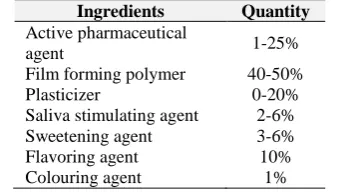
those whom require controlled or sustained release are unsuitable candidates of FDTS. Table 2: Composition of fast dissolving oral film
Ingredients Quantity Active pharmaceutical
agent 1-25%
Film forming polymer 40-50% Plasticizer 0-20% Saliva stimulating agent 2-6% Sweetening agent 3-6% Flavoring agent 10% Colouring agent 1%
Challenges for development of FDTS 1. Taste masking
Undesirable taste is one of the important formulation problems that are encountered with many drugs. Bitter drugs in the form of FDTS can’t be accepted by the patients. Administration of bitter drugs orally with acceptable level of palatability is the aim of all manufacturers. As most drugs are unpalatable, rapid disintegrating drug delivery systems usually contain the medicament in a taste- masked form. Delivery systems disintegrate or dissolve in patient’s oral cavity, thus releasing the active ingredients which come in contact with the taste buds; hence, taste-masking of the drugs becomes critical to patient compliance. Taste-masking technologies are being used for bitter-tasting drugs like the macrolide antibiotics, non-steroidal anti-inflammatory drugs, and penicillins. However taste masking of water-soluble bitter drugs, with a high dose, is difficult to achieve by using sweeteners alone11.
2. Hygroscopicity
It is the capacity of a product (e.g. cargo, packaging material) to react to the moisture content of the air by absorbing or releasing water vapor. Hygroscopicity is, of course, an important characteristic of a powder. It can be shown, roughly, for a fairly soluble compound that the hygroscopicity is related to its solubility. FDTS should have low sensitivity to humidity. This problem can be especially challenging because many highly water soluble excipients are used in formulation. Highly water-soluble excipients are susceptible to moisture; some will even deliquesce at high humidity. A good package design or other strategy should be
followed to protect FDTS from atmospheric
conditions12.
3. Mouth feel
The particles generated after disintegration of the FDTS should be as small as possible in oral cavity for the good feeling. Moreover addition of flavors and
cooling agents like menthol improve the mouth feel13.
4. Aqueous solubility
Water-soluble drugs pose various formulate ion
challenges because they form eutectic
can be prevented by using various matrix-forming excipients such as mannitol than can induce crystallinity and hence, impart rigidity to the
amorphous composite14.
5. Amount of drug
For lyophilized dosage forms, the drug dose must be lower than 400 mg for insoluble drugs and less than 60 mg for soluble drugs. This parameter is particularly challenging when formulating a fast-dissolving oral films or wafers. The application of technologies used for FDTS is limited by the amount of drug that can be
incorporated into each unit dose15.
6. Mechanical strength and disintegration time FDTS are formulated to obtain disintegration time usually less than a minute. FDTS dissolves or disintegrates quickly in the oral cavity upon the contact with saliva, resulting in solution or suspension of the administered medicine. It is obvious that increasing the mechanical strength will delay the disintegration time. So a good compromise between these two parameters is always essential. While doing so, maintaining a good
mechanical strength is a prime challenge16.
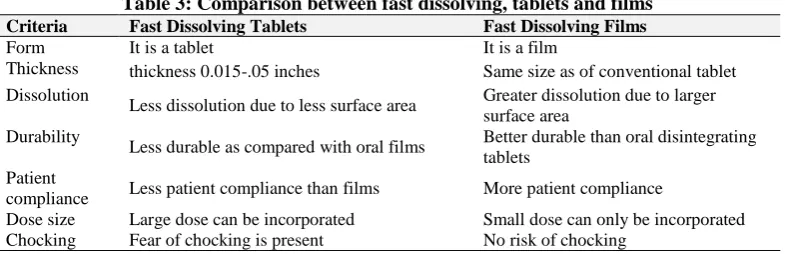
Table 3: Comparison between fast dissolving, tablets and films Criteria Fast Dissolving Tablets Fast Dissolving Films
Form It is a tablet It is a film
Thickness thickness 0.015-.05 inches Same size as of conventional tablet Dissolution
Less dissolution due to less surface area Greater dissolution due to larger surface area
Durability
Less durable as compared with oral films Better durable than oral disintegrating tablets
Patient
compliance Less patient compliance than films More patient compliance
Dose size Large dose can be incorporated Small dose can only be incorporated Chocking Fear of chocking is present No risk of chocking
7. Cost
The technology used for FDTS should be economical. Special technologies used may increase the cost of final products.
Technologies for preparation of FDTS A. Non-patented Technologies 1. Direct Compression
Direct compression is the easiest way to manufacture tablets. Direct compression is viewed as the technique of choice for the manufacture of tablets containing thermolabile and moisture-sensitive drugs. The great advantage of direct compression is the low manufacturing cost. It uses conventional equipment, commonly available excipients, and a limited number process steps. Single or combined action of disintegrants, water soluble excipients and effervescent agents depends on the disintegration and solubilization of directly compressed tablets. Breakage of tablet edges during handling and tablet crack during the opening of blister alveolus, all result from insufficient
physical resistance protection17.
2. Tablet Moulding
Tablets prepared by this method are solid dispersions. Molded tablets are less compact than compressed tablets, with a porous structure that facilitates rapid disintegration and easy dissolution. Molded tablets offer improved taste due to water-soluble sugars present in dispersion matrix. Moulding technique is of
two types18.
a. Solvent method
In this technique damping the powder blend is done by an alcoholic solvent and then compressing at low pressure in molded plates to form a wet mass. After air drying tablets prepared by this technique are less compact than compressed tablets and posses a porous
structure that accelerates the dissolution19.
b. The heat process
It involves preparation of a suspension that contains a drug, agar and sugar and pouring the suspension in the blister packaging wells, solidifying the agar at the room temperature to form a jelly and drying at 30ºC under vacuum. The mechanical strength of molded tablets is to be notified and hence binding agents are mixed to give strength. The taste masked drug particles were prepared by spray congealing a molten mixture of hydrogenated cottonseed oil, sodium carbonate, lecithin, polyethylene glycol and an active ingredient
into a lactose based tablet triturate form20.
3. Spray Drying
For producing porous and fine powders that dissolve rapidly spray drying technique is used. The formulations are included by hydrolyzed and non hydrolyzed gelatins as supporting agents, mannitol as
bulking agent, sodium starch glycolate or
crosscarmellose sodium as disintegrating and an acidic material (e.g. citric acid) and/or alkali material (e.g. sodium bicarbonate) to improve disintegration and dissolution. This formulation technique gives porous
powder and disintegration time < 20 sec17.
4.Sublimation
The key to rapid disintegration for mouth dissolving tablets is the presence of a porous structure in the tablet matrix. Conventional compressed tablets that contain highly water-soluble ingredients often fall to dissolve rapidly because of low porosity of the matrix. Highly volatile ingredients like ammonium bicarbonate, ammonium carbonate, benzoic acid, menthol, camphor, naphthalene, urea, urethane or phthalic anhydride could be compressed along with other excipients into a tablet. The volatile material is then removed by sublimation leaving behind a highly porous matrix. Tablets manufactured by this technique are reported to usually disintegrate in 10-20 sec. and exhibit sufficient
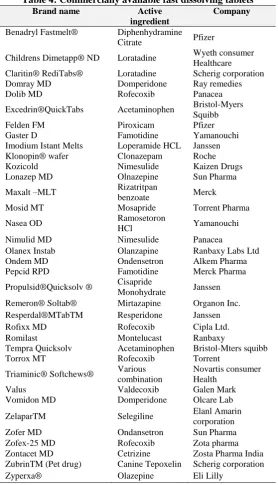
Table 4: Commercially available fast dissolving tablets
Brand name Active
ingredient
Company
Benadryl Fastmelt® Diphenhydramine
Citrate Pfizer
Childrens Dimetapp® ND Loratadine Wyeth consumer Healthcare
Claritin® RediTabs® Loratadine Scherig corporation Domray MD Domperidone Ray remedies
Dolib MD Rofecoxib Panacea
Excedrin®QuickTabs Acetaminophen Bristol-Myers Squibb
Felden FM Piroxicam Pfizer
Gaster D Famotidine Yamanouchi Imodium Istant Melts Loperamide HCL Janssen Klonopin® wafer Clonazepam Roche Kozicold Nimesulide Kaizen Drugs Lonazep MD Olnazepine Sun Pharma
Maxalt –MLT Rizatritpan
benzoate Merck Mosid MT Mosapride Torrent Pharma
Nasea OD Ramosetoron
HCl Yamanouchi Nimulid MD Nimesulide Panacea
Olanex Instab Olanzapine Ranbaxy Labs Ltd Ondem MD Ondensetron Alkem Pharma Pepcid RPD Famotidine Merck Pharma
Propulsid®Quicksolv ® Cisapride
Monohydrate Janssen Remeron® Soltab® Mirtazapine Organon Inc. Resperdal®MTabTM Resperidone Janssen Rofixx MD Rofecoxib Cipla Ltd. Romilast Montelucast Ranbaxy
Tempra Quicksolv Acetaminophen Bristol-Mters squibb
Torrox MT Rofecoxib Torrent
Triaminic® Softchews® Various combination
Novartis consumer Health
Valus Valdecoxib Galen Mark
Vomidon MD Domperidone Olcare Lab
ZelaparTM Selegiline Elanl Amarin corporation Zofer MD Ondansetron Sun Pharma Zofex-25 MD Rofecoxib Zota pharma Zontacet MD Cetrizine Zosta Pharma India ZubrinTM (Pet drug) Canine Tepoxelin Scherig corporation Zyperxa® Olazepine Eli Lilly
5.Lyophilization or freeze drying
A process in which water is sublimated from the product after freezing is called freeze drying. Freeze dried forms offer more rapid dissolution than other available solid products. The tablets are very porous in nature and dissolve quickly when come in contact with salivary the lyophilization technique. The active drug is dispersed in an aqueous solution of a carrier which is a
polymer15. First the trays having sample are freeze in
blister packs by passed through liquid nitrogen freezing tunnel to freeze the drug solution or dispersion. First of all, the material is frozen to bring it below its eutectic point. This primary drying is done to decrease the moisture to about 4% w/w of dry product. By repeating secondary drying which reduce the bound moisture to the required volume of the drug product. However the use of freeze-drying is restricted due to high cost of equipment and processing. The freeze- drying technique has demonstrated improved absorption and
increase in bioavailability. A major limitation of the final dosage form comprises lack of physical resistance
in standard blister packs21.
6. Melt Granulation
Melt granulation technique is a process by which pharmaceutical powders are efficiently agglomerated by a meltable binder. It is a technique useful to enhance the dissolution rate of poorly water-soluble drugs, such as griseofulvin. There is no need of drying that is main benefit of the melt granulation technique benefit is compared to a conventional granulation is that no water or organic solvents is required. Since there is no drying step, the process is less time consuming and requires
less energy than wet granulation22.
7. Mass extrusion
cylinder of the product into even segments using heated blade to form tablet. The dried cylinder can also be used to coat granules for bitter drugs and thereby
achieving taste masking22,25.
8. Cotton candy process/ candy floss process
In this technology, the matrix is formed from saccharides or polysaccharides processed into an amorphous floss through a shear foam process. This technique makes use of a unique spinning mechanism to produce floss-like crystalline structure, which mimic cotton candy that’s why this is called Cotton candy process involves the formation of matrix of polysaccharides or saccharides by simultaneous action
of flash melting and spinning23.
B. Patented Technologies 1. Lyoc
Lyoc technology is patented by Pharmalyco. Lyoc utilizes a freeze drying process but it differs from Zydis in that the product is frozen on the freeze dryer shelves. In order to prevent homogeneity by sedimentation during this process, these formulations also require a large proportion of undissolved inert filler such as mannitol, to increase the viscosity of the in process suspension. The high proportion of filler used reduces the potential porosity of the dried dosage form and hence results in denser tablets with disintegration rates that are comparable with the loosely compressed fast
melt formulations24.
2. Wow tab Technology
Wowtab technology is patented by Yamanouchi Pharmaceutical Co. The WOW in Wowtab signifies the tablet is to be given “With Out Water”. It consist of combination of low- moldability saccharides like lactose, mannitol, glucose, sucrose, and xylitol and high-moldability saccharides like maltose, sorbitol, and oligosaccharides in order to produce fast dissolving tablets using conventional granulation and tableting
techniques4,6,9.
3. Flash dose technology
Flash dose technology has been patented by Fuisz Technologies Ltd. It uses a unique spinning mechanism so as to produce a floss-like crystalline structure, much like cotton candy. The Flash dose tablets consist of self–binding shear form matrix termed as “floss. This crystalline sugar can then incorporate the drug and be compressed into a tablet. The final product which is being produced has a very high surface area for dissolution. It disperses and dissolves quickly once
placed on the tongue25.
4. DuraSolv technology
DuraSolv R technology was developed by Ciba to provide stronger tablets for packaging in blisters or bottles. DuraSolv is so durable that it can be packaged in either traditional blister packaging or vials. The key ingredients in this formulation are filler and lubricant. The tablets have low friability (about 2%). The disintegration time is less than 60 seconds. This method can produce tablets by using the direct
compression method, conventional tableting
methodologies and conventional package equipment.
Thus, the production cost is significantly reduced26.
5. Quicksolv technology
Quicksolv technology is patented by Janssen Pharmaceutica, Beese, Belgium. This method claimed to prevent or to reduce the incidence of cracking during the final preparation, having uniform porosity and also the adequate strength for handling.
In this technology, the matrix compositions are dissolved in the solvent (usually water), and then this
solution is frozen3,7. The first solvent will remain in
the solid form, and then the frozen solution contacts the second solvent which is usually, ethanol, menthol, or acetone. Thus, the first solvent is removed after a few hours of contacting the second solvent to result in a usable matrix. The final product disintegrates almost instantly27.
6. Ziplets/Advatab
This technology is patented by Passano con Barnago, Italy. In this technique water-insoluble ingredient are merged with one or more effective disintegrants to produce ODT with improved mechanical strength and
optimal disintegration time at low compression force28.
7. Nanocrystal technology
This is patented by Elan, King of Prussia. In this technique, crystal colloidal dispersions of the drug
substances are combined with water soluble
ingredients, followed by filling into blister and lyophillization. This technique avoids manufacturing processes such as granulation, blending, and tableting, which is more advantageous for highly potent and
hazardous29.
8. OraSolv technology
OraSolv was Cima's first fast-dissolving/disintegrating dosage form. This includes the use of effervescent disintegrating agents which is compressed with low pressure to produce the fast dissolving tablets. Tablets are made by direct compression technique at low compression force in order to minimize oral dissolution time. The evolution of carbon dioxide from the tablet produces a fizzing sensation, which is a positive organoleptic property. The limitation associated is that
the tablets produced are soft and friable9.
9. Pharmabrust technology
Pharmaburst technology is being patented by SPI pharma. By this methodology tablets have sufficient
strength and can be packed in blister packs and bottles.
The tablet manufactured by this process involves a dry blend of a drug, flavors, and lubricant then followed by compression into tablets which then dissolve within
30-40 seconds5.
10. Zydis technology
convenience and disadvantage is that the freeze drying
process is quite expensive manufacturing process30.
11. Quick-dis technology
This technology is a proprietary patented technology of Lavipharm Laboratories. It is a thin, flexible, and quick dissolving film. The film is placed on the top or the floor of the tongue. It is retained at the site of application and rapidly releases the active agent for local and/or systemic absorption.
12. Flash tab technology
Prographarm laboratories has patented the Flash tab technology. This technology engages in the preparation of rapidly disintegrating tablet which consists of an active ingredient in the form of microcrystals. To
prepare drug microgranules all the processing utilized conventional tabletting technology like coacervation, extrusion-spheronization, simple pan coating methods and microencapsulation. Disintegration time of these
tablets is less than one minute31.
13. Frosta technology
This technology is patented by Akina. Plastic granules are prepared and compressed at low pressure to produce strong tablets with high porosity. The process involves mixing the porous plastic material with water penetration enhancer followed by granulating with binder. The tablets obtained have excellent hardness and rapid disintegration time ranging from 15 to 30 sec
depending on size of tablet32.
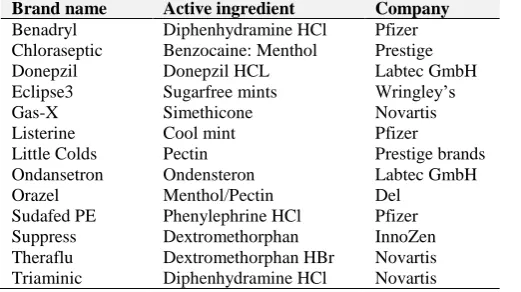
Table 5: Examples of commercially available fast dissolving oral films Brand name Active ingredient Company
Benadryl Diphenhydramine HCl Pfizer Chloraseptic Benzocaine: Menthol Prestige Donepzil Donepzil HCL Labtec GmbH Eclipse3 Sugarfree mints Wringley’s
Gas-X Simethicone Novartis
Listerine Cool mint Pfizer Little Colds Pectin Prestige brands Ondansetron Ondensteron Labtec GmbH Orazel Menthol/Pectin Del
Sudafed PE Phenylephrine HCl Pfizer Suppress Dextromethorphan InnoZen Theraflu Dextromethorphan HBr Novartis Triaminic Diphenhydramine HCl Novartis
Evaluation of fast dissolving tablets 1. Weight variation
20 tablets were selected randomly from the lot and
weighted individually to check for weight variation.
Deviation of±10% is allowed for tablet of less than or
equal to 80mg, ±7.5% deviation is allowed for tablet in between 80 to 250 mg. For a tablet of more than 250
mg, ±5% deviation is allowed33.
2. Tensile Strength
Tensile strength is the measure of force required to break a tablet by compressing it in the radial direction and is measured using a tablet hardness tester. The plunger of the hardness tester is driven down at a speed of 20 mm/min for measuring the hardness of the tablets34.
3. Friability
The friability test for a tablet is carried out and the limit is not more than 1% using tablet friability apparatus, carried out at 25 rpm for 4 min (100 rotations). Big challenge for a formulator is that how to achieve friability within this limit for FDT product keeping hardness at its lowest possible level in order to achieve a minimum possible disintegration time. This test is again not applicable for lyophilized and flash dose tablets, but is always recommended for tablets prepared
by direct compression and moulding techniques11,15.
4. Moisture Uptake Study
Mouth dissolving tablets have high concentration of hydrophilic excipients with the minimum possible hardness which together contributes to their increased susceptibility to moisture uptake hence special attention is required during the storage and packaging of these dosage forms. The test can be carried out by keeping ten tablets along with calcium chloride in a
dessicator maintained at 37°C for 24 hr to ensure complete drying of the tablets. The tablets are then weighed and exposed to 75% RH, at room temperature for 2 weeks. For achieving the required humidity keep saturated sodium chloride solution in the dessicator for 24 hr. The tablets are reweighed and the percentage
increase in weight is recorded35.
5. Tablet Porosity
The mercury penetration porosimeter can be used to measure the tablet porosity which is a relative assessment of the degree of water penetration in the
formulation, responsible for its fast disintegration9,16.
6. Wetting Time and Water Absorption Ratio This study is carried out by using a piece of double folded tissue paper placed in a petri dish containing 6 ml of water. One tablet was placed on this paper and the time for complete wetting of tablet was noted as wetting time. The wetted tablet was then weighed and the water absorption ratio, R, was determined according to equation.
Where Wb and Wa are the weights of tablet before and after water absorption respectively. Where R is water
absorption ratio28.
7. In-vivo disintegration time
The time for disintegration of Orally Disintegrating tablets is less than one minute and in actual it is just 5
to 30 seconds time duration for the disintegration25,26.
8. Dissolution Test
with scouting runs for a bioequivalent orally dissolving tablets. Other media such as 0.1N HCl and buffers (pH - 4.5 and 6.8) should be evaluated for orally dissolving tablets much in the similar way as conventional tablets. USP dissolution apparatus 1 and 2 can be used for this study. USP 1 Basket apparatus may have certain applications, but sometimes, tablet fragments or disintegrated tablet masses may become trapped on the inside top of the basket at the spindle where little or no effective stirring occurs, yielding irreproducible dissolution profiles. USP 2 Paddle apparatus, which is the most suitable and common choice for ODTs, with a paddle speed of 50 rpm commonly used. Typically, the dissolution of tablets is very fast when using USP monograph conditions; hence, slower paddle speeds may be utilized to obtain a profile. The USP 2 Paddle apparatus at 50 to 100 rpm is suitable for dissolution
testing of taste-masked drug as well36,37.
FAST DISSOLVING ORAL FILMS
Fast dissolving oral films (FDOFs) are the most highly developed form of oral solid dosage form due to more flexibility and comfort. It improves the efficacy of drugs by dissolving within 60 seconds in oral cavity after the contact with saliva without chewing and no
need of water for administration38. It gives rapid
absorption and instant bioavailability of drugs due to high blood flow and permeability. Fast dissolving oral films are based on the technology of the transdermal patch. Sometimes taste masking agents are also added
to mask the taste of the active ingredient34. Fast
dissolving oral films have advantages like:
1. Thin film is more stable, durable and quick
dissolving than other conventional dosage forms.
2. Improved dosage accuracy as compared to liquid
formulations.
3. No need of water with improved patient
compliance. Does not interfere with normal
function like talking, drinking etc11.
4. Accessibility of larger surface area that leads to
quickly disintegrate and dissolution in the oral cavity within seconds.
5. No first-pass hepatic metabolism thus improved
bioavailability25.
6. Ease of handling and transportability.
7. Pleasant mouth feel
Formulation methodology for fast dissolving films 1. Solvent casting method
In solvent casting method water soluble polymers are dissolved in water and the drug along with other excipients is dissolved in suitable solvent then both the solutions are mixed and stirred and finally casted in to
the Petri plate dried and cut in to uniform dimensions38.
2. Semisolid casting
In semisolid casting method firstly a solution of water-soluble film forming polymer is prepared. The resulting solution is added to a solution of acid insoluble polymer (e.g. cellulose acetate phthalate, cellulose acetate butyrate), which was prepared in ammonium or sodium hydroxide. Finally the gel mass is casted in to the films or ribbons using heat controlled drums. The thickness of the film is about 0.015-0.05
inches. The ratio of the acid insoluble polymer to film
forming polymer should be 1:439.
3. Hot melt extrusion
In hot melt extrusion method firstly the drug is mixed with carriers in solid form. Then the extruder having heaters melts the mixture. Finally the melt is shaped in to films by the dies.
4. Solid dispersion extrusion
In this method immiscible components are extrude with drug and then solid dispersions are prepared. Finally the solid dispersions are shaped in to films by means of dies
5. Rolling method
In rolling method a solution or suspension containing drug is rolled on a carrier. The solvent is mainly water and mixture of water and alcohol. The film is dried on
the rollers and cut in to desired shapes and sizes16,17.
Technologies for fast dissolving films 1. Wafer Tab
Wafer Tab is a drug delivery system which incorporates pharmaceutical actives into an ingestible film strip. It provides rapid dissolution and release of active pharmaceutical ingrdient when the strip comes into contact with saliva in the mouth. The WaferTab film strip can also be flavoured for additionally improved taste-masking. The film can be prepared in a variety of shapes and sizes and is an ideal method for delivering medicines which require fast release and also for use by patients who have difficulty
swallowing40.
2. XGEL
XGel film Technology developed by BioProgress was causing a revolution in the product offerings and manufacturing methods. It is nonanimal-derived, approved on religious grounds and is suitable for vegetarians. These film can be taste masked, coloured, layered, and capable of being enteric properties whilst also having the ability to incorporate active pharmaceutical ingredients. The XGEL™ film systems can be made to encapsulate any oral dosage form, and
can be soluble in either cold or hot water41.
3. Foamburst
In this technology gas is blown into the film during production, resulting in a film with a honeycombed structure. The voids in the film may be gas-filled, empty or filled with other materials to produce specific taste-burst characteristics or to deliver active drugs. The light honeycombed structure results in capsules that dissolve rapidly, causing a melt-in-the mouth sensation. This technology has attracted interest from food and confectionary manufacturers as a means of
carrying and releasing flavours42.
4. Soluleaves
This technology is used to produce a range of oral
delivery films that can incorporate active
ingredients, colours and flavours. In this technology the film is produced in order to release the active ingredients on coming in contact with saliva. These are designed in such a way that they adhere to mucous membrane in order to release the drug slowly in
Evaluation parameters 1. Thickness
The thickness of the patch is measured using digital Vernier Calliper with a least count of 0.01 mm at different spots of the film. The thickness was measured at three different spots of the patch and average was
taken and SD was calculated44.
2. Weight variation
A particular centimeter square of the film is cutted at different places from the casted film. The weight of
each film is taken and weight variation is calculated22.
3. Folding endurance
Folding endurance is determined by repeated folding of the film at the same place till the strip breaks. The number of times the film is folded without breaking is
computed as the folding endurance value25.
4. Tensile strength
Tensile strength is the maximum stress applied to a
point at which the film specimen breaks45. It is
calculated by the applied load at rupture divided by the cross-sectional area of the film as given below:
5. Percent elongation
A film sample stretches when stress is applied and it is referred to as strain. Strain is basically the deformation of film divided by original dimension of the sample. Elongation of film increases as the plasticizer content increases.
Where, L = Increase in length of film, Lo = Initial length of film.
6. Surface pH
The film to be tested was placed in a petri dish and is moistened with 0.5ml of distilled water and kept for 30sec. The pH is noted after bringing the electrode of the pH meter in contact with the surface of the
formulation and allowing equlibriation for 1min35.
7. Uniformity of drug content
This parameter is determined by dissolving one film of dimension 2x2cm by homogenization in 100 ml of stimulated saliva of pH 6.8 for 30 min with continuous shaking. The absorbance was measured using an UV
spectrophotometer37.
8. In vitro dissolution studies
Dissolution profile of fast dissolving films is carried out using USP type II (paddle apparatus) with 300 mL of simulated salivary fluid (pH 6.8) as dissolution medium maintained at 37±0.50C. Medium was stirred at 100 rpm. Samples were withdrawn at every 30sec interval, replacing the same amount with the fresh medium. Amount of drug in the withdrawn samples was determined by UV spectrophotometer.
9. Ex vivo permeation studies through porcine oral mucosa
Permeation studies were carried using the modified Franz diffusion cell of specific internal diameter. The buccal pouch of the freshly sacrificed pig was procured from the local slaughter house. The buccal mucosa of the freshly sacrificed pig or mouse is used for this purpose and washed in isotonic phosphate buffer of pH
6.6 and used immediately. Samples obtained are
studied by UV spectrophotometer46.
CONCLUSION
Due to decline in dysphagia swallowing ability with age, many elderly patients complain that it is difficult for them to take some currently used dosage forms such as tablets, capsules, or powders, fast dissolving tablets are thus a best alternative of these dosage forms. Fast dissolving tablets formulations obtained by some of these technologies have sufficient mechanical strength, quick disintegration/dissolution in the mouth. An extension of market monopoly, which can be provided by a fast-dissolving tablets or oral, films/disintegrating dosage form, leads to increased revenue of the pharmaceutical company which is also leads to target underserved and undertreated patient populations. Their unbeatable advantages such as administration without water, anywhere, anytime lead to their suitability to geriatric and pediatric patients.
Rapid onset, good stability and increased
bioavailability lead to its current growth in the market which is extended day by day.
ACKNOWLEDGEMENTS
Author express sincere thanks to Mr. Tarun Virmani, Assistant Professor, MVN University for guiding and supporting the authors during the work.
CONFLICT OF INTEREST
No conflict of interest associated with this work.
REFERENCES
1. Chawdory YK, Saumya M, MadhuBabu M, et al. A review on fast dissolving drug delivery systems- A pioneering drug delivery technology. Bull Env Pharmacol. Life Sci 2012; 1 (12):08- 20.
2. Vikas A, Bhavesh HK, Derek VM, Rajendra KK. Drug delivery: Fast dissolve systems. Encycl Phar Tech 2007; 1: 1104–14. https://doi.org/10.4103/2231-4040.90877
3. Kumar A, Bhushan V, Singh M, Chauhan A. A review on evaluation and formulation of Fast dissolving tablet. Int J Drug Res Tech 2011; 1(1): 8.
4. Saini S, Nanda A, Hooda M, Komal. Fast dissolving films (FDF): innovative drug delivery system. Pharmacol Online 2011; 2: 919-928.
5. Kuchekar BS, Badhan A, Mahajan C, H S. Mouth dissolving Tablets: A novel drug delivery system. Pharma Times 2003; 35: 7-9. https://doi.org/10.4103/0250-474X.73930
6. Reddy LH, Ghosh B and Rajneesh. Fast dissolving drug delivery systems: A review of the literature. Indian J Pharm Sci 2002; 64(4): 331-336.
7. Yadav G, Kapoor A. Bhargava S. Fast dissolving tablets recent advantages: A review. Int J Pharm Sci Res 2012; 3(3): 728-738.
https://doi.org/10.13040/IJPSR.0975-8232.3(3).727-36
8. Lieberman HA, Lachman L, Schwartz JB. 2nd
ed. Vol. 3. New York: Marcel Dekker Inc; 2005. Pharmaceutical Dosage Forms: Tablets; 187.
9. Nautiyal U, Singh S, Singh R, Kakkar S. Fast dissolving tablets a novel boon: A review. J Pharm Chem Bio Sci 2014; 2(1): 5- 26. https://doi.org/10.22159/ijcpr.2018v10i2.25876
10.Jha SK, Geethalakshmi A, Bhatia V, Shukla TP. ODT: A technology for mankind. J Glob Pharm Tech. 2010; 2; 11-17.
11.Vaishali B, Khadbadi SS, Purushottam, Patil R, Malik S. Fast dissolving tablets: A novel approach to drug delivery. Indo Am J Pharm Res 2016; 6(4): 5009- 5023.
12.Roy A. Orodispersible tablets: A review. Asian J Pharm Clin Res 2016; 1:19-26. https://doi.org/10.4103/0976-9668.71663
13.Kumar S, Garg SK. Fast dissolving tablets (FDTS): Current status, new market oppurtunities, recent advances in manufacturing technologies and future prospects. Int J Pharm Pharm Sci 2014; 6(7): 22-35.
14.Sehgal P, Gupta R, Singh U, Chaturvedi A, et al. Fast delivery Tablets: A new venture in drug delivery. Am J Pharm Tech Res 2012; 2(4): 252- 279.
15.Gandhi A. Mouth dissolving tablets: A new venture in modern formulation technology. Pharm Innov 2012; 1(8): 14- 31.
16.Roser BJ, Blair J. Rapidly Soluble Oral Dosage Forms, Method of making same and Compositions Thereof. US patent No., US 5762961, 1998.
17.Sharma D, Kaur D, Verma S, Singh D, et al. Fast dissolving oral films technology: A recent trend for an innovative oral drug delivery system. Int J Drug Deliv 2015: 60- 75.
18.Arya A, Chandra A, Sharma V, Pathak K. Fast dissolving oral films: An innovative drug delivery system and dosage form. Int J Chem Tech Res 2010; 2(1): 576- 583.
19.Chaturvedi A, Shrivastva P, et al. Fast dissolving films: A review. Current Drug Deliv 2011; 8(4): 373- 380.
https://doi.org/10.2174/156720111795768022
20.Nweje-Anyalowu Paul C, Anyalogbu Ernest AA, White AJ. Design and evaluation of chronotherapeutic pulsatile drug delivery system of Cilnidipine. Universal J Pharm Res 2017; 2(5): 18-22. https://doi.org/10.4161/biom.1.1.17717
21.Shruti C, Prabhu, Parsekar SD, Shetty A, et al. A review on fast dissolving sublingual films for systemic drug delivery. Int J Pharm and Chem Sci 2014; 3(2): 501- 511.
22.Kumar SV, Gavaskar B, Sharan G and Rao YM. Overview on fast dissolving Films. Int J Pharmacy Pharm Sci 2010; 2(3): 29-33.
23.Arora P, Sethy VA. Orodispersible tablets: A comprehensive review. Int J Res Dev Pharm L Sci 2013; 2(2): 270- 284.
PMID: 27168675
24.Verma BK, Pandey S, Arya P. Tablet granulation: current scenario and recent advances. Universal J Pharm Res 2017; 2(5): 34-39.http://doi.org/10.22270/ujpr.v2i5.RW1
25.Nayak AK, Manna K. Current developments in orally disintegrating tablet technology. J Pharm Edu Res 2011; 2(1): 21- 34.
26.Irfan M, Rabel S, Bukhtar Q, et al. orally disintegrating films: A modern expansion in drug delivery system. Saudi Pharm J 2015; 24(5): 537- 546.
https://doi.org/10.1016/j.jsps.2015.02.024
27.Pahwa R, Piplani M, Sharma PC, Kaushik D, Nanda S. Orally disintegrating tablets-friendly to pediatrics and geriatrics. Archi of Appli Sci Res 2010; 2(2): 35–48.
28.Sharma D. Formulation development and evaluation of fast disintegrating tablets of salbutamol sulphate for respiratory disorders. Int Scholar Res Noti 2013; 1- 8.
https://doi.org/10.1155/2015/640529
29.Gupta DK, Bajpai M, Chatterjee DP. Fast mouth dissolving disintegrating tablet and patient counseling points for FDDTs- A review. Int J Res Devol in Pharm Lif Sci 2014; 3(3): 949- 958.
30.Igwe J. Chibueze, Emenike IV, Oduola AR. Formulation and evaluation of Finasteride sustained-release matrix tablets
using different rate controlling polymers. Universal J Pharm Res. 2016; 1(2): 25-31.http://doi.org/10.22270/ujpr.v1i2.R3
31.Sharma D, Singh G, Kumar D, Singh M. Formulation development and evaluation of fast disintegrating tablets of salbutamol sulphate, cetrizine hydrochloride in combined pharmaceutical dosage form: A new era in novel drug delivery for pediatrics and geriatrics. J Drug Deliv 2015: 1- 10. https://doi.org/10.1155/2015/640529
32.Heer D, Agarwal G, Harikumar SL. Recent trends in fast dissolving drug delivery system- An overview of formulation technology. Pharmacophore 2013; 4 (1): 1-9.
https://doi.org/10.4103/2231-4040.90877
33.Prajapati BP, Ratnakar N. A Review on recent patents on fast dissolving drug delivery system. Int J of Pharm Tech Res 2009; 1 (3): 790-798.
https://doi.org/10.2174/187221131303191125162209
34. Zade PS, Kawtikwar PS, Sakarkar DM. Formulation, evaluation and optimization of fast dissolving tablet containing tizanidine hydrochloride. Int J Pharm Tech Res 2009; 1: 34–42.
35.Praksh V, Maan S, et al. Fast disintegrating tablets: Opportunity in drug delivery system. J Adv Pharm Technol Res. 2011; 2(4): 223- 235.
https://doi.org/10.4103/2231-4040.90877
36.Chauhan V, Kumar K, Teotia D. Fast dissolving tablets: a promising approach for drug delivery. Universal J Pharm Res 2017; 2(4): 58-64. https://doi.org/10.4103/2231-4040.90877
37.Saka M, Singh S. A review on advancement in mouth dissolving tablets Research. J Pharm, Biol Chem Sci 2012, 824-36.
38.Siddiqui MDN, Garg G, Sharma PK. A short review on a novel approach in oral fast dissolving drug delivery system and their patents. Adv Bioll Res 2011; 5 (6): 291-303,
39.Nandy BC, Mazumder B, Pathak K, Saxena N. An overview on fast dissolving drug delivery system. Am J Pharm Sci Res 2011; 1 (2), 2249-4898.
40.Dey P, Maiti S. Orodispersible tablets: A new trend in drug delivery. J Nat Sci Biol Med 2010; 1(1), 2-5.
https://doi.org/10.4103/0976-9668.71663
41.Ghosh T, Ghosh A, Prasad D. A Review on Orodispersible tablets and its Future prospective. Int J Pharm Pharm Sci 2011; 3: 1.
42.Siddiqui MD, Garg G, Sharma PK. A Short Review on A Novel Approach in Oral fast dissolving drug delivery system and their patents. Adv Biol Res 2011; 5 (6), 291-303.
43.Ghodake PP, Karande KM, Osmani RA, Bhosale RR, Harkare BR and Kale BB. Mouth dissolving films: An innovative vehicle oral drug delivery. Int J Pharma Res Rev 2013; 2(10):41-47.
44.Shah Murad Mastoi, Azmat Ali, Hina Aslam, Khalid Niaz. Comparision of antidyslipiemic potential of 80 milligrams of Fenofibrated with 8 grams of Nigella sativa seeds daily. Universal J Pharm Res 2017; 2(6): 50-52.
https://doi.org/10.22270/ujpr.v2i6.R9
45.Kannuri R, Challa T, Chamarthi H. Taste masking and evaluation methods for orodispersible tablets. Int J Pharm Ind Res 2011; 1(3):201-210.
https://doi.org/10.4103/0976-9668.71663