higher education institution
E.M. Stoffberg
lLibrary and Information Services, Tshwane University of Technology Private Bag X680, Pretoria 0002, South Africa
[email protected]
and
A.S. Blignaut
2
Faculty of Education, North West University Potchefstroom, South Africa
Seugnet.
[email protected]
Received: 12thDecember 2006
Accepted: 29th October 2007
This paper analyses and evaluates the current institutional Information Literacy Training Programme (ILTP) at the Tshwane University
of
Technology. The Library and Information Services re-examines its ILTPs from previously merged Technikons in terms of the background and conditions as well as the design and approval of a new programme. This baseline evaluation examines the development of a training programme for scholars using electronic databases in the contact on-campus delivery mode and to the proposed multimodal training approach. We recommend the content, format, assessment approaches and delivery mode for the ILTP.Keywords: Information literacy; electronic databases; academic libraries; online learning; multi modal learning
Introduction
Databases in the information world have changed from merely card systems to sophisticated electronic research tools, demanding very specific user skills. Students and staff members are per se not trained to use the new media. Former Information literacy training programmes (ITLP) designed to transfer literacy skills are generally presented only on-campus and are not web-enabled. With the merger of three former technikons (Technikon Pretoria, Technikon Northern Gauteng, Technikon North-West), Tshwane University of Technology (TUT) faces a new dispensation that demands new approaches to ensure the accommodation of all stakeholders. A transparent design and development process should include both the technology-enabled generation as well as previously disadvantaged student communities.
Background
At TUT we realise the importance of Information Literacy to support students in their learning, enhance their careers and ultimately prom'ot~ lifelong learning (Zinn, 2000, De Jager and Sayed, 1998). Consequently, we designed and developed an ILTP according to,the Australian and New Zealand Information Literacy Framework standards for the dissemination of the knowledge and skills of dealing with online electronic databases (Bundy, 2004).
We faced a number ~f.~hallenges to successfully introduce the new programme as information literacy training is a relatively new library function. Unexpected new factors such as large classes, insufficient library staff to meet the training demand and inadequate training facilities such as appropriately equipped lecture and computer training rooms confronted us. The current ILTP is a voluntary training initiative and the Institution makes no provision in its timetables for students to attend information literacy training sessions. Moreover, faculty frequently requests library staff to address specific domain-related objectives during training sessions. Librarians are generally not prepared to facilitate large student groups. The traditional contact programme almost completely excludes off-campus students unless librarians visit the remote learning sites. The vast increase of distant learners at TUT compels librarians to support and to provide for such students (Ojedokun, 2000). Therefore, ILTP doesn't reach the students targeted in TUT's Information Literacy policy (TUT Library and Information Services, 200Sa).
Inadequate allocation of financial and human resources leads to severe constraints on the effective development and implementation of a profound ILTP.A team consisting of a single training librarian cannot make full use of the advances in
I. Ms Elsa Stoffberg is a Training Librarian, Library and Information Services, Tshwane University of Technology Pretoria Campus, South Africa.
ICT for education in terms of design, development, implementation, evaluation and maintenance of a programme of this scale. The demand calls not only for the support of librarians, and for providing training facilities such as computer and training rooms, but also for additional educational technology aids such as data projectors, DVD players, headphones and interactive classroom-management systems. These created huge and unexpected demands on the library budget.
Initiating the information literacy training programme
In February 2005 the LIS executive committee (EXCO) formulated its strategic and executive plans for 2005 and beyond, including the development and implementation of an ILTP (TUT Library and Information Services, 2005b). The LIS EXCO mandated the Information Literacy Training Committee to design, develop, and implement an ILTP at TUT to integrate access of information resources for the development of students' academic, extra-curricular and personal and career development activities. At the meeting in August 2005, the Information Literacy workgroup proposed a draft policy on Information Literacy training that mandated targeting all TUT students and academics, meeting the institutional requirements for academic programmes, and aligning the programme to the TUT skills and development policies (TUT Library and Information Services, 2005c).
The LIS became the first non-academic department represented in the Partners@Work initiative of the Directorate of Telematic Education (TE) at TUT. This programme provides a year-long intensive training and development in curriculum design, pedagogy, online student-support, communication and the use of technology at higher educational institutions. This initiative aligns with the Virtual Learning Environment (VLE) training programme of the Waterford Institute of Technology Libraries, Waterford, Ireland (Quinlan and Hegarty, 2006). Ms V. Agyei, Executive Director of LIS, appointed the training librarian to the project for the period of July 2005-June 2006 (TUT Library and Information Services, 2005a). The training librarian had to explore, investigate and augment the ILTP according to the specifications of the South African Qualifications Authority's (SAQA) She also redesigned the contextual aspects of the programme, selected and assigned appropriate educational technologies to enhance teaching and learning, and made the programme accessible within the constraints of budgetary and human resources.
Information literacy training programmes
Nationally and internationally higher education institutions list the required information literacy skills to successfully conduct independent study. These include the recognition of required information, the ability to retrieve the information from library catalogues, electronic databases or other collections, and the skill to use the information delivered to users in different formats (Tucker and Palmer, 2003). Information-literate students should be able to assess the value of information (peer-reviewed versus popular information) and effectively use it within ethical and legal boundaries of plagiarism and copyright. Such competencies enable developing students to operate as citizens of the knowledge society (Maybee, 2006).
We grouped the various information literacy content and skills as modules for the new ILTP (Table I). Module five (Electronic Databases) is a crucial component for all students and academics as it includes the independent retrieval, evaluation, and application of recent peer-reviewed electronic information.
Table I Modules of the Information Literacy Training Programme at TUT
Module I
Module 2
Module 3
Module 4
Module 5
Module 6
Introduce the library and its services.
Locate information in the library by using the library homepage and in-house databases.
Use relevant formats of printed and multimedia.
Access, retrieve, evaluate, and apply scholarly information published on the Internet.
Identify and use electronic databases on the Electronic Resources Portal.
Use the Harvard style of referencing in research reports.
During the first four months of 2006 we received requests for Module Five training from many academic departments. Due to insufficient resources, it was not possible to accommodate all requests. The high demand for training on electronic databases, as well as the imperative to change the delivery mode, Module Five (Table I) became the first module developed and delivered in the new format.
Baseline evaluation of the existing information literacy programme
units of module five. We standardised, designed and customised the module content according to national and international standards. Six specific outcomes made up the module (Table2).
Table 2
Baselineevaluationof the existingtraining Module FiveTime: 180 minutes Units
5.1
Characteristics and terminologies of electronic databases
Identify and use electronic databases on the Electronic Resources Portal (ERP)
Specific outcomes Methods Media
Familiarise students with • database characteristics • terminologies
• types
• nature of electronic information,
Facilities
5.2
Access to the ERP
5.3
Selection of databases
5,4 Search techniques 5.5 Evaluation criteria 5.6 Practical experience
Introduce students to • access the LIShomepage
• logon to the ERP with own student number • navigate and retrieve electronic resources • logon to a database
• use URL and ERP logon information Introduce students to
• available databases • database coverage • specific databases Allow students to • identify a specific topic • analyse a topic • use Boolean operators • use truncation • optimise search results Allow students to
• search popular and scholarly information • evaluate Internet-based information • evaluate electronic databases information Demonstrate successful
• access to ERP information • selection of appropriate databases • planning of search strategies • retrieval and refining of search results • marking and exporting of articles
c: 0 .;:; u ::l b VI .!: -0 VI
Q)
~
~
~
u 0.IT .!: ..c:VI VI
Q) Q)
::l
:s1
a. .~
E
•..
u en VI~
VI VI~ ~
Q)u '-
•..
u Q)0- c: u
•..
(ij(ij '0
~
0c:
•..
c:0 ::l a.. Q) -0
.;:; -0 '- c: Q)
'5 .;; Q) '-
•..
'5
~
2l c:~
~
'C.E .E a..
At the Pretoria learning site, Module Five training normally comprises a 180 minute contact session with 20-30 participants in a computer training room with direct accessto the electronic databases.During this campus-basedtraining we use animated demonstrations or direct access of electronic databasesto enhance the learning. NetOpSchool™, a network program, creates a trainer-controlled computer classroom that enables the trainer to access participants' computers from a console and attend to their learning problems without scurrying from student to student. The limited number of students and the controlled environment ensure a smooth course delivery and ease the participants through the basic procedures to advanced and more complex searches.The time allocated is normally sufficient to complete the scheduled learning tasks.
Advantages
of the existing programme
During a contact session we interact with a spectrum of knowledge and information on electronic databasesrelating to terminology, retrieval, and the evaluation of information. Although it requires more preparation, we customise examples for different disciplines, subject areas and user groups. Traineesaccessthe electronic databasesvia computer terminals to practise and apply their newly attained information-literacy skills under the guidance of the training librarian. Training sessionsare scheduled according to the time table of the user group.
Challenges
of the existing programme
require the presence of information technology (IT) support staff to ensure technical efficacy. Only on-campus students
can currently be accommodated, leaving little chance for off-campus or part-time students to attend training sessions. As information literacy training is not compulsory, many students never attain these skills.
We soon realised that the students needed basic computer literacy skills for the training programme. Students with insufficient skill are referred to a campus computer literacy training programme before commencing the ILTP. However,
Don Tapscott (1998) refers to the first generation of students that grew up with electronic technology as the "Net Generation". Lippencott (2005) points out that the Net generation may be technology-savvy but lacks basic academic and research skills. A new ILTP should provide for TUT's diversity in student competencies.
Currently, course notes are distributed during training sessions, but they should form an integral part of the new ILTP. Course notes should also be available in a variety of formats to accommodate all users.
Many students prefer to seek information via the Internet. Lippencott (2005) maintains that only 28% of Colorado State University students use databases, while 58% use Google ™ and other search engines for information searches. The
crucial issue, therefore, is that web-enabled students' first search in Google, and thereafter seek the traditional library web pages and library catalogues. A new ILTP should recognise this tendency.
Current contact training mode versus
multi modal
training approaches
Table 3
Comparison of contact tuition, online delivery and multimodal training approachesAspect Contact mode Online delivery Multimodal training
Content • Flexible content • Stable content
• Flexible order of content
• Flexible order of content
• Stable content • Additional links
• Linked to media
• Uniform training • Remote access
• Combination of notes. CD-ROMs
• Fixed order of content • Self-paced exercises and online formats
Learning • Achievable learning outcomes • Achievable outcomes • Achievable outcomes
outcomes • Locus of control with trainer • Locus of control with student • Locus of control with student
Duration
• Self-determinate
• Self-paced • Self-determinate
• 180 minutes • Reliant on system speed • Reliant on system speed
Access • On campus • On campus
• On campus • Off campus • Off campus
Computer • Web browsers
literacy • Web browsers • Web browsers • e-Mail
• e-Mail • e-Mail • MS Word'.
• MS Word'. • MS Word'. • PDFs
• PDFs • PDFs • Additional media
Training • Scheduled classes
• Anytime • Any time
schedule
• Anywhere • Anywhere
• Customized sessions
• Insufficient opportunities • Indefinite repeats • Indefinite repeats
Availability • On campus
• Any time
• Scheduled hours • Anytime • LMS dependant
• Librarian's office hours • LMS dependant • Available as separate media
• On-campus computer training facility • Any-where • Anywhere
Facilities
• Off-campus computer training facilities • Off campus computers • Off-campus computers
at other learning sites • Internet access • Internet access
Online instruction should take its rightful place next to on-campus training to serve the broad and divers community of learners (Gutierrez and Wang, 200 I). Librarians spend much time and effort on campus students, while the LIS policy stipulates that the broader TUT cliental should be served via the electronic media. A multi modal technology-based approach to training can address many of the above-mentioned challenges. Technology ensures students' access to
training material from remote sites in their own time and at their own pace (Tricarico et
aI.,
200 I). Flexible learning
becomes possible -- catering to all students'
requirements
by removing the barriers of time, space and location
(Th6rsteinsd6ttir, 200 I, Scott and Alexander, 2000). A real student-centred
approach then becomes viable. E-Iearning
provides the opportunity to use powerful multimedia for learning, resulting in cost benefits for the institution. Also, online
and multimodal approaches demand the use of a wider range of resources than before. Table 3 provides a summary of
the different training approaches.
Online tutorials and multimedia should supplement, not replace, the human intervention (Gutierrez and Wang, 200 I).
UNISA augments written assignments and examinations through a student-tracking system that includes study guides and
various self-paced activities (Machet and Behrens, 2000). UNISA realises that study material should also be available in
printable format, be presented
in a short period of time include practical contact sessions, and contain generic
explanations and examples. They accomplished all this with a reduced staff (Machet, 2005). At TUT, we encountered
many of the same challenges when redesigning a new ILTP.
Student
statistics
and training numbers
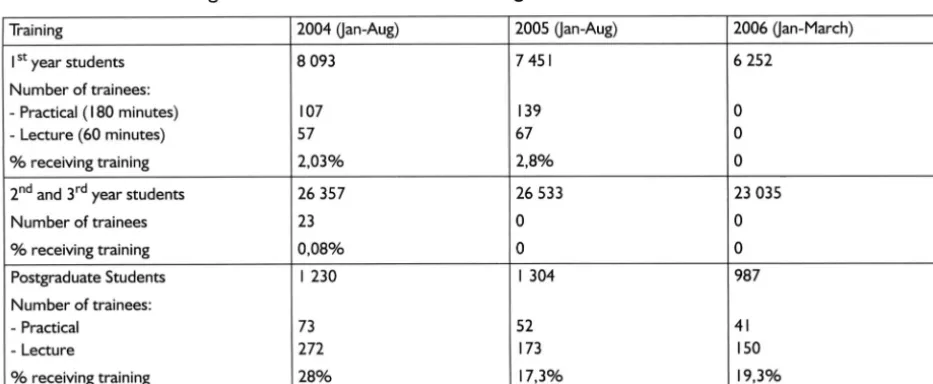
TUT's registration and training statistics indicated that the LISdoes not attain its goal of serving the intended student
population. In this paper, we list statistics from the Pretoria learning site to report the current situation and make future
projections (Table 4).
Table 4
Pretoria learning site student and Module Fivetraining statistics
Training 2004 Oan-Aug) 2005 Oan-Aug) 2006 Oan-March)
Ist year students 8093 7451 6252
Number of trainees:
- Practical (180 minutes) 107 139 0
- Lecture (60 minutes) 57 67 0
% receiving training 2.03% 2,8% 0
2ndand 3rdyear students 26357 26533 23035
Number of trainees 23 0 0
% receiving training 0.08% 0 0
Postgraduate Students I 230 1304 987
Number of trainees:
- Practical 73 52 41
- Lecture 272 173 150
% receiving training 28% 17.3% 19.3%
Table 4 indicates that in 2004, of the 28% post-graduate students only 5.3% received practical training, while 24.7%
attended a one hour lecture. In 2005 these numbers declined to 4% for the practical training and 13.3% for the lecture.
In 2006, 4.1 % received practical training and 15.2% attended a lecture. However, from our experience, the students that
only attended the lecture were more likely to return for information librarian support. It is also clear that the percentage
of students who attained Module Five training remains disappointingly low. It is therefore a priority to re-design the
programme and provide equal opportunities to off-campus and part-time students while maintaining skills proficiency.
However, only the Pretoria learning site has a training librarian and the appointment of more training librarians is
essential.
Proposed framework
for an ILTP
We compiled a proposed framework to address issues of quality training, while increasing trainee numbers. We adapted
and expanded the ILTP modules to optimise students' learning experiences with as many Critical Cross Field Outcomes
as possible (South African Qualifications Authority, 2000). This included a unique combination of media, online activities
and assessment strategies to match learning outcomes with contemporary delivery approaches (Scott and Alexander,
2000, Maybee, 2006, Lippencott, 2005, Quinlan and Hegarty, 2006).
We approached the design and development of the ILTP in phases: commencing with re-evaluating the existing programme through a baseline evaluation, planning the next steps, and constructing a proposed format for the framework. We also took into account the particular requirements of the TUT students, the low budget and staffing constraints, availability of infrastructure, and the existing skills and competencies of the training librarian. In many respects, the training librarian benefited from the Partners@Work programme, and her new skills widely contributed to the new framework. Her newly attained skills included the exposure to a variety of media, curriculum-development strategies and web-based teaching skills.
As the ILTP training is voluntary, the training librarian aimed not to create a formal academic approach but a fun, enjoyable, and memorable online experience. The contemporary graphic user interface (GUI) appeals to students through a colourful, light-hearted and playful tone; the playful content characters; and a motivating storyline. Figure I indicates how the character associated with Module Five, Jonathan Spooner, engageswith a virtual librarian through dialogue.
Table of Contents for Module 5: Electronic Oatabases
1.2 Charc"":eristlts
.. 1.3C!MSlflclitlon
,_ 2.2 E1~ctrorsResw(es
~
2,3; Access the-ERP
85.J:Typesofdatobases
3: 1\m of ciatWase-s
~
J.2W><""msal
data.'>.,es J,JFuI!Textdatawes
8..3.4M~km a$eit!"ton
4Databo'exo'mno
5.": Oatat>llSe searchr19
':.1X!:fchjl-!?rIts
4,2 .4n"kse Y9Ul'Tooe
4,3 BWeflnoperators
4,4Search:T!1f!Cate
~".:. 5 search: Field lilnt
Information Literacy - ELCD: Electronic Database
Your location: Home Pa'Je 'Information Lit"racy Traioln9 ) Leamin9 Modules) MQdul" 5: EI"ctrQnlc Qatabas"s ) 5.1: [n General) 1: [n general
r'ly name is Jonathan Spooner and I'm a first year- student in Journalism.
We had to prepare an assignment on The influence of television on teenagers. I really outdid myself and created an assignment I'm Quite
proud of.
But I've jut been to the lecturer and he infon led me that my assignment is not good enough because I've used only information fl'Om the
Intgm~t. Why, I don't under-stand.
He then said that I should use informa.lli'.ill from Electronic databases to add more "body" to the assignment.
Please help me out here. I don't really know what he's talking about. What on ealth ar-eElectronic Databases. what is he talking about?
I have Questions such as:
+1 What are electronic databases? +1 Why are they special?
+1 Should they be treated and used differently than the Internet?
Figure 1 Graphic user interface of the ILTP
Module Five consists of six learning units linked via a central menu system (Figure I). Students freely navigateamong the pagesand they are not restricted by time to attain the information. To enhance the learning experience, we added the following: a glossary of more than 350 terms; an online guide consisting of an introduction, contact information, site structure; a list of modules in the ILTP outcomes; and assessmentcriteria of the ILTP.We also added supplementary links to additional information on information search techniques, database terminology, and examples relevant to students' assignments.The frequently-asked-question section refersinter alia to questions such as, "Which databasescan I use to obtain reference to SA articles?", "I need to know the latest international research on my topic", or "I need full text information on my topic."
Student activities included online quizzes to reinforce contextual aspects(created with an HTML template), electronic tests at the end of units (created with Respondus
TM),
Internet crossword puzzles (created with EclipseCrosswordTM),
challengesand solutions, online flash cards, games and fill-in-the-blanks exercises (created with StudyMateTM).
At the endof each sub-unit, media on an interactive DVD explains particular issues further. Web-enabled slideshows (created in MS PowerPoint'M and converted with Impatica™), video clips (captured with Camtasia™), and text documents (in PDF) aim to simulate the use of databases.
The outcomes and assessment criteria (in compliance with the SAQA (South African Qualifications Authority, 2000) and institutional standards for academic programmes) forms part of the informal assessment of the programme and a no credit test follows the programme ..However, we aim to determine if students acquired the information literacy skills. The e~d-of-programme summative assessment verifies that students are became information literacy users. They are required to identify the database to retrieve specific information, create search statements, access specific databases, execute and refine searches, select and mark appropriate articles, and export them to an email box.
However, 'a n~mber of aspects remain unresolved and will be addressed during the next phase of programme development. These include: group-work assignments, interactive e-mail communication between programme participants and library staff, a help-desk for additional support to users, the marketing of the ILTP amongst'its users,aS well as inclusion of the ILTP into the TUT web portal. All of these requirewide-ranging competencies from a team of developers -- including role players such as training librarians, curriculum developers, graphical artists, web developers and course facilitators.
Peer review of the proposed programme
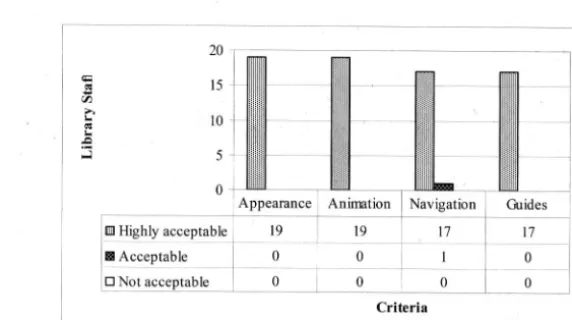
To ensure that the new ILTP was inclusive, efficient and visually appealing, we conducted three peer reviews of the ILTP with the library staff from the Pretoria, Soshanguve and Ga-Rankuwa learning sites. These took place on 4, 5 and 17 May 2006 when nineteen staff members evaluated the appearance of the programme, the animations, navigational aspects, student guides and interactive activities of the online Module Five. The evaluations clearly indicated a positive review of the proposed format, and they allocated a full score to the appearance, animation and guides. Navigational aspects received a 94% approval (Figure 2). The evaluation of student activities such as electronic quizzes, tests, games and self-activities also received a high appraisal (Figure 3).
20
I
15 - --- ~-
---".1-10 - --- ::'
---
=~ill!mi~-5 - ---
~:i
---il!II'!
0
l..-
,_
Appearance Anirretion Navigation Guides
D Highly acceptable 19 19 17 17
-- --
--~ Acceptable 0 0 1 0
- -~- +---- - 1--- --
-D Not acceptab Ie 0 0 0 0
Criteria
Figure 2 Peer review of the graphical user interface of the proposed ILTP
20
~ I I
15
-I,
=-:(
Ijl~=
""!i:::-::
10 5
- !il:':I-~lt:'i .__
J ..___
1'1._
0
Quizzes Respondus™ StudyMate™ Self-activities
III Highly acceptable 18 17 19 19
_._-_.~
-•
Acceptable 0 1 0 0
-DNot acceptable 0 0 0 0
Learner Acthities
All student activities, with the exception of the electronic tests, received full marks from the library staff. In their comments they observed, 'The students will enjoy all the different levels of activities"; "Excellent work. I do like the format", "Never seen something like this"; "the programme is fantastic", and "It is user friendly". The peer review mandated the training librarian to proceed with the design and development of the remaining sections of the ILTP according to the proposed format.
Conclusions
The merger of technikons necessitated the LIS to re-visiting their existing Information Literacy Training Programme to ensure that the new student community housed at the nine learning sites is best served by a generic information literacy programme. The baseline evaluation of the programme, with special reference to Module Five (Electronic Databases), clearly indicated the best practices and areas of improvement. The continued development of the proposed ILTP entails a continued close-cooperation with the Directorate of Telematic Education of the TUT, IT services, Directorate Curriculum Development and Directorate Student Development. Cooperation between all stakeholders will ensure the forming of a community of practice relating to the academic development of TUT students. Also, we advocate the development of more training librarians in the effective use of technology-based training of students in order to sustain the ILTP.Continued support from the LIS EXCO is necessary to further the design, maintenance and delivery of the ILTP to TUT students and academics through the allocation of adequate resources and funding.
We propose that through a process of developmental research, the following issues be investigated:
• What institutional structures are necessary to further develop and maintain an ILTP for a new generation TUT students? • How can a new ILTP be developed to become part of a credit-bearing programme linked to life-long learning
development of TUT students?
• What would the return of investment (RIO) be for a fully-developed ILTP in terms of infrastructure, human resources, development costs, and gains in terms of student development?
References
BUNDY, A. (Ed.) (2004)Australian and New Zealand Information Literacy Framework principles. standards and practice. Adelaide, Australian and New Zealand Institute for Information Literacy.
COGNITIVE APTITUDE ASSESSMENT(2004) BaselineEvaluation.
DE JAGER, K. & SAYED, Y (1998) Aspects of information literacy at five institutions of higher education in the Western Cape. South African journal
of
higher education. 12, 197-203.GUTIERREZ, C. & WANG, J. (200 I) A comparison of an electronic vs. print workbook for information literacy instruction. The journal
of
Academic Librarianship. 27,208-212.HELLER-ROSS,H. (1999) Library support for distance learning programs: A distributed model The journal
of
Library Services for Distance EducationL1PPENCOTT,J. K. (2005) Net generation students & libraries.Educause. March/April 2005, 56-66.
MACHET, M. P.(2005) An evaluation of information literacy courses offered at a distance education university.Mousaion. 23, 180-195.
MACHET, M. P.& BEHRENS,S. (2000) Information literacy through distance learning.Innovation, 8-14.
MAYBEE, C. (2006) Undergraduate perceptions of information use: the basis for creating user-centered student information literacy instruction. The journal
of
Academic Librarianship. 32, 79-85.OJEDOKUN, A. A. (2000) Library support services for distance education in Southern Africa.Africa journal
of
Library. Archives and Information Studies.QUINLAN, N. & HEGARTY, N. (2006) Librarians outside the box: Waterford Institute of Technology's library-based virtual learning environment (VLE) training and development programme.New Library World. 107,37-47.
SCOTT, G. & ALEXANDER, S. (2000) Online learning: rhetoric or reality?
SOUTH AFRICAN QUALIFICATIONS AUTHORITY (2000) The National Qualifications Framework and the StandardsSetting. Pretoria.
TAPSCOTT, D. (1998)Growing up digital: the rise
of
the Net Generation .. New York, McGraw-Hili.THORSTEINSDOTTIR, G. (200 I) Information-seeking behaviour of distance learning students.Information Research.
TRICARICO, M. A., THOLL, S. V. D. & O'MALLEY, E. (200 I) Managingtechnology: interactive online instruction for library research: the small academic library experience.The journal
of
Academic Librarianship. 27,220-223.TUCKER, B. & PALMER,S. (2003) Integration of information literacy training into engineering and technology education. TUT LIBRARYAND INFORMATION SERVICES(2005a) Minutes of the I st meeting of the Executive Committe of the library
and Information Services (LIS) held on 4 February 2005 Tshwane University of Technology.
TUT LIBRARY AND INFORMATION SERVICES(2005b) Minutes of the meeting of the Library and Information Services management committee held on 14January2005. Tshwane University of Technology.
TUT LIBRARY AND INFORMATION SERVICES(2005c) Policy on Information Literacy Training. Tshwane University of Technology.
ZINN, S. (2000) Information Literacy in South Africa: making strides with information and communication technology. IASL Newsletter.