International Journal of Computer Science and Software Engineering (IJCSSE), Volume 6, Issue 9, September 2017 ISSN (Online): 2409-4285 www.IJCSSE.org Page: 202-206
Energy Hole Minimization Using Redundant Route in Wireless Sensor
Network
Md. Abir Hossain1, Md.Ibrahim Khalil2, Nur-E-Alam Siddiqi3 and Md.Mahfuz Reza4
1, 2, 3, 4 Department of Information and Communication Technology, Mawlana Bhashani Science and Technology,
University Tangail 1902, Bangladesh.
1
[email protected], [email protected], [email protected], [email protected]
ABSTRACT
Energy consumption is crucial issue in wireless sensor network. Typically in a sensor network moves on a low traffic load but in case of detection of an event it becomes high. In high traffic load situation, a lot of packets forwarded and also collisions increased. Due to increased collision and a lot of packets forwarding consumes a lot of energy of a sensor node. A few media access control (MAC) protocol has been proposed to handle the variety of both light and heavy traffic load situation among them RC-MAC is one which allows switching of modes to handle different traffic loads. In RC-MAC, nodes waste energy to stay awake and create energy hole in a network. In order to better utilize the conserve energy of a sensor node, we propose a energy hole mitigation technique of Receiver-Centric MAC(RC-MAC) which has better energy conservation and better throughput than RC-MAC. The proposed research work uses a beacon technique that lets nodes to get sleep appropriately between data transmission and change the data routing path to avoid energy hole problem.
Keywords: Energy Hole Problem, Duty Cycling, Asynchronous MAC Protocol.
1. INTRODUCTION
In wireless sensor network, sensor node incorporated with limited battery power, tiny processors and having few megabytes of memory. The nodes are placed at large distance away from the human access and also placed almost 110m apart[1] from each other node.
Application areas of wireless sensor networks are going to be robust and cover almost all sectors in our daily life. Many futuristic applications are developing based on wireless sensor network. Automated irrigation system [2], urban traffic management [3], environmental hazard detection and monitoring, underwater 3D picture sampling and monitoring [4], traffic congestion monitoring, industrial monitoring etc. are example of wireless sensor networks in real life scenarios [5]. Different event driven networks are also present which
exhibit different characteristic then usual kind of wireless sensor network. They normally run in low traffic mode where a node usually has no data or few packets to send unless there is an event in the network. In low traffic mode, nodes can send their data with less contention to the sink node. When an event is detected by the system, it changes adaptively based on incoming traffic. This simultaneous data transmission of a large number of nodes makes the network vulnerable to collision of data packets, which eventually decreases the throughput of the network. It becomes very hard to achieve high throughput in this situation.
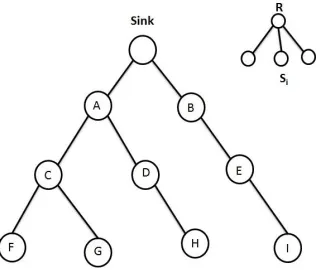
A hierarchical tree structure is shown in Figure 1, where sink is at the top and intermediate nodes are deployed below sink. Each node has a fixed parent to send data. These parents are ideally positioned at center to coordinate data packets of child.
In a tree structure, each node receives packets from multiple senders within the range and sends packets to their own parent. Parent can decrease contention between children by allowing only one child to send at a time. The fairness can be maintained by giving more medium access opportunity to the children with higher bandwidth demand [6]. This kind of technique is useful for basic parent children set but when the network increases linearly then scheduling between nodes becomes difficult. If we can define different frequency channel to different parent- children set then this problem can be solved. The main aim of this paper is If an energy hole is created then new parent node will be selected to forward data packet to sink.
2. RELATED WORKS
203 International Journal of Computer Science and Software Engineering (IJCSSE), Volume 6, Issue 5, May 2017 M. A. Hossain et. al
Fig. 1. General Tree Structure Used In Proposed Scheme For Data Gathering.
This classification is helpful for the researchers to find the right direction in the evolution of MAC protocols. The goal of various protocols differs from each other.
Asynchronous MAC protocol such as, RC-MAC, RI-MAC, in which, main emphasis is on saving the energy without paying the cost of synchronizing between cycles. The different nodes have different active/sleep state and asynchronous MAC protocol looks to communicate between nodes without waking all of them. On contrary, in synchronous MAC protocol all the nodes wake up at the same time. DW-MAC [14] is a synchronous MAC,in which,node wake up synchronously according to their demand to transmit data. At high traffic mode this technique helps to yield to get better throughput. Frame slotted MAC protocol allocated different time slot to nodes so that no two nodes in same neighborhood have the same time slot to communicate, such as Y-MAC [15] This gives solution to the hidden terminal problem and helps to create a collision free environment. Multichannel MAC protocols are developed to increase the network capacity. Tree-MAC [16] is a multichannel MAC protocol which use Multichannel technique to transmit data efficiently.
Asynchronous MAC protocol use sender-initiated Low power listening (LPL) and receiver- initiated Low Power Probing (LPP) is used to decrease the cost and get bet- ter throughput [17]. A-MAC utilizes LPL method in sender node listen for preamble from receiver. RC-MAC integrates scheduling with contention based medium access protocol [18]. It reduces control overhead to improve the performance and lost packets are recovered in a hop by hop recovery pattern. In low traffic mode, RC-MAC adopts a duty cycling mode and sender node stay active and wait silently for receiver to respond. When receiver respond, then senders content for
channel access after taking an initial back off. In high traffic mode, the nodes are scheduled one by one. Only the scheduled child can transmit data, other nodes refrain from sending and take certain back off. RI-MAC is asynchronous MAC protocol which uses receiver initiated data transmission [19]. In RI- MAC, each node wakes up after certain period and check for any incoming data-frame. Sender waits for hearing any beacon from receiver. X-MAC uses a strobed preamble that consists of sequence of short preambles prior to DATA transmission [20]. X-MAC conserve energy by avoiding overhearing while reducing latency almost by half on average. X-MAC uses an algorithm to dynamically adjust receiver duty cycles to optimize for energy consumption per packet, latency, or both.
3. THE PROPOSED SYSTEM OVERVIEW
3.1 Traditional RC-MAC
Traditional RC-MAC is asynchronous MAC protocol which takes advantages of tree structure which is naturally formed in data collection of a sensor network [21]. For this structure, the receiver is able to coordinate senders channel access to reduce contention and improve throughput. In RC-MAC scheduling function is shifted to the receiver side to avoid collision in a basic parent children unit. The scheduling uses the bandwidth demand of different node to give them different channel access opportunities. The scheduling is dynamically adjusted so that no unit can occupy the channel exclusively. The lost packets are recovered in a hop-by-hop pattern with sequence number. In RC-MAC scheduling of the child is done by reusing the ACK in high traffic mode. Parent broadcast an ACK and it is overheard by all of its children. A scheduling message is piggybacked to all of its children with child node ID. After hearing this piggybacked message, only the scheduled child can transmit and other children refrain from transmission of their own packets. But still there remains some unsolved issue which is described below:
3.2 Creation of energy holes in the network
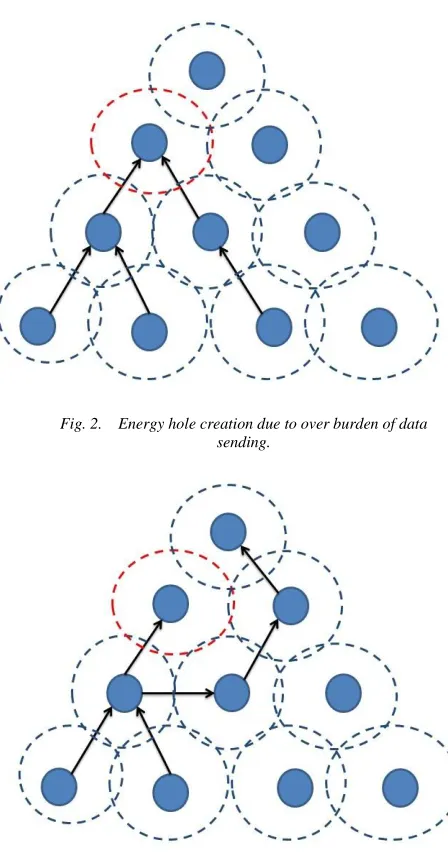
RC-MAC uses a tree- based network topology, in which, sink is situated in the center of different tree structure and nodes are below the sink in a hop-by- hop manner. The nodes which are close to sink have to take the extra load of sending data of other node with their own data.After a certain amount of time, energy deprivation, start to happen in those nodes. In Figure 2, we see that upper-level nodes collect data from lower level nodes and also forward data to their parent, hence extra energy is wasted in these nodes.
The nodes having energy hole problem are prohibited to forward their data to the sink. As a result, part of the network becomes worthless, average delay increases and throughput decreases and a lot of data packet are lost.
204 International Journal of Computer Science and Software Engineering (IJCSSE), Volume 6, Issue 5, May 2017 M. A. Hossain et. al
Fig. 2. Energy hole creation due to over burden of data sending.
Fig. 3. Data routing path alteration.
3.3 Energy-hole Problem Minimization
After forwarding a lot of packets, if any parent node is drain out of energy, their child nodes must find an alternative path or parent to send their data packets. One solution for the problem can be selecting any relay node in nodes interference range. If the node can find a relay node with sufficient energy to send packet to sink then the problem is solved. Battery status of the nodes will be sent in a beacon. In Figure 3, we showed the process of choosing alternate parent to avoid energy hole problem. In later, we describe two different algorithms for checking parent handover situation in case energy threshold is reached and then the next algorithm
find alternate parent after checking their energy threshold value.
Fig. 4. Parent handover check algorithm
Figure 4 describes the algorithm to parent handover check. Here Battery-energy, Msg-packet and energy threshold value is given as input. Battery energy is checked with threshold value and alternate parent is chosen or not is based on the result of checking. After selecting parent node, child node forward data packets to sink.
Fig. 5. Alternate parent algorithm
205 International Journal of Computer Science and Software Engineering (IJCSSE), Volume 6, Issue 9, September 2017 R. Dalai and K. K. Senapati
4. SIMULATION AND RESULT ANALYSIS
We used OMNET++ 4.6 discrete event simulator to simulate the traditional RC-MAC and our proposed EERC- MAC. We can also simulate various other MAC protocols by using this simulator. Event generation and traffic handling can be done swiftly in this simulator. We have used different simulation parameter for simulating RC-MAC and the proposed scheme.
For our simulation, we distributed the nodes in a tree based manner over an 800x100m simulation area in both cases. We fixed battery power to 1000J to complete the simulation in both cases. For the proposed scheme simulation, we reserve threshold value 5 percent energy to detect energy hole problem. For RC-MAC simulation we disabled the threshold value function, because the traditional RC-MAC does not set threshold value for energy awareness.
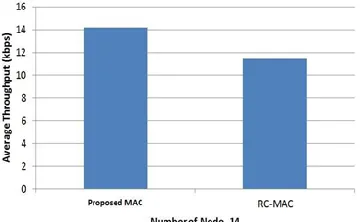
Fig. 6. Average throughput comparison between the proposed scheme and RC-MAC.
We will simulate the same network for both MAC in a test bed of 9, 14, 20 nodes. Nodes are situated in a level-by level manner in increasing number. For first level, there are 2 nodes, for second level there are 3 nodes and next three levels have 4, 5 and 6 nodes each.
We used tree network topology in both simulation and position of nodes is static. Sink node is situated at the top level. Sink collects data from every child node. Each child node is 60m away in same tree level and 80m away below from the upper layer. Carrier sensing range and interference range of these nodes are generally 120m and in special cases it can be increased. Number of nodes can be changed but tree structure will remain for every time. 1.1 Average throughput
In Figure 6, we have shown the result of comparison be- tween the proposed scheme and RC-MAC for 14 node.The distinction between these results in important because, one setback of RC-MAC is the energy hole creation which results in data packet lost, network congestion, decrease the throughput of the system, but in contrast the proposed scheme minimzes the energy hole
creation and increase the throughput. The main goal of improving any MAC protocol is increasing the average throughput and system utilization. The result shows that the average throughput of the proposed scheme is improved considerably compare to RC-MAC because we have succeed to avoid energy hole situation by choosing alternate parent in case the current parent dies. We have described the algorithm before in section III.
4.1 Average success rate comparison
In Figure 7, we first run the simulation for 100s, 200s, 300s, 400s, and 500s respectively, and examined the successful data collection rate between the proposed scheme and RC-MAC. As we solved energy hole situation by choosing alternate parent, hence each child node can send their data packets to their parent more successfully. This solution significantly decreases data packet loss and retransmission. The result shows that the proposed scheme has better success rate than RC-MAC.
Fig. 7. Average success rate comparison between proposed scheme and RC-MAC.
The receiver-centric scheduling improves the performance of data aggregation, when a node has multiple children. If the nodes are in close distance, they search for multiple paths to the sink. Data collection at the sink is higher if receiver centric nature is used.
5. CONCLUSION
206 International Journal of Computer Science and Software Engineering (IJCSSE), Volume 6, Issue 9, September 2017 R. Dalai and K. K. Senapati
Simulation results prove that the throughput is signifi- cantly improved by receiver-centric scheduling. The improved throughput helps also to bring better energy efficiency in nodes battery. In future, we will look forward to search a rechargeable system that never let a network down and always dedicate a redundant network routing path for sending its packets in the network.
REFERENCES
[1] Saifullah, A., Rahman, M., Ismail, D., Lu, C.Chandra,
R., & Liu, J. (2016, November). SNOW: Sensor network over white spaces. In Proceedings of the 14th ACM Conference on Embedded Network Sensor Systems CD-ROM (pp. 272-285).ACM.
[2] Gutiérrez, J., Villa-Medina, J. F., Nieto Garibay, A.,
&Porta-Gándara, M. Á. (2014). Automated irrigation system using a wireless sensor network and GPRS module. IEEE transactions on instrumentation and measurement, 63(1), 166-176.
[3] Nellore, K., &Hancke, G. P. (2016). A survey on urban
traffic management system using wireless sensor networks.Sensors, 16(2), 157.
[4] Gasparoni, F., Aiello, G., Lainati, A.,
Sechi,.,Maddalena, D., Grasso, T., ... &Miozza, L.
(2016, April). Clean Sea-Underwater Robotic
Technology for Environmental and Asset Integrity Monitoring in Deep and Ultra-Deep Water. In SPE International Conference and Exhibition on Health,
Safety, Security, Environment, and Social
Responsibility.Society of Petroleum Engineers.
[5] M. Hassan, L. Murphy, and R. Stewart, “Traffic
differentiation and dynamic duty cycle adaptation in ieee 802.15. 4 beacon enabled wsn for real-time applications,” Telecommunication Systems, vol. 62, no. 2, pp. 303–317,2016.
[6] P. Huang, C. Wang, and L. Xiao, “Rc-mac: A
receiver-centric mac protocol for event-driven wireless sensor networks,” IEEE Transactions on Computers, vol. 64, no. 4, pp. 1149–1161, 2015.
[7] Zhang, Y., Lazos, L., Chen, K., Hu, B.,
&Shivaramaiah, S. (2014, April). FD-MMAC:
Combating multi-channel hidden and exposed terminals using a single transceiver. In INFOCOM, 2014 Proceedings IEEE (pp. 2742-2750).IEEE.
[8] Zeng, X., Li, W., & Ma, Y. (2013, November).
Directional-transmission-based solution for hidden and exposed terminal problems in inter-vehicular network. In Consumer Electronics, Communications and Networks (CECNet), 2013 3rd International Conference on (pp. 289-292). IEEE.
[9] Chakraborty, S., Nandi, S., &Chattopadhyay, S. (2016).
Alleviating hidden and exposed nodes in high-throughput wireless mesh networks. IEEE Transactions on Wireless Communications, 15(2), 928-937.
[10]Agarwal, S., Jain, V., &Goswami, K. (2014). Energy
efficient mac protocols for wireless sensor network.
International Journal on Computational Sciences & Applications (IJCSA), 4(1), 153-160.
[11]Kuila, P., & Jana, P. K. (2014). Energy efficient
clustering and routing algorithms for wireless sensor networks: Particle swarm optimization approach. Engineering Applications of Artificial Intelligence, 33, 127-140.
[12]Kurt, S., Yildiz, H. U., Yigit, M., Tavli, B., &Gungor, V. C. (2017). Packet size optimization in wireless sensor networks for smart grid applications. IEEE Transactions on Industrial Electronics, 64(3), 2392-2401.
[13]P. Huang, L. Xiao, S. Soltani, M. W.Mutka, and N. Xi,
“The evolution of mac protocols in wireless sensor networks: A survey,” IEEE Com- munications Surveys & Tutorials, vol. 15, no. 1, pp. 101–120, 2013.
[14]Y. Sun, S. Du, O. Gurewitz, and D. B. Johnson,
“Dw-mac: a low la- tency, energy efficient demand-wakeup mac protocol for wireless sensor networks,” in Proceedings of the 9th ACM international symposium on Mobile ad hoc networking and computing. ACM, 2008, pp.53–62.
[15]Y. Kim, H. Shin, and H. Cha, “Y-mac: An
energy-efficient multi-channel mac protocol for dense wireless sensor networks,” in Proceedings of the 7th international conference on Information processing in sensor networks. IEEE Computer Society, 2008, pp.53–63.
[16]W.-Z. Song, R. Huang, B. Shirazi, and R. LaHusen,
“Treemac: Local- izedtdma mac protocol for real-time high-data-rate sensor networks,” Pervasive and Mobile Computing, vol. 5, no. 6, pp. 750–765, 2009.
[17]P. Dutta, S. Dawson-Haggerty, Y. Chen, C.-J. M.
Liang, and A. Terzis, “A-mac: A versatile and efficient receiver-initiated link layer for low- power wireless,” ACM Transactions on Sensor Networks (TOSN), vol.8, no. 4, p. 30, 2012.
[18]P. Huang, C. Wang, L. Xiao, and H. Chen, “Rc-mac: A
receiver-centric
mediumaccesscontrolprotocolforwirelesssensornetwork s,”inQuality of Service (IWQoS), 2010 18th International Workshop on. IEEE, 2010, pp.1–9.
[19]Y. Sun, O. Gurewitz, and D. B. Johnson, “Ri-mac: a
receiver-initiated asynchronous duty cycle mac protocol for dynamic traffic loads in wireless sensor networks,” in Proceedings of the 6th ACM conference on Embedded network sensor systems. ACM, 2008, pp.1–14.
[20]M. Buettner, G. V. Yee, E. Anderson, and R. Han,