1343
Comparison Of Mixing Hydrodynamics And Mass
Transfer Efficiency For A Newly Designed Static
Mixer With Different Baffle Elements
D.Revathi, G.Nirmal, S.Rahul, K.Srinivasaponlokesh
Abstract: A static mixer is a device inserted into a pipeline with the objective of handling liquid streams to divide, recombine, accelerate, spread, swirl or form layers as they pass through the static element. Most fluid processing industries such as Chemical, Oil, Gas and Petrochemical Industries use static mixers with an extensive range of applications. Static mixer integrated with different static elements in a tubular arrangement enables the flow of fluids in various directions, and it catches more importance in terms of less energy depletion and more mixing rate. Static mixing with perforated baffle elements is used to improve fluid mixing with minimal energy consumption as compared with dynamic mixing. Pressure drop, Consumption of energy, Bubble size and Rate of mass transfer are mainly taken into account to test and design the static mixer element for air-water and air-kerosene system. Here we tested different baffle type elements to observe and compare the above mentioned hydrodynamic properties. This investigation shows that perforated baffles show better result in terms of improved mixing performance, higher mass transfer rate and minimal power consumption than other static elements in the existing works of literature.
Keywords: Static mixer, mass transfer rate, mixing performance, hydrodynamics
—————————— ——————————
1
I
NTRODUCTIONIn recent years, there is a significantly increased volume of chemical production continuous processes, which turns the operation of mixing is perhaps the most widely used one. It can be performed in a flow mixing vessel or directly in a pipeline continuously. Various modern types of mixing equipment are used nowadays in which static mixer (also called a motionless mixer) plays an active role in providing the highest standard of combining efficiency, reliability, and economy. A series of stationary mixing elements are inserted usually inside the static mixer in which rapid splitting, elongation, and transportation of the components help in achieving the mixing action. Each static element is a specially designed, rigid structure that divides the flow and recombines it in a geometric sequence. The static mixers are characterized by little maintenance, small space requirements, limited energy consumption, no rotating parts and no power requirements other than pumping.Different types of static mixers prevail, such as Kenics, Sulzer, Lenntech, Karman, Ross, Lightnin. They were differed by their shape (helical, three-blade, embossed elements, etc.) but also by their material (SS, Polypropylene, Polyvinylchloride, Polytetrafluoroethylene, etc.) [5]. Static mixers are also involved in dosing, dispersion, laminar flow heat exchange, and emulsion formation. They were extended by many crucial benefits for combining liquids, gases, and powders, and they were tried and tested in many different industries [4]. Static mixers are used to allow for homogeneity within the flow characteristics after mixing. Static mixers are extra widely used while compared to dynamics mixers due to their less cost, potential to be located into existing pipelines, and decrease shear forces which can be found on the mixer at some stage in the system [8]. The elective innovation to static blended vessels speaks to a reasonable alternative for
processes were increased because of its minimization and persistent working mode and offers a few efficient favourable circumstances [10]. Usually, in gas-liquid two-phase mechanisms, for the treatment of wastewater, ozonation and disinfection process, the liquid was the continuous phase. And for the treatment of polluted atmospheres (gas cleaning), the gas was the ongoing phase [9]. Zdenek Lecjaks et al. [7] explored pressure drop and homogenization productivity of two Newtonian fluids in a static mixer. They structured helical sort static mixers. It was discovered that the helical sort static mixer gives low-pressure drop contrasted with others. Investigation of homogenization productivity was to assess the impact of hydrodynamic states of the stream and consistency proportions of Newtonian fluids. Industrial processes needed to supply a dispersion of two immiscible fluids one within another came up with massive surface tension. The attractive force settlers accustomed to make sure the form separated from the encompassing continuous phases. The structure tends to drives to the interface, and once resting for a few time can coalesce in their reservoir [11]. Emulsification in motionless mixer frameworks has been widely read for concentrated emulsions utilizing disconnected Drop size distributions estimations [3]. The dispersion effectiveness in static blenders was a multiplex process contingent upon hydrodynamics behaviour, turbulent structure and physicochemical properties of the multiphase framework [13]. A picture post-handling was executed at the inlet and outlet of the mixers to evaluate the mean Sauter diameter of bubbles. The capacity to anticipate the actual sizes, the shapes and speeds of the bubbles was confirmed by leading a few examinations with experimental relationships and information detailed in the literature [24].
To improve the comprehension of how static mixer work and how to more readily use them in a natural building (or, explicitly, drinking water treatment), a numerical model for reenacting violent streams in helical static mixers was created. Mathematical recreations for a two-component helical static mixer and the figured outcomes are examined to explain the intricate, three-dimensional highlights of the stream [14]. Kwon et al. [15] designed a static mixer that was mainly used for treating ballast water by adding high concentrated chemicals. Their designed static mixer can be effectively fused into ballast
————————————————
Mrs.D.Revathi, Assistant Professor, Department of Chemical Engineering, Kongu Engineering College, Erode, Tamilnadu, Contact No: 9487505959, E-mail id: [email protected]
frameworks and prevents cavitation due to lower pressure drops. In the observation of comparing hydrodynamic properties among the different static elements such as Needle, Blade, Plate, Wheel and Baffle, the Baffle type element grabs enhanced signification in terms of lesser energy utilization and more profound mixing rate compared to other elements [1]. The horizontal and vertical upward positioning of the static mixer came up with a high-pressure drop compared with that of the empty tube and vertical downward [5]. In the effect of laminar and turbulent flow in gas-liquid mixing has been examined and from that higher Reynolds number contributes to increase in mixing efficiency and from that literature, another term was also observed that if higher the hold-up percentage in the gas-liquid system then higher the residence time distribution of fluids [16]. Because of their inline distributive mixing capabilities and considerable industrial potential for continuous processing of stable emulsions, static mixers are used as reactors in many industrial areas. Furthermore, it can create emulsion on a micron or nanoscale with droplets [17]. Here, however, we are mainly involved with the droplets generation through the Kenics static mixer. Though several mathematical research on the liquid-liquid dispersion in static mixers has been reported in the literature [18]. The determination or selection of the static mixing configuration relies predominantly upon the particular piece of work and on the flow regime of the procedure. Likewise to mechanical agitators, general plan rules for static mixers are not accessible because of the intricate fluid dynamic attributes of each mixing gadget [19]. The exhibition of a static mixer was generally assessed by two criteria which are the nature of mixing and the pressure drop or proportionately the friction factor. The mixing quality or the level of mixing was generally evaluated by way of estimating the coefficient of variance downstream of the static mixer [21]. Much of the current literature on static mixers pays interest to the exam of mixing ability of liquid-liquid dispersions and related applications. For instance, several authors have expected the combination performances for numerical mixer geometrics by using injecting polymers, with the aid of injecting dye fluids, by acting CFD simulations, or via using the Laser Fluorescence method in the static mixer [20]. Static mixer in various conditions has been utilized as an unassertive mixing instrument to accomplish appropriate mixing, in this manner conducting of mercaptan evacuation. Through the air-kerosene mixing, kerosene pretreatment was performed, and it can be used in other applications [22]. Hosseini et al. (2019) determined that the efficient mixing effect when the number of mixing elements increases. The flow regimes with any wide variety of mixing elements, for a lower length diameter ratio, produce lesser pressure drops through their experiments [25].In the present work, an optimal design of the static mixer is fabricated and tested with different perforated baffle elements, which compares the hydrodynamic parameters such as mass transfer coefficient, pressure drop, homogenization efficiency, number and character of mixing elements and their rate of mixing behaviour. In the paper, the above indicated were published only on our results on mathematical optimization of this mixer.
2 Materials and Methods
Experimental Setup
Our main aim is to develop a capable mixing device for the observation of mixing hydrodynamics. The air-water system and air-kerosene system are used in this study to design the static mixer. This preparatory set up constitutes specification of 76.2 mm outer diameter of the static mixer pipe,74.2 mm inner diameter of the static mixer pipe, 2mm thickness of static mixer pipe, 46 cm length of static mixer pipe, Perspex (Acrylic) material of construction, 74 mm diameter of the baffle type static element, 2 mm thickness of the static component, SS 304 grade of material of construction of static elements, 46 cm length of the shaft, 6mm thickness of the shaft and SS 304 grade shaft. Four designed static element plates with the same perforations are inserted in the static mixer pipe in which each element is stationed at a distance of 7.5 cm each. A mercury-filled u-tube manometer is attached between the 1st and 4th element in the static mixer pipe to measure the pressure drop. A bubble capturing cell is located at the end of the static mixer pipe in which the bubble diameter is to be measured through a digital camera. For pumping the water into the static mixer, a self-priming centrifugal pump is used. The water flow rate is measured using 500-5000 GPH water rotameter. The airflow meter is used to regulate the airflow rate from 0 to 20 LPM. In the static mixer pipe, the compressor injects compressed air like bubbles. Through the stationary elements, these bubbles are mixed with water, and therefore, the bubble size is reduced. The decrease in bubble size enhances the rate of mixing and contributes to a large amount of Dissolved Oxygen (DO) in water. Superficial liquid and gas velocities ranging from 0.4 to 0.8 m/s are performed in this study. In this study, the parameters such as Manometric height difference, Pressure drop, Bubble diameter, Dissolved oxygen, Mass transfer coefficient and Power consumption are performed and compared.
3 Results and Discussions
3.1 Pressure Drop
1345
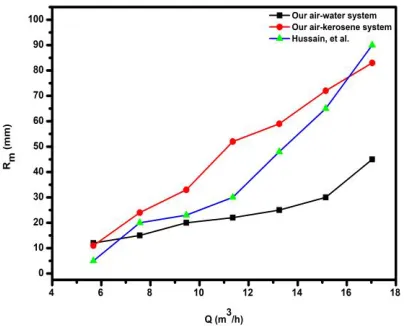
points. From the Manometric height differences measured, we can able to find out the pressure drop inside the static mixer. Figure 1 shows that the graph between the Manometric height differences concerning flow rate for our perforated baffle elements and existing literature values. Since the liquid flow rate directly influences the pressure drop, pressure drop increases with an increase in liquid flow rate for both air-water and air-kerosene system. This result shows that newly designed 12 perforated stationary baffle element creates low-pressure drop, which tends to provide more area available for mass transfer and mixing gets increased. Results presented in figure 2 shows that the graph between the velocity and pressure drop and as the pressure drop increases the mixing efficiency increases in this gas-liquid mixing.
Figure1. Comparison between Liquid flow rate and Manometric Height Difference
Figure2. Comparison between Liquid Velocity and Pressure Drop
3.2 Bubble Size Determination
Bubble generation is recorded with a high-speed camera, and it is operated in the full-frame mode, which has a proper pixel resolution. Through this method, from the captured photograph, bubble size iss determined, which has an accuracy between 95% and 99% [23]. After the approximation, the size of the bubble diameter gets decreased when there is an increase in liquid flow rate, which also designates the amount of mixing of hydrodynamics, which finally describes
the mass transferred between fluids. The study of bubble diameter depends on the energy input and the type and number of mixing elements. The diameter of the bubble, combined with the gas holdup, enables the interfacial area to be determined. Initially, for lower flow rates, the bubble diameter is higher in size. By increasing the flow rates, the bubble diameter gets decreased, which in turn increases the amount of dissolved oxygen in the collecting tank. The equation (A) in terms of Reynolds number and Weber number acquired to find bubble diameter is given by Legrand et al., which are given as follows. The values for coefficients and constants of the equation are collected from the Hussain et al., which provides the finished up model condition (B).
db/ds = K x NWe x NRe (A)
db/ds= 1.15 * 10 -36
x NWe -4.775
x NRe 10
(B)
Figure3. Comparison between Liquid flow rate and Bubble Diameter
3.3 Dissolved Oxygen Content
Figure4. Comparison between Liquid Flow rate and Dissolved Oxygen
3.4 Mass Transfer Coefficient
The process of mass transfer between air and water across an interface depends on the chemical potential driving force, which is more commonly expressed in terms of concentration of the air and water species. Also, the mass transfer between air and kerosene are obtained through these relations. The method acquired to find out KLa was used by Hussain et al.,
which are as follows in (C) and (D) KLa = K x VL
a
x VG b
(C) KLa = 12.20*10
-4
x VL 1.51
x VG -0.26
(D)
From the calculated values of the mass transfer coefficient, it is observed that the velocity of water directly affects the mass transfer coefficient, which in turn, when there is an increase of velocity of water, there is also an increased mass transfer coefficient. The mass transfer between air and water increases with a decrease in bubble diameter due to the formulation of mixing intensity by detecting the reduction in bubble size.
Figure5. Comparison between Liquid Velocity and Mass Transfer coefficient
3.5 Power Consumption
Power consumption is the most prominent criterion for the static mixer. Comparing to the dynamic mixer, it yields less power consumption. The power generated (Watt) per unit of mass (kilogram) of the air-water system was calculated through the equation used by Heyouni et al., which is given as follows.
(P/M) = QL* ΔP / {ρ * FSM * (1- GH) * VSM}
As the pressure difference between the two points in static mixer directly influences the power utilization, so by utilizing the information, the velocity of the liquid phase was seen as the controlling parameter of power consumption. While using 12 triangular pitch perforated baffle element of air-water system yield less power consumption compared to existing kinds of literature, our experimental work in designing a new type of static mixer can be appropriate to industrial purposes.
Figure6. Comparison between Liquid Velocity and Power Consumption
4 Nomenclature
Table1. List of quantities used
Symbol Quantity Unit
db Bubble Diameter m
DO Dissolved Oxygen mg/l
ds Main Pipe Diameter m
FSM Void Fraction of Static Mixer -
GH Gas Holdup -
Rm Height Difference in Manometer mm KLa Mass Transfer Coefficient s-1
L Length of Static Mixer m
P/M Power consumed Per Unit Mass W/kg
ΔP Pressure Drop N/m2
QG Gas flow rate m3/h
QL Flow rate of Liquids m3/h
VG Velocity of Gas m/s
VL Velocity of Liquids m/s
VSM Volume of Static Mixer m
3
ρ Density of Liquids kg/m3
μ Dynamic Viscosity of Liquids kg/ms
1347
5 Dimensionless numbers
NRe = Reynolds number =
𝑑𝑠∗𝑉𝐿∗ρ
μ
NWe = Webers Number =
𝑉𝐿2∗ρ∗L
σ
6 Conclusion
This investigation portrays the hydrodynamics and mass exchange of a static mixer with various positioning of baffle elements inside the static mixer. The Reduction in pressure, Diameter of the bubble, and Mass transfer coefficient are obtained for different baffle elements, and working conditions are compared. The following results were concluded in our study.
a. The pressure drop in the 12 perforated baffle element of our air-water system, which is precisely affected by water velocity, constitutes a lesser pressure drop compared with other works of literature by our experimental study. The connections established got can accurately anticipate the pressure drop for each structure tried.
b. The approximated bubble sizes across rely upon the velocity of water and air and on the design of the static mixer. The fast decline in drop size portrays the degree of mixing between the air-water system, and the breakage of a bubble is constrained by the structure of the stationary component and fluid stream rate. Here the 12 perforated baffle element of our air-water system provides lesser bubble sizes, which directly increases their mixing rate.
c. The 12 perforated baffle element of our air-water system used to be observed to supply higher mixing rate, which contributes to producing the higher dissolved oxygen content. Also, in the air-kerosene system, higher dissolved oxygen is obtained.
d. Since our newly designed 12 perforated static element occurs in lesser drop sizes, it resulted in creating more amount of mass transferred between fluids in a static mixer. Hence our work yields more mass transfer coefficient compared to existing works of literature.
e. The power consumed by our newly designed 12 perforated static element of our air-water system is once proved out to be a long way much less than existing factors in the literature. This power consumption is once found to be equivalent to pressure drop and liquid flow rate.
7 References
[1] Hussain, Mazhar, Anwar Rasheed Saleemi, and Javed Rabbani. "Advancement in mixing hydrodynamics using motionless mixer." Mehran University Research Journal of Engineering & Technology 34.3 (2015): 235.
[2] Heyouni, Abderrahim, M. Roustan, and Z. Do-Quang. "Hydrodynamics and mass transfer in gas–liquid flow through static mixers." Chemical Engineering Science 57.16 (2002): 3325-3333.
[3] Legrand, J., P. Morançais, and G. Carnelle. "Liquid-liquid dispersion in an SMX-Sulzer static mixer." Chemical Engineering Research and Design 79.8 (2001): 949-956.
[4] Munter, Rein. "Comparison of mass transfer efficiency and energy consumption in static mixers." Ozone: science & engineering 32.6 (2010): 399-407.
[5] Couvert, Annabelle, Marie‐France Péculier, and Alain Laplanche. "Pressure drop and mass transfer study in static mixers with gas continuous phase." The Canadian Journal of Chemical Engineering 80.4 (2002): 727-733. [6] Turunen, I., and Heikki, H., ―The Simulation of a
CoCurrent Bubble Reactor‖, European Consortium for Mathematics in Industry Volume 6, September, (1994): 159-168.
[7] IR, JI [Rbreve] I., and ZDENĔK LECJAKS. "Pressure drop and homogenization efficiency of a motionless mixer." Chemical Engineering Communications 16.1-6 (1982): 325-334.
[8] Yang, Hei Cheon, and Sang Kyoo Park. "Pressure drop in motionless mixers." KSME international journal 18.3 (2004): 526.
[9] Couvert, A., C. Sanchez, I. Charron, A. Laplanche, and C. Renner. "Static mixers with a gas continuous phase." Chemical engineering science 61, no. 11 (2006): 3429-3434.
[10]Coroneo, Mirella, Giuseppina Montante, and Alessandro Paglianti. "Computational fluid dynamics modeling of corrugated static mixers for turbulent applications." Industrial & engineering chemistry research 51.49 (2012): 15986-15996.
[11]Bozzano, Giulia, and Mario Dente. "Mechanism of drop coalescence at the interface of two immiscible liquids." Computer Aided Chemical Engineering. Vol. 28. Elsevier, 2010. 55-60.
[12]Legrand, J., P. Morançais, and G. Carnelle. "Liquid-liquid dispersion in an SMX-Sulzer static mixer." Chemical Engineering Research and Design 79.8 (2001): 949-956. [13]Briceno, M., J. L. Salager, and J. Bertrand. "Influence of
dispersed phase content and viscosity on the mixing of concentrated oil-in-water emulsions in the transition flow regime." Chemical Engineering Research and Design 79.8 (2001): 943-948.
[14]Jones, S. Casey, Fotis Sotiropoulos, and Appiah Amirtharajah. "Numerical modeling of helical static mixers for water treatment." Journal of Environmental Engineering 128.5 (2002): 431-440.
[15]Kwon, Jae Hyeong, Jae Hong Jung, Hai Don Lee, Yong Seok Park, and Dae Won Kim. "Development of a hydrodynamic static mixer for mixing chemicals in ballast water treatment systems." Journal of water process engineering 8 (2015): 209-220.
[16]Vishal Pralhad Bhaskar, S.T.Patil. "Performance of Mixing Efficiency and RTD of Static Mixer in Liquid-Liquid And Gas-Liquid Mixture." International Journal of Advance Research, Ideas and Innovations in Technology 3.5 (2017) www.IJARIIT.com.
[17]Ghanem, Akram, Thierry Lemenand, Dominique Della Valle, and Hassan Peerhossaini. "Static mixers: Mechanisms, applications, and characterization methods– A review." Chemical Engineering Research and Design 92, no. 2 (2014): 205-228.
[19]Paglianti, Alessandro, and Giuseppina Montante. "A mechanistic model for pressure drops in corrugated plates static mixers." Chemical Engineering Science 97 (2013): 376-384.
[20]T. Lemenand, D. Della Valle, Y. Zellouf, H. Peerhossaini, Droplets formation in turbulent mixing of two immiscible fluids, Int. J. Multiphase Flow 29 (2003) 813–840.
[21]Etchells, A. W., and Chris F. Meyer. "Mixing in pipelines." Handbook of industrial mixing (2004): 391-447. [22]Parvareh, A. "investigation of mercaptan removal from
Kerosene using passive mixing tools: Experimental study and CFD modeling." Iranian Journal of Chemical Engineering (IJChE) 14.3 (2017): 55-64.
[23]Vazquez, A., et al. "A look at three measurement techniques for bubble size determination." Experimental thermal and fluid science 30.1 (2005): 49-57.
[24]Marco Scala, Lionel Gamet, Louis-Marie Malbec, Huai-Zhi Li, Hydrodynamics of gas-liquid dispersion in transparent Sulzer static mixers SMXTM, Chemical Engineering Science, 213 (2019), 115398.