Available online on 15.05.2019 at http://jddtonline.info
Journal of Drug Delivery and Therapeutics
Open Access to Pharmaceutical and Medical Research
© 2011-18, publisher and licensee JDDT, This is an Open Access article which permits unrestricted non-commercial use, provided the original work is properly cited
Open Access
Review Article
A Decisive overview on Three Dimensional Printing in Pharmaceuticals
Ghadge Snehal*, Aloorkar Nagesh, Sudake Suresh
Department of Pharmaceutics, Satara College of Pharmacy, Satara, Maharashtra, 415004, India
ABSTRACT
With the rapid pace of development in the pharmaceutical industries the researchers are equally contributing in developing the latest technology for their growth. The computer aided design and manufacturing that provides 3 dimensional (3D) printed dosage forms which the new step is being that to be taken into a consideration. With the Food and Drug Administration (FDA) approval to first 3D pri nted tablet in August 2015, Spritam®, since the 3D printing has become a novel method for the design of drug delivery system. It has the capability of
dispensing the drug more accurately, precisely and layer by layer assembly which helps in forming complex composition and geometries. It enables the preparation of personalised dosage form and tailored release profiles. Therefore, it can be seen as a future of solid dosage forms produced on demand, with customised dose and in lower cost. It can also help in reducing side effects caused by excessive doses. This review highlights the 3D printing technology and its applications in growth of pharmaceutical sector. The novel technology is simple, rapid and design most complex things. Hence this technology can take drug delivery technology to another horizon.
Keywords: Computer aided design, Drug delivery system, 3D printing, Spritam®, Novel technology.
Article Info:Received 23 March 2019; Review Completed 03 May 2019; Accepted 06 May 2019; Available online 15 May 2019
Cite this article as:
Ghadge S, Aloorkar N, Sudake S, A Decisive overview on Three Dimensional Printing in Pharmaceuticals, Journal of Drug Delivery and Therapeutics. 2019; 9(3):591-598 http://dx.doi.org/10.22270/jddt.v9i3.2837
*Address for Correspondence:
Ghadge Snehal, Department of Pharmaceutics, Satara College of Pharmacy, Satara, Maharashtra, 415004, India
INTRODUCTION
The 3D printing is progressively growing in all the corners of the world. With its enormous potential for applications in infinite areas, the 3D printing technology has become a topic of interest of technology enthusiasts, manufacturers and media with a sense of curiosity. In the last few decades, the 3D printing industry has shown aemission of low cost printers entering the market due to the expiration of certain technological patents which helped in popularizing 3D printing further. Globally, 3D printing is already a $6 billion market and is expected to cross $8.43 billion by 2020, which not too far ahead. It may be a good time for India to seriously think of a ‘Print in India’ campaign. 1
Three dimensional printing (3DP) is particularly an emerging technology expected to develop pharmaceutical manufacturing along with other fields. The 3DP technologies have capability to produce limitless dosage forms that are challenges conventional drug fabrication methods not only in product quality and efficacy but also in cost efficiency because of 3D printers have already been successful in producing novel dosage forms within minutes. Three situations where this on-demand pharmacy capability may be applicable include printing directly on the implants or tissue scaffolds, printing “just in-time” in healthcare facilities or in other resource-constrained settings and printing low-stability drugs for immediate consumption. In all these
circumstances this technology provides attractive solution to explore on demand pharmacy. 2
Three dimensional printing is a comparatively new rapid prototyping (RP) technique. The system was first developed at the Massachusetts Institute of Technology (1992) and is based on computer aided design (CAD) models that are manipulated by a terminal computer. The 3DP system involved a very simple layer wise process that can be applied rapidly.3 The 3D object is made by deposition of material or by binding of materials in successive layers. 4. Three dimensional objects are rapidly made on a reasonably sized machine connected to computer containing blueprints for the object. 5
The first 3D printed drug to receive approval from the United State FDA is now being shipped to pharmacies. The Pennsylvania based Aprecia Pharmaceuticals said its 3D-printed Spritam® (levetiracetam) tablets are used to treat epilepsy. The company is also working on at least three other 3D printed drugs that it expects to eventually bring to market. 7
HISTORY
The Charles (Chuck) developed the first 3D printer in 1984 and named the technique as Stereo Lithography. In 1993 MIT used 2D ink jet printing technology to 3D printers named it as 3 dimensional printing techniques. The Z Corporation obtained licences from MIT in 1995 and started to develop 3D printers for general market. Z Corporation launched first high definition colour 3D printer in 2005. It follows the achievement of RERAP the first open source 3D printer introduced by Cornell University in 2006. The first 3D printer that could produce functional prototype parts was introduced, which made a great achievement Urbee, the first car ever with three wheels and two seats to have its entire body printed out on a giant 3D printer. Recently in August 2014, Organovo the pioneer in biological 3D printing company demonstrated that its 3D human liver system can detect the toxicity of a drug. 8
ADVANTAGES
3-D Printing technology has the following advantages: 1. Lower cost: In China they were able to construct 10
one storey houses at less than $5000 per house. Construction of a similar house costs is more than the stipulated price.
2. Time: Three dimensional printing allows constructing working models in just hours instead of days or weeks. 3. Efficiency: Generating prototypes with 3D printers is
much easier and faster.
4. Flexible: Different materials can be used in the 3 D models. It makes very easy to create construction models or prototypes for a wide variety of projects within many industries.
5. Durable products: The objects do not absorb moisture or warp over time making them last for longer.
6. Quality: The products with an excellent surface finish are produced.
7. Functional models: Realistic live functional models can be produced as opposed to working with paper of digital models. 9
DISADVANTAGES
1. Intellectual property problem: The comfort with which replicas can be created using 3D technology raises issues over intellectual property rights. The availability of blueprints online free of cost may change with for-profit organizations wanting to generate profits from this new technology.
2. Limitations of size: The 3D printing technology is currently limited by size limitations. Very large objects are still not possible when built using 3D printers.
3. Limitations of raw material: At present, 3D printers can work with approximately 100 different raw materials. This is insignificant when compared with the enormous range of raw materials used in traditional manufacturing. More
research is required to devise methods to enable 3D printed products to be more durable and robust.
4. Cost of printers: The cost of buying a 3D printer still does not make its purchase by the average householder possible. Also, different 3D printers are required in order to print different types of objects. Also, printers that can manufacture in colour are costlier than those that print monochrome objects.
5. Fewer manufacturing jobs: As with all new technologies, manufacturing jobs will decrease. This disadvantage can have a large impact to the economies of third world countries especially China, that depend on a large number of low skill jobs.
6. Unchecked production of danger items: Liberator, the world’s first 3D printed functional gun, showed how easy it was to produce one’s own weapons, provided one had access to the design and a 3D printer. Governments will need to devise ways and means to check this dangerous tendency. 10
PRINCIPLE
The main principle of 3DP is stereo lithography, outlined by Charles Hull in a 1984 patent as “a system for generating three-dimensional objects by making a cross-sectional pattern of the object to be formed”. This means that any 3D object generated using a 3D drawing software is firstly split into layers and then these layers are then successively printed by the machine on top of one another.11
The main 3 steps involved during 3DP process which are described as follows:
1. Modelling: The 3D printable models may be created with a CAD package, via a 3D scanner or by a plain digital camera and photogrammetric software. The modelling process of preparing geometric data for 3D computer graphics is similar to plastic arts such as sculpting. The 3D scanning is a process of collecting digital data on the shape and appearance of a real object, creating a digital model based on it.
2. Printing: The 3D model from the STL file must first be examined for "manifold errors," before printing, this step termed as the "fix up." Generally from a model obtained through 3D scanning, STL file have been produced and have many manifold errors in them that need to be rectified. Examples of these errors are surfaces that do not connect, or gaps in the models. STL file need to be processed by a piece of software called a "slicer," which converts the model into a series of thin layers and produces a G-code file containing instructions tailored to a specific type of 3D printer (FDM printers). Then with 3DP client software G-code file can be printed (which loads the G code, and uses it to instruct the 3D printer during the 3DP process)? Layer thickness and X– Y resolution in dots per inch (dpi) or micrometers (µm) describe by the printer resolution. The typical layer thickness is around 100 µm (250 dpi), even though some machines can print layers as thin as 16 µm (1,600 dpi). X-Y resolution is comparable to that of laser printers. The particles (3D dots) are around 50 to 100 µm (510 to 250 dpi) in diameter.
polymer products in high quantities, but additive manufacturing can be faster, more flexible and less expensive when producing relatively small quantities of parts. The 3D printers give designers and concept development teams the ability to produce parts and concept models using a desktop size printer.
3. Finishing: However the printer produced resolution is sufficient for lots of applications, printing a slightly oversized version of the desired object in standard resolution, and then removing material with a higher resolution subtractive process can achieve greater precision. Some printable polymers allow the surface finish to be smoothed and improved by using chemical vapor processes. Some additive manufacturing techniques are capable of using multiple materials in the course of constructing parts. These techniques are able to print in multiple colors and color combinations simultaneously, and would not necessarily require painting. Some printing techniques require internal supports to be built for overhanging features during construction. These supports must be mechanically removed or dissolved upon completion of the print. All of the commercialized metal 3D printers involve cutting the metal component off of the metal substrate after deposition. A new process for the GMAW 3DP allows for substrate surface modifications to remove aluminum or steel 12
TYPES OF 3D PRINTING
1) Fused Deposition Modelling (FDM): Fused Deposition Modelling is an additive manufacturing technology generally used for modelling, prototyping and production applications. It works on an "additive" principle by laying down the successive layers of materials in series. A plastic filament or metal wire is unwound from a coil and supplies material to an extrusion nozzle which can turn the flow on and off. To melt the material the nozzle is heated and can be moved in both horizontal and vertical directions by a numerically controlled mechanism, directly controlled by a computer-aided manufacturing (CAM) software package. The model is produced by extruding small beads of thermoplastic material to form layers as the material hardens immediately after extrusion from the nozzle. Stepper motors or servo motors are typically employed to move the extrusion head. FDM, a prominent form of rapid prototyping, is used for prototyping and rapid manufacturing.
Advantages: Cheaper since expensive models use a different (water soluble) material to remove supports completely. Even cheap 3D printers have enough resolution for many applications.
Disadvantages: Supports leave marks that require removing and sanding. Because of Thermo plastic material warping limited texting is allowed. 5
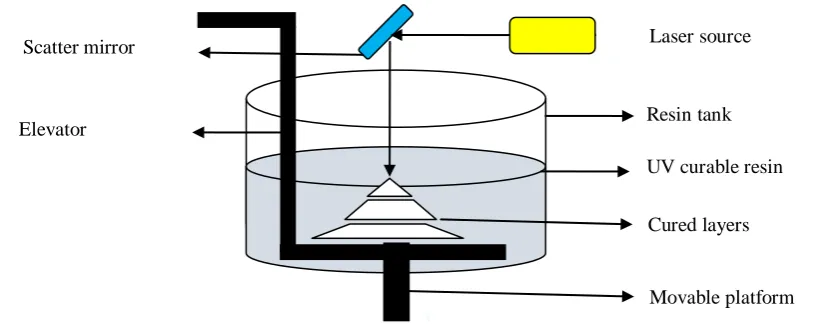
2) Stereo Lithography: Charles Hull discovered this technique in 1988 as a first printing technique of 3D system. During the printing process photopolymer material like resin or acrylate was used which can cured by UV laser. 11
It is rapid and popular prototyping technology which can produce highly accurate and detailed polymer parts. Stereo lithography builds objects one layer at a time by tracing a laser beam on the surface of a vat of liquid photopolymer, inside of which is a movable stage to support the part being built. Wherever the laser beam strikes the surface of the liquid the photopolymer quickly solidifies. The platform is lowered by a distance equal to the layer thickness (typically 0.003-0.002 inch), and a resultant layer is formed on top of the previously completed layers. Thus three dimensional
object out of many layers formed completely due to the self-adhesive property of material causes each succeeding layer to bond to the earlier one. Objects which have overhangs or undercuts must be supported during the fabrication process by support structures. These are either manually or automatically designed with a computer program developed for rapid prototyping. Once complete, the part is elevated above the vat and drained. Excess polymer is swabbed or rinsed away from the surfaces. In several cases, a final cure is given by placing the part in a UV oven. After the final cure, supports are cut off the part and surfaces are polished, sanded or otherwise finished. 13
Advantages: For prototyping this technique is most commomly used as it is less time-consuming and it is
Nozzle
Object
Support material
Platform
Heater elements
Material pool
relatively cheaper compared to other prototyping method. Nevertheless, the SLA process requires support structures for some parts mainly for those with overhangs.
SLA is one of the most accurate 3DP processes with excellent surface finish and smoother surface than most other rapid prototyping methods. Smooth surface indicates a great level of detail and the design is very accurate. Moreover parts can be printed in a very short period of time depending on its
size and shape. SLA also allows different options when it comes to material. Although SLA can produce a large variety of shapes, it is often very expensive 14
Disadvantages: This method is extremely high resolution and considerably fast, but the nature of the pool of drug-loaded material has an inherent risk of cross contamination between the fabrications of different drug products. 15
3) Laminated object manufacturing (LOM): It is a 3D printing technology developed by Helisys Inc. (now Cubic Technologies). In LOM technology layers of adhesive-coated paper, plastic, or metal laminates are successively joined together and cut to appropriate shape with a laser cutter. After the printing process, the objects may be additionally modified by machining. The typical layer resolution for this process is defined by material feedstock and usually ranges in thickness from one to a many sheets of paper of a copy. 10 As the name indicates the process laminates thin sheets of film. The laser has only to cut the periphery of each layer. In
this process to take-up roller on the other side the build material is stretched from a supply roller across a platform. A heated roller passes over the paper bonding it to the platform. A laser, focused to penetrate through one thickness of paper cuts the profile of that layer. The excess around and inside the model is carved into small squares to facilitate its removal. The objects created using LOM technique are durable, multilayered structures which can be machined, sanded, polished, coated and painted. It is used as visual models and for limiting testing 8.
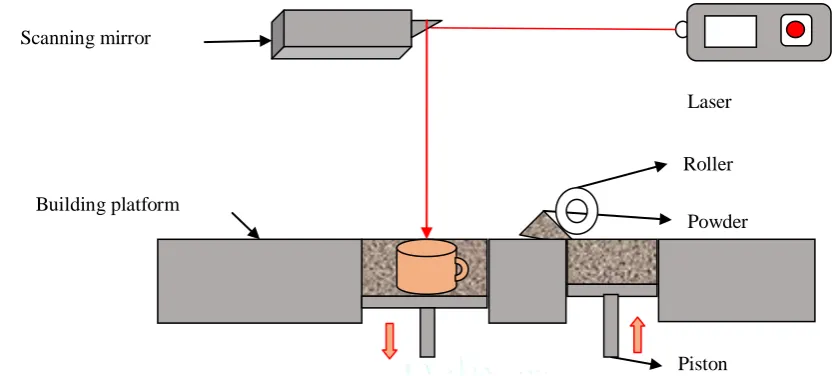
4) Selective Laser Sintering (SLS): Selective laser sintering is a quick manufacturing process based on the use of powder coated metal additives, a process generally used for rapid prototyping. For scanning and aligning particles in predetermined sizes and shapes of the layers a continuous laser beam are used as heating source. The geometry of the scanned layers corresponds to various sections of the models established by computer-aided design (CAD) or from
files produced by stereo-lithography. After scanning the first layer, the scanning of second layer continues which is placed over the first, repeating the process from the bottom to the top until the product is complete. 16
To fuse small particles of plastic, metal, ceramic or glass powders into a mass that has the desired three dimensional shape, this technology uses high power laser. The laser
Platform
Mirror
Laser
Sheet material
Layer counter
Take up roll
Optic block
Tile
Fig. 3. Laminated object manufacturing principle.
Movable optic head
Elevator
Scatter mirror
Laser source
Cured layers
UV curable resin
Movable platform
Resin tank
selectively fuses the powdered material by scanning the cross-sections (or layers) generated by the 3D modelling program on the surface of a powder bed. After each cross section is scanned, the powder bed is lowered by one layer thickness. Then a new layer of material is applied on top and the process is repeated until the object is completed. All
untouched powder remains as it is and becomes a support structure for the object. Therefore there is no need for any support structure which is an advantage over SLS and SLA. All unused powder can be used for the next print. SLS was developed and patented by Dr. Carl Deckard at the University of Texas in the mid-1980s 17
3DP IN PHARMACEUTICALS
To making nice medicine 3DP promises a future of drugs printed on demand, to custom doses, and the possibility that cost may no longer be a barrier. And children could be among the patients to benefit most.
The potential of 3DP is about being able to deliver what one want when one want, says engineer Ricky Wildman from University of Nottingham in the United Kingdom. They were trying to find the right materials that can be used as inks to make tablets with varying doses of drugs. In particular, Wildman is looking at inkjet 3D printing. He has replaced coloured inks with polymers, drugs and other materials used in pill manufacture. Using inkjet he is exploring the techniques by which suspensions and liquid-based materials can be triggered to make solids. 18
Mohamed Albed Alhnan, a pharmaceutical scientist at the University of Central Lancashire in Preston UK, says that the
trouble with this technology is finding the right materials. He used fused deposition modelling (FDM) based 3D printer to fabricate extended release tablet of prednisolone loaded polyvinyl alcohol (PVA) filaments and to control its dose. 19 Goyanes A., have explored the feasibility of fabricating controlled release budesonide tablet using fused deposition modelling (FDM), 3DPtechnology with hot melt extrusion (HME) and fluidized bed coating. Budesonide was loaded in polyvinyl alcohol filaments using HME. Capsule shaped tablets containing budesonide were prepared by engineering the filaments using a FDM 3D printer and were further over coated with layer of enteric polymer. The formulation was tested in dynamic dissolution bicarbonate buffer system with commercial budesonide products. The new 3D printed caplet formulation showed sustained release throughout the distal intestine and colon.
He has also prepared drug-loaded paracetamol and caffeine filaments of polyvinyl alcohol with fused-deposition modelling of 3DP. The design configurations included a multilayer device, with each layer containing drug, whose
identity was different to the drug in the adjacent layers, and a two-compartment device comprising a caplet embedded within a larger caplet (DuoCaplet), with each compartment containing a different drug.
(A)
(B)
(C)
Fig.5. Caplet prior to coating (A), caplet after coating (B) and cross section of coated caplet (C)
20Laser
Scanning mirror
Roller
Building platform
Piston
Powder
Wang J. evaluated the suitability of stereo lithography (SLA) to fabricate drug-loaded tablets with modified-release characteristics. The SLA printer made solid objects by using a laser beam to photo polymerise monomers. They used polyethylene glycol diacrylate (PEGDA) as a monomer and diphenyl (2, 4, 6-trimethylbenzoyl) phosphine oxide was used as a photo-initiator. Acetaminophen (paracetamol) and 4-aminosalicylic acid (4-ASA) were selected as model drug. By adding polyethylene glycol 300 (PEG 300) to the printing solution tablets and formulation were printed and fabricated with different properties. The loading of 4-ASA and paracetamol in the printed tablets was 5.40% and 5.69% respectively. In a realistic dynamic dissolution simulation of the gastrointestinal tract, drug release from the tablets was dependent on the composition of the formulations, but independent of dissolution pH. In conclusion, the SLA 3DP technology allows the manufacture of drug loaded tablets with specific extended-release profiles. In the future this technology could become a manufacturing technology for the elaboration of oral dosage forms, for industrial production or also for personalised dose. 22
Aprecia Pharmaceuticals based in Langhorne, Pennsylvania, filed its first 3D-printed product for approval to the US Food and Drug Administration (FDA) in Oct 2014. The company is developing a system that can print large doses of drugs in a formulation that makes them easy to swallow. Aprecia’s product, called ZipDose, is built up from layer upon layer of powders of the drug bound together by droplets of liquid. 23
3DP in fabrication of novel drug delivery system (NDDS)
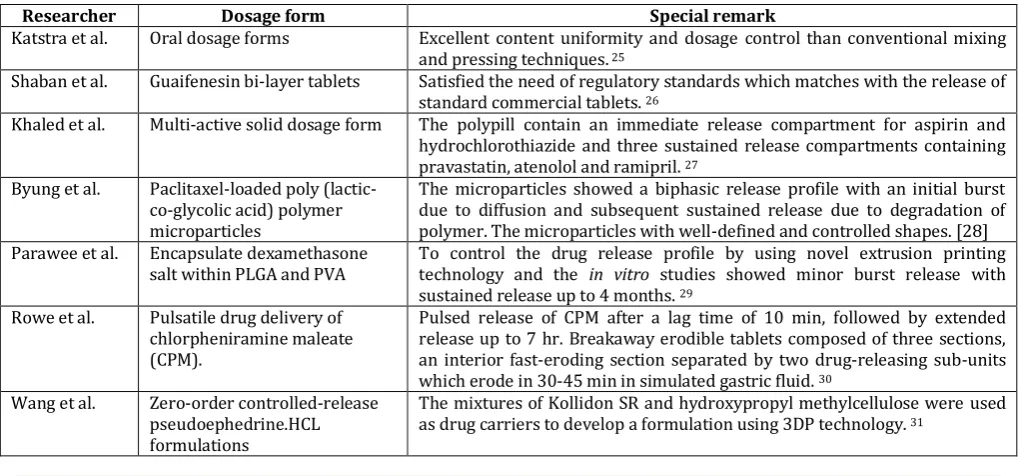
Drug delivery means delivery of an active pharmaceutical ingredient (API) in the body or at the specific site to achieve its desired therapeutic effect. The idea of drug delivery has greatly progressed over the years from conventional dosage forms to novel target drug delivery systems. Therefore, the conventional method like direct tableting are now progressively evolved towards multi-step manufacturing technologies, including granulation, extrusion or coating processes, to allow the development of controlled-release systems. Recently the novel concepts of formulation have emerged (For e.g., nano-scale medicines, biomimetic particles and functionalized liposomes) as well as more sophisticated manufacturing methods. Thus, 3DP process naturally appeared to be an essential tool in research and development area to fit with actual industrial directions of reducing both time and costs in the early stage of a novel manufacturing concept, reducing the inherent risk of new development to fail at later stages. 3DP in pharmaceutical industry represents a well-designed tool for designing simple, accurate, cheap, structured and tailored drug delivery systems. This flexibility can offer many novel strategic approaches for the research and development of controlled-release drug delivery systems. In the last 15 years, a large variety of 3DP have been introduced into the rapid prototyping industry. 24 The few of the applications of 3DP were enlisted in Table 1.
Table 1: Drug delivery systems fabricated using 3DP
Researcher Dosage form Special remark
Katstra et al. Oral dosage forms Excellent content uniformity and dosage control than conventional mixing
and pressing techniques. 25
Shaban et al. Guaifenesin bi-layer tablets Satisfied the need of regulatory standards which matches with the release of standard commercial tablets. 26
Khaled et al. Multi-active solid dosage form The polypill contain an immediate release compartment for aspirin and hydrochlorothiazide and three sustained release compartments containing pravastatin, atenolol and ramipril. 27
Byung et al. Paclitaxel-loaded poly (lactic-co-glycolic acid) polymer microparticles
The microparticles showed a biphasic release profile with an initial burst due to diffusion and subsequent sustained release due to degradation of polymer. The microparticles with well-defined and controlled shapes. [28]
Parawee et al. Encapsulate dexamethasone
salt within PLGA and PVA To control the drug release profile by using novel extrusion printing technology and the in vitro studies showed minor burst release with sustained release up to 4 months. 29
Rowe et al. Pulsatile drug delivery of
chlorpheniramine maleate (CPM).
Pulsed release of CPM after a lag time of 10 min, followed by extended release up to 7 hr. Breakaway erodible tablets composed of three sections, an interior fast-eroding section separated by two drug-releasing sub-units which erode in 30-45 min in simulated gastric fluid. 30
Wang et al. Zero-order controlled-release
pseudoephedrine.HCL formulations
The mixtures of Kollidon SR and hydroxypropyl methylcellulose were used as drug carriers to develop a formulation using 3DP technology. 31
Fig.6. Caplet embedded within a larger caplet (DuoCaplet), with each compartment
Melocchi et al. Oral pulsatile release capsular
device Using fused deposition modelling 3D printer, fabricated the capsular device for oral pulsatile release using erodible hydroxypropyl cellulose (HPC). 32
Deng et al Novel doughnut-shaped
multi-layered acetaminophen delivery devices
Based on computer-aided design models, different devices containing acetaminophen, hydroxypropyl methylcellulose as matrix and ethyl cellulose (EC) as a release-retardant material were prepared automatically using a three-dimensional printing system. 33
Deng et al. Novel fast disintegrating tablet Which have special inner structure characteristics using 3D printer. 34 Nikolaos et al. Felodipine solid dispersion Felodipine solid dispersion using polyvinyl pyrrolidone by inkjet printer. 35
Alvaro et al. Salicylic acid patches To treat acne using stereo lithography printer. The patch showed high drug
loading with release rate of 291 μg/cm2 for 3 hr. 36
Muzna et al. Immediate release tablets Non-melting filler which allowed a consistent flow from printer’s nozzle to
facilitate 3D printed tablets using Eudragit as a polymer filament with four different physiological drugs entrapped. Tablets possessed excellent mechanical strength and acceptable in-batch variations. 37
Netalia et al. Controlled-release oral dosage
forms Accurate dosing and tailored drug delivery according to dosage requirements. 38
Gyeong et al. Novel 3D-printed patches Composed of a blend of poly (lactide-co-glycolide), polycaprolactone, and
5-fluorouracil to deliver the anti-cancer drug in a sustained manner for 4 weeks when applied at tumor site. 39
Netalia et al. T-shaped intrauterine systems and subcutaneous rods to deliver drugs up to 30 days.
Investigated the printability of different grades of ethylene vinyl acetate copolymers for fused-deposition modelling based 3DP technology. 40
Deng et al. Novel fast disintegrating tablet
using computer-aided models (3D printer)
To have control over the material composition, microstructure, and surface texture. 41
Deng et al. Zero-order drug release tablets
using 3D printer. The matrix tablets with 68% drug weight exhibited material gradients in radial direction with drug-free release-barrier layers on both the sides. In
vitro results showed linear release up to 12 hr, through two-dimensional
surface erosion mechanism. 42
Alvaro et al. Capsule-shaped solid devices
loaded with multiple drugs. Used multi-nozzle 3D printer for the fabrication. Device was loaded with acetaminophen and caffeine. 43
CONCLUSION
3D printing is a layer- by-layer, automated process capable of producing complex, personalised products on demand. In recent years, researchers proposed dozen of 3d printing innovations to improve the safety, efficacy,and tolerability of medicines. The commercial feasibility of this technology has been shown through the FDA approval of 3D printed drug product in august 2015
With so much interest and research found in the past few years, 3D printing in pharmaceutics has reached an impressive rhythm of development and promises great progress in the future. 3DP is a simple, cost-effective way of manufacturing personalised oral medicines and other drug devices.
REFERENCES
1. Venkatesharam N, Opportunities and challenges of 3D printing technique – an Indian perspective., Int J Curr Res, 2015; 7(5):16552-16555.
2. Ozkan T, Ienima M, Ali B, Manufacturing engineering challenges of pharmaceutical 3D printing for on demand drug delivery, Engineering technique open access journal, 2018; 1(5):001-003.
3. Deng, guang, yu, limin-zhu, Three dimensional printing of pharmaceutics. Journal of pharmaceutical science, 2009; 97(7): 3666-3690.
4. Prasad LK, Smith H, 3D printing technique for drug delivery: A review, Drug development and industrial pharmacy, 2015; 37(7):1019-1035.
5. Bhushnare OG, Gholve SV, 3D printing and pharmaceutical manufacturing opportunities and challenges, International journal of bioassay, 2016; 5(7):4723- 4738.
6. Bansal M, Sharma V, 3D printing for future of pharmaceutical dossage form, International journal of applied pharmaceutics, 2018; 10(3):1-7.
7. This is the first 3D printed drug to win FDA approval. http://www.computerworld.com.
8. Harshavardhan G, Hari Charan G, Reddy PV, Kumar KS, 3D Printing: The Dawn of a New Era in Manufacturing, International Journal on Recent and Innovation Trends in Computing and Communication, 2014; 2(8):2373- 2376. 9. Peter TM, Mawere C, Macdonald M, The Impact and Application
of 3D Printing Technology, International Journal of Science and Research, 2014; 3(6):2148-2152.
10. Gokhare VG, Raut DN, Shinde DK, A Review paper on Printing Aspects and Various Processes Used in the 3D-Printing, International Journal of Engineering Research & Technology, 2017; 6(6):953- 958.
11. Bhandari S, Regina B, 3D Printing and its Applications, International Journal of Computer Science and Information Technology Research, 2014; 2(2):378-380.
12. Singh SB, Advanced manufacturing techniques(3d printing), International Journal of Mechanical and Production Engineering, 2016; 4(4):16-23.
13. Ramya A, Vanapalli SL, 3D printing technologies in various applications. International Journal of Mechanical Engineering and Technology, 2016; 7(3):396–409.
14. Shiwpursad J, Jianbin X, Comparison of Different Types of 3D Printing Technologies, International Journal of Scientific and Research Publications, 2018; 8(4):1-9.
15. Lepowsky E, Tasoglu S, 3D printing for drug manufacturing: A perspective on the future of pharmaceuticals, International journal of Bioprint, 2018; 4(1):119.
16. Reddy S, Madhava V, Reddy CS, 3D Printing Technologies and
Processes – A Review, IOSR Journal of Engineering, 2017; 7(9):01-14.
17. Al-maliki J, Al-maliki A, The Processes and Technologies of 3D Printing. International Journal of Advances in Computer Science and Technology, 2015; 4(10):161-165.
18. Kazi MS, Jasvi UK, 3D printing: a new avenue in pharmaceuticals, World Journal of Pharmaceutical Research, 2016; 5(5):1686-1701.
19. Skowyra J, Pietrzak K, Alhnan MA, Fabrication of extended-release patient-tailored prednisolone tablets via fused deposition modelling (FDM) 3D printing, European Journal of Pharmaceutical Sciences, 2015; 68:11-7.
budesonide tablets via desktop (FDM) 3D printing, International Journal of Pharmaceutics, 2015; 496(2):414-420. 21. Goyanes A, Wang J, Buanz A, Pacheco RM, Telford R, Gaisford S, Basit AW, 3D Printing of Medicines: Engineering Novel Oral Devices with Unique Design and Drug Release Characteristics, Mol. Pharmaceutics, 2015; 12(11):4077–4084.
22. Wang J, Goyanes A, Gaisford S, Basit AW, (Stereolithographic (SLA) 3D Printing of Oral Modified-Release Dosage Forms, International Journal of Pharmaceutics, 2016;503(1-2):207-212.
23. Jacob J, Coyle N, West TG, Monkhouse DC, Surprenant HL, Jain NB, Rapid disperse dosage form containing levetiracetam. 24. Maulvi FA, Shah MJ, Solanki BS, Patel AS, Soni TG, Application of
3D Printing Technology in the Development of Novel Drug Delivery Systems, Int J Drug Dev & Res, 2017; 9:44-49. 25. Katstra W, Palazzolo R, Rowe C, Giritlioglu B, Teung P, Oral
dosage forms fabricated by Three Dimensional Printing™, Journal of controlled release, 2000;66(1-2):1-9.
26. Khaled SA, Burley JC, Alexander MR, Roberts CJ, Desktop 3D printing of controlled release pharmaceutical bilayer tablets, International journal of pharmaceutics, 2014; 461(1-2):105-111.
27. Khaled SA, Burley JC, Alexander MR, Yang J, Roberts CJ, 3D printing of five-in-one dose combination polypill with defined immediate and sustained release profiles, Journal of controlled release, 2015; 217:308-314.
28. Lee BK, Yun YH, Choi JS, Choi YC, Kim JD, Fabrication of drug loaded polymer microparticles with arbitrary geometries using a piezoelectric inkjet printing system, International journal of pharmaceutics, 2012;427(2):305-310.
29. Rattanakit P, Moulton SE, Santiago KS, Liawruangrath S, Wallace GG, Extrusion printed polymer structures: a facile and versatile approach to tailored drug delivery platforms, International journal of pharmaceutics, 2012; 422(1-2):254-263.
30. Rowe C, Katstra W, Palazzolo R, Giritlioglu B, Teung P, Multimechanism oral dosage forms fabricated by three dimensional printing™, Journal of controlled release, 2000; 66(1):11-17.
31. Wang CC, Tejwani MR, Roach WJ, Kay JL, Yoo J, Development of near zero-order release dosage forms using three-dimensional printing (3DP) technology, Drug development and industrial pharmacy, 2006; 32(3):367-376.
32. Melocchi A, Parietti F, Loreti G, Maroni A, Gazzaniga A, 3D printing by fused deposition modeling (FDM) of a
swellable/erodible capsular device for oral pulsatile release of drugs, Journal of Drug Delivery Science and Technology, 2015; 30:360-367.
33. Yu DG, Branford-White C, Ma ZH, Zhu LM, Li XY, Novel drug delivery devices for providing linear release profiles fabricated by 3DP, International journal of pharmaceutics, 2009; 370(1-2):160-166.
34. Yu DG, Shen XX, Branford WC, Zhu LM, White K, Novel oral fast disintegrating drug delivery devices with predefined inner structure fabricated by Three Dimensional Printing, Journal of Pharmacy and Pharmacology, 2009;61(3):323-329.
35. Scoutaris N, Alexander MR, Gellert PR, Roberts CJ, Inkjet printing as a novel medicine formulation technique, Journal of controlled release, 2011;156:179-185.
36. Goyanes A, Det-Amornrat U, Wang J, Basit AW, Gaisford S, 3D scanning and 3D printing as innovative technologies for fabricating personalized topical drug delivery systems, Journal of controlled release, 2016; 234:41-48.
37. Sadia M, Sośnicka A, Arafat B, Isreb A, Ahmed W, Adaptation of pharmaceutical excipients to FDM 3D printing for the fabrication of patient tailored immediate release tablets, International journal of pharmaceutics, 2016; 513(1-2):659-668.
38. Genina N, Fors D, Vakili H, Ihalainen P, Pohjala L, et al., Tailoring controlled-release oral dosage forms by combining inkjet and flexographic printing techniques, European Journal of Pharmaceutical Sciences, 2012; 47:615-623.
39. Yi HG, Choi YJ, Kang KS, Hong JM, Pati RG, A 3D-printed local drug delivery patch for pancreatic cancer growth suppression, Journal of controlled release, 2016; 238:231-141.
40. Genina N, Holländer J, Jukarainen H, Makila E, Salonen J, Ethylene vinyl acetate (EVA) as a new drug carrier for 3D printed medical drug delivery devices, European Journal of Pharmaceutical Sciences, 2015; 90:53-63.
41. Yu DG, Branford-White C, Yang YC, Zhu LM, Welbeck EW, A novel fast disintegrating tablet fabricated by three-dimensional printing, Drug development and industrial pharmacy, 2009; 35(12):1530-1536.
42. Yu DG, Yang XL, Huang WD, Liu J, Wang YG, Tablets with material gradients fabricated by three-dimensional printing, Journal of pharmaceutical sciences, 2007; 96(9):2446-2456. 43. Goyanes A, Wang J, Buanz A, Martínez-Pacheco R, Telford R, 3D