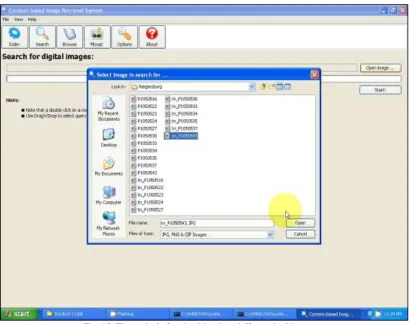
Sketch for Match using Content based Image
Retrieval
Pournima B Minajagi Sumangala Biradar
PG Student Associate Professor
Department of Computer Science & Engineering Department of Information Science Engineering Visvesvaraya Technological University,Belagavi- 590018,
Karnataka
Visvesvaraya Technological University, Belagavi- 590018, Karnataka
Abstract
The paper presents an efficient Content Based Image Retrieval (CBIR) system using color and texture. In proposed system, two different feature extraction techniques are employed. A universal content based image retrieval system uses color, texture and shape based feature extraction techniques for better matched images from the database. In proposed CBIR system, color and texture features are used. The texture features were extracted from the query image by applying block wise Discrete Cosine Transforms (DCT) on the entire image and from the retrieved images the color features were extracted by using moments of colors (Mean, Deviation and Skewness) theory. The proposed system has used Corel database of 1000 images. The feature vectors of the query image will then be compared with feature vectors of the database to obtain similar images. Individual and combined vectors using color and texture features were computed and the combined feature vector results were comparatively better. The proposed system provides an efficiency of 60%.
Keywords: Content Based Image Retrieval, Color Models, DCT, Color Moments
________________________________________________________________________________________________________
I. INTRODUCTION
Content Based Image Retrieval:
Content-based image retrieval also known as query by image content and content-based visual information retrieval problem of searching for digital images in large database. Content-based means that the search will analyze the actual contents of image. The term content in this context might refer to colors, shapes, textures or any other information that can be derived from the image itself. The earliest use of the term Content Based Image Retrieval in the literature seems to be by Kato, was to describe his experiments in automatic retrieval of images from a database by color and shape features. The term has since been widely used to describe the process of retrieving desired images from a large collection on the basis of features (such as color, Texture and shape) that can be automatically extracted from the images themselves. The features used for retrieval can be either primitive or semantic, but the extraction process must be predominantly automatic.
The ideal approach of querying an image database is using content semantics, which applies the human understanding about image. Unfortunately, extracting the semantic information in an image efficiently and accurately is still a question. Even with the most advanced implementation of computer vision, it is still not easy to identify an image of horses on a road. So, using low level features instead of semantics is still a more practical way. Until semantic extraction can be done automatically and accurately, image retrieval systems cannot be expected to find all correct images. They should select the most similar images to let the user choose the desired images. The number of images of retrieved set can be reduced by applying similarity measure that measures the perceptual similarity.
A typical CBIR system consists of three major components and the variations of them depend on features used. Feature extraction – Analyze raw image data to extract feature specific Information.
Feature storage – Provide efficient storage for the extracted information, also help to improve searching speed. Similarity measure – Measure the difference between images for determining the relevance between images.
Content Based Image Retrieval using Color:
Retrieving image based on color similarity is achieved by computing a color histogram for each image that identifies the proportion of pixels within images holding specific values. Current research is attempting to segment color proportion by region and by spatial relationship among several color region. Among different types of low level features, color is the most straightforward information which can be easily retrieved from digital images with simple and compact description, while others require more pre-processing and computational tasks such as pattern recognition or texture analysis.
While comparing image by color feature, three properties are usually considered:
2) Color distance – Distance between colors, usually in a perceptually uniform color space. Closer between matched colors means more similar.
3) Spatial distribution – Usually used while combining color with other features such as texture and shape.
In a typical color similarity measure, area of matching is usually counted as the similarity color distance is used to control the matching between colors and to adjust the similarity. In conventional color image retrieval system, the most straight forward approach is using color histogram. Histograms of each color, for example, images of 256 colors, will be generated. Similarities between such images are then performed and measured by Histogram Intersection Method (HIM). This is the basic approach and can give simple and efficient representation of color distribution. Histogram approach is not limited by taking the number of pixels of each color in the image or using HIM similarity measure. Indexes of histograms can represent many types of features such as colors in different color space, coefficients in transformed domain or spatial-related information. There are also many variations in comparing histograms. But histograms have a limitation that the feature space is fixed, compactness of the description is limited, because histograms will not skip non-existed colors. One argument that we can use a lower resolution histogram to improve the compactness but it is a tradeoff between compactness and accuracy.
Relevance Feedback:
Although JPEG defined efficient and most commonly used CBIR methods, content based methods still have limitations that they may not be able to find the images that exactly match user’s expectation. One reason is that a precise query cannot be formulated Although DCD can describe color features in a compact and effective way, Drawbacks of its default similarity measure method pull down the performance of DCD. By just giving an image as query, Interactive searching may be used for improving the retrieval result by refining the query by user’s feedback. JPEG did not handle interactive searching directly. They use content management approach to describe multimedia contents in a structural format. This uses textual semantics. This can improve the efficiency of browsing and text based searching, but not for content based searching. Also it is not interactive and the improvement may not show instantly. For content based interactive searching, Relevance Feedback (RF) is a commonly used technique which use user selected relevance information to refine the query.
It can be used as an extension of similarity measure and will not affect JPEG standard. Since the representations depend on the features, relevance feedback algorithms may be different for each descriptor. In this research, a merged palette histogram approach is proposed to improve Dominant Color Descriptor searching with use of RF. But the effect of this coefficient is still not very clear. It is unable to balance the effect of “area of matching” and “distance between colors”. It causes ambiguous retrieval results. These problems will be described in chapter 4, and a new Merged Palette Histogram Similarity Measure (MPHSM) will be proposed to tackle these problems.
II. BACKGROUND AND RELATED WORK
Content Based Image Retrieval is the retrieval of images based on visual features such as color, texture and shape. Reasons for its development are that in many large image databases, traditional methods of image indexing have proven to be insufficient, laborious, and extremely time consuming. These old methods of image indexing, ranging from storing an image in the database and associating it with a keyword or number, to associating it with a categorized description, have become obsolete. In CBIR, each image that is stored in the database has its features extracted and compared to the features of the query image. Several CBIR systems currently exist, and are being constantly developed. The Color Selection exploited CBIR system [6], facilitates query-by-color. It is based on 11 color categories, used by all people, while thinking of and perceiving color. Then the low frequency DCT coefficients that are transformed from YUV color space as feature vectors are used for retrieval of images [7]. This system allows users to select its dominant feature of query images so as to improve the retrieval performance. But the technique is sufficient for performing effective retrieval by introducing users' opinions on the query images. In Region of Interest Image Indexing System [4], user can select the region of interest (ROI) and the system will search all the images in the database to find the all related regions among the database. A Universal Model for Content-Based Image Retrieval combine three feature extraction methods namely color, feature and edge histogram descriptor [5]. The image properties analyzed in this work are by using computer vision and image processing algorithms. For color the histogram of images are computed, for texture co-occurrence matrix based entropy, energy, etc., are calculated and for edge density it is Edge Histogram Descriptor (EHD) that is found. For retrieval of images, a novel idea is developed based on greedy strategy to reduce the computational complexity. Such existing approaches required large storage space and lot of computation time to calculate the matrix of features. Therefore, in this paper, the efficient content based image retrieval using advanced color and texture feature extraction is deployed. The color features are extracted using three color moments and texture features are extracted directly from block based DCT coefficients which are in transform domain. Hence it does not need any complex computation for texture feature extraction. The proposed method can be directly applied to image in the compressed domain, this solve the storage space problem.
III. PROPOSED WORK
efficient algorithms are utilized and increased computational power becomes inexpensive. This involves entering an image as a query into a software application that is designed to employ CBIR techniques in extracting visual properties, and matching them. This is done to retrieve images in the database that are visually similar to the query image.
Target search in content-based image retrieval(CBIR) systems refers to finding a specific (target) image such as a particular registered logo or a specific historical photograph. Existing techniques, designed around query refinement based on relevance feedback, suffer from slow convergence, and do not guarantee to find intended targets. To address these limitations, we propose several efficient query point movement methods. We prove that our approach is able to reach any given target image with fewer iterations in the worst and average cases.
We propose a new index structure and query processing technique to improve retrieval effectiveness and efficiency. We also consider strategies to minimize the effects of users’ inaccurate relevance feedback. Extensive experiments in simulated and realistic environments show that our approach significantly reduces the number of required iterations and improves overall retrieval performance. The experimental results also confirm that our approach can always retrieve intended targets even with poor selection of initial query points.
Relevance Feedback Techniques:
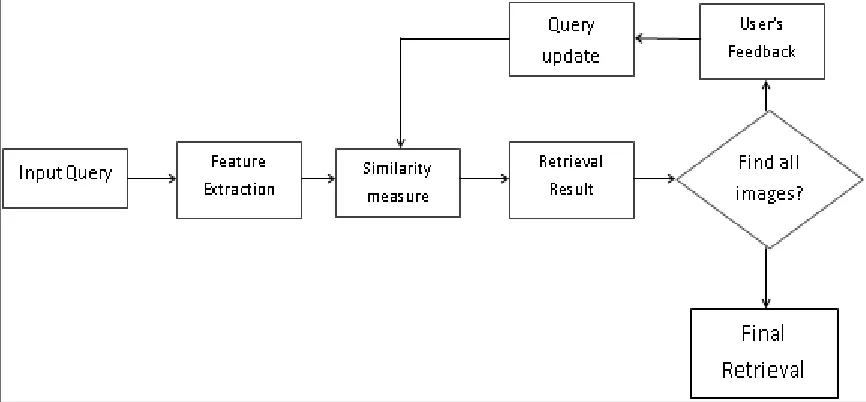
Relevance feedback is an interactive process that starts with normal CBIR. The user input a query, and then the system extracts the image feature and measure the distance with images in the database. An initial retrieval list is then generated. User can choose the relevant image to further refine the query, and this process can be iterated many times until the user find the desired images. In below fig 3.1 shows the flow of image retrieval with relevance feedback. The user reply the system that the retrieved images is relevant or not, and the system refine the query based on the user selected relevant images. A new retrieval list is then generated based on the refined query.
Fig. 3.1: Flow of image retrieval with relevance feedback
Introduction to JPEG:
In this research, several methods are proposed to improve the retrieval accuracy of JPEG Dominant Color Descriptor. In this chapter, related materials in JPEG including visual descriptors, reference software, and experiments will be introduced.
The major purpose of JPEG is to provide description on multimedia contents for effective searching, identifying, filtering, and browsing on multimedia contents such as images, videos, audios, and other digital or even analogue materials JPEG is now an international standard. A set of tools and dataset have been defined including a reference development platform the experimentation Model (XM), a common dataset for experiments, and a performance metric Averaged Normalize Modified Retrieval Rate.
JPEG standard, which was initiated in a MPEG work item called “Multimedia Content Description Interface” in 1997. The objective of JPEG is to provide standardized descriptions for streamed and stored multimedia contents including images, audio and video. They help users or applications to identify, categorize or filter these contents.
JPEG Visual Descriptors:
The JPEG descriptors that were developed can be broadly classified into general visual descriptors and domain specific visual descriptors. It can be divided into 4 major types of features: color, texture and shape. Major properties of these descriptors will be given below.
Indexing:
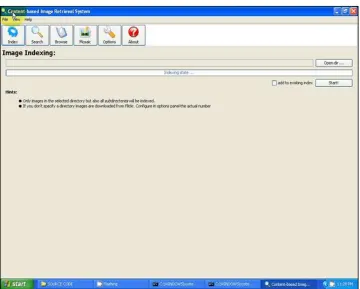
Indexing the whole set of images using K-means Clustering algorithm. Indexing is done using an implementation of the Document Builder Interface. A simple approach is to use the Document Builder Factory, which creates Document Builder instances for all available features as well as popular combinations of features (e.g. all JPEG features or all avail-able features).
In a content based image retrieval system, target images are sorted by feature similarities with respect to the query (CBIR).In this indexing, we propose to use K-means clustering for the classification of feature set obtained from the histogram. Histogram provides a set of features for proposed for Content Based Image Retrieval (CBIR). Hence histogram method further refines the histogram by splitting the pixels in a given bucket into several classes. Here we compute the similarity for 8 bins and similarity for 16 bins. Standard histograms, because of their efficiency and insensitivity to small changes, are widely used for content based image retrieval. But the main disadvantage of histograms is that many images of different appearances can have similar histograms because histograms provide coarse characterization of an image.
The k-means algorithm takes the input parameter, k, and partitions a set of n objects into k clusters so that the resulting intra cluster similarity is high but the inter cluster similarity is low. Cluster similarity is measured in regard to the mean value of the objects in a cluster, which can be viewed as the cluster’s center of gravity. “How does the means algorithm work”. The k-means algorithm proceeds as follows. First, it randomly selects k of the objects, each of which initially represents a cluster mean or center. For each of the remaining objects, an object is assigned to the cluster to which it is the most similar, based on the distance between the object and the cluster mean. It then computes the new mean for each cluster.
The k-means Algorithm:
Algorithm: k-means. The k-means algorithm for partitioning based on the mean value of the objects in the cluster. Input: The number of clusters k and a database containing n objects.
Output: A set of k clusters that minimizes the squared-error criterion.
Method:
1) arbitrarily choose k objects as the initial cluster centers: 2) repeat
3) (re)assign each object to the cluster to which the object is the most similar, based on the mean value of the objects in the cluster;
4) Update the cluster means, i.e., calculate the mean value of the objects for each cluster; 5) Until no change.
Annotation:
Central part of Annotation is the so called “semantic description panel”. It allows the user to define semantic objects like agents, places, events and times which are saved on exit for reusing them the next time starting Annotation. These semantic objects can also be imported from an existing JPEG file to allow exchange of objects between users and editing and creating those objects in a user preferred tool. Semantic objects can be used for creating the description by dragging and dropping them onto the blue panel with the mouse.
As once the objects exist, they can be reused if some pictures or series have the same context. This is especially true for objects representing persons, animals and places like the relatives, colleagues, friends, favorite pets or places like “at home” or “at work”. After dropping all the needed objects onto the blue panel the user can interconnect these objects by drawing relations (visualized by arrows) between them using the middle mouse button. The directed graph, which is generated through these user interactions with Caliph, can be saved as part of a JPEG description.
The challenging problem of real-time image annotation in their project titled “Annotating Images by Mining Image Search Results.” Different from recently published generative and discriminative modeling approaches for image annotation, the work represents a new dimension because it relies on searching in a very large collection of images with textual descriptions. The approach has three main steps: a search process, a mining process, and a filtering process. A large number of real-world images have been used to test the method and promising results are reported.
Since most images posted on the Web are not indexed semantically, e.g., by keywords, “concept-based image retrieval” has depended on low-level signatures. The “Automatic Semantic Annotation of Real World Web Images” by R.C.F. Wong and C.H.C. Leung addresses this “semantic gap” with a novel method for automatic semantic annotation aimed at retrieving appropriate images in response to user-generated queries about the image content.
Color Layout:
Color is one of the most widely used features in image retrieval. It is robust to background complication and invariant of image size and Orientation. As stated in chapter 1, three major properties of color image similarity are usually considered
Area of Matching, Color Distance, and Spatial Distribution.
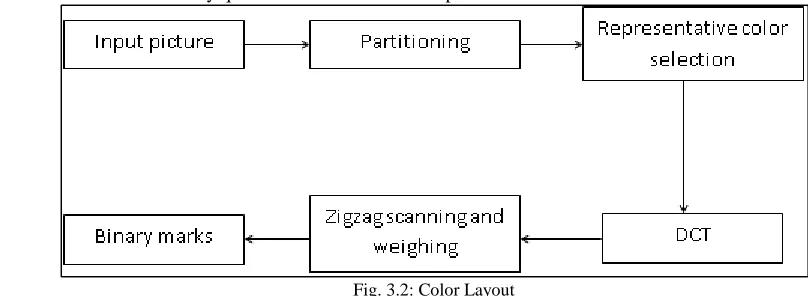
Area of matching is most commonly used because its idea is very clear and it can be represented accurately by histograms. In most histogram representations, histogram entries lay on the selected color space. The CLD represents the spatial distribution of colors in an image. The extraction process of the CLD consists of the following four stages.
The image array is partitioned into 8x8 blocks.
Representative colors are selected and expressed in YCbCr color space.
Each of the three components (Y, Cb and Cr) is transformed by 8x8 DCT (Discrete Cosine Transform). The resulting sets of DCT coefficients are zigzag-scanned and the first
Few coefficients are nonlinearly quantized to form the descriptor.
Fig. 3.2: Color Layout
In above fig 3.2 shows the color layout of CLD descriptor is thus a very compact representation of the color layout and allows for very fast searches in databases.
Color Spaces:
There are many color spaces designed for different systems and standards, but most of them can be converted by a simple transformation.
1) RGB (Red-Green-Blue) - Digital images are normally represented in RGB color space; it is the most commonly use color space in computers. It is a device dependent color space, which used in CRT monitors.
2) CMY (Cyan-Magenta-Yellow), CMYK (CMY-Black) – It is a subtractive color space for printing, it models the effect of color ink on white project. Black component is use for enhancing the effect of black color.
3) HSB (Hue Saturation Brightness) – It was used to model the properties of human perception. However it is inconvenient to calculate color distance due to its discontinuity of hue at 360º.
4) YIQ, YCbCr, YUV – Used in television broadcast standards. Y is the luminance
Histograms:
In color based image retrieval, histogram is the most commonly used representation for color features. Statistically, it utilizes a property that images having similar contents should have a similar color distribution.
However, histograms are not limited by describing the area of each color. The entries of the histogram can also represent other features. For instant, texture features can be represented by histograms formed by coefficients in transformed domain and the value of each histogram entry represents the intensity of each coefficient.
Cumulative Color Histogram:
As an alternative consideration that most color histograms are very sparse and sensitive to noise and global color shifting, proposed using the cumulative color histogram. It solved shortcomings of simple histogram with histogram intersection since cumulative histogram does not have shifting problem.
Color Sets:
uniform space, such as CIE, and then quantized the transformed color space into M bins. A color set is defined as a selection of colors from the quantized color space.
Color Descriptors:
Color is the most distinguishing visual features in image and video retrieval. It is robust to changes in the background colors and is independent of image size and orientation. Many forms of color distributions and representations are adopted in JPEG, including some color-spatial descriptors such as Color Layout, Color Structure, and some color quantization based descriptors such as Scalable Color and Dominant Color.
Color Spaces Descriptor
This descriptor does not extract features from images. It defines a set of normative color spaces for interoperability between various color descriptors.
There are 6 normative color spaces: RGB, YCbCr, HSV, HMMD, Monochrome and Linear Transformation Matrix reference to RGB.
Dominant Color Descriptor (DCD):
DCD is a compact color descriptor, designed for small storage and high speed retrieval. Image feature is formed by a small number of representative colors. These colors are normally obtained by using clustering and color quantization. The descriptor consists of the representative colors, their percentages in a region, spatial coherency of the color, and color variance.
Scalable Color Descriptor (SCD):
SCD is a color histogram in a uniformly quantized HSV color space with Haar transform. It is scalable because the precision of histogram bins value can vary from 16 to 1000 bitsper bin for different requirements. Number of bins can also be specified. Simple histogram intersection can be used for similarity measure by matching the Hear Coefficients.
Color Layout Descriptor (CLD):
JPEG CLD represents spatial distribution of color in an image, and it is a compact descriptor. It is formed by dividing the image into an 8x8 grid, and then the representative color of each tile is obtained. A Discrete Cosine Transform (DCT) is performed on the 8x8 block and the DCT coefficients are used as the descriptor. Similarity between CLDs can be measured by the root of squared differences of each matched coefficients. It should be noted that representation of CLD is in frequency domain, the coefficient represents the visual pattern in three separated channels of YCbCr, and information of particular colors cannot be directly accessed. Inverse DCT is needed for accessing spectral information.
Color Structure Descriptor (CSD):
The main purpose of the CSD is to express local color features in images. To this aim, an 8x8 sized structuring block scans the image in a sliding window approach. With each shift of the structuring element, the number of times a particular color is contained in the structure element is counted, and a color histogram is constructed in such a way. Simple histogram intersection can be used for similarity measure.
YCbCr and Y'CbCr are a practical approximation to color processing and perceptual uniformity, where the primary colors corresponding roughly to Red, Green and Blue are processed into perceptually meaningful information. By doing this, subsequent image/video processing, transmission and storage can do operations and introduce errors in perceptually meaningful ways. Y'CbCr is used to separate out a luma signal (Y') that can be stored with high resolution or transmitted at high bandwidth, and two Chroma components (Cb and Cr) that can be bandwidth-reduced, subsampled, compressed, or otherwise treated separately for improved system efficiency. One practical example would be decreasing the bandwidth or resolution allocated to "color" compared to "black and white", since humans are more sensitive to the black-and-white information.
Edge Histogram:
The EHD represents the spatial distribution of edges in an image. The extraction process of the EHD consists of the following stages:
The image array is divided into 4x4 sub images.
Each sub image is further partitioned into non-overlapping square image blocks whose size depends on the resolution of the input image.
The edges in each image-block is categorized into one of the following six types: vertical, horizontal, 45± diagonal, 135± diagonal, non-directional edge and no-edge.
the sub image.
The normalized bin values are nonlinearly quantized. There are five types of edge histogram: Vertical edge
Horizontal edge 45 degree edge 135 degree edge Non-directional edge
Fig. 3.3: Five types of edges histogram
Fig a shows vertical edge of histogram, fig b shows the horizontal edge of histogram, fig c shows the degree edge of the histogram, fig d shows the 135 degree edge of histogram and fig e shows the non-directional edge of histogram.
IV. EXPERIMENTAL RESULTS
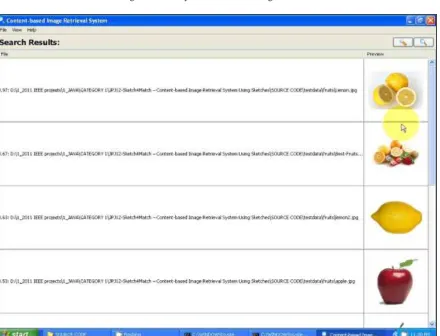
Fig. 4.8: Similar Images have been retrieved.
V. CONCLUSION
Content Based Image Retrieval (CBIR) is an automatic process for searching relevant images based on image features and user inputs. JPEG is an international standard for multimedia content description, and it is an important achievement for CBIR. JPEG has a collection of effective descriptors for images, videos, audios and other multimedia contents. In its visual part, several color descriptors are defined, in which Dominant Color Descriptor (DCD) is a compact and effective descriptor. However, due to the Short comings of its similarity measure method, the DCD’s performance is worse than a more compact Color Layout Descriptor. This is mainly due to the use of a modified Quadratic Histogram Distance Measure (DCD-QHDM) in DCD., DCD cannot be directly used in Relevance Feedback (RF) image retrieval with simple histogram weighting technique for further improving the accuracy using user feedback.
REFERENCES
[1] Sang-Mi Lee, Hee-Jung Bae and Sung-Hwan Jung, “Efficient Content based Image Retrieval Methods using Color & Texture,” ETRI Journal, Vol. 20, No. 3, pp.272-283, 1998.
[2] Remco C. Veltkamp and Mirela Tanase, “Content Based Image Retrieval Systems: A Survey,” International Journal of Engineering Science and Technology, Vol. 20, No. 5, pp. 1-62, 2002.
[3] Dr. H.B.Kekre, Sudeep D. Thepade and Akshay Maloo, “Image Retrieval using Fractional Coefficients of Transformed Image using DCT and Walsh Transform,” International Journal of Engineering Science and Technology. Vol. 2, No. 4, pp. 362-371, 2010.
[4] Greg Pazz, Ramin Zabih and Justin Miller, “Region of Image Indexing System by DCT and Entropy,” International Journal of Engineering Science and Technology, Vol. 8, No. 2, pp. 93-101, 2002.
[5] S. Nandagopalan, Dr. B. S. Adiga, and N. Deepak, “A Universal Model for content Based Image Retrieval,” International Journal of Computer Science, Vol. 4, No. 4, pp. 531-538, 2009. [6] E.L. van den Broek, L.