An Improve Genetic Algorithm Based on Fixed
Point Algorithms
Ruizhen Gao
Hebei University of Engineering, Handan 056038, Hebei, China E-mail: [email protected]
Jingjun Zhang, Yanmin Shang and Yuzhen Dong
Hebei University of Engineering, Handan 056038, Hebei, China E-mail: [email protected], [email protected], [email protected]
Abstract—An improved genetic algorithm is proposed to solve optimal problems, which is based on fixed point algorithms of continuous self-mapping in Euclidean space. The algorithm operates on a simplicial subdivision of searching space and generates the integer labels at the vertices, then, applied crossover operators and increasing dimension operators according to these labels. In this case, it is used as an objective convergence criterion and termination criterion that the labels of every individual are completely labeled simplexes. The algorithm combines genetic algorithms with fixed point algorithms and triangulation theory to maintain the proper diversity, stability and convergence of the population. Several numerical examples are provided to be examined and the numerical results illustrate that the proposed algorithm has higher global optimization capability, computing efficiency and stronger stability than traditional numerical optimization methods and the standard genetic algorithm.
Index Terms—genetic algorithm; fixed point; simplicial subdivision; integer label; completely labeled simplex
I. INTRODUCTION
The basic principles of traditional numerical optimization methods(NUM) is that the optimization process starts from a given initial point of the solution space, then carries on the single point iteration along the definite search direction and approaches optimal solution gradually[1-3]. This process, affected by the initial point, is
a steady iteration and has a single track, and difficult to obtain the global optimal solution, especially for optimization problems of non-convex functions and multimodal functions.
For the shortcomings, stochastic optimization methods have been developed rapidly[4-5]. Genetic Algorithms
(GAs) are the most popular implementation and have been successfully applied to a variety of complex real world problems[6-8]. The GAs are iterative procedures
evolving a population of individuals. The individuals are candidate solutions to a specific domain. During each generation, the individuals in the current population are rated for their effective evaluations, and a new population of candidate solutions is formed using reproduction operators, such as selection, crossover, and mutation[9].
GAs has an influence on the population diversity directly.
The majority genetic algorithms keep the diversity of population through niche technology. Though this technology, the super-individual can be prevented by using the fitness information of individuals within niche, and the diversity of population can also be kept, so the solutions distribute evenly in the solution space in order to avoid premature convergence[10-14]. However, niche
technology can not fully guarantee the probabilistic stability and ergodicity of population distribution, and these shortcomings lead to premature convergence, slow convergence rate in latter period and also influent the validity and practicality. In theory, GAs can converge to the global optimum, but actually, there are no mature principle and methods to design the convergence criteria, in contrary, the actual design relies on experiences and understanding degree of the question which is to be solved. The common method is taken the max iteration as convergence criteria, or when average fitness has not been enhanced significantly of consecutive m iterations, the algorithm will stops. Therefore, the objective design of convergence criteria has great significance.
In this paper, an improved GA based on fixed point algorithm and subdivision theory is proposed, joining the thought of simplicial subdivision to keep diversity of population. Crossover operators and increasing dimension operators relying on the integer labels are designed to guide the optimization process of genetic algorithm. Whether every individual of the population is a completely labeled simplex can be used as an objective convergence criterion and that determined whether the algorithm will be terminated. The contrast optimization results have indicated that the improved GA is highly valid.
II. FIXEDPOINTALGORITHM A. Basic Concepts
Definition 1 (Fixed Point): Suppose that
X
is a subsetof the vector of n
R
, for a random pointx
ofX
, there iscall that
x
is a fixed point off
.Definition 2 (Simplex): Suppose that
x
0,
"
,
x
p ofm
R
are the points which are independent of affine,subject to m
R
is a subset of nR
andm
<
n
. At the circumstance, we call that<
p>
x
x
0,
"
,
is a simplex,subject to:
}
1
;
,
,
0
,
0
|
{
,
,
0 0
0
∑
∑
=>
=
==
=
>=
<
p i i i
p i
i i
p
p
i
x
x
x
x
λ
λ
λ
"
"
and each point of p
x
x
0,
"
,
is called the vertex ofthe simplex.
Definition 3 (Simplicial Subdivision): Suppose that
C
is a convex set of nR
; then call thatG
is a simplicial subdivision ofC
, ifG
satisfies the three following conditions.(1) It is the set of an n-dimensional simplex.
(2) All surfaces of simplexes of
G
constitute a segmentation ofC
.(3) Each point of
C
has a domain which intersects with limited simplex inG
.Definition 4 (
K
1Subdivision ofR
n): Each coordinatecomponent of the point in the set of
K
10is integer, andN
is a vector denoted byN
=
{
,1
"
,
n
}
. Each basic vector such as nu
u
1,
"
,
ofR
nis respectively columnvector of the unit matrix
π
is a substitution ofN
and an n-dimension simplex of<
n>
y
y
0,
"
,
denoted by)
,
(
01
y
π
k
, with condition of i i 1 (i)u y
y = − + π . All the simplexes like
k
1(
y
0,
π
)
constitute a set denoted asK
1, that isK
1 subdivision,Definition 5 (Completely Labeled Simplex):
Taken
σ
as a completely labeled simplex satisfying that the integer labels of its vertices aren
+
1
kind ofdifferent labels such as
0
,
"
,
n
.B. Fixed Point Algorithm
Fixed point theory is one of the most famous results in topology and it has applied widely in many fields. With respect to the following optimal problems: Suppose that
f
is a self-mapping, also is a convex function, thatis n n
R
R
f
:
→
, looking for a pointx
that is the minimum off
. The necessary and sufficient condition ofbeing an extreme point is that its gradient is zero, that is
∇
f
(
x
*)
=
0
.Suppose thatg
is a self-mapping, thatis n n
R
R
g
:
→
, we can converse the solution ofzero point problems to solution of fixed point problems though the function of
g
(
x
)
=
x
−
∇
f
(
x
)
, subjectto n
R
x
∈
.The fixed point algorithm carries on proper simplicial subdivision to the solution space firstly, then computes the integer labels at the vertices, and at last, generates the finite sequences composed of adjacent nearly-complete simplexes, though the pivotal operations among the simplexes. According to the degree of a simplex, we can judge whether the simplex is a completely labeled simplex. The vertices of the completely labeled simplex are
ε
fixed points. The two-dimension optimal problems carry onK
1 subdivision, integer label and pivotal operations; begin from an artificial initial point outside the domain; then generates the finite sequences composed of adjacent nearly-complete simplexes, eventually arrive at a completely simplex which contains the optimization solution off
. To solve the two-dimension optimalproblems, carry on
K
1subdivision to the Euclidean SpaceR
2, the goal is to find such a triangle under theself-mapping of
g
. The first coordinate component of one vertex of the triangle dropped, another vertex's second coordinate component decreased, and two coordinate components of the third vertex remained unabated. Because of continuity ofg
, if this triangle'sdiameter is small enough, the changes of three vertices will not differ too far. In this case, each vertex is an approximate fixed point.
III. THEIGABASEDONFIXEDPOINT
ALGORITHMANDSUBDISIONTHEORY The premise of solving optimal problems with fixed point algorithm is that the optimal function is convex function. The algorithm finds the completely labeled simplex which contains the global optimum along with the sequence of nearly-complete labeled simplex, however, the actual optimization problems are often non-convex functions and multimodal functions, which corresponds lots of completely labeled simplexes, and among which, there must be a completely labeled simplex containing global optimum at least. The simplex sequence which embarks from the artificial beginning point can determine only one completely labeled simplex; therefore, it is very difficult to find the completely labeled simplex which contains the globally optimal solution. So how to find all the completely labeled simplexes is the key problem, genetic algorithm has a strong ability of searching global optimal solution and can find all completely labeled simplexes.
In the fixed point algorithm, the integer label of vertex in subdivision is decided by the relation between function
f
and its various components. With thisinformation, the algorithm can converge to a nearby completely labeled simplex quickly, finding the
ε
fixed point. The genetic algorithm searches the optimal solution by using bearing simplex and information of its vertices` integer labels to enhance the principle necessity and keep balance between randomness and necessity.nearly-complete labeled simplexes. As a node, the degree of a nearly-complete labeled simplex does not exceed 2 and the number of simplex of the bounded function
(
n)
R
f
is limited. If the times going thougheach nearly-complete is finite, the computation process can achieve a completely labeled simplex within finite steps. By using the information, genetic algorithm can design the objective convergence criteria.
In this paper, the performance of a genetic algorithm is improved by joining the fixed point algorithm into the genetic algorithm.
A. Encode Scheme
Given that the shortcomings of binary-code such as low accuracy, occupation of storage space and the poor efficiency, the algorithm uses real-code to generate high-precision individual. The real-code can produce individuals with high accuracy and is suitable for the computation of continuous variables. However, its scope of application is relatively broad, which enhances the randomness of genetic algorithm with poor stability and premature convergence. In this section, the information of vertices and the integer label are introduced to real-code. The code is as follows:
{ X
n n
n
y
y
z
z
f
x
x
1"
,
0,
"
,
,
0"
,
}Subject to
x
i,
i
∈
(
,1
"
,
n
)
is the design variable ofindividual;
y
i,
i
∈
(
0
,
"
,
n
)
is the vertex of bearingsimplex;
z
i,
i
∈
(
0
,
"
,
n
)
is the integer label ofy
i ;X
f
is the objective function value corresponding tox
i.B. Fitness Function
The searching process of genetic algorithm is based on the fitness information of individual and the fitness is obtained according to the objective function for the optimization problem. The design goal of the IGA proposed in this paper is to find the completely labeled simplexes and evaluate the individuals on the basis of the integer label information of bearing simplex of the individual.
C. The Initialization of the IGA
Firstly, the optimization problems are transformed into fixed point problems. Secondly, carries on simplicial subdivision to the self-mapping
f
denotedby n n
R
R
f
:
→
; set the population size and generate theinitial generation; calculates the bearing simplex of each individual and the integer labels of vertices; at last, calculates the function value corresponding to each individual.
D. Crossover Operator
The crossover operator generates the new individual though the recombination of two father individuals, so this operator is an important means of generating new individual. The operating process of crossover operator of the IGA presented in this paper is divided into two steps: (1) Classy the bearing simplexes by the information of
integer label of nearly-complete labeled edge.
(2) Carry on the crossover operation between the individuals belonging to different class or different bearing simplexes.
E. Mutation Operator
This algorithm adapts the uniform mutation, and generates the individuals firstly in the simplexes which do not contain any individual, and secondly mutate the individual in non-completely labeled simplex.
F. Increasing Dimension Operator
When the dimension of vertex label of an individual generated randomly or by genetic operation is less than
n
(the dimension is denoted bym
, that ism
<
n
), the search process begins from this individual and carries on searching along a sequence of adjacent simplexes with same dimension. Accordingly, the searching can find a simplex with dimension ofm
+
1
, and carrying on searchsuccessively can find the simplex with dimension ofn.
Given the above reasons, this algorithm presented in this paper adds a new genetic operator based on the three traditional ones. The reason is as follows:
The integer labels of vertices of bearing simplex may be the same. At the same time, the edges of these bearing simplexes are not nearly-complete labeled edges. However, in theory, each individual converges in a completely labeled simplex. To enable the individual with the same integer labels achieve the nearly-complete labeled simplex though a certain route, the increasing dimension operator is designed. Taken two-dimension Euclidean Space for example, the process of increasing dimension operator is as follows:
Process of increasing dimension: Finds the vertex whose objective function value is max by comparing the vertices with same integer label in a simplex, and then denote the vertex as
y
0, and the other two vertices are denoted byy
1andy
2. The substitution of vectorN
has two forms when N={1,2}, respectively are{1,2}and{2, 1}.τ
(
0
)
is a edge which is determined byy
1andy
2.Replace the original simplex with an adjacent simplex which shares
τ
(
0
)
with the original one. And then find a new point randomly in it as a new individual and calculate its integer labels of vertices. If the three labels are still the same, then repeat the above process until finding a simplex with different labels. If a simplex has been searched, then marking it with a flag, and at this time, replace the original individual with the current one. The current one must be superior to the original.G. Selection Operator
selected into the next iteration.
H. Diversity of Population
The diversity of population affects the performance of algorithm directly. The algorithm proposed in this paper adapts two strategies to maintain population diversity and to avoid emerging the super individual. The two strategies are as follows:
(1) The individuals in a bearing simplex are similar, and so the crossover operation is prohibited between individuals in a same bearing simplex, avoiding the same individual appearing.
(2) When carrying on the increasing dimension operation, replace the original individual with the searching individual.
I. Convergence Criteria
When the bearing simplex of all individuals in population are the completely labeled simplex, the algorithm stops. At last, output the
ε
fixed point. To elaborate the application of this convergence criterion used in this paper, here, this paper takes the dual multimodal functions as example.J. Flow of improvement genetic algorithm
Step1: The optimized problem will be transformed
into the fixed point problem.
Step2: Carry on K1 subdivision to the solution space.
Step3: Generate initial population.
Step4: Calculate the bearing simplex of the individual
and compute integer label of its vertices.
Step5: While (not satisfying convergence criteria).
Do {Carrying on crossover operator Carrying on mutation operator
Carrying on increasing operator Carrying on selection operator Judgment of convergence criteria}
Step6: Output the information of completely labeled
simplex.
IV. EXPERIMENTSANDANALYSIS A. Test Functions:
In this paper, the optimization experiment is carried on by using three functions which respectively belong to typical convex functions and non-convex functions, and the experiment adapts three methods such as NUM, SGA and the IGA proposed in this paper. The test functions are as follows:
5
5
)
(
min
:
2 1 21
=
∑
−
≤
≤
= i
i
i
x
x
X
θ
θ
(
)
20
20
1
)
(
100
)
(
min
:
2 1 2 2 2 1 2≤
≤
−
−
+
−
=
ix
x
x
x
X
θ
θ
Among the above equations, the mapping of
θ
1is a simple convex function and it reaches the minimum at the point of (0, 0), as in figure 1;θ
2is a non-convex function and the minimum point of it is (1, 1), as in figure2.
Figure 1 Convex function ofθ1
Figure 2 Non-convex function ofθ2
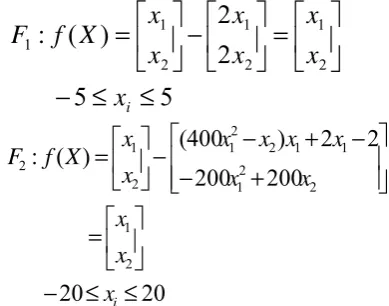
According to the flow of IGA, the optimized problem will be transformed into the fixed point problem firstly and the process is as follows:
5
5
2
2
)
(
:
2 1 2 1 2 1 1≤
≤
−
⎥
⎦
⎤
⎢
⎣
⎡
=
⎥
⎦
⎤
⎢
⎣
⎡
−
⎥
⎦
⎤
⎢
⎣
⎡
=
ix
x
x
x
x
x
x
X
f
F
20
20
200
200
2
2
)
400
(
)
(
:
2 1 2 2 1 1 1 2 2 1 2 1 2≤
≤
−
⎥
⎦
⎤
⎢
⎣
⎡
=
⎥
⎥
⎦
⎤
⎢
⎢
⎣
⎡
+
−
−
+
−
−
⎥
⎦
⎤
⎢
⎣
⎡
=
ix
x
x
x
x
x
x
x
x
x
x
X
f
F
Then carry on
K
1subdivision to the solution space in two-dimension Euclidean Space. Label the vertices of simplexes according tol
(
x
)
. AsF
1is a convex function, the global optimization solution is contained in the completely labeled simplex.θ
2 is a non-convex function. The gobal optimization solution is contained in the completely labeled simplex.B.Optimization Results and Analysis:
The above analysis shows that the global optimization solution is closely related to the completely labeled simplex. Under the given subdivision accuracy, the optimization solution which meets the requirement of accuracy is in completely labeled simplex.
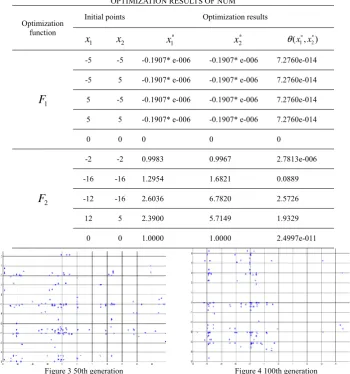
(1) The process of NUM: Carry on the optimization by
functions. Different initial points obtain different optimization results, the results are shown in table 1.
From the data analysis, it can be seen that NUM obtain different results when the initial points are different for non-convex functions and multimodal functions, especially for the latter, this algorithm often falls into local optimal solution.
(2) The parameters of the SGA are set as follows: the
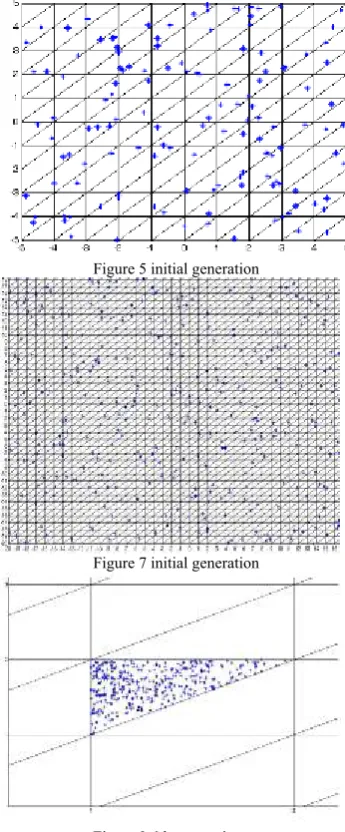
chromosome length of binary-code is 10; the population size is 200; the crossover probability is 0.6 and the mutation probability is 0.02; the max generation is 100. the population distribution in the 50th generation is described in figure 3, figure 4 describe the population distribution when the iteration is 100.
From these figures, it can be seen that the results of the SGA are different each time. Besides, it also has shortcomings of poor stability and obvious difference between convergence effect and theoretical results.
(3) The parameters of the IGA are set as follows: the
population size is 200. For the convex function of
θ
1, the IGA runs 4 iterations at most. In figure 5, the distribution of initial population is described; figure 6 describe the population distribution corresponding to 4th generation. The simplex in which the individuals are crowded is a completely labeled simplex containing the globaloptimization solutions. For the non-convex function of
θ
2, the improved algorithm runs 6 iterations at most. In figure 7, the distribution of initial population is described; figure 8 to figure 9 describe the population distribution in the evolution process. Combining with figure 1, it can be seen that the algorithm converges into the extreme value rapidly in the 6th generation. In figure 10, the intersection of the three colors corresponds to the global optimization solution.V. CONCLUSION
In this paper, an IGA for the optimization of convex functions and non-convex functions has been presented. The IGA is based on fixed point algorithm and subdivision theory; the crossover operator and increasing dimension operator are designed with information of integer labels of vertices. Along with the sequence of nearly-complete labeled simplexes, all the completely labeled simplexes can be found quickly. From the experimental results, it can be seen that the validity, stability and convergence of the IGA are also guaranteed. The algorithm has been tested on several standard test problems and which proves that the algorithm has a higher valid and effectiveness.
TABLE 1.
OPTIMIZATION RESULTS OF NUM
Optimization function
Initial points Optimization results
1
x x2 x1∗ x∗2 θ(x1∗,x2∗)
1
F
-5 -5 -0.1907* e-006 -0.1907* e-006 7.2760e-014
-5 5 -0.1907* e-006 -0.1907* e-006 7.2760e-014
5 -5 -0.1907* e-006 -0.1907* e-006 7.2760e-014
5 5 -0.1907* e-006 -0.1907* e-006 7.2760e-014
0 0 0 0 0
2
F
-2 -2 0.9983 0.9967 2.7813e-006
-16 -16 1.2954 1.6821 0.0889
-12 -16 2.6036 6.7820 2.5726
12 5 2.3900 5.7149 1.9329
0 0 1.0000 1.0000 2.4997e-011
Figure 5 initial generation Figure 6 4th generation
Figure 7 initial generation Figure 8 6th generation
Figure 9 6th generation Figure 10 labeled simplex distribution ofF2
ACKNOWLEDGEMENT
The authors gratefully acknowledge the supports of National Natural Sciences Foundation of China under the project number 60875037 and Natural Sciences Foundation of Hebei Province under number F2007000710 and number E2008000731.
REFERENCES
[1] Q. Zhang and H. Muhlenbein, “On the convergence of a class of estimation of distribution algorithms”, IEEE Trans. Evol. Comput., vol. 8, pp. 127-136, 2004
[2] Deepak Sharma, Kalyanmoy Deb, N.N. Kishore, “A domain-specific crossover and a helper objective for generating minimum weight compliant mechanisms”,
GECCO, pp. 1723-1724, 2008
[3] D. Duhamel, “Shape optimization of noise barriers using genetic algorithms”, Journal of Sound and Vibration, Vol.
297, pp.432-443, 2006
[4] P. Kalra, P.B. Mahapatra, D.K. Aggarwal, “An evolutionary approach for solving the multimodal inverse kinematics problem of industrial robots”, Mechanism and Machine Theory, vol. 41, pp. 1213-1229, 2006
[5] J.H.Holland, Adaptation in Natural and Artificial Systems,
Ann Arbor: The University of Michigan Press, 1975 [6] J.J. Grefenstette, “Optimization of control parameters for
genetic algorithms”, IEEE Transactions on Systems, Man, andCybernetics, SMC, vol. 16, pp. 122-128, 1986
[7] Xing Li-ning, Chen Ying-wu, Cai Huai-ping, “An intelligent genetic algorithm designed for global optimization of multi-minima functions”, Applied Mathematics and Computation, vol. 178, pp. 355-371,
2006
[8] Jun Zhang, Henry Shu-Hung Chung, Wai-Lun Lo, “Clustering-Based Adaptive Crossover and Mutation Probabilities for Genetic Algorithms”, IEEE Transactions on Evolutionary Computation, vol. 11, pp. 326-335, 2007
[9] Zhenguo Tu, Yong Lu, “A robust stochastic genetic algorithm (StGA) for global numerical optimization”,
IEEE Transactions on Evolutionary Computation, vol.
8(5), pp. 456- 470, 2004
[10] R. Farmani, J.A. Wright, “Self-adaptive fitness formulation for constrained optimization”, IEEE Transactions on Evolutionary Computation, vol. 7, pp. 445-455, 2003
[11] D. Bugajewski, “Fixed point theorems in hyperconvex spaces revisited”, Math. Comput. Model, vol. 32, pp.
[12] H.E. Scarf, “The approximation of fixed points of a continuous mapping”, SIAM. J. Appl. Math., vol. 15, pp.
1328- 1341, 1967
[13] Regan and R. Precup, “Fixed point theorems for set valued maps and existence principles for integral inclusions”, J. Math. Anal. Appl., vol. 245, pp. 594-612, 2000
[14] Salvador Garcia., Francisco Herrera, “An Extension on ‘Statistical Comparisons of Classifiers over Multiple Data Sets’ for all Pairwise Comparisons”, J. of Machine Learning Research, vol. 9, pp. 2677-2694, 2008
Ruizhen Gao was born July 2, 1979, in Hebei, China, He received the B.S. degree in mechanical design and the M.S. degree in applied technol. of computer from Hebei University of Engineering, Handan, China, in 2002 and 2005. He is Lecturer at Hebei University of Engineering. His main research is ralated to the optimization techniques and application to the mechanical systems. He has published more than 20 technical papers.
Jingjun Zhang was born Sep. 15, 1963, China, He received the PH.D. degree in computation mechanics from Jilin University, China, in 1996.
In 1997, he became Professor at Hebei University of Engineering. He has published more than 80 technical papers. His scientific work has been mainly carried out in the filed of advanced design method (optimal design, multiobjective optimization, etc.).
Yanmin Shang was born Nov. 8, 1982, China, He received M.S. degree in applied technol. of computer from Hebei University of Engineering, Handan, China, in 2010