e-ISSN: 2278-067X, p-ISSN: 2278-800X, www.ijerd.com Volume 7, Issue 10 (July 2013), PP. 11-20
Performance Analysis of Data Encryption Standard
Algorithm & Proposed Data Encryption Standard
Algorithm
Shah Kruti Rakeshkumar.
11
Babariya Institute of Technology, Assistant Professor
Abstract:- The principal goal guiding the design of any encryption algorithm must be security against unauthorized attacks. Within the last decade, there has been a vast increase in the accumulation and communication of digital computer data in both the private and public sectors. Much of this information has a significant value, either directly or indirectly, which requires protection. The algorithms uniquely define the mathematical steps required to transform data into a cryptographic cipher and also to transform the cipher back to the original form. Performance and security level is the main characteristics that differentiate one encryption algorithm from another. Here introduces a new method to enhance the performance of the Data Encryption Standard (DES) algorithm is introduced here. This is done by replacing the predefined XOR operation applied during the 16 round of the standard algorithm by a new operation depends on using two keys, each key consists of a combination of 4 states (0, 1, 2, 3) instead of the ordinary 2 state key (0, 1). This replacement adds a new level of protection strength and more robustness against breaking methods.
Keywords:- DES, Encryption,Decryption,SAC
I. INTRODUCTION
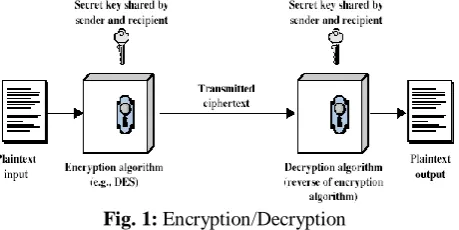
Cryptography is usually referred to as “the study of secret”, while now a days is most attached to the definition of encryption. Encryption is the process of converting plain text “unhidded” to a cryptic text “hidded” to secure it against data thieves. This process has another part where cryptic text needs to be decrypted on the other end to be understood in figure 1.
Fig. 1: Encryption/Decryption Cryptography Goals :[2]
1. CONFIDENTIALLY : Information in computer transmitted information is accessible only for reading by authorized parties.
2. AUTHENTICATION- Origin of message is correctly identified with an assurance that identity is not false. 3. INTERGRITY- Only authorized parties are able to modify transmitted or stored information.
4. NON REPUDIATION- Requires that neither the sender, nor the receiver of message be able to deny the transmission.
5. ACCESS CONTROL- Requires access may be controlled by or for the target system. 6. AVAILIBILITY- Computer system assets are available to authorized parties when needed.
II. DATA ENCRYPTION STANDARD
sixteen Feistel iterations surrounded by two permutation layers: an initial bit permutation IP at the input, and its inverse IP−1 at the output. The structure of the cipher is depicted in Figure 2. The decryption process is the same as the encryption, except for the order of the round keys used in the Feistel iterations.[12]
The 16-round Feistel network, which constitutes the cryptographic core of DES, splits the 64- bit data blocks into two 32-bit words, LBlock and RBlock (denoted by L0 and R0). In each iteration (or round), the second word Ri is fed to a function f and the result is added to the first word Li. Then both words are swapped and the algorithm proceeds to the next iteration. The function f of DES algorithm is key dependent and consists of 4 stages.
Fig. 2:DES Algorithm
1. Expansion (E):The 32-bit input word is first expanded to 48 bits by duplicating and reordering half of the bits.[11]
2. Key mixing :The expanded word is XORed with a round key constructed by selecting 48 bits from the 56-bit secret key, a different selection is used in each round.
3. Substitution. The 48-bit result is split into eight 6-bit words which are substituted in eight parallel 6×4-bit S-boxes. All eight S-boxes, are different but have the same special structure.
4. Permutation (P) : The resulting 32 bits are reordered according to a fixed permutation before being sent to the output.
The modified RBlock is then XORED with LBlock and the resultant fed to the next RBlock register.The unmodified RBlock is fed to the next LBlock register. With another 56 bit derivative of the 64 bit key, the same process is repeated.
III. IMPROVED 4-STATES OPERATION
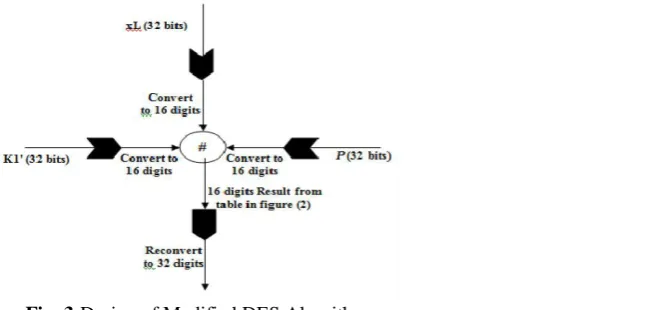
To increase the security and key space, that makes the encryption algorithms more robustness to the intruders, a new manipulation bits process has been added in by using different truth table for manipulation bits process work on 4- states (0,1,2,3) , while the traditional binary process (XOR) work on (0, 1) bits only. The symbol # has been used to refer to the operator that execute this process use truth tables that shown in figure 3.[7]
The new operation needs 3 inputs, the first one specify the table number that should be used to calculate the result among the 4 tables, the other 2 inputs define the row and column number in the specified table where the cross point of them gives the result.
Here, example for # operation, this operation need 3 inputs, first one specify the table number that should be used to calculate the result among the four truth tables as shown in Table 1, the other 2 inputs define the row and column number in the specified table where the cross point of them gives the result this result is in 16 digits.
Input in 32 bit binary format 1001011101010010101001111010001001 which is converted into the number 2 1 1 3 1 1 0 2 2 2 1 3 2 2 0 2 1
Input 1: 0 1 3 0 1 2 2 3 1 Input 2: 3 2 2 1 0 1 2 1 1 Input 3: 1 0 0 2 1 3 2 1 2 Result : 3 0 2 3 1 2 2 2 2
Table: Truth Table
IV. PROPOSED ALGORITHM OF DES
This research proposed a new improvement to the DES algorithm. The proposed improvement makes use of the new operation defined in the previous section, operation (#) applied during each round in the original DES algorithm, where another key is needed to apply this operation, this key may come in binary form and convert to a 4-states key. Here, originally DES algorithm linear cryptanalysis and differential cryptanalysis attacks are heavily depends on the S-box design.
Consequently, multiple keys will be used in each round of the original DES, the first key Ki will be used with the f function. The second key will be the first input to the # operation, the second input will be the output of the f function, and the third input to the # operation will be the value Li, Algorithm shows the three 32-bits input to the # operation ,and the 32-bits output, with places needed to convert these 32- bits to 16-digits. These three inputs to the # operation should be firstly converted from 32 bits to a 16 digits each may be one of four states (0,1,2, 3), i.e., each two bits converted to its equivalent decimal digits.
Algorithm of modified data encryption standard with 4 state operation :
INPUT:- plaintext m1 . . . m64; 64-bit two keys K=k1 . . . k64 and K'=k1' . . . k64' (includes 8 parity bits).
OUTPUT:- 64-bit ciphertext block C=c1 . . .c64.
1. (key schedule) Compute sixteen 48-bit round keys Ki, from K. 2. (key schedule) compute sixteen 32-bit round keys Ki', from K'
2. (L0, R0) _IP(m1, m2,. . .m64) (Use IP Table to permute bits; split the result into left and right32-bit halves L0=m58m50 . . . m8,R0=m57m49 . . . m7)
3. (16 rounds) for i from 1 to 16, compute Li and Ri as follows: 3.1. Li=Ri-1
3.2. Ri = Li-1 # f (R i-1, Ki) where f(Ri-1, Ki) = P(S(E(Ri-1) Å Ki)), computed as follows:
(a) Expand Ri-1 = r1r2 . . . r32 from 32 to 48 bitsT_E(Ri-1). (Thus T= r32r1r2 . . . r32r1.)
(b) T'_T XOR Ki . Represent T ' as eight 6-bit character strings: T ' = (B1 . . . B8) (c)T '' _ F
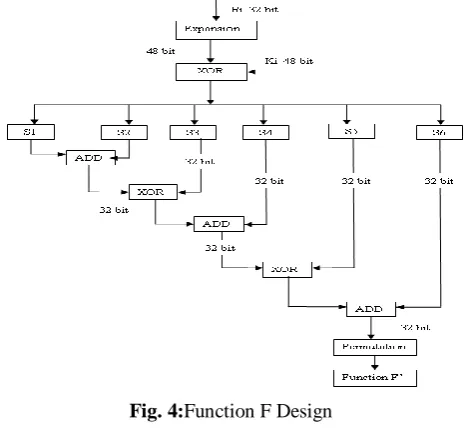
Function F = ((((((( S1+S2) mod 2 ^ 32) XOR S3) + S4) mod 2^32) XOR S5) +S6)mod 2^32 Here Si(Bi) maps to the 8 bit entry inrow r and column c of Si
yielding t16t7 . . . t25.)
and the operation # in Ri = Li-1 # f (R i-1, Ki) is computed as follows:
(a) convert the 32 bits resulted from f (R i-1, Ki) into 4-states 16 digits call itf '
(b) convert the 32 bits of Li-1 to 4-states 16 digits call it Li-1' (c) convert the 32 bits of Ki' to 4-states 16 digits call it Ki''
(d) compute Ri by applying the # operation on f ', Li-1', and Ki'' according to truth tables shown in figure
4. b1b2 . . . b64 _ (R16, L16). (Exchange final blocks L16, R16.) 5. C _ IP-1 (b1b2 . . . b64). (Transpose using IP-1 C = b40b8 . . . b25.) 6. End.
Fig. 4:Function F Design
V. TEST RESULTS.
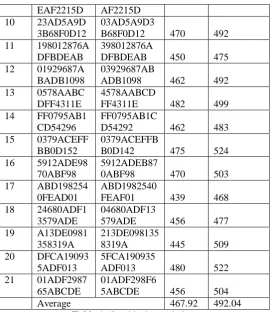
In order to study the performance, the algorithm has been tested on an Intel based machine running Microsoft Windows 7 with a 2.50 GHz Intel Core 2 i5 processor and 4 GB of main memory. The algorithm is developed on JAVA with Net Beans 6.9 software. The proposed algorithm has been extensively tested for avalanche effect and SAC. Both the criterion tested on proposed algorithm and is compared with original algorithm. The following subsections show the experimental results.
Test Results of Avalanche Effects
SR NO.
Original Secret Key
Modified Secret Key
DES Algorit hm
Proposed DES Algorithm
1 05771BBAA FCDE9F3
15771BBAAF
CDE9F3 480 487 2 56AD1230E
FAD1790
46AD1230EF
AD1790 470 483 3 109ADE987
211ADFB
109ADC9872
11ADFB 490 498 4 23ACB259A
BD56890
03ACB259A
BD56890 485 500 5 09ADFB553
3129FFD
29ADFB5533
129FFD 461 490 6 AADDFF33
221290AB
AADDFF332
21290A3 446 498 7 BADF09135
789225A
2ADF091357
89225A 447 467 8 AB1298DA
3968235A
8B1298DA39
EAF2215D AF2215D 10 23AD5A9D
3B68F0D12
03AD5A9D3
B68F0D12 470 492 11 198012876A
DFBDEAB
398012876A
DFBDEAB 450 475 12 01929687A
BADB1098
03929687AB
ADB1098 462 492 13 0578AABC
DFF4311E
4578AABCD
FF4311E 482 499 14 FF0795AB1
CD54296
FF0795AB1C
D54292 462 483 15 0379ACEFF
BB0D152
0379ACEFFB
B0D142 475 524 16 5912ADE98
70ABF98
5912ADEB87
0ABF98 470 503 17 ABD198254
0FEAD01
ABD1982540
FEAF01 439 468 18 24680ADF1
3579ADE
04680ADF13
579ADE 456 477 19 A13DE0981
358319A
213DE098135
8319A 445 509 20 DFCA19093
5ADF013
5FCA190935
ADF013 480 522 21 01ADF2987
65ABCDE
01ADF298F6
5ABCDE 456 504 Average 467.92 492.04
Table 1 :One bit change in key
SR NO . Original Secret Key Modified Secret Key DES Algorit hm Proposed DES Algorithm
1 13345779 9BBCDFF 1
133457799
BBCDFF2 484 493
2 11345766 89ACCBE E
2134576689
ACCBEE 446 495
3 1453699A AFF00DC 2
1453699AA
FF00DC7 479 485
4 7564133A EFF0BCD 1
F564133AE
FF0BCD3 458 469
5 05771BB AAFCDE 9F3
25771BBA
AFCDE9F1 459 469
6 56AD123 0EFAD17 90
77AD1230E
FAD1790 485 499
7 109ADE9 87211AD FB
909ADC987
211ADFB 479 492
8 23ACB25 9ABD568 90
73ACB259
ABD56890 465 489
9 09ADFB5 533129FF
69ADFB55
D 10 AADDFF
33221290 AB
ABDDFF33
221290A3 446 498
11 BADF091 35789225 A
BADF0919
5789225A 459 472
12 AB1298D A3968235 A
9B1298DA3
968235A 467 505
13 1159023A DEAF221 5D
115902FAD
EAF2215D 492 506
14 23AD5A9 D3B68F0 D12
23AD5C9D
3B68F0D12 485 490
15 19801287 6ADFBD EAB
198012876 ADF8DEA B
454 489
16 01929687 ABADB1 098
01929687F
BADB1098 460 482
17 0578AAB CDFF431 1E
0578AA94
DFF4311E 458 490
18 FF0795A B1CD542 96
FF0795AB0
4D54296 474 499
19 0379ACE FFBB0D1 52
0379ACEFF
3B0D142 488 499
20 5912ADE 9870ABF 98
5912ADEB
870ABF90 468 497
21 ABD1982 540FEAD 01
2BD198254
0FEAF03 478 511
Average 468.56 492.52
Table 2 :Two bit change in key
SR NO . Original Secret Key Modified Secret Key DES Algo rith m Propose d DES Algorith m
1 13345779 9BBCDFF 1
033457799 BBCDFF2
483 521
2 11345766 89ACCBE E
0134576689 ACCBE8
482 492
3 1453699A AFF00DC 2
D453699A AFF00DC3
481 490
4 7564133A EFF0BCD 1
6764133AE FF0BCD3
455 482
5 05771BB AAFCDE
20771BBA AFCDE9F3
9F3 6 56AD123
0EFAD17 90
56881230E FAD1790
481 502
7 109ADE9 87211AD FB
609ADE987 211ADFB
487 500
8 23ACB25 9ABD568 90
03ACB259 A8D56890
488 497
9 09ADFB5 533129FF D
29ADFA55 3B129FFD
480 490
10 AADDFF 33221290 AB
AADDF833 221290A3
472 498
11 BADF091 35789225 A
BADF09F3 5789225A
487 498
12 AB1298D A3968235 A
AB1248DA 3968235A
481 506
13 1159023A DEAF221 5D
11590D3A DEAF2215 D
464 481
14 23AD5A9 D3B68F0 D12
23AD5A9D 3FE9F0D12
479 496
15 19801287 6ADFBD EAB
F98012876 ADFBDEA B
485 500
16 01929687 ABADB1 098
01929687A B2F31098
460 507
17 0578AAB CDFF431 1E
0570FABC DFF4311E
466 500
18 FF0795A B1CD542 96
FF0795AB1 C414296
469 489
19 0379ACE FFBB0D1 52
0379ACE7E AB0D152
477 487
20 5912ADE 9870ABF 98
1912ADED 870ABF9C
466 488
21 ABD1982 540FEAD 01
ABD19825 C8BEAD01
476 500
22 24680AD F13579A DE
24680AD79 2579ADE
486 501
23 A13DE09 81358319 A
A13DE09F1 358319A
474 503
24 DFCA190 935ADF0 13
DFCA1909 35ADF152
25 01ADF29 8765ABC DE
01A9F2987 64AB4DE
490 504
Average 476.9
6
496.96
Table 3 :Three bit change in key
Now another criterion for testing on proposed DES algorithm is SAC which states that any output bit j of an S-box should change with probability ½ when any single input bit i is inverted for all i, j. The SAC is one of the design criterions for function f. Such S-Boxes exhibit which is generally referred to as Good Avalanche Effect, where inverting any input bit i causes approximately half of the output bits to be inverted, this is equivalent to good Diffusion.
Here, In SAC when we given 48 bits input to the function F and perform all operation in function F after that we got 32 bits output. In those 32 bits output data numbers of bits are change when we change 1 or more bits change in input data.
Now, we saw when we change one bit in input data at that time number of bits are change. The following Table shows the SAC results when change one bit in input data.
SR No DES Proposed DES
DES Results(% )
Proposed DES Results (%)
1 2 17 6.25 53.125
2 2 16 6.25 50
3 2 20 6.25 62.5
4 3 15 9.375 46.875
5 4 17 12.5 53.125
6 2 17 6.25 53.125
7 3 20 9.375 62.5
8 2 16 6.25 50
9 2 16 6.25 50
10 2 16 6.25 50
11 3 18 9.375 56.25
12 2 18 6.25 56.25
13 4 17 12.5 53.125
14 2 16 6.25 50
15 3 16 9.375 50
16 2 18 6.25 56.25
17 2 17 6.25 53.125
18 2 17 6.25 53.125
Average 2.444 17.055
7.639 53.298 Difference 14.611 45.659
Table 4 : SAC 1 bit change in input data to function F
SR No DES Proposed DES
DES Results(%)
Proposed DES Results(%)
1 2 19 6.25 59.375
2 2 20 6.25 62.5
3 5 23 15.625 71.875
4 2 18 6.25 56.25
5 1 15 3.125 46.875
7 2 19 6.25 59.375
8 2 17 6.25 53.125
9 2 15 6.25 46.875
10 2 17 6.25 53.125
11 5 18 15.625 56.25
12 2 17 6.25 53.125
13 1 18 3.125 56.25
14 1 15 3.125 46.875 15 3 19 9.375 59.375
16 1 20 3.125 62.5
17 2 18 6.25 56.25
18 2 15 6.25 46.875
Average 2.222 18 6.94 56.25 Difference 15.777 49.30
Table 5 : SAC 2 bits change in input data to function F
When we change one bit in an input at that time number of output bits are change in original DES 7.638% ratio and modified DES 53.2986% ratio. So, finally difference between original DES and proposed DES is 45.69%
When we change two bits in an input at that time number of output bits are change in original DES 6.94% ratio and modified DES 56.25% ratio. So, finally difference between original DES and proposed DES is 49.305%.
VI. CONCLUSION
As we toward a society where automated information resources are increased and cryptography will continue to increase in importance as a security mechanism. Electronic networks for banking, shopping, inventory control, benefit and service delivery, information storage and retrieval, distributed processing, and government applications will need improved methods for access control and data security. The information security can be easily achieved by using Cryptography technique. DES is now considered to be insecure for some applications like banking system. there are also some analytical results which demonstrate theoretical weaknesses in the cipher. So it becomes very important to augment this algorithm by adding new levels of security to make it applicable. By adding additional key, modified S-Box design, modifies function implementation and replacing the old XOR by a new operation as proposed by this thesis to give more robustness to DES algorithm and make it stronger against any kind of intruding. DES Encryption with two keys instead of one key already will increase the efficiency of cryptography.
ACKNOWLEDGMENT
I take this opportunity to acknowledge those who have been great support and inspiration through the research work. My sincere thanks to Prof. Bhavika Gambhava for her diligence, guidance, encouragement and help throughout the period of research, which have enabled me to complete the research work in time. I express my deep sense of gratitude to Prof. C. K. Bhensdadia, Professor and Head of Computer Engineering Department of Dharmsinh Desai University, Nadiad, Gujarat for providing the necessary facilities during the research and encouragement from time to time. I also thank him for the time that he spread for me, from his extreme busy schedule. Special thanks to the institute, Dharmsinh Desai University, for giving me such a nice opportunity to work in the great environment. Thanks to my friend and colleague who have been a source of inspiration and motivation that helped to me during my dissertation period. And to all other people who directly or indirectly supported and help me to fulfill my task. Finally, I heartily appreciate my family members for their motivation, love and support in my goal.
REFERENCES
[1] National Bureau of Standards – Data Encryption Standard, Fips Publication 46,1977.
[2] O.P. Verma, Ritu Agarwal, Dhiraj Dafouti,Shobha Tyagi “ Performance Analysis Of Data Encryption Algorithms “ , 2011
[3] Gurjeevan Singh, Ashwani Kumar Singla, K.S.Sandha “ Performance Evaluation of Symmetric Cryptography Algorithms, IJECT, 2011.
[5] Dr. Mohammed M. Alani “ Improved DES Security” ,International Multi-Conference On System, Signals and Devices, 2010
[6] Tingyuan Nie, Teng Zhang “ A Study of DES and Blowfish Encryption Algorithm”,TENCON, 2009 [7] Afaf M. Ali Al- Neaimi, Rehab F. Hassan “ New Approach for Modified Blowfish Algorithm Using 4
– States Keys” , The 5th International Conference On Information Technology,2011 [8] J.Orlin Grabbe “The DES Algorithm Illustrated”
[9] Dhanraj, C.Nandini, and Mohd Tajuddin “ An Enhanced Approch for Secret Key Algorithm based on Data Encryption Standard”, International Journal of Research And Review in Computer Science, August 2011
[10] Gurjeevan Singh, Ashwani Kumar, K.S. Sandha “A Study of New Trends in Blowfish Algorithm ”, International Journal of Engineering Research and Application,2011
[11] W. Stallings, Cryptography and Network Security: Principles and Practices, 5th ed., Prentice Hall, 1999.