Research Article
Speciation of Binary
Complexes of Cd(II) and
Pb(II), With L-Glutamine
In Cationic Micellar
Medium
P. Sujatha1*, G. Himabindu1,
P. Surya Sunitha2 and Y.Vamsi Kumar1 1. Department of Engineering Chemistry,
Andhra University, Visakhapatnam-530 003, India.
2. School of chemistry, Andhra University, Visakhapatnam-530 003, India.
Date Received: 13th November 2017; Date accepted:
20th November 2017; Date Published: 21st
November 2017
Abstract
A computer assisted pH-metric investigation has been made on the speciation of binary complexes of Cd(II) and Pb(II) with L-Glutamine(Gln). The titrations are carried out with sodium hydroxide in varying concentrations (0.0 – 2.5% w/v) of CTAB – water mixtures at an ionic strength of 0.16 mol L-1
and at a temperature of 303 K. The stability con-stants were determined using the computer pro-gram MINIQUAD 75. The best fit chemical models are chosen based on statistical parameters like crystallographic R-factor, χ2, skewness and
kurto-sis. The effect of solvent, dielectric constant of the medium and the electrostatic interactions between the complex species on the stability of the com-plexes are discussed.
Key words: Chemical speciation, L-Glutamine, CTAB, Stability constants, MINIQUAD 75.
INTRODUCTION
Chemical speciation of metals is important to un-derstand the distribution, mobility bioavailability, toxicity of the metals and also to set environmental quality standards (1). Bioavailability of a particular metal depends on its complex chemical reactions of dissolution, binding and complexation with the constituents of the environmental aquatic phase (2). Complexation significantly decreases bioavai-lability of metals (3). Extensive attention has been paid in recent years to study chemical speciation of amino acids with toxic and essential metals (4, 5, 6).
L - Glutamine (Gln), the most abundant amino acid in blood, constitutes 60% of the total free amino acid pool in skeletal muscle. In human blood, its concentration is about 0.6 to 0.9 mmol/L (7). It is depleted under stress conditions, such as malig-nancy (8), and the development of cachexia is ac-companied by massive depletion of Gln in skeletal muscle. This results in a negative impact on the function of host tissues that are dependent upon adequate stores of Gln for optimal functioning (9).
Heavy metals such as lead and cadmium are toxic substances which exert adverse effects on neuro-logical, reproductive, renal and hematological sys-tems in humans and animals. The neurotoxicity of lead is of special interest, since cognitive and motor deficits in children have been associated with low levels of lead exposure (10, 11). Lead is absorbed in the kidneys, where it causes proximal tubular dys-function after acute exposure, or irreversible neph-ropathy that leads to renal failure after chronic exposure.
Cadmium is highly toxic, and one of the most im-portant environmental pollutants in industrialized countries. It accumulates in the human body and can induce renal dysfunction (12). Cadmium and lead can cause significant reduction in gonadotro-pin binding, which alters the steroidogenic enzyme activity of granulosa cells and dysfunctions the production of hormones, leading to infertility (13).
Hence, the influence of cationic micellar media (CTAB) on the chemical speciation is reported in this paper.
EXPERIMENTAL Materials
GR sample of CTAB (Qualigens, India) was used as such and its purity was checked by determining critical micellar concentration (CMC) conductome-trically. The CMC value of CTAB was 0.00093 mol dm-3 at 303K. Metal solutions of Pb(II) and Cd(II)
nitrates were prepared. To increase the solubility of Gln and to suppress the hydrolysis of metal salts, the mineral acid (nitric acid) concentration in the above solutions was maintained at 0.05 mol dm-3.
To assess the errors that might have crept into the determination of the concentrations, the data were subjected to analysis of variance of one way classi-fication (ANOVA) (14). The concentration of alkali was determined using the Gran plot method (15, 16).
Procedure
A Systronics (Model 335, India) pH meter of 0.01 readability (0-14 pH) in conjunction with a glass combination pH electrode was used to monitor changes in hydrogen ion concentration. The glass electrode was equilibrated in a well-stirred micel-lar solution containing an inert electrolyte. All the titrations were performed at 303.0±0.1 K in a me-dium containing varying concentrations of CTAB (0.5-2.5 % w/v) maintaining an ionic strength of 0.16 mol dm-3with sodium nitrate. In each of the
titrations, the titrand consisted of approximately 1m mol mineral acid in a total volume of 50 cm3.
Titrations with different metal-to-ligand ratios (1:2.5, 1:3.5 and 1:5) were carried out with 0.4 mol dm-3 sodium hydroxide.
Modelling Strategy
The computer program SCPHD (17) was used to calculate the correction factor. The binary stability constants were calculated from pH-metric titration data using the computer program MINIQUAD75 (18), which exploits the advantage of a constrained least-squares method in the initial refinement and reliable convergence of the Marquardt algorithm. During the refinement of the binary systems, the correction factor and the protonation constants of Glutamine were fixed. The variation of stability
constants with the mole fraction of the medium was analysed on electrostatic grounds based on solute-solute and solute-solvent interactions.
RESULTS AND DISCUSSION
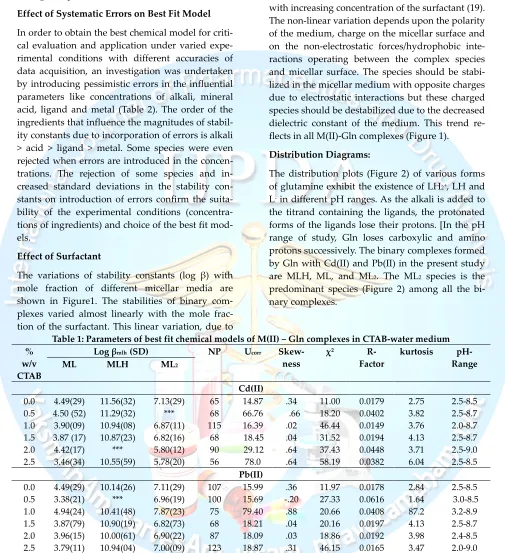
The results of the final best-fit models that contain the stoichiometry of the complex species and their overall formation constants along with some of the important statistical parameters are given in table 1. Very low-standard deviation in overall stability constants (log β) signifies the precision of these constants. The small values of Ucorr (sum of squares
of deviations in concentrations of ingredients at all experimental points) corrected for degrees of free-dom, small values of mean, standard deviation and mean deviation for the systems are validated by the residual analysis.
Residual Analysis:
The results of the best-fit models that contain the stoichiometry of the complex species and their overall formation constants along with some of the important statistical parameters are given in Table 1. A very low standard deviation in log β values indicates the precision of these parameters. The small values of Ucorr (the sum of squares of
met-al – ligand species in micellar media.
Effect of Systematic Errors on Best Fit Model
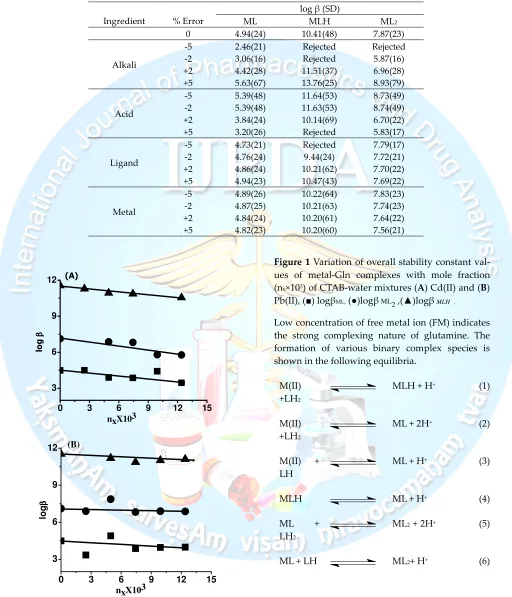
In order to obtain the best chemical model for criti-cal evaluation and application under varied expe-rimental conditions with different accuracies of data acquisition, an investigation was undertaken by introducing pessimistic errors in the influential parameters like concentrations of alkali, mineral acid, ligand and metal (Table 2). The order of the ingredients that influence the magnitudes of stabil-ity constants due to incorporation of errors is alkali > acid > ligand > metal. Some species were even rejected when errors are introduced in the concen-trations. The rejection of some species and in-creased standard deviations in the stability con-stants on introduction of errors confirm the suita-bility of the experimental conditions (concentra-tions of ingredients) and choice of the best fit mod-els.
Effect of Surfactant
The variations of stability constants (log β) with mole fraction of different micellar media are shown in Figure1. The stabilities of binary com-plexes varied almost linearly with the mole frac-tion of the surfactant. This linear variafrac-tion, due to
the dielectric constant of the medium, decreases with increasing concentration of the surfactant (19). The non-linear variation depends upon the polarity of the medium, charge on the micellar surface and on the non-electrostatic forces/hydrophobic inte-ractions operating between the complex species and micellar surface. The species should be stabi-lized in the micellar medium with opposite charges due to electrostatic interactions but these charged species should be destabilized due to the decreased dielectric constant of the medium. This trend re-flects in all M(II)-Gln complexes (Figure 1).
Distribution Diagrams:
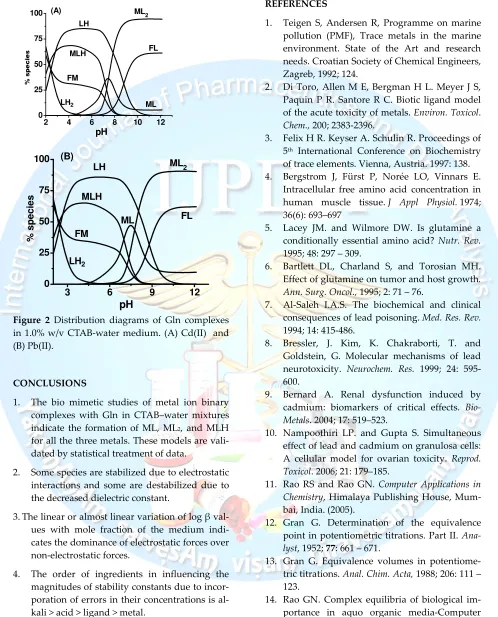
The distribution plots (Figure 2) of various forms of glutamine exhibit the existence of LH2+, LH and
L- in different pH ranges. As the alkali is added to
the titrand containing the ligands, the protonated forms of the ligands lose their protons. [In the pH range of study, Gln loses carboxylic and amino protons successively. The binary complexes formed by Gln with Cd(II) and Pb(II) in the present study are MLH, ML, and ML2. The ML2 species is the
predominant species (Figure 2) among all the bi-nary complexes.
Table 1: Parameters of best fit chemical models of M(II) – Gln complexes in CTAB-water medium %
w/v CTAB
Log βmlh (SD) NP Ucorr
Skew-ness
χ2
R-Factor
kurtosis pH-Range
ML MLH ML2
Cd(II)
0.0 4.49(29) 11.56(32) 7.13(29) 65 14.87 .34 11.00 0.0179 2.75 2.5-8.5
0.5 4.50 (52) 11.29(32) *** 68 66.76 .66 18.20 0.0402 3.82 2.5-8.7
1.0 3.90(09) 10.94(08) 6.87(11) 115 16.39 .02 46.44 0.0149 3.76 2.0-8.7
1.5 3.87 (17) 10.87(23) 6.82(16) 68 18.45 .04 31.52 0.0194 4.13 2.5-8.7
2.0 4.42(17) *** 5.80(12) 90 29.12 .64 37.43 0.0448 3.71 2.5-9.0
2.5 3.46(34) 10.55(59) 5.78(20) 56 78.0 .64 58.19 0.0382 6.04 2.5-8.5
Pb(II)
0.0 4.49(29) 10.14(26) 7.11(29) 107 15.99 .36 11.97 0.0178 2.84 2.5-8.5
0.5 3.38(21) *** 6.96(19) 100 15.69 -.20 27.33 0.0616 1.64 3.0-8.5
1.0 4.94(24) 10.41(48) 7.87(23) 75 79.40 .88 20.66 0.0408 87.2 3.2-8.9
1.5 3.87(79) 10.90(19) 6.82(73) 68 18.21 .04 20.16 0.0197 4.13 2.5-8.7
2.0 3.96(15) 10.00(61) 6.90(22) 87 18.09 .03 18.86 0.0192 3.98 2.4-8.5
2.5 3.79(11) 10.94(04) 7.00(09) 123 18.87 .31 46.15 0.0165 3.47 2.0-9.0
Table 2 : Effect of errors in influential parameters on the stability constants of Pb(II)-Gln complexes in 1.0% w/v CTAB-water medium.
Ingredient % Error
log β (SD)
ML MLH ML2
0 4.94(24) 10.41(48) 7.87(23)
Alkali
-5 2.46(21) Rejected Rejected
-2 3.06(16) Rejected 5.87(16)
+2 4.42(28) 11.51(37) 6.96(28)
+5 5.63(67) 13.76(25) 8.93(79)
Acid
-5 5.39(48) 11.64(53) 8.73(49)
-2 5.39(48) 11.63(53) 8.74(49)
+2 3.84(24) 10.14(69) 6.70(22)
+5 3.20(26) Rejected 5.83(17)
Ligand
-5 4.73(21) Rejected 7.79(17)
-2 4.76(24) 9.44(24) 7.72(21)
+2 4.86(24) 10.21(62) 7.70(22)
+5 4.94(23) 10.47(43) 7.69(22)
Metal
-5 4.89(26) 10.22(64) 7.83(23)
-2 4.87(25) 10.21(63) 7.74(23)
+2 4.84(24) 10.20(61) 7.64(22)
+5 4.82(23) 10.20(60) 7.56(21)
0 3 6 9 12 15
3 6 9 12
lo
g
ββββ
nxX103
(A)
0 3 6 9 12 15
3 6 9 12
lo
g
ββββ
nxX103 (B)
Figure 1 Variation of overall stability constant val-ues of metal-Gln complexes with mole fraction (nx×103) of CTAB-water mixtures (A) Cd(II) and (B)
Pb(II), (■) logβML, (●)logβ 2
ML ,(▲)logβMLH .
Low concentration of free metal ion (FM) indicates the strong complexing nature of glutamine. The formation of various binary complex species is shown in the following equilibria.
M(II) +LH2
MLH + H+ (1)
M(II) +LH2
ML + 2H+ (2)
M(II) + LH
ML + H+ (3)
MLH ML + H+ (4)
ML + LH2
ML2 + 2H+ (5)
2 4 6 8 10 12 0 25 50 75 100 % s p e c ie s pH FL
(A) ML2
ML FM
LH2 MLH
LH
3 6 9 12
0 25 50 75 100 ML 2 ML MLH LH % s p e c ie s pH LH2 FL FM (B)
Figure 2 Distribution diagrams of Gln complexes in 1.0% w/v CTAB-water medium. (A) Cd(II) and (B) Pb(II).
CONCLUSIONS
1. The bio mimetic studies of metal ion binary complexes with Gln in CTAB–water mixtures indicate the formation of ML, ML2, and MLH
for all the three metals. These models are vali-dated by statistical treatment of data.
2. Some species are stabilized due to electrostatic interactions and some are destabilized due to the decreased dielectric constant.
3.The linear or almost linear variation of log β val-ues with mole fraction of the medium indi-cates the dominance of electrostatic forces over non-electrostatic forces.
4. The order of ingredients in influencing the magnitudes of stability constants due to incor-poration of errors in their concentrations is al-kali > acid > ligand > metal.
REFERENCES
1. Teigen S, Andersen R, Programme on marine pollution (PMF), Trace metals in the marine environment. State of the Art and research needs. Croatian Society of Chemical Engineers, Zagreb, 1992; 124.
2. Di Toro, Allen M E, Bergman H L. Meyer J S, Paquin P R. Santore R C. Biotic ligand model of the acute toxicity of metals. Environ. Toxicol.
Chem., 200; 2383-2396.
3. Felix H R. Keyser A. Schulin R. Proceedings of 5th International Conference on Biochemistry
of trace elements. Vienna, Austria. 1997: 138. 4. Bergstrom J, Fürst P, Norée LO, Vinnars E.
Intracellular free amino acid concentration in human muscle tissue. J Appl Physiol. 1974; 36(6): 693–697
5. Lacey JM. and Wilmore DW. Is glutamine a conditionally essential amino acid? Nutr. Rev.
1995; 48: 297 – 309.
6. Bartlett DL, Charland S, and Torosian MH. Effect of glutamine on tumor and host growth. Ann. Surg. Oncol., 1995; 2: 71 – 76.
7. Al-Saleh I.A.S. The biochemical and clinical consequences of lead poisoning. Med. Res. Rev.
1994; 14: 415-486.
8. Bressler, J. Kim, K. Chakraborti, T. and Goldstein, G. Molecular mechanisms of lead neurotoxicity. Neurochem. Res. 1999; 24: 595-600.
9. Bernard A. Renal dysfunction induced by cadmium: biomarkers of critical effects. Bio-Metals. 2004; 17: 519–523.
10. Nampoothiri LP. and Gupta S. Simultaneous effect of lead and cadmium on granulosa cells: A cellular model for ovarian toxicity. Reprod. Toxicol. 2006; 21: 179–185.
11. Rao RS and Rao GN. Computer Applications in
Chemistry, Himalaya Publishing House,
Mum-bai, India. (2005).
12. Gran G. Determination of the equivalence point in potentiometric titrations. Part II. Ana-lyst, 1952; 77: 661 – 671.
13. Gran G. Equivalence volumes in potentiome-tric titrations. Anal. Chim. Acta, 1988; 206: 111 – 123.
Andhra University, Visakhapatnam, India (1989).
15. Gans P, Sabatini A. and Vacca A. An improved computer program for the computation of formation constants from potentiometric data.
Inorg. Chim. Acta,1976; 18: 237-239.