370 | P a g e
AN EFFICIENT METHOD FOR RECOGNIZING
IDENTICAL TWINS USING FACIAL ASPECTS
B. Lakshmi Priya
1, Dr. M. Pushpa Rani
2 1Ph.D Research Scholar in Computer Science, Mother Teresa Women’s University, (India)
2
Professor & Head, Dept. of Computer Science, Mother Teresa Women’s University, (India)
ABSTRACT
In this paper, the impact of biometric identification system must be able to distinguish between individuals even
in situation where the biometric signature may be similar, such as in the identical twins. Main focus is on twin
based image retrieval which retrieves all images from database by matching some of the basic features of
identical twins like nose, lips, eyes, forehead and face features. Database images were collected from different
twin’s festivals from the World Wide Web. With the advancement of computer technology Image Retrieval based
on Identical twin face recognition is a challenging task because of the high degree of similarity in their overall
facial appearance. Commercial face recognition systems exhibit poor performance in differentiating between
identical twins. This researcher experiments show that modal of face recognition systems can distinguish two
different persons who are identical twins. The effect of using a variety of facial aspects representation and
suggest a method of identifying identical twins.
Keywords: Facial components, Feature Extraction, Image Retrieval, Lip Highlights Detection,
Mouth Corner.
I. INTRODUCTION
Biometric comes from the Greek language and is derived from words bio (life) and metric (measure). A
biometric system is basically a pattern recognition system automated methods of recognizing a person based on
physiological or behavioural characteristics of a person. Physiological Characteristics related to human shape of
body like face, iris, retina, finger prints, hand geometry and palm print. Behavioural Characteristics related to
behavioural of the person like voice, signature and keystroke dynamics. Some more promising biometric
strategies are hand veins, facial thermo gram, DNA, odor /scent. Biometric technologies are a secure means of
authentication because biometric data of every person is unique and cannot be shared cannot be copied and can’t
be lost. Biometrics, which refers to automatic identification of people based on their physical or behavioural
characteristics, is constitutionally more reliable than traditional knowledge-based (password) or token-based
(access card) methods of identification. Identical twins can have biometric signatures that are very similar,
especially when the signature is derived from a face image. While face recognition software system exhibited
inadequate performance, there are other biometric modalities that can offer a performance increase at the cost of
increased invasiveness. Distinguishing identical twins based on facial appearance is one of the most challenging
problems in facial recognition due to the similarity in their facial appearance and hence telling them apart using
facial features is not a trivial task. However, to the best of our knowledge, no studies have yet been carried out
371 | P a g e
such features can improve the performance of facial recognition systems for this specific task. Thus, this paperprovides an understanding of how to use facial aspects to accomplish this goal. As the performance of face
recognition system in constrained environment continues to improve focus is shifting from methods that
improve face recognition performance in general, to methods that handle specific cases of failure. Until recently,
a scenario that has been known to confound even human face recognition had not been studied for automated
face recognition systems. This setup is the ability to distinguish between identical twins. Because identical twins
are genetically equivalent, their facial appearance is also quite similar. Generally, differences in their appearance
can only be attributed to exposure to different environmental factors and rare cases of genetic mutations.
II. LITERATURE SURVEY
Jain Anil et al. [1] this paper give an introduction to biometric system which is basically a pattern recognition
system. Biometric based user authentication system serve as a reliable means for meeting the challenges in today’s world of information and network security. In this introduction to multi-biometric systems, their
classification and various integration strategies and presented. Multi-biometric system employs more than one
biometric trait and hence provides greater level of security as compared to uni-modal biometric system. Its
patterns are complex and have degree of randomness in them.
Lin et al. [2] this paper presented the face at multiple layers in term of global appearance, facial features, skin
texture and irregularities that contribute towards identification. Global appearance and facial features are
modelled using a multilevel PCA (principal component analysis) followed by regularized LDA (Linear
discriminate analysis)
Pierrard et al. [3] this paper presented a framework to localize prominent facial skin irregularities, like moles
and birthmarks. They use a multi scale template matching algorithm for face recognition. A discrimination
factor is computed for each point by using skin segmentation and local saliency measure and is used to filter
point.
Sun et al. [4] this paper presented a study of distinctiveness of biometric characteristics in identical twins using
fingerprint, face and iris biometrics. They observed that though iris and fingerprints show little to no
degradation in performance when dealing with identical twins, face matches experienced problems is
distinguishing between identical twins. All of these studies were either conduct on very small twin biometric
database or evaluated using existing in house or commercial matchers.
Phillips et al. [5] this paper presented the first detailed study on discrimination of identical twins using different
face recognition algorithms. They compared three different commercial face recognition algorithms on the
identical twins dataset acquired at twin’s burg, Ohio. The dataset consists of images acquired under varying
condition such as facial pose, illumination, facial expression etc.
Jain et al. [6] this paper presented various issues related to multimodal biometric system have been presented.
By combining multiple biometric traits, the performance of biometric system can be improved various
applications of multimodal biometric system and different levels of fusion are discussed. The multimodal
biometric is very popular in these days due to its performance and advance level of security though some
complexity also exists in multimodal system which reduces its acceptability in many areas.
Srinivas Nisha et al. [7] this paper provides differentiation between twins using facial marks alone. Facial marks
are considered to be unique and inherent characteristics of an individual. Facial marks are defined as visible
372 | P a g e
random position of the face. By extracting different facial mark features they aim to differentiate betweenidentical twins. There are eleven types of facial marks including moles, freckles, freckle groups, darkened skin,
lightened skin, etc
Shinde Anagha et al. [9] in this paper approach to the detection and identification of human faces is presented
and then recognizes the person by comparing characteristics of the face to those of known individuals is
described. A face recognition system using the principal component analysis (PCA) algorithm was
implemented. The algorithm is based on Eigen faces approach which represents a PCA method in which a small
set of significant features are used to describe the variation between face images. Experimental results for
different number of Eigen faces are shown to verify the viability of the proposed method.
III. PROPOSED METHOD
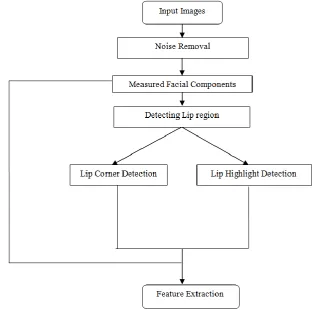
The Fig. 1 describes the Process flow for Detecting Identical twins. The proposed system is based on four
primary stages. The different phases are Pre-processing, Feature Extraction, Classification, and Verification.
Figure 1: Detection of Identical Twins Process
3.1 Pre-Processing
The aim of pre-processing is improvement of the image data that suppresses unwanted distortions or noise
removal enhances some images features important for further processing.
3.2 Feature Extraction
Feature extraction is a special form of dimensional reduction. Two kinds of features are used in this paper
through pattern recognition. One is facial component there are accuracy of distinguishing between identical twin
373 | P a g e
through the fast box filtering in additionally found that lip highlight detection while red or other coloration maybe applied to the mouth to reshape for the feature extracted from local patches[14]. The similar facial
components are placed into one group while the others lip recognition [15] in another group. To encode this
similarity, there is descriptor, which is useful for classification of similar facial feature.
3.3 Classification
In recent years, with the development of digital image techniques and digital albums in the internet, the use of
digital image retrieval process has increased dramatically. Image retrieval systems categorized as text based
information retrieval (TBIR) and content-based image retrieval (CBIR). The most common method for
comparing two images in content based image retrieval is using an image distance measure. An image distance
measure compares the similarity of two images in various dimensions such as colours, texture, shape and others.
After extracting the facial features their length, width and area are computed by some classifier. Classification is
based on different conditions. This classifier helps to construct discriminating groups to recognize probe face
sketch through face photos database.
3.4 Verification
The features of face are grouped in one category and are compared with already extracted feature of face and if
matching is found indicates twins otherwise not. Basically dataset is collection of images having images of
twins was used images of subjects were acquired at the Twins Day festival.
IV. CONCLUSION
This paper proposes an efficient Method for Distinguishing Identical Twins by Using Facial aspects consisting
of twins faces. These researchers analysed the effects of the database on identical twin images from face
recognition algorithms and compared the results with lip recognition algorithms to detect the mouth corner and
highlights also. After extracting the facial features and lip region area classifier method are used to identify the
distinguishing features. The results indicate that twins are easily identifiable.
REFERENCES
[
1] Jain Anil.K, Fellow, Ross Arun, Prabhakarsalil (Member IEEE): “A Introduction to BiometricRecognition,” IEEE Transactions on circuits and systems for video technology, ISSN: 1051-8215, VOL.
14, pp.:4-20, Issue No. 1, JANUARY 2004.
[2] D. Lin and X. Tang, “Recognize high resolution faces: From macrocosm to microcosm,” IEEE Computer
Society Conference on Computer Vision and Pattern Recognition, ISSN: 1051-8215, VOL. 2, pp.:1355–
1362, 2006.
[3] J. S. Pierrard and T. Vetter, “Skin detail analysis for face recognition,” IEEE Conference on Computer
Vision and Pattern Recognition, Minneapolis, MN, ISSN: 1063-6919, pp.: 1–8, June 2009.
[4] Z. Sun, A. A. Paulino, J. Feng, Z. Chai, T. Tan, A. K. Jain, “A study of multi biometric traits of identical
twins, ”SPIE, Biometric Technology for Human Identification, Orlando, Florida, VOL.7, pp.: 1–12, April
374 | P a g e
[5] P. Phillips, P. Flynn, K. Bowyer, R. Voder Bruegge, P. Grother, G.Quinn, and M. Pruitt, “Distinguishingidentical twins by face recognition,” IEEE International Conference Automatic Face Gesture Recognition
and Workshops, Santa Barbara, CA, pp.: 185– 192, March 2011.
[6] Jain Arun, Aggarwal sona, “Mult imodal Biometric System: A Survey,” International Journal of Applied
Science and Advance Technology, ISSN: 0973-7405, VOL. 1, pp.: 58-63, January-June 2012.
[7] Ho Jan-Ming, LinShu-Yu, Fann Chi-Wen, Wang Yu-Chun, Chang Ray-I, “A Novel Content Based Image
Retrieval System Using KMeans With Feature Extraction,” International Conference on Systems and
Informatics , Yantai,pp.:785-790, May 2012.
[8] Srinivas Nisha, Aggarwal Gaurav, Flynn Patrick J. Fellow, IEEE, and Bruegge Richard W. Vorder,
“Analysis of Facial Marks to Distinguish Between Identical Twins,” IEEE Transactions On Information
Forensics And Security, ISSN: 1556-6013, Issue No. 5, VOL. 7, pp.: 1536-1550, OCTOBER 2012.
[9] Shinde Anagha A., Ruikar Sachin D., “Face Recognition using PCA and Eigen Face Approach,”
International Conference on Recent Trends in Engineering & Technology (ICRTET'2013), PP.: 7-12,
2013.
[10] Patvardhsn C., Verma A.K., Lakshmi C. Vasantha, “Robust Content Based Image Retrieval Based On
Multi-Resolution Wavelet Features and Edge Histogram,”IEEE Second international conference on Image
Information Processing, Shimla, pp.: 447-452, December2013.
[11] Syam B., J Victor Sharon Rose, Rao Y. Srinivasa, “Efficient Similarity Measure via GeneticAlgorithm for Content Based Medical Image Retrieval with Extensive Features,” Kottayam, pp.: 704-711, March 2013.
[12] Karl Ricanek Jr. and Gayathri Mahalingam, “Biometrically, How Identical Are Identical Twins?,” IEEE
Computer Society, ISSN: 0018-9162,Issue No. 3, Vol. 46, pp.: 94-96, March 2013.
[13] Iván González-Díaz, Member, IEEE, Carlos E. Baz-Hormigos, and Fernando Díaz-de-María, Member,
IEEE, “A Generative Model for Concurrent Image Retrieval and ROI Segmentation,” IEEE Transactions
on Multimedia, ISSN: 1520-9210, Issue No. 1, VOL. 16, pp.: 169-183, January
[14] Guodong Guo, Senior Member, IEEE, Lingyun wen, and shuicheng yan, Senior Member, IEEE, “Face
Authentication With Makeup Changes” IEEE Transactions on Circuits and systems for video technology ,
VOL. 24. No.5 May 2015.
[15] Yun-Fu Liu, Student Member, IEEE, Chao-Yu Lin, and Jing-Ming Guo, Senior Member, IEEE, “Impact of