Some Characterization Results Based on Conditional Expectation
of Function of Dual Generalized Order Statistics
M. I. Khan
Department of Statistics & Operations Research Aligarh Muslim University
Aligarh, 202 002. India [email protected] M. Faizan
Department of Statistics & Operations Research Aligarh Muslim University
Aligarh, 202 002. India [email protected]
Abstract
Two families of probability distributions are characterized through the conditional expectations of dual generalized order statistics (dgos) and spacing of two dgos conditioned on a non-adjacent dual generalized order statistics. Further, some of its deductions are also discussed.
Keywords: Characterization, Conditional expectation, Dual generalized order statistics, Probability distributions.
1. Introduction
The concept of generalized order statistics (gos) has been introduced as a unified approach to a variety of models of ordered random variables with different interpretation (Kamps, 1995), such as ordinary order statistics, sequential order statistics, progressive type II censoring, record values and Pfeifer’s records. Generalized order statistics serve as a common approach to a structural similarities and analogies. Several of these models can be effectively applied, e.g., in reliability theory. Using this concept of gos, Burkschatet al. (2003) introduced the concept of dual generalized order statistics (dgos) that enables a common approach to descending ordered random variables like reverse ordered order statistics, lower record values etc.
Let X1,X2,,Xn be a sequence of independent and identically distributed (iid) random variable with absolutely continuous distribution function (df) F(x) and the probability density function (pdf) f (x), x(,). Further, let nN , n2, k 1,
1 1
2
1, , , )
(
~
m m mn n
m ,
n 1
r
j j
r m
M , such that r knrMr 1, for all
} 1 , , 2 , 1
{
n
r . Then, X(r,n,m~, k), r 1,2,,n are called dgos if their joint pdf
is given by
) ( )] ( [ ) ( )] (
[ 1
1
1 1
1 n
k n n
i i
m i n
j j F x f x F x f x
k i
(1.1)Here we will assume two cases:
Case I: m1 m2 mn1 m.
The pdf of the rth dgos is given by (Burkschatet al., 2003)
1 1
1 )
, , ,
( ( ) ( 1)![ ( )] ( )[ ( ( ))]
rnmk r m r
X x rc F x f x g F x
f r (1.2)
The joint pdf of the rth and sth dgos is
)) ( ( ) ( )] ( [ )! 1 (
)! 1 ( ) ,
( 1 1
) , , , ( ), , , ,
( x y r cs r F x f x g F x
f r
m m
s k
m n s X k m n r
X
) ( )] ( [ ))] ( ( )) ( (
[h F y h F x s r 1 F y s 1f y
m
m
, y x, (1.3)
where
1 ,
log
1 ,
1 1 )
( 1
m x
m x
m x
hm m
and
) 1 ( ) ( )
( m m
m x h x h
g , x[01,).
The conditional pdf of X(s,n,m,k) given X(r,n,m,k) x, 1rsn
) | ( | y x fsr
1 1 )! 1 (srs cr
c
) ( )]
( [ ) 1 (
)] ( [ ] )) ( ( ))
( [(
1 1
1 1
1 1
y f x
F m
y F y
F x
F
r
s r
s
r s m m
(1.4)
Case II: i j i j,i, j 1,,n1.
The pdf of therth dgos is given by (Burkschatet al., 2003)
) ( ) , ~ , ,
( x
fX rn m k 1
1
1 ( ) ( )[ ( )]
c f x r a r F x i
i i
r (1.5)
and the joint pdf of the rth and sth dgos is
j
x F
y F s a c
y x
f s
r j
r j s
k m n s X k m n r X
( , ) ( ) (( ))
1 ) ( 1
) , ~ , , ( , ) , ~ , , (
) (
) ( ) (
) ( )] ( [ ) (
1 F y
y f x F
x f x F r a
r
i i
i
(1.6)
where
n r i r
a r j i
i j
j j i
i
( ) , , 1
1 )
(
1
(1.7)
and
n s i r s
a s j i
i j r
j j i r
i
( ) , , 1
1 )
(
1 )
(
Thus, the conditional pdf of X(s,n,m~,k) given X(r,n,m~,k)x, 1r sn is
) (
) ( )
( ) ( ) ( )
| (
1
1 ) ( 1
1
| y x cc a s FF xy Ff xy
f s i
r i
r i r
s r
s
, x y (1.9)
If m0, k 1, then X(r,n,m,k) reduces toXnr1:n, the (nr1)thorder statistics, from a sample of size n and when m1, then X(r,n,m,k) reduces to the rth k lower record value (Pawlas and Szynal, 2001). A number of results on characterization of distributions of dual generalized order statistics are available in the literature. For a detailed survey one may refer to Ahsanullah (2004), Mbah and Ahsanullah (2007), Khan et al. (2009) and Khan et al. (2010) and references contained therein. In this paper, two general classes of distributions
0 , )
(x e ( ) a
F ah x ,x(,) (1.10)
and
c b x h a x
F( )[ ( ) ] , x(,) (1.11)
have been characterized through conditional expectation of function of dgos,where
c b
a, , and h(x) are so chosen that F(x)in (1.10) and (1.11) are df .
It may be noted that the df F(x) and thepdf f(x) in (1.10) and (1.11) are related respectively as
) (
) ( )
(
x h a
x f x
F (1.12)
and
] ) ( [
) ( )
( ) (
b x ah
x h ac x
F x f
(1.13)
Khan et al. (2010) have characterized the general class of distributions through conditional expectation of dgos conditioned on non-adjacent dgos.We have extended the result of Khan et al. (2010) for the difference of the conditional expectations conditioned on non-adjacentdgos, its particular cases for order statistics, lower record statistics as obtained by Khanet al.(2011) and Faizan and Khan (2011) are discussed.
2. Characterizations of distributions when
j i
i j,i, j 1,,n1.
Theorem 2.1:Let X be an absolutely continuous random variable with the df F(x) and thepdf f(x) in the interval(,), where and may be finite or infinite, then for
n t s r
1 ,
] ) , ~ , , ( | )} , ~ , , ( { )} , ~ , , ( {
[h X s n m k h X t n m k X l n m k x
E
s
t
j j
a 1
1 1
if and only if
0 , )
(x e ( ) a
F ah x (2.2)
where h(x) is a monotonic and differentiable function of x such that h(x)0 as x
and h(x)F(x)0 as x.
Proof:First we shall prove that (2.2) implies (2.1). It can be seen (Athar et al., 2008) that ] ) , ~ , , ( | )} , ~ , , 1 ( { )} , ~ , , ( {
[h X t n m k h X t n m k X r n m k x
E
dy x F y F y h t a c
c t x i
r i r i r t
) ( ) ( ) ( ) ( 1 ) ( 1 2Therefore, for1rstn
] ) , ~ , , ( | )} , ~ , , ( { )} , ~ , , ( {
[h X s n m k h X t n m k X r n m k x
E
1 0 ] ) , ~ , , ( | )} , ~ , ,1 ( { )} , ~ , , ( { [ t s i x k m n r X k m n i s X h k m n i s X h E
s t j x k m n r X k m n j X h k m n j X h E 1 ] ) , , , ( | )} , , , 1 ( { )} , , , ( { [
s t j x j r i r i r j dy x F y F y h j a c c i 1 1 ) ( 1 2 ) ( ) ( ) ( ) (
s t j j a 1 1 1 , in view of (1.9) and (1.12)
This proves the necessary part.
For the sufficiency part, we have at
s t j j a c 1 1 1 )} , ~ , , ( {[h X t n m k
E h{X(s,n,m~,k)}|X(r,n,m~,k) x]c
dy y F y f x F y F y h t a c c i x t r i r i r t ) ( ) ( ) ( ) ( ) ( ) ( 1 ) ( 1 1
c dy y F y f x F y F y h s a c c i x s r i r i r s
) ( ) ( ) ( ) ( ) ( ) ( 1 ) ( 1 1 (2.3)Differentiating (2.3) w.r.t.x we have
) ( ) ( ) ( ) ( ) ( ) ( ) ( 1 ) ( 1 1 1 ) ( 1
1 a t
c c x F x f x h t a c c x F x f t r i r i i r t t r i r i r
t
dy x F y f y F y h x i i
)] ( [ ) ( )] ( [ ) ( 1 ) ( ) ( ) ( ) ( 1 ) ( 11 a s h x
c c x F x f s r i r i r s
0 )] ( [ ) ( )] ( [ ) ( ) ( ) ( ) ( 1 1 ) ( 1 1
dy x F y f y F y h s a c c x F xf s x
Rearranging the terms in (2.4) and noting that ( ) 0 1
)
(
s a
s
r i
r
i ,
c
r
r1c
r1 and )( ) (
)
( ( )
1 )
1
( t a t
a r
i i r r
i , we get
)] ( )
(
[gt|r x gt|r1 x [gs|r(x)gs|r1(x)]0
where
] ) , ~ , , ( | )} , ~ , , ( { [ ) (
| x E h X s n m k X r n m k x
gsr
or,
c x g x g x
g x g x g x
gt|r( ) s|r( ) t|r1( ) s|r1( ) t|s( ) s|s( ) (2.5)
Noting thatgs|s(x)h(x), we have
c x h x
gt|s( ) ( )
i.e.
t
s
j j
a x h x k m n s X k m n t X h E
1
1 1 ) ( ] ) , ~ , , ( | )} , ~ , , ( {
[ (2.6)
Using the result (Khanet al., 2006)
) ( ] ) , ~ , , ( | )} , ~ , , ( {
[h X t n m k X s n m k x g| x
E ts ,
implies
e x Au du
x
F( ) ( ) (2.7)
where
) ( )]
( ) ( [
) ( )
(
| 1
| 1
| ah u
u g u g
u g u
A
s t s
t s
s
t
(2.8)
we get,
0 , )
(x e ( ) a
F ah x
and hence the Theorem.
Remark 2.1: Atsr, [ { ( , ,~, )}| ( , ,~, ) ] 1 1 ( )
1
x h a
x k m n s X k m n t X h
E t
s
j j
as obtained by Khanet al. (2010).
Remark 2.2: Atm0,k 1, we will get the following result for order statistics for n
t s r
1
] |
)} {( )} {(
[h X : h X : X : x
E sn tn rn
s
t
j n j
a 1 1
1 1
] |
)} {( )} {(
[h X : h X : X: y
E sn rn tn
1 s 1 1
r j j a as obtained by Khanet al.(2011).
Remark 2.3: Atm1, k1 and
a
Corollary 2.1: Under the conditions as given in Theorem 2.1 and for 1rstn )
( )}] , ~ , , ( { )} , ~ , , ( {
[h X s n m k h X r n m k h x
E
] ) , ~ , , ( | )} , ~ , , ( {
[h X s n m k X r n m k x
E
(2.9)
if and only if
0 , )
(x e ( ) a
F ah x (2.10)
Proof:The proof from Theorem 2.1 and Remark 2.1.
Further, putting m0,k 1 in equation (2.9), we will get the result for order statistics as follows,
) ( )}] {(
)} {(
[h X : h X : h x
E rn sn E[h{(Xr:n)}|Xs:n x]
Theorem 2.2: LetX be an absolutely continuous random variable with the df F(x) and the pdf f(x) in the interval(,), where and may be finite or infinite, then for
n t s r
1 ,
] ) , ~ , , ( | )} , ~ , , ( {
[h X t n m k X l n m k x
E
1 , , ]
) , ~ , , ( | )} , ~ , , ( {
[ *
| *
|
ats E h X s n m k X l n m k x bts l r r (2.11) if and only if
c b x h a x
F( )[ ( ) ] (2.12)
where
t
s
j j
j s
t c
c a
1 *
| 1
and (1 * )
| *
|s ts
t ab a
b
Proof: First we shall prove that (2.12) implies (2.11). In view of Khan et al. (2010), we have
] ) , ~ , , ( | )} , ~ , , ( {
[h X t n m k X r n m k x
E *
| *
|r ( ) tr t h x b
a
a b a b x h
atr
* ( )
| (2.13)
where
* | *
| 1
*
| 1 sr ts
t
r
j j
j r
t c a a
c
a
and
) 1
( *
| *
|r tr
t ab a
b
] ) , ~ , , ( | )} , ~ , , ( {
[h X t n m k X r n m k x
E
a b a b x h a
ats sr
* ( )
| *
|
* | *
| *
|s sr ( ) ts
t a h x ab ab baa
a
a b
* [ { ( , ,~, )}| ( , ,~, ) ]
| E h X s n m k X r n m k x
ats *
For the sufficiency part, we have dy y F y f x F y F y h t a c c i x t r i r i r t ) ( ) ( ) ( ) ( ) ( ) ( 1 ) ( 1 1
i x F y F y h s a c ca s x
r i r i r s s t
) ( ) ( ) ( ) ( 1 ) ( 1 1 *| Ff((yy)) dybt*|s (2.14)
Differentiating (2.14) w.r.t.x and rearranging, we get
) ( ) ( ) ( 1 ) ( 1 1 1 ) ( 1
1 a t
c c x h t a c c t r i r i i r t t r i r i r
t
dyx F y f y F y h x i i )] ( [ ) ( )] ( [ ) ( 1 ) ( ) ( ) ( 1 ) ( 1 1 1 ) ( 1 1 *
| cc a s h x cc a s
a s r i r i i r s s r i r i r s s
t
dyx F y f y F y h x i i )] ( [ ) ( )] ( [ ) ( 1
After noting that ( ) 0 1 ) (
s a s r i ri ,cr r1cr1and ai(r1)(t)(r1i)ai(r)(t), we get
) ( 1 ) ( 1 1
1 a t
c c t r i r i r t r
dy x F y f y F y h x i i
)] ( [ ) ( )] ( [ ) ( 1 ) ( 2 ) 1 ( 11 a t
c c t r i r i r t r
dy
x F y f y F y h x i i
)] ( [ ) ( )] ( [ ) ( 1
( ) 1 ) ( 1 1 1 *| c c a s
a s r i r i r s r s t dy x F y f y F y h x i i
)] ( [ ) ( )] ( [ ) ( 1 ) ( 2 ) 1 ( 11 a s
c c s r i r i r s r
dyx F y f y F y h x i i )] ( [ ) ( )] ( [ ) ( 1 That is, )] ( ) (
[ | | 1
1 gtr x gtr x
r
at*|sr1[gs|r(x)gs|r1(x)] where ] ) , ~ , , ( | )} , ~ , , ( { [ ) (
| x E h X s n m k X r n m k x
gsr
or, ) ( ) ( ) ( )
( *| | | 1 *| | 1
| x a g x g x a g x
gtr ts sr tr ts sr
* | |
* |
|s( ) ts ss( ) ts
t x a g x b
g
(2.15)
Noting thatgs|s(x)h(x), we have *
| *
|
|s( ) ts ( ) ts t x a h x b
g
i.e. * | * | ( ) ] ) , ~ , , ( | )} , ~ , , ( {
[h X t n m k X s n m k x atsh x bts
Using the result (Khanet al., 2006)
) ( ] ) , ~ , , ( | )} , ~ , , ( {
[h X t n m k X s n m k x g| x
E ts ,
implies
x Au du e
x
F( ) ( ) (2.17)
We get
c b x h a x
F( )[ ( ) ] and hence the Theorem.
Remark 2.4:It may be seen that when i j but mi mj m, then
)! ( )! 1 (
1 )
1 ( )
1 (
1 )
( 1
) (
i t r i m
t
air t r t i
)! ( )! 1 (
1 )
1 ( ) 1 (
1 )
( 1
i r i
m r
ai r r i
and consequently (1.5) will reduce to (1.2), (1.6) to (1.3).
Remark 2.5:Atm0,k 1, we will get result for order statistics as follows, ]
) ( | )} {(
[h X : X : x
E tn rn
* | :
: *
|s [ {( sn)}|( rn) ] ts
t E h X X x b
a
or
] ) ( | )} {(
[h X : X : y
E rn tn ar*|s E[h{(Xs:n)}|(Xt:n) y]br*|s where
1 *
| 1
s
r j s
r ccj j
a and (1 * )
| *
|s rs
r ab a
b
as obtained by Khanet al.(2011).
Remark 2.6:Ats r, it reduces to as obtained by Khanet al. (2010).
Remark 2.7: At
c a
a , b1 and c then F(x)[ah(x)b]c eah(x) as
obtained in Theorem 2.1.
3. Conclusion
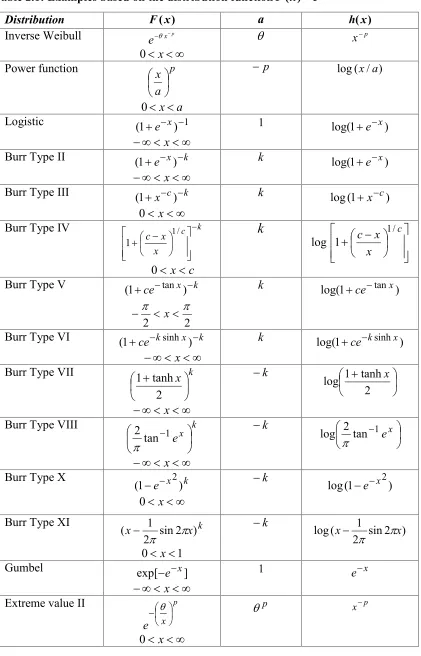
In this paper, conditional expectation of the difference of two dgos conditioned on non-adjacent dgos are considered to characterize the df F(x)eah(x) whose particular
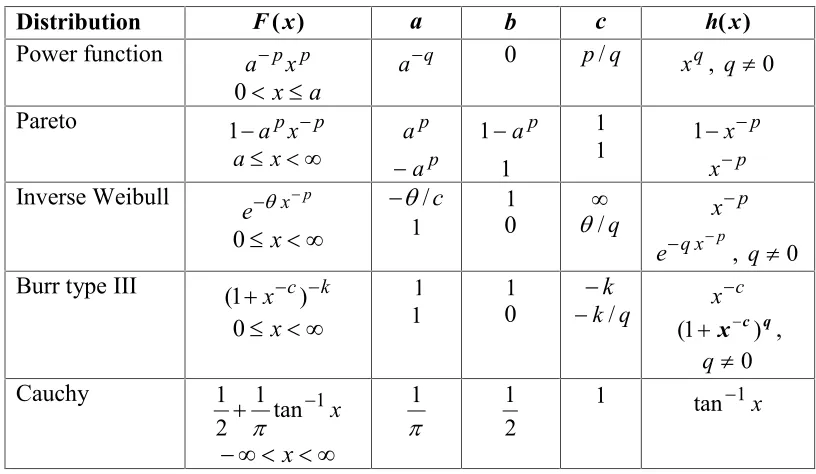
cases are given in the Table 2.1 with proper choice ofa,b, candh(x). Also c
b x ah x
F( )[ ( ) ] is characterized through the conditional expectation of dgos
Table 2.1: Examples based on the distribution functionF(x)eah(x)
Distribution F(x) a h(x)
Inverse Weibull x p e
x 0
xp
Power function p
a x
a x 0
p
log(x/a)
Logistic (1ex)1
x
1 log(1ex)
Burr Type II (1ex)k
x
k log(1ex)
Burr Type III (1xc)k x 0
k log(1xc)
Burr Type IV c k
x x
c
1/
1
c x 0
k
c
x x c 1/ 1
log
Burr Type V (1cetanx)k
2 2
x
k log(1cetanx)
Burr Type VI (1ceksinhx)k
x
k log(1ceksinhx)
Burr Type VII x k
2 tanh 1
x
k
2 tanh 1
log x
Burr Type VIII k
x e
2tan1
x
k
2tan1ex log
Burr Type X e x k
) 1
( 2 x 0
k
) 1
(
log ex2
Burr Type XI x sin2 x)k 2
1
(
1 0x
k
) 2 sin 2
1 (
log x x
Gumbel exp[ex]
x
1 ex
Extreme value II p
x e
x 0
p
Table 2.2: Examples based on the distribution functionF(x)[ah(x)b]c
Distribution F(x) a b c h(x)
Power function apxp
a x 0
q
a 0 p/q xq, q 0
Pareto 1apxp x a
p
a
p
a
p
a
1
1
1
1 x p
1
p
x
Inverse Weibull x p
e
x 0
c /
1 10 /q xpp
x q
e , q 0 Burr type III (1xc)k
x 0
1
1 10 kk/q x c
q c
x )
1
( ,
0
q
Cauchy 1 tan 1x
2
1
x
1
2
1 1 tan1x
Acknowledgement
The authors are grateful to Professor A.H. Khan, Department of Statistics and Operations Research, Aligarh Muslim University for his valuable suggestions in preparing this paper. We are also thankful to the referees for their useful suggestions, which lead to the improvement of the manuscript.
References
1. Ahsanullah, M. (2004). A characterization of the uniform distribution by dual generalized order statistics.Comm. Statist. Theory Methods, 33, 2921-2928. 2. Athar Haseeb, Anwar, Z. and Khan, R.U. (2008). On recurrence relations for the
expectations of function of lower generalized order statistics. Pakistan. J. Statist., 24, 111-122.
3. Burkschat, M., Cramer, E. and Kamps, U. (2003). Dual generalized order statistics.Metron, LXI (1), 13-26.
4. Faizan, M. and Khan, M.I. (2011). A characterization of continuous distributions through lower record statistics.Prob Stat Forum., 4, 39-43.
5. Kamps, U. (1995). A Concept of Generalized Order Statistics, B.G. Teubner Stuttgart.
6. Khan, A.H., Anwar, Z. and Chishti, S. (2010). Characterization of continuous distributions through conditional expectation of functions of dual generalized order statistics.Pakistan J. Statist., 26, 615-628.
8. Khan, A.H., Faizan, M. and Haque, Z. (2011). Characterization of continuous distributions via conditional expectations of non-adjacent order statistics. Submitted for publication.
9. Khan, M.J.S., Haque, Z. and Faizan, M. (2009). On characterization of continuous distributions conditioned on a pair of non-adjacent dual generalized order statistics.Aligarh J. Statist., 29,107-119.
10. Mbah, A.K. and. Ahsanullah, M. (2007). Some characterization of the power function distribution based on lower generalized order statistics. Pakistan J. Statist., 23, 139-146.