Low Complexity Greedy Power
Allocation Algorithm for Proportional
Resource Allocation in Multi-User
OFDM Systems
Najib A. Odhah, Moawad I. Dessouky, Waleed E. Al-Hanafy, and Fathi E. Abd El-Samie
Faculty of Electronic Engineering, Menoufia University, Menouf, EgyptAbstract—User Orthogonal Frequency Division Multi-plexing (MU-OFDM) is an efficient technique for achieving high downlink capacity in high-speed communication systems. A key issue in MU-OFDM is the allocation of the OFDM sub-carriers and power to users sharing the channel. In this paper a proportional rate-adaptive resource allocation algorithm for MU-OFDM is presented. Subcarrier and power allocation are carried out sequentially to reduce the complexity. The low complexity proportional subcarriers allocation is followed by Greedy Power Allocation (GPA) to solve the rate-adaptive re-source allocation problem with proportional rate constraints for MU-OFDM systems. It improves the work of Wong et al. in this area by introducing an optimal GPA that achieves approximate rate proportionality, while maximizing the total sum-rate capacity of MU-OFDM. It is shown through simu-lation that the proposed GPA algorithm performs better than the algorithm of Wong et al., by achieving higher total ca-pacities with the same computational complexity, especially, at larger number of users and roughly satisfying user rate proportionality.
Keywords—GPA, MU-OFDM, proportional resource allocation, sum-rate capacity.
1. Introduction
MU-OFDM is a technology that has become increasingly important for wireless systems over the past decade. It is considered as one of the two cornerstone technologies of the next generation wireless networks, with Multiple-Input Multiple-Output (MIMO) systems being the other one. MU-OFDM is an expansion upon the basic prin-ciples of the Single-User Orthogonal Frequency Division Multiplexing (SU-OFDM) technology, and is designed to accommodate wideband multi-user systems.
SU-OFDM is one of the promising signal processing tech-niques to provide a high performance physical layer. It has been widely adopted in standards by wireless industry such as IEEE 802.11a and IEEE 802.11g Wireless Local Area Networks (WLAN), IEEE 802.16 fixed Wireless Metropoli-tan Area Networks (WMAN) which was later extended in IEEE 802.16e (WiMAX) to satisfy high speed mobility and to support both fixed and mobile user stations [1], [2]. SU-OFDM is based on multicarrier transmission in which the broadband channel is divided intoN narrowband
sub-channels, each with a bandwidth much smaller than the coherence bandwidth of the channel. The high rate data stream is then split into N substreams of lower rate data which are modulated intoN OFDM symbols and transmit-ted simultaneously on N orthogonal subcarriers [3]. The low bandwidth of the subchannels along with the frequency spacing between them are necessary to have flat fading or-thogonal subcarriers with approximately constant channel gain during each transmission block.
In SU-OFDM, the user can use the total power to transmit on all N subcarriers. The system is then optimized by ex-ploiting the frequency selectivity of the channel and dynam-ically adapting the modulation type and power on each sub-carrier. These dynamic power allocation schemes [4], [5] have shown significant performance gain in terms of throughput compared to static schemes.
In an MU-OFDM system there is a need for a multiple access scheme to allocate the subcarriers and the power to the users. In static subcarrier allocation schemes, each user is assigned to predetermined time slots or the fre-quency bands respectively, regardless of the channel status. In other words, in non-adaptive fixed subcarrier allocation schemes, an independent dimension is allocated to each user without considering the channel status. In such sys-tems, the optimization problem of maximizing the total throughput of the system reduces to only power allocation or bit loading on the subcarriers. On the other hand, since the fading parameters for different users are mutually in-dependent, the probability that a subcarrier is in deep fade for all users is very low. Each subcarrier is likely to be in a good condition for some users in the system. This is the principle of MU-OFDM with adaptive power alloca-tion in which subcarrier allocaalloca-tion itself plays a very sig-nificant role in maximizing the total throughput by using multiuser diversity. A survey of the adaptive MU-OFDM system design problems including an overview of physical layer, Medium Access Control (MAC), and radio resource allocation design issues are provided in [6], [7].
The problem of allocating the base station resources (sub-carriers, rates, and powers) to the different users in an MU-OFDM system has been an area of active research over the past several years. This problem has been studied from two perspectives; schemes that minimize the amount of transmit
power (Margin Adaptive (MA) approaches [8]–[11]), and those that maximize the sum-rate capacity of the system (Rate Adaptive (RA) approaches [12]–[19]).
In an MU-OFDM system with adaptive subcarrier and power allocation, since the fading parameters for differ-ent users are mutually independdiffer-ent, the probability that a subcarrier is in deep fade for all users is very low, and thereby each subcarrier is likely to be in a good condition for some users in the system. This allocation plays a very significant role in maximizing the total sum-rate capacity by using a multi-user diversity [7].
In [16] the RA problem was investigated, wherein the ob-jective was to maximize the total sum-rate capacity over all users subject to power and Bit Error Rate (BER) con-straints. It was shown that in order to maximize the total sum-rate capacity, each subcarrier should be allocated to the user with the best gain on it, and the power should be allocated using the waterfilling algorithm across the sub-carriers. However, no fairness among the users was con-sidered in [16]. This problem was partially addressed in [12] by ensuring that each user would be able to trans-mit at a minimum rate, and also in [13] by incorporating a notion of fairness in the resource allocation through max-imizing the minimum user’s data rate. In [18] the fairness was extended to incorporate varying priorities. Instead of maximizing the minimum user’s capacity, the total sum-rate capacity was maximized subject to user rate proportional-ity constraints. This is very useful for service level dif-ferentiation, which allows flexible billing mechanisms for different classes of users. However, the algorithm proposed in [18] involves solving non-linear equations, and this re-quires computationally expensive iterative operations and is thus not suitable for a cost-effective real-time implementa-tion. The authors in [19] developed a subcarrier allocation scheme that linearizes the power allocation problem, while achieving approximate rate proportionality. The resulting power allocation problem is thus reduced to a solution of simultaneous linear equations.
This paper uses the subcarrier allocation algorithm pro-posed in [19] and simplifies the power allocation using the GPA algorithm to optimally allocate the transmit power. In simulation, the proposed algorithm achieves a higher total sum-rate capacity than that achieved by [19] and satisfies the same computational complexity, while achieving an ac-ceptable rate proportionality.
The rest of this paper is organized as follows. In Section 2, the system model of MU-OFDM with adaptive subcarrier and power allocation is presented. The proposed resource allocation algorithm is described in Section 3. Simulation results are given in Section 4. Finally, conclusions are given in Section 5.
2. System Model
The block diagram of the downlink of MU-OFDM sys-tem is shown in Fig. 1. At the base station transmitter, the bits for each of the differentK users are allocated to
Fig. 1. System model of the downlink MU-OFDM.
theNsubcarriers, and each subcarriern(1≤n≤N) of user k(1≤k≤K) is allocated a power pk,n. It is assumed that subcarriers are not shared by different users. Each of the user’s bits are then modulated into N M-level Quadrature Amplitude Modulation (QAM) symbols, which are sub-sequently combined using the Inverse Fast Fourier Trans-form (IFFT) into an MU-OFDM symbol. This is then trans-mitted through a slowly time-varying, frequency-selective Rayleigh channel with bandwidth B. The subcarrier allo-cation is known to all users through a control channel; hence each user needs only to decode the bits on his as-signed subcarriers. It is assumed that each user experi-ences independent fading, and the channel gain of user k in subcarrier n is denoted as gk,n, with Additive White
Gaussian Noise (AWGN) with power σ2=N
0B/N where
N0is the noise power spectral density. The corresponding
subcarrier Signal-to-Noise Ratio (SNR) is thus denoted as hk,n=g2k,n/σ2and thekth user’s received SNR on
subcar-rier n is γk,n=pk,nhk,n. The slowly time-varying channel
assumption is crucial, since it is also assumed that each user is able to estimate the channel perfectly, and these estimates are known to the transmitter via a dedicated feedback chan-nel. These channel estimates are then used as input to the resource allocation algorithms. In order that the BER con-straints are met, the effective SNR has to be adjusted, ac-cordingly. The BER of a square M-level QAM with Gray bit mapping as a function of the received SNR γk,n and
the number of bitsrk,ncan be approximated to within 1 dB
forrk,n≥4and BER≤10−3[20]. BERMQAM(γk,n)∼=0.2 exp
−1.6γk ,n 2rk,n−1 (1) Solving forrk,n rk,n=log2 1+γk,n Γ =log2 1+pk,nHk,n (2)
where Γ=−ln(5BER)/1.6 is a constant SNR gap, and Hk,n=hk,n/Γis the effective subcarrier SNR.
The problem of the MU-OFDM resource allocation with proportional rate constraints is formulated as follows. Objective: max ck,n,pk,n B N K
∑
k=1 N∑
n=1 ck,nlog2(1+pk,nHk,n).Subject to C1: ck,n∈ {0,1}, ∀k,n C2: pk,n≥0, ∀k,n C3 K
∑
k=1 ck,n=1, ∀n C4: K∑
k=1 N∑
n=1 pk,n≤Pt C5: Ri:Rj=φi:φj, ∀i,j∈ {1,2, . . . ,K}, i6=j (3) where the objective is to maximize the total sum-rate ca-pacity within the total power constraint of the system, while maintaining rate proportionality among the users indicated in C5. Here,ck,nis the subcarrier allocation indicator suchthatck,n=1if and only if subcarriernis assigned to userk,
andPt is the total transmit power constraint.
In C5, Rk= B N N
∑
n=1 ck,nrk,n= B N N∑
n=1 ck,nlog2(1+pk,nHk,n) (4)is the total data rate for userkandφ1,φ2, . . . ,andφK are the
normalized proportionality constants where ∑Kk=1φk=1.
Note that constraintsC1andC2 in Eq. (3) ensure the
cor-rect values for the subcarrier allocation indicator and the power, respectively. C3 imposes the restriction that each
subcarrier can only be assigned to a single user, C4 and
C5 are the power and proportional rate constraints,
respec-tively.
3. The Proposed Resource Allocation
(PRA) Algorithm
The resource allocation problem of the MU-OFDM system is divided into two stages; subcarrier allocation and power allocation stage. In the first stage, the number of subcarri-ers to be allocated to each user is first determined before the actual subcarrier assignments are chosen, whereas the second one is concerned with subsequent power allocation. The proposed resource allocation algorithm depends on the first stage and uses the GPA algorithm to optimally allocate the total transmit power to subcarriers that were previously proportionally allocated by the greedy subcarrier alloca-tion [19].
The subcarrier and power allocation algorithm proposed in [19], which is referred to in our simulations as Ian Re-source Allocation (IRA) algorithm, is summarized in the following steps.
Step 1: Determine the number of subcarriers Nk to be
initially assigned to each user;
Step 2: Assign the subcarriers to each user in a way that ensures rough proportionality;
Step 3: Assign the total powerpk for userk to maximize
the capacity, while enforcing the proportionality;
Step 4: Assign the powers pk,nfor each user’s subcarriers
subject to his total power constraint pk.
The proposed algorithm considers the first two steps to optimally and proportionally allocate the subcarriers to the users, but uses GPA to avoid the mathematical complexity of the power allocation in [19].
3.1. Greedy Subcarrier Allocation
The subcarrier allocation stage is described as follows. Step 1: Subcarriers Allocation
The subcarriers of each user in the MU-OFDM system are proportionally allocated to satisfy N1:N2:· · ·:NK = φ1:φ2:· · ·:φKthat relaxes the proportionality constraint C5
in Eq. (3) to simplify the solution of the resource alloca-tion problem of the MU-OFDM system. The proporalloca-tion of subcarriers assigned to each user is approximately the same as their eventual rates after power allocation, and thus would roughly satisfy the proportionality constraints, i.e., Nk=φkN⌋. This may lead toN∗=N−∑Kk=1Nk
unal-located subcarriers.
Step 2: Subcarriers Assignment
This step allocates the per-user subcarriers Nk, and then
the remainingN∗subcarriers in a way that maximizes the overall sum-rate capacity, while maintaining a rough pro-portionality with a greedy algorithm, which is a modifica-tion of the one used in [19], as described below:
(a) Fork=1 toK Rk=0 forn=1toN ck,n=0 end end pk,n=Pt/N N={1,2, . . . ,N}
In this step, all the variables are initialized. Rkis the capac-ity for each user, andNis the set of unallocated subcarriers.
(b) Fork=1 toK ˜ n=argmax n∈N Hk,n ck,n˜=1 Nk=Nk−1 N=N\{n˜} Rk=Rk+NBlog2(1+pk,n˜Hk,n˜) end
In this step, the unallocated subcarrier that has the max-imum gain for each user is assigned for that user. Note
that the probability of assignment of the same subcarrier for more than one user will be very low, whenN≫K.
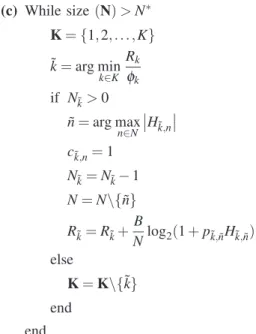
(c) While size(N)>N∗ K={1,2, . . . ,K} ˜ k=arg min k∈K Rk φk if Nk˜>0 ˜ n=arg max n∈N Hk˜,n ck˜,n=1 Nk˜=N˜k−1 N=N\{n˜} R˜k=R˜k+ B Nlog2(1+p˜k,n˜Hk˜,n˜) else K=K\{k˜} end end
In this step, the subcarriers are assigned to each user ac-cording to the greedy policy that the user, who needs a sub-carrier most in each iteration, chooses the best subsub-carrier. Since proportional rates are enforced, the need of a user is determined by the user who has the least capacity divided by its proportionality constant.
(d) K={1,2, . . .,K} for n=1 toN∗ k=arg max k∈K Hk,n ck˜,n=1 R˜k=Rk˜+ B N log2(1+pk˜,nHk˜,n) K=K\{k} end
In this step, the remainingN∗ subcarriers are assigned to the best users.
3.2. Greedy Power Allocation
After the available subcarriers are proportionally allocated to the users, a GPA algorithm is used to optimally allo-cate the transmit power between the alloallo-cated subcarriers to maximize the sum-rate capacity of the MU-OFDM un-der the proportional user rate constraint as in Eq. (3). The GPA algorithm of the MU-OFDM system can be described by the following steps.
Step 1: Calculate the power of each user in the MU-OFDM system as follows: pk= N
∑
n=1 ck,npk,n. (5)Step 2: The problem of subcarriers and power allocation for the MU-OFDM system in Eq. (3) is simplified into the problem of power allocation for a single-user OFDM system as follows [21]: max pk,n B N N
∑
n=1 ck,nlog2(1+pk,nHk,n), ∀k∈ {1,2, . . . ,K} (6)with total user power budgetpk, target BER, and maximum
permissible QAM modulation order. These constraints can be formulated as:
N
∑
n=1
ck,npk,n≤pk, pb,n=BER, rn≤rmax (7)
where pk,n is the amount of power allocated to the nth
subcarrier of kth user to achieve a BER pb,n, and rmax
is the maximum number of permissible allocated bits per subcarrier. Note that the BERs are assumed equal, i.e., pb,n=BER, ∀n ∈ {1,2, . . .,N}, and therefore the
sub-script n will be dropped from the BER notation to be-come pb.
Fig. 2. An illustrative example for grouping of subcarriers.
Step 3: The problem of power allocation for subcarriers in the single-user OFDM system is solved by the GPA algo-rithm that is summarized as follows:
(a) CalculateγlQAM for allMl,1≤l≤L, andPb=BER
using Eq. (1), whereγlQAM is the SNR of the QAM level that is permissible by the transmission system, i.e.,Ml=2r
max
l .
(b) Redistribute subcarriers according to their SNRsγk,n
into QAM groups Gl, 1≤l≤L bounded by QAM
levels γlQAM and γlQAM+1 with γ0QAM =0 and γLQAM= +∞as shown in Fig. 2, i.e.,
(c) Forn=1 toNK
Findln that satisfies Eq. (8)
ifln=0 rk,n=0 pupk,n=γ QAM ln Hk,n else ifln<L rk,n=log2Mln, p up k,n= γlQAMn+1 −γlQAMn Hk,n else rk,n=log2Mln, p up k,n= +∞ end end
(d) Collect power difference from total budget: pd= Nk
∑
n=1 γk,n−γlQAMn Hk,nInitiate greedy bit allocation to rgpak,n =rk,n,∀n∈ {1,2, . . . ,Nk}, pgpad =pd
while ppgad ≥min(pupk,n)andmin(ln)<L,1≤n≤Nk j=arg min
1≤n≤Nk (pupk,n)
lj=lj+1, pgpad =pgpad −pupk,j
iflj=1
rgpak,j =rkgpa,j +log2Mlj, p
up k,j= γlQAM j+1 −γ QAM lj Hk,j else iflj<L
rgpak,j =rgpak,j +log2
M lj Mlj−1 , pupk,j=γ QAM lj+1−γ QAM lj Hk,j else
rgpak,j =rkgpa,j +log2
M lj Mlj−1 , pupk,j= +∞ end end Rgpak = Nk
∑
n=1 rkgpa,n.Step 4: Repeat the GPA algorithm for all users to calculate the sum-rate capacity of the MU-OFDM system:
Rgpa= K
∑
k=1 Rgpak . (9)4. Simulation Results
The frequency selective multipath channel was modeled as consisting of six independent Raleigh multipaths, with an exponentially decaying profile. A maximum delay spread of 5 µs and a maximum Doppler shift of 30 Hz were as-sumed. The channel information was sampled every 0.5 ms to update the subcarriers and power allocation. The total transmit power was assumed as 1 W, the total bandwidth as 1 MHz, and total subcarriers as 64. The average subcar-rier SNR = 20 dB, and BER = 10−3, giving an SNR gap
Γ=−ln(5×10⁻³/1.6=3.3. This constant is used in the
calculation of the rate rk,n of user k in subcarrier n given
in Eq. (2).
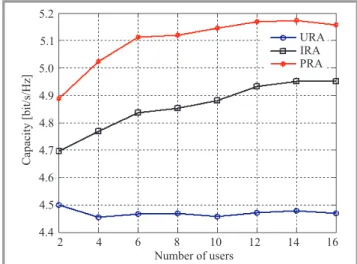
Fig. 3. Average sum-rate capacity versus number of users in an MU-OFDM system.
In Fig. 3, the average sum-rate capacity versus the number of users is depicted for the case ofN= 64 and SNR = 20 dB. This figure shows that the average sum-rate capacity for the two dynamic resource allocation algorithms; the IRA algorithm and the PRA algorithm is increased significantly with the number of users, while the average sum-rate capac-ity for the Uniform Resource Allocation (URA) algorithm remains approximately constant. In the URA algorithm, the resources (subcarriers and power) are allocated equally to the users of the MU-OFDM system regardless of their channel gains. So, the multi-user diversity is not exploited and the average sum-rate capacity of the URA algorithm is approximately constant at 4.48 bit/s/Hz. On the other hand, the capacities of the IRA and PRA algorithms are increased as the number of users is increased. This is the effect of multi-user diversity gain which is more prominent in systems with larger number of users.
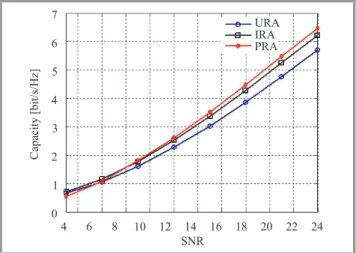
Figure 4 depicts the total sum-rate capacity versus the aver-age SNR for various radio resource allocation algorithms. This figure shows that the total sum-rate capacity for all the algorithms is increased with the increase in the average SNR and the two dynamic resource allocation algorithms; IRA and PRA outperform the URA algorithm. Both of the two dynamic resource allocation algorithms have
ap-proximately the same performance although the transmit power allocation strategies are different for them.
Figure 5 shows the normalized proportions of the capac-ities for each user for the case of 16 users averaged over 10000 channel realizations. The normalized user capac-ity is given byRk divided by∑16k=1Rk, and is observed for
Fig. 4. Average sum-rate capacity versus SNR in an MU-OFDM system.
Fig. 5. Normalized user rate proportions versus user index in an MU-OFDM system.
Fig. 6. Average CPU time for compiled Matlab code versus users’ number in an MU-OFDM system.
both IRA and PRA algorithms. This is compared to the normalized random generated proportionality constraints
φ1,φ2, . . . ,φK that are referred to in Fig. 5 by Gamma. The
IRA and PRA satisfy an acceptable proportionality among the users for MU-OFDM systems.
Figure 6 shows a comparison of the computational com-plexity between the three resource allocation algorithms. These algorithms were run on a Pentium-4 3 GHz personal computer running Windows XP Professional. The simula-tion experiments used floating-point arithmetics. The sim-ple URA algorithm exhibits less computational comsim-plexity with bad capacity performance, whereas the computational complexity of the two dynamic algorithms; IRA and PRA gets high with the number of users, and the PRA algorithm achieves less complexity at larger number of users.
5. Conclusion
This paper proposed an optimal solution for the rate-adaptive resource allocation problem with proportional rate constraints for MU-OFDM systems. It benefited from the greedy subcarriers allocation of [19] to proportionally al-locate the available subcarriers to the users. After that, the resource allocation problem is dealt with as a single-user resource allocation problem which is solved by the GPA al-gorithm to maximize the sum-rate capacity of the system, while achieving approximate rate proportionality. This so-lution avoids the mathematical complexity of [19], while achieving a higher sum-rate capacity. It has been shown through simulations that the PRA algorithm achieves less complexity for higher numbers of users.
References
[1] “IEEE standard for local and metropolitan area networks part 16: Air interface for fixed and mobile broadband wireless access systems”, IEEE, Tech. rep. 802.16, Oct. 2004.
[2] “IEEE standard for local and metropolitan area networks part 16 and amendment 2”, IEEE, Tech. rep. 802.16e , Feb. 2006.
[3] H. Schulze and C. Lueders,Theory and Applications of OFDM and CDMA Wideband Wireless Communications. John Wiley, 2005. [4] P. Chow, J. Cioffi, and J. Bingham, “A practical discrete multitone
transceiver loading algorithms for data transmission over spectrally shaped channels”,IEEE Trans.Commun., vol. 43, pp. 773–775, 1995. [5] R. Fischer and J. Huber, “A new loading algorithm for discrete multi-tone transmission”, inProc. IEEE Global Telecom. Conf. Globecom 1996, London, England, 1996, vol. 1, pp. 724–728.
[6] M. Sternadet al., “Towards systems beyond 3G on adaptive OFDMA transmission”, Proc. IEEE Inst. Electr. Electron. Eng., vol. 95, iss. 12, pp. 2432–2455, 2007.
[7] S. Sadr, A. Anpalagan ,and K. Raahemifar, “Radio resource alloca-tion algorithms for the downlink of multiuser OFDM communica-tion systems”,IEEE Commun. Surveys & Tutorials, vol. 11, no. 3, pp. 92–106, 2009.
[8] C. Wong, R. Cheng, K. Lataief, and R. Murch, “Multiuser OFDM with adaptive subcarrier, bit, and power allocation”,IEEE J. Select. Areas Commun., vol. 17, pp. 1747–1758, 1999.
[9] D. Kivanc, G. Li, and H. Liu, “Computationally efficient bandwidth
allocation and power control for OFDMA”,IEEE Trans. Wireless
Commun., vol. 2, pp. 1150–1158, 2003.
[10] L. Xiaowen and Z. Jinkang, “An adaptive subcarrier allocation
al-gorithm for multiuser OFDM system”, inProc. IEEE VTC 2003,
[11] G. Zhang, “Subcarrier and bit allocation for real-time services in
multiuser OFDM systems”, inProc. Int. Conf. Commun. IEEE ICC
2004, Paris, France, vol. 5, pp. 2985–2989.
[12] H. Yin and H. Liu, “An efficient multiuser loading algorithm for
OFDM based broadband wireless systems”, inProc. IEEE Global
Telecom. Conf. Globecom 2000, San Francisco, USA, 2000, vol. 1, pp. 103–107.
[13] W. Rhee and J. M. Cioffi, “Increase in capacity of multiuser OFDM system using dynamic subchannel allocation”, inProc. 51st IEEE Veh. Technol. Conf. IEEE VTC 2000, Tokyo, Japan, 2000, vol. 2, pp. 1085–1089.
[14] G. Song and Y. G. Li, “Adaptive subcarrier and power allocation in
OFDM based on maximizing utility”, inProc. 57th IEEE Semian.
Veh. Technol. Conf. IEEE VTC 2003-Spring, Seoul, Korea, 2003, vol. 2, pp. 905–909.
[15] G. Song and Y. Li, “Cross-layer optimization for OFDM wireless networks-part ii: algorithm development”, IEEE Trans. Wireless Commun., vol. 4, pp. 625–634, 2005.
[16] J. Jang and K. Lee, “Transmit power adaptation for multiuser OFDM systems”, IEEE J. Select. Areas Commun., vol. 21, pp. 171–178, 2003.
[17] C. Mohanram and S. Bhashyam, “A sub-optimal joint subcarrier and
power allocation algorithm for multiuser OFDM”,IEEE Commun.
Lett., vol. 9, pp. 685–687, 2005.
[18] Z. Shen, J. G. Andrews, and B. L. Evans, “Optimal power
allo-cation in multiuser OFDM systems”, inProc. IEEE Global
Tele-com. Conf. Globecom 2003, San Francisco, USA, 2003, vol. 1, pp. 337–341.
[19] I. Wong, Z. Shen, B. Evans, and J. Andrews, “A low complexity algorithm for proportional resource allocation in OFDMA systems”, inProc. IEEE Worksh. Sig. Proces. Syst. SIPS 2004, Austin, Texas, USA, 2004, pp. 1–6.
[20] A. Goldsmith, Wireless Communications. Cambridge University
Press, 2005.
[21] W. Al-Hanafy and S. Weiss, “Greedy power allocation for multicar-rier systems with reduced complexity”, inProc. 27th Nat. Radio Sci. Conf. NRSC 2010, Menouf, Egypt, 2010, vol. 27, pp. 16–18.
Najib A. Odhah received the B.Sc. and M.Sc. from the Fac-ulty of Electronic Engineering, Menoufia University, Menouf, Egypt, in 2002 and 2009, re-spectively. He is currently work-ing towards the Ph.D. degree in Electrical Communications En-gineering at Menoufia Univer-sity, Egypt. From 2003 to 2006, he worked as a demonstrator in the Department of Electronics, Faculty of Engineering and architecture, Ibb University, Ibb, Yemen. His research ar-eas of interest include Multicarrier Communication Sys-tems, Multiple-Input Multiple-Output (MIMO) SysSys-tems, Digital Signal Processing, Digital Communications, Inter-ference Cancelation, Channel Equalization and Channel Estimation.
E-mail: Najib [email protected] Faculty of Electronic Engineering Menoufia University
Menouf, Egypt
Moawad I. Dessoukyreceived the B.Sc. (Honors) and M.Sc. degrees from the Faculty of Electronic Engineering, Me-noufia University, Menouf, Egypt, in 1976 and 1981, respectively, and the Ph.D. from McMaster University, Ca-nada, in 1986. In 1986 he joined the teaching staff of the Department of Electronics and Electrical Communications, Faculty of Electronic Engineering, Menoufia University, Menouf, Egypt. He has published more than 180 scientific papers in national and international conference proceedings and journals. He is currently the head of the Dept. Electronics and Electrical Communications, Faculty of Electronic En-gineering, Menoufia University. He has received the most cited paper award from Digital Signal Processing journal for 2008. His current research areas of interest in-clude spectral estimation techniques, image enhancement, image restoration, super resolution reconstruction of im-ages, satellite communications, and spread spectrum tech-niques.
E-mail: Dr [email protected] Faculty of Electronic Engineering Menoufia University
Menouf, Egypt
Waleed E. Al-Hanafyreceived the B.Sc. (Honors) and M.Sc. degrees from the Faculty of Electronic Engineering, Me-noufia University, Menouf, Egypt, in 1996 and 2002, respectively, and the Ph.D. from Strathclyde University, Glasgow, UK, in 2010. In 2010 he joined the teaching staff of the Department of Electronics and Electrical Communications, Faculty of Electronic Engineering, Menoufia University, Menouf, Egypt. He has published more than 20 scientific papers in national and international conference proceedings and journals. His current research areas of interest include the signal processing for communications in particular precoding and equalization methods of MIMO systems, adaptive power/bit loading approaches, Multi-User MIMO, OFDM systems, and resource allocation of wireless communica-tion systems.
E-mail: Waleed [email protected] Faculty of Electronic Engineering Menoufia University
Fathi E. Abd El-Samie re-ceived the B.Sc. (Honors), M.Sc., and PhD. from the Fac-ulty of Electronic Engineering, Menoufia University, Menouf, Egypt, in 1998, 2001, and 2005, respectively. In 2005 he joined the teaching staff of the Department of Electronics and Electrical Communications, Faculty of Electronic Engineer-ing, Menoufia University, Menouf, Egypt. He is a co-author
of about 140 papers in national and international confer-ence proceedings and journals. He has received the most cited paper award from Digital Signal Processing journal for 2008. His current research areas of interest include im-age enhancement, imim-age restoration, imim-age interpolation, super resolution reconstruction of images, data hiding, mul-timedia communications, medical image processing, optical signal processing, and digital communications.
E-mail: Fathi [email protected] Faculty of Electronic Engineering Menoufia University