
From Verbs to Tasks:
An Integrated Account of Learning Tasks
from Situated Interactive Instruction
by
Shiwali Mohan
A dissertation submied in partial fulfillment of the requirements for the degree of
Doctor of Philosophy
(Computer Science and Engineering) in e University of Michigan
2015
Doctoral Commiee:
Professor John E. Laird, Chair Professor Edmund H. Durfee Professor Richard L. Lewis Associate Professor Edwin Olson
Intelligence is what you use when you don't know what to do. —Jean Piaget
© Shiwali Mohan All Rights Reserved
Anowledgments
I would like to thank my advisor John Laird who has been an inspiring teacher as well as an approachable and caring mentor. He motivated me to explore my own ideas, even when my progress was slow in the initial years. When I was too shy to talk, he constantly encouraged me to contribute more in classes and meetings. As I grew as researcher, he gave me the freedom to develop my own agenda. In his pursuit of understanding human-level intelligence, in his desire to learn, in being critical of his own work, and in being humble, he has set an excellent example of a researcher for me to strive for.
I would also like to thank my commiee members - Ed Durfee, Rick Lewis, Edwin Olson, and Andrea omaz without whose guidance this thesis would not be in its current shape. eir constructive feedback has raised the standard of my thesis. Ed's insistence on clearly identifying my claims and contributions has made the dissertation more readable. Rick's class on psychology of language helped me have an holistic view of the human language faculty and inspired me to pursue questions related to language understanding and learning. Without Edwin, R would have never been able to live a happy life in the real-world. Andrea's research and guidance has helped me keep my work grounded in HRI challenges.
Past and current members of the Soar lab have greatly influenced my research. anks to Nate Derbinsky for patiently listening to my half-baked ideas and guiding me in writ-ing my first few papers; to Joseph Xu for constructive feedback on my papers and talks and for always having the time to help me debug my code; and to Justin Li for thoughtful discussions on various aspects of my thesis, for fixing Soar kernel bugs, and for always
being ready for a cup of coffee. is thesis would not have seen the light of day if Aaron Mininger and James Kirk hadn't put in tremendous effort in designing R, writing code, fixing bugs, and in doing great research. I continue to be in awe of Aaron's engineering and James's hacking skills. I thank Steven Jones and Elizabeth Mamantov for their excite-ment and 'new-grad-student' optimism. It cheered up the cynic in me while I was writing this dissertation.
I thank Emily Mower Provost and Maya Cakmak for their encouragement and invalu-able advice about the future. ey have inspired me to continue as a researcher aer I graduate. anks to my friends - Yash Adhia, Fatema Haque, Ramya Iyer, Rahul Jha, Vasudev Lal, Vineet Raichur, and Aayush Shah for making my time in Ann Arbor mem-orable. I am also thankful to Sulochana Dhar, Parul Jain, and Parul Batra for being my cheering squad all through college and grad school.
I am grateful for the continuing love and support of my family. My sister Monali Mohan and my brother Ravi Mohan always had the time to talk to me about things that were fun and things that were not. Without my mother Veena Gupta, I would not have had the courage to come to the US and pursue graduate studies. I have relied on her for heartening conversations whenever I felt discouraged about hard classes, rejected papers, and the relentless Michigan winters.
anks to my loving husband Shekhar Mial for being by my side and helping me through my darkest moments and for being incredibly excited about my work.
Contents
Dedication . . . ii
Anowledgments . . . iii
List of Tables . . . viii
List of Figures . . . ix Abstract. . . xi Chapter 1 Introduction . . . 1 1.1 Research approach . . . 5 1.1.1 An Integrated Account . . . 5 1.1.2 Architectural Implementation . . . 6
1.1.3 alitative and Functional Evaluation . . . 6
1.2 Looking Ahead . . . 7
Chapter 2 Situated Interactive Instruction . . . 9
2.1 Situated Interactive Instruction . . . 9
2.2 Properties . . . 10 2.2.1 Modality . . . 10 2.2.2 Control . . . 12 2.2.3 Content . . . 13 2.3 Desiderata . . . 15 2.3.1 Situated Comprehension . . . 15 2.3.2 Integrative Interaction . . . 16 2.3.3 Incremental Learning . . . 17
Chapter 3 Related Work . . . 19
3.1 Grounded Language Semantics . . . 19
3.1.1 Computational Linguistics . . . 19
3.1.2 Integrated AI Systems . . . 21
3.1.3 Robotics . . . 22
3.2.1 Virtual Agents . . . 23
3.2.2 Conversational Robots . . . 23
3.3 Interactive Learning . . . 24
3.3.1 Learning from Low-level Interactions . . . 24
3.3.2 Learning from High-level Interactions . . . 25
3.4 Summary and Discussion . . . 28
Chapter 4 Rosie Overview . . . 29
4.1 e Soar Cognitive Architecture . . . 29
4.1.1 Architecture Overview . . . 29 4.1.2 Analysis . . . 32 4.2 Rosie . . . 33 4.2.1 Environment . . . 33 4.2.2 Knowledge Representation . . . 35 4.2.3 Interaction Cycle . . . 39
4.3 Summary and Discussion . . . 42
Chapter 5 Verbs and Tasks . . . 44
5.1 Prior Work on Grounded Verb Semantics . . . 46
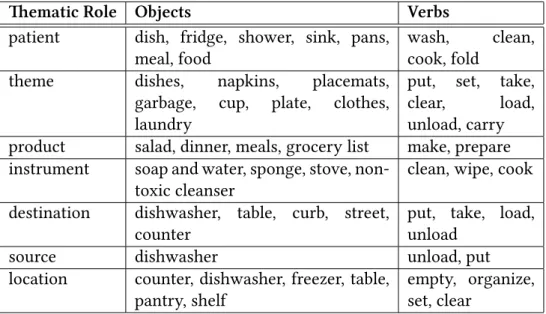
5.2 An Analysis of Task Verbs . . . 47
5.2.1 Chores Dataset . . . 48
5.2.2 Semantic Analysis . . . 48
5.2.3 Task-Oriented Analysis . . . 54
5.3 A Task-Oriented Representation for Grounded Verb Semantics . . . 56
5.3.1 Syntactic Knowledge . . . 58
5.3.2 Association Knowledge: Map . . . 59
5.3.3 Structural Knowledge . . . 59
5.3.4 Procedural Knowledge . . . 61
5.4 Discussion . . . 64
5.5 Looking Ahead . . . 65
Chapter 6 Comprehending Situated Commands . . . 67
6.1 Comprehending Imperative Sentences . . . 68
6.2 e Indexical Hypothesis . . . 70
6.3 Our Approach . . . 71
6.4 e Indexical Model of Comprehension . . . 73
6.4.1 Indexing . . . 75
6.4.2 Instantiating Domain Knowledge . . . 77
6.4.3 Meshing . . . 78
6.4.4 Active and Expandable . . . 79
6.5 Reference Resolution . . . 81
6.5.1 Non-linguistic Contexts . . . 82
6.5.2 Resolving References in the Indexical Model . . . 84
6.5.3 Integrative Processing . . . 86
6.6.1 Exploiting the Hearer's Instructional Experience . . . 92
6.6.2 Integrative Processing . . . 94
6.7 Summary and Discussion . . . 97
Chapter 7 Maintaining Flexible Dialog . . . 100
7.1 Collaborative Discourse eory . . . 101
7.2 Our Approach . . . 102
7.3 Mixed-Initiative Dialog Model . . . 103
7.3.1 Interaction State Representation . . . 103
7.3.2 Interaction Management . . . 106
7.4 Evaluation . . . 107
7.4.1 Adaptive, Flexible Dialog . . . 109
7.4.2 Mixed-Control of Learning . . . 111
7.5 Summary and Discussion . . . 114
Chapter 8 Learning Goal-Oriented Tasks . . . 116
8.1 Explanation-based Generalization . . . 117
8.2 Our Approach . . . 118
8.3 Formulating Task Learning as EBG . . . 120
8.3.1 Assumptions . . . 120
8.3.2 Formulation . . . 120
8.4 Interactive Task Learning . . . 121
8.4.1 Executing a Known Task . . . 122
8.4.2 Learning a New Task . . . 125
8.4.3 Learn Associative Default Values . . . 134
8.5 Evaluation . . . 141
8.5.1 Comprehensiveness . . . 141
8.5.2 Generality . . . 143
8.5.3 Transfer . . . 147
8.5.4 Mixed-Initiative . . . 150
8.6 Summary and Discussion . . . 152
Chapter 9 Conclusions . . . 154
9.1 Future Work . . . 157
9.2 Conclusion . . . 159
Appendix . . . 161
List of Tables
Table
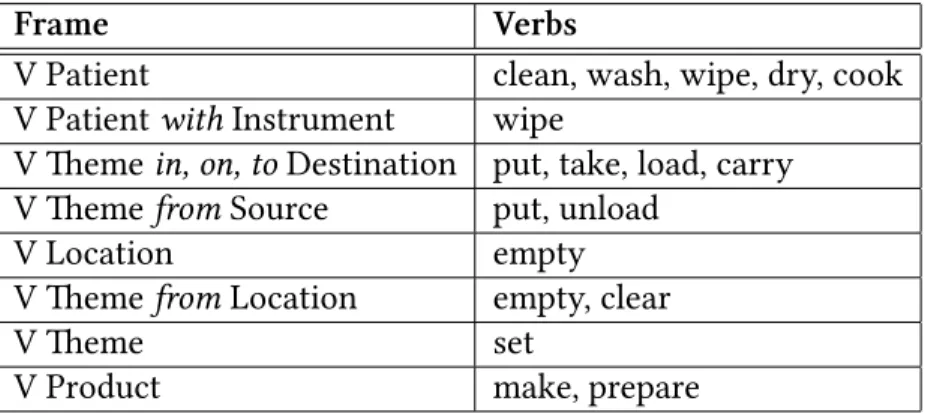
5.1 ematic roles represented in the chores dataset . . . 50 5.2 Syntactic frames represented in the chores dataset . . . 53 8.1 Learned tasks, parameters, policy space, and goals . . . 141
List of Figures
Figure
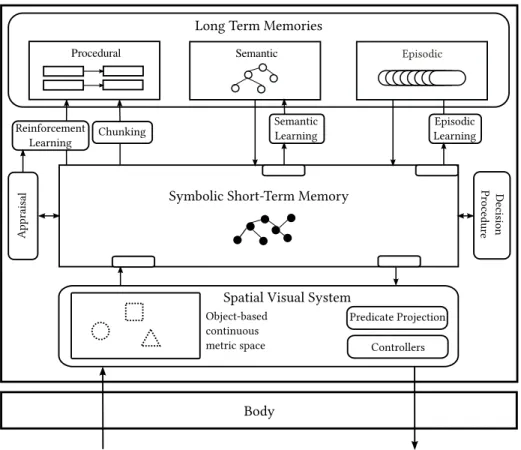
4.1 e Soar Cognitive Architecture (adapted from J. Laird, 2012) . . . 30
4.2 R's table-top workspace and the interaction window. . . 34
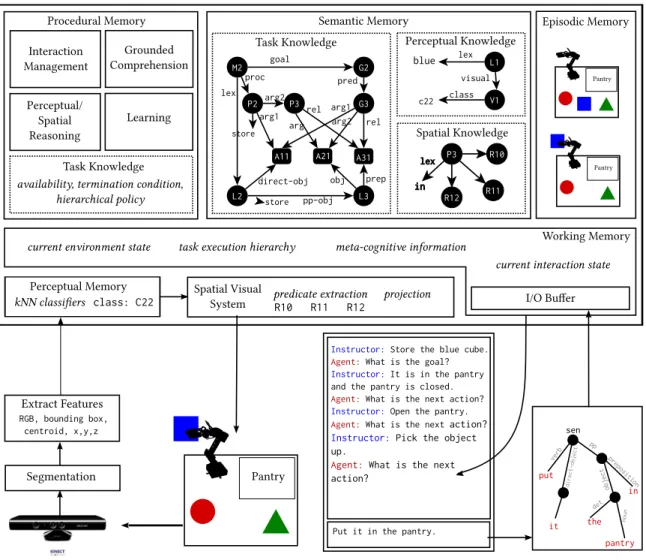
4.3 R Structural Diagram . . . 36
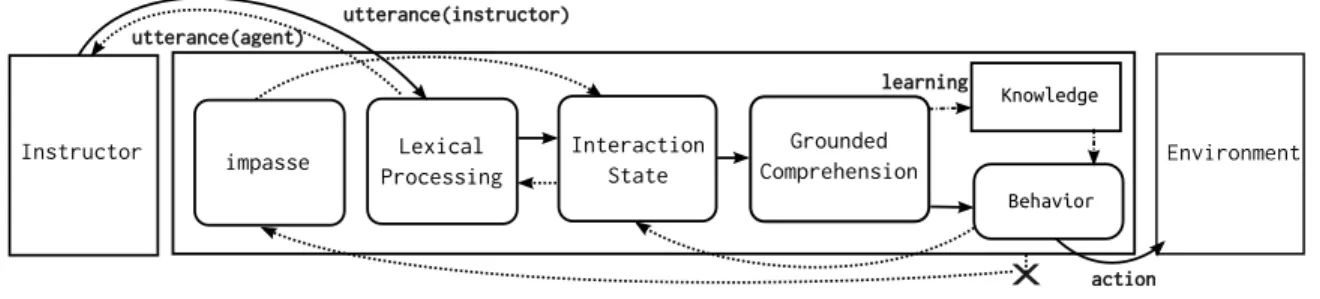
4.4 R's Interaction Cycle . . . 40
4.5 R's learning interaction trace. . . 40
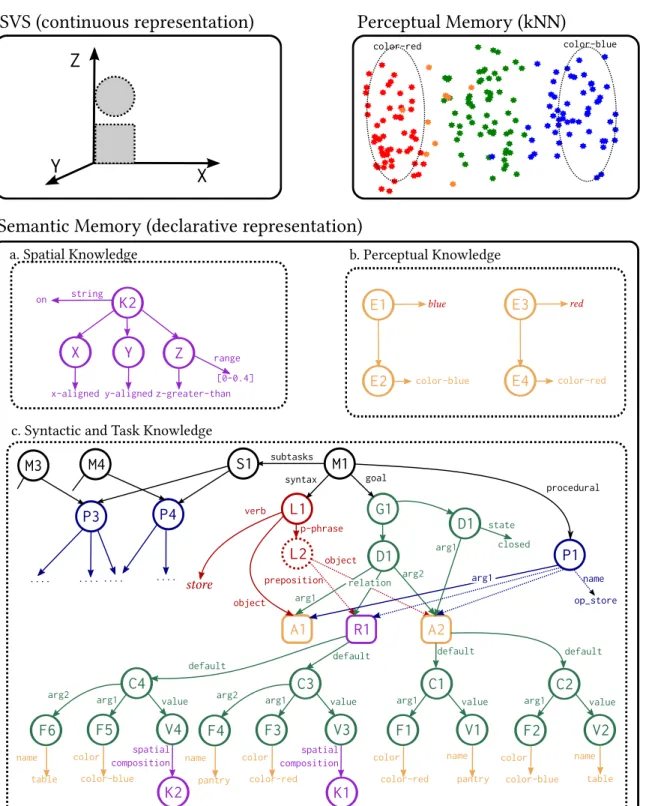
5.1 A task-oriented representation for grounded verb semantics in R's memories. Nodes and symbols in color purple correspond to spatial knowl-edge, orange to perceptual knowlknowl-edge, green to goal definition and con-straints, blue to procedural knowledge, and red to syntactical knowledge. . 57
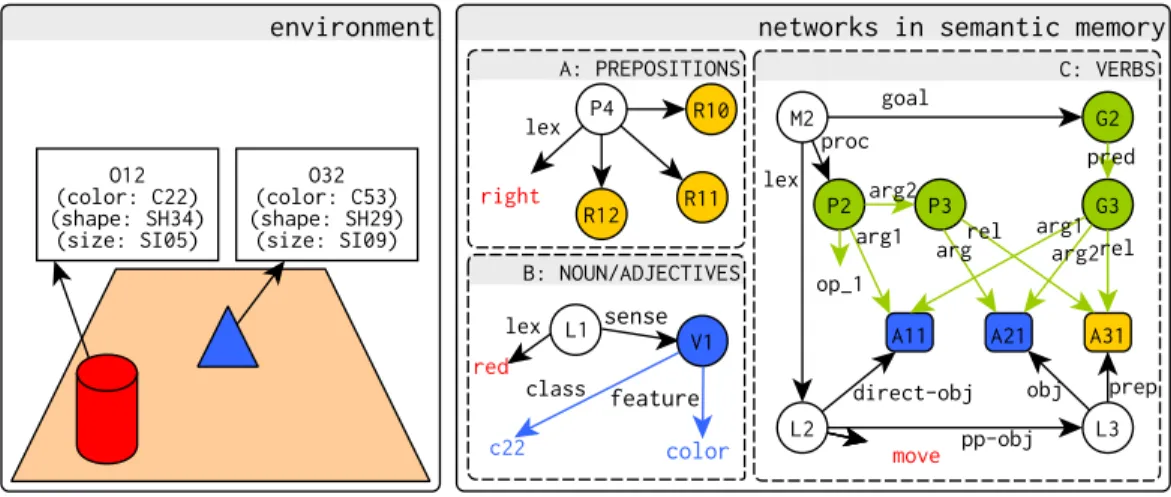
6.1 Environment state and the knowledge encoded in R's semantic mem-ory. e white nodes (P4, L1, M2, L2, L3) represent indexical maps between amodal linguistic symbols (in red: right, red, move) and modal domain knowledge. Yellow nodes (R10, R11, R12, A31) represent spa-tial symbols and slots (round rectangles: A31), blue nodes (V1, A11, A21) represent visual symbol and slots, and green nodes (P2, P3, G2, G3) represent procedural symbols. . . 74
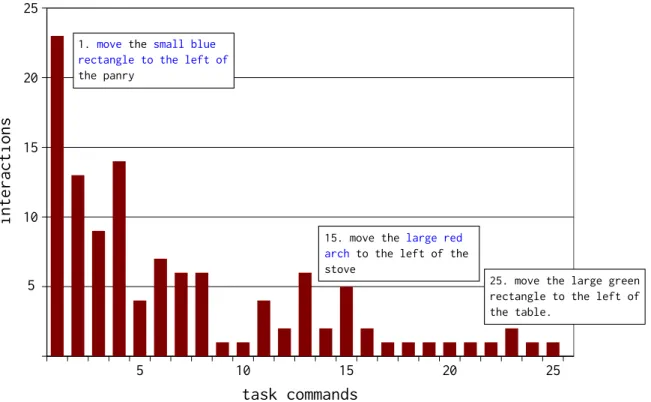
6.2 Number of agent-initiated interactions per task command. e boxes show task commands 1, 15, and 25. e words in color blue are unknown to R when that task command was given. . . 81
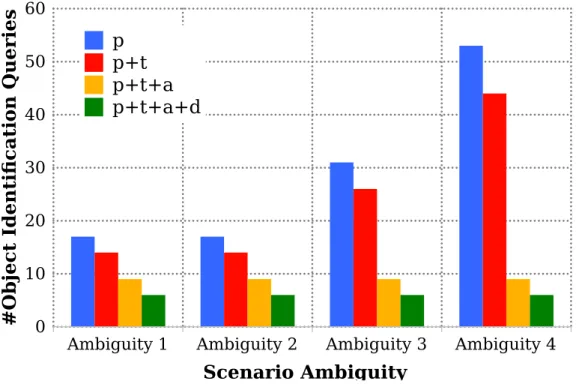
6.3 Number of object queries asked by R for RE resolution. . . 90
6.4 Number of interactions required for comprehending verbs in different al-ternations. . . 96
7.1 Annotated human-agent dialog for acquisition ofstore . . . 104
7.2 Number of agent-initiated interactions per task command in different ini-tial stages of prior knowledge. . . 110
7.3 Initial and final environment states for learningset the table task. . . 111
7.4 Human-agent interaction trace for instructor-controlled teaching strategy (simplified). . . 112
7.5 Human-agent interaction trace for agent-controlled teaching strategy (sim-plified). . . 113
8.1 Semantic representation ofstore. . . 123
8.2 (le) Interactions for learningstorewith exploration depthK = 0. (right) Interactions for learningstorewith exploration depthK = 2. . . 125
8.3 Simplified Soar trace for interactive task execution. . . 126
8.4 Simplified Soar trace for retrospective instruction-aided learning. . . 132
8.5 Associative default values forstore. . . 136
8.6 Relaxed associative default values for R3andA4in structural knowledge ofstore. . . 139
8.7 New associative default values for R3and A4in structural knowledge of store. . . 140
8.8 Learned hierarchical policies. . . 142
8.9 Procedural generalization during task learning. . . 145
8.10 Conceptual generalization for learning implicit parameters of tasks. . . 148
8.11 Instruction assisted transfer during learning. . . 149
Abstract
Intelligent collaborative agents are becoming common in the human society. From virtual assistants such asSiriandGoogle Nowto assistive robots, they contribute to human activ-ities in a variety of ways. As they become more pervasive, the challenge of customizing them to a variety of environments and tasks becomes critical. It is infeasible for engineers to program them for each individual use. Our research aims at building interactive robots and agents that adapt to new environments autonomously by interacting with human users using natural modalities.
is dissertation studies the problem of learning novel tasks from human-agent dialog. We propose a novel approach for interactive task learning,situated interactive instruction (SII), and investigate approaches to three computational challenges that arise in designing SII agents: situated comprehension,mixed-initiative interaction, andinteractive task learn-ing. We propose a novel mixed-modality grounded representation for task verbs which encompasses their lexical, semantic, and task-oriented aspects. is representation is use-ful in situated comprehension and can be learned through human-agent interactions. We introduce the Indexical Model of comprehension that can exploit extra-linguistic contexts for resolving semantic ambiguities in situated comprehension of task commands. e Indexical model is integrated with a mixed-initiative interaction model that facilitates a flexible task-oriented human-agent dialog. is dialog serves as the basis of interactive task learning. We propose an interactive variation of explanation-based learning that can acquire the proposed representation. We demonstrate that our learning paradigm is effi-cient, can transfer knowledge between structurally similar tasks, integrates agent-driven
exploration with instructional learning, and can acquire several tasks. e methods pro-posed in this thesis are integrated in R - a generally instructable agent developed in the Soar cognitive architecture and embodied on a table-top robot.
Chapter 1
Introduction
With the recent advances in artificial intelligence, computational agents have begun to take on new roles as intelligent collaborators in the human society. Virtual assistants -SiriandGoogle Now- are on their way to becoming standard phone interfaces, providing human users a novel way of interacting with their cellphones and accessing information. It is expected that general-purpose, personal robots will become pervasive in domestic, public, and industrial spaces within the next decade. ey will assist humans in a vari-ety of activities including doing household tasks and collaborating on the assembly line. Personal robots, along with other intelligent agents such as smart homes and cars, will add tremendously to the quality of human life. ey will offer persons with impairments more independence, help older adults with their daily chores, transport people and goods, and perform search and rescue in environments that are too dangerous for humans.
Several challenges have to be addressed to make progress towards this vision. Each home, office, or assembly line is organized differently. Users will want the agents to per-form a variety of tasks and will have different preferences. Customizing every agent for its deployment environment and user preferences is resource intensive and costly. One approach to this challenge is designing a generally intelligent agent that can adapt to the user requirement on its own instead of relying on dedicated programming. is approach requires that the agent be an efficient online learner. It needs to learn object recognition, semantic organization and categorization, spatial relations, and tasks from experiences in its environment and exploit this knowledge immediately for performance. Learning
through self-directed exploration alone can be challenging and slow, requiring numerous interactions with the environment. is has motivated research on human-agent interac-tion driven learning paradigms that studies how human feedback, guidance, and structure can be used to reduce the complexity of learning. e goal is to develop agents that can be easily extended by human users using natural interactions to perform new tasks.
Recently, interactive task learning (ITL) was identified as a challenge problem for inte-grated intelligent agents (J. Laird, 2014). In order to learn a new task, an agent must learn a variety of types of knowledge. It not only should know the description of task goals but also learn to recognize relevant objects, their features, and relationships from its sensory stream. It must learn to manipulate its environment to make progress toward its goals. It also needs to acquire task parameters and specifications. Prior work (Chernova and omaz, 2014) on learning from demonstration, dialog, and reinforcement has addressed the ITL problem in parts. Several initiatives have focused on acquisition of control poli-cies from either human generated embodied traces or reward. However, very few have studied learning comprehensive representations of tasks from scratch.
A related challenge is that of supporting natural interactions with human collabora-tors. Most commercially available agents and robots rely on menu-driven interactions that are completely controlled by the human user. To design autonomous agents that can meaningfully interact with humans to collaborate on tasks, more natural interaction modalities such as language, gestures, sketching, or demonstrations have to be explored. BothSiriandGoogle Nowhave taken encouraging steps in this direction by relying on spo-ken language. However, their interaction paradigm is unidirectional, and they merely re-spond to human initiated queries. Furthermore, they are constrained to pre-programmed behaviors. An agent that learns effectively and efficiently by interacting with humans must assume control of interactions on occasion and guide the conversation for its own learning.
guides a novice to execute a novel task. is dialog is rich in useful information identi-fying task relevant features, decomposition structure, goals, and constituent actions. In comparison with other interaction modalities such as embodied traces or rewards that can only encode very specific information (execution trajectory or value judgment), the lin-guistic modality is extremely expressive. It can be used to communicate a variety of infor-mation, and therefore, is useful in developing strong and flexible task learning paradigms. However, it also poses a significant challenge. As the communication is high-level, the agent must translate the linguistic symbols to representations that it uses for perceiving, reasoning about, and manipulating its world. e contextual flexibility of human language and the ambiguities pervasive in it make this a hard problem.
is thesis addresses the problem of interactive task learning from human-agent in-structional dialog. We introduce a learning paradigm based on linguistic communication calledsituated interactive instruction(SII). In the SII approach, a human instructor and an agent learner are simultaneously embedded in a shared environment. e shared percep-tions and common sense knowledge about the world provides acommon groundthrough which the dialog is situated in aspects of the world. e human instructor gives the agent instructions to execute new tasks. e agent grounds linguistic symbols in the instruc-tions to objects, their perceptual aributes, spatial relainstruc-tionships, and tasks definiinstruc-tions. rough this grounding process, the agent extracts specific examples from the environ-ment that form the basis of learning. e agent effectively combines knowledge in inter-actions with its experience in the environment to extract generally applicable knowledge and adds it to its repertoire. e task structure, parameters, and execution knowledge so acquired crucially provide the means through which the semantics of verbs are grounded in the physical properties of the world. Grounding verbs in task representation acquired from the instructor contributes to expanding the common ground between the agent and the instructor. is not only allows the agent to communicate about tasks but also aids in learning complex hierarchical tasks. e interactions are mixed-initiative and distribute
the onus of learning between both participants.
More specifically, this thesis proposes answers to the following questions.
• How can verbs be grounded in task goals and execution knowledge? Answering this question is critical for communicating about tasks and producing behavior in re-sponse to task commands (imperatives) such asset the table. e challenge key to this question is identifying a representation which encodes lexical, semantic, and procedural aspects of verbs and tasks that can be realized in a computational system.
• How can task commands be understood? is questions deals with grounded inter-pretation of language - generating meaning by connecting words to non-linguistic knowledge of the world. Linguistic interactions are contextual, flexible, and am-biguous which makes understanding even simple imperatives a significant chal-lenge.
• How can task-oriented linguistic interaction be sustained? In order to learn task rep-resentations, the agent must acquire various aspects such as their parameters, goals, execution policy, etc. is may involve extended conversations about these aspects. In order to learn useful knowledge from interactions, the agent should be able to sustain and direct these conversations.
• How can task goals, structure, and execution knowledge be learned interactively? Learn-ing the structure of novel tasks and how to execute them is a challengLearn-ing computa-tional problem that requires acquiring a variety of knowledge including goal defini-tions and hierarchical control information. Additionally the data available to learn from is sparse, necessitating knowledge-intensive learning paradigms.
is thesis can also be characterized as a case study in designing complex agents that have several intelligent capabilities. e methods in this thesis developed in answering the questions above are integrated in R, a generally instructable agent. R can
interactively learn a diverse variety of concepts including perceptual categorization and classification (Mohan, Mininger, Kirk, et al., 2012), spatial composition (Mohan, Mininger, Kirk, et al., 2012), hierarchical tasks (Mohan and J. Laird, 2014), and simple games (Kirk and J. Laird, 2014).
1.1 Resear approa
We approach the challenge of designing interactive learning agents with the following three strategies.
1.1.1 An Integrated Account
Developing a generally intelligent artificial agent has proved to be an incredibly hard challenge. A strategy that has been successful is to divide the problem of general AI into smaller problem areas. is has led to tremendous successes in various sub-fields of AI from recommender systems to autonomous robot navigation. Recent advances have led to methods in several domains that can handle real-world complexity. However, there has been limited work in studying how algorithms and methods developed in these sub-fields can be integrated into a consistent framework for end-to-end intelligent behavior.
e problem of learning new tasks from human-agent dialog necessitates the integra-tion of several intelligent capabilities including language comprehension and generaintegra-tion, interaction and dialog, perception and actuation, and learning. Each of these is a signifi-cant research challenge in its own regard. In order to make this cross-capability integra-tion tractable, we focus on task learning in a simple robotic domain (described in detail in Chapter4). e domain consists of a robotic arm that can manipulate blocks on its table-top workspace. is strategy simplifies the perceptual and actuation challenges, allowing us to study representations and processes useful for interactive task learning while main-taining end-to-end behavior. Our research is embedded in a larger research initiative that
investigates methods to learn a variety of concepts ground-up in a single integrated agent. e concepts that can be learned include perceptual aributes and spatial relations, tasks, and simple games.
In studying situated language comprehension, we restrict the grammar and vocabu-lary of communication toconcretenouns, adjectives, and verbs that can be grounded into perceptual data and control hierarchies. is allows us to explore connections between language and other aspects of intelligent behavior.
1.1.2 Aritectural Implementation
Designing an agent with several intelligent capabilities is challenging and necessitates an agent architecture that provides reliable and efficient mechanisms for perceptions, actua-tion, memory, decision making and learning. e representations and methods described in this paper are implemented as components of R (Mohan, Mininger, Kirk, et al., 2012) which is developed in the Soar cognitive architecture (J. Laird, 2012). Soar incor-porates various learning, memory, and control mechanisms and is commied to reactive behavior (50 ms perceive-decide-act cycle), online learning, and diverse modality-specific representations. is makes Soar a suitable AI architecture for use on robots and in in-teractive learning. An analysis of memories and processing useful in designing R is presented in Chapter4.
1.1.3 alitative and Functional Evaluation
Our methods are motivated by and evaluated on desirable characteristics of interactive learning agents. Chapter2identifies the desiderata for an intelligent agent that can main-tain a situated task-oriented dialog and learn from this experience. is is based on prior work in various fields that have studied human-human task-oriented dialog. e methods introduced in the later chapter are analyzed on how close they are to desirable behavior
of interactive learners.
For functional evaluations, the primary metric used is the number of human-agent uerances required to learn or execute a task. A competent interactive learner bears a significant responsibility for its own learning and takes initiative in generalizing its ex-perience, applying its background knowledge to learning, and exploring its environment. Consequently, it requires less interaction with its instructor in comparison with a passive learner that relies on the instructor to structure instructions and provide examples for appropriate generalization.
is thesis takes an agent-oriented view of learning from human-agent dialog, ad-dressing integration of various intelligent capabilities that will allow an agent to sustain a task-oriented dialog and learn useful representations from it. erefore, the evaluations are functional, focusing on correctness and efficiency of task learning. In future, we will evaluate our methods in human-robot/agent interaction contexts to explore variability in human instruction and to develop methods that are robust to these variations.
1.2 Looking Ahead
Chapter2 introducessituated interactive instruction(SII) - our approach to learning new tasks. We begin by studying the properties of task-oriented dialog which forms the basis of SII. Based on these properties, we then derive design requirements for agents that can learn from SII.
Chapter3reviews literature related to our research and positions this thesis with re-spect to contributions made by prior work.
In Chapter4 we present an overview of R, an SII agent. We begin with a brief primer to the underlying cognitive architecture, Soar, and analyze the degree to which the architecture satisfies SII requirements. Next, we describe our experimental robotic domain and how it is interfaced withRosie.
Chapter 5 presents a semantic and task-oriented analysis of verbs used to describe common domestic tasks. is analysis is then used to motivate amixed-modality repre-sentation for verbs that encodes lexical, semantic, and task-oriented knowledge.
Chapter6proposes a computational model of situated language comprehension based on the Indexical Hypothesis Glenberg and Robertson, 1999. e Indexical Model gener-ates meaning representations by translating amodal linguistic symbols to modal repre-sentations of beliefs, knowledge, and experience external to the linguistic system. It in-corporates multiple information sources including perceptions, domain knowledge, and short-term and long-term experiences during comprehension to alleviate various seman-tic ambiguities.
Chapter7describes a computational model for maintaining task-oriented flexible human-agent dialog. We show that the interaction model is sensitive to the human-agent's knowledge state and accommodates instructor-driven and learner-driven learning strategy.
In Chapter8, we study learning goal-oriented hierarchical tasks from SII. We frame acquisition of novel tasks as an explanation-based learning (EBL) problem and propose an interactive learning variant of EBL. We show that our approach can exploit information in situated instructions along with the domain knowledge to demonstrate fast generaliza-tion on several tasks. e knowledge acquired transfers across structurally similar tasks. Finally, we show that our approach seamlessly combines agent-driven exploration with instructions for mixed-initiative learning.
Chapter9re-iterates the contributions of this thesis and discusses open questions in interactive task learning.
Chapter 2
Situated Interactive Instruction
Task-oriented dialog arises naturally in scenarios when people collaborate on tasks. It is also common in instructional scenarios when an expert guides a novice in a new task. Research on collaborative task-oriented dialog suggests that such dialog is rich in infor-mation relevant to task execution. It may identify relevant perceptual features (Grosz and Sidner, 1986; Ovia and Cohen, 1991; Scheutz, Cantrell, et al., 2011), subtasks (Grosz and Sidner, 1986; Bangalore et al., 2008), or goals (Grosz and Sidner, 1986; Scheutz, Cantrell, et al., 2011). It may also contain corrections (Litman and Allen, 1987), clarification (Lit-man and Allen, 1990) or preconditions for task execution (Lochbaum, 1998). Task dialog, therefore, can serve as an important tool to learn a new task and forms the basis of our situated interactive instruction(SII) approach to interactive learning.
2.1 Situated Interactive Instruction
In SII, ainstructor ormentor and a learner are simultaneously embedded in a shared en-vironment and the instructor guides the novice to execute a novel task. e instructor and the learner form a system of joint learning, which distributes the onus of learning between both participants. e instructor takes initiative in identifying relevant percep-tual features, objects, and relationships in the shared environment and in structuring and decomposing the task. e learner takes initiative in actively comprehending and apply-ing the instructions to the current situation, in applyapply-ing common-sense reasonapply-ing and
experience to understand ambiguous instructions, in exploring its environment, and in posing relevant queries that elicit instructions useful in making progress in the task.
To design an agent that can learn from SII, several complex aspects of intelligence and cognition have to be addressed. Not only must the agent maintain an ongoing, mixed-initiative dialog with the instructor, it must also act in the world in accordance with the instructions, and learn from its experience of the world. e challenge of developing SII learners requires studying how language comprehension, dialog management, per-ception, decision-making, action, and experience-driven learning can be integrated in a single agent architecture. In order to guide the design of our agent, its capabilities, and their integration, we first study the properties of general situated interactive instruction in Section2.2and then, derive the design requirements in2.3along with identifying the specific aspects this thesis addresses.
2.2 Properties
e properties of an interactive learner can be characterized along three dimensions. e first dimension,modality, pertains to how the information in interactions is encoded. e second, control, pertains to which participant of human-agent interaction has the onus of learning. e third dimensiondata, characterizes data available to the learner to learn from. Below we characterize SII along these dimensions.
2.2.1 Modality
Information in human-agent interaction can be encoded in various ways. In typical learn-ing from demonstration approaches (Argall et al., 2009; Chernova and omaz, 2014), the agent is given embodied traces of desired behavior either through teleoperation or by direct manipulation of its actuators. e traces are composed of state-action pairs from which the agent can induce a control policy. Interactive reinforcement learning methods
(Maclin and Shavlik, 1996; omaz et al., 2006; Knox and Stone, 2010; Griffith et al., 2013) have looked at interaction as a medium for rewarding the agent for behavior. Both classes of interactions are low-level and are very close to agent's reasoning units (state, action, rewards). Other approaches (Rybski et al., 2007; Cantrell, Talamadupula, et al., 2012; Mer-içli et al., 2014) have looked athigh-level dialog-type interactions. Interactions in SII are high-level and rely on:
P1 Language: Language in task-oriented dialog is referential and is used to identify and bring to the aention of the collaborator the objects of interests, actions to be taken in the environment, useful relationships between objects, and feedback from the environment. For example,
"so you see that thing on the wall on the right"(Byron and Fosler-Lussier, 2005)
"You should be seeing a door in front of you"(Scheutz, Cantrell, et al., 2011)
rough such references, the speaker and the hearer accumulate acommon ground of shared beliefs and mental representations. is allows them tosituatethe com-munication in the current task and environmental state. Comprehending instruc-tions requires the agent to translate the amodal symbols in the linguistic uerance to its modal beliefs about perceptual state, domain knowledge, and experiences. Even very simple instructions can be linguistically complex and ambiguous requir-ing the hearer to use non-lrequir-inguistic context and domain knowledge for unambigu-ous interpretations. Disfluencies, continuations, and ungrammatical constructions are common (Scheutz, Cantrell, et al., 2011) .
P2 Multi-modal: Although language is the primary modality in task-oriented dialog, other modalities (Cassell et al., 1999) may be employed to convey information criti-cal for task performance. Gestures are important for establishing object references and may be used to communicate size or distance. Eye-gaze and gestures are useful in conveying understanding, confusion, or distress.
2.2.2 Control
Human-agent interaction for learning can be viewed on a continuum of instructor/agent control. Learning from demonstration or by imitation focuses on instructor-controlled interactions, in which the instructor provides examples of task performance, object recog-nition and categorization, etc. e agent observes these examples, maps the performance onto its own capabilities and induces knowledge, goals, or reward functions. Such sys-tems place the onus of learning completely on the instructor, requiring the instructor to model the learner and provide good samples from the feature space so that the learner can acquire general hypotheses. Other approaches (Maclin and Shavlik, 1996; omaz et al., 2006; Knox and Stone, 2010; Knox and Stone, 2012; Griffith et al., 2013) incorporate human feedback as a reward in a reinforcement learning architecture, leing the agent (or the agent designer) control learning. A few others (Allen et al., 2007; Huffman, 1994) have explored distributing initiative between the instructor and the agent. SII can be characterized as:
P3 Mixed-initiative: Task-oriented dialog is mixed-initiative, flexible, and collabora-tive. Participants advance the dialog in accordance with their intentions and goals and comply with each other's requests. Dialog provides an opportunity for mixed-control of learning. An example from Grosz and Sidner (1986) (annotation ours):
E:First you have to remove the flywheel.
A:How do I remove the flywheel? (learner initiative)
E:First, loosen the two allen head setscrews holding it to the sha, then pull it off.
A:OK. I can only find one screw. Where's the other one? (learner initiative) …
E:Use the wheelpuller. Do you know how to use it? (instructor initiative) A:No.
E:Do you know what it looks like? (instructor initiative) A:Yes.
E:Show it to me please.(instructor initiative) A:OK.
of the wheel, then tighten the screw onto the center of the sha. e wheel should slide off.
Mixed initiative in task dialog offers some advantages. A learner that can assume control on occasion can guide its own learning by requesting clarifications, asking for missing information, exploring its environment, and correcting instructor’s re-sponse based on its own understanding of the state. A learner that can relinquish control on occasion, can take advantage of instructor’s knowledge of task struc-turing and goal decomposition. In a mixed control seing, the instructor can rely on the learner to provide information about its state and the environment. e in-structor can verify the learner’s learning by questioning the learner and provide corrections without having to continuously model the state of learner's knowledge.
2.2.3 Content
Information content in interactive learning can vary along several dimensions including what information is encoded, how its presented, and how much of it is available to learn from. It can be characterized as:
P4 Diverse information types: As noted earlier, task-oriented dialog contains a vari-ety of information including task goals, decomposition substructure, relevant per-ceptual features etc. e agent must continuously reason about how the current instruction relates to the task in order to use it effectively.
P5 Incremental: Task instructions rarely contain the complete procedure to do task in a single interaction. Rather, the dialog unfolds as the listener acts in the en-vironment in response to the instructions, resulting in complex interactions. For example, an instructional dialog for following a particular path in the environment is given below (Scheutz, Cantrell, et al., 2011).
Instructor: OK, continue to walk straight. Robot (continuing straight): OK.
Instructor: You should be seeing a door in front of you. Robot (looking out for a door): Yes.
Instructor: Good, go through that door.
Robot (moving through the door):OK. I'm through the door. Instructor: Alright. Keep going. ere should be a whiteboard. Robot (looking for whiteboard): OK, I’m not seeing it yet. ere it is. Instructor: Great, then you should see an intersection, go there. Robot (looking out for an intersection while moving): Got it, OK.
Such interaction requires that sensing, language understanding, and behavior must be intertwined and must be performed online. e information provided for per-forming the task is spread out in time. To learn from the interaction, the agent must maintain the memory of task performance that is available for later analysis and generalization.
P6 Situation Specific: Task-oriented dialog is specific to the current situation observ-able to the speaker and the hearer.
"Good, go through that door."(Scheutz, Cantrell, et al., 2011)
"And put it so that it’s covering the hole in the boom of that lile cap." (Ovia and Cohen, 1991).
erefore, the information extracted from the dialog applies to only a few scenarios and does not encode how tasks can be executed in general.
P7 Sparse: In general, learning requires a large amount of data. A reinforcement learn-ing architecture may need several iterations of taklearn-ing an action and observlearn-ing the reward to induce a good policy. A supervised learning architecture may need sev-eral labeled examples for inducing gensev-eral concept definitions. However, human time is costly and numerous, repetitive interactions about the task are undesirable. Consequently, large amount of data may not be readily available while learning
from human-agent interactions. erefore, the agent must implement methods that learn from a few instructions and examples.
2.3 Desiderata
Based on the properties of instructional dialog identified above, we now derive the desider-ata for SII learners. We refer to these desiderdesider-ata throughout the remainder of this disser-tation while studying the related work and developing the functional characteristics of computational models well as evaluating our work.
D1 Real-time reactivity. e agent is embodied as a robot and must maintain interac-tivity with its dynamic environment along with supporting a real-time1dialog with a human collaborator. is requires that the agent be reactive to changes in its sensory input and respond in real-time.
2.3.1 Situated Comprehension
As the human-agent interaction in SII is high-level (P1) and multi-modal (P2), the agent must implement a comprehension model that extracts useful information from instructor's uerances. e comprehension model must be:
D2 Referential. It must implement a theory of translating amodal linguistic symbols used for communication to modal representations of beliefs, knowledge, and expe-rience that are external to the linguistic system.
D3 Integrative. Human language is highly contextual and relies on several non-linguistic sources to convey meaning. To successfully comprehend language, a model must exploit multiple information sources, including perceptions, domain knowledge, 1Real-time in this context means that the response to instructions and questions in generated in less than 500 milliseconds so that the human instructor is not disengaged.
common-sense knowledge, and short- and long-term experiences. It should also readily incorporate information from non-verbal communication such as gestures and eye gazes.
D4 Active. All reasoning and knowledge access must be performed online as the inter-action progresses. is processing should inform further communication with the collaborator and learning.
D5 Expandable. As the agent gathers knowledge and experience of its environment, it should use be able to use this to comprehend instructor's uerances.
D6 Incremental. e model must build up the meaning representation as each word is processed. Incremental processing generates expectations about likely continua-tions and informs linguistic, speech perception and provides robustness to noise.
2.3.2 Integrative Interaction
e agent must maintain a continual, online interaction with its human instructor. To facilitate this, an interaction model is required that is:
D7 Task-oriented. e interaction model should capture the structure of task oriented communication, provide discourse context for resolving ambiguities, correct inter-pretation of instructions (P4), and organize dialog so that it is useful in task execu-tion and learning. It must be useful for generating learning-oriented interpretaexecu-tions of instructions and for asking questions relevant to the task execution.
D8 Integrative. e model should reason about a joint space of comprehension, inter-action, behavior, and learning in order to interpret and advance the ongoing dialog.
D9 Flexible. SII affords mixed-control of learning (P3). To take advantage of this, the interaction model must be flexible. e model should allow both participants of SII to change the focus of communication (flexible initiation) regarding various aspects
(perceptual, spatial, semantic, procedural) of task (flexible content). Furthermore, the model should not impose any requirements on the order in which task-relevant knowledge is presented (flexible ordering) but rely on what is required for making progress in the current task.
2.3.3 Incremental Learning
e characterization of data in task-oriented dialog requires that the learning paradigm be
-D10 Multi-method. It must employ methods that can learn useful knowledge from dif-ferent types of information in SII (P4).
D11 Assimilative. e paradigm must collect information that is presented incremen-tally (P5) in the dialog and induce an integrated task representation. e acquired knowledge should integrate with prior knowledge that either has been pre-encoded or has been acquired through other experience with the environment.
D12 Multi-task. e learning paradigm should be useful in learning a variety of tasks.
D13 General. As the data is situation-specific (P6), the paradigm generalize specific instruction to unseen scenarios that may arise during task performance in future.
D14 Fast. Given that the data available for learning is sparse (P7), knowledge-rich learn-ing algorithms must be employed. e paradigm should be able exploit the back-ground knowledge to learn the best generalization from specific examples.
D15 Transferable. e sparsity of data (P7) also motivates exploiting the similarity be-tween tasks to transfer knowledge from a known task to a new one.
D16 Active. As task-dialog affords mixed control, the agent must be an active partici-pant in its own learning. e agent must detect when it lacks knowledge to make
progress on the task and take actions to acquire that knowledge. is might include exploring its environment, model, or asking a relevant question to the instructor.
D17 Online. e paradigm must acquire knowledge online, as the dialog progresses, without interrupting other processes.
Chapter 3
Related Work
Various fields in AI have studied the computational challenges relevant to the design of SII learners. erefore, our work can be compared to a wide variety of approaches along dif-ferent dimensions. To present a coherent analysis of the related work, we use the desider-ata for SII learners identified earlier. e following sections briefly summarize and analyze the previous work categorized by its primary motivation. Section3.1presents work that focuses on grounding language in extra-linguistic representations, section 3.2describes the progress made in sustaining human-agent dialog, and section3.3summarizes the prior work in interactive learning. is thesis is uniquely placed as it presents an integrated agent design addressing each of these categories.
3.1 Grounded Language Semantics
Designing a linguistic faculty for intelligent agents has been one of the original goals of AI. e research pursued to approach this goal can be organized under the following broad categories. e prior work reviewed in this section addresses thesituated comprehension desiderata (D2-D6).
3.1.1 Computational Linguistics
Research on semantics in computational linguistics and natural language processing can be broadly categorized into three distinct groups,formal,distributional, andgrounded
se-mantics. While the earlier two approaches have been well studied in the literature, the last approach has recently gained momentum. e formal approaches to semantics rep-resent meaning as amodal first-order logic symbols and statements. Although this lets an agent incorporate extra-linguistic knowledge during comprehension through inference, the symbols and predicates are not grounded in the environment. Distributional seman-tics only incorporates linguistic contexts with no explicit groundings to the observations from the environment.
Work on grounded language acquisition has taken an application-oriented approach and has developed solutions for applications including navigational tasks (MacMahon et al., 2006; D. Chen and Mooney, 2011) and RoboCup sportscasting (Liang et al., 2009). ese projects have focused on acquisition (D5) of grounded lexicon and semantic parsers from aligned corpora of agent behavior and the text that describes it. ere are several reasons for why such approaches cannot be used to design collaborative agents that engage in situated communication. ese methods apply data-intensive learning paradigms offline. Although this provides guarantees about robustness to noise in linguistic input, the meth-ods cannot be adapted to learn online (D17). Failure in comprehension is reported but is not used to drive communication or learning (D4). Further, the work proposes that the en-tire complexity of language comprehension be encoded in a semantic parser and does not address the use of reasoning mechanisms and background conceptual knowledge for the purposes of language comprehension. Finally, these approaches assume a propositional state and action representations. is simple representation of the world state and dynam-ics poses problems in adapting the comprehension model to agents embedded in physical environments that require complex, relational representations for reasoning and action. Additionally, these approaches do not provide insights into the role of non-linguistic con-text on language processing (D3).
3.1.2 Integrated AI Systems
ere has been a long history of studying language understanding and generation in AI systems going back to SHRDLU (Winograd, 1972). SHRDLU was an early aempt to de-sign an intelligent agent that could understand and generate natural language referring to objects and actions (D2) in a simple virtual blocks world. It performed semantic inter-pretation by aaching short procedures to lexical units. It demonstrated simple learning as the user could define compositions of blocks (such as a tower) that the system would remember and could construct and answer questions about (minimally addresses D5). However, the system did not learn new procedures or perceptual knowledge, constraining the system to pre-programmed behaviors and features. e system's reliance on formal logic for internal representation not only made it harder to extend its capabilities but also made it brile and unsuitable for robotic domains. Nevertheless, SHRDLU pioneered the view that language processing for agents greatly benefits from general problem solving capabilities, which this thesis also propounds.
Ongoing work on Direct Memory Access Parsing (DMAP; Livingston and Riesbeck, 2009) studies the utility of incorporating information from ontological and instance-based inference for linguistic processing in the context of learning by reading. DMAP incremen-tally integrates conceptual memory (available through an ontology) during parsing, which can reduce the number of ambiguous interpretations and reference resolution. DMAP has several desirable properties. It is referential (D2), integrative (D3), and active (D4) but it has not been investigated in human-agent interaction contexts.
Other work has addressed the challenge of situated language processing for human-agent interaction. Scheutz, Eberhard, et al. (2004) presented a visually-grounded, filter-based model for reference resolution that is implemented on a robot with audio and video inputs. Ambiguities are resolved by accounting for aentional context arising from fixa-tions in the work area. In a related work, Kruijff et al. (2007) demonstrated incremental parsing at multiple levels that includes non-linguistic contexts, such as the ongoing dialog
and declarative pre-encoded selectional restrictions along with visual semantics. Apart from being referential and integrative, these projects address issues that arise in spoken dialog processing and online, incremental comprehension (D6). Brenner et al. (2007) de-scribe how action commands can be interpreted in a task-oriented fashion to identify and instantiate goals and plans. is model brings in knowledge about initial state and goal descriptions that are relevant to generating and executing a plan.
3.1.3 Robotics
In robotics, language comprehension has been studied within the context of grounding verbs in reasoning for force-dynamic properties (Siskind, 2001), describing a visual scene (Roy, 2002), learning and describing perceptual features (Matuszek et al., 2012), under-standing descriptions of a scene (Gorniak and Roy, 2004), underunder-standing spatial direc-tions (Kollar et al., 2010), and understanding natural language commands for navigation (Tellex et al., 2011). ese comprehension models work with the complex state and action representations required for reasoning about physical worlds (D2). eir primary focus has been on the acquisition of grounding models through offline learning from human-generated descriptions of robot's perceptions or behavior. e agents are prone to failure if their training is insufficient for grounding a novel instruction. An interactive agent on the other hand will switch to learning mode if it is unable to comprehend the instruction. It is unclear if such data intensive, corpus-based learning paradigms can be effectively incorporated in online and incremental human-agent interactions.
3.2 Human-Agent Dialog
Conversational systems have been investigated both for virtual agents/characters and for robots operating in physical world. While the research on conversational virtual agents has focused on the desiderata forintegrative interaction(D7-D9), research on
conversa-tional robots has also addressed some desiderata forsituated comprehension(D2-D6).
3.2.1 Virtual Agents
Research on virtual conversational agents (Cassell, 2000a) has progressed in two sepa-rate themes. A body of research (Cassell, 2000b; Poggi et al., 2005; Swartout et al., 2006) has focused onbelievable agents, usually embodied in human avatars. e agents devel-oped have several similarities to human conversational behavior including recognizing and generating verbal and non-verbal interactions; dealing with conversational functions such as turn-taking, feedback, and repair mechanisms; giving signals that indicate the state of conversation; and, expressing emotions. Typically, the dialog strategies devel-oped are not task-oriented (D7).
A separate body of research has looked at conversational agents engaged in collabo-rative tasks with humans. Although, these agents tend to less believable, they are more relevant to this thesis as they address desiderataD7. Rich and Sidner (1998) demonstrated an application-independent collaboration manager that allows an agent to provide intel-ligent, mixed-initiative assistance for an air-travel application. e agent was a planning system that interacted with a human user to determine the constraints and goals of their air-travel and managed reservations. Task-oriented virtual agents have been recently incorporated in smartphone architectures. Siri (Apple, 2013) and Google Now (Google, 2013) collaborate with users to search the web, user's emails, calendars etc. and retrieve relevant information.
3.2.2 Conversational Robots
Recent advancements in AI, vision, and robotics has made real-time interactions with robots feasible. Consequently, several research projects have begun to look at linguistic human-robot interactions. Cantrell, Scheutz, et al. (2010) demonstrate a natural language
understanding architecture for human-robot interaction that integrates speech recogni-tion, incremental parsing, incremental semantic analysis and situated reference resolu-tion. e semantic interpretation of sentences is based on lambda representations and combinatory categorial grammar.
Other research has looked at the consequences of embodiment in physical worlds in human-robot dialog and the various challenges it presents. Human and robots have sig-nificant differences in perceiving the shared environment and their representations may be misaligned. Chai et al. (2014) investigate how a robot operating with impoverished rep-resentations can use its communicative experience to mediate a shared perceptual basis. Deits et al. (2013) demonstrate that dialog strategies implemented using an information-theoretic framework are useful in reducing uncertainty in language understanding. Both of these projects demonstrate referential (D2) and active (D4) comprehension along with implementing flexible (D9) dialog strategies. Other work such as Mutlu et al. (2009) has studied the role of gaze cues in human-robot dialog (D3).
3.3 Interactive Learning
Research on interactive learning has explored learning from various types of interaction modalities. Low-level interactionsinclude embodied traces provided through teleoperation or kinesthetic training, observed traces from similarly embodied agents, and rewards. High-level interactionstypically involve the use of symbolic language or gestures to convey information. is body of work primarily addresses the incremental learning desiderata (D10-D17).
3.3.1 Learning from Low-level Interactions
Learning from embodied demonstration traces has historically focused on learning control policies orskills(Sammut et al., 1992; Atkeson and Schaal, 1997). e demonstration traces
are obtained either through teleoperation or shadowing. ese traces consists of relevant state-action pairs from which the agent can derive control policies. Argall et al. (2009) and Chernova and omaz (2014) provide a more comprehensive survey of skill learning from demonstration.
A few prior approaches have studied learning tasks from demonstration. ey frame task learning as learning compositions of known primitive actions. Bentivegna et al. (2004) proposed a framework that learns subgoals from segmented observed data. e system can use its experience to optimize its policy of selecting subgoals. Grollman and Jenkins (2010) formulate the problem of task acquisition as inferring a finite-state machine from segmented observations of a demonstrator performing the task. While the former is a batch learning system, the laer focuses on learning interactively during performance. Although powerful, these methods are instructor-driven (D9) and rely on the instructor to provide good samples for appropriate generality. Further, these methods usually re-quire several demonstrations (D14) and do not make any claims about generality (D13) and transferability (D15).
Other work (Maclin and Shavlik, 1996; omaz et al., 2006; Knox and Stone, 2010; Griffith et al., 2013) has explored instructions as rewards in a reinforcement learning framework. Usually, the agent is pre-encoded with state descriptors and actions. Dur-ing its exploration of its environments an intelligent observer can reward the agent for perceived good behavior. is reward is used to optimize an action selection policy. ese methods have focused on only a single aspect of task learning and cannot be extended to learning goals or action pre-conditions, models etc. (D10).
3.3.2 Learning from High-level Interactions
Prior work on task learning from spoken dialog (Rybski et al., 2007; Cantrell, Talamadupula, et al., 2012; Meriçli et al., 2014) addresses learning task procedures. rough linguistic con-structions (obtained by imposing additional syntactic constraints on natural language),
these agents can be programmed to execute procedures defined over their primitive, pre-encoded actions. An example from Rybski et al., 2007 is below.
>> When I say deliver message >> If Person1 is present >> Give message to Person1 >> Otherwise
>> If Person2 is present >> Give message to Person2 >> Otherwise
>> Report message delivery failure >> Goto home
Using domain-general mechanisms, this instruction is translated into procedures that are added to the agent’s repertoire. In these approaches too, the onus of learning is on the instructor (D9,P3) who must explicitly identify the pre-conditions, termination crite-rion, and the procedure of doing a task. Furthermore, the instructions deviate from what constitutes a natural task-oriented dialog which usually involves executing a specific task (P6). Instead, explicit programming control structures such as the if-then block (in the example above) are included in instructions.
Others have looked at learning from task-oriented interactions. Early work done on learning from instruction by Huffman and J. Laird (1995) demonstrated how instructions can be useful in learning different types of knowledge in the problem space computa-tional model (PSCM) for a virtual agent. Our work can be characterized as a significant extension to this work. We present an integrated account of task learning, comprehen-sion, and interaction management. e prior work neither identified the space in which tasks vary nor identified the representations sufficient for representing a variety of tasks (D12), which is central to this thesis. Further, the prior work was silent on the generality and transferability of acquired knowledge.
Nicolescu and Mataric (2003) proposed learning task behavior networks from expe-rienced demonstrations. e demonstrations can be accompanied by verbal instructions that are used to indicate moments with relevant sensory features (here), to induce the
learner in doing certain actions (drop), and signaling the beginning and end of the demon-stration (start,done). e learning framework also allowspractice trials in which the in-structor can provide feedback and corrections to the robot's performance using speech. e approach integrates language with demonstration (P2,D10) which results in quicker generalization of task representations. e authors do not comment on if their task rep-resentation can be used for encoding a variety of tasks (D12) or if acquired networks can be shared between multiple tasks (D15).
Allen et al. (2007) demonstrated a virtual learning agent that learns executable task models from a single collaborative session of demonstration, learning, and dialog. e human teacher provides a set of tutorial instructions accompanied with related demon-strations in a shared environment, from which the agent acquires task models. e ini-tiative of learning is on the human user. However, the agent controls certain aspects of its learning by making generalizations about certain tasks without requiring the human to provide numerous examples (D15). is approach is novel in that it combines learn-ing from demonstrations with explicit instructions (P2,D10). Although the approach de-scribed is powerful, the authors do not make any claims about generality of their methods and if their methods are sufficient for learning a variety of tasks. e agent lived in a vir-tual environment which simplified the problem of grounding words to elements of the world.
X. Chen et al. (2010) describe a unified agent architecture for human-robot collabo-ration that combines natural language processing and common sense reasoning. ey developed a planning agent that relies on communication with the human to acquire fur-ther information about under-specified tasks. e agent also demonstrates limited learn-ing by acquirlearn-ing novel common sense rules through dialog. Although the work demon-strates integrated natural language processing, common sense reasoning, planning, and robot navigation and manipulation, it is silent on how their design could be extended to demonstrated diverse and comprehensive task learning (D10).
3.4 Summary and Discussion
In this chapter, we reviewed prior work that studies different computational challenges of SII. While these aspects -situated comprehension,human-agent dialog,interactive learning - have been explored individually by different AI communities, very few initiatives have looked at integrating these capabilities in a single agent which is one of the main thrusts of this thesis. Several methods proposed recently (Liang et al., 2009; Kollar et al., 2010; Tellex et al., 2011; D. Chen and Mooney, 2011) for situated comprehension rely on offline learning from a human-generated corpus. ese methods are unsuitable for interactive agents that must process information and acquire knowledge online while being reactive to their world and collaborators. Similarly, work on believable conversational agents has limited relevance to designing functional learning agents. Our proposed approach for situated task-oriented dialog stresses the role of non-linguistic context for comprehension and can be categorized with work done in integrated AI systems (Scheutz, Eberhard, et al., 2004; Brenner et al., 2007; Kruijff et al., 2007) and in conversational robots (Cantrell, Scheutz, et al., 2010; Chai et al., 2014). e task learning paradigm proposed in this thesis shares goals and motivations with Huffman and J. Laird, 1995 and Allen et al., 2007. Our work makes significant extensions to these approaches by proposing and analyzing general, composable, hierarchical task representations that provide grounding to verbs.
Chapter 4
Rosie Overview
R is a generally instructable agent developed in the Soar cognitive architecture (J. Laird, 2012) and embodied in a table-top robotic arm. It uses the SII approach to learn concepts such as perceptual aributes (color, shape, size), spatial relationships (right-of, in), tasks (place,stack), and simple games (tower-of-hanoi,tic-tac-toe). Below we describe Soar, the cognitive architecture underlying R and then give a brief overview of R's environment, interfaces, and processing cycle.
4.1 e Soar Cognitive Aritecture
Soar is a cognitive architecture that has been applied to a wide variety of AI applications and cognitive models. Recent extensions to Soar, including episodic and semantic memo-ries, as well as a visual-spatial system, enhance Soar's ability to support the SII approach for interactive task learning. Components relevant to R's design are described in be-low. Later, we analyze the degree to which it satisfies the requirements of SII agents. For definitions of the terms used here refer to Appendix 1.
4.1.1 Aritecture Overview
Figure 4.1 shows a structural diagram of Soar. Soar's working memory represents the agent's current state. Functionally, it serves as a common substrate that maintains sym-bolic relational representations of current and recent sensory data, current goals, and the
Long Term Memories
Semantic
Procedural Episodic
Symbolic Short-Term Memory
Reinforcement Learning Chunking Semantic Learning Episodic Learning Appraisal De cision Pr oce dur e Body
Spatial Visual System
Predicate Projection Controllers Object-based
continuous metric space
Figure 4.1: e Soar Cognitive Architecture (adapted from J. Laird, 2012)
agent's interpretation of the current situation encoded as connected, directed graph. It also provides interfaces to Soar's long-term memories and other modules. e unit of knowledge representation in working memory is a working memory element (WME).
Soar contains a task-independent spatial visual system (SVS) that supports transla-tion between the continuous representatransla-tions required for perceptransla-tion and actuatransla-tion in the physical world and the symbolic, relational representations necessary for high-level reasoning. e continuous environment state is represented in SVS as a scene graph com-posed of discrete objects and their continuous properties. SVS computes truth-values of continuous spatial predicates about objects describing properties such as alignment, con-tainment, etc. in response to queries issued in working memory. e set of predicates that SVS can reason about is task independent and fixed, but predicate extraction is controlled using task-specific knowledge.
Semantic memorystores context independent knowledge about the world as a directed graph. e agent can store working memory elements into semantic memory. Later, these can be retrieved by creating a cue in a working memory buffer. e best match to the cue (biased by recency and frequency) is retrieved from semantic memory to working memory. Semantic memory provides bi-directional access to knowledge. e agent can retrieve a node either by creating a cue composed of its children or by retrieving its parent. Episodic memorystores context-dependent records of the agent's experiences. It takes snapshots of working memory (episodes) and stores them in chronological order, enabling the agent to retrieve both the context and temporal relations of past experiences. e agent can deliberately retrieve an episode by creating a cue in a working memory buffer. e best partial match (biased by recency) is retrieved and added to working memory.
Procedural memorycontains the agent's knowledge of when and how to perform ac-tions, both internal, such as accessing knowledge in long-term memories or querying SVS, and external, such as manipulating its environment. is knowledge is encoded asif-then rules.
At the lowest level, Soar's processing consists of matching and firing rules in the pro-cedural memory. Unlike most rule-based systems, the locus of decision making is not the selection of a rule. Instead, Soar fires all rules in parallel. e rules propose, evaluate, or apply operators, which are the locus of decision making. Only a single operator can be selected at a time, and once an operator is selected, rules sensitive to its selection and the current context perform its actions (both internal and external) by modifying working memory. Soar's primitive decision cycle consists of the following phases: encode per-ceptual input, elaborate current state, propose operators, select operator, process output command, and access long-term memories/SVS.
Whenever procedural knowledge for selecting or applying an operator is incomplete or in conflict, an impasse occurs and a substate is created in which more reasoning can occur. In Soar, complex behavior arises not from complex, pre-programmed plans or
se-quential procedural knowledge, but from the interplay of the agent's knowledge (or lack thereo) and the dynamics of the environment.
Chunkingis a learning mechanism, similar to explanation-based learning (Mitchell et al., 1986), that creates new rules from the reasoning that occurred in a substate. When a result is created in a substate, a rule is compiled. e conditions of this rule are the working-memory elements that existed before the substate and that were necessary for creating the result, and the actions are the result. e rule is added to procedural memory and can fire immediately. Soar also incorporates reinforcement learning that tunes oper-ator selection strategy in accordance with intrinsic or environmental reward functions.
4.1.2 Analysis
Soar provides a variety of knowledge representations and learning mechanisms (D10). e semantic memory encodes context-independent declarative knowledge; episodic mem-ory stores temporal changes in the agent's state; procedural memmem-ory can represent goal-driven control hierarchies; and SVS can reason about continuous of the physical world. is is useful in representing different aspects of task knowledge including goals, decom-positional substructure, control hierarchies, relevant perceptual features etc along with syntax and semantics of verbs. e memories and SVS store modal representations of perceptual and spatial knowledge provide grounding to linguistic symbols (D2).
Soar adopts theproblem space computational model (PSCM: Newell and Simon, 1972) andbounded rationality(Simon, 1991) as core theoretical commitments in order to main-tain reactivity to environmental changes. A typical Soar decision cycle, takes much less than 50milliseconds. Empirical evidence suggests that this is sufficient for reactive
be-havior in numerous domains including human-computer interaction tasks, video games, and robotics. A decision cycle may involve accessing large bodies of knowledge in long-term memories, however, each access (in the expected case) is a bounded search and is guaranteed to complete in finite time. Computationally unbounded search such as

![3 Methyl 1H pyrrolo[2,1 c][1,4]oxazin 1 one](data:image/gif;base64,R0lGODlhAQABAIAAAP///wAAACH5BAEAAAAALAAAAAABAAEAAAICRAEAOw==)