WSN 48 (2016) 32-40 EISSN 2392-2192
Crowdsourcing – what it is, works and why it
involves so many people?
Marika Świeszczaka, Krzysztof Świeszczakb
Faculty of Economics and Sociology, University of Lodz, Lodz, Poland
a,bE-mail address: [email protected] , [email protected]
ABSTRACT
Crowdsourcing is a recent concept, very popular in companies’ practice and literature. In literature there are many definitions of this concept, but some of them are inconsistent and incomplete. In this paper, existing definitions of crowdsourcing are analyzed to extract common elements and to establish the basic characteristics of any crowdsourcing initiative. Based on these existing definitions, an exhaustive and consistent definition for crowdsourcing is presented and contrasted in thirty two cases.
Keywords: crowdsourcing; crown; task; definitione; Web
1. INTRODUCTION
“Crowdsourcing” is a relatively recent concept, unknown too well in the literature. The word “crowdsourcing” is a combination of two words: "crowd" meaning the group of people and the "source" meaning the origin of something. However, this compilation does not reflect the quintessence of crowdsourcing, its purpose and benefits, as well as the organization. In literature we can find many definitions of it, but this variety causes that depending upon the perspective and the definition used, certain initiatives classified by some authors as crowdsourcing, are not classified as such by others.
In this paper, existing definitions of crowdsourcing are analyzed to extract common elements and to establish the basic characteristics of any crowdsourcing initiative. Based on these existing definitions, an exhaustive and consistent definition for crowdsourcing is presented and contrasted in thirty two cases. The methodology used to obtain a global definition for crowdsourcing follows two stages: the research for documentation about crowdsourcing via a review of the literature and the creation of an exhaustive definition based on commonly detected elements.
2. THE CONCEPT OF CROWDSOURCING IN THE LITERATURE
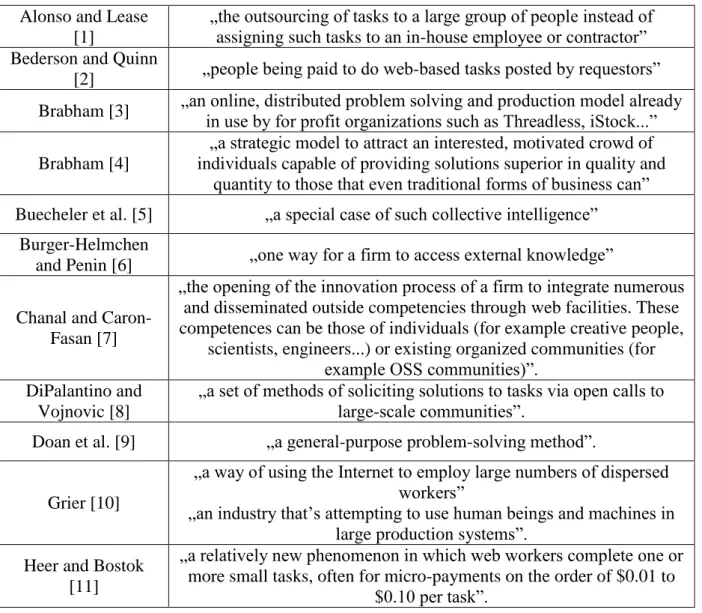
Table 1 contains 40 definitions of crowdsourcing, which come from 32 distinct articles published between 2006 and 2011. Quoted definitions constitute the basis for further analysis.
Table 1. Definition of crowdsourcing in literature. Alonso and Lease
[1]
„the outsourcing of tasks to a large group of people instead of assigning such tasks to an in-house employee or contractor” Bederson and Quinn
[2] „people being paid to do web-based tasks posted by requestors” Brabham [3] „an online, distributed problem solving and production model already
in use by for profit organizations such as Threadless, iStock...” Brabham [4]
„a strategic model to attract an interested, motivated crowd of individuals capable of providing solutions superior in quality and
quantity to those that even traditional forms of business can” Buecheler et al. [5] „a special case of such collective intelligence”
Burger-Helmchen
and Penin [6] „one way for a firm to access external knowledge” Chanal and
Caron-Fasan [7]
„the opening of the innovation process of a firm to integrate numerous and disseminated outside competencies through web facilities. These competences can be those of individuals (for example creative people,
scientists, engineers...) or existing organized communities (for example OSS communities)”.
DiPalantino and Vojnovic [8]
„a set of methods of soliciting solutions to tasks via open calls to large-scale communities”.
Doan et al. [9] „a general-purpose problem-solving method”.
Grier [10]
„a way of using the Internet to employ large numbers of dispersed workers”
„an industry that’s attempting to use human beings and machines in large production systems”.
Heer and Bostok [11]
„a relatively new phenomenon in which web workers complete one or more small tasks, often for micro-payments on the order of $0.01 to
Heymann and Garcia-Molina [12]
„getting one or more remote Internet users to perform work via a marketplace”. Howe [13]
„a web based business pattern, which make best
use of the individuals on the internet, through open call, and finally get innovative solutions”.
Howe [14]
„he application of Open Source principles to fields outside of software”
„the act of a company or institution taking a function once performed by employees and outsourcing it to an undefined (and general large) network of people in the form of an open call. This can take the form
of peer-production (when the job is performed collaborative), but is also often undertaken by sole individual. The crucial prerequisite is the: use of an open call format, and the wide network of potential
laborers”.
„business practice that means literally to outsource an activity to the crowd”.
Howe [15]
„the act of taking a job traditionally performed by a designated agent (usually an employee) and outsourcing it to an undefined, generally
large group of people in the form of an open call” „just a rubric for a wide range of activities”
„the mechanism by which talent and know ledge is matched to those of need it”.
Kazai [16]
„an open call for contributions from members of the crowd to solve a problem or carry out human intelligence tasks, often in exchange for
micro-payments, social recognition, or entertainment value”.
Kleeman et al. [17]
„a form of the integration of users or consumers in internal processes of value creation. The essence of crowdsourcing is the intentional mobilization for commercial exploitation of creative ideas and other
forms of work performed by consumer”. „outsourcing of tasks to the general internet public”.
„a profit oriented form outsources specifics
tasks essential for the making or sale of its product to the general public (the crowd) in the form of an open call over the internet, with
the intention of animating individuals to make a contribution to the firms production process for free or significantly less than that
contribution is worth to the firm”. La Vecchia and
Cisternino [18] „a tool for addressing problems in organizations and business”. Ling [19] „new innovation business model through internet”
Liu&Porter [20]
„the outsourcing of a task or a job, such as a new approach to packaging that extends the life of a product, to a large group of potential innovators and inviting a solution. It is essentially open in
nature and invites collaboration within a community”. Mazzola and
Distefano [21]
„an intentional mobilization, through web 2.0, of creative and innovative ideas or stimuli, to solve a problem, where voluntary users
are included by a firm within the internal problem solving process, not necessarily aimed to increase profit or to create product or market
innovations, but in generally, to solve a specific problem”. Oliveira et al. [22]
„a way of outsourcing to the crowd tasks of intellectual assets creation, often collaboratively, with the aim of having easier access to
a wide variety of skills and experience”. Poetz and Schreier
[23]
„outsource the phase of idea generation to a potentially large and unknown population in the form of an open call”.
Porta et al. [24] „enlisting customers to directly help an enterprise in every aspect of the lifecycle of a product or service”.
Reichwald and Piller [25]
„interactive value creation: in terms of isolated activity of individual as directed toward one unit of the product, involving a cooperation
between firm and users in the development of a new product”. Ribiere&Tuggle [26]
„consists of making an open online call for a creative idea, or problem solving, or evaluation or any other type of business issues, and to let
anyone (in the crowd) submit solutions”.
Sloane [27]
„one particular manifestation of open innovation. It is the act of outsourcing a task to a large group of people outside your organization, often by making a public call for response. It is based on
the open source philosophy, which used a large ‘‘crowd’’ of developers to build the Linux operating system”.
Vukovic [28] „new on-line distributed problem solving and production model in which networked people collaborate to complete a task”. Vukovic et al. [29] „a new online distributed production model in which people
collaborate and may be awarded to complete task”.
Wexler [30] „focal entity’s use of an enthusiastic crowd or loosely bound public to provide solutions to problems”.
Whitla [31]
„a process of outsourcing of activities by a firm to an online community or crowd in the form of an “open call””.
„process of organising labour, where firms parcel out work to some form of (normally online) community, offering payment for anyone
within the ‘crowd’ who completes the tasks the firm has set”. Yang et al. [32] „the use of an Internet-scale community to outsource a task”. Source: own analysis based on relevant literature.
3. RESULTS OF DEFINITIONS’ ANALYSIS
The textual analysis of these definitions emerges the following questions:
Who forms it?
What is the purpose of it?
Why people want to join it?
Who initiates it?
What it is?
What is the type of call used?
What is the medium used?
How long it can works? Who forms it?
The majority of the authors agree in defining crowd as a voluntary [21] undefined [15,23] large group of people [1], interested and motivated [4], which can also be understood as a general public [17].
What is more, crowd can be created by [7,10-15,17,20,22,23,25,31,32]:
individuals (Internet users, web workers, creative people, scientists, engineers, dispersed workers, potential innovators) or
existing organized communities (online community, Internet-scale community) What is the purpose of it?
Crowd is formed for:
doing web-based tasks [2] or
solving problem [3,21,26,28,30] or
finding solution [4,8,9,16] or
doing task [1,11,22,28,29,32] or
looking for external knowledge [6] or competences [7] or
outsourcing some activity to crowd [14, 15] or
creating some ideas [17,23,25,26] or
evaluation [26] or
added value, such as value creation [17] or increased profits [21]. Why people want to join it?
People participate in crowdsourcing because of getting money (micropayments) [2,3, 11,16,17,29,31] or other profits, such as social recognition or entertainment value [16]. On the other hand Kleeman [17] said that the task should be done for free or for less than is worth to the firm.
Who initiates it?
Most authors agree that crowdsourcing is initiated by company [7,10,11,14,15,17,18, 21,24,25,27,31].
What the initiator gets in return?
Crowdsourcing provides the initiator the result for given task [1,11,22,28,29,32] or the resolution of a problem [3,4,8,9,16,21,26,28,30]. It is worth noting that initiator can also get in return knowledge (according to Burger-Helmchen and Penin [6]), competences (according to Chanal and Caron-Fasan [7]), ideas (according to Kleeman [17], Poetz and Schreier [23],
Reichwald and Piller [25] and Ribiere&Tuggle [26]) or added value, such as value creation [17] or increased profits [21].
What it is?
Crowdsourcing is defined as:
outsourcing (process) [1,7,17,20,22,23,27,31,32],
case [5],
method [8, 9, 10],
phenomenon [11],
business pattern (business model) [3,4,13,19,28,29],
application (tool) [14,18],
act [14,15,27].
According to the result of this analysis, the crowdsourcing is process of outsourcing of some activity to crowd or business model in use of company.
What is the type of call used?
In ten definition we can find out information that for proposing tasks to the crowd companies use open (public) call [8,13-17,20,23,26,27,31].
What is the medium used?
All the authors that mention the utilized medium make reference to the Internet, explicitly [3,10,12-14,17,19,28,31], or implicitly, like Bederson and Quinn [2], Chanal and Caron-Fason [7], Heer and Bostok [11], Mazzola and Distefano [21] when they speak of a web.
How long it can works?
None of presented definition resolve this question, but by reference to the creation of the crowd (solution of the problem), we can conclude that crowdsourcing lasts as long as the task does it takes.
4. CONCLUSIONS
The term “crowdsourcing” is in a constant evolution, but due to its increasing importance, it is necessary to agree on a universal concept of serving as base stock for subsequent analysis. Following the analysis of a group of definitions of crowdsourcing exist, it has been shown that in the literature is the lack of consensus and a certain semantic confusion.
From the analysis undertaken and fusing the previous partial elements, a definition that covers any type of crowdsourcing initiative has been created. It discerns whether a given activity is crowdsourcing or not, and formalizes a theoretical base for further studies. The definition is as follows:
„Crowdsourcing is a process of outsourcing of task or problem to solve to group of people who participate in this activity through the Internet for profit (especially money), which last as long as company get the solution”.
There should be noted that this definition does not cover all aspects of crowdsourcing and because this is the synthesis of existing definitions, it can be used in general, not particular cases. However, due to the high complexity of the concept, it is recommended to further research on the issue.
Biography
Marika Świeszczak: a doctoral student on the Faculty of Sociology of University of Lodz and also professor assistant at the Department of Finance in the University of Lodz. Interested in ethics in banking, innovation, gamification and marketing.
Krzysztof Świeszczak: a doctoral student on the Faculty of Sociology of University of Lodz and also professor assistant at the Department of Finance in the University of Lodz. Interested in ethics in banking, banking, entrepreneurship.
References
[1] O. Alonso, M. Lease, Crowdsourcing 101: Putting the WSDM of Crowds to Work for You, [In:] Proceedings of the fourth ACM international conference on Web search and data mining, WSDM ’11, ACM, New York, 2011, p. 1-2.
[2] B. B. Bederson, A. J. Quinn, Web workers Unite! Addressing Challenges of Online Laborers, [In:] Proceedings of the 2011 annual conference extended abstracts on Human Factors in Computing Systems, CHI ’11, Vancouver, 2011, p. 1.
[3] D. C. Brabham, Moving the crowd at iStockphoto: The composition of the crowd and motivations for participation in a crowdsourcing application, „First Monday” no 13(6), 2008, p. 75.
[4] D. C. Brabham, Crowdsourcing as a Model for Problem Solving: An Introduction and Cases, „Convergence: The International Journal of Research into New Media
Technologies” 14(1), 2008, p. 75-90.
[5] T. Buecheler, J. H. Sieg, R. M. Füchslin, R. Pfeifer, Crowdsourcing, Open Innovation and Collective Intelligence in the Scientific Method: A Research Agenda and
Operational Framework, [In:] H. Fellerman et al (eds), Artificial Life XII. Proceedings of the Twelfth International Conference on the Synthesis and Simulation of Living Systems, Odense, Denmark, 19-23 August, 2010, p. 679-686.
[6] T. Burger-Helmchen, J. Penin, The limits of crowdsourcing inventive activities: What do transaction cost theory and the evolutionary theories of the firm teach us?, [In:] Workshop on Open Source Innovation, Strasbourg, France 2010, p. 2.
[7] V. Chanal, M. L. Caron-Fasan, How to invent a new business model based on
crowdsourcing: The crowdspirit ® case, [In:] EURAM, Lubjana, Slovenia, 2008, p. 5. [8] D. DiPalantino, M. Vojnovic M., Crowdsourcing and all-pay auctions, [In:] Proceedings
[9] A. Doan, R. Ramakrishnan, A. Y. Halevy, Crowdsourcing systems on the World-Wide Web, „Communications of the ACM” no 54(4), 2011, p. 86-96.
[10] D. A. Grier, Not for All Markets, „Computer” no 44(5), 2011, p. 6-8.
[11] J. Heer, M. Bostok, Crowdsourcing graphical perception: using mechanical turk to assess visualization design, [In:] Proceedings of the 28th international conference on Human factors in computing systems, CHI’10, ACM, New York, 2010, p. 203-212. [12] P. Heymann, H. Garcia-Molina H., Turkalytics: analytics for human computation, [In:]
Proceedings of the 20th International Conference on World wide web, WWW ’11, ACM, New York, 2011, p. 477-486.
[13] J. Howe, Crowdsourcing: A definition. Crowdsourcing: Why the Power of the Crowd is Driving the Future of Business. Weblog, 2 June, Available at
http://crowdsourcing.typepad.com/cs/2006/06 /crowdsourcing_a.html (accessed 20-4-2016).
[14] J. Howe, The rise of crowdsourcing, „Wired” no14(6), 2006.
[15] J. Howe, Crowdsourcing: How the Power of the Crowd is Driving the Future of Business, Business Books, Great Britain 2008.
[16] G. Kazai, In Search of Qualityin crowdsourcing for Search Engine Evaluation, [In:] Proceedings of the 33rd European Conference on Advances in Information Retrieval (Springer-Verlag, Berlin/Heidelberg, 2011, p. 165-176.
[17] F. Kleeman, G. G. Voss, K. Rieder, Un(der)paid Innovators: The Commercial Utilization of Consumer Work through crowdsourcing, „Science, Technology and Innovation Studies” no 4(1), 2008, p. 5-26.
[18] G. La Vecchia, A. Cisternino, Collaborative workforce, business process crowdsourcing as an alternative of BPO, [In:] Proceedings of First Enterprise crowdsourcing Workshop in conjunction with ICWE 2010, Springer-Verlag, Berlin/Heidelberg, 2010, p. 425-430. [19] P. Ling, An Empirical Study of Social Capital in Participation in Online crowdsourcing,
„Computer” no 7(9), 2010, p. 1-4.
[20] E. Liu, T. Porter, Culture and KM in China, „VINE” no 40(3/4), 2010, p. 326-333. [21] D. Mazzola, A. Distefano, Crowdsourcing and the participacion process for problem
solving: the case of BP, [In:] VII Conference of the Italian Chapter of AIS. Information technology and Innovation trend in Organization, Napoles, Italy, 2010, p. 3.
[22] F. Oliveira, I. Ramos, L. Santos, Definition of a crowdsourcing Innovation Service for the European SMEs, [In:] F. Daniel et al. (eds.), Current Trends in Web Engineering, Springer, Berlin/Heidelberg, 2010, p. 412-416.
[23] M. K. Poetz, M. Schreier, The Value of crowdsourcing: Can Users Really Compete with Professionals in Generating New Product Ideas?, „Journal of Product Innovation Management”, 2009, Forthcoming. Available at http://ssrn.com/abstract=1566903. [24] M. Porta, B. House, L. Buckley, A. Blitz, Value 2.0: eight new rules for creating and
capturing value from innovative technologies, „Strategy & Leadership” no 36(4), 2008, p. 10-18.
[25] R. Reichwald, F. Piller, Interaktive Wertschöpfung. Open Innovation,
Individualisierung und neue Formen der Arbeitsteilung, Gabler, Wiesbaden, 2006, p. 58.
[26] V. M. Ribiere, F. D. Tuggle, Fostering innovation with KM 2.0., „VINE” no 40(1), 2010.
[27] P. Sloane, The brave new world of open innovation, „Strategic Direction” no 27(5), 2011, p. 3-4.
[28] M. Vukovic, Crowdsourcing for enterprises, [In:] Proceedings of the 2009 Congress on Services – I, IEEE Computer Society, Washington, DC, USA 2009, p. 686-692.
[29] M. Vukovic, L. Mariana, J. Laredo, PeopleCloud for the Globally Integrated Enterprise, [In:] D. Asit et al. (eds), Service-Oriented Computing, Springer-Verlag,
Berlin/Heidelberg, 2009, p. 539.
[30] M. N. Wexler, Reconfiguring the sociology of the crowd: exploring crowdsourcing, „International Journal of Sociology and Social Policy” no 31(1), 2011, p. 6 – 20. [31] P. Whitla, Crowdsourcing and Its Application in Marketing, „Contemporary
Management Research” no 5(1), 2009, p. 15-28.
[32] J. Yang, L. A. Adamic, M. S. Ackerman, Crowdsourcing and knowledge sharing: strategic user behaviour on tasks, [In:] Proceedings of the 9th ACM conference on Electronic commerce, ACM, New York, 2008, p. 246-255.