Deloitte TMT COE · Deloitte Insight Series Report · 2013 · Issue 2
MVNO Competition
Deloitte
Technology, Media, Telecom
Center of Excellence
Deloitte Technology, Media, Telecom Center of Excellence
(TOCE) is the first TMT Center of Excellence established in
China by an internationally renowned accounting and
consulting firm. TCOE is also Deloitte's third regional TMT
Center of Excellence following North America and Europe.
TCOE's vision and objectives are: leverage Deloitte's years of
TMT service experiences, act in a global perspective but at a
local basis to set up a think tank and research team. TCOE
consists of strong global industry experts, research consultants
and professional local research groups in China. TCOE will
provide proactive thought leadership to service providers,
upstream and downstream enterprises, industry authorities and
regulators in the China TMT industry
.
Content
I.
Status Quo of the Global MVNO Market
1
II.
Operation Strategy of the MVNO Business
3
III.
Key Success Elements of MVNO
9
Authors
12
Contact Details for Deloitte Greater China Practice
14
1
I Status Quo of the
Global MVNO Market
On May 2013, the Ministry of Industry and Information Technology issued the Notice for the Launch of MVNO Pilot Program in China, which means that private enterprises are allowed to enter into the MVNO business (Mobile Virtual Network Operator, referred to as MVNO hereafter). This notice indicates that in a short time, we will see MVNOs in China's telecom market. The development of the MVNO business is under the backdrop of a
progressive opening-up of China's telecom market and telecom businesses. As the telecom market continues to become increasingly mature, different segments begin to demonstrate different demands. However, because telecom markets in various nations are usually dominated by several monopoly players who can hardly satisfy the various needs of each segment, room is created for MVNOs.
The MVNOs do not establish their own real mobile network; instead, they rent network infrastructure from telecom incumbents to operate telecom businesses such as voice, SMS, and data services. According to the statistics from MIIT, in 2012, the total revenue of China's telecom market reached RMB 1.08 trillion. Taking the average market share for about 3% of the total global market, the future market size of MVNO businesses will be around RMB 30 billion1. MVNO originated from Europe in the 1990s of the last century. An open telecom market in Western European countries provided a sound external environment for the development of the MVNO business. Since 2000, Western European and North American markets led the first wave of MVNO
development, and now those markets have entered into a mature stage looking to create new value. Since 2005, the MVNO business began to catch up in the Asia Pacific region and Asia Pacific started to lead the second wave of MVNO growth. As of May 2013, the total numbers of MVNOs in the world reached 1207, among them, 723 are in Europe, 197 are in Asia Pacific, and 174 are in North America2.
1
Sources:COLEAGO Consulting
2.Sources:Deloitte's Statistics from Prepaid MVNO Website
Analysis of MVNO Competition Strategy 2 Chart 1:2012 Global MVNO number and distribution
Source:Deloitte Statistics from Prepaid MVNO website, May 2013
From the development trend of the MVNO business, the MVNO markets in Western Europe and North America are more mature and account for 7~10% of the market share, while in other countries, market share of the MVNO business is only about 3%.
Chart 2:Global MNVO Market Share
Sources:COLEAGO Consulting
Deloitte estimates that in the next three years, global MVNO growth will mainly occur in emerging countries. The opening of the Chinese MVNO market will further lead Asian Pacific countries to be the growth point of the global MVNO business. However, in terms of market share, the MVNO market in Asia still falls behind that of Western Europe and North America by about 5%.
60% 16% 14% 5% 4% 1% Europe:723 Asia-Pacific:197 North America:174 CIS/EU:61 Middle East:43 Latin America:9
3
II Operation Strategy of
MVNO
Since MVNOs do not have their own networks, they must rent network
infrastructure from telecom operators in order to provide telecom services. This prerequisite determines that the operation strategy will be core to the success of MVNOs; otherwise, they can't get thseir share standing beside telecom incumbents as powerful competitors and business partners.
What are the operation strategies for a MVNO business? Deloitte has picked several classic cases in global MVNO development to make an in-depth analysis.
Analysis of MVNO Competition Strategy 4
Case Study 1: Virgin Group's MVNO services in India
Virgin Group is the largest private company in UK, it has about 200 subsidiaries. Its business scope covers airline, train, soft drink, music, holiday entertainment, automobile, wine, publishing and wedding dresses, etc. At the end of 1999, the company set up Virgin Mobile in partnership with UK's one2one Telecom Company with equal stake. After its entrance into UK's telecom market, it acquired 300,000 clients in less than 7 months. Virgin Group also cooperated with mobile internet operators in Australia, Singapore, North America, South Africa, and India, and has become a successful example in the MVNO business.
The targeted group of Virgin is young people between 15 to 30 years old. For them, the Virgin brand represents fashionable, dynamic, and
comprehensive services. In India, people under-25-years-old account for about 50% of the total population. Thanks to the conjunction in targeted group, India is the best targeted market for Virgin to promote its products in all categories.
Since Indian laws forbid direct foreign investment in the MVNO business, in 2008, Virgin Group set up Virgin Mobile India Ltd. Company in partnership with Tata Teleservices, the second largest CDMA operator in India, by signing a franchise agreement, with each of the two parties holding 50% of the stake. The newly-found company launched the Virgin Mobile brand in March 2008, which was positioned as "the first mobile service in India specially targeted at a younger generation" and offered the most favourable prepaid service plan in India. A year after its launch, Virgin Mobile enjoyed a brand awareness rate close to 90% in its targeted customers. President of Virgin pointed out "as a virtual mobile company, we purchase voice minutes from traditional network operators and then provide telecom services under the Virgin brand. Unlike other telecom operators, who use most of their investment to build network infrastructure, we use all of our investment to provide services to our customers. "
By leveraging the content and brand advantages of its parent company, Virgin Mobile easily found a way to differentiate its servicefrom other
5
Virgin Mobile fully leveraged the advantage of Virgin brand, enhanced in-depth cooperation with other sub-brands under the Virgin Group, and used the resources of the mature master brand to provide characterized services to its own customers. Virgin Mobile's cell phone integrates all kinds of services by Virgin Group and achieved great synergy and mutual-promotion of multiple businesses under the Virgin brand.
At the same time, cross-selling of various businesses increased customer loyalty, and the joined forces of various sub-brands also became important merits to attract new customers.
normal telecom services. The service philosophy highlighted by Virgin Mobile is "it is more than a mobile phone". Virgin Mobile worked closely with the airline, travel, and music companies of the Virgin Group to conduct bundling sales and provide diversified services with favorable prices to young customers. Once you become a Virgin Mobile customer, you enjoy multiple services including shopping, travelling, ticket and hotel booking services via your cellphone. Virgin Mobile customers also enjoy a 10% discount when purchasing travel products offered by Virgin Group, and can also use their mobile phone to purchase or rent video tapes and DVDs from Virgin Music's retail shops. So in a certain sense, Virgin Mobile is more than a communication tool, it is a terminal integrating all kinds of offerings by Virgin Group.
Moreover, Virgin Mobile carries on the same unique taste of Virgin Group in their sales and marketing approach. For example, it designed a Get Paid for Incoming Plan to give customers point rewards for incoming calls. So for customers, receiving calls could also mean "making money". Virgin Mobile also organized an online campaign to encourage customers to attend a voting program for TV adverts on Virgin Mobile. As a result, about 18 million people attended this program, which accounts for 50% of total internet users in India.
Virgin Mobile's highly-segmented branding strategy and differentiated marketing strategy successfully attracts many young customers.
Approximately 70% of young people gave up services by other operators and shifted to Virgin Mobile.
Analysis of MVNO Competition Strategy 6 Although ESPN had rich resources in providing sports content and focused on a specific customer group with shining characteristics, the services it provided to its clients from game scores to video roundups were not attractive enough for users to pay extra fees. ESPN's pricing strategy and marketing strategy in this early stage of its market entry didn't provide enough motivation for potential customers to switch mobile network operators, and eventually led to its unsuccessful move into the MVNO market.
Case Study 2: Failed Move by ESPN into the MVNO Business
At the end of 2005, ESPN entered into the MVNO market with the launch of its own mobile phone service brand--ESPN mobile, by renting American telecom operator Sprint Nextel's network. ESPN's market positioning is to leverage its advantage in sports content to provide sports news, real time score, best roundups and game videos to its users. Users would be kept up to date with the latest sports news, and ESPM would lock up these targeted customers in its segmented market. In November 2005, ESPN began to sell ESPN mobile phones in cooperation with the electronic product retailer Best Buy, and at the same time, expanded its market through telemarketing and online marketing.However, seven months later, after spending about $150 million on ESPN mobile, it only acquired 30,000 users, far less than the break-even point of at least 500,000 users. As a result, in December 2006, MVNO Mobile ESPN had to announce the closing of its business.
The key attribute of ESPN's unsuccessful move lies in the failure of its marketing strategy in acquiring new customers and the high charge for its exclusive content service. If a user wanted ESPN's mobile service, he/she would have to spend $199 to buy a mobile phone, and then spend an extra $35 to $225 per month for the content. This unreasonably high price scared away many potential customers. According to a report by the market research firm Brandimensions, 60% of the 1900 interviewees gave up subscribing for ESPN's service for the aforementioned reasons.
Furthermore, ESPN didn't spend enough money on traditional channels and its online marketing campaign was nothing new. All these factors combined were the reasons for ESPN's failure in acquiring enough subscribers in a short time in order to achieve break-even point. This ultimately led to ESPN leaving the MNVO business.
7
Besides leveraging advantages in branding or distribution channels to enter into the MVNO market, other companies focused on a specific segment in order to achieve precision pricing and differentiated services.
For example, the new-immigrant-focused Lebara Mobile company was established by three Sri Lanka immigrants in the UK. The company hired Vodafone's network in many European countries to provide telephone services to minority group customers including immigrants, expatriates, overseas student, etc., who often need to make international calls. Because of a clearly-defined targeted group and explicit promotional approach, Lebara enjoyed a very high loyalty among minority group customers.
Some fixed network operators in the telecom industry do not build up their own mobile network, but they can leverage their years of operation experience in the telecom industry as well as their existing customer base, to provide quadruple play service with a favorable price by renting mobile network from other operators and bind customer resources. The classic cases are ONO and TELE2.
Tele 2 and ONO have advantages in the MVNO business because as telecom operators themselves, they have their own telecom infrastructure and
customer base. After the opening of the MVNO market, they provided
quadruple play services to bind customer resources. At the same time, with the rich operation experience accumulated over years, they can also minimize expenditures, such as the MVNO service fee and operation cost, etc. In comparison with other enterprises aiming to enter the MVNO business, Tele2 and ONO both have an obvious natural advantage.
Case Study 3: ONO realize quadruple play with the help of MVNO
ONO, a Spanish broadband communication company, was founded in 1998, which provided telephone, television and network services to household customers. Based on its existing infrastructure, ONO launched new generation of cable infrastructure, allowing its customers to enjoy 3-in-1 service of television, telephone and internet. By the end of 2002, about one third of ONO customers used this 3-in-1 service. In February 2006, when Spain opened its MVNO market in cooperation with Telefonica, ONO became the fourth operator in Spain to provide quadruple play service integrating fixed-in telephone, mobile phone, internet and television.Analysis of MVNO Competition Strategy 8 Deloitte based its analysis on international MVNO practice, and classified MVNO operation models into 4 categories (see chart 3)
Chart 3:Four Typical Marketing Strategies of MVNOs
9
III Key Success Elements
of MVNO
Deloitte believes there are three key elements to success in the MVNO business:
Firstly, the company must have resource advantage. When we look back at MVNO development in the world, successful MVNO companies usually have at least one of the following resource advantages:
1. A sound distribution channel:In the international market, there are
successful MVNO examples like Tesco Mobile in the UK and Ireland, Carrefour in Europe and Taiwan, Wal-Mart in the US, etc. In analyzing the key to their success, it was clear that these retailers have sound distribution channels, and as a result, when they expand to new customers, they can minimize the marketing and service cost. For MVNO businesses, acquisition of initial customers is the most difficult step in the market campaign; professional retailers can easily solve this problem.
2. A Strong Brand:Some brands are very powerful in that they strongly
attract customers in their specific targeted group, such as Virgin and Disney Group. These brands can leverage their own advantages to attract new customers in the targeted group at a comparatively lower cost, and at the same time, use the brand's unique marketing approach to realize bundling sales with other products under the same brand to improve customer loyalty.
3. Operator's Own Resources:When entering into a new market, for the
purpose of cost-saving and avoiding certain policy restrictions, some telecom operators can open a MVNO business by hiring mobile network from local operators. Thanks to their rich experience in telecom
operation and the fixed customer base in broadband or television services, they have prominent advantages when exploring the new MVNO market.
What is worth mentioning is that in January 2013, China Telecom reached a cooperation agreement with the British mobile network operator Everything Everywhere (referred to as EE hereinafter). In the
Analysis of MVNO Competition Strategy 10 future, China Telecom can carry out marketing campaigns in the UK under its own brand by EE's MVNA subsidiary Transatel.
4. Content Advantage:Having multiple resources, businesses can
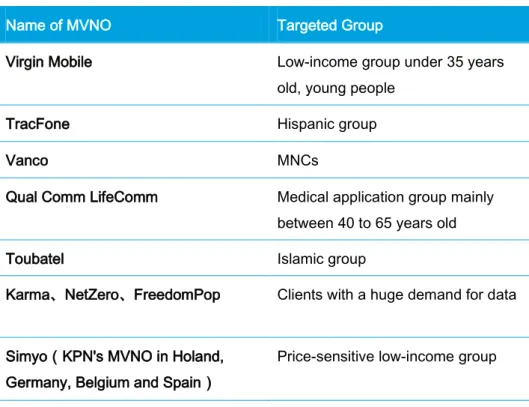
conduct bundling sales between mobile services and content services through MVNOs. This was the case for Universal and ESPN. Universal Music Mobile France is the MVNO operation setup by Universal Group. It offers free music downloads in its mobile service package and effectively binds its content resource with MVNO services to improve loyalty of existing customers and to expand its market share of MVNOs. Secondly, MNVOs need to have a clear positioning of its marketing strategy, to differentiate its services from those provided by telecom operators.
If we look at the targeted groups of MVNOs, they cover almost all customer groups with unique features. (see table 1)
Table 1:Summary of MVNO segments in the world
Name of MVNO Targeted Group
Virgin Mobile Low-income group under 35 years
old, young people
TracFone Hispanic group
Vanco MNCs
Qual Comm LifeComm Medical application group mainly
between 40 to 65 years old
Toubatel Islamic group
Karma、NetZero、FreedomPop Clients with a huge demand for data
Simyo(KPN's MVNO in Holand, Germany, Belgium and Spain)
11
MVNO practice has proved that in order to survive, players in the MVNO market need to deeply explore specific demand of targeted customer groups, highly integrate telecom services with its own business, provide an innovative product portfolio and try to avoid direct price war with telecom operators. Thirdly, MNVOs need to attract a large amount of initial customers in a short time. If a MNVO can't rapidly expand its market in the early stage of its market entry, it is very difficult to make any big breakthrough in the future.
In general, in comparison with mobile network operators, the fixed cost of MVNO is relatively small. The fixed cost only accounts for about 25% of a MVNO's total cost, while that for a real network operator is about 75%. Moreover, in the international MVNO market, MVNO players have covered almost all the industries from retailing, entertainment, manufacturing to telecommunications, etc.
If we look at the development of the MVNO business in Europe and North America, the starting stage of a MVNO business is usually about 5 year. Once the MVNO market is open, new players will emerge in large scale; then, only the fittest can survive after the peak stage, mainly those MVNOs with
competitive advantages. From this perspective, the development of MVNO is very familiar to that of internet companies in the sense that there will be only one winner in each market segment.
So, for normal customers, joining MVNO services means they have to change their mobile number or switch to other operators. At the early stage of market entry, if a MVNO can't give potential customers enough reasons to give up their current mobile service operator and provide enough subsidy to compensate for the switching cost, they will lost attractiveness to potential customers. In the future, if a MVNO can't attract enough customers in a short time to lower operation cost, it will definitely be eliminated by the market.
Analysis of MVNO Competition Strategy 12
Authors
William Chou
Deloitte China TMT Industry Managing Partner Deloitte China VC Program Leader
Venture Capital Association of IAC Vice Chairman Email: [email protected]
William Chou is the Managing Partner of Deloitte China TMT Industry, Education Industry and Deloitte China VC Program. He also serves as a mentor for the 7th AAMA Cradle Program.
William has more than 25 years of accounting, audit and consultancy experience. He is the leader of a cross-functional team which focuses on the market demands from industrial shifts. In addition, he is in charge of the research of Deloitte China's operational strategy and the industry, as well as to provide professional services to clients. He participates in the business of Deloitte Global, having a seat in Deloitte Global TMT Execution Committee. He is also a member of Deloitte China Board of Directors.
Meng Zhaoli
Head of Deloitte China TMT Center of Excellence Email: [email protected]
Dr. Meng Zhaoli graduated from the National University of Singapore and is the Head of Deloitte China TMT Center of Excellence. She has more than ten years of research experience in areas as Internet economy, electronic industry, new energy industry and corporate management. In recent years, she published dozens of research outputs on China Daily, Interfax, Hubei Daily, PKU Business Review and CEIBS Businese
Review, etc. She is a co-author of Managerial Economics, which was selected by
many reputed colleges as a MBA textbook. In addition, she is lecturing MBA courses in several universities, such as Shanghai International Studies University and Central University of Finance and Economics, etc. Before she joined Deloitte, Dr. Meng Zhaoli served as the Director of Research of the Accenture Center of Excellence in Greater China Region, the Lead Researcher of Samsung Economic Research Institute and the Assistant Professor in Renmin University of China.
13
Experts Team
Po Hou
Partner at Deloitte Consulting
Deloitte China Management Consulting Leader Email:[email protected]
Mr. Hou Po is a partner at Monitor Deloitte, leading consulting practices in
technology, media and telecom industry. In his 15 years career in management consulting, Mr. Hou Po has served clients including telecom operators, media production, advertising, telecommunication manufacturers, software and internet companies, covering a wide range of scopes including growth strategy, M&A, operation control, and organization structure, etc. Before joining Deloitte, Mr. Hou Po worked at McKinsey and Oliver Wyman.
Jack Gau
Partner at Monitor Deloitte based in Beijing
Email:[email protected]
Dr. Gau is a Partner at Monitor Deloitte based in Beijing. Jack helps clients to fundamentally improve their strategy, business processes, innovation, and leadership and organization in North America, Europe, and Asia. Jack has experience in a variety of industries, including telecom, electronics, high tech, automotive, industrial products, chemicals and private equity, etc. Jack has a Ph.D. from Harvard University and an MBA from Wharton School. Before joining Deloitte, Jack used to worked at McKinsey (US) and Accenture (China).
Analysis of MVNO Competition Strategy 14
Deloitte China Offices
Beijing
Deloitte Touche Tohmatsu CPA LLP Beijing Branch
8/F Deloitte Towe,The Towers, Oriental Plaza
No.1 East Chang An Avenue
Beijing,China Postal Code: 100738
Tel: + 86 (10) 8520 7788 Fax: + 86 (10) 8518 1218
Chongqing
Deloitte Advisory Services (Chongqing) Company Limited
Room 10-12, 13/F Chongqing Int`l Trade Center No.38 Qing Nian Road, YuZhong District Chongqing, China Postal Code: 400010 Tel: +86 (23) 6310 6206 Fax: +86 (23) 6310 6170 Dalian
Deloitte Touche Tohmatsu CPA LLP Dalian Branch
Room 1503 Senmao Building
No.147 Zhongshan Road, Dalian, China Postal Code: 116011
Tel: + 86 (411) 8371 2888 Fax: + 86 (411) 8360 3297
Guangzhou
Deloitte Touche Tohmatsu CPA LLP Guangzhou Branch
26/F TEEM Tower
No.208 Tianhe Road, Guangzhou, China Postal Code: 510620
Tel: + 86 (20) 8396 9228 Fax: + 86 (20) 3888 0119 / 0121
Hangzhou
Deloitte Business Advisory Services (Hangzhou) Company Limited
Suite 605, International A Area, EAC No.18 Jiaogong Road,
Hangzhou, China Postal Code: 310013 Tel: + 86 (571) 2811 1900 Fax: + 86 (571) 2811 1904
Harbin
Deloitte Management Advisory (Shanghai) Limited
Harbin Branch
Suit 1618, Development Zone Management Building
No.368 Changjiang Road, Nangang District
Harbin, China Postal Code: 150090
Tel: +86 (451) 85860060 Fax: +86 (451) 85860056
Hong Kong
Deloitte Touche Tohmatsu 35/F One Pacific Place 88 Queensway, Hong Kong Tel: + (852) 2852 1600 Fax: + (852) 2541 1911
Jinan
Deloitte Advisory (Shanghai) Company Limited, Jinan Liaison Office
Unit 1018, 10/F, Tower A, Jinan Citic Plaza No.150 Luo Yuan Street, Jinan China Postal Code: 250011
Tel: +86 (531) 8518 1058 Fax: +86 (531) 8518 1068
Macau
Deloitte Touche Tohmatsu
19/F The Macau Square Apartment H-N
43-53A Av. do Infante D. Henrique Macau
Tel: + (853) 2871 2998 Fax: + (853) 2871 3033
Nanjing
Deloitte Touche Tohmatsu CPA LLP Nanjing Branch
11/F Golden Eagle Plaza
No.89 Hanzhong Road, Nanjing, China Postal Code: 210029
Tel: + 86 (25) 5790 8880 Fax: + 86 (25) 8691 8776
Shanghai
Deloitte Touche Tohmatsu CPA LLP 30/F Bund Center
No.222 East Yan An Road
Shanghai, China Postal Code: 200002
Tel: + 86 (21) 6141 8888 Fax: + 86 (21) 6335 0003
Shenzhen
Deloitte Touche Tohmatsu CPA LLP Shenzhen Branch
13/F China Resources Building No.5001 East Shennan Road
Shenzhen, China Postal Code: 518010
Tel: + 86 (755) 8246 3255 Fax: + 86 (755) 8246 3186
Suzhou
Deloitte Business Advisory Services (Shanghai) Limited
Suzhou Branch
23/F, Building 1, Global Wealth Square No.88 Suhui Road, Industrial Park
Suzhou, China Postal Code: 215021 Tel: + 86 (512) 6289 1238
Fax: + 86 (512) 6762 3338 / 6762 3318
Tianjin
Deloitte Touche Tohmatsu CPA LLP Tianjin Branch
30/F, Office Building, The Exchange No.189 Nanjing Road, Heping District
Tianjin, China Postal Code: 300051
Tel: + 86 (22) 2320 6688 Fax: + 86 (22) 2320 6699
Wuhan
Deloitte Advisory (Shanghai) Company Limited
Wuhan Liaison Office
Unit 2, 38/F New World International Trade Tower
No.568 Jianshe Avenue, Wuhan, China Postal Code: 430022
Tel: +86 (27) 8526 6618 Fax: +86 (27) 8526 7032
Xiamen
Deloitte Advisory (Shanghai) Company Limited
Xiamen Liaison Office
Unit E, 26/F International Bank Tower No.8 Lujiang Road, Siming District
Xiamen, China Postal Code: 361001
Tel: +86 (592) 2107 298 Fax: +86 (592) 2107 259
Deloitte refers to one or more of Deloitte Touche Tohmatsu Limited, a UK private company limited by guarantee, and its network of member firms, each of which is a legally separate and independent entity. Please see www.deloitte.com/cn/en/about for a detailed description of the legal structure of Deloitte Touche Tohmatsu Limited and its member firms.
About Deloitte Global
Deloitte provides audit, tax, consulting, and financial advisory services to public and private clients spanning multiple industries. With a globally connected network of member firms in more than 150 countries, Deloitte brings world-class capabilities and high-quality service to clients, delivering the insights they need to address their most complex business challenges. More than 200,000 Deloitte professionals are committed to becoming the standard of excellence.
About Deloitte in Greater China
We are one of the leading professional services providers with 21 offices in Beijing, Hong Kong, Shanghai, Taipei, Chongqing, Dalian, Guangzhou, Hangzhou, Harbin, Hsinchu, Jinan, Kaohsiung, Macau, Nanjing, Shenzhen, Suzhou, Taichung, Tainan, Tianjin, Wuhan and Xiamen in Greater China. We have nearly 13,500 people working on a collaborative basis to serve clients, subject to local applicable laws. About Deloitte China
In the Chinese Mainland, Hong Kong and Macau, services are provided by Deloitte Touche Tohmatsu, its affiliates, including Deloitte Touche Tohmatsu Certified Public Accountants LLP, and their respective subsidiaries and affiliates. Deloitte Touche Tohmatsu is a member firm of Deloitte Touche Tohmatsu Limited (DTTL).
As early as 1917, we opened an office in Shanghai. Backed by our global network, we deliver a full range of audit, tax, consulting and financial advisory services to national, multinational and growth enterprise clients in China.
We have considerable experience in China and have been a significant contributor to the development of China's accounting standards, taxation system and local professional accountants. We provide services to around one-third of all companies listed on the Stock Exchange of Hong Kong.
This publication contains general information only, and none of Deloitte Touche Tohmatsu Limited, its member firms, or their related entities (collectively the “Deloitte Network”) is by means of this publication, rendering professional advice or services. Before making any decision or taking any action that may affect your finances or your business, you should consult a qualified professional adviser. No entity in the Deloitte Network shall be responsible for any loss whatsoever sustained by any person who relies on this publication.