Robust Kronecker-Decomposable Component Analysis for Low-Rank Modeling
Mehdi Bahri
1Yannis Panagakis
1,2Stefanos Zafeiriou
1,31
Imperial College London, UK
2Middlesex University London, UK
3University of Oulu, Finland
[email protected], {i.panagakis, s.zafeiriou}@imperial.ac.ukAbstract
Dictionary learning and component analysis are part of one of the most well-studied and active research fields, at the intersection of signal and image processing, com-puter vision, and statistical machine learning. In dictionary learning, the current methods of choice are arguably K-SVD and its variants, which learn a dictionary (i.e., a decompo-sition) for sparse coding via Singular Value Decomposition. In robust component analysis, leading methods derive from Principal Component Pursuit (PCP), which recovers a low-rank matrix from sparse corruptions of unknown magnitude and support. However, K-SVD is sensitive to the presence of noise and outliers in the training set. Additionally, PCP does not provide a dictionary that respects the structure of the data (e.g., images), and requires expensive SVD com-putations when solved by convex relaxation. In this paper, we introduce a new robust decomposition of images by com-bining ideas from sparse dictionary learning and PCP. We propose a novel Kronecker-decomposable component anal-ysis which is robust to gross corruption, can be used for low-rank modeling, and leverages separability to solve sig-nificantly smaller problems. We design an efficient learning algorithm by drawing links with a restricted form of tensor factorization. The effectiveness of the proposed approach is demonstrated on real-world applications, namely back-ground subtraction and image denoising, by performing a thorough comparison with the current state of the art.
1. Introduction
Sparse dictionary learning [40,45,34] and Robust Prin-cipal Component Analysis (RPCA) [6] are two popular methods of learning representations that assume different structure and answer different needs, but both are special cases of structured matrix factorization. Assuming a set of
Ndata samplesx1, . . . ,xnrepresented as the columns of a matrixX, we seek a decomposition ofXinto meaningful components of a given structure, in the generic form:
min
Z l(X,Z) +g(Z) (1)
Where l(·)is a loss function, generally the ℓ2 error, and
g(·)a possibly non-smooth regularizer that encourages the desired structure, often in the form of specific sparsity re-quirements.
WhenZ is taken to be factorized in the formDR, we obtain a range of different models depending on the choice of the regularization. Imposing sparsity on the dictionary
Dleads to sparse PCA, while sparsity only in the codeR
yields sparse dictionary learning. The current methods of choice for sparse dictionary learning are K-SVD [1] and its variants [32], which seek an overcomplete dictionaryDand a sparse representationR= [r1, . . . ,rn]by minimizing the following constrained objective:
min
R,D||X−DR|| 2
F, s.t.||ri||0≤T0, (2)
where||.||Fis the Frobenius norm and||.||0is theℓ0
pseudo-norm, counting the number of non-zero elements. Problem (2) is solved in an iterative manner that alternates between sparse coding of the data samples on the current dictionary, and a process of updating the dictionary atoms to better fit the data using the Singular Value Decomposition (SVD). When used to reconstruct images, K-SVD is trained on overlapping image patches to allow for overcompleteness [14]. Problems of this form suffer from a high computa-tional burden that limits their applicability to small patches that only capture local information, and prevent them from scaling to larger images.
The recent developments in robust component analysis are attributed to the advancements in compressive sensing [7,13, 8]. In this area, the emblematic model is Robust Principal Component Analysis, proposed in [6]. RPCA as-sumes that the observation matrixXis the sum of a low-rank componentA, and of a sparse matrixEthat collects the gross errors, or outliers. Finding the minimal rank solu-tion forAand the sparsest solution forEis combinatorial and NP-hard. Therefore, RPCA is obtained by solving the Principal Component Pursuit (PCP) in which the discrete rank andℓ0-norm functions are approximated by their
con-vex envelopes as follows:
min
where ||.||∗ is the nuclear norm and ||.||1 is the standard
ℓ1 norm. Like sparse dictionary learning, Robust PCA is
a special case of (1). The nuclear-norm relaxation is con-vex but the cost of performing SVDs on the full-size ma-trix A is high. Factorization-based formulations exploit the fact that a rank-rmatrix A ∈ Rm×n can be decom-posed inA = UVT,U ∈ Rm×r,V ∈ Rn×r, to impose low-rankness. These formulations are non-convex and algo-rithms may get stuck in local optima or saddle points. We refer to [28] for recent developments on the convergence of non-convex matrix factorizations, [44,36,50,47] for low-rank problems, and [16] specifically for matrix completion.
1.1. Separable dictionaries
Analytical separable dictionaries have been proposed as generalizations of 1-dimensional transforms in the form,
e.g., of tensor-product wavelets, and have since fallen out of flavour for models that drop orthogonality in favour of over-completeness to achieve geometric invariance [40]. How-ever, recent work in the compressed sensing literature has shown a regain of interest for separable dictionaries for very high-dimensional signals where scalability is a hard-requirement. Notably, high-resolution spatial angular rep-resentations of diffusion-MRI signals, such as in HARDI (High Angular Resolution Diffusion Imaging), represent each voxel by a 3D signal, yielding prohibitive sampling times. Traditional compressed sensing techniques can only handle signal sparsity bounded below by the number of vox-els (1 atom per voxel) and still cannot meet the needs of medical imaging, but Kronecker extensions [42,41] of Or-thogonal Matching Pursuit (OMP) [37,11], Dual ADMM [5], and FISTA [4] allow sparser signals.
The recent Separable Dictionary Learning (SeDiL) [23] considers a dictionary that factorizes into the Kronecker product of two smaller dictionariesA andB, and matrix observationsX = (Xi)i. The observations have sparse rep-resentationsR= (Ri)iin the basesA,B, and the learning problem is recast as:
min A,B,R 1 2 X i ||Xi−ARiBT||2F+λg(R)+κr(A)+κr(B) (4) Where the regularizersgandrpromote, respectively, spar-sity in the representations, and low mutual-coherence of the dictionaryD=B⊗A. Here,Dis constrained to have or-thogonal columns,i.e., the pairA,Bshall lie on the prod-uct manifold of two prodprod-uct of sphere manifolds. A differ-ent approach is taken in [25]. A separable 2D dictionary is learnt in a two-step strategy similar to that of K-SVD. Each matrix observationXi is represented asARiBT. In the first step, the sparse representationsRiare found by 2D OMP. In the second step, a CP decomposition is performed on a tensor of residuals via Regularized Alternating Least
Squares to solveminA,B,R||X −R×1A×2B||F1.
1.2. Contributions
In this paper, we propose a novel method for separable dictionary learning based on a robust tensor factorization that learns simultaneously the dictionary and the sparse rep-resentations. We extend the previous approaches by intro-ducing an additional level of structure to make the model robust to outliers. We do not seek overcompleteness, but rather promote sparsity in the dictionary to learn a low-rank representation of the input tensor. In this regard, our method combines ideas from both Sparse Dictionary Learn-ing and Robust PCA. We propose a non-convex paralleliz-able ADMM algorithm and provide experimental evidence of its effectiveness. Finally, we compare the performance of our method against several tensor and matrix factoriza-tion algorithms on computer vision benchmarks, and show our model systematically matches or outperforms the state of the art. We make the code available online2along with supplementary material.
Notations Throughout the paper, matrices (vectors) are denoted by uppercase (lowercase) boldface letterse.g., X, (x). I denotes the identity matrix of compatible dimen-sions. The ith column of X is denoted as xi. Tensors are considered as the multidimensional equivalent of matri-ces (second-order tensors), and vectors (first-order tensors), and denoted by bold calligraphic letters, e.g., X. The or-derof a tensor is the number of indices needed to address its elements. Consequently, each element of anMth-order tensorX is addressed byM indices,i.e.,(X)i1,i2,...,iM
.
=
xi1,i2,...,iM.
The sets of real and integer numbers are denoted byR andZ, respectively. AnMth-order real-valued tensorX is defined over the tensor spaceRI1×I2×···×IM
, whereIm∈Z form= 1,2, . . . , M.
The mode-nproduct of a tensor X ∈ RI1×I2×...×IM with a matrixU∈RJ×In, denoted byX ×
nU, is defined element-wise as (X ×mx)i1,...,in−1,in+1,...,iM = In X in=1 xi1,i2,...,iMxin. (5) The Kronecker product of matrices A ∈ RI×K, and
B ∈ RL×M, is denoted by A⊗B, and yields a matrix of dimensionsI·L×K·M.
Finally, we define the tensorTucker rankas the vector of the ranks of its mode-nunfoldings (i.e., its mode-nranks), and the tensormulti-rank[48,31] as the vector of the ranks of its frontal slices. More details about tensors, such as the definitions of tensor slices and mode-nunfoldings, can be found in [26] for example.
1c.f. notations for the product×n 2https://github.com/mbahri/KDRSDL
2. Model and updates
We first formulate our structured factorization, and de-scribe a tailored optimization procedure.
2.1. Robustness and structure
Consider the following Sparse Dictionary Learning problem with Frobenius-norm regularization on the dictio-naryD, where we decomposeN observationsxi ∈ Rmn onD∈Rmn×r1r2 with representationsr i∈Rr1r2: min D,R X i ||xi−Dri||22+λ X i ||ri||1+||D||F (6)
We assume a Kronecker-decomposable dictionary D =
B⊗AwithA∈Rm×r1,B∈Rn×r2. To model the
pres-ence of outliers, we introduce a set of vectorsei ∈ Rmn and, with d = r1r2 +mn, define the block vectors and
matrices: yi = ri ei ∈Rd C= B⊗A I ∈Rmn×d (7) We obtain a two-level structured dictionaryCand the as-sociated sparse encodingsyi. Breaking-down the variables to reduce dimensionality and discarding the constant||I||F:
min A,B,R,E X i ||xi−(B⊗A)ri−ei||22 +λX i ||ri||1+λ X i ||ei||1+||B⊗A||F (8)
Suppose now that the observationsxiwere obtained by vec-torizing two-dimensional data such as images, i.e., xi =
vec(Xi),Xi ∈Rm×n. We find preferable to keep the ob-servations in matrix form as this preserves the spatial struc-ture of the images, and - as we will see - allows us solve ma-trix equations efficiently instead of high-dimensional linear systems. Without loss of generality, we chooser1=r2=r
andri= vec(Ri),Ri∈Rr×r, and recast the problem as:
min A,B,R,E X i ||Xi−ARiBT−Ei||2F +λX i ||Ri||1+λ X i ||Ei||1+||B⊗A||F (9)
Equivalently, enforcing the equality constraints and writing the problem explicitly as a structured tensor factorization:
minA,B,R,E λ||R||1+λ||E||1+||B⊗A||F s.t X =R×1A×2B+E (10)
Where the matricesXi,Ri, andEiare concatenated as the frontal slices of 3-way tensors. Figure1illustrates the de-composition.
We imposer≤min(m, n)as a natural upper bound on the rank of the frontal slices ofL=R×1A×2B, and on
its mode-1and mode-2ranks.
=
×
1×
2+
Figure 1: Illustration of the decomposition.
2.2. An efficient algorithm
Problem (10) is not jointly convex, but is convex in each component individually. We resort to an alternating-direction method and propose a non-convex ADMM proce-dure that operates on the frontal slices.
Minimizing||B⊗A||Fpresents a challenge: the
prod-uct is high-dimensional, the two bases are coupled, and the loss is non-smooth. Using the identity ||A⊗B||p =
||A||p||B||pwhere||.||pdenotes the Schatten-pnorm (this follows from the compatibility of the Kronecker product with the singular value decomposition), and remarking that
||B||F||A||F ≤
||A||2 F+||B||
2 F
2 , we minimize a simpler
up-per bound (||ABT||
∗[39]). The resulting sub-problems are smaller, and therefore more scalable. In order to obtain ex-act proximal steps for the encodingsRi, we introduce a split variableKisuch that∀i, Ki=Ri. Thus, we solve:
min A,B,R,KE λ||R||1+λ||E||1+ 1 2(||A|| 2 F+||B|| 2 F) s.t X =K×1A×2B+E s.t R=K (11) Introducing the tensors of Lagrange multipliersΛ and Y, such that theithfrontal slice corresponds to theith con-straint, and the dual step sizesµandµK, we formulate the Augmented Lagrangian of problem (11):
minλX i ||Ri||1+λ X i ||Ei||1+ 1 2(||A|| 2 F+||B|| 2 F)+ X i hΛi,Xi−AKiBT−Eii+ X i hYi,Ri−Kii+ µ 2 X i ||Xi−AKiBT−Ei||2F+ µK 2 X i ||Ri−Ki||2F (12) We can now derive the ADMM updates. EachEi is given by shrinkage after rescaling:
Ei=Sλ/µ(Xi−AKiBT+ 1
µΛi) (13)
A similar rule is immediate to derive forRi, and solving for
AandBis straightforward with some matrix algebra. We therefore focus on the computation of the split variableKi.
1e-3 1e-2 1e-1 1e-7 1e-6 1e-5 1e-5 1e-3 1e-2 1e-1 1
Rel. Err. - L (60% noise)
KDRSDL
1e-3 1e-2 1e-1 0.6 0.7 0.8 0.9 1 Density - E (60% noise) KDRSDL
Figure 2: Recovery performance with 60% corruption. Rel-ativeℓ2error and density.
Differentiating, we findKisatisfies:
µKKi+µATAKiBTB (14)
=AT(Λi+µ(Xi−Ei))B+µKRi+Yi The key for an efficient algorithm is here to recognize equa-tion (14) is a Steinequation, and can be solved in cubical time and quadratic space inr by solvers for discrete-time Sylvester equations - such as the Hessenberg-Schur method [19] - instead of the naiveO(r6)
time,O(r4)
space solution of vectorizing the equation in anr2
linear system.
In practice, we solve a slightly different problem with
αP
i||Ri||1+λPi||Ei||1. This introduces an additional
degree of freedom and corresponds to rescaling the coef-ficients ofRi. We found the modified problem to be nu-merically more stable and to allow for tuning of the relative importance of||R||1and||E||1. We obtain Algorithm1.
3. Discussion
We show experimentally that our algorithm successfully recovers the components of the decomposition (10), we then prove the formulation encourages two different notions of low-rankness on tensors, and finally discuss the issues of non-convexity and convergence.
3.1. Validation on synthetic data
We generated synthetic data following the model’s as-sumptions by first sampling two random basesAandBof known ranks rA andrB, N Gaussian slices for the core
R, and forming the ground truth L = R×1A×2 B.
We modeled additive random sparse Laplacian noise with a tensorE whose entries are0with probabilityp, and1or
−1with equal probability otherwise. We generated data for
p = 70%andp = 40%, leading to a noise density of, re-spectively,30%and60%. We measured the reconstruction error onL,E, and the density ofEfor varying values ofλ, andα= 1e−2. Our model achieved near-exact recovery of bothLandE, and exact recovery of the density ofE, for suitable values ofλ. Experimental evidence is presented in Figure2for the60%noise case.
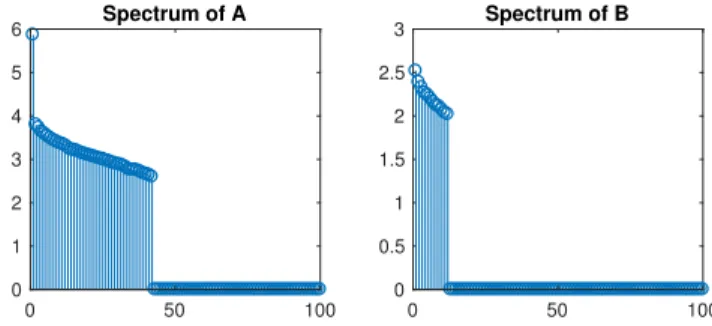
0 1 2 3 4 5 6 Spectrum of A 0 50 100 0 0.5 1 1.5 2 2.5 3 Spectrum of B 0 50 100
Figure 3: Sample spectrums ofAandB, the ground truth is 42 forAand 12 forB, and is attained.r= 100.
The algorithm appears robust to small changes in λ, which suggests not only one value can lead to optimal re-sults, and that a simple criterion that provides consistently good reconstruction may be derived, as in Robust PCA [6]. In the30%noise case, we did not observe an increase in the density ofE asλincreases, and theℓ2error on bothEand
Lwas of the order of1e−7(c.f. supplementary material).
3.2. Low-rank solutions
Seeing the model from the perspective of Robust PCA (3), which seeks a low-rank representationAof the dataset
X, we minimize the rank of the low-rank tensorL. More precisely, we show in theorem3.1that we simultaneously penalize the Tucker rank and the multi-rank ofL.
Theorem 3.1. Algorithm 1 encourages low mode-1 and mode-2rank, and thus, low-rankness in each frontal slice ofL, for suitable choices of the parametersλandα. Proof. From the equivalence of norms in finite-dimensions,
∃k ∈ R∗+,||A ⊗B||∗ ≤ k||A ⊗B||F. We minimise
λ||E||1+α||R||1+||A⊗B||F. By choosingα= α ′
k, λ= λ′
k, we penalizerank(A⊗B) = rank(A)rank(B). Given that the rank is a non-negative integer,rank(A)orrank(B)
decreases necessarily. Therefore, we minimize the mode-1
and mode-2 ranks ofL = R×1 A×2B. Additionally, ∀i,rank(ARiBT)≤min(rank(A),rank(B),rank(Ri)). Exhibiting a validkmay help in the choice of parame-ters. We show∀A∈Rm×n, ||A||∗≤
p
min(m, n)||A||F:
We know∀x ∈Rn,||x||1 ≤ √n||x||2. By definition, the
Schatten-pnorm ofAis theℓpnorm of its singular values. Recalling the nuclear norm and the Frobenius norm are the Schatten-1and Schatten-2norms,Ahasmin(m, n) singu-lar values, hence the result.
In practice, we find that on synthetic data designed to test the model, we effectively recover the ranks ofAandB
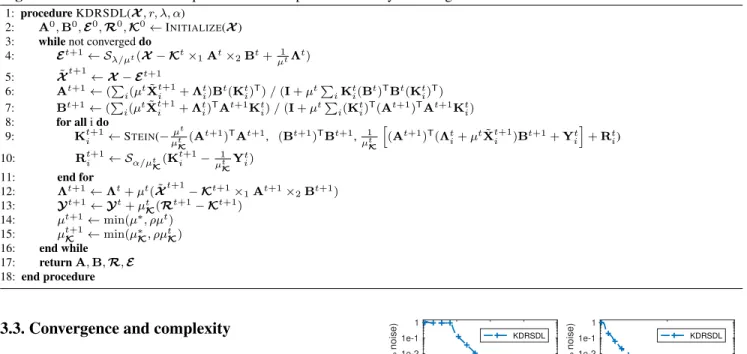
Algorithm 1Kronecker-Decomposable Robust Sparse Dictionary Learning. 1: procedureKDRSDL(X, r, λ, α) 2: A0,B0,E0 ,R0 ,K0← INITIALIZE(X) 3: whilenot convergeddo
4: Et+1← S λ/µt(X−Kt×1At×2Bt+µ1tΛt) 5: X˜t+1←X−Et+1 6: At+1←(P i(µtX˜t +1 i +Λti)Bt(Kti)T)/(I+µt P iKti(Bt)TBt(Kti)T) 7: Bt+1←(P i(µtX˜t +1 i +Λti)TAt +1Kt i)/(I+µt P i(Kti)T(At +1)TAt+1Kt i) 8: for allido 9: Kt+1 i ←STEIN(−µ t µt K (At+1)TAt+1, (Bt+1)TBt+1, 1 µt K h (At+1)T(Λt i+µtX˜t +1 i )Bt+1+Yti i +Rt i) 10: Rt+1 i ← Sα/µt K( Kt+1 i − 1 µt K Yt i) 11: end for 12: Λt+1←Λt+µt( ˜Xt+1 −Kt+1× 1At+1×2Bt+1) 13: Yt+1←Yt+µt K(Rt +1−Kt+1) 14: µt+1←min(µ∗, ρµt) 15: µtK+1←min(µ∗K, ρµtK) 16: end while 17: returnA,B,R,E 18: end procedure
3.3. Convergence and complexity
Convergence and initialization: The problem is non-convex, therefore global convergence is a priori not guar-anteed. Recent work [24, 43] studies the convergence of ADMM for non-convex and possibly non-smooth objective functions with linear constraints. Here, the constraints are not linear. In [21, 22] the authors derive conditions for global optimality in specific non-convex matrix and tensor factorizations that may be extended to other formulations, including our model. However, the theoretical study of the global convergence of our algorithm is out of the scope of this paper and is left for future work. Instead, we provide experimental results and discuss the strategy implemented.
We propose a simple initialization scheme in the wake of [29]. We initialize the basesAandBand the coreRby performing SVD on each observationXi =UiSiViT. We setRi =Si,A = N1 PiUi andB = N1 PiVi. To ini-tialize the dual-variables for the constraintXi−ARiBT−
Ei = 0, we take µ0 = P ηN
i||Xi||F where η is a
scal-ing coefficient, chosen in practice to be η = 1.25 as in [29]. Similarly, we chose µ0
K =
ηN P
i||Ri||F. These
cor-respond to averaging the initial values for each individual slice and its corresponding constraint. Our convergence criterion corresponds to primal-feasibility of problem (11), and is given bymax(errrec,errsplit) ≤ǫwhereerrrec =
maxi||
Xi−ARiBT−Ei||2F
||Xi||2F anderrsplit = maxi
||Ri−Ki||2F
||Ri||2F . Empirically, we obtained systematic convergence to a good solution, and a linear convergence rate, as shown in Figure
4. The parameterρ >1can be tuned and affects the speed of convergence. High values may lead to the algorithm di-verging, while values closer to 1 will lead to an increased number of iterations. We usedρ= 1.2and set upper bounds
µ∗=µ0 ×107 andµ∗K=µ 0 K×10 7
as usual with ADMM.
0 20 40 60 80 Number of iterations 1e-7 1e-6 1e-5 1e-5 1e-3 1e-2 1e-1 1 Cv. criterion (30% noise) KDRSDL 0 50 100 Number of iterations 1e-7 1e-6 1e-5 1e-5 1e-3 1e-2 1e-1 1 Cv. criterion (60% noise) KDRSDL
Figure 4: Convergence on synthetic data with 30% and 60% corruption.
Computational complexity: The time and space com-plexity per iteration of Algorithm1areO(N(mnr+ (m+
n)r+mn+ min(m, n)r2+ r3 + r2)) andO(N(mn+ r2) + ( m+n)r+r2)
. Sincer≤min(m, n), the terms in
rare asymptotically negligible, but in practice it is useful to know how the computational requirements scale with the size of the dictionary. Similarly, the initialization procedure has costO(N(mnmin(m, n)+(min(m, n))3
+mn)+mn)
in time and needs quadratic space per slice, assuming a stan-dard algorithm is used for the SVD[9]. Several key steps in the algorithm, such as summations of independent terms, are trivially distributed in aMapReduce[12] way. Proximal operators are separable in nature and are therefore paral-lelizable. Consequently, highly parallel and distributed im-plementations are possible, and computational complexity can be further reduced by adaptively adopting sparse linear algebra structures and algorithms.
4. Experimental evaluation
We compared the performance of our model against a range of state-of-the-art tensor decomposition algorithms on four low-rank modeling computer vision benchmarks:
two for image denoising, and two for background subtrac-tion. As a baseline, we report the performance of ma-trix Robust PCA implemented via inexact ALM (RPCA) [6,29], and of Non-Negative Robust Dictionary Learning (RNNDL) [35]. We chose the following methods to in-clude recent representatives of various existing approaches to low-rank modeling on tensors: The singleton version of Higher-Order Robust PCA (HORPCA-S) [18] optimizes the Tucker rank of the tensor through the sum of the nuclear norms of its unfoldings. In [46], the authors consider a sim-ilar model but with robust M-estimators as loss functions, either a Cauchy loss or a Welsh loss, and support both hard and soft thresholding; we tested the soft-thresholding mod-els (Cauchy STandWelsh ST). Non-convex Tensor Robust PCA (NC TRPCA) [2] adapts to tensors the matrix non-convex RPCA [33]. Finally, the two Tensor RPCA algo-rithms [31, 48] (TRPCA ’14 andTRPCA ’16) work with slightly different definitions of the tensor nuclear norm as a convex surrogate of the tensor multi-rank.
For each model, we identified a maximum of two pa-rameters to tune via grid-search in order to keep parameter tuning tractable. When criteria or heuristics for choosing the parameters were provided by the authors, we chose the search space around the value obtained from them. In all cases, the tuning process explored a wide range of parame-ters to maximize performance. The range of values investi-gated are provided as supplementary material.
When the performance of one method was significantly worse than that of the other, the result is not reported so as not to clutter the text, and is made available in the supple-mentary material. This is the case of Separable Dictionary Learning [23] whose drastically different nature renders un-suitable for robust low-rank modeling, but was compared for completeness. For the same reason, we did not compare our method against K-SVD [1], or [25].
4.1. Background subtraction
Background subtraction is a common task in computer vision and can be tackled by robust low-rank modeling: the static or mostly static background of a video sequence can effectively be represented as a low-rank tensor while the foreground forms a sparse component of outliers.
Experimental procedure We compared the algorithms on two benchmarks. The first is an excerpt of theHighway
dataset [20], and consists in a video sequence of cars travel-ling on a highway; the background is completely static. We kept 400 gray-scale images re-sized to48×64pixels. The second is theAirport Halldataset ([27]) and has been cho-sen as a more challenging benchmark since the background is not fully static and the scene is richer. We used the same excerpt of 300 frames (frames 3301 to 3600) as in [49], and kept the frames in their original size of144×176pixels.
We treat background subtraction as a binary
classifica-(a) Cauchy ST (b) Welsh ST (c) TRPCA ’16 (d) HORPCA-S (e) NCTRPCA
(f) RNNDL (g) RPCA (h) KDRSDL (i) Ground truth (j) Original Figure 5: Results onAirport Hall. TRPCA ’14 removed.
tion problem. Since ground truth frames are available for our excerpts, we report the AUC [15] on both videos. The value ofαwas set to1e−2for both experiments.
Results We provide the original, ground truth, and recov-ered frames in Figure5for theHallexperiment (Highway
in supplementary material).
Table 1 presents the AUC scores of the algorithms, ranked in order of their mean performance on the two benchmarks. The two matrix methods rank high on both benchmarks and only half of the tensor algorithms match or outperform this baseline. Our proposed model matches the best performance on theHighwaydataset and provides significantly higher performance than the other on the more challengingHallbenchmark. Visual inspection of the re-sults show KDRSDL is the only method that doesn’t fully capture the immobile people in the background, and there-fore achieves the best trade-off between there-foreground detec-tion and background-foreground contaminadetec-tion.
Algorithm Highway Hall
KDRSDL (proposed) 0.94 0.88 TRPCA ’16 0.94 0.86 NC TRPCA 0.93 0.86 RPCA (baseline) 0.94 0.85 RNNDL (baseline) 0.94 0.85 HORPCA-S 0.93 0.86 Cauchy ST 0.83 0.76 Welsh ST 0.82 0.71 TRPCA ’14 0.76 0.61
Table 1: AUC onHighwayandHallordered by mean AUC.
4.2. Image denoising
Many natural and artificial images exhibit an inherent low-rank structure and are suitably denoised by low-rank modeling algorithms. In this section, we assess the perfor-mance of the cohort on two datasets chosen for their popu-larity, and for the typical use cases they represent.
We consider collections of grayscale images, and color images represented as 3-way tensors. Laplacian (salt & pep-per) noise was introduced separately in all frontal slices of
0 10 20 30 0 KDRSDL (proposed) Cauchy ST Welsh ST TRPCA '14 TRPCA '16 HORPCA-S NC TRPCA RNNDL (baseline) RPCA (baseline) PSNR - Yale 10% 30% 60% 0 0.2 0.4 0.6 0.8 1 FSIM - Yale 10% 30% 60%
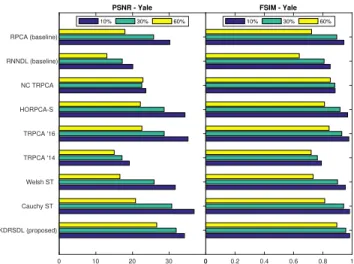
Figure 6: Mean PSNR and FSIM on the 64 images of the first subject ofYaleat noise levels 10%, 30%, and 60%.
the observation tensor at three different levels: 10%, 30%, and 60%, to simulate medium, high, and gross corruption. In these experiments we set the value ofαto1e−3for noise levels up to 30%, and to1e−2at the 60% level.
We report two quantitative metrics designed to measure two key aspects of image recovery. The Peak Signal To Noise Ratio (PSNR) will be used as an indicator of the element-wise reconstruction quality of the signals, while the Feature Similarity Index (FSIM, FSIMc for color im-ages)[30] evaluates the recovery of structural information. Quantitative metrics are not perfect replacements for sub-jective visual assessment of image quality; therefore, we present sample reconstructed images for verification. Our measure of choice for determining which images to com-pare visually is the FSIM(c) for its higher correlation with human evaluation than the PSNR.
Monochromatic face images Our face denoising exper-iment uses the Extented Yale-B dataset [17] of 10 different subject, each under 64 different lighting conditions. Ac-cording to [38,3], face images of one subject under vari-ous illuminations lie approximately on a 9-dimensional sub-space, and are therefore suitable for low-rank modeling. We used the pre-cropped 64 images of the first subject and kept them at full resolution. The resulting collection of images constitutes a 3-way tensor of 64 images of size192×168. Each mode corresponds respectively to the columns and rows of the images, and to the illumination component. All three are expected to be low-rank due to the spatial corre-lation within frontal slices and to the correcorre-lation between images of the same subject under different illuminations. We present the comparative quantitative performance of the methods tested in Figure6, and provide visualizations of the reconstructed first image at the 30% noise level in Figure7. We report the metrics averaged on the 64 images.
(a) Cauchy ST (b) Welsh ST (c) TRPCA ’16 (d) HORPCA-S (e) NCTRPCA
(f) RNNDL (g) RPCA (h) KDRSDL (i) Noisy (j) Original Figure 7: Results on the Yale benchmark with 30% noise. TRPCA ’14 removed.
At the 10% noise level, nearly every method provided good to excellent recovery of the original images. We there-fore omit this noise level (c.f. supplementary material). On the other hand, most methods, with the notable exception of KDRSDL, NC TRPCA, and TRPCA ’16, failed to pro-vide acceptable reconstruction in the gross corruption case. Thus, we present the denoised images at the 30% level, and compare the performance of the three best performing methods in Table2for the 60% noise level.
Clear differences appeared at the 30% noise level, as demonstrated both by the quantitative metrics, and by visual inspection of Figure7. Overall, performance was markedly lower than at the 10% level, and most methods started to lose much of the details. Visual inspection of the results confirms a higher reconstruction quality for KDRSDL. We invite the reader to look at the texture of the skin, the white of the eye, and at the reflection of the light on the subject’s skin and pupil. The latter, in particular, is very close in na-ture to the white pixel corruption of the salt & pepper noise. Out of all methods, KDRSDL provided the best reconstruc-tion quality: it is the only algorithm that removed all the noise and for which all the aforementioned details are dis-tinguishable in the reconstruction.
Noisy KDRSDL NC TRPCA TRPCA ’16
PSNR 26.6057 22.8502 22.566
FSIM 0.8956 0.8509 0.8427
Table 2: Three best results onYaleat 60% noise. At the 60% noise level, our method scored markedly higher than its competitors on image quality metrics, as seen both in Figure6 and in Table2. Visualizing the
re-0 10 20 30 0 KDRSDL (proposed) Cauchy ST Welsh ST TRPCA '14 TRPCA '16 HORPCA-S NC TRPCA RNNDL (baseline) RPCA (baseline) PSNR - Facade 10% 30% 60% 0 0.2 0.4 0.6 0.8 1 FSIMc - Facade 10% 30% 60%
Figure 8: PSNR and FSIMc of all methods on the Facade benchmark at noise levels 10%, 30%, and 60%.
constructions confirms the difference: the image recovered by KDRSDL at the 60% noise level is comparable to the output of competing algorithms at the 30% noise level.
Color image denoising Our benchmark is theFacade im-age [10]: the rich details and lighting makes it interesting to assess fine reconstruction. The geometric nature of the building’s front wall, and the strong correlation between the RGB bands indicate the data can be modeled by a low-rank 3-way tensor where each frontal slice is a color channel.
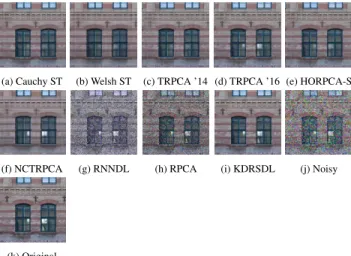
At the 10% noise level, KDRSDL attained the highest PSNR, and among the highest FSIMc values. Most meth-ods provided excellent reconstruction, in agreement with the high values of the metrics shown in Figure8. As in the previous benchmark, the results are omitted because of the space constraints (c.f. supplementary material). At the 30% noise level, Cauchy ST exhibited the highest PSNR, while TRPCA ’16 scored best on the FSIMc metric. KDRSDL had the second highest PSNR and among the highest FSIMc scores. Details of the results are provided in Figure9. Vi-sually, clear differences are visible, and are best seen on the fine details of the picture, such as the black iron ornaments, or the light coming through the window. Our method best preserved the dynamics of the lighting, and the sharpness of the details, and in the end provided the reconstruction visually closest to the original. Competing models tend to oversmooth the image, and to make the light dimmer; indi-cating substantial losses of high-frequency and dynamic in-formation. KDRSDL appears to also provide the best color fidelity.
In the gross-corruption case, KDRSDL was the best per-former on both PSNR and FSIMc. As seen on Figure
3, KDRSDL was the only method with TRPCA ’16 and HORPCA-S to provide a reconstruction with distinguish-able details, and did it best.
(a) Cauchy ST (b) Welsh ST (c) TRPCA ’14 (d) TRPCA ’16 (e) HORPCA-S
(f) NCTRPCA (g) RNNDL (h) RPCA (i) KDRSDL (j) Noisy
(k) Original
Figure 9: Results on the Facade benchmark with 30% noise.
Noisy KDRSDL TRPCA ’16 HORPCA-S
PSNR 23.8064 23.6552 22.8811
FSIMc 0.9152 0.9109 0.9060 Table 3: Three best results onFacadeat 60% noise.
5. Conclusion
The method we propose combines aspects from Ro-bust Principal Component Analysis, and Sparse Dictionary Learning. As in K-SVD, our algorithm learns iteratively and alternatively both the dictionary and the sparse repre-sentations. Similarly to Robust PCA, our method assumes the data decompose additively in a sparse and low-rank component, and is able to separate the two signals. We introduce a two-level structure in the dictionary to allow for both scalable training, and robustness to outliers. Im-posing this structure exhibits links with tensor factoriza-tions and allows us to better model spatial correlation in images than classical matrix methods. These theoretical ad-vantages translate directly in the experimental performance, as our method exhibits desirable scalability properties, and matches or outperforms the current state of the art in low-rank modeling.
6. Acknowledgements
The work of Y. Panagakis has been partially supported by the European Community Horizon 2020
[H2020/2014-2020] under Grant Agreement No. 645094 (SEWA).
S. Zafeiriou was partially funded by EPSRC Project EP/N007743/1 (FACER2VM).
References
[1] M. Aharon, M. Elad, and A. Bruckstein. K-SVD: An al-gorithm for designing overcomplete dictionaries for sparse representation. IEEE Transactions on Signal Processing, 54(11):4311–4322, 2006.1,6
[2] A. Anandkumar, P. Jain, Y. Shi, and U. N. Niranjan. Ten-sor vs Matrix Methods: Robust TenTen-sor Decomposition under Block Sparse Perturbations. In A. Gretton and R. C. Chris-tian, editors,Proceedings of the 19th International Confer-ence on Artificial IntelligConfer-ence and Statistics, AISTATS 2016, Cadiz, Spain, 2016. JMLR.org.6
[3] R. Basri and D. Jacobs. Lambertian reflectance and linear subspaces. IEEE Transactions on Pattern Analysis and Ma-chine Intelligence, 25(2):218–233, 2 2003.7
[4] A. Beck and M. Teboulle. A Fast Iterative Shrinkage-Thresholding Algorithm for Linear Inverse Problems.SIAM Journal on Imaging Sciences, 2(1):183–202, 2009.2
[5] S. Boyd. Distributed Optimization and Statistical Learning via the Alternating Direction Method of Multipliers. Founda-tions and TrendsR in Machine Learning, 3(1):1–122, 2010.
2
[6] E. J. Cand`es, X. Li, Y. Ma, and J. Wright. Robust principal component analysis? Journal of the ACM, 58(3):1–37, 5 2011.1,4,6
[7] E. J. Cand`es, J. Romberg, and T. Tao. Robust uncertainty principles: Exact signal reconstruction from highly incom-plete frequency information. IEEE Transactions on Infor-mation Theory, 52(2):489–509, 2 2006.1
[8] E. J. Candes and T. Tao. Decoding by linear programming.
IEEE Transactions on Information Theory, 51(12):4203– 4215, 12 2005.1
[9] T. F. Chan. An Improved Algorithm for Computing the Sin-gular Value Decomposition. ACM Transactions on Mathe-matical Software, 8(1):72–83, 1982.5
[10] X. Chen, Z. Han, Y. Wang, Q. Zhao, D. Meng, and Y. Tang. Robust Tensor Factorization with Unknown Noise. InThe IEEE Conference on Computer Vision and Pattern Recogni-tion (CVPR), pages 5213–5221, 2016.8
[11] G. M. Davis, S. G. Mallat, and Z. Zhang. Adap-tive time-frequency decompositions. Optical Engineering, 33(7):2183–2191, 1994.2
[12] J. Dean and S. Ghemawat. MapReduce: Simplied Data Pro-cessing on Large Clusters.Proceedings of 6th Symposium on Operating Systems Design and Implementation, pages 137– 149, 2004.5
[13] D. L. Donoho. For most large underdetermined systems of equations, the minimal L1-norm near-solution approxi-mates the sparsest near-solution. Comm. Pure Appl. Math., 59(7):907–934, 2006.1
[14] M. Elad and M. Aharon. Image denoising via sparse and re-dundant representation over learned dictionaries.IEEE Tran-sations on Image Processing, 15(12):3736–3745, 12 2006.1
[15] T. Fawcett. An introduction to ROC analysis.Pattern Recog-nition Letters, 27(8):861–874, 2006.6
[16] R. Ge, J. D. Lee, and T. Ma. Matrix completion has no spu-rious local minimum. InAdvances in Neural Information
Processing Systems 29: Annual Conference on Neural In-formation Processing Systems 2016, December 5-10, 2016, Barcelona, Spain, pages 2973–2981, 2016.2
[17] A. Georghiades, P. Belhumeur, and D. Kriegman. From few to many: illumination cone models for face recognition un-der variable lighting and pose.IEEE Transactions on Pattern Analysis and Machine Intelligence, 23(6):643–660, 6 2001.
7
[18] D. Goldfarb and Z. T. Qin. Robust Low-Rank Tensor Re-covery: Models and Algorithms. SIAM Journal on Matrix Analysis and Applications, 35(1):225–253, 3 2014.6
[19] G. Golub, S. Nash, and C. Van Loan. A Hessenberg-Schur method for the problem AX + XB= C. IEEE Transactions on Automatic Control, 24(6):909–913, 12 1979.4
[20] N. Goyette, P. M. Jodoin, F. Porikli, J. Konrad, and P. Ish-war. changedetection.net: A new change detection bench-mark dataset. In IEEE Computer Society Conference on Computer Vision and Pattern Recognition Workshops, pages 1–8, 2012.6
[21] B. Haeffele, E. Young, and R. Vidal. Structured low-rank matrix factorization: Optimality, algorithm, and applications to image processing. In T. Jebara and E. P. Xing, editors, Pro-ceedings of the 31st International Conference on Machine Learning (ICML-14), pages 2007–2015. JMLR Workshop and Conference Proceedings, 2014.5
[22] B. D. Haeffele and R. Vidal. Global Optimality in Ten-sor Factorization, Deep Learning, and Beyond. CoRR, abs/1506.0, 2015.5
[23] S. Hawe, M. Seibert, and M. Kleinsteuber. Separable Dictio-nary Learning. Proceedings of the IEEE Computer Society Conference on Computer Vision and Pattern Recognition, 3 2013.2,6
[24] M. Hong, Z. Q. Luo, and M. Razaviyayn. Convergence analysis of alternating direction method of multipliers for a family of nonconvex problems. In 2015 IEEE Interna-tional Conference on Acoustics, Speech and Signal Process-ing (ICASSP), pages 3836–3840, 2015.5
[25] S. H. Hsieh, C. S. Lu, and S. C. Pei. 2D sparse dictionary learning via tensor decomposition. 2014 IEEE Global Con-ference on Signal and Information Processing, GlobalSIP 2014, pages 492–496, 2014.2,6
[26] T. G. Kolda and B. W. Bader. Tensor Decompositions and Applications.SIAM Review, 51(3):455–500, 8 2009.2
[27] L. Li, W. Huang, I.-H. Gu, and Q. Tian. Statistical Modeling of Complex Backgrounds for Foreground Object Detection.
IEEE Transactions on Image Processing, 13(11):1459–1472, 11 2004.6
[28] X. Li, Z. Wang, J. Lu, R. Arora, J. D. Haupt, H. Liu, and T. Zhao. Symmetry, saddle points, and global geometry of nonconvex matrix factorization. CoRR, abs/1612.09296, 2016.2
[29] Z. Lin, M. Chen, and Y. Ma. The Augmented Lagrange Mul-tiplier Method for Exact Recovery of Corrupted Low-Rank Matrices.arXiv:1009.5055, page 23, 9 2010.5,6
[30] Lin Zhang, Lei Zhang, Xuanqin Mou, and D. Zhang. FSIM: A Feature Similarity Index for Image Quality Assessment.
IEEE Transactions on Image Processing, 20(8):2378–2386, 8 2011.7
[31] C. Lu, J. Feng, Y. Chen, W. Liu, Z. Lin, and S. Yan. Ten-sor Robust Principal Component Analysis: Exact Recovery of Corrupted Low-Rank Tensors via Convex Optimization. In The IEEE Conference on Computer Vision and Pattern Recognition (CVPR), 2016.2,6
[32] J. Mairal, M. Elad, and G. Sapiro. Sparse learned represen-tations for image restoration.Sparse learned representations for image restoration, (December):1–10, 2008.1
[33] P. Netrapalli, U. N. Niranjan, S. Sanghavi, A. Anandkumar, and P. Jain. Non-convex Robust PCA. Advances in Neural Information Processing Systems 27 (Proceedings of NIPS), pages 1–9, 10 2014.6
[34] B. A. Olshausen and D. J. Field. Sparse coding with an over-complete basis set: A strategy employed by V1? Vision Research, 37(23):3311–3325, 1997.1
[35] Q. Pan, D. Kong, C. Ding, and B. Luo. Robust Non-negative Dictionary Learning. InProceedings of the Twenty-Eighth AAAI Conference on Artificial Intelligence, AAAI’14, pages 2027–2033. AAAI Press, 2014.6
[36] D. Park, A. Kyrillidis, C. Caramanis, and S. Sanghavi. Find-ing Low-Rank Solutions via Non-Convex Matrix Factoriza-tion, Efficiently and Provably.ArXiv e-prints, 2016.2
[37] Y. C. Pati, R. Rezaiifar, and P. S. Krishnaprasad. Orthogonal matching pursuit: recursive function approximation with ap-plications to wavelet decomposition. InProceedings of 27th Asilomar Conference on Signals, Systems and Computers, pages 40–44, 11 1993.2
[38] R. Ramamoorthi and P. Hanrahan. An efficient representa-tion for irradiance environment maps. InProceedings of the 28th annual conference on Computer graphics and interac-tive techniques - SIGGRAPH ’01, volume 64, pages 497– 500, New York, New York, USA, 2001. ACM Press.7
[39] B. Recht, M. Fazel, and P. A. Parrilo. Guaranteed Minimum-Rank Solutions of Linear Matrix Equations via Nuclear Norm Minimization. Optimization Online, 52(3):1–33, 6 2007.3
[40] R. Rubinstein, A. M. Bruckstein, and M. Elad. Dictionaries for sparse representation modeling.Proceedings of the IEEE, 98(6):1045–1057, 6 2010.1,2
[41] E. Schwab, R. Vidal, and N. Charon. Efficient Global Spatial-Angular Sparse Coding for Diffusion MRI with Sep-arable Dictionaries.ArXiv e-prints, Dec. 2016.2
[42] E. Schwab, R. Vidal, and N. Charon. Spatial-Angular Sparse Coding for HARDI. In S. Ourselin, L. Joskowicz, M. R. Sabuncu, G. Unal, and W. Wells, editors, Medical Image Computing and Computer-Assisted Intervention – MICCAI 2016: 19th International Conference, Athens, Greece, Oc-tober 17-21, 2016, Proceedings, Part III, pages 475–483. Springer International Publishing, Cham, 2016.2
[43] Y. Wang, W. Yin, and J. Zeng. Global Convergence of ADMM in Nonconvex Nonsmooth Optimization. ArXiv e-prints, 2015.5
[44] K. Wei, J.-F. Cai, T. F. Chan, and S. Leung. Guarantees of Riemannian Optimization for Low Rank Matrix Completion.
ArXiv e-prints, 2016.2
[45] J. Wright, Y. Ma, J. Mairal, G. Sapiro, T. S. Huang, and S. Yan. Sparse Representation for Computer Vision and
Pattern Recognition. Proceedings of the IEEE, 98(6):1031– 1044, 6 2010.1
[46] Y. Yang, Y. Feng, and J. A. K. Suykens. Robust Low-Rank Tensor Recovery With Regularized Redescending M-Estimator. IEEE Transactions on Neural Networks and Learning Systems, 27(9):1933–1946, 9 2015.6
[47] X. Zhang, L. Wang, and Q. Gu. A Nonconvex Free Lunch for Low-Rank plus Sparse Matrix Recovery. ArXiv e-prints, Feb. 2017.2
[48] Z. Zhang, G. Ely, S. Aeron, N. Hao, and M. Kilmer. Novel methods for multilinear data completion and de-noising based on tensor-SVD. Proceedings of the IEEE Computer Society Conference on Computer Vision and Pattern Recog-nition, pages 3842–3849, 2014.2,6
[49] Q. Zhao, G. Zhou, L. Zhang, A. Cichocki, and S.-I. Amari. Bayesian Robust Tensor Factorization for Incomplete Mul-tiway Data. IEEE Transactions on Neural Networks and Learning Systems, 27(4):736–748, 4 2016.6
[50] Z. Zhu, Q. Li, G. Tang, and M. B. Wakin. Global Optimality in Low-rank Matrix Optimization.ArXiv e-prints, Feb. 2017.