Constructing Minority Representation:
Empirical-Theoretical Study
Jelena Lončar
PhD
University of York
Politics
September 2017
3
Abstract
Performance and performativity are deeply entwined in political representation. This research explores the performance of minority representation – i.e., how representatives from ethnic minority backgrounds shape their positions and deliver their claims about and for minorities depending on the audience they address – and the performativity of their representative claims – i.e., how they contribute to the construction of ethnic identities and interests, which they purportedly merely describe or present. In doing so, the thesis reuses, tests and expands the increasingly influential theoretical understanding of representation as claim-making, while, at the same time, it effects a much-needed constructivist turn in the empirical study of the representation of ethnic minorities. In theoretical terms, the dissertation argues that the categories of descriptive and substantive representation remain essential to the study of minority representation. Its contribution to the theoretical literature is in reconceptualising these categories in line with the constructivist turn.
The constructivist understanding of political representation has had considerable theoretical impact, but limited operationalization and empirical application. When applied to the study of group representation, the representation of gender has commanded attention. The thesis breaks new ground in applying it to the study of the representation of minority ethnic groups, a field in which the traditional understanding of representation as responsiveness to the pre-given demands and interests of constituents remains dominant. Focusing on two similar cases where ethnicity has been historically and institutionally constructed as a relevant feature to be represented in political forums, this thesis shows that rather than factors determining the behaviour of representatives, institutional and cultural backgrounds can be, and are often, deployed creatively as resources in the claim-making process whereby ethnic identifications are produced and reproduced over time.
4
Table of Contents
Abstract ... 3 Table of Contents ... 4 List of Tables ... 7 List of Figures ... 8 Acknowledgements ... 9 Declaration ... 11 Chapter 1: Introduction ... 121.1. Theoretical background: from unidirectional responsiveness towards the constructivist turn ... 14
1.2. Research design and methodology ... 16
1.3. A note on terminology and spelling ... 17
1.4. Relevance of the thesis ... 19
1.5. Outline of the thesis ... 21
Chapter 2: Rethinking political representation of ethnic groups ... 23
2.1. Introduction ... 23
2.2. How is ethnic representation studied? ... 24
2.3. The constructivist turn in political representation ... 29
2.4. The constitutive representation of ethnic groups ... 33
2.4.1. Rethinking descriptive representation ... 34
2.4.2. Rethinking substantive representation ... 38
2.4.3. The performance of group representation ... 40
2.5. Conclusion ... 43
Chapter 3: Representative claims analysis: research design and methodology ... 45
3.1. Introduction ... 45
3.2. Research design ... 47
3.2.1. Selection of cases: Serbia and Kosovo ... 49
3.3. Institutional and cultural incentives: Serbia and Kosovo ... 51
3.3.1. Similarities ... 52
3.3.2. Differences ... 56
5
3.5. Data and methods ... 62
3.5.1. Plenary speeches... 62
3.5.2. Interviews ... 64
3.5.3. Research ethics ... 70
3.5.4. Representative claims analysis ... 71
3.6. Conclusion ... 76
Chapter 4: The performance of minority representation in Serbia ... 79
4.1. Introduction ... 79
4.2. Constructing a representative through shape-shifting ... 83
4.2.1. Descriptive representation ... 84
4.2.2. Substantive representation ... 89
4.3. Constructing constituencies ... 95
4.3.1. Minorities as unified, culturally specific identity groups ... 96
4.3.2. Minorities as equal citizens ... 99
4.4. Claim-making before different audiences ... 103
4.5. Conclusion ... 107
Chapter 5: The performance of minority representation in Kosovo ... 111
5.1. Introduction ... 111
5.2. Constructing a representative ... 114
5.2.1. Descriptive representation ... 114
5.2.2. Substantive representation ... 121
5.3. Constructing constituency: what is it in the name? ... 125
5.3.1. Old and new boundaries: constructing Kosovo Serb identity ... 128
5.3.2. Emerging identities in a post-conflict society ... 133
5.4. Claim-making before different audiences ... 138
5.5. Conclusion ... 143
Chapter 6: Background incentives and the performance of minority representation in Serbia and Kosovo ... 146
6.1. Introduction ... 146
6.2. The performance of minority representation: delegates vs. trustees ... 150
6.3. Acting for minorities: voice vs. outcome ... 155
6.4. The construction of ethnicity: unity vs. difference ... 160
6.5. Conclusion ... 170
Chapter 7: Conclusion ... 172
6
7.2. The contribution of the thesis ... 178
7.3. Limitations of the study ... 181
7.4. Avenues for future research ... 183
Appendices ... 185
Appendix 1: List of MPs ... 185
Appendix 2: List of interviewees ... 187
Acronyms and abbreviations ... 188
7
List of Tables
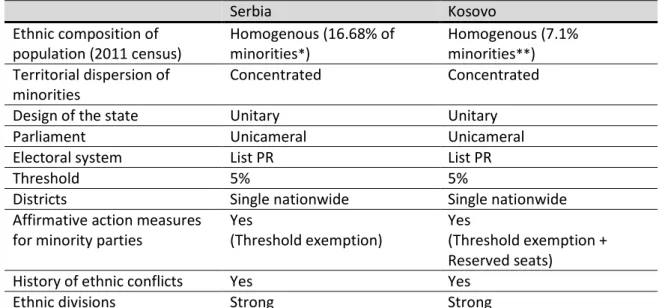
Table 1: Comparison of cases: institutional and cultural incentives ……….55
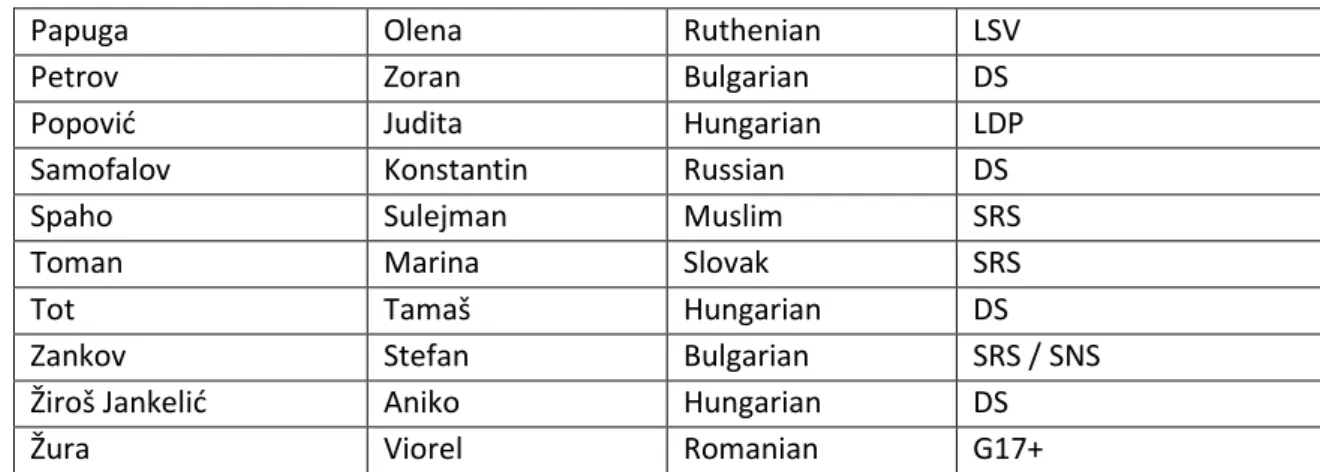
Table 2: Minority MPs elected on minority lists to the 8th National Assembly of Serbia (2008-2012) ………185
Table 3: Minority MPs from minority parties elected on majority lists to the 8th National Assembly of Serbia (2008-2012)………185
Table 4: Minority MPs from majority parties in the 8th National Assembly of Serbia (2008-2012) ………185
Table 5: Minority MPs in the 4th Assembly of Kosovo (2010-2014) ……….……….186
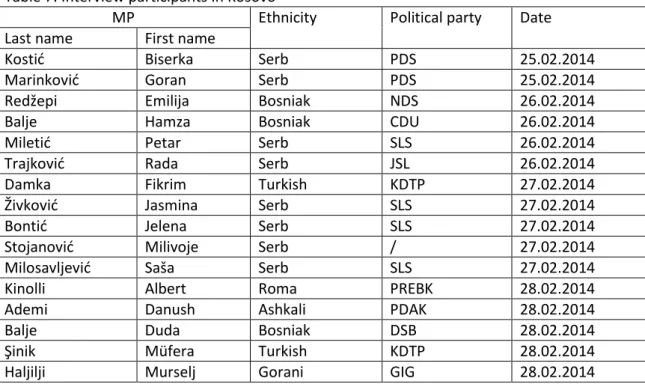
Table 6: Interview participants in Serbia ………187
8
List of Figures
Figure 1: The influence of institutions on the behaviour of representatives ………..56
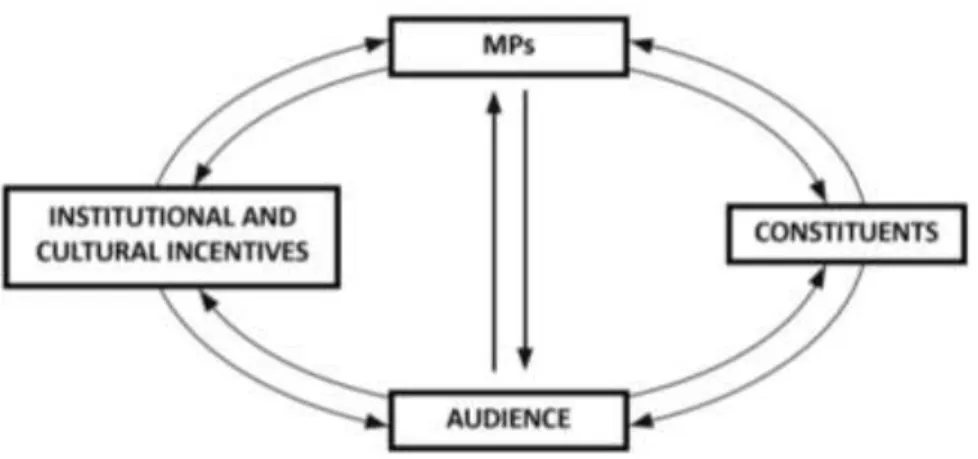
Figure 2: Representation as a dynamic relationship between representatives, constituents, audience and background incentives ……….……60
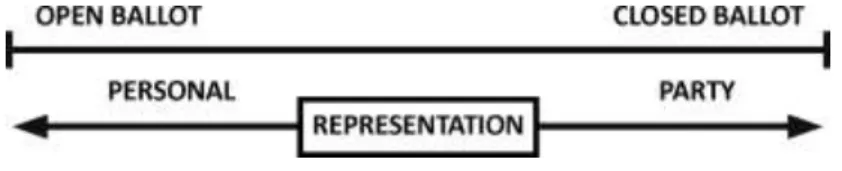
Figure 3: The influence of ballot structure on MPs’ positioning ………151
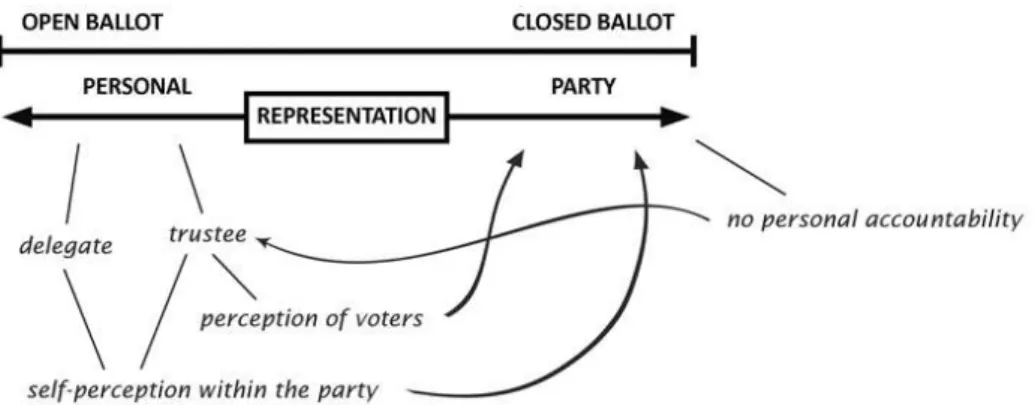
Figure 4: The dynamics of representative performance ………....154
Figure 5: The influence of a party’s institutional strength on MPs’ positioning ………..…..158
9
Acknowledgements
I would like to thank the many people who have supported me throughout the research process. This thesis would not have been possible without the support and guidance of my wonderful supervisors Dr Mónica Brito Vieira and Professor Nina Caspersen. I would like to thank Mónica for her passionate dedication to this project, detailed feedback on the numerous drafts, personal encouragement in moments of despair and panic, and for the hours of long supervisory meetings she dedicated to discussing issues of representation with me. I am indebted to Nina for her unwavering support and advice, and her considerate and patient guidance over the last years. I am truly grateful for being able to learn from both of them. I would also like to acknowledge the support of my previous supervisors Dr Mihaela Mihai and Dr Audra Mitchell and my MRes examiner Dr Sofia Vasilopoulou, who believed in this project and encouraged me along the way.
Thank you to the University of York for the scholarship that has funded me through this process. I am also grateful to the Open Society Foundation and the Fund for Young Talents of the Serbian government for financial support during my studies. I would like to acknowledge the support of the Faculty of Political Science at the University of Belgrade for granting me study leave to pursue my studies at the University of York and my wonderful colleagues there for their friendly support. In particular I would like to thank the political sociology team, Professor Vukašin Pavlović, Professor Zoran Stojiljković, Professor Slaviša Orlović, and Dr Dušan Spasojević for taking over my teaching responsibilities while I have been in York. I am also grateful to the administrative staff at both universities, in particular to Liz O’Brien and Lisa Webster at the University of York and Marija Vasiljević, Branka Popadić and Ivana Ilić Šunderić at the University of Belgrade for their valuable assistance with practical issues.
I also appreciate the support of the Youth Initiative for Human Rights during my fieldwork in Kosovo. Thank you to the many MPs who took the time to be interviewed for this thesis, and provided me with valuable insight into the world of representative claims. I am also grateful to Dafina Halili for teaching me Albanian, which made my fieldwork in Kosovo much easier and more productive.
I feel deeply indebted to Professor Eric Gordy who took the time to read the thesis and offered some very perceptive comments. I am grateful to Dr Mihaela Mihai, Dr Christina Isabel Zuber, Professor Karen Bird, Dr Timofey Agarin and Dr Licia Cianetti for their comments on parts of my work that became published papers. Thank you also to Maggie Studholme for proofreading this thesis.
10
I learned a lot from the presentations and participants at the workshop Representation of Minorities: Perspectives and Challenges, which I co-organised with Dr Licia Cianetti in May 2015 at the University of York. Thank you to all the participants for the lively and inspiring discussion. Thanks are also due to the British International Studies Association Postgraduate Network (BISA PGN), and to the Conflict, Security and Development research cluster in the Department of Politics, and the Morrell Centre for Toleration at the University of York for the financial support of this workshop.
I have also benefited much from participating at various conferences and workshops. I would particularly like to mention the workshop on the representative turn organised by Dr Mónica Brito Vieira at the end of September 2015 at the University of York. I thank Mónica for the opportunity to participate and learn from scholars whose work has been central to shaping the theoretical arguments of this thesis.
On a more personal note, I want to thank all the lovely people I have met in York, especially colleagues from the Department of Politics and my housemates Phil, Abi, Teresa, Jelena, Alex and David who have been so kind to share their time and thoughts with me. Finally, I am grateful for the support of my family and friends in Belgrade. Above all I would like to thank my husband Bojan Krstić and our son Petar for their enormous love. Petar has brought so much light and happiness into our lives and made all the hard work more worthwhile. This thesis would not have been possible without Bojan’s unselfish understanding, patience and support. I dedicate this thesis to him.
11
Declaration
I certify that the thesis I have presented for examination for the Ph.D. degree from the University of York is solely my own work, other than where I have clearly indicated that it is the work of others. All sources are acknowledged as References. The work has not previously been presented for an award at this, or any other, university.
Several paragraphs in Chapter 1 related to the ways the existing literature studies minority representation were initially discussed in: Lončar, J. (2017). Accountability of minority representation: methodological advancements, Nationalities Papers, online ahead of print, pp. 1-17.
Issues related to identification of minority representatives in Serbia discussed in Chapter 2 were published in: Lončar, J. (2016). Electoral Accountability and Substantive Representation of National Minorities: The Case of Serbia, East European Politics and Societies and Cultures, 30:4, pp. 703-724.
12
Chapter 1: Introduction
I want to live in a city where love is more important than religion. I want to live in a city where Serbian and Bosnian aren’t foreign languages. I want to live in a city where Serbs and Bosniaks are one because they worship the same God in a different way. And I want to live in a city where people respect differences of opinion.
This is me. This is you. This is who we are! We are all humans! This is me! This is you! This is who we are! Good people!
Excerpts from the play Beton Mahala [Concrete Hamlet]
The play Beton Mahala (Concrete Hamlet) has since 2015 been performed all over the Western Balkan region, but has been forbidden in a town in Serbia where it originated from. It was written and has been performed by a group of teenagers, amateur actors from Novi Pazar, a multiethnic town in Serbia where Bosniaks and Serbs comprise the two major ethnic groups. By critically discussing the positions of the majority and the minorities, the actors challenge the dominant views about essentialism of ethnic identities and differences. The play is based on actors’ personal experiences and conceptualised around problems arising from conflictual inter-ethnic relations (Serb-Bosniak) such as naming of a mother tongue (Serbian or Bosnian1) or conflicts with parents for falling in love with a person of different ethnicity. Almost all political parties in Novi Pazar perceived the play as offensive to the authentic identity of the Bosniak minority. Being aware of how words construct meaning, they joined their efforts to ban the play. The issues the play raised were seen as dangerous as they challenged the dominant image of ethnicity as natural and essential to one’s identity, which has been so carefully cultivated by minority parties and representatives. The play has been described as “anti-Islamic” (Džodan, 2015), “anti-Bosniak” (Nićiforović and Strugar, 2015), and “controversial” (Direktno.Hr, 2016). While framed as protection of identity, these reactions, and consequent banning of the play, aimed to conceal the role of the parties in constructing inter-ethnic relations and what is to be recognised as an authentic identity. This is the issue I explore in this thesis.
1
Serbian and Bosnian are basically the same languages, hence the additional importance of naming: it is what distinguishes them the most.
13
Similarly to the above play, this thesis challenges the essentialist understanding of ethnicity and ethnic interests. The central argument of this thesis is that political representation is also a creative activity in which representatives construct themselves as
representatives of minorities and at least partly construe ethnic identities and minority groups by making claims about them and their interests. While this research is inspired by the widespread perception of ethnic identities in the Balkans as natural things in the world, it is also called for by a gap in the literature on minority representation that tends to take minority groups and their interests as essential categories.
Much of the existing literature on minority representation assumes that despite internal heterogeneity, the shared experience of structural discrimination allows us to identify a set of essential interests that are common to all members of a minority group. Based on this, the literature suggests that presence of any member of a group in parliament secures presence to the whole group (Anwar, 2001, Celis, Eelbode et al., 2013, Dancygier, 2013, Moser, 2008, Protsyk, Matichescu et al., 2008, Saggar and Geddes, 2000, Schönwälder, 2013, Teney, Jacobs et al., 2010, Togeby, 2008). These representatives are further expected to advance essential minority interests in parliament (Bird, 2011, Celis and Wauters, 2010, Dunning and Nilekani, 2013, Gay, 2007, Jensenius, 2013, Jones, O'Toole et al., 2015, Saalfeld and Kyriakopoulou, 2011). In doing so, the previous literature tends, even if unintentionally, to treat groups as homogenous, unitary bounded actors with a natural essence. Regardless of internal diversity based on e.g. class or gender, it is assumed that ethnicity is sufficient to unite them and distinguish them from all other groups.
In contrast, I suggest that when analysing minority representation we have to conceive ethnic groups as imagined communities, constructed over time, and through complex processes as homogenous and natural objects (Anderson, 2006, Handler, 1994). Ethnic groups and ethnic identities are better conceptualised in terms of ongoing negotiation, categorisation, construction and reconstruction (Handler, 1994, p. 27). As Hall argues, they are “never singular but multiply constructed across different, often intersecting and antagonistic, discourses, practices and positions. They are subject to a radical historicization, and are constantly in the process of change and transformation” (Hall, 1996, p. 4). Such conceptualisation of ethnic groups is not new. Nor is politics, and in particular political representation, external to those “discourses, practices and positions” whereby ethnic identification is constructed on different, sometimes intersecting, sometimes purely antagonistic terms. It is rather the case, I argue, that it lies at their core. Even those researchers who understand representation as a unidirectional responsiveness to pre-defined minority interests otherwise acknowledge intra-group differences and the relational and strategic nature of ethnicity (Wauters, Eelbode et al., 2016). But this recognition demands a further step. In particular, it implies that there is a need
14
to equip empirical researchers on minority representation with theoretical and methodological tools to analyse representation without falling into the essentialist traps and taking the full complexity of ethnicity into account. This is the main objective of this thesis.
In the remainder of this chapter, I explain the rationale of my research, research design and methodology. In addition, I demonstrate the relevance of this research for both theory and practice, and provide an outline of the following chapters.
1.1. Theoretical background: from unidirectional responsiveness
towards the constructivist turn
In the effort to shift the focus of minority research from presence and responsiveness to minority interests towards a more constructivist understanding of representation, I propose that we go back to the representative turn in the 1990s, which has contributed most to the interest of empirical researchers in minority representation (Kymlicka, 1995, Mansbridge, 1999, Phillips, 1995, Williams, 1998, Young, 2000). The researchers of minority representation embraced two main contributions of this turn. First, rather than seeing representation as an elitist project opposed to democracy and participation, they adopted a view that representation is inherent to democracy (Näsström, 2011). Second, they suggested that descriptive representation of groups in political institutions is needed to undo the pervasive structural discrimination to which such groups tend to be subject (Brito Vieira, 2017a). Based on this, researchers of minority representation concluded that shared experience of discrimination and marginalisation allows us to identify a set of essential interests that are common to all members of a minority group (Cameron, Epstein et al., 1996, Dunning and Nilekani, 2013, Gamble, 2007, Jensenius, 2013, Juenke and Preuhs, 2012, Minta, 2011, Owens, 2005, Preuhs, 2007, Tate, 2003, Ueda, 2008).
Yet, what the empirical researchers of minority representation have failed to acknowledge is that the representative turn scholars also started to unveil some of the complexities of social identity and how institutions might want to reflect it. Young (2000), for example, argued that members of social groups have their own views, opinions and interests and their identities are constructed through various life experiences, contacts and membership of different social groups. In her words: “Political theory would do well to disengage social group difference from a logic of identity, in two ways. First, we should conceptualize social groups according to a relational rather than a substantialist logic. Secondly, we should affirm
15
that groups do not have identities as such, but rather that individuals construct their own identities on the basis of social group positioning” (Young, 2000, p. 82). As they were more interested in issues of democracy than representation, scholars such as Young (2000) or Kymlicka (1995) did not offer a new understanding of representation based on the constructed quality of identity. For these reasons, and despite embracing several aspects of the representative turn such as a renewed interest in representative institutions, empirical researchers continued working within the traditional accounts of representation, understood as a principal-agent relationship which should be directed by the pre-defined interests of fixed minority constituencies (Pitkin, 1967). In claiming that there are some essential interests out there that came into being prior to representation, they reduced representation to a unidirectional responsiveness and denied it any creative and relational character.
I suggest, on the other hand, that groups and their interests are also constructed during the representative process. By making claims about groups, representatives constitute them as a democratic political subject “that becomes recognizable as a unified and not merely aggregated entity only by means of representation” (Disch, 2015, p. 490). This thesis, therefore, aims to shift the focus from presence and interests towards the performance of representative claims. In doing so, I join the more recent wave of scholars making a constructivist turn, which is often subsumed under the broader representative turn (Disch, 2011, Saward, 2010).
The constructivist turn advances our understanding of representation in the following aspects: 1) it recognises representation’s creative and aesthetic aspects, i.e. representation is a claims-making activity that is constitutive of both representatives and the represented; 2) representation is relational; it does not depend on the will or interests of either representatives or the represented; it is produced and performed in the complex and dynamic relations between representatives, constituents and diverse audiences; 3) representation is cultural in a sense that it is not sufficient that a claim is made; the success of representative claims depends on their cultural resonance. This understanding enables us not only to explore the dynamics of representation but also to avoid essentialisation of groups.
In addition, the constructivist scholars argue that conceiving of representation as a dynamic activity requires us to dismiss the old and static categories such as descriptive and substantive representation. In this thesis, I however, suggest that the use of these concepts may be beneficial if we redefine them in accordance with the constructivist turn. I endeavour to do this in the following chapter.
16
1.2. Research design and methodology
I apply the above presented theoretical framework to the cases of Serbia and Kosovo. These two cases are interesting for the analysis of minority representation because of their ethnic diversity and institutional and cultural incentives for representation of ethnicity such as lifted threshold and reserved seats for minority parties, recent experience of ethnic conflict and inter-ethnic tensions. My empirical analysis focuses in particular on parliamentary representation and claims made by MPs with minority background for the following reasons: first, in Serbia and Kosovo parliaments remain the main locus of minority representation because of the weak minority civil society and lack of public visibility of claims made by non-elected actors; and second, in both Serbia and Kosovo, claims about and for minorities tend to be made exclusively by representatives with minority background because of deep inter-ethnic divisions that are produced through historical events and encouraged by institutional design.
Based on the institutional and cultural setting in which representation is performed, Serbia and Kosovo make for two very similar cases. Both Serbia and Kosovo are ethnically diverse, with numerous and geographically concentrated ethnic groups. They are both unitary states with unicameral parliaments, a proportional electoral system with 5% electoral threshold and a single nationwide electoral district. Both parliaments have affirmative action measures such as lifted threshold for minority parties, while Kosovo also guarantees parliamentary seats for minority parties. Finally, both societies are divided along ethnic lines with high discrimination against ethnic minorities. Although sufficiently similar to enable a focused comparison, Serbia and Kosovo also differ in several respects: the ballot structure, the relative institutional strength of minority parties, presence and the influence of international actors and depth of ethnic divisions.
I analyse portrayals of representatives and constituencies made during plenary speeches and semi-structured interviews. I chose to focus on plenary speeches because they allow MPs to express their views on a range of issues, reflect on policy proposals, ask parliamentary questions, and add new issues to the agenda. In addition, plenary debates are televised and transcripts of plenary sessions are publicly available. In contrast, in both of my cases, records of committee meetings are unavailable, and MPs do not have websites or blogs through which one could access their views and public statements. Interviews, being more personal, add an additional quality to my analysis: they give MPs a chance to elaborate on their perceptions, beliefs and motivations, explain how they understand their roles and
17
positions in parliament and how affected they feel by the institutional and cultural background they work in.
I explore the performance of representative claims about and for minorities by focusing on: 1) resources that claim-makers use to construct themselves as representatives of minority groups, 2) portrayals of minority groups and their interests, and 3) influence of the intended audiences on the shaping of minority related claims. Following Saward (2010, p. 36), this analysis is conducted by dividing each of the claims made in plenary speeches and interviews into the following components: An MP puts forward a subject which stands for an
object that is related to an ethnic group and is offered to an audience.
I acknowledge, however, that representative claims are not made in a vacuum. Institutional and cultural backgrounds provide opportunities and constraints for particular behaviour, and create expectations in the audience. Rather than making claims out of thin air, representatives carefully tailor their claims to persuade the audience. They know that the felicity of their claims depends on their resonance with the audience. To this purpose, they explore the institutional incentives and cultural resources in making their claims convincing. Yet, I aim to show that these incentives do not determine representative behaviour. Representatives actively negotiate and sometimes challenge the incentives they face. Hence, I offer a more dynamic analysis in which due attention is given to the ways in which political actors mobilise institutions and background culture as resources for the pursuit of the new courses of action they favour.
1.3. A note on terminology and spelling
In this thesis, I use the term “constituency” to refer to all those that minority MPs claim to speak for. Since minority representation is in the focus of my study, I particularly focus on representative claims that evoke minority groups as intended constituencies. This is important to clarify since the term constituency in the existing literature usually refers to either those eligible to vote or those who voted for a representative (Rehfeld, 2005, p. 35). In addition, in my understanding, the term refers to “objects of representation” rather than referents. An object is a representative’s idea of an ethnic group rather than ethnic group itself (the referent) (Saward, 2010, p. 36). The term audience, on the other hand, refers to all those who receive the claim and engage with it either by accepting, challenging or rejecting it (Saward, 2006, p. 303).
18
In addition, the terms “minority representatives” and “minority MPs”, which I use throughout the thesis, relate to all MPs who claim to have ethnic minority background. In contrast to those studies that operationalise minority or ethnic representatives as those who make claims about or for ethnic groups (Saalfeld and Kyriakopoulou, 2011), I use the term in a more narrow meaning merely because of the scope of my thesis that encompasses only the claims by MPs with minority origin. By using the term, I furthermore, do not imply anything related to their behaviour, i.e. I do not aim to suggest that they are representatives of minorities or in any way representative of minorities.
The terms minority groups, ethnic groups, ethnic minority groups, national minorities and minority communities appear interchangeably throughout the thesis to refer to the evoked minority constituencies, i.e. ethnic groups that are in minority in relation to the dominant ethnic group. I am, however, aware that these terms could imply different meanings. For instance, minority groups in Serbia are constitutionally defined as national minorities, which positions them as minorities of national relevance, favouring therefore integration. In Kosovo, on the other hand, minority groups are labelled as “communities”, which positions them as unitary objects, but also aims to give them a more equal weight to the dominant ethnic group (Toth and Vizi, 2014). In Serbia, minority MPs are present not only in minority parties but also in nation-wide parties, which I refer to as “majority parties” or following Sikk and Bochsler (2008) sometimes as “mainstream parties”.
Finally, it is important to clarify terminology and spelling that I use related to my cases. I use the term “Serb MPs” rather than “Serbian MPs” to refer to MPs with Serb ethnic origin. In cases I use the term “Serbian”, I refer to the country, e.g. the Serbian government. Different uses of the terms “Serb” and “Serbian” may be encountered in the literature. For instance, some authors use the term Serbians for all citizens of Serbia; others use it to refer to Serbs from Serbia, while connecting the term “Serb” to Serbs from other countries (Judah, 2000). I suggest that this would only create confusion. Since this thesis focuses on representation of ethnic groups, I chose to refer to the ethnic background of representatives and constituencies regardless of their citizenship or regional backgrounds. I also use the term “Kosovo” rather than “Kosova” or “Kosovo and Metohija” because this is the region’s name in English. Kosovo Albanians prefer the term Kosova, while Kosovo and Metohija is a Serbian name for the region. However, if any of these terms was used in the MPs’ claims, I did not “translate” it but used the term they preferred. My use of any of these terms bears no political implications regarding the status of Kosovo. Similarly, in Kosovo Serbs and Albanians use different names for cities and municipalities. In those cases, I chose to use the term used by the MPs whose claims I analysed.
19
Names of places and persons are mostly originally spelt rather than Anglicised. Yet, in some of the cases, e.g. when spelling the names of minority MPs in majority parties, I used Serbian spelling because that is how they chose to have their name spelled in the official parliamentary documents. MPs from minority parties, on the other hand, have their names spelt in original. For instance, the names of the Hungarian MPs Bálint Pásztor and Elvira Kovács would in Serbian be spelt as Balint Pastor and Elvira Kovač. When it comes to places, I did Anglicise some of the names such as Belgrade (rather than Beograd) or Serbia (rather than Srbija) because they are widely known in the English speaking world by their Anglicised names.
1.4. Relevance of the thesis
The primary original contribution of this thesis is a new conceptualisation of minority representation and empirical analysis of representation as performance of representative claims. This is relevant for our understanding of representation and future empirical research.
First, the theoretical framework I offer in this thesis throws new light on minority representation and enables us to analyse how representatives construct themselves as ethnic minority representatives and how they contribute to the construction of the ethnic identity they propose to represent in the process. While some of the recent literature, particularly on gender representation, explores how representatives construct the represented and their interests (Celis and Childs, 2012, Celis, Childs et al., 2014, Schouteden and Wauters, 2017, Squires, 2008), barely any attention has so far been paid to the resources representatives use in positioning themselves as those who know who their constituents are and what they need. This is important because the success of representative claims depends on whether claim-makers succeed in constructing themselves as authentic and legitimate representatives of true and objective interests of their evoked constituents. My approach also offers the theoretical and methodological tools for exploring other important questions that were neglected in the previous literature, such as: What is going on in representation beyond elections and intra-party relations? Which groups and interests are evoked in representation and what is there in “evoking” them, i.e. how in effect their identity is actively articulated? Who speaks for those groups, which are not present in parliament? Why do MPs sometimes make contradictory claims and promises? How do different audiences affect shaping of the representative claims?
Second, a reconceptualization of descriptive and substantive representation is relevant for any empirical research on minority representation. Our understanding of minority representation has for decades been shaped by the concepts of descriptive and substantive
20
representation that empirical scholars are not ready to give up on. Despite calls for abandoning of these categories as not useful to explain the complexity of representation, even those scholars who acknowledge the constructedness of minority interests continue using them (Bird, 2015, Cianetti, 2014, Hodžić and Mraović, 2015, Toró, 2017). I offer ways of reworking these concepts and operationalizing them for empirical research that render them more fruitful.
Third, there has been a disconnect between the representation theory and empirical research on minority representation, a gap my thesis aims to fill. While constructivist turn in representation has been embraced in the gender representation research, empirical research on ethnic minority has remained impermeable to changes in our understanding of representation, and has continued working with the traditional and static categories of representation. More specifically, the thesis offers a new light on the performance of minority representation in the region so often reduced to conflict prevention and presence of group members in national parliament.
Fourth, the thesis informs comparative analysis of minority representation. It identifies similarities and differences in claims-making in the analysed cases. While this thesis focuses on the how of representation rather than the what or the why, my approach still allows me to analyse how representatives react to and negotiate diverse institutional and cultural incentives in constructing themselves as representatives and minority groups as their constituency. Understanding institutional incentives and cultural resources as things that enable – or might be made to enable - representatives to pursue their goals challenges previous literature that perceives a relationship between background setting and representation as static and unidirectional.
Fifth, the study of the performance of minority representation in Serbia and Kosovo is important because it fills a gap in the literature, which has until now focused mostly on the US (Fine and Aziz, 2013, Gay, 2007, Haynie, 2001, Kraus and Swanstrom, 2002, Marschall and Ruhil, 2007, Meier, Juenke et al., 2005, Minta, 2009, Parry and Miller, 2006, Preuhs, 2007, Swain, 1993, Tate, 2003). Over the past two decades, Central and Eastern European parliaments guaranteed the presence to minority groups. Despite this, we have little information on what this presence means for representation of minorities. In these countries, minority representation has been reduced to minority presence, which is seen as being necessary for peace and democratic stability. My research adds to our knowledge of the region by showing how representation is performed in the context of deep ethnic cleavages and institutional incentives for the representation of ethnicity.
21
1.5. Outline of the thesis
Inspired by the recent advances in the representation theory, Chapter 2 offers a new conceptualisation of minority representation. I conceive of representation as a dynamic, relational, creative and cultural claims-making activity. Informed by both the constructivist understanding of ethnicity and the constructivist turn in representation theory, the main objective of this chapter is the reconceptualisation of descriptive and substantive representation. Rather than defining them as forms of representation, I see them as positions representatives construct so that they might occupy them in making claims about and for minority groups and their interests. To make their claims convincing, representatives more or less explicitly evoke their ethnic resemblance with the constituency (descriptive representation) or their capacity to know minority interests and act upon them (substantive representation).
In Chapter 3, I develop the research design and outline methodological foundation of my research. This chapter introduces the case studies and rationale for their comparability. I suggest that the two cases have similar institutional and cultural backgrounds that make a basis for their comparability. While explaining their similarities and differences, I actively engage with existing literature to explore how these incentives affect the process of shaping of representative claims. This chapter, further, shows that my research departs from the previous literature in a sense that I do not take these incentives as determinants but rather as resources, which representatives use to make their claims more resonant with the audience. In the remainder of this chapter, I explain the methods of data selection and data analysis. I propose that the representative claims analysis is employed for studying the performance of minority representation and set the grounds for its application in the empirical research.
Chapters 4 and 5 explore the performance of representative claims in Serbia and Kosovo respectively. In my cases, representation of minorities is performed by MPs as claim-makers and around ethnic groups as referents. While claim-claim-makers and referents are stable and known in advance, I argue that the subjects and objects of representation and audiences are constituted in the representative process. I explore how MPs construct themselves as descriptive and substantive representatives of ethnic groups, how they construct minority groups and their interests and how they shape their claims depending on the audience they address. This differentiates my research from the previous literature on minority representation that tends to take both the identity of a representative and the constituents as something pre-given, static and fixed.
22
Chapter 6 builds on the previous two chapters by exploring the relationship between representative claims and background incentives in Serbia and Kosovo. In this chapter I tackle the issue of whether and how institutional incentives and cultural background influence the process and nature of claim making for and about ethnic minorities. In doing so, this chapter seeks to provide an alternative understanding of background incentives: rather than taking them as a given, I argue that representatives actively negotiate and sometimes challenge the incentives they face. My analysis is hence a more dynamic one. I explore how political actors mobilise institutions and culture as resources for obtaining their specific goals.
Finally, in Chapter 7, I summarize the main findings, discuss their theoretical and empirical contributions, and acknowledge the limitations of my study. In addition, I suggest directions for future research.
23
Chapter 2: Rethinking political representation of ethnic groups
2.1. Introduction
Much of the literature in the field of ethnic representation focuses on the relationship between descriptive and substantive representation of minority interests and thereby relies on traditional accounts of political representation as a principal-agent relationship, taken to be a matter of “acting in the interests of the represented in a manner responsive to them” (Pitkin, 1967, p. 209). However, our understanding of representation has moved beyond different variations of this static and unidirectional approach. We now know that representation is a dynamic and multi-directional process in which constituencies, their perceived interests, and representatives are at least partially constructed in the process of being spoken for and about (Saward, 2010).
This chapter aims to extend the focus and possibilities of ethnic minority research by introducing the notion of the constitutive representation of ethnic groups. I suggest that the analysis of ethnic minority representation would be significantly refined if we adopted a more constructivist understanding of representation. I argue further that this shift is necessary if we want to avoid the essentialisation of minority groups. As I argued in the Introduction to this thesis, ethnicity is not a static and objective category but socially, politically and historically constructed, performed and transformed. It is not a given “thing”, but the evolving product of a complex process of identification, to which the political practice of claim-making is integral. In that sense, what Butler says of gender could be applied to ethnicity:
[Ethnicity] proves to be performative—that is, constituting the identity it is purported to be. In this sense, [ethnicity] is always a doing, though not a doing by a subject who might be said to preexist the deed… There is no [ethnic] identity behind the expressions of [ethnicity]; that identity is performatively constituted by the very “expressions” that are said to be its results (Butler, 1999, p. 33).
This requires us to change both the questions we ask in researching minority representation and our understanding of what minority representation is about and how it is performed. I suggest that we should analyse representation as a performance that at least partly creates both the representatives and the represented, and the relations among them. I argue, further, that this understanding of representation can be reconciled with more usual categories such as descriptive and substantive representation, which are deemed so important
24
for minority representation, but only insofar as they are reconceptualised in the light of the claim-making approach. This is the objective of this chapter.
The first section of the chapter considers the limits of the traditional understanding of descriptive and substantive representation and calls for a shift towards a more constructivist approach in understanding ethnic representation. The second section introduces the main strengths of the constructivist turn in representation theory. In the light of this turn, the third section offers a new understanding of group representation by reconceptualising descriptive representation. I argue that descriptive representation refers to the claim-making process whereby the representative leads her constituents to take her and their “common” identity for granted. This involves the externalisation – indeed the performance – of identity, or personal self-identification, in order to produce ethnic identification with the constituency. The latter constitutes, in turn, a powerful resource in legitimising one’s claim to speak in the name of the group and of its “natural” or “necessary” interests. In the fourth section, I aim to redefine substantive representation. I suggest that substantive representation refers not only to actions taken or results delivered, but also to the construction of representatives as those who can know and can act upon what they frame as essential minority interests. In other words, for interests to come to be perceived as the interests of the constituency they need to be constituted and articulated as such, and this is the work of politics. In the final section, following constructivist scholars, I offer an understanding of representation as performance, i.e. a dynamic, relational, creative and context-dependent activity.
2.2. How is ethnic representation studied?
Ethnicity and ethnic groups are produced and reproduced through social interactions. This has been widely acknowledged in nationalism studies and the sociology of race and ethnicity literature (Jenkins, 2008, Nagel, 1994). However, when we think about inter-ethnic relations, representation of ethnic minorities or ethnic conflicts we tend to take ethnic groups as a given. Even scholars who otherwise recognise that ethnic groups are constructed tend to do this. Previous research on minority representation tends to treat ethnic minorities as internally homogenous and externally bounded unitary collective actors. This has made their boundaries appear to be harder than they actually are, rather than produced and reproduced over time. It has also diverted attention from the ways in which the meaning of ethnic identification is re-created, and the role of politics in this reinvention. I argue in this section that the
25
constructedness of ethnicity requires us to think of ethnic representation in more performative and creative terms.
Most of the literature on ethnic representation subscribes to the traditional account of political representation. It is particularly informed by Pitkin’s understanding of descriptive and substantive representation. Pitkin defines descriptive representation as standing for the represented “by virtue of a correspondence or connection between them, a resemblance or reflection” (Pitkin, 1967, p. 61). Descriptive representation, operationalised as the presence of group members in representative institutions, has long been at the centre of minority studies (Grofman, 1998, Nakao, 2011, Sobolewska, 2013). These studies, particularly in Central and Eastern Europe, tend to focus on the impact of electoral rules on the number of minority representatives that make it to the legislature (Bochsler, 2010, King and Marian, 2012, Protsyk, Matichescu et al., 2008, Protsyk and Sachariew, 2012).
Since descriptive representation itself is not evidence of effective minority representation, the research, particularly in the US, has shifted from mere descriptive representation to the analysis of its impact on substantive representation (Bullock, 1995, Bühlmann, Widmer et al., 2010, Canon, 1999, Casellas and Leal, 2011, Gamble, 2007, Haynie, 2001, Hänni, 2014, James, 2011, Lublin, 1997, Minta and Sinclair-Chapman, 2013, Swain, 1993, Tatari, 2010, Tate, 2003, Whitby, 1997, Whitby and Krause, 2001). These studies primarily have normative concerns: they are interested in “good representation”, that is, articulating “standards for assessing the performance of individual representatives” (Dovi, 2012, p. 22) or evaluating empirically the behaviour of minority representatives. Following Pitkin, the studies on ethnic representation assess representation by asking whether and under what conditions representatives act “in the interest of the represented, in a manner responsive to them” (Pitkin, 1967, p. 209). Because responsiveness is at the center of such understanding of representation, Pettit refers to it by using the term “responsive representation”: “Responsive representers act for or speak for the representees, playing the part of an agent in relation to a principal; how they act is responsive to how the representees would want them to act” (Pettit, 2009, p. 65). For Pettit, representatives need to “track the wishes of the representee” (p. 71). In reducing substantive representation to congruence of representatives’ roll call votes with the constituencies’ perceptions much of the literature on ethnic representation embraces Pettit’s definition of responsiveness (Casellas and Leal, 2011, Hero and Tolbert, 1995, Kopkin, 2017, Lublin, 1997, Overby and Cosgrove, 1996, Swain, 1993, Tate, 2003, Whitby and Krause, 2001). Yet, such understanding is often unjustly attributed to Pitkin. Pitkin argues that a representative cannot always follow the instructions of the constituents because they may not have the experience, knowledge or skills to know what action is in their best interest. It is rather the case, as she argues, that representatives’ actions should always be guided by, and
26
responsive to, the constituents’ real interests2 rather than their wishes or perceptions. As Pitkin argues, the question is not:
whether the representative ought to act in his constituents’ interest as he sees it or as they see it. Both formulations distort; he must act in their interest, period. Their view of their interest may or may not be definitive, depending on the issue and the situation; but if he follows it, it should be because the action accords with their interest, not because they merely think it does (Pitkin, 1967, p. 165).
Hence, although Pitkin’s understanding of substantive representation is more constructivist than much of the empirical literature tends to acknowledge, for Pitkin constituents still have objective and true interests that need to be represented (Pitkin, 1967, p. 210). Her understanding of interests returns us to an essentialist path.
Responsiveness to interests rather than constituencies’ beliefs and perceptions has been in the focus of a more recent literature on ethnic representation (Cameron, Epstein et al., 1996, Dunning and Nilekani, 2013, Gamble, 2007, Jensenius, 2013, Juenke and Preuhs, 2012, Minta, 2011, Owens, 2005, Preuhs, 2007, Tate, 2003, Ueda, 2008). This literature maintains that shared experience of discrimination and marginalisation allows us to identify a set of essential interests that are common to all members of a minority group. Following Young who suggests that “claims to cultural recognition usually are means to the end of undermining domination or wrongful deprivation” (Young, 2000, p. 83), they argue that individual rights are not sufficient to undo the pervasive structural discrimination to which such groups tend to be subject. Hence, in addition to anti-discrimination policies, minority groups need the protection of their culture and affirmative action measures such as a guaranteed proportional presence in public institutions (Bird, 2011, Minta and Sinclair-Chapman, 2013).
In making this argument, they seem to share Pitkin’s understanding that interests are somehow objective, transparent, accessible and defined prior to representation. In addition, it is either explicitly or implicitly suggested that the role of descriptive representatives is to follow and, in so doing, advance the essential interests of the groups they belong to. Substantive representation is thereby operationalised as acting in the “natural” or “necessary” interests of ethnic groups. Those who experience structural discrimination may indeed feel that elimination of discrimination is in their interest. Yet, in taking interests as essentialist and defined prior to representation, we are prevented from observing how representatives engage with cultural incentives and constraints, whether they reinforce or change them, how their claims contribute to the construction of new interests or what their motivation is for evoking particular interests in their speeches. For instance, representatives may, responding to the
27
cultural expectations of their constituents, speak about interests as “necessities” or “fundamentals”, but they may do it strategically, to win over their opponents or achieve other goals. If interests are constructed in such a way, it is hard to claim otherwise. Hence, rather than taking interests as a starting point of a discussion on representation, I argue that interests are an end point of the construction process, to which representation is integral.
In defining representation as a static and unidirectional responsiveness to group’s pre-defined interests, the literature on ethnic representation fails to capture the constructed aspects of ethnicity. While there is a rich literature in sociology on how group identity is portrayed and constructed through the processes of social and cultural representations (Ahmad and Evergeti, 2010, Aspinall, 2015, Kahani-Hopkins and Hopkins, 2002, Ray, 2003, Sela-Sheffy, 2004), ethnic representation scholars have not incorporated these findings in their research. In other words, they have overlooked the ways in which 1) identity and ethnicity are such vital rhetorical resources in the politics of claim-making, as well as the ways in which 2) the process of making claims for and about ethnic groups contributes actively to the processes of social identification on which identity and ethnicity depend. Yet, the sociology scholars correctly remind us that ethnic groups should not be treated as “substantial entities to which interests and agency can be attributed” (Brubaker, 2002, p. 164, Brubaker, 2004, p. 8). Brubaker rightly warns us that: “Ethnicity, race and nationhood exist only in and through our perceptions, interpretations, representations, categorizations and identifications. They are not things in the world, but perspectives on the world” (Brubaker, 2002, p. 174-175, Brubaker, 2004, p. 17). Politics is integral to the development and reproduction of these perspectives.
As such, ethnic groups do not have “true” interests or intrinsic identities that should be represented. Ethnic groups and ethnic identity are rather being constantly reproduced through various social, political and cultural processes (Wimmer, 2008). Besides that, they consist of individuals who are at the same time members of different groups and whose identities, opinions and attitudes are shaped through various life experiences and contacts within and outside of the group, including processes of institutional socialisation, such as those which occur in parliaments: “Ethnicity is situationally defined, produced and reproduced in the course of interactions that occur at or across – and in the process help to constitute – the ethnic boundary in question” (Jenkins, 2008, p. 54). These interactions are both internal, in the sense that group members in their mutual exchanges define the meaning and content of group identity and external in the sense that group unity is necessarily constructed in relation to the Other:
What goes on at and across the boundary affects the ‘cultural content’ of identity. Our ‘cultural stuff’ will, even if only in part, reflect our interactions with Other(s): how those Others categorize and behave towards us, how they label us. Nor is this
28
all. Our categorizations of Others, and the routines that we evolve for dealing with them, are also intrinsic to our ‘cultural’ repertoire. Social interaction at and across the boundary will necessarily involve categorizations: of ‘us’ by ‘them’, and of ‘them’ by ‘us’. Whose categorizations are the more influential, and the balances that are struck between group identification and categorization, are ongoing open questions, emerging out of history and past experience, located within power relations in the here-and-now, and constitutive of the ongoing situation. Whose definition of the situation counts, nominally and virtually, impinges upon the (external) interactional boundary and (internal) ‘cultural content’ (Jenkins, 2008, p. 171).
In this sense, while acting for group interests or standing for the group based on a shared ethnic identity is often de-politicising, insofar as both identity and interests are presented as unassailable, “natural” or “necessary”, what is really at stake is a highly contested and power-driven process whereby she who defines the meaning of ethnicity and of vital interests most convincingly gains control over the represented group. Therefore, we should not simply ask what group interests are, which representatives are responsive to them or whether the composition of a representative institution reflects the ethnic composition of the population as a whole. Instead, I suggest that we focus on when, why and how categories such as groups and ethnicity are invoked and constructed during the representative process.
Because of the constructed and performative nature of ethnicity, the research on minority representation could benefit significantly from embracing the so-called “constructivist turn” in political representation. Marked by the work of Saward (2006, 2010), Mansbridge (2003, 2011), Rehfeld (2006), Disch (2011) and Urbinati (2000), the constructivist turn has contributed significantly to our understanding of what is involved in the practice of representing. In particular, it has shown that representation is far more dynamic and performative than traditionally assumed: it does not merely work from the represented to the representatives; representatives suggest to the constituents what they should care about, contributing thereby to the construction of their interests and identities. In turn, the constituents and wider audience are invited to accept these claims as accurate.
Saward’s (2006, 2010) claim-making approach is particularly useful for the research on ethnic minority representation. The claim-making approach shifts the focus from acting or standing for the groups’ essential interests and identities to representative claims to represent, embody, stand for, know, symbolise or project the interests, the needs, the desires, the wants, or the characters of something or someone (Saward, 2006, p. 305). The following sections will, first, consider the main benefits of this new approach to representation, and second, reconsider ethnic representation in the light of this turn.
29
2.3. The constructivist turn in political representation
The constructivist turn in representation challenges the traditional understanding of representation in several ways. First, it acknowledges that constituencies and their interests are at least partially constructed in the process of representing. Second, it emphasises the dynamic and relational aspects of representation instead of unidirectional responsiveness. Third, it shifts our attention from the representative forms to the representative process.
In representation, different interests are voiced, created and confronted against each other. Elected representatives, the media and civil society organisations make different claims about, and in the name of, others. They do not merely provide information but also tell their audience what they should care about. They thereby influence the creation of, and change the opinions and preferences of, the audience (Thomassen, 2007, p. 116). By arguing that the representative’s role is to act in the objective interests of the represented, Pitkin (1967) neglected the constitutive dimension of representation. By contrast, Saward (2006, 2010) contends that the interests of the represented are not always crystalized and that representatives through their representative claims also shape and articulate these interests, convincing constituencies and audiences that these are the things the former should care about. He argues that “by following Pitkin too closely we stand to lose a sense of contingency, and the strong element of dynamic constructedness of representative politics (along with the importance of those who do constructing) across a variety of democratic and other contexts” (Saward, 2010, p. 15). Disch (2011) pushes this argument further by arguing that there is nothing beyond construction. For her, “representing is an activity that produces ontological effects while seemingly merely to follow from an existing state of affairs” (Disch, 2011, p. 107-108). In her view, representation literally brings the represented into being and infuses them with a distinctive political meaning of their own. It is this – not ethnicity or interests as such – that might cause people to believe themselves to be and need/want certain things, and to act in certain ways.
My account differs from Disch in a sense that I see representation as contributing to the construction of the represented. While identities and interests are constructed, the processes of identity construction and contestation go well beyond representation: identities and interests are constructed and reconstructed over time and through complex social, political and historical processes, which involve representation but cannot be reduced to it. In that sense, my understanding of representation is closer to Saward who argues that “of course people and groups exist prior to evocation or constitution in politics. There is always a
30
representations (M) [who] puts forward a subject (S) which stands for an object (O) which is related to a referent (R) and is offered to an audience (A)” (Saward, 2010, p. 36). Saward explains that “the idea of the referent expresses the sheer materiality of people and things, versus the constructions of meaning that different actors, perspectives and claims may place upon them” (Saward, 2012, p. 125-126). Such construction refers to objects of representation: objects of representation are not natural categories, but the claim-maker’s ideas, her imagi(ni)ng or portrayal of a referent. Saward’s critics suggest that the distinction implies that there is “something beyond representation”, which gives his argument “an unnecessary metaphysical flourish” (Thompson, 2012, p. 111). According to Disch, in making the distinction between referents and objects, Saward fails to observe that material realities are also made: “this making entails not just placing various meanings upon entities that are somehow independent, but rather affirming that materiality is discursively constituted” (Disch, 2012b, p. 117). I agree with Saward that “little is gained by denying the real and the material – a constructivist approach aims to reveal processes whereby specific meanings or constructions are naturalized or normalized, rather than questioning the real and material entities out of which meanings are built” (Saward, 2012, p. 126). Furthermore, the distinction between referents and objects of representation is particularly important for the representation of ethnic minorities. The literature on minority representation tends to treat minority groups as a given, assuming that representation is virtually unmediated: representative claims are believed to simply make the referent present, rather than offer a particular image of a referent or a perspective on what might count as its interest. The distinction between referent and object suggests that referent does not have an essential substance: its characteristics, identities and interests are subject to different interpretations.
By formulating a claim, the maker of the claim invites audience to recognise it as their own preference and recognise her as their legitimate representative. Therefore, representation is relational rather than unidirectional. Relational means here that representation works both ways from the representative to the represented, and in the opposite direction, as well as from the representative to the audience and in the opposite direction. Saward’s use of subject-object terminology to describe this relationship has been criticised by Disch as recognising agency only on the side of representatives (Disch, 2012b, p. 116). She proposes instead the terms signifier and signified as more appropriate if representation is indeed understood as mutually constitutive. Yet, as Saward contends, both subjects and objects of representation are effects of claim-making rather than actually existing categories (Saward, 2012, p. 125). Furthermore, in representation, relations range considerably more widely, since every representative claim presupposes the possibility of a counter-claim. There is no representation without openness to counter-claims. The claim is
31
always at risk of being contested or rejected by the would-be constituency or audience, which, in a plural democracy, includes other political parties. When making a claim, a representative invites the audience to accept her as their representative and the claim made about and for them as something in which they view themselves. Since representation includes the active making of what is to be represented and the contestation of claims, representation should be seen as a dynamic on-going relationship among various actors. This has hardly been taken into account in the literature on ethnic representation, but it is something I seek to reconstitute in my analysis.
The audience may be anyone to whom, or for whom, the representative claims to speak. For example, when David Cameron speaks in Scotland “to the people of this country“ several days before the Scottish independence vote and tells them “what is at stake“, he not only presents facts, but also makes a contestable claim about the future. In his performance, he not only expressed the opinions of his constituents, but, more importantly, tried to convince Scottish voters not to vote for independence (and to recognise him as their representative in that moment). His audience in this speech were the “people of Scotland”, whom he spoke to, but also “millions of people across England, Wales and Northern Ireland – and many in Scotland, too who would be utterly heart-broken by the break-up of the United Kingdom” as he claimed to speak for all of them (Dearden, 2014). On another occasion, Cameron spoke in the Knesset, the Israeli Parliament, where he referred to his Jewish ancestry and claimed to have “some sense of connection” to the Israeli people (Holehouse, 2014). He was thereby doing two things. First, he was seeking to address Israeli citizens as his intended audience while also suggesting that they form for him a kind of surrogate constituency. Second, he was presenting himself and asking to be recognised as someone who is predisposed to act for the interests of Jewish people abroad. Representative claims are as much a matter of self-presentation as of re-presentation. In examining them, the emphasis must be placed therefore on representation’s constitutive rather than merely presentational qualities.
In addition to the constitutive and dynamic understanding of representation, Saward invites us to think of representation as an activity, a performance instead of focusing on its definitions and forms (Saward, 2006, p. 298). While this approach has been criticised for the lack of clarity on what exactly representation is (Rehfeld, 2017), definitions and typologies reduce representation to a static view and prevent us from acknowledging the dynamics and shape-shifting of representation. If formerly descriptive and substantive representation were treated as separate representative forms, we are now invited to look not so much at what they are as at what is going on in representing descriptively or substantively, i.e. at how representation is performed. The assumption here is that representatives do not simply act as