SCIENTIFIC REPORTS
Extensions of Fuzzy Sets in Image Processing: An
Overview
M. Pagola, E. Barrenechea, H. Bustince, J. Fernandez, M. Galar, A. Jurio, C. Lopez-Molina, D.
Paternain, J. Sanz, Universidad Publica de Navarra, Spain
P. Couto, P. Melo-Pinto, University of Trás-os-Montes and Alto Douro, Portugal
1. Introduction
Computer vision systems are made up of several stages in which they try to extract the information of the image. The stages and the purpose of its algorithms, depends on the application of the articial vision system. Usually the systems are split in three main stages. The rst stage is devoted to noise ltering, smoothing or contrast enhan-cement (it's also known as preprocessing or low level vi-sion), the second stage is devoted to image segmentation, to split objects or regions according to their characteri-stics (intermediate level vision). Third stage involves the understanding of the scene (high level vision).
Uncertainty is present in every process of computer vision, therefore fuzzy techniques have been widely use in almost any of the processes. Extensions of fuzzy ts are not as specic as their counter-parts of fuzzy se-ts, but this lack of specicity makes them more realistic for some applications. Their advantage is that they allow us to express our uncertainty in identifying a particular membership function. This uncertainty is involved when extensions of fuzzy sets are processed, making results of the processing less specic but more reliable. Many au-thors based on this advantage proposed dierent image processing algorithms using extensions of fuzzy sets. This work presents a valuable review for the interested reader of the recent works using extensions of fuzzy sets in image processing. The chapter is divided as follows: rst we re-call the basics of the extensions of fuzzy sets, i.e. Type-2 fuzzy sets, Interval-valued fuzzy sets and Atanassov's In-tuitionistic fuzzy sets. In sequent sections we review the methods proposed for noise removal (section 3), image en-hancement (section 4), edge detection (section 5) and seg-mentation (section 6). There exist other image segmenta-tion tasks such as video de-interlacing, stereo matching or object representation that are not described in this work.
2. Extensions of fuzzy sets
From the beginning it was clear that fuzzy set theo-ry [48] was an extraordinatheo-ry tool for representing hu-man knowledge. Nevertheless, Zadeh himself established (see [49]) that sometimes, in decision-making processes, knowledge is better represented by means of some ge-neralizations of fuzzy sets. A key problem of represen-ting the knowledge by means of Fuzzy sets is to choo-se the membership function which best reprechoo-sents such knowledge.
Sometimes, it is appropriate to represent the member-ship degree of each element to the fuzzy set by means of an interval. From these considerations arises the extension of fuzzy sets called theory of interval-valued fuzzy sets, that is, fuzzy sets such that the membership degree of each
element of the fuzzy set is given by a closed subinterval of the interval [0,1]. Hence, not only vagueness (lack of
sharp class boundaries), but also a feature of uncertainty (lack of information) can be addressed intuitively.
These sets were rst introduced in the 1970s. In May 1975 Sambuc (see [37]) presented in his doctoral thesis the concept of an interval-valued fuzzy set named a Φ-fuzzy
set. That same year, Zadeh [49] discussed the representa-tion of type 2 fuzzy sets and its potential in approximate reasoning.
The concept of a type 2 fuzzy set was introduced by Za-deh [49] as a generalization of an ordinary fuzzy set. Type 2 fuzzy sets are characterized by a fuzzy membership func-tion, that is, the membership value for each element of the set is itself a fuzzy set in[0,1].
Formally, given the referential setU, a type 2 fuzzy set
is dened as an objectAwhich has the following form: A={(u, x, µu(x))|u∈U, x∈[0,1]},
where x ∈ [0,1] is the primary membership degree of u
and µu(x) is the secondary membership level, specic to
a given pair(u, x).
One year later, Grattan-Guinness [27] established a de-nition of an interval-valued membership function. In that decade interval-valued fuzzy sets appeared in the literatu-re in various guises and it was not until the 1980s, that the importance of these sets, as well as their name, was denitely established.
Fig1. Fuzzy membership function.
Fig2. Interval valued fuzzy membership function. Lower bound and upper bound
A particular case of a type 2 fuzzy set is an interval type 2 fuzzy set (see [31][32]). An interval type 2 fuzzy setAin U is dened by
A={(u, A(u), µu(x))|u∈U, A(u)∈L([0,1])},
whereA(u)is a closed subinterval of[0,1], and the
func-tion µu(x) represents the fuzzy set associated with the
elementu∈U obtained whenxcovers the interval[0,1];
µu(x)is given in the following way:
µu(x) =
aifA(u)≤x≤A(u)
0otherwise ,
where 0 ≤ a ≤ 1. It turns out that an interval type 2
fuzzy set is the same as an IVFS if we takea= 1.
Another important extension of fuzzy set theory is the theory of Atanassov's intuitionistic fuzzy sets ([1], [2]). Atanassov's intuitionistic fuzzy sets assign to each element of the universe not only a membership degree, but also a nonmembership degree, which is less than or equal to 1 minus the membership degree.
An Atanassov's intuitionistic fuzzy set (A-IFS) on U
is a set
ˆ
A={(u, µAˆ(u), νAˆ(u))|u∈U},
where µAˆ(u)∈[0,1]denotes the membership degree and
νAˆ(u) ∈ [0,1] the nonmembership degree of u in Aˆ and
where, for allu∈U, µAˆ(u) +νAˆ(u)≤1.
In [1] Atanassov established that every Atanassov in-tuitionistic fuzzy set Aˆ on U can be represented by an
interval-valued fuzzy setAgiven by A: U →L([0,1])
u→[µAˆ(u),1−νAˆ(u)], for allu∈U.
Using this representation, Atanassov proposed in 1983 that Atanassov's intuitionistic fuzzy set theory was equi-valent to the theory of interval-valued fuzzy sets. This equivalence was proven in 2003 by Deschrijver and Kerre [20]. Therefore, from a mathematical point of view, the results that we obtain for IVFSs are easily adaptable to A-IFSs and vice versa. Nevertheless, we need to point out that, conceptually, the two types of sets are totally die-rent. This is made clear when applications of these sets are constructed (see [43]).
In 1993, Gau and Buehrer introduced the concept of vague sets [26]. Later, in 1996, it was proven that vague sets are in fact A-IFSs [6].
A compilation of the sets that are equivalent (from a mathematical point of view) to interval-valued fuzzy sets can be found in [21]. Two conclusions are drawn from this study:
1.- Interval-valued fuzzy sets are equivalent to A-IFSs (and therefore vague sets), to grey sets (see [19]) and to L
-fuzzy set in Goguen's sense with respect to a special lattice
L([0,1]).
2.- IVFSs are a particular case of probabilistic sets (see [23]), of soft sets (see [3]), of Atanassov's interval-valued intuitionistic fuzzy sets and evidently of Type 2 fuzzy sets.
3. Noise Reduction
In this section we focus on gray scale images and the use of fuzzy logic theory extensions for noise removal.
Many applications of image processing perform ima-ge noise removal before any further processing such as segmentation, enhancement, edge detection or compres-sion. Noise removal is a crucial task for most applications mainly for two reasons:
• Digital images are often corrupted by impulse noi-se during image acquisition, image transmission and image processing due to a number of imperfections present in these tasks environments.
• The noise can critically aect any image post-processing decisively compromising their performan-ce.
For these reasons, noise removal is one of the most important steps for most image processing applications, regarding the overall performance of the applications and, is still a challenging problem in image processing.
When using fuzzy sets for noise removal, since their memberships are crisp values, it is not possible to know which one is the best membership function and, dierent membership functions will lead to dierent processing re-sults. On the other hand, when using type-2 fuzzy sets, since their membership functions are also fuzzy, provides us with a more ecient way of dealing with uncertainty and, consequently, a more robust way of determining the membership functions.
In their work, Sun and Meng [39], make the assumption that, since impulse corruption is usually large compared with the strength of the signal, then the noise corrupted pixels have intensity values that are near the saturated val-ues (lower and upper limits of the gray scale used). Based on this assumption, a inverted ladder membership func-tion is used as initial membership funcfunc-tion from which the type-2 fuzzy set is constructed (Fig. 3).
Fig3. Type-2 Fuzzy Set constructed from the initial ladder membership function
After dening the inverted ladder membership func-tion based on parametersa,a1 anda2, the lower and
up-per limits of the type-2 fuzzy set are obtained using the following equations:
µU(x) = [µ(x)] 1
α
µL(x) = [µ(x)]α
whereα∈(1,2].
After the construction of the type-2 fuzzy set, the pro-bability of a pixel been corrupted by impulse noise (PPC) is represented by the centroid-type-reduction [46] of the set. This way, the larger PPC means the bigger probabi-lity of the pixel been corrupted and, the less PPC means the less probability. Finally, a threshold of corruption is established in such way that if the pixel's PPC is bigger than the threshold its restored value is the mean of the pixels intensities in the subimage (n×nltering window
centered at the pixel) and, if the pixel's PPC is less than the threshold it maintains its intensity.
Tulin, Basturk and Yuksel [42] proposed a type-2 fuzzy operator for detail preserving restoration of impulse noise corrupted images, that processes the pixels contained in a
3×3ltering window and outputs the restored value of the
window center pixel. The proposed operator is structure that combines four type-2 neuro-fuzzy lters, four defu-zziers and a postprocessor. Each one of the type-2 NF lters are identical and accept the center pixel and two of its neighborhoods (processing the horizontal, vertical, diagonal and reverse diagonal pixel neighborhoods of the ltering window) and produces an output that represen-ts the uncertainty interval (i.e., lower and upper bounds) for the center pixel restored value in the form of a type-1 interval. Each combination of the inputs of the lter and their associated type-2 interval Gaussian membership functions is represented by a rule in the form:
if(X1∈Mi1)and(X2∈Mi2)and(X3∈Mi3), then
Ri=ki1X1+ki2X2+ki3X3+ki4
There are N fuzzy rules in the rulebase where, Ri
de-notes the output of theith rule (N rules,i = 1,2,· · ·N)
and Mij denotes the ith Gaussian membership function
of the jth input (3 inputs, j = 1,2,3) and is dened as
follows: Mij(u) = exp −1 2( u−mij σij )
where mij and σij are the mean and the standard
deviation of the membership function, respectively. Note that the membership functions Mij (Fig. 4)
are interval membership functions with their boundaries characterized by upper and lower Gaussian membership functions (see [42]).
Fig4. Type-2 interval Gaussian membership function
The optimal values for the parameters of each one of the type-2 interval Gaussian membership functions are ob-tained by training using the least squares optimization algorithm. Finally, the output of each NF lter is the weighted average of the individual rules outputs.
The defuzzier blocks convert the input fuzzy sets co-ming from the corresponding type-2 NF lters into a scalar value by performing centroid defuzzication (the centroid is the center of the type-1 interval fuzzy set).
The output of the defuzzier blocks are four scalar val-ues that are to be the candidates for the ltering window center pixel restored value. The postprocessor converts the four candidates into a single output value by discar-ding the lowest and the highest values and averaging the remaining two values.
In [42] Tulin, Basturk and Yuksel proposed an exten-sion of this operator where the the original neighborhood topologies (horizontal, vertical, diagonal and reverse dia-gonal pixel neighborhoods) are extended to 28 possible neighborhood topologies corresponding to a ltering ope-rator with 28 NF lters, 28 defuzziers and a postpro-cessor. However, authors emphasized that, for most l-tering applications, one does not have to use all of these neighborhood topologies.
In this new operator, the NF lters and the defuzziers work in the same way as in the original operator. The way the new postprocessor produces the output value from the scalar values obtained at the outputs of the defuzziers is dierent from the original one. The postprocessor calcu-lates the average of its inputs and truncates it to a 8-bit integer number, which is the output of the operator.
Wang, Chung, Hu and Wu [45] proposed a interval type-2 fuzzy lter for Gaussian noise suppression while maintaining the original structure of the image. Based on interval type-2 fuzzy sets is constructed a selective fee-dback fuzzy neural network (SFNN) suitable for image representation. In reality, this SFNN is a universal appro-ximator that works as a lter for Gaussian noise suppres-sion that preserves the ne structure of the image from the theoretical viewpoint.
First, the image is fuzzied in using linguistic concepts in such way that the gray scale interval is equally divided in K0 partitions. Each one of these partitions is
descri-bed with a Gaussian shape and its membership function obtained by drawing all the Gaussians having mean and standard deviation.
The proposed SFNN has ve components: two neu-rons in the input layer (since, the input is a 2-D digital image), three hidden layers and the output layer. Since, a digital image can be viewed as a continuous 2-D func-tion and, according to the structure of the SFNN (see [45]) it can be used to approximate a continuous function, the SFNN is used to express a digital image and, a Gaussian noise lter is designed based on it. For each one of the
K0partitions a optimal gray level is computed in a small
operating window (mean of the pixels in the window) and, the window gray level which is nearest to the optimal gray level is selected as the optimal gray level in the operating window.
After the operating window slides over the whole ima-ge, the mean absolute error of the input image and the
output image (ltered image) are calculated and if the dierence between these two values is less than a small positive number the process stops; otherwise the gray le-vels of the input image are replaced by the gray lele-vels of the output image and the process is restarted.
In [4], Bigand and Colot, use IVFS entropy to take into account the uncertainty present in the image noise removal process. Their motivation is to assess, and ulti-mately remove, the uncertainty of the membership values using the length of the interval in an IVFSs (the longer the interval, the more uncertainty).
For each pixel, the uncertainty of a precise FS is modeled by the closed intervals delimited by the upper (µU(x)) and lower (µL(x)) membership functions dened
as follows:
µU(x) = [µ(x;g, σ)] 1 2
µL(x) = [µ(x;g, σ)]2
whereµ(x;g, σ)is a Gaussian fuzzy number dened as:
µ(x;g, σ) = exp −1 2( x−g σ ) 2
Then, in order to be used as a criterion to automatical-ly nd fuzzy region width and thresholds for segmentation of noisy images, the entropy (which they wrongly called in-dex of ultrafuzziness) of each one of the constructed IVFSs is calculated as follows: Γ(x) = 1 M.N G−1 X g=0 [h(x).(µU(x)−µL(x))]
whereGis the number of gray levels of aM×N image.
This entropy is used to obtain a image homogram (in the same way as proposed by Cheng [18] using FSs) since, according to the authors,Γrepresents the homogeneity
di-stribution across intensities of the considered image. This homogram is used to nd all major homogeneous regions while ltering noise in such way that, if a pixel belongs to one of these regions then the pixel is noise-free else pixel is noisy.
Finally, using a3×3ltering window, the median lter
is applied to all the pixels identied as noisy pixels. Discussion Ecient noise removal in corrupted images is still a challenging problem in image processing most-ly due to the imperfection/uncertainty inevitabmost-ly present in noisy environments. The main idea of these works is to take into account the total amount of the impreci-sion/uncertainty present in the process of image noise l-tering by means of the use of fuzzy sets extensions namely, interval-valued fuzzy sets and type-2 fuzzy sets.
All the presented lters inherit the advantages of fuzzy sets extensions theory, where an extra degree of fuzziness provides a more ecient way of dealing with uncertainty than with ordinary fuzzy sets.
Hence, using fuzzy sets extensions in noise ltering see-ms to bee a very promising idea that can lead to the design of ecient ltering operators.
4. Enhancement
In image enhancement, the main goal is to produce a new image that endows more accurate information for analysis than the original one. In this context, fuzzy logic extensions are used to represent and manipulate the uncer-tainty involved in the image enhancement process. Both type-2 fuzzy sets and A-IFSs approaches presented in this section, are able to model and minimize the eect that the uncertainty has in the image enhancement problem.
Image Enhancement using Type-2 Fuzzy Sets In [22], Ensa and Tizhoosh proposed a type-2 fuzzy ima-ge enhancement method based on extension of the local-ly adaptive fuzzy histogram hyperbolization method [41], improving its performance by extending it from a type-1 to a type-2 method where the additional third dimension of the type-2 sets gives more degrees of freedom for bet-ter representation of the uncertainties associated with the image.
First, based on the value of homogeneity µHomo, the
image is divided into several sub-images.
µHomo=
1− gmaxLocal−gminLocal
gmaxGlobal−gminGlobal 2
Setting the minimum and maximum local window sizes to 10 and 20 respectively and, using a fuzzy if-then-else
rule, the local window size surrounding each supporting point is calculated.
The type-2 fuzzy set is obtained by blurring the type-1 fuzzy set dened by the membership function µ(gmn) of
each gray level.
µ(gmn) = gmn−gmin
gmax−gmin
Wheregmn represents the pixel gray level and,gmin and
gmax represent the image minimum and maximum gray
levels respectively.
The type-2 fuzzy set is constructed dening the upper and lower membership values using interval-valued fuzzy sets in the following way:
µU P P ER(x) = (µ(x))0.5 µLOW ER(x) = (µ(x))2
And, the proposed type-2 membership function is dened by:
µT2(gmn) = (µLOW ER×α) + (µU P P ER×(1−α))
withα=gM ean
L .
where, L is the number of gray levels and gM ean the
mean gray value of each sub-image.
Finally, using the µT2 values, the new gray levels of
the enhanced image are calculated using the following expression withβ= 1.1: g0mn= L×1 e01×1 ×he0µ(gmn)β−1 i
Image Enhancement using A-IFSs Entropy In [44], Vlachos and Sergiadis studied the role of entropy in A-IFSs for contrast enhancement. Dierent concepts of entropy on A-IFss and their behavior are analyzed in the context of image enhancement.
In this work, image enhancement is regarded as a en-tropy optimization problem within an A-IFS image pro-cessing framework where, in the rst stage the image is transferred into the fuzzy domain and sequentially into the A-IFS domain, where the proposed processing is per-formed. Finally, the inverse process is carried out in order to obtain the processed image in the gray-level domain.
Therefore, an intuitionistic fuzzication scheme for constructing an A-IFS for representing the image, based on entropy optimization, was proposed. First, the image (N×M pixels havingL gray-levels) is represented in the
fuzzy domain byA.
A={hgij, µA(gij)i|gij ∈0,×, L−1}
with,i∈ {1,×, M}andj∈ {1,×, N}.
A optimal derivation of a combination of membership and non-membership functions that model the image gray-levels is achieved by maximizing the intuitionistic fuzzy entropy of the image (i.e., maximum intuitionistic fuzzy entropy principle).
First, the membership function µA(g)of the fuzzied
image is calculated.
µA(g) =
g−gmin
gmax−gmin
The A-IFS for representing the image,
ˆ
A=hg, µAˆ(g;λ), νAˆ(g;λ)i|g∈0,×, L−1
is then constructed, by means of µA(g), using the
following expressions:
µAˆ(g, λ) = 1−(1−µA(g))λ
and
νAˆ(g, λ) = (1−µA(g))λ(λ+1)
where λ is obtained using an optimization criterion
that is formulated as follows:
λ= arg max
λ≥1
{E( ˆA;λ)}
Where E is an entropy measure. Entropies
pro-posed by Burillo and Bustince [5] and by Szmidt and Kacprzyk [38] where used.
The defuzzication is made using the maximum index of fuzziness intuitionistic defuzzication [43] by selecting a parameterαin the following way:
α= 0, ifα0 <0 α0, if06α061 1, ifα0 >1 where α0= PL−1 g=0hA(g)πAˆ(g;λ)(1−2µAˆ(g;λ)) 2PLg=0−1hA(g)π2Aˆ(g;λ)
withhA being the histogram of the fuzzied imageA.
Finally, the new intensity gray levels g0 are obtained
through the expression:
g0 = (L−1)µD
α( ˆA)(g) where
µD
α( ˆA)(g) =α+ (1−α)µAˆ(g;λ)−ανAˆ(g;λ) Discussion In their work, Ensa and Tizhoosh [22] de-monstrated that using type-2 fuzzy logic a better ima-ge contrast enhancement is achieved than with its type-1 counterpart.
In Vlachos and Sergiadis approach [44], A-IFSs are used as a mathematical framework to deal with the va-gueness present in a digital image by means of the A-IFS extra degree of freedom that allows a exible modeling of imprecise and/or imperfect information present in images, better than classical fuzzy sets. They concluded that the dierent notions of intuitionistic fuzzy entropy used [5, 38] treat images in dierent ways, making the selection of the appropriate entropy measure to be application-dependent.
5. Edge Detection
In the ideal case, the result of applying an edge de-tector to an image may lead to a set of connected cur-ves that indicate the boundaries of objects, the bounda-ries of surface markings as well curves that correspond to discontinuities in surface orientation. Thus, applying an edge detector to an image may signicantly reduce the amount of data to be processed and may therefore lter out information that may be regarded as less relevant, while preserving the important structural properties of an image.
Fig7. Example of edge detection
One of the seminal works of edge detection was Can-ny's [15]. Its aim was to discover the optimal edge detec-tion algorithm. In this situadetec-tion, an optimal edge detector means:
• Good detection - the algorithm should mark as many real edges in the image as possible.
• Good localization - edges marked should be as close as possible to the edge in the real image.
• Minimal response - a given edge in the image should only be marked once, and where possible, image noise should not create false edges.
Some fuzzy approaches to edge detection already exist and perform quite well (see [28]). Why then work with an extension of fuzzy sets? A classical denition of what an edge within an image should be is: a signicantly change in the intensity of adjacent neighboring pixels. To state a specic threshold on how large the intensity change be-tween two neighboring pixels must be, is not a simple task and obviously depends on the scene, illumination etc. So it's clear that extensions of fuzzy sets can be used to deal with this uncertain concept.
In the literature of extensions of fuzzy sets applied to edge detection there exist three dierent approaches. In the rst one the main idea is to assign each pixel of the image with an interval, and then measuring its entropy de-cide if it's edge or not. In the second approach a interval type fuzzy system is used to classify pixels and, in the third approach AIFSs are used to deal with the uncertainty of edge pattern matching.
First approach [12]: Consider the fact that edge de-tection techniques attempt to nd pixels whose intensity (gray level) is very dierent from those of its neighbors. An element of f (image) belongs to an edge if there is a big enough dierence between its intensity and its neighbors` intensities. (Notice that this denition is intentionally fuz-zy in its own right). The method begins assigning an IVFS to each matrix f and therefore each element has associated an interval as membership degree. The lower and upper bounds of this interval are determined by the concepts of tn-processing and sn-processing
Denition 1 ([10]) Consider a matrixf ∈ M, any two t-normsT1andT2in[0,1], and a positive integernless than
or equal to N−1
2 and
M−1
2 . We dene the tn-processing of
f as follows: gn T1,T2 :M → Mn given by gTn1,T2(f(x, y)) = n T1 i=−n j=−n (T2(f(x−i, y−j), f(x, y))) with n≤x≤N−(n+ 1), n≤y≤M−(n+ 1)
In this case it is said that we use a submatrix of order
(2n+ 1)×(2n+ 1).
Denition 2 ([10]) Let n be an integer number
grea-ter than zero. We dene the IVn matrix associated with
f ∈ Mas the interval-valued fuzzy set Gn given by
Gn= ((x, y), Gn(x, y) = gnT 1,T2(f(x, y)), g n S1,S2(f(x, y)) ∈L([0,1]))|x∈X, y∈Y being gn T1,T2 and g n
S1,S2 the tn-processing and the
sn-processing given by Denition 1.
Obviously, we can also associate with each matrix f the
following interval-valued fuzzy set f:f={((x, y),f(x, y) = [f(x, y), f(x, y)]∈L([0,1]))|x∈X, y∈Y}.
The following denition associates with the IVFSGna
fuzzy set whose membership function is the length of the intervals inGn.
Denition 3 ([10]) Given a matrixf ∈ Mand its corre-spondingGn. We call W-matrix off, a new matrix
obtai-ned by assigning to each of its elements the corresponding interval length ofGn. It is denoted asW(Gn). Therefore
W(Gn) =
((x, y), W(Gn)(x, y) = gn
S1,S2(f(x, y)) −
gTn1,T2(f(x, y)))|(x, y)∈X×Y ∈F Ss(X×Y).
Every matrixf is thus associated with an interval-valued
fuzzy setGn and a fuzzy setW(Gn).
The normalized entropy ofGnis given by the following
expression: EN(Gn) = P n≤x≤N−(n+1) n≤y≤M−(n+1) gn S1,S2(f(x, y))−g n T1,T2(f(x, y)) (N−2·n)×(M−2·n) (2) It is logical to relate those elements ofGnwhose
member-ship degree intervals are large to the location of the edge. This fact leads us to establish the following:
The normalized entropy of Gn establishes the
avera-ge length of the intervals that represent the membership function of the elements. A large entropy implies that the intervals are large, meaning that the dierence between
gn
T1,T2 and g n
S1,S2 tends to be large for each element. In
such a matrix there are many changes in intensity, and a higher proportion of elements belong to an edge. Con-versely, a small entropy implies that few elements of the matrix belong to an edge. The normalized entropy ofGn
therefore indicates the proportion of elements that are part of an edge.
Denition 4 We say that an element(x, y)belongs to the
(i) f(x, y) ≥ g n ∨,∨(f(x,y))+gn∧,∧(f(x,y)) 2 = K0.5(G n(x, y)), and
(ii) its interval has sucient length.
To identify elements ofGnwith a long enough interval
to belong to an edge, we start by considering two intensity valuespandqwhose values are yet to be determined. For
the moment, we simply require p≤q andp, q ∈[0,1](in
a binary image, we would havep= 0 and q= 1). From
these two values we base on the following rule to obtain the edges:
(a) IfW(Gn(x, y))≥q, then the element belongs to an
edge.
(b) If p ≤ W(Gn(x, y)) < q, then we need a way of
distinguishing elements that belong to the edge from those that do not belong.
(c) If W(Gn(x, y)) < p, then the element (x, y)
ge-nerally does not belong to the edge. Such elements can be considered, however, if very few elements satisfy conditions (a) and (b).
From previous rule is proposed the following algorithm, in which relevant pixels are added to the edge by means of dierent actions (please see [12]).
(BZ1) Calculate the IVn matrix Gn and its
as-sociated W-matrix (by means of gn
∧,∧ and
gn
∨,∨).
(BZ2) Calculatepandq, then construct the setsGn p,
Gn
p,q andGnq.
(BZ3) Calculate the entropies EN(Gnp), EN(Gnp,q)
andEN(Gnq).
(BZ4) Calculate T∧,∧(f, Gn).
(BZ5) Calculate EN(T∧,∧(f, Gn)np),
EN(T∧,∧(f, Gn)np,q) andEN(T∧,∧(f, Gn)nq).
(BZ6) Execute (Action1), (Action2) or (Ac-tion3).
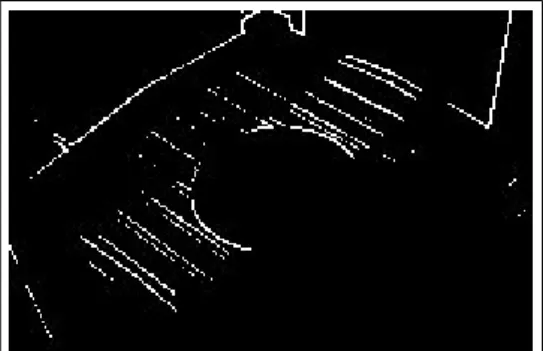
(BZ7) Sum the binary images obtained in (BZ6). (BZ8) Clean and thin the lines.
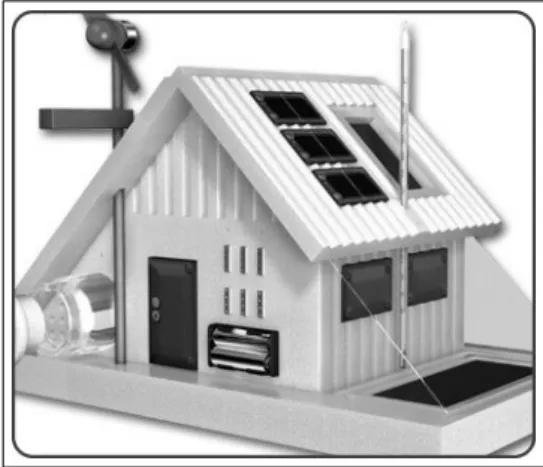
Fig 8. Example image
Fig 9. Edge image after Action 1
Fig 10. Edge image after Action 2
Fig 11. Edge image after Action 3
Fig 12. Edge image after BZ8
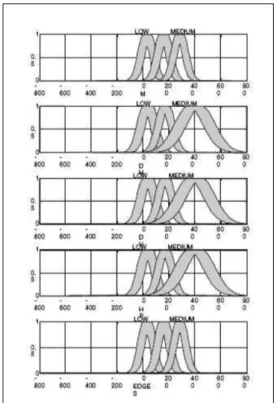
Second approach [33, 34]: the goal is to design a system which makes it easier to include edges in low con-trast regions, but which does not favor false edges by eect of noise. Because of this specications the authors design an Interval type 2 fuzzy system.
The system has 4 inputs and one output that is the degree of edginess of each pixel.
The input variables are the gradients with respect to x-axis and y-axis, to which they call DH and DV respec-tively. The other two inputs are the pixels ltered when
convolute two masks to the original image. One is a high-pass lter and the other a low-high-pass lter. The high-high-pass lter HP detects the contrast of the image to guarantee the border detection in relative low contrast regions. The low-pass lter M allow to detect image pixels belonging to regions of the input were the mean gray level is lower. These regions are proportionally more aected by noise, supposed uniformly distributed over the whole image.
Seven interval valued fuzzy rules allow to evaluate the input variables, so that the obtained image displays the ed-ges of the image in color near white (HIGH tone), whereas the background was in tones near black (tone LOW).
Fig 13. Interval valued membership functions designed for the input variables and the output
variable: Degree of edginess.
1. If (DH is LOW) and (DV is LOW) then (EDGES is LOW)
2. If (DH is MEDIUM) and (DV is MEDIUM) then (EDGES is HIGH)
3. If (DH is HIGH) and (DV is HIGH) then (EDGES is HIGH)
4. If (DH is MEDIUM) and (HP is LOW) then (EDGES is HIGH)
5. If (DV is MEDIUM) and (HP is LOW) then (EDGES is HIGH)
6. If (M is LOW) and (DV is MEDIUM) then (EDGES is LOW)
7. If (M is LOW) and (DH is MEDIUM) then (EDGES is LOW)
Third Approach [16]:the authors propose an intui-tionistic fuzzy divergence to deal with the uncertainty in
an edge pattern matching scheme. The intuitionistic fuz-zy set takes into account the uncertainty in assignment of membership degree known as hesitation degree.
The main idea behind template edge matching is to detect tipical intensity distributions that are usually in edges. The authors propose the following algorithm to deal with uncertainty present in the matching process by means of an intuitionistic divergence.
• Step 1. Form 16 edge-detected templates.
• Step 2. Apply the edge templates over the image by placing the center of each template at each point (i,j) over the normalized image.
• Step 3. Calculate the intuitionistic fuzzy divergen-ce (IFD) between each elements of each template and the image window and choose the minimum IFD value.
• Step 4. Choose the maximum of all the 16 minimum intuitionistic fuzzy divergence values.
• Step 5. Position the maximum value at the point where the template was centered over the image. • Step 6. For all the pixel positions, the max-min value
has been selected and positioned.
• Step 7. A new intuitionistic divergence matrix has been formed.
• Step 8. Threshold the intuitionistic divergence matrix and thin.
• Step 9. An edge-detected image is obtained. Experimental studies reveal that, for edge detection the result is completely dependent on the selection of he-sitation constant and thereby by the hehe-sitation degree (also called the intuitionistic fuzzy index). The intuitio-nistic method detects the dominant edges clearly, while removing the unwanted edges.
6. Segmentation
Image segmentation is a critical and essential compo-nent of image analysis and/or pattern recognition system and is one of the most dicult tasks in image processing, that can determine the quality of the nal result of the system.
The goal of image segmentation is the partition of an image in dierent areas or regions.
Denition 5 Segmentation is grouping pixels into re-gions such that
1. ∪k
i=1Pi = Entire image ({Pi} is an exhaustive
partitioning).
2. Pi∩Pj = 0, i6=j({Pi}is an exclusive partitioning).
3. Each regionPisatises a predicate; that is, all points
of the partition have some common property. 4. Pixels belonging to adjacent regions, when taken
jointly, do not satisfy the predicate.
There exist three dierent approaches using fuzzy methods:
• Histogram thresholding. • Feature space clustering. • Rule based systems.
There exist dierent works that use extensions of fuz-zy sets within the three approaches. The most commonly studied method is thresholding with extensions of fuzzy sets. The rst work on this topic was made by Tizhoosh [40].
One of the earlier papers of fuzzy thresholding is [36] in 1983. The idea behind the fuzzy thresholding is to rst transfer the selected image feature into a fuzzy subset by means of a proper membership function and then select and optimize a global or local fuzzy measure to attain the goal of image segmentation.
In [36] the authors used the S-function to fuzzify the image. They minimize the entropy in such a way that the nal segmented image is the one which has less doubtful pixels.
Said membership functions represent the brightness set within the image. The basic idea of using this member-ship function is that, if we take the value of a parameter as the threshold value, the dark pixels should have low membership degrees, and on the contrary, brighter pixels should have high membership degrees. The pixels with membership function near 0.5 should be the ones that are not clearly classied. Therefore the set with less entro-py is the set with less amount of pixels with uncertain membership (around 0.5).
In 2005 Tizhoosh [40] presented a paper that uses In-terval type 2 fuzzy sets in image thresholding (we must point out that he tries to use type 2 fuzzy sets, however in the paper he only uses Interval Type 2 fuzzy sets). His study is based on the modication of the classical fuzzy algorithm of Huang and Wang [29], so that he applies an
αfactor as interval generator to the membership function.
Starting from a membership function, Tizhoosh obtains an interval valued fuzzy set that contains dierent mem-bership functions and is useful for nding the threshold of an image.
Fig.14 Threshold as a fuzzy number used by Tizhoosh. Transformation of a FS into a IVFS.
He assigns each intensity with the following interval of membership, µU and µL being the upper and lower
membership degrees:
µL(g) =µ(g)α (3)
µU(g) =µ(g)1/α
Withα∈ (1,∞), and therefore 0 ≤µL(q)≤µU(q)≤ 1.
Sometimes parameter α can be interpreted as linguistic
edges.
Tizhoosh's idea for proposing his algorithm is to re-move the uncertainty of membership values by using type II fuzzy sets.
Vlachos and Sergiaidis [43] also propose a modication of Tizhoosh's algorithm, using Atanassov's intuitionistic fuzzy sets (see [1]). Their basis are membership functions similar to Huang's but, instead of minimizing the entro-py, the algorithm minimizes the divergence with set1 (seeˆ
[17]). The structure of the intuitionistic algorithm is the same as Tizhoosh's. The construction of the intuitionistic fuzzy sets is done in the following way:
µAˆ(g, t) =λµA(g, t) (4)
νAˆ(g, t) = (ˆ1−λµA(g, t))λ
With λ ∈ [0,1], being Aˆ an intuitionistic fuzzy set, and
the divergence: DIF S( ˆA,ˆ1, t) = L−1 X g=0 hA(g) µAˆ(g,t)ln 2µAˆ(g, t) 1 +µAˆ(g, t) +νAˆ(g, t)ln2 +ln 2 1 +µAˆ(g, t) (5)
Tizhooh's algorithm is applied directly to color seg-mentation using RGB in [35]. Moreover in [47] it's used to segment color image skin lesions.
But there exist an improvement of Tizhoosh algorithm, that arises from the selection of the membership functions. It was proved, that the membership functions that best represent the image are the ones used in [25, 29], that re-present how similar the intensity of each pixel is to the mean of the intensities of the object or to the mean of the intensities of the background. By dening the functions in this way, the set with lowest entropy is the set that contains the greatest number of pixels around the mean of the intensities of the background and the mean of the intensities of the object.
Starting form the idea of obtaining the uncertainty from the information given by the user, we have propo-sed several approximations using A-IFS [8, 9] (where the key point is to calculate the intuitionistic index) and also using interval valued fuzzy sets [7] (where the key point is to calculate the lengths of the intervals). These works lead us to introduce the concept of an ignorance function to try to model the lack of knowledge from which experts may suer when determining the membership degrees of some pixels of an image Q to the fuzzy set representing the background of the image, QB, and to the fuzzy set
representing the object in the image,QO.
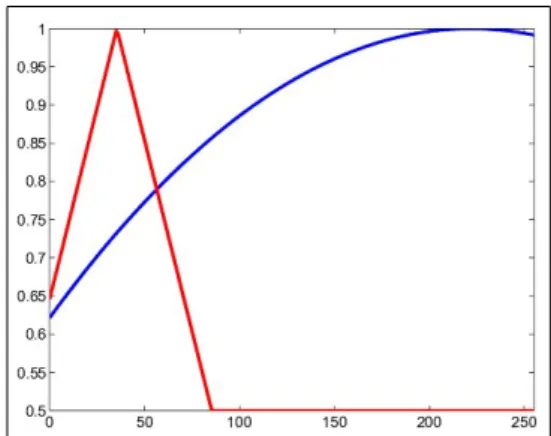
The classical fuzzy thresholding algorithm is modied due to the user should pick two functions, one to represent the background and another one to represent the object. We have chosen this representation since, in this way, the expert is able to get a better representation of the pixels for which he is not sure of their membership to the object
or the background. In Fig. 15 we show two membership functions, one to represent the background and the other to represent the object.
Fig 15. Two dierent membership functions to represent the background and the object with t=150
As we have already said in the previous paragraph, we are going to represent the images by means of two die-rent fuzzy sets. For this reason, in our proposed algorithm we introduce the concept of ignorance function Gu. Such
functions are a way to represent the user's ignorance for choosing the two membership functions used to represent the image (object and background). Therefore, in our al-gorithm we will associate to each pixel three numerical values:
• A value for representing its membership to the ba-ckground, which we will interpret as the expert's knowledge of the membership of the pixel to the background.
• A value for representing its belongingness to the object, which we will interpret as the expert's knowledge of the membership of the pixel to the object.
• A value for representing the expert's ignorance of the membership of the pixels to the background or to the object. This ignorance hinders the expert from making an exact construction of the member-ship functions described in the rst two items and therefore it also hinders the proper construction of step(a)of the fuzzy algorithm. The lower the value
of ignorance is, the better the membership function chosen to represent the membership of that pixel to the background and the one chosen to represent the membership to the object will be. Evidently, there will be pixels of the image for which the expert will know exactly their membership to the background or to the object but there will also be pixels for whi-ch the expert is not able to determine if they belong to the background or to the object.
Under these conditions, if the value of the function of ignorance (Gu) for a certain pixel is zero, it means that
the expert is positively sure about the belongingness of the pixel to the background or to the object. However, if the expert does not know at all whether the pixel belongs to the background or to the object he must represent its
membership to both with the value 0.5, and under these conditions we can say that the expert has total ignorance regarding the membership of the pixel to the background and the membership of the same pixel to the object.
In [13] a methodology is proposed to construct Ignorance functions.
Ignorance functions can be constructed from t-norms as the miimum or te product or other functions like the geometric mean that are not t-norms. We have proposed several ways to construct IVFSs from a fuzzy membership function and an ignorance function.
In [13] it's proved that solution provided by the IVFS algorithm is better than the solution provided by the fuzzy algorithm when wrong membership functions are chosen and for special type of images (ultrasound images) the ignorance functions are useful for fast segmentation.
Clustering: A very common method for segmenting images is clustering. The most studied algorithm for this purpose is the Fuzzy Cluster Means (FCM), which aims to nd the most characteristic point of each cluster, con-sidered its centroid, and the membership degree of every object to each cluster. Some authors have adapted this algorithm to type-2 fuzzy sets. In [30] Hwang et al. try to dene and manage the uncertainty of fuzziermin FCM.
They dene the lower and upper interval memberships using two dierent values of m. To manage
appropria-tely the uncertainty dened in an interval type-2 fuzzy set through all steps of FCM, they update cluster centers em-ploying type reduction and defuzzication methods using type-2 fuzzy operations.
In [24] Jurio et al. transform the original image into an interval valued fuzzy set and adapt the FCM to it. In order to do that, we calculate the distance between each pattern and each cluster by the interval-valued restricted equivalence function.
Fuzzy rule based systems:
Data driven methods have also used in image segmen-tation. Starting from man made segmentations as ground truth data, machine learning algorithms have been used to create intellingent systems devoted to segment similar images as the trainig ones. Neural networks are the most common, and also fuzzy rule based systems have provided good results.
In [14] we introduce an application of interval-valued systems to the segmentation of prostate ultrasound ima-ges. The system classies each pixel as prostate or back-ground. The input variables are the values of each pixel in dierent processed images as proximity, edginess and enhanced image. The system has 20 rules and is trained with ideal images segmented by an expert.
7. Final remarks and future trends
As a brief resume of the conclusions of all the works re-viewed using extensions of fuzzy sets in image processing, authors claim that the motivation of using extensions is their capability to deal with uncertainty present in all ima-ge processing steps. Looking to the results presented we can say that this research line is really promising. However we have found two points that we must notice:
1. All works that have been revised use interval type 2 fuzzy sets, although in the title are presented as
type-2 fuzzy sets. This occurs maybe due to the complexity of dealing with real type-2 fuzzy sets or due to the fact that it's really dicult to dene a type-2 fuzzy set.
2. Works dealing with intuitionistic fuzzy sets, do not use the complete information given by the intui-tionistic fuzzy sets. The non-membership does not represent anything. Authors use the hesitation in-dex πbut as we have seen in the introduction it is
equivalent to the length of an interval in IVFS. A really important conclusion is that all works can be done using Interval valued fuzzy sets. Therefore a problem of notation and work visibility is derived. Hence future research, form the extensions point of view, must focus on problems that denition and com-putation of general type 2 fuzzy sets are tractable. Al-so, nding applications or image representations in which membership and non-membership can be generated inde-pendently in order to use all of the power of A-IFSs, should be researched.
From the point of view of image processing algorithms point of view, extensions of fuzzy sets can also be used in video summarization or content image retrieval.
Acknowledgements: This work has been partially supported by POCI 2010 (Programa Operacional Cien-cia e Investigacao 2010), and by the Spanish Mini-stry of Education and Science under project referenceS TIN2010-15055 and TIN2011-29520.
References
[1] Atanassov K.: Intuitionistic fuzzy sets. Fuzzy Sets and Systems, 20, 87-96 (1986)
[2] Atanassov K.: Intuitionistic Fuzzy Sets. Theory and Applications, Physica-Verlag, Heidelberg (1999)
[3] Basu K., Deb R., Pattanaik P.K.: Soft sets: an ordi-nal formulation of vagueness with some applications to the theory of choice. Fuzzy Sets and Systems, 45, 4558 (1992)
[4] Bigand A. and Colot O.: Fuzzy lter based on interval-valued fuzzy sets for image ltering, Fuzzy Sets and Systems, (2009) doi:10.1016/j.fss.2009.03.010,
[5] Burillo P., Bustince H.: Entropy on intuitionistic fuzzy sets and on interval-valued fuzzy sets. Fuzzy Sets and Systems, 78, 3053016 (1996)
[6] Bustince H. , Burillo P.: Vague sets are intuitionistic fuzzy sets. Fuzzy Sets and Systems, 79, 403405 (1996) [7] Bustince H., Pagola M., Barrenechea E., Orduna R.:
Re-presentation of uncertainty associated with the fuzzica-tion of an image by means of interval type 2 fuzzy sets. Application to threshold computing. Proceedings of Eu-rofuse Workshop: New Trends in Preference Modelling, EUROFUSE,(Spain), 73-78 (2007).
[8] Bustince H., Mohedano V., Barrenechea E., Pagola M.: An algorithm for calculating the threshold of an image representing uncertainty through A-IFSs, Proceedings of
Information Processing and Management of Uncertain-ty in Knowledge-Based Systems, IPMU, Paris, 23832390 (2006)
[9] Bustince H., Barrenechea E., Pagola M., Orduna R.: Ima-ge Thresholding Computation Using Atanassov's Intui-tionistic Fuzzy Sets, Journal of Advanced Computational Intelligence and Intelligent Informatics, 11(2), 187194 (2007)
[10] H. Bustince, E. Barrenechea, M. Pagola, R. Orduna: Con-struction of interval type 2 fuzzy images to represent ima-ges in grayscale. False edima-ges, Proceedings of IEEE In-ternational Conference on Fuzzy Systems, London, 73-78 (2007)
[11] H. Bustince, D. Villanueva, M. Pagola, E. Barrenechea, R. orduna, J. Fernandez, J. Olagoitia, P. Melo-Pinto, and P. Couto,: Stereo Matching Algorithm using Interval Valued Fuzzy Similarity, FLINS 2008 - 8th International FLINS Conference on Computational Intelligence in Decision and Control, Spain ,1099-1104 (2008)
[12] H. Bustince, Barrenechea E, M. Pagola and J. Fernan-dez: Interval-valued fuzzy sets constructed from matrices: Application to edge detection, Fuzzy Sets and Systems, (2009) doi:10.1016/j.fss.2008.08.005
[13] H. Bustince, , M. Pagola, E. Barrenechea, J. Fernandez, P. Melo-Pinto, P. Couto, H.R. Tizhoosh and J. Montero: Ignorance functions. An application to the calculation of the threshold in prostate ultrasound images, Fuzzy Sets and Systems, (2009) doi:10.1016/j.fss.2009.03.005 [14] H. Bustince, G. Artola, M. Pagola, E. Barrenechea, H.
Ti-zhoosh,: Sistema neurodifuso intervalo-valorado aplicado a la segmentacion de imagenes de ultrasonidos, XIV Con-greso Español Sobre Tecnologias y Logica Fuzzy, Spain (2008)
[15] J. Canny: A computational approach to edge detec-tion, IEEE Transactions on Pattern Analysis and Machine Intelligence, 8, 679-698 (1986)
[16] Tamalika Chaira, A.K. Ray: A new measure using in-tuitionistic fuzzy set theory and its application to edge detection. Applied Soft Computing, 8(2), 919-927 (2008) [17] Chaira T. , Ray A. K.: Segmentation using fuzzy di-vergence. Pattern Recognition Letters, 24, 1837-1844 (2003)
[18] Cheng H., Jiang X. and Wang J.: Color image segmenta-tion based on homogram thresholding and region merging. Pattern Recognition, 35(2), 373-393 (2002)
[19] Deng J.L.: Introduction to grey system theory, Journal of Grey Systems, 1, 124 (1989)
[20] Deschrijver G., Kerre E.E.: On the relationship be-tween some extensions of fuzzy set theory. Fuzzy Sets and Systems, 133(2), 227235 (2003)
[21] Deschrijver G., Kerre E.E.: On the position of intuitio-nistic fuzzy set theory in the framework of theories mo-delling imprecision. Information Sciences, 177, 18601866 (2007)
[22] Ensa P. and Tizhoosh H., Type-2 fuzzy image enhance-ment, Lecture Notes in Computer Science, 3656, 159-166, (2005)
[23] Hirota K.: Concepts of probabilistic sets, Fuzzy Sets and Systems,5, 3146 (1981)
[24] Jurio A., Bustince H., Barrenechea E., Pagola M., Pa-ternain D., Ignorance-based fuzzy clustering algorithm. In 9th International Conference on Intelligent Systems Design and Applications, Pisa, Italia, 2009.
[25] Forero M.G.: Fuzzy thresholding and histogram analysis, Fuzzy Filters for Image Processing, Eds: M. Nachtegael, D. Van der Weken, D. Van de Ville, E.E. Kerre, Springer, 129-152, (2003)
[26] Gau W.L., Buehrer D. J.: Vague sets. IEEE Transactions on Systems, Man and Cybernetics, 23(2), 751759 (1993) [27] Grattan-Guinness I.:Fuzzy membership mapped onto interval and many-valued quantities. Z. Math. Logik Grundlag. Mathe., 22, 149160 (1976)
[28] M.M. Gupta, G.K. Knopf, P.N. Nikiforuk: Edge percep-tion using fuzzy logic, in Fuzzy Computing M.M. Gupta and T. Yamakawa (Editors) Elsevier Science Publishers, 35-51 (1988)
[29] Huang L.K., Wang M.J.: Image thresholding by mini-mimizing the measure of fuzziness, Pattern recognition, 28(1), 41-51 (1995)
[30] Cheul Hwang, Frank Chung-Hoon Rhee: Uncertain Fuzzy Clustering: Interval Type-2 Fuzzy Approach toC-Means,
IEEE Transactions on Fuzzy Systems, 15(1):107-120, (2007)
[31] Mendel J.M., John R. I.: Type-2 fuzzy sets made sim-ple. IEEE Transactions on Fuzzy Systems, 10(2), 117127 (2002)
[32] Mendel J.M.:Uncertain Rule-Based Fuzzy Logic Systems, Prentice-Hall, Upper Saddle River, NJ (2001)
[33] Mendoza, O., Melin, P., Licea, G.: Fuzzy Inference Syste-ms Type-1 and Type-2 for Digital Images Edge Detection. Journal of Engineering Letters, 15(1), 45-52 (2007) [34] Mendoza, O., Melin, P., Licea G.: A new method for edge
detection in image processing using interval type-2 fuz-zy logic, In Proceedings of Granular Computing, 151-156 (2007)
[35] Tehami, S., Bigand, A., Colot, O., Color Image Segmen-tation Based on Type-2 Fuzzy Sets and Region Merging, LECTURE NOTES IN COMPUTER SCIENCE, 4678, (2007)
[36] Pal S. K., King R. A. and Hashim A. A.: Automatic grey level thresholding through index of fuzziness and entropy.Pattern Recognition Letters. 1(3), 141-146 (1983) [37] Sambuc R., Function Φ-Flous, Application a l'aide
au Diagnostic en Pathologie Thyroidienne, These de Doctorat en Medicine, University of Marseille (1975)
[38] Szmidt E. and Kacprzyk J.:Entropy and similarity of intuitionistic fuzzy sets. In: Proc. Information Proces-sing and Management of Uncertainty in Knowledge-Based Systems, Paris, France, 2375-2382 (2006)
[39] Sun Z. and Meng G.: An image lter for eliminating im-pulse noise based on type-2 fuzzy sets. In: ICALIP 2008. International Conference on Audio, Language and Image Processing, 1278-1282 (2008)
[40] Tizhoosh H.R.: Image thresholding using type-2 fuzzy sets, Pattern Recognition, 38, 23632372 (2005)
[41] Tizhoosh H., Krel G. and Muchaelis B.:Locally Adapti-ve Fuzzy Image Enhancement, In: Computational Intelli-gence, Theory and Applications, proceedings of 5th fuzzy days, 272-276 (1997)
[42] Tulin Yildrim M., Basturk A. and Emin Yuksel M.:A Detail-Preserving Type-2 Fuzzy Logic Filter for Impulse Noise Removal from Digital Images, In Proc. FUZZIEEE, U.K., 751-756 (2007)
[43] Vlachos I. K. and Sergiadis G. D.: Intuitionistic fuzzy in-formation - Applications to pattern recognition. Pattern Recognition Letters, 28, 197-206 (2007)
[44] Vlachos I. and Sergiadis G.: The Role of Entropy in Intui-tionistic Fuzzy Contrast Enhancement, Lecture Notes in Computer Science, Foundations of Fuzzy Logic and Soft Computing, 104-113 (2007)
[45] Wang S.T., Chung F.L., Hu D.W. and Wu X.S.: A new Gaussian noise lter based on interval type-2 fuzzy logic systems, Soft Computing, 9, 398-406 (2005)
[46] Wei S. and Zeng-qi S.: Research on Type-2 Fuzzy Logic System and its application, Fuzzy Systems and Mathematics, 19, 126-135 (2005)
[47] M. Emin Yuksel, Senior Member, IEEE, and Murat Borlu, Accurate Segmentation of Dermoscopic Images by Image Thresholding Based on Type-2 Fuzzy Lo-gic, IEEE Transactions on Fuzzy Systems, (2009) doi: 10.1109/TFUZZ.2009.2018300
[48] Zadeh L.A.: Fuzzy sets, Information Control, 8, 338353 (1965)
[49] Zadeh L.A.: The concept of a linguistic variable and its application to approximate reasoning I. Information Sciences, 8, 199249 (1975)
[50] Zhonggui Sun; Guangwu Meng: An image lter for elimi-nating impulse noise based on type-2 fuzzy sets, ICALIP 2008, International Conference on Audio, Language and Image Processing, 1278-1282, (2008)