Hybrid Cloud Computing QoS Glitches
Lubna Luxmi Dhirani, Thomas NeweDepartment of Electronic and Computer Engineering University of Limerick
Limerick, Ireland.
[email protected], [email protected]
Shahzad Nizamani Department of Software Engineering Mehran University of Engineering and Technology
Jamshoro, Pakistan. [email protected]
Abstract—The Hybrid Cloud Computing model has been growing extensively due to its Infrastructure as a Service (IaaS) architecture, customisation and cost benefits. The hybrid cloud services are measured based on the Quality of Service parameters defined by the public cloud vendors. These parameters (i.e. availability, scalability, latency etc.) vary from vendor-to-vendor, developing complexity and confusion on the grounds of methods of service assessments. A Cloud Service Level Agreement (SLA) lists the QoS provisions to be provided to the tenant, the objectives, and exclusions. Regardless of vendors promised uptimes and service metrics, the tenants are susceptible to the following threats: data governance, Denial of Services, multi-tenancy, etc. Cloud computing has often been compared as a utility, but the basic different between a utility and the cloud is the amount of risk involved with data protection, provisioning and control. Few cloud standards have been developed for standardizing the hybrid cloud model but since each public cloud vendor provides different applications and services, these standards do not resolve the existing cloud QoS issue. Since each enterprise implementing the cloud and vendor supplying the services is diverse, a customized Trio (Cloud-IT-Business) QoS model is required to resolve the business need. The authors have designed a model to resolve this existing cloud QoS issue, the abstraction of the model is detailed in this paper.
Keywords—Hybrid Cloud computing, Quality of Service, Cloud Computing Standards, Cloud Fishbone.
I. HYBRID CLOUD COMPUTING
Cloud Computing is an IT-based service provided by different cloud vendors, these services differentiate based on the type of cloud architecture (i.e. public, private, hybrid and community) and delivery models (Infrastructure as a Service (IaaS), Platform as a Service (PaaS), Software as a Service (SaaS), etc.). Clouds computing supports large-scale distributed computing systems built on the key concepts of: computing as a utility, virtualized resources, on-demand computing, etcetera. These concepts have enabled the cloud platform as a promising platform for enterprises to outsource their IT operations [1].
Hybrid Cloud Computing blends two different architectures (public and private cloud) based on cloud tenants demand as shown in Fig.1. Hybrid cloud is majorly utilized by tenants who own premises private clouds and develop on-spot computational requirements for data processing. Hybrid cloud supports applications to run simultaneously on two different cloud architectures, eliminating cloud bursting situations or failovers.
Fig. 1. Hybrid Cloud Infrastructure QoS.
This paper focuses on the Hybrid Cloud QoS issues specifically the cost dimension and is divided into the following sections: Section II discusses the importance of Quality of Service in Cloud, IT and Business. Section III briefs the Cloud Quality Process Improvement and decision making in the cloud, Section IV discusses cloud cost and pricing models. Section V concludes the paper.
II. QUALITY OF SERVICE
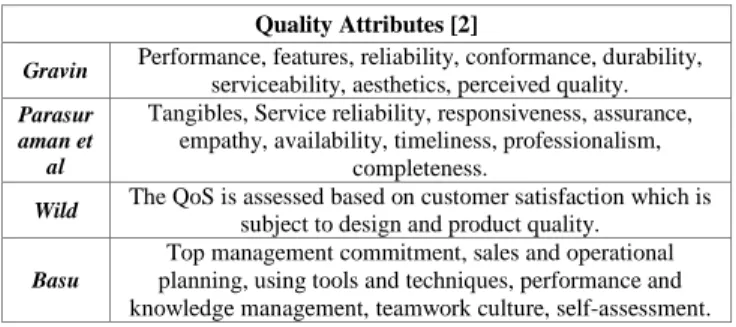
Quality of Service (QoS) is widely used by both IT and commercial service sectors to define accuracy, performance, efficiency, portability, security, etc. QoS is a Total Quality Management (TQM) [2] term and benchmarks an enterprises capability and Key Performance Indicators (KPIs) to measure the delivered QoS. The term Quality has been described differently by various authors as shown in Table I.
TABLE I. VARIOUS DESCRIPTIONS FOR QUALITY
Quality Attributes [2]
Gravin Performance, features, reliability, conformance, durability, serviceability, aesthetics, perceived quality. Parasur
aman et al
Tangibles, Service reliability, responsiveness, assurance, empathy, availability, timeliness, professionalism,
completeness.
Wild The QoS is assessed based on customer satisfaction which is subject to design and product quality.
Basu
Top management commitment, sales and operational planning, using tools and techniques, performance and knowledge management, teamwork culture, self-assessment. QoS has a significant impact on the overall success on any organization as it significantly affects the profit aspect. The total cost of quality is divided into costs associated to failure and controlling the issue. These factors are further categorized
into external/internal failure, design and appraisal costs as shown in Fig. 2.
Fig. 2. Costs associated to Quality Management [2]
The costs associated to QoS can further be are characterized into: actual costs and hidden costs, in terms of cloud implementations, the hidden costs (i.e. scrap, rework, loss of market share, lost customers, etc.) have a broader impact on the cloud vendors profits.
A. QoS in Cloud Computing
“The growth of cloud computing has been followed by strong demand for standards. The reason for this demand in based on: promoting interoperable platforms, open source middleware, avoiding vendor lock-in and ease the cloud migrations of tenants to vendor cloud-based services [3]”.
Quality of Service is defined through service metrics in a Service Level Agreement (SLA) document provided by the cloud vendor. The service metrics sometimes also referred as performance metric differentiate in terms of names and services provided. The QoS of cloud applications and services are measured in percentages ranging between 99.5-99.95%. Non-conformity of standards and metrics consistency leads to QoS breaches and SLA violations. Such issues contribute to more complexity in the Hybrid Cloud as private and public clouds implement different standards and QoS assessments. Table. II illustrates cloud standards implemented commercially by different cloud vendors at IaaS, PaaS and SaaS levels.
TABLE II. COMMONLY USED CLOUD STANDARDS
Cloud Standards IaaS
NIST. National Institute of Standards Technology describes metrics for assessing the cloud vendors capabilities.
ISO. International Organization for Standardization. ISO 27000 has been implemented by cloud vendors as a standard for security in the cloud computing ecosystem. This is a generic standard implemented by IT based companies and is not specifically designed for the cloud environment, which leads many QoS based issues unresolved [4].
Open Stack. OpenStack provides software tools for developing and managing cloud computing platforms [5] which is supported by a wide range of IT community, anticipating it as cloud future.
OVF. Open Virtualization Format is a known cloud IaaS standard providing virtualization capabilities, physical computing and cloud use cases advancing cloud tenants and vendors. It delivers an interoperable amd extensible packaging facilitating virtual machines (VMs) flexibility [4].
TOSCA. Topology and Orchestration Services for Applications [4] enables interoperablibility between IaaS and cloud applications.
Cloud Standards IaaS
OCCI. Open Cloud Computing Interface is a Protocol and API for different cloud management tasks at the IaaS layer [4]. OCCI has advanced into flexible APIs focusing on integration, portability, interoperability, and extensibility.
CIMI. Cloud Infrastructure Management Interface standardizes communications between cloud environments to achieve interoperable cloud infrastructure [4]. CIMI is a self-service interface for IaaS, allowing tenants dynamically provisioning, configuring and administering their cloud usage.
CDMI. Cloud Data Management Interface defines the functional interface which applications use to create, retrieve, update and delete data elements from the Cloud. The interface allows tenants to optimize the cloud storage capabilities and manage containers. This interface provides the following features [4]: manage containers, accounts, security access and monitoring/billing information, etc.
PaaS
CAMP. Cloud Application Management Protocol standardizes PaaS management interface and multi-cloud application management [4].
SaaS
There are no specific cloud based standards at the SaaS layer, though the following are some of the commonly implemented standards [4]: IP (v4, v6), TCP, SSL/TLS, HTML, XML, REST, etc.
Each standard differs based on functionality and cloud deployment architecture leaving the tenants under confusion over the standards feasibility and control.
B. QoS in Information Technology
To standardize IT based processes different software process models (i.e. SDLC, Waterfall, etc.) [6] and quality models (Capability Maturity Model (CMM), Capability Maturity Model-Integration (CMM-I) [7], LeanIT [8], IT Infrastructure Library (ITIL) [9]) are used. The aim of these tools was to reduce the delays building the projects, analyzing the requirements properly, reducing the number of defects and time-to-reach market and most importantly benchmarking the entire project stages assessing product efficiency.
The software process quality models have improved the Software development QoS and lifecycle, leading to lesser scrap, rework, cost and time factor. IT-based Companies deploying CMM Level 5, ITIL etc. hold more customers than their competitors, as the quality models depict the quality standards and product delivery in time creating more value. C. QoS in Business
TQM has been the core factor in the enterprises success strategy. QoS not only creates more customers and value but also saves costs associated to defects, time cost, and people cost. Re-engineering, Enterprise Business Process Management (EBPM), Change Management, etc. are strategies implemented as a part of QoS deployment. Wastage was referred with different names such as: the gold in the mine, quality costs, the cost of poor quality (COPQ) [10].
If COPQ: Ʃ (all costs) = 0
The above equation states that if COPQ is equal to 0 that means there are no quality problems [11] and this is what
enterprises and cloud deployments are meant to achieve. Quality costs may disappear if no defects are produced [12].
Quality models such as: TQM, Lean, Six Sigma, etc. were developed and implemented to ensure controlled quality and process improvements in business reducing the total number of defects. The Six Sigma model DMAIC approach statistically reduces the defects to 3.4 errors per million opportunities resulting in 99.999997% accuracy.
III. CLOUD – QUALITY PROCESS IMPROVEMENT Each enterprise has a different blueprint for hybrid clouds, the cloud SLAs are customized based on the tenant’s IT infrastructure, in such cases one quality model may not resolve the quality standards issue. This is the current practice which cloud vendors offer and lead to vendor lock-ins. The Cloud QoS model should be capable of translating each metric and assess the performance threshold. The metrics also require a path for further continuous improvement, improving operational effectiveness, providing a competitive advantage and a sustainable of growing Return on Investment (ROI).
Cloud TQM may assist in achieving sustainable progress in the tenant’s enterprise. With the essence of TQM, this paper particularly focuses on quality attributes contributing to waste costs. It also shows differences between tenant’s expectation and vendor perception gap on cloud QoS. As a tool TQM approach is capable of minimizing this deference (gap) gaining sustainable growth where Cloud system and their role could leverage sustainability of firm by minimizing cost. Cloud TQM’s aims towards achieving the following purposes: sustainable growth, cloud deployment model supporting enterprises sustainability, cloud System and cost minimizes approach [13]
Quality Planning (QP), Quality Control (QC), Quality Improvement (QI) are generic quality processes implemented by enterprises to control the QoS. To ensure Cloud Quality Process Improvement, it is important to align these processes with the tenant’s cloud strategy. Two of these processes cannot be controlled explicitly, the tenant’s SLA must have provisions to monitor and assess them together. The hybrid cloud is deployed to support the enterprises core business, keeping them separate will not allow the process to be monitored and controlled.
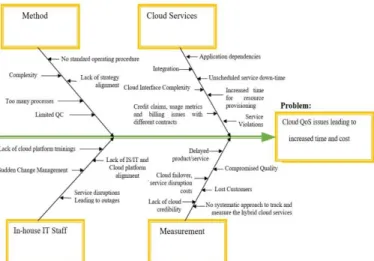
The authors illustrate an abstract Fishbone diagram for a cloud tenant, highlighting various quality issues leading to time delays and increased costs (See Fig.3). The fishbone [14] also given an insight over the importance of aligning and benchmarking the processes as a single unit.
The fishbone technique is also known as the Cause and Effect approach. This method identifies causes/reasons as a reference point and effects denote the problems with an enterprise. Causes may fall under one, few or all of the following states [15]: money, method, machines, material, marketing, measurement, management and maxims.
Fig. 3. Fishbone diagram for Cloud tenant (abstract use-case)
Cloud vendors claim that hybrid cloud setups can reduce the Total Cost of Ownership by 25% [16]. The Service Level Agreement which consists of offering and exclusions, limits these claims and the SLA does not guarantee uninterrupted or error free services.
Fig. 4 illustrates the abstract Cloud-IT-Business model and the necessity of merging, assessing and aligning the QoS parameters altogether.
Fig. 4. Cloud-IT-Business QoS
QoS is important for tenants, who assume cloud vendors to deliver the promised services, and for cloud vendors, who need to find the right tradeoffs between QoS levels and operational costs [17]. Discovering an optimal tradeoff is a tough decision, often aggravated by Service Level Agreements specifying QoS targets and economic penalties related to SLA breaches [18].
A. Decision-Making In The Cloud
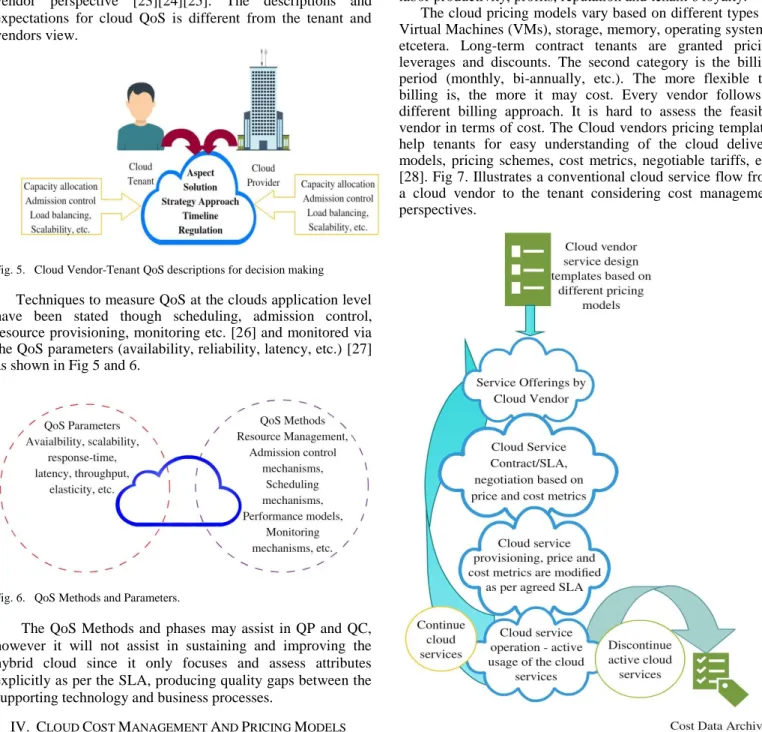
Decision making in the cloud is complex because the QoS metrics defined by cloud vendors fail to provide precise or accurate results. This happens because of multi-tenancy workload interference posed at the IaaS and PaaS levels. There are various SLA Management tools (i.e. IBM ITOM, Ansible, Microsoft Hybrid IT Management, etc.) [19] which assist in monitoring the SLA performance levels, but some of these tools require agent deployment on all machines leading to data control and privacy breach issues. Various authors [20][21][22] have discussed decision making (aspect, solution, strategy, timeline, regulation) in the cloud from tenant and vendor perspective [23][24][25]. The descriptions and expectations for cloud QoS is different from the tenant and vendors view.
Fig. 5. Cloud Vendor-Tenant QoS descriptions for decision making Techniques to measure QoS at the clouds application level have been stated though scheduling, admission control, resource provisioning, monitoring etc. [26] and monitored via the QoS parameters (availability, reliability, latency, etc.) [27] as shown in Fig 5 and 6.
Fig. 6. QoS Methods and Parameters.
The QoS Methods and phases may assist in QP and QC, however it will not assist in sustaining and improving the hybrid cloud since it only focuses and assess attributes explicitly as per the SLA, producing quality gaps between the supporting technology and business processes.
IV. CLOUD COST MANAGEMENT AND PRICING MODELS This section discusses the cloud cost management and criteria for pricing. Cloud tenants deploy hybrid clouds due to
flexibility, convenience and cost benefits (TCO). On-premises: upfront, on-going and operational expenses take out a high portion of the overall profits. Although with cloud deployments, tenants may be associated to distinct types of costs (i.e. deployment, integration, operational, vendor lock-in, in-direct (downtime), etc.). The cloud costs are calculated based on the usage metric. Each metric (i.e. network, storage, server, etc.) is assessed explicitly (reliability, availability, measuring type) and is billed accordingly. Tenants differ by different cloud service and application usage and require a different or customized Service Level Agreement (SLA). Sudden failovers potentially affect several areas, including labor productivity, profits, reputation and tenant’s loyalty.
The cloud pricing models vary based on different types of Virtual Machines (VMs), storage, memory, operating systems, etcetera. Long-term contract tenants are granted pricing leverages and discounts. The second category is the billing period (monthly, bi-annually, etc.). The more flexible the billing is, the more it may cost. Every vendor follows a different billing approach. It is hard to assess the feasible vendor in terms of cost. The Cloud vendors pricing templates help tenants for easy understanding of the cloud delivery models, pricing schemes, cost metrics, negotiable tariffs, etc. [28]. Fig 7. Illustrates a conventional cloud service flow from a cloud vendor to the tenant considering cost management perspectives.
The hybrid clouds cost management system may involve huge QoS complexity in federated, multi-cloud or cloud vendor sub-contracting/brokering situations as billing mechanisms and resource service provisioning are different for each cloud service vendor. Some vendors may direct the billing service between the tenant and subcontractor, but majority of vendors only direct the cloud resource provisioning whereas the billing incurs through the vendors interface. In such situations service disruptions and outage lead to various risks such as: insights, visibility and control.
The authors designed a cloud (use-case) fishbone highlighting the causes and effects raising QoS-based issues which need to be mitigated for cost reduction and error free service, sustaining and improving the cloud QoS parameters. Once a problem/error is diagnosed it may be incorporated in the QP phase and benchmarked for sustainable measures.
V. CONCLUSION
Cloud computing enables cloud tenants to improve the efficiency, availability and flexibility of their IT systems over time. With enterprises increased adaption towards the cloud platform, vendors are embracing the support for interoperable applications and services [4]. However, completely relying on Cloud Standards does not result into the anticipated QoS.
The Hybrid Cloud model provides maximum optimization of resources, mobility, convenience, cost benefits but it also comes with a set of limitations such as: data control, security, privacy issues, etc. The QoS solutions discussed by [16] and [27] are based on the application layer in the cloud architecture, it does not comprehend or resolve the various QoS issues in the hybrid cloud. These limitations occur because of a lack of understanding between the cloud vendors solution and tenant’s requirement analysis, deployment and migration.
Quality of Service issues lead to increasing the cost factor, scrap and rework for tenants who do not have complete control over the vendor provided services and data centers. The authors suggest aligning the cloud architecture with its existing IT infrastructure and the business strategy to assess the overall Cloud QoS performance levels. With the help of Quality models, the number of defects in the SLA can be reduced, since it focused on quality planning, control and improvement.
This paper discussed approaches for improving the cloud QoS by integrating the enterprises Total Quality Management and IT system with the cloud ecosystem. Cloud QoS is based on multiple factors but the authors specifically focused on the cost factors contributing to time-delays, scrap and re-work. Methods such as: fishbone technique has been discussed for analyzing the cloud QoS and way to reduce the IT-Cloud-Business quality gaps improving the service model.
ACKNOWLEDGMENT
This project is funded by the Erasmus Mundus LEADERS program.
REFERENCES
[1] A. Singh., A. Singh., A. J. Mahariba, “Cloud Federation Management and Beyond: Requirements, Relevant Standards, and Gaps,”
International Journal of Advance Research, Ideas and Innovations in
Technology, vol 3, no. 3, 2017. Accessed on: 03/03/2018 [Online].
Available on:
https://pdfs.semanticscholar.org/25e0/d7e86060d9b779de586ef1b5754b 18d58401.pdf
[2] R. Basu, Implementing Six Sigma and Lean: A Practical Guide to Tools and Techniques. Elsevier Butterworth-Heinemann, 2009.
[3] N. Borenstein and J. Blake, “Cloud Computing Standards: Where’s the Beef?,” IEEE Internet Computing, vol. 15, no. 3, pp. 74-78, 2011. [4] http://www.cloudwatchhub.eu/cloud-standards-guide. Accessed on:
03/03/2018.
[5] https://opensource.com/resources/what-is-openstack. Accessed on: 03/03/2018.
[6] S. H. Kan, Metrics and Models in Software Quality Engineering. 2nd Addison-Wesley Longman Publishing Co., Inc. Boston, MA, USA, 2002.
[7] www.cmminstitute.com Accessed on: 02/10/2018. [8] www.leanitassociation.com Accessed on: 02/10/2018. [9] www.itgovernance.com Accessed on: 02/10/2018.
[10] J. M. Juran, The Quality Control Handbook. 1st ed., New York, NY, McGraw-Hill, 1951.
[11] J. M. Juran, Juran on Leadership for Quality – An Executive Handbook. The Free Press NY, © Juran Institute Inc, 1989.
[12] J.J. Dahlgaard and S. M. Dahlgaard‐Park, “Lean production, six sigma quality, TQM and company culture,” The TQM Magazine, vol. 18, no. 3, pp. 263-281, 2006. [Online]. Available on: https://www.emeraldinsight.com/doi/full/10.1108/09544780610659998. Accessed on: 02/02/2018.
[13] A. Happy, “Could Cloud TQM Drive Sustainable Development?,” Advances in Business Information Systems and
Analytics, pp. 140-161, 2015.
[14] K. Ishikawa, Guide to Quality Control. Tokyo, Asian Productivity Organization, 1979.
[15] K. Ishikawa, What is Total Quality Control?, The Japanese Way. EnglewoodCliffs, Prentice Hall, 1985.
[16] https://pages.nokia.com/T001XT_Hybrid.Cloud.LargeEnterprise.LP.htm l. Accessed on: 03/31/2018.
[17] D. Ardagna, G. Casale, M. Ciavotta, J.F. Perez, W. Wang, W., “Quality-of-Service in Cloud Computing: modeling techniques and their applications,” Journal of Internet Secvices and Applications, vol 5, no. 11, 2014. Springer.
[18] D. Ardagna, B. Panicucci, M. Trubian, L. Zhang, L., “Energy-aware autonomic resource allocation in a multitier virtualized environments,”
IEEE trans Serv Computing, vol. 5, no. (1), pp. 2-19, 2012.
[19] L.L. Dhirani, T. Newe, S. Nizamani, ”Hybrid Multi-cloud Demystifying SLAs for customer benefit,” Paper accepted at 2018 2nd International
Conference on Cloud and Big Data Computing (ICCBDC 2018),
Barcelona, Spain.
[20] N. Bonvin, T. Papaioannou, K. Aberer, “An economic approach for scalable and highly-available distributed applications,” In: Proceedings of the 2010 IEEE 3rd International Conference on Cloud Computing,
CLOUD 2010, pp. 498–505, 2010. Miami, FL, USA.
[21] L. Agostinho, G. Feliciano, L. Olivi, E. Cardozo, E. Guimaraes, “A bio-inspired approach to provisioning of virtual resources in federated clouds,” In: Proceedings of the 2011 IEEE Ninth International Conference on Dependable, Autonomic and Secure Computing, DASC 2011, pp. 598–604, 2011. Sydney, NSW, Australia.
[22] W. Ellens, M. Zivkovic, J. Akkerboom, R. Litjens, H. van den Berg, “Performance of cloud computing centers with multiple priority classes,” In: Proceedings of the 2012 IEEE 5th International Conference
on Cloud Computing, CLOUD 2012, pp. 245–252, 2012. Honolulu, HI,
[23] Q. Zhu, T. Tung, “A performance interference model for managing consolidated workloads in QoS-aware clouds,” In: Proceedings of the 2012 IEEE Fifth International Conference on Cloud Computing,
CLOUD 2012, pp. 170–179, 2012. Honolulu, HI, USA.
[24] W. Wang, B. Li, B. Liang, “Towards optimal capacity segmentation with hybrid cloud pricing,” In: Proceedings of the 2012 IEEE 32nd International Conference on Distributed Computing Systems, ICDCS 2012, pp. 425–434, 2012. Macau, China.
[25] L. Wu, SK. Garg, R. Buyya, “SLA-based admission control for a software-as-a-service provider in cloud computing environments,” J
Comput Syst Sci 2012, vol 78, no. 5, pp. 1280–1299, 2012.
[26] M. Jelassi, C. Ghazel, L. Saidane, "A survey on quality of service in cloud computing," 2017 3rd International Conference on Frontiers of
Signal Processing (ICFSP), 2017.
[27] H. H. Ramadan, D. Kashyap, “Quality of Service (QoS) in Cloud Computing,” International Journal of Computer Science and
Information Technologies, vol. 8, no. 3, pp. 318-320, 2017.
[28] T. Erl, Z. Mahmood, Z. and R. Puttini, R., Cloud Computing Concepts Technology & Architecture. Prentice Hall, 2013.