E-Module Based Problem Solving in Basic Physics
Practicum for Science Process Skills
https://doi.org/10.3991/ijoe.v15i15.10942
Darmaji, Astalini, Dwi Agus Kurniawan (), Hanaiyah Parasdila, Iridianti
Universitas Jambi, Jambi, Indonesia [email protected]
Susbiyanto
Eotvost Lorand University, Budapest, Hungary
Kuswanto, Muhammad Ikhlas
Central Luzon State University, Science City of Munoz, Philippines
Abstract—This paper presents the research on e-modules is based on
prob-lem solving for science process skills. E-modules are made with the stages of development, implementation, and evaluation adopted from the Branch. The purpose to see the science process skills and physical education students' per-ceptions of Universitas Jambi after using e-module basic physics lab-based sci-ence process skills using the model of problem solving using kvisoft applica-tion.
Keywords—E-module, Problem Solving, Basic Physics, Science Process Skills
1
Introduction
student interaction with learning resources has a profound effect on learning outcomes [5].
Learning resources are all things that can facilitate students in obtaining a number of information, knowledge, experience, and skills in the teaching and learning pro-cess. Teaching materials are a set of learning tools or tools that contain learning mate-rials, methods, boundaries, and ways to evaluate systematically and attractively de-signed in order to achieve the expected goals, namely achieving competence or sub-competency with all its complexity [6]. These materials are very important in making knowledge accessible to students and can encourage students to engage with knowledge in various ways [7]. In [8], the author believe that Learning resources are instruments used in presenting and transmitting educational content to students. In addition, learning resources are also supporting materials available for use by teachers in classes and reading material for students [9]. The use of teaching materials in the learning process has benefits for students, among others, generating motivation, de-veloping creativity, arousing prior knowledge, encouraging the process of understand-ing, thinking and logical reasonunderstand-ing, communication and interaction of students, and contributing to the development of different skills and the acquisition of values stu-dents, as well as retention of the desired knowledge, skills, and attitudes [10].
One of the learning resources used in learning carried out in the laboratory is a practicum module. The practicum module is a module compiled to assist in the im-plementation of practicum which contains the experimental title, objectives, theoreti-cal basis, tools and materials, and questions that lead to goals following the rules of scientific writing [11]. Instructions for practicum as one of the learning resources in practical activities should be a guide for students in developing science process skills [12]. Science process skills are skills that make it easier for students to understand abstract concepts if they learn through concrete objects and are done alone by students through direct learning experience [13]. Therefore, it is important in the basic physics practicum guide to contain aspects of science process skills.
One of the software used in converting printed modules in the form of flipbook-shaped e-modules is the Kvisoft flipbook maker. The application of flipbook maker software is one of the applications that support it as a learning media that will assist in the learning process because the application is not only fixed on writings but it can be included in a motion animation, video, and audio that can make an interactive learn-ing media interestlearn-ing so learnlearn-ing becomes not monotonous [17].
Basic physics experiment module that has been modified into a form of e-modules using kvisoft application has many benefits, which can be accessed offline or online via Smartphone or tablet. Teaching materials developed using information and com-munication technology products can stimulate students' thoughts, feelings, concerns and interests in a process that is more effective [18]. Learning uses technology through teaching materials so that students can manage learning activities according to their flexible time and activities [19].
The purpose of this study is to develop teaching materials in the form of e-modules by using the kvisoft flipbook maker application and knowing how students' percep-tions relate to the e-module that will be developed.
2
Methodology
This research is a development, implementation, and evaluation research with:
In the development stage, the basic physics practicum module that is available is then made into a Kvisoft-based software design rule. Development of e-modules validated by experts to test the validity of the product and the final result of the e-module development process is the design of e-e-modules which will be implement-ed in the next process.
In the implementation phase, problem solving based e-module based on basic physics using the prepared kvisoft application is implemented in accordance with its role and function as e-learning which can facilitate basic physics practicum in the hope that system users can use it well and can improve student understanding practicum material to be delivered. In addition, the use of kvisoft-based e-module can make it easier for students in terms of mobile-based use and can be carried eve-rywhere without having to carry printed basic physics modules. The final result of the implementation process is a problem solving basic physics practicum module using the Kvisoft application that can help the basic physics practicum process for students.
In the evaluation phase, the process carried out was to look at the science process skills of students and students' perceptions of the use of problem solving based physics practicum modules using the Kvisoft application using observation sheets and perception questionnaires.
phys-ics basic e- module using the kvisoft application . The instruments used in this study were observation sheets and perception questionnaires. The observation sheet is used to measure science process skills of students with category 1 = very bad, 2 = not good, 3 = good, and 4 = very good. Science process skills observed are 16 indicators with a total of 60 statements. Whereas the perception questionnaire was used to de-termine students' perceptions of the use of Kvisoft-based basic physics E-module with a total of 20 statements with a range of categories 1 = very low, 2 = low, 3 = moder-ate, 4 = high, and 5 = very high. For category perceptions questionnaire listed in Table 1:
Table 1. Category Perception students
Interval Category
20.0 – 36.0 Vary Not Good 37.0 – 52.0 Not Good 53.0 – 68.0 Enough 69.0 – 84.0 Good 85.0 – 100.0 Very Good
Data obtained through observation sheets were analyzed using inferential statistics with t test (Independent sample t-test) with the help of SPSS 24 computer program. While perception questionnaire data were analyzed using descriptive statistics assisted by SPSS 24 computer program.
3
Results and Discuss
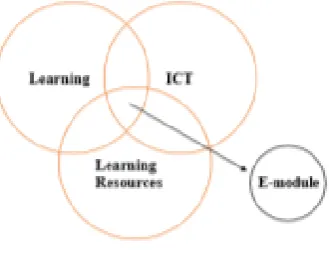
Fig. 1. Diagram of the Relation of Learning, ICT, and Learning Resources
Learning activities are designed so that students can actively construct concepts, laws or principles through the stages of observing, formulating problems, submitting hypotheses, collecting data, drawing conclusions and communicating concepts or principles found. As long as the learning activities take place, of course all students need learning resources as a tool that is used as a source of learning information. Teaching materials have various types consisting of printed and non-printed teaching materials. Print teaching materials consist of books, handouts, and modules.
Along with the advancement of information technology, teaching materials used in the learning process also develop and innovate for the advancement of education. One of the beneficiaries of information technology is the world of education. E-Learning processes can be defined as teaching-learning processes through support for infor-mation and communication technologies (ICT) [21]. The use of e-learning as teaching and learning tools is now rapidly expanding into education, with thousands of courses offered by educational institutions [22]. Education uses information technology as a learning medium, as well as increasing the capacity of lecturers and students to im-prove the quality of education. The most frequent type of learning resource used are: E-journal, E-book, E-module, full text database (aggregate), indexing and abstract database, reference database (biography, dictionary, directory, encyclopedia, etc.), numerical and statistical databases, images and audio-visual resources [23]. All of these resources are an advantage, when you come to learning and teaching activities [23].
The use of information technology is one important factor that allows the speed of transformation of knowledge to students. Research by utilizing information and com-munication technology, one of which is the development of printed module teaching materials into electronic-based modules, better known as E-Modules.
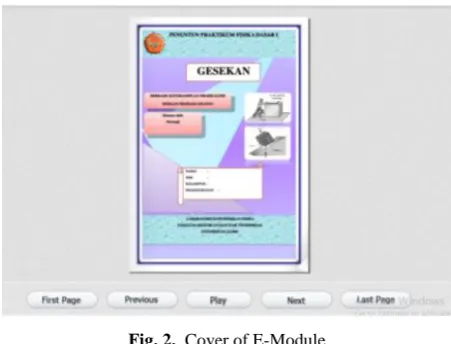
Fig. 2. Cover of E-Module
Figure 2 is the cover of an e-module for basic physics practicums with friction ma-terial
Fig. 3. Table of Contents of E-Module
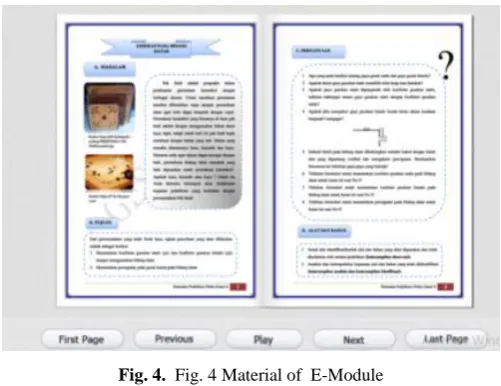
Fig. 4. Fig. 4 Material of E-Module
Figure 4 is the material contained in the e-module for basic physics practicums with friction material
Fig. 5. Work Procedures of E-Module
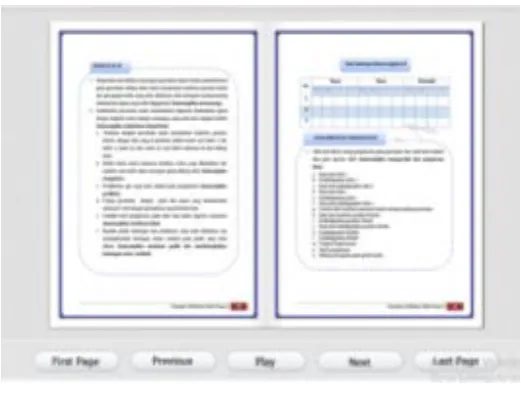
Fig. 6. Data Analysis of E-Module
Figure 6 is a data analysis used using e-modules for basic physics practicums with friction material
Fig. 7. References of E-Module
lan-guage that is easy to understand and communicative [24]. After obtaining validation and being feasible to use as a learning device, the implementation phase is imple-mented. Implementation is carried out in small groups to find out student perceptions of modified guides. The implementation was carried out to 144 students who took basic physics practicum out of a total of 300 students.
After the basic physics e-module based on problem solving using the Kvisoft ap-plication modified, basic physics based e-module based on problem solving using the Kvisoft application was implemented in a small group of students in basic physics practicum to see science process skills and student perceptions of e-use kvisoft based module. Practical activity was more effective in fostering students of the acquisition of science process skills [25]. The following is presented the results of student percep-tions analyzed using descriptive statistics shown in table 2.
Table 2. Students’ Perception
Category
Mean Std. Deviation Min Max %
Interval Attitude Total
20.0 – 36.0 Very Not Good 0
3.6394 39 95
0.0
37.0 – 52.0 Not Good 9 6.3
53.0 – 68.0 Enough 45 0.48502 31.3
69.0 – 84.0 Good 67 46.5
85.0 – 100.0 Very Good 23 15.9
TOTAL 144 100
From table 2, which came from 144 respondents from physics education program in universitas jambi and processed results using the SPSS program application, it was perceptions to e-module have a good category of 46.5% for a67 total of 144 students, enough at 31.3% for a total of 45 out of 144 students, very good at 15.9% for a total of 23 out of 144 students, and not good at 6.3% for a total of 9out of 144.
Based on student perception data collected from perception questionnaires at Jambi University Physics Education students, it can be seen that students' perceptions of using basic physics based e-module based on problem solving using Kvisoft applica-tion are high with a mean value of 3.6394 supported by low standard deviaapplica-tion values 0.48502 which means that the use of e-modules for students is very needed and help-ful. e- module is often conferred to be more effective than face-to-face learning [26].
This is because the use of problem solving based physics basic e-module using the Kvisoft application is simpler in its use than carrying printed modules. The ad-vantages of e-module as a particular medium is a more effective than printed module [27].
Table 3. Independent Sample t-test
T df Mean Std.Deviation 95% confidence interval
Lower Upper
Student perceptions in e-modules
19.624 144 3.0906 .24321 18.234 .6120 19.624 138.067 2.2033 .30015 17.985 .8615
From table 3 it can be seen that the value of t obtained (tcount) with ttable values. The value of t table can be found in table 3 statistics at the significance of 0.025 (2-sided test) with degrees of freedom (df) 144. In this study the results for ttable are 1.97658. While for the value of tcount can be seen in table 3. (Column t) which is 19,624. The hypothesis testing criteria is the value of tcount is greater than the value of ttable, there is a rejection of H0 [28]. So, it can be concluded that there are significant differences in mastery of science process skills between physics education students who use Kvisoft-based e-modules and do not use basic physics practicum e-modules. It can be seen from table 3 that the mean value of students 'science process skills is 3.0906, which means that the use of e-modules can train students' science process skills.
Based on the data obtained from the implementation of process-based e-modules, it can be seen that the use of e-modules is effective in training student science pro-cessing skills. This is based on e-module is part of e-learning, where the use of e-learning in e-learning makes the e-learning process can be carried out continuously. Be-sides that E-learning is a solution in offering various possibilities for social networks so that in this way the teacher can store various records of student interactions in col-laborative learning [16]. And students are motivated to learn in class because of the comfortable laboratory space that makes students eager to go to the laboratory [29].
Through learning to use products from information and communication technology various multimedia services can be easily transferred, such as audio, video, graphics that have high resolution so that the thinking process can lead to thinking [29]; [30]. Added also the advantages of using e-learning is that students can interact not only in two directions but can be done multi-purpose. where science use skills can be used through e-modules, where the use of e-modules utilizes media such as comput-ers/laptops, events that make smart phones students interested and motivated [31]; [32].
4
Conclusion
5
Acknowledgement
We would like to thank to head of laboratory, Physics Education’ lecturers, and students who helped this research.
6
References
[1]Astalini, Kurniawan, D. A., Perdana, R., & Kurniawan, W. (2019). Identification Attitudes of Learners on Physics Subjects. EST Journal of Educational Science and Technology, 5(1), 39-48. https://doi.org/10.26858/est.v5i1.8231
[2]Kurniawan, D, A., Astalini., & Anggraini,L. (2018). Evaluasi Sikap SMP Terhadap IPA di Kabupaten Muaro Jambi. Jurnal Ilmiah Didaktika: Media Ilmiah Pendidikan dan Pengaja-ran. 19(1), 123-139.
[3]Hidayat, H., Kusumaningrum, I., & Mardin, A. (2017). Needs Analysis of Entrepreneur-ships Pedagogy of Technology and Vocational Education with Production Base Learning Approach in Higher Education. International Journal on Advanced Science, Engineering and Information Technology, 7(5), 1701-1707. https://doi.org/10.18517/ijaseit.7.5. 1510
[4]Kyriakides, L. & Creemers, B. P. M. (2008). “Using a Multidimensional Approach to Measure the Impact of Classroom Level Factors upon Student Achievement: a Study Test-ing the Validity of the Dynamic Model”. School Effectiveness and School Improvement, 183-306. https://doi.org/10.1080/09243450802047873
[5]Butcher. (2006). Designing Learning: From Module Outline to Effective Teaching, Ox-ford: Routledge. https://doi.org/10.4324/9780203968482
[6]Fajriah, Ulfah Nur, Madziatul Churiyah, (2016). Utilizing InstructionalMedia for Teaching Infrastructure Administration, Journal ofEducation and Practice, Vol.7, No.6.
[7] Linda, R., Herdini, H., & Putra, T. P. (2018). Interactive E-Module Development through Chemistry Magazine on Kvisoft Flipbook Maker Application for Chemistry Learning in Second Semester at Second Grade Senior High School. Journal of Science Learning, 2(1), 21-25. https://doi.org/10.17509/jsl.v2i1.12933
[8]Bušljeta, R. (2013). Effective Use of Teaching and Learning Resources. Czech-Polish His-torical and Pedagogical Journal, 5(2), 55-70. https://doi.org/10.2478/cphpj-2013-0014 [9]Bizimana, D., & Orodho, J. A. (2014). Teaching and learning resource availability and
teachers’ effective classroom management and content delivery in secondary schools in Huye District, Rwanda.
[10]Harrison, F. (2003). Using learning resources to enhance teaching and learning. Center For Education Development: London
[11]Hofstein, A., & Lunetta, V. N. (2004). The laboratory in science education: Foundations for the twenty‐first century. Science education, 88(1), 28-54.https://doi.org/10. 1002/sce.10106
[12]Gobaw, G. F., & Atagana, H. I. (2016). Assessing Laboratory Skills Performance in Un-dergraduate Biology Students. Academic Journal of Interdisciplinary Studies, 5(3), 113. https://doi.org/10.5901/ajis.2016.v5n3p113
[13]Karamustafaoğlu S (2011). Improving the Science Process Skills Ability of Science Stu-dent Teachers Using I Diagrams. Eurasian J. Phys. Chem. Educ. 3(1):26-38.
Se-ries (Vol. 895, No. 1, p. 012009). IOP Publishing. https://doi.org/10.1088/1742-6596/895/1/012009
[15]Divayana, D. G. H., Santiyadnya, N., Ratnaya, I. G., Sudirtha, I. G., & Darmayasa, I. P. (2019). Digital book for assessment and evaluation courses based on Kvisoft-kelase asyn-chronous pattern. TELKOMNIKA, 17(1), 328-336.https://doi.org/10.12928/telko mnika.v17i1.9764
[16]Nindy Apsari, A., & Kustijono, R (2017). Development Of E-Book Using Kvisoft Flip-book Maker To Train Science Process Skill For Senior High School Students In Curricu-lum 2013. Inovasi Pendidikan Fisika, 6(3).
[17]Fonda, A., & Sumargiyani, S. (2018). The Developing Math Electronic Module With Sci-entific Approach Using Kvisoft Flipbook Maker Pro For Xi Grade Of Senior High School Students. Infinity Journal, 7(2), 109-122.https://doi.org/10.22460/infinity. v7i2.p109-122
[18]Yondri, S., Irfan, D., Putri, M., Zaus, M. A., & Islami, S. (2019). Evaluation of Packet Tracer Application Effectiveness in Computer Design Networking Subject. International Journal on Advanced Science, Engineering and Information Technology, 9(1), 54-59002E. https://doi.org/10.18517/ijaseit.9.1.5931
[19]Idris, N., Hashim, S. Z. M., Samsudin, R., & Ahmad, N. B. H. (2017). Intelligent learning model based on significant weight of domain knowledge concept for adaptive e-learning. International Journal on Advanced Science, Engineering and Information Technology, 7(4-2), 1486-1491. https://doi.org/10.18517/ijaseit.7.4-2.3408
[20]Branch, R. M. (2009). Instructional design: The ADDIE approach (Vol. 722). Springer Science & Business Media. https://doi.org/10.1007/978-0-387-09506-6
[21]Aoki, K. (2010). The Use of ICT and e-Learning in Higher Education in Japan. World Academy of Science, Engineering & Technology, 66, 868-872.
[22]Martínez-Caro, E., Cegarra-Navarro, J. G., & Cepeda-Carrión, G. (2015). An application of the performance-evaluation model for e-learning quality in higher education. Total Quality Management & Business Excellence, 26(5-6), 632-647. https://doi.org/10.1080/ 14783363.2013.867607
[23]Anshari, M., Alas, Y., & Guan, L. S. (2016). Developing online learning resources: Big data, social networks, and cloud computing to support pervasive knowledge. Education and Information Technologies, 21(6), 1663-1677. https://doi.org/10.1007/s10639-015-9407-3
[24]Sohn, W. S., Ko, S. K., Lee, K. H., Kim, S. H., Lim, S. B., & Choy, Y. C. (2001). Stand-ardization of eBook documents in Korean industry. Computer Standards & Interfaces , 45-60. https://doi.org/10.1016/S0920-5489(01)00103-9
[25]Noesgaard, S. S., & Ørngreen, R. (2015). The Effectiveness of E-Learning: An Explorative and Integrative Review of the Definitions, Methodologies and Factors That Promote e-Learning Effectiveness. Electronic Journal of E-learning, 13(4), 278-290.
[26]Nwagbo, C., & Chukelu, U. C. (2011). Effects of biology practical activities on students’ process skill acquisition. Journal of the Science Association of Nigeria (JSTAN), 46(1), 58, 70.
[27] Welsh, E. T., Wanberg, C. R., Brown, K. G., & Simmering, M. J. (2003). E‐learning: emerging uses, empirical results and future directions. International Journal of Training and Development, 7(4), 245-258. https://doi.org/10.1046/j.1360-3736.2003.00184.x [28]Cramer, D. (2003). Advanced quantitative data analysis. McGraw-Hill Education (UK). [29]Karyotaki, M., & Drigas, A. (2015). Online and other ICT Applications for Cognitive
[30]Xing, Lifu. (2018). Evaluation of Physical Education Multimedia Teaching for Data As-similation. International Journal of Online and Biomedical Engineering. 14(4). 30-42. https://doi.org/10.3991/ijoe.v14i04.8366
[31]Romero, S., Guenaga, M., Garcia-Zubia, J., & Orduna, P. (2015). Automatic Assessment of Progress Using Remote Laboratories. International Journal of Online and Biomedical Engineering. 11(2), 49-54. https://doi.org/10.3991/ijoe.v11i2.4379
[32]Astalini, Kurniawan, D. A., Perdana, R., & Kurniawan, W. (2019). Identification Attitudes of Learners on Physics Subjects. EST Journal of Educational Science and Technology, 5(1), 39-48. https://doi.org/10.26858/est.v5i1.8231
[33]Kurniawan, D, A., Astalini., & Anggraini,L. (2018). Evaluasi Sikap SMP Terhadap IPA di Kabupaten Muaro Jambi. Jurnal Ilmiah Didaktika: Media Ilmiah Pendidikan dan Pengaja-ran. 19(1), 123-139.
[34]Astalini, A., Kurniawan, D. A., Sulistiyo, U., Perdana, R., & Susbiyanto, S. (2019). E-Assessment Motivation in Physics subjects for Senior High School. International Journal of Online and Biomedical Engineering (iJOE), 15(11), 4-15. https://doi.org/10.3991/ijoe. v15i11.10843
7
Authors
Darmaji is associate professor and member Group Research ASPS (Attitude to-wards Physics and Science Processing Skills).Physics Education Program, Universitas Jambi, Jalan Raya Jambi – Ma. Bulian, KM 15, Mendalo Indah, Jambi, 36361, Indo- Paper—E-Module Based Problem Solving in Basic Physics Practicum for Science Process Skills nesia. Her research interest include E-Assessment and Evaluation spe-cially in Attitude Towards Physics and Science Processing Skills (Email:
Astalini is associate professor and leader Group Research ASPS (Attitude towards Science and Science Processing Skills). Because attitude towards science is very im-portant for life now, students who have the attitude of science are needed in the pre-sent because modern society is very dependent on science. Science Education Pro-gram, Universitas Jambi, Jalan Raya Jambi – Ma. Bulian, KM 15, Mendalo Indah, Jambi, 36361, Indonesia. Her research E-Assessment and Evaluation specially in Attitude towards Physics and Science Processing Skills. (Email: [email protected])
Susbiyanto is a doctoral student in Eotvost Lorand University, 1075 Budapest, Kazinczy U. 23-27, Budapest, 1075, Hungary (Email: [email protected])
Kuswanto is a postgraduate student in Central Luzon State University, Science City of Munoz, Philippines (Email: [email protected]).
Muhammad Ikhlas is a postgraduate student in Central Luzon State University, Science City of Munoz, Philippines (Email: [email protected]).
Hanaiyah Parasdila is a graduate students at universitas Jambi and member Group Research ASPS (Attitude towards Physics and Science Processing Skills).Science Education Program, Universitas Jambi, Jalan Raya Jambi – Ma. Bu-lian, KM 15, Mendalo Indah, Jambi, 36361, Indonesia. Her research interest include E-Assessment and Evaluation specially in Science Processing Skills (Email: [email protected])
Irdianti is a graduate students at universitas Jambi and member Group Research ASPS (Attitude towards Physics and Science Processing Skills).Science Education Program, Universitas Jambi, Jalan Raya Jambi – Ma. Bulian, KM 15, Mendalo Indah, Jambi, 36361, Indonesia. Her research interest include E-Assessment and Evaluation specially in Science Processing Skills (Email: [email protected]).