SHIV SHAKTI
International Journal in Multidisciplinary
and Academic Research (SSIJMAR)
Vol. 5, No. 5, October 2016 (ISSN 2278 –
5973)
Influence Of Quality Of Work Life On Organizational
Commitment Amongst Employees In Manufacturing
Sector
DR. RASHMI KODIKAL
Associate Professor, MBA Department, PA Engineering College, Mangalore
HABEEB UR RAHIMAN
Asst. Professor, MBA Department, PA Engineering College, Mangalore
Impact Factor = 3.133 (Scientific Journal Impact Factor Value for 2012 by Inno Space Scientific Journal Impact Factor)
Global Impact Factor (2013)= 0.326 (By GIF)
Indexing:
ABSTRACT
Improving the work quality of employees and retaining them in the
organisation has always been a herculean task for the managers. QWL and
organisational commitment are two issues that are given paramount
importance by behavioural scientists. Keeping this in mind, this research paper
investigates the means that exists between the two variables. A sample of 115
employees was used for the investigation. For the purpose of data collection, a
sets of questionnaire as distributed among the employees in various
manufacturing sector and same were used for statistical analysis. The obtained
results via Mannwhitney Test, P test, correlation and linear regression showed
that there is low level of relationship between quality of work life and
organizational commitment. This study contributes to the existing literature
and suggests some human resource development strategies to improve quality
of work life, so that commitment of employees could improve.
KEYWORDS:
Quality of work life, Organizational commitment, manufacturing sector
Quality of work life (QWL) has been the major concern of the human resource
(HR) practitioners in today’s era. The policies regarding the bringing changes
in QWL started from 1960’s. Countries like Europe and US have conducted
various experiments towards enhancing the quality of work. (Gallie 2003,
Martel and Depuis, 2006). In India too various facets of QWL have been
studied since the late 1990s. Before independence, the concept of quality of
work life was not in practice for various reasons. In India various initiatives
has been introduced since then to justify quality in work place. Some of the
momentums are Factories Act 1948, Employees state insurance Act 1948,
Employees Compensation Act 1923, Maternity Benefit Act 1961, Employees
Provident Fund and Miscellaneous Provisions Act 1952, Payment of Gratuity
Act 1972 etc. to name a few.
Historically the concept of quality of work life had originally included only
the issues of wage, working hours and working conditions (Sekharan 1985).
However, the concept has now been expanded to include such factors as the
extent of workers involvement in the job, their level of satisfaction with
various aspects with work environment, their perceived job competence,
accomplishment on the job. The relationship between QWL and organizational
commitment (OC) is an area that has tapped the curiosity of the HR managers
whether QWL leads to increased OC is an area that researchers have looked in
The past studies have founded that, besides providing a conductive
environment to the employees, gaining their trust and commitment is another
challenge found by HR managers. Organizational commitment strengthens
employees positive attitude and can be contrasted with other work related
attitudes, such as job satisfaction and organizational identification etc.
Employees committed attitude has major impact towards improvement of
organizational behavior. From the view point of Allen and Meyer (1997),
there are three “mind sets” which can charactarise an employee’s commitment
to the organization. Affective commitment, Continuance (rational)
commitment and Normative (loyalty) commitment. Affective Commitment
refers to emotional attachment, identification with and involvement of an
employee in the organization; i.e. an employee intrinsically desires to continue
in the organization. Continuance Commitment arises out of knowledge about
costs associated with leaving the organization; i.e. the employee thinks that it
is his or her need to continue working in the organization. Finally, Normative
Commitment reflects a feeling of obligation to give back to the organization
and an employee high on Normative Commitment would continue because he
or she ought to do so.
LITERATURE REVIEW
For the better understanding of the nexus between QWL and Commitment, the
researchers have received articles from 1970’s onwards. Assuming of the articles
A. Gani and Riyaz Ahmad (1995) concludedthat, thereare four categories
working environment factors, relational factors, job factors, and financial
factors. The results of the study show that adequate financial returns from the
job, besides desire for job security, better working conditions and
advancement opportunities continue to be the major consideration in
employees' working and it boosts QWL.
Baldev R. Sharma and Rama J. Joshi (2001) study revealed that executives
are, by and large, quite satisfied in this organisation. Out of the 14
organisational characteristics examined only two, i.e. performance appraisal
and job content, have emerged as the best predictors of organisational
commitment.
Beal et al. (2006) reviled that lowered quality of work life would eventually
relate to higher work-to-family interference. For deep acting and expression
of naturally felt emotions, the regulation strategies would relate positively to
quality of work life because by adopting these strategies, employees would
experience lower emotional dissonance, which would affect their
psychological well-being.
Benham Talebi et al. (2012) discussed a Walton’s QWL model in order to
associate between the employee’s QWL and their effectiveness. The obtained
results revealed that there was a significant relationship between the
variables of salary and benefits, job security, healthy and secure work
determining the job development direction with the employees’
effectiveness.
Cummings and Worley (2005) stated that the term QWL gained importance
in the late 1960s as a way of concerns about effects of job/work on health
and general wellbeing and ways to positively influence the quality of a
person’s work experience. Until the mid 1970s, employer’s concern was on
work design and improvement working conditions. However, in the next
decade of 1980s, the concept of QWL included other aspects that affect
employees’ job satisfaction and productivity and these aspects are, reward
systems, physical work environment, employee involvement, rights and
esteem needs.
Hadi Farid et al. (2015) showed that there is a high significant relationship
between quality of work life and organizational commitment amongst
academician. This study also contributes to the existing literature and suggests
improving human resource development strategies on how the related ministry
and universities could improve their employees’ commitment.
Heskett J.L et al. (1997) stated that QWL which is measured by the feelings
that employees have toward their jobs, colleagues, and companies would
ignite a chain effect leading to an organization growth and profitability in the
end. To improve the QWL of the employees companies are now emphasizing
on cordial employee relations and adopting a human resource strategy that
Huang et al. (2007) opined that different aspects of QWL would lead to
distinctive impacts on organizational and occupational commitments and
turnover intentions. Then again, Shahr Ashoob as cited by Asgariand Dadashi
(2011) in his research concluded that there is significant and positive
relationship between QWL and OC.
Jerome. S. (2013) found that there is no significant relationship between
educational and QWL and no significant relation between the income and
QWL. There is no significant relationship between the age of the respondents
and their overall quality of work life and no significant relationship between
the educational qualification of the respondents and their overall quality of
work life.
K. R.Nia & Maryam Maleki (2013) studied the relationship between
quality of work life and organizational commitment of academicians and
showed that there is positive relation between the QWL and organisational
commitment. Study summarizes that organisation commitment is the result
high QWL.
Kord Tamini et al. (2011) overviewed organisational commitment is
considered as a partisan, affective attachment to the objectives, values and
visions of the organization to one’s role with regard to goals and values and to
the organization for its own sake, regardless of its purely instrumental worth.
ill health and injury at work and outside of work, and enhancement of good
health), (b) economic and family needs (pay, job security, and other family
needs), (c) social needs (collegiality at work and leisure time off work), (d)
esteem needs (recognition and appreciation of work within the organization
and outside the organization), (e) actualization needs (realization of one's
potential within the organization and as a professional), (f) knowledge needs
(learning to enhance job and professional skills), and (g) aesthetic needs
(creativity at work as well as personal creativity and general aesthetics).
May, Lau & Johnson (1999) opined that beyond salary, employees expect
to gain benefits from their work such as appreciation towards achievement,
career development and growth, and harmonious organizational climate and
supportive managerial style to name a few for consideration for them
(employees) to remain with the organization. It is suggested that companies
offering better quality of work life and supportive working environments will
likely be at an advantage when it comes to hiring and retaining valuable
people
Meyer and Allen, (1991) in their study on a three-component
conceptualization of organizational commitment stated, Organisational
commitment is a composite of three elements namely, affective, continuance
and normative commitment. Study considered each component to develop as a
function of different antecedents and to have different implications for
Mitchell W. Fields James W. Thacker (1992) stated that the company
commitment increases only when participants perceived the QWL effort as
successful, but union commitment increases irrespective of the perception of
QWL success.
Noushin et al. (2013) studied relationship between QWL and Organizational
Commitment found that there is direct and significant co-relation between
fair and enough payment (salary and allowances) and Organizational
Commitment and also significant correlation between health security and
work conditions and Organizational Commitment and balance in work and
other life aspects with organizational commitment. This study also observed
Salary and allowance have least effect on Organizational Commitment and at
the other side, health and security, work condition stands most important
factor affecting the commitment of employees.
Pallavi, Kulkarni (2013) in their research titled training and development and
quality of work life, based on the reviews it was concluded the training moulds
the employee’s attitude and helps them to achieve a better co-operation within
the organization. Training and development program improve the quality of
work life by creating an employee supportive workplace
Rabia Amjad and Rafia Rafique (2013) found that, quality of life at work is
a predictor of job commitment. Results of the study also show that Quality of
workers. Study also opined that enhanced quality of life at work can ultimately
improve job performance where by leading to organizational growth among
rescue workers.
Radha Yadav et al. (2014)e proved that quality of work life is becoming an
imperative issue to achieve the goals of the organization in every sector
whether it is education, service sector, banking sector, tourism,
manufacturing. The study of opined that an organization provides a better
QWL then it develops the healthy working environment as well as satisfied
employee. High QWL can give a result in better organizational performance,
effectiveness, innovativeness. Consequently, to contribute better life for all
those people whom organizational members serve and with whom they deal
and interact. Today, quality of work life also affects the corporate social
responsibility. Quality of work life is the corroboration between the
employees and their organization it improves the family life as well as work
life of the individual.
Rama J. Joshi (2007) study reveal that the level of satisfaction of women
employees with QWL in their respective organisations was quite high in
spite of the overall work life conditions as provided by the company
/management being only average (as perceived by them).While the wider
issues having implications for the entire workforce were taken care of in their
specific issues were generally ignored (except for in hospitals where the
dominant gender was female).
Roderick D. Iverson, Donna M. Buttigieg (1999) demonstrated that,
organisation need to focus more on affective and normative commitment
rather than other component based cost. Study also opined that managing the
forms of commitment do not pose any inconsistencies in policy formation.
The study also recommended that future research needs to be conducted to
test the generalizability of these outcomes and to explore further the question
of managing commitment in its various components.
Shore and Wayne (1993) found that continuance commitment is negatively
related to OCB. Shore and Wayne (1993) further explained that organisational
members who feel bound to their employing organisation because of an
accrual of side bets are less inclined to perform OCB. In the workplace,
employees’ OCB is likely to result in thoughts of sharing knowledge.
Tanaya Nayak and Chandan Kumar Sahoo (2015) found that employee
commitment acts as a significant relationship between quality of work life and
organisational performance. Study concludes by stating positive policy design
and appropriate initiative to improve QWL may improve organisational
commitment. Study also emphasised on having better QWL can attract and
retain qualified and motivated employees which can possibly lead to enhance
Tung-Chun Huang et al. (2007) found that, career commitment is a very
important antecedent determinant of organizational commitment; however, no
significant effect was found from organizational commitment to career
commitment. Study concludes by observing competitive and fair reward of
pay and benefits are useful for fostering auditors’ career and organizational
commitment. Results also indicate that auditors are becoming more interested
in elevating their quality of life.
Umar Nazir et al. (2011) addressed the effect of office harassment on the
quality of work life of employees while job stress and organizational
commitment were tested as mediators. Results suggested that organizational
commitment mediated the relation between office harassment and quality of
work life while job stress did not mediate the relationship. Furthermore,
analysis confirmed that there existed an inverse relationship between office
harassment and quality of work life.
Walton (1973) has stated that the major conceptual areas that have been to
be identified in QWL are adequate and fair compensation, safe and healthy
working conditions, development of human competencies, growth and
security, social integration for understanding quality of work life.
It is clear from above literature that study on QWL and commitment in
specific are limited. The researcher put their efforts to measure QWL of
employees from various sectors, factors influencing QWL and also which
The research was undertaken by the researches with the following
objectives.
The research paper was taken up with the objective of finding out the various
factors that influence QWL in the manufacturing sector. Besides the
empirical enquiry also taken with the goal of finding out the relationship that
insisted between QWL and OC.
RESEARCH METHODOLOGY
The research was carried out in some selected industries in Mangaluru district
and Mysore district of Karnataka India. The sample for the primary data was
gathered on the basis of stratified random sampling method. Based on Yemen
Thara’s method with level of 9% level of significance a sample of 115 was
considered. The analysis consisted of demographic variables questions
pertaining to QWL and commitment.
INSTRUMENTS USED
The research tool that was used consisted of a questionnaire based on
Walton’s (1975) QWL scale and Meyer and Allen's (1990) organizational
commitment scale. Also, Pearson Correlation Coefficient was used to
calculate rate of significant relationship between components.
The questionnaire containing details pertaining to eight dimensions of QWL
1. Adequate and fair compensation
This is a fundamental to QWL. Human beings work for livelihood. Therefore
success of rest of the initiatives depends upon fulfillment of this. In spite of
the importance gained by the other factors during last two decades,
compensation plays a greater role in employee’s satisfaction. Especially in a
country like India, where the employee welfare programmes take back seat,
compensation is the main source of satisfaction of the employee. Some of the
factors of compensation are fair remuneration, wage balance, recompenses
participation in results and extra benefits.
2. Opportunity of work
This is related to career aspects of employees. Meaningful career paths must be
laid down and career mapping of employees is to be followed. The provisions of
advancement opportunities play a central role in QWL. An employee is most
satisfied, given an opportunity to use and develop his capabilities. According to
Maslow, people want to satisfy their higher needs once they satisfy their basic
needs like fair pay and good physical condition. These higher orders needs
include recognition and social status. Various factors are namely Professional
growth, training as well as participate and situation and frequency.
3. Social integration
Relationships between and among the employees is an indicator of healthy
informal interactions. All kind of religions, races, crafts, and designations
must be treated equally on a social platform. Various sub factors are
discrimination, relationship with colleagues and commitment to work.
4. Social relevance
Employees must be given the perspective of how his/her work in the
organization helps the society. This is essential to build relevance of the
employee’s existence to the society he/she lives in. The employees feel a need
to relate their work socially. If his organization is attracted/criticized by the
Government or public on any aspect, the employee develops stress and is
frustrated. The various factors are proud of the work, institutional image and
community integration.
5. Work Condition
Quality of working hour, work load, work conditions, security equipment &
production and fatigue feeling are the various important factors of working
conditions.
6. Capacities of work
Work today has become fractionated, deskilled and tightly controlled. Planning
the work is often
separated from implementing it. Jobs differ in how much they enable the worker
self-opportunity to make decision, importance of the task, and polyvalence at
work, performance evaluation and possibility conferred
7. Constitutionalism
Enhanced QWL should also ensure zero dilation of the constitutional guarantee
by executive decision. Such guarantee as right to personal privacy, freedom of
speech, equitable treatment, and governance by the “Rule of Law” are necessary
to uphold to improve QWL. The various factors are respecting the individuals,
freedom of expression and discussion and norms
8. Total life space
The demand of the work like late hours, frequent travel, quick transfers are, both,
psychologically and socially very costly to the employee and his family.
Following are factors are family life, possibilities leisure and schedule of work
and rest.
RESULTS AND DISCUSSION
The concept of QWL is closely related to the demographic variables of the sample
studied. Using different statistical tools the impact of the QWL and commitment on
the demographic variables were tested.
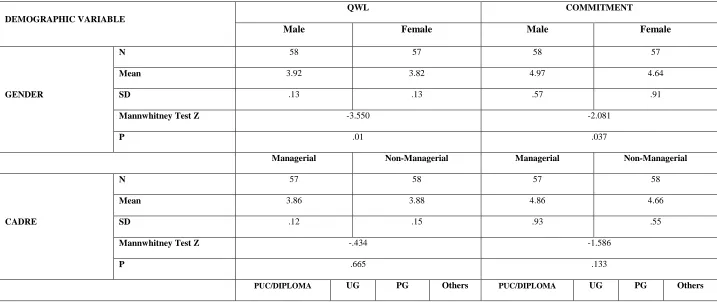
The analysis of the gender of the respondents revealed that there was equal
participation of Male (50.43%) and female (50.57%) respondents. Majority of
TABLE NO 1
The table describing the demographic characterisation of the respondents
DEMOGRAPHIC VARIABLE
QWL COMMITMENT
Male Female Male Female
GENDER
N 58 57 58 57
Mean 3.92 3.82 4.97 4.64
SD .13 .13 .57 .91
Mannwhitney Test Z -3.550 -2.081
P .01 .037
Managerial Non-Managerial Managerial Non-Managerial
CADRE
N 57 58 57 58
Mean 3.86 3.88 4.86 4.66
SD .12 .15 .93 .55
Mannwhitney Test Z -.434 -1.586
P .665 .133
QUALIFICATION
N 11 55 41 8 11 55 41 8
Mean 3.88 3.86 3.88 3.88 4.8 4.7 4.88 5.18
SD .15 .13 .13 .21 .82 .9 .62 .42
Chi-Square .903 4.229
P .825 .238
Bellow 25 25-35 35-45 45-55 55 Above Bellow 25 25-35 35-45 45-55 55 Above
AGE
N 3 52 14 16 30 3 52 14 16 30
Mean 3.86 3.84 3.87 3.91 3.91 5.04 4.88 4.68 4.61 4.83
SD .1 .13 .15 .15 .14 .16 .81 1.02 .91 .51
Chi-Square 4.846 4.450
P .304 .349
Bellow 5 5-10 10-15 15 Above Bellow 5 5-10 10-15 15 Above
EXPERIENCE
N 15 68 31 1 15 68 31 1
Mean 3.86 3.86 3.89 3.89 4.4 4.86 4.89 5.11
SD .15 .15 .11 .1 1.29 .65 .68 .1
Chi-Square 1.221 1.753
The study also included testing of various hypotheses that were formulated
after the thorough review of articles. The results of the hypotheses tested are
as follows:
THE RESULTS OF THE HYPOTHESIS TESTING ARE LISTED
BELOW.
1. There is a very significant relationship between Quality of work life and
gender (P=.01)
2. There is a significant relationship between Gender and commitment
(P=.037)
3. There is a significant relationship between Quality of work life and Cadre
(P=.665)
4. There is a significant relationship between commitment and cadre
(P=.133)
5. There is no significant relationship Quality of work life and qualification
(P=.825)
6. There is a significant relationship between commitment and qualification
(P=.238)
7. There is a significant relationship between quality of work life and Age
(P=.304)
8. There is a significant relationship between commitment and Age (P=.349)
9. There is no significant relationship between quality of work life and
10.There is no significant relationship between commitment and experience
(P=.625)
It can be concluded that Gender and Age significantly impact the QWL.
Whereas, Gender, cadre, qualification and age have a impact on the
commitment of employees.
ROOT MEAN SQUARE ERROR OF APPROXIMATION (RMSEA)
PATH DIAGRAM
PATH DIAGRAM: 1
.13
.18
.12
.71
. 25
.19
.22
.25 Working
condition
Capacities at the work
Opportunities at work place
Compensation
Social integration
Constitutionalism
Space occupy
Root Mean Square Error of Approximation describes the impact of various
dimensions towards quality of work life and organizational commitment. In
RMSE path diagram emphasizes on eight dimensions of QWL ( work
condition, capacity at work, opportunity at work place, compensation, social
integration, constitutionalism, space occupy, social relevance and importance)
and 3 dimension in commitment (continuous, normative and alternative
commitment).
According to RMSE path diagram 1, compensation contributes high level of
influence (71%) in comparison of other dimension. on the other hand
opportunities at work place has least influence on QWL which is only 12%.
Apart from these, social integration and social relevance and importance
(25%), space occupy (22%), constitutionalism (19%), capacity at work place
(18%) and working condition (13%).
PATH DIAGRAM: 2
.80 .11
.60
.74
COMMITMENT
Continues Commitment
Affective Commitment
Normative
In this study as per RMSE path diagram 2 emphasizes on strength of the
relationship between Quality of work life and commitment. From the view
point of Allen and Meyer (1997), there are three “mind sets” which can
characterize an employee’s commitment to the organization. Affective
commitment, Continuance (rational) commitment and Normative (loyalty)
commitment. As per the study only 60% employees have emotional bond with
organization; i.e. an employee intrinsically desire to continue in the
organization which is affective commitment which impacts the overall
commitment of organization. Similarly 80% have continuance commitment
which results in majority of the employees willing to continue in organization.
Finally, 74% employees have normative commitment which makes them feel
that they have an obligation towards the organization and so continue working
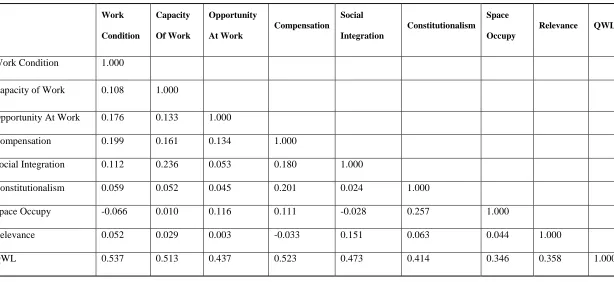
TABLE NO. 2- CORRELATION COEFFICIENT
Work
Condition
Capacity
Of Work
Opportunity
At Work
Compensation Social
Integration
Constitutionalism Space
Occupy
Relevance QWL
Work Condition 1.000
Capacity of Work 0.108 1.000
Opportunity At Work 0.176 0.133 1.000
Compensation 0.199 0.161 0.134 1.000
Social Integration 0.112 0.236 0.053 0.180 1.000
Constitutionalism 0.059 0.052 0.045 0.201 0.024 1.000
Space Occupy -0.066 0.010 0.116 0.111 -0.028 0.257 1.000
Relevance 0.052 0.029 0.003 -0.033 0.151 0.063 0.044 1.000
Correlation between variables influencing QWL
Correlation shows the degree of relation between variables that influence the
QWL. From table No (2), it can be inferred that work conditions (.537),
compensation (.523) and capacity to work (.513) are closely related to QWL
as positive degree of relationships exist. When individual degree of
relationship was analysed it was found that work condition was positively
related to six variables namely Capacity Of Work(0.108), Opportunity At
Work(0.176), Compensation(0.199), Social Integration(0.112),
Constitutionalism(0.059), Relevance(0.052) and negatively related to space
occupied(-.06)
CONCLUSION
In the ancient era, only quality of products manufactured received importance
and role of people was neglected but ever since the emergence of behavioral
era emerged QWL of employees has received due diligence. It is discernible
fact that industry is prone to change. It was known that, work is one of the
basic needs of human being and the satisfaction from it also represents a need.
From this perspective, managers have sustained the maxim that, by uplifting
the workman’s quality of life, organization will improve as a whole.
We can deduce from this study that gender and age significantly have an
impact on quality of work life. Where as in case of commitment of employees
comparison with other. However, correlation between the variable shows
positive influence on the QWL .from correlation analysis (Table No 2), it can
be inferred compensation (.523) and capacity to work (.513) are closely
related. When individual degree of relationship was analysed by using
RMSEA path diagram, it was found that compensation (.71) has high
influence on QWL of employees, where remaining all seven dimension found
to be moderate influence on QWL. At the same time, continuance commitment
has more influence (.80) in comparison to other two variants wiz. Affective
(.60) and Normative (.74) commitment. We can be concluded that employees
are not emotionally attached to the organizational and the principles. Instead it
is the personal drive that makes them continue working in the organization.
In conclusion, the research findings demonstrated that, QWL and commitment
are two different paths in an employees work life, which does have a degree of
influence on each other but are technically independent variables.
REFERENCES
1. A. Gani and Riyaz Ahmad (1995), Correlates of Quality of Work Life:
An Analytical Study, Source: Indian Journal of Industrial Relations, Vol.
31, No. 1 (Jul., 1995), pp. 1-17
2. Bahman Kord Tamini, Badroddin Oraei Yazdany and Fereshteh
Bakhshi Bojd (2011), The Social Sciences, Year: 2011 | Volume: 6
3. Baldev R. Sharma and Rama J. Joshi (2001) Determinants of
Organisational Commitment in a Manufacturing Organisation in the
Private Sector, IJIR, Vol. 37, No. 2, October 2001
4. Beal, D. J., Trougakos, J. P., Weiss, H. M., & Green, S. G. (2006).
Episodic processes in emotional labor: Perceptions of affective delivery
and regulation strategies. The Journal of Applied Psychology, 91,
1053-1065. doi: 10.1037/0021-9010.91.5.1053.
5. Cummings, T and Worley, C. (2005), “Organization Development and
Change”, 8th ed. Southwestern College Publishing, Cincinnati, OH
6. Hadi Farid , Zahra Izadi, Ismi Arif Ismail, Farhad Alipour (2015)
Relationship between quality of work life and organizational commitment
among lecturers in a Malaysian public research university, The Social
Science Journal 52 (2015) 54–61
7. Heskett, J., W. E. Sasser Jr., and L. Schlesinger (1997). The Service
Profit Chain: How Leading Companies Link Profit and Growth to Loyalty,
Satisfaction, and Value. New York: Free Press, 1997.
8. Jerome. S. (2013).International Journal of Advance Research in Computer
Science and Management Studies Volume 1, Issue 4, September 2013 pg.
49-57
9. K. R.Nia& Maryam Maleki (2013), A study on the relationship between
quality of work life and organizational commitment of faculty members at
Organizational Behavior and Human Resource Management, Vol. 1, No.
4,
10. Kord Tamini, Bahman (2011), "study of the relationship between
organizational commitment and job burnout and organizational spirituality
among postal office staff of Zahedan and Gorgan, journal of management
studies, issue 14: 120-144.
11. Lynn McFarlane Shore and Sandy J. Wayne (1993). Commitment and
Employee Behavior: Comparison of Affective Commitment and
Continuance Commitment with Perceived Organizational Support, Journal
of Applied Psychology 1993, Vol. 78, No. 5, 774-780
12. M. Joseph Sirgy, David Efraty, Phillip Siegel and Dong-Jin Lee
(2001)A New Measure of Quality of Work Life (QWL) Based on Need
Satisfaction and Spillover Theories Social Indicators Research, Vol. 55,
No. 3 (Sep., 2001), pp. 241-302
13. May, B. E., Lau, R. S. M., & Johnson, S.K. (1999). A longitudinal study
of quality of work life and business performance. South Dakota Business
Review, 58 (2), 3-7.
14. Meyer, J. P., & Allen, N. J. (1991). A three-component conceptualization
of organizational commitment. Human Resource Management Review,
7,61-89
15. Mitchell W. Fields James W. Thacker (1992) Influence of Quality of
16. Noushin Kamali Sajjad (2013), Studying the Relationship between
Quality of work life and Organizational Commitment, Research Journal of
Recent Sciences, 3(2)
17. Pallavi P. Kulkarni (2013), Journal of Arts, Science & Commerce, Vol.–
IV, Issue–2, April 2013[136]
18. Rabia Amjad and Rafia Rafique (2013), Quality Of Life At Work As
Predictor of Job Commitment in 1122 Rescue Workers, Pakistan Journal
of Psychology, June 2013, 44, 1, 81- 93
19. Radha Yadav, Ashu Khanna (2014), Literature Review on Quality of
Work Life and Their Dimensions, IOSR Journal Of Humanities And
Social Science (IOSR-JHSS) Volume 19, Issue 9, Ver. V (Sep. 2014), PP
71-80 e-ISSN: 2279-0837, p-ISSN: 2279-0845
20. Rama J. Joshi (2007), Quality of Work Life of Women Workers: Role of
Trade Unions, Indian Journal of Industrial Relations, Vol. 42, No. 3 (Jan.,
2007), pp. 355-382
21. Roderick D. Iverson, Donna M. Buttigieg (1999) Affective, Normative
and Continuance Commitment: Can the `Right Kind' of Commitment be
managed? Journal of Management Studies 36:3 May 1999 0022-2380
22. Tanaya Nayak and Chandan Kumar Sahoo (2015), Quality of Work
Life and Organizational Performance: The Mediating Role of Employee
Commitment, Journal of Health Management 17(3) 263–273 © 2015
sagepub.in/home.nav DOI: 10.1177/0972063415589236
http://jhm.sagepub.com
23. Tung Chun Huang, John Lawler, Ching-Yi Lei (2007), Social Behavior
and Personality: an international journal, pp. 735-750, Volume 35, 2007,
Issue 6
24. Umar Nazir, Tahir Masood Qureshi, Tooba Shafaat and Amina Ilyas
(2011) African Journal of Business Management Vol. 5(25), pp.
10276-10285,
25. Walton, R. (1973), ― Quality of Work life Indicators- Prospects and
Problems- A Portigal Measuring the Quality of working life, pp-57-70,