A Monthly Double-Blind Peer Reviewed (Refereed/Juried) Open Access International e-Journal - Included in the International Serial Directories Indexed & Listed at:
VOLUME NO.3(2013),ISSUE NO.02(FEBRUARY) ISSN2231-5756
INTERNATIONAL JOURNAL OF RESEARCH IN COMMERCE, IT & MANAGEMENT
CONTENTS
CONTENTS
CONTENTS
CONTENTS
Sr.No.
TITLE & NAME OF THE AUTHOR (S)
Page No. 1. IDENTIFICATION OF KEY MOTIVATIONAL FACTORS; AN IMPLEMENTATION OF MASLOW'S HIERARCHY OF NEEDS IN PAKISTANI ORGANIZATIONS
MUHAMMAD TAHIR AKBAR & DR. MUHAMMAD RAMZAN
1
2. PROFITABILITY OF POTATO BASED CROPPING PATTERNS COMPARED TO RICE BASED CROPPING PATTERNS IN MYMENSINGH REGION
ROMAZA KHANUM, MD.SHARIFUL ISLAM & D. AFROZA
5
3. THE IMPACT OF ACCOUNTING INFORMATION SYSTEMS IN THE QUALITY OF FINANCIAL INFORMATION IN THE PRIVATE JORDANIAN UNIVERSITIES: AN EMPIRICAL STUDY
DR. ATEF A. S. AL-BAWAB
11
4. THE ROLE OF SNNPRS MARKETING AND COOPERATIVE BUREAU IN THE EXPANSION AND DEVELOPMENT OF COOPERATIVES IN SNNPR REGION, ETHIOPIA, AFRICA
DR. S. BALAMURUGAN
18
5. STUDY ON THE HEALTH LIFESTYLE OF SENIOR LEARNERS IN TAIWAN
JUI-YING HUNG & CHIEN-HUI YANG
27
6. EFFECT OF INFORMATION TECHNOLOGY ON CORPORATE FINANCIAL REPORTING IN NIGERIA
AKINYOMI OLADELE JOHN &DR. ENAHORO JOHN A.
31
7. DIAGNOSTIC STUDY ON INTERACTIVE ADS AND ITS RESPONSE TOWARDS THE FM RADIO
EMON KALYAN CHOWDHURY & TAHMINA REZA
36
8. ACCOMMODATION OF ETHNIC QUEST FOR SELF-GOVERNANCE UNDER ETHNIC FEDERAL SYSTEM IN ETHIOPIA: THE EXPERIENCE OF SOUTHERN REGIONAL STATE
TEMESGEN THOMAS HALABO
42
9. UNIVERSITY PERFORMANCE MEASUREMENT USING THE BALANCED SCORECARD METHOD – SPECIAL FOCUS TO THE LEARNING AND GROWTH PERSPECTIVE
W.M.R.B.WEERASOORIYA
46
10. INDEPENDENT DIRECTORS IN LISTED INDIAN PUBLIC SECTOR ENTERPRISES: AN ANALYTICAL STUDY
MOHINDER SINGH TONK
51
11. RELATIONSHIP BETWEEN EMOTIONAL & SOCIAL COMPETENCES AND TRANSFORMATIONAL LEADERSHIP STYLE
BADRI BAJAJ & DR. Y. MEDURY
56
12. ICT DEVELOPMENTS IN HIGHER EDUCATION IN INDIA: THE ROAD MAP AHEAD
DR. M. K. SINGH & DR. SONAL SHARMA
60
13. CONSUMER SENSITIVITY TOWARDS PRICING OF COSMETIC PRODUCTS: AN EMPIRICAL STUDY
DR. D. S. CHAUBEY, LOKENDRA YADAV & HARISH CHANDRA BHATT
67
14. CONVENIENCE YIELD: EMPIRICAL EVIDENCES FROM INDIAN CHILLI MARKET
IRFAN UL HAQ & DR. K CHANDERASEKHARA RAO
74
15. CELLULAR PHONES: THE HUB OF MODERN COMMUNICATION - AN ANALYTICAL STUDY
DR. A. RAMA & S. MATHUMITHA
78
16. WOMAN LEADERSHIP IN AXIS BANK: A COMPARISON OF WOMAN AND MAN LEADER USING CAMEL MODEL
ARTI CHANDANI & DR. MITA MEHTA
83
17. A STUDY OF ANTS TEAMBUILDING TECHNIQUES AND ITS APPLICATION IN ORGANIZATIONAL WORK TEAMS
AMAR DATT & DR. D. GOPALAKRISHNA
90
18. BASEL II AND INDIAN CREDIT RATING AGENCIES – IMPACT & IMPLICATIONS
RAVI KANT & DR. S. C. JAIN
95
19. A STUDY ON THE CONSUMPTION PATTERN OF BAKERY PRODUCTS IN SOUTHERN REGION OF TAMIL NADU
DR. A. MARTIN DAVID, R. KALYAN KUMAR & G.DHARAKESWARI
101
20. e-COMMERCE: AN INVISIBLE GIANT COMPETITOR IN RETAILING IN EMERGING COUNTRIES
NISHU AYEDEE.
107
21. THE GREAT MATHEMATICIAN SRINIVASA RAMANUJAN
G. VIJAYALAKSHMI
111
22. ISSUES RELATING TRANSITION IPv4 TO IPv6 IN INDIA
ANANDAKUMAR.H
117
23. QUALITY OF WORK-LIFE: A TOOL TO ENHANCE CONFIDENCE AMONG EMPLOYEES
JYOTI BAHL
124
24. GLOBAL RECESSION: IMPACT, CHALLENGES AND OPPORTUNITIES
SHAIKH FARHAT FATMA
128
25. IMPACT OF CELL PHONE ON LIFESTYLE OF YOUTH: A SURVEY REPORT
MALIK GHUFRAN RUMI, PALLAVI TOTLANI & VINSHI GUPTA
133
26. EFFECTIVENESS OF TRAINING IN AUTO COMPONENT INDUSTRY – AN EMPIRICAL STUDY
R.SETHUMADHAVAN
143
27. THE IMPACT ON MARKETING BY THE ADVENT OF WEB 2.0 INTERNET TOOLS
JAYAKUMAR MAHADEVAN
146
28. MARKET INFLUENCE ON THE TECHNOLOGY IN THE ENERGY SECTOR - A STUDY OF INDIAN SCENARIO
MANOHAR SALIMATH C
150
29. SPOT ELECTRICITY PRICE MODELLING AND FORECASTING
G P GIRISH
154
30. AN ANALYTICAL STUDY OF RURAL MARKETING IN INDIA - OPPORTUNITIES AND POSSIBILITY
BASAVARAJAPPA M T
158
CHIEF PATRON
CHIEF PATRON
CHIEF PATRON
CHIEF PATRON
PROF. K. K. AGGARWAL
Chancellor, Lingaya’s University, Delhi
Founder Vice-Chancellor, Guru Gobind Singh Indraprastha University, Delhi
Ex. Pro Vice-Chancellor, Guru Jambheshwar University, Hisar
FOUNDER
FOUNDER
FOUNDER
FOUNDER PATRON
PATRON
PATRON
PATRON
LATE SH. RAM BHAJAN AGGARWAL
Former State Minister for Home & Tourism, Government of Haryana
Former Vice-President, Dadri Education Society, Charkhi Dadri
Former President, Chinar Syntex Ltd. (Textile Mills), Bhiwani
CO
CO
CO
CO----ORDINATOR
ORDINATOR
ORDINATOR
ORDINATOR
AMITA
Faculty, Government M. S., Mohali
ADVISORS
ADVISORS
ADVISORS
ADVISORS
DR. PRIYA RANJAN TRIVEDI
Chancellor, The Global Open University, Nagaland
PROF. M. S. SENAM RAJU
Director A. C. D., School of Management Studies, I.G.N.O.U., New Delhi
PROF. M. N. SHARMA
Chairman, M.B.A., Haryana College of Technology & Management, Kaithal
PROF. S. L. MAHANDRU
Principal (Retd.), Maharaja Agrasen College, Jagadhri
EDITOR
EDITOR
EDITOR
EDITOR
PROF. R. K. SHARMA
Professor, Bharti Vidyapeeth University Institute of Management & Research, New Delhi
CO
CO
CO
CO----EDITOR
EDITOR
EDITOR
EDITOR
DR. BHAVET
Faculty, M. M. Institute of Management, Maharishi Markandeshwar University, Mullana, Ambala, Haryana
EDITORIAL
EDITORIAL
EDITORIAL
EDITORIAL ADVISORY BOARD
ADVISORY BOARD
ADVISORY BOARD
ADVISORY BOARD
DR. RAJESH MODI
Faculty, Yanbu Industrial College, Kingdom of Saudi Arabia
PROF. SANJIV MITTAL
University School of Management Studies, Guru Gobind Singh I. P. University, Delhi
PROF. ANIL K. SAINI
Chairperson (CRC), Guru Gobind Singh I. P. University, Delhi
DR. SAMBHAVNA
VOLUME NO.3(2013),ISSUE NO.02(FEBRUARY) ISSN2231-5756
INTERNATIONAL JOURNAL OF RESEARCH IN COMMERCE, IT & MANAGEMENT
DR. MOHENDER KUMAR GUPTA
Associate Professor, P. J. L. N. Government College, Faridabad
DR. SHIVAKUMAR DEENE
Asst. Professor, Dept. of Commerce, School of Business Studies, Central University of Karnataka, Gulbarga
ASSOCIATE EDITORS
ASSOCIATE EDITORS
ASSOCIATE EDITORS
ASSOCIATE EDITORS
PROF. NAWAB ALI KHAN
Department of Commerce, Aligarh Muslim University, Aligarh, U.P.
PROF. ABHAY BANSAL
Head, Department of Information Technology, Amity School of Engineering & Technology, Amity
University, Noida
PROF. A. SURYANARAYANA
Department of Business Management, Osmania University, Hyderabad
DR. SAMBHAV GARG
Faculty, M. M. Institute of Management, Maharishi Markandeshwar University, Mullana, Ambala, Haryana
PROF. V. SELVAM
SSL, VIT University, Vellore
DR. PARDEEP AHLAWAT
Associate Professor, Institute of Management Studies & Research, Maharshi Dayanand University, Rohtak
DR. S. TABASSUM SULTANA
Associate Professor, Department of Business Management, Matrusri Institute of P.G. Studies, Hyderabad
SURJEET SINGH
Asst. Professor, Department of Computer Science, G. M. N. (P.G.) College, Ambala Cantt.
TECHNICAL ADVISOR
TECHNICAL ADVISOR
TECHNICAL ADVISOR
TECHNICAL ADVISOR
AMITA
Faculty, Government M. S., Mohali
FINANCIAL ADVISORS
FINANCIAL ADVISORS
FINANCIAL ADVISORS
FINANCIAL ADVISORS
DICKIN GOYAL
Advocate & Tax Adviser, Panchkula
NEENA
Investment Consultant, Chambaghat, Solan, Himachal Pradesh
LEGAL ADVISORS
LEGAL ADVISORS
LEGAL ADVISORS
LEGAL ADVISORS
JITENDER S. CHAHAL
Advocate, Punjab & Haryana High Court, Chandigarh U.T.
CHANDER BHUSHAN SHARMA
Advocate & Consultant, District Courts, Yamunanagar at Jagadhri
SUPERINTENDENT
SUPERINTENDENT
SUPERINTENDENT
SUPERINTENDENT
SURENDER KUMAR POONIA
CALL FOR MANUSCRIPTS
CALL FOR MANUSCRIPTS
CALL FOR MANUSCRIPTS
CALL FOR MANUSCRIPTS
Weinvite unpublished novel, original, empirical and high quality research work pertaining to recent developments & practices in the area of Computer, Business, Finance, Marketing, Human Resource Management, General Management, Banking, Insurance, Corporate Governance and emerging paradigms in allied subjects like Accounting Education; Accounting Information Systems; Accounting Theory & Practice; Auditing; Behavioral Accounting; Behavioral Economics; Corporate Finance; Cost Accounting; Econometrics; Economic Development; Economic History; Financial Institutions & Markets; Financial Services; Fiscal Policy; Government & Non Profit Accounting; Industrial Organization; International Economics & Trade; International Finance; Macro Economics; Micro Economics; Monetary Policy; Portfolio & Security Analysis; Public Policy Economics; Real Estate; Regional Economics; Tax Accounting; Advertising & Promotion Management; Business Education; Management Information Systems (MIS); Business Law, Public Responsibility & Ethics; Communication; Direct Marketing; E-Commerce; Global Business; Health Care Administration; Labor Relations & Human Resource Management; Marketing Research; Marketing Theory & Applications; Non-Profit Organizations; Office Administration/Management; Operations Research/Statistics; Organizational Behavior & Theory; Organizational Development; Production/Operations; Public Administration; Purchasing/Materials Management; Retailing; Sales/Selling; Services; Small Business Entrepreneurship; Strategic Management Policy; Technology/Innovation; Tourism, Hospitality & Leisure; Transportation/Physical Distribution; Algorithms; Artificial Intelligence; Compilers & Translation; Computer Aided Design (CAD); Computer Aided Manufacturing; Computer Graphics; Computer Organization & Architecture; Database Structures & Systems; Digital Logic; Discrete Structures; Internet; Management Information Systems; Modeling & Simulation; Multimedia; Neural Systems/Neural Networks; Numerical Analysis/Scientific Computing; Object Oriented Programming; Operating Systems; Programming Languages; Robotics; Symbolic & Formal Logic and Web Design. The above mentioned tracks are only indicative, and not exhaustive.
Anybody can submit the soft copy of his/her manuscript anytime in M.S. Word format after preparing the same as per our submission guidelines duly available on our website under the heading guidelines for submission, at the email address: [email protected].
GUIDELINES FOR
GUIDELINES FOR
GUIDELINES FOR
GUIDELINES FOR SUBMISSION OF MANUSCRIPT
SUBMISSION OF MANUSCRIPT
SUBMISSION OF MANUSCRIPT
SUBMISSION OF MANUSCRIPT
1. COVERING LETTER FOR SUBMISSION:
DATED: _____________ THE EDITOR
IJRCM
Subject: SUBMISSION OF MANUSCRIPT IN THE AREA OF .
(e.g. Finance/Marketing/HRM/General Management/Economics/Psychology/Law/Computer/IT/Engineering/Mathematics/other, please specify)
DEAR SIR/MADAM
Please find my submission of manuscript entitled ‘___________________________________________’ for possible publication in your journals.
I hereby affirm that the contents of this manuscript are original. Furthermore, it has neither been published elsewhere in any language fully or partly, nor is it under review for publication elsewhere.
I affirm that all the author (s) have seen and agreed to the submitted version of the manuscript and their inclusion of name (s) as co-author (s).
Also, if my/our manuscript is accepted, I/We agree to comply with the formalities as given on the website of the journal & you are free to publish our contribution in any of your journals.
NAME OF CORRESPONDING AUTHOR: Designation:
Affiliation with full address, contact numbers & Pin Code: Residential address with Pin Code:
Mobile Number (s): Landline Number (s): E-mail Address: Alternate E-mail Address:
NOTES:
a) The whole manuscript is required to be in ONE MS WORD FILE only (pdf. version is liable to be rejected without any consideration), which will start from the covering letter, inside the manuscript.
b) The sender is required to mention the following in the SUBJECT COLUMN of the mail:
New Manuscript for Review in the area of (Finance/Marketing/HRM/General Management/Economics/Psychology/Law/Computer/IT/ Engineering/Mathematics/other, please specify)
c) There is no need to give any text in the body of mail, except the cases where the author wishes to give any specific message w.r.t. to the manuscript. d) The total size of the file containing the manuscript is required to be below 500 KB.
e) Abstract alone will not be considered for review, and the author is required to submit the complete manuscript in the first instance.
f) The journal gives acknowledgement w.r.t. the receipt of every email and in case of non-receipt of acknowledgment from the journal, w.r.t. the submission of manuscript, within two days of submission, the corresponding author is required to demand for the same by sending separate mail to the journal.
2. MANUSCRIPT TITLE: The title of the paper should be in a 12 point Calibri Font. It should be bold typed, centered and fully capitalised.
3. AUTHOR NAME (S) & AFFILIATIONS: The author (s) full name, designation, affiliation (s), address, mobile/landline numbers, and email/alternate email address should be in italic & 11-point Calibri Font. It must be centered underneath the title.
VOLUME NO.3(2013),ISSUE NO.02(FEBRUARY) ISSN2231-5756
INTERNATIONAL JOURNAL OF RESEARCH IN COMMERCE, IT & MANAGEMENT
5. KEYWORDS: Abstract must be followed by a list of keywords, subject to the maximum of five. These should be arranged in alphabetic order separated bycommas and full stops at the end.
6. MANUSCRIPT: Manuscript must be in BRITISH ENGLISH prepared on a standard A4 size PORTRAIT SETTING PAPER. It must be prepared on a single space and single column with 1” margin set for top, bottom, left and right. It should be typed in 8 point Calibri Font with page numbers at the bottom and centre of every page. It should be free from grammatical, spelling and punctuation errors and must be thoroughly edited.
7. HEADINGS: All the headings should be in a 10 point Calibri Font. These must be bold-faced, aligned left and fully capitalised. Leave a blank line before each heading.
8. SUB-HEADINGS: All the sub-headings should be in a 8 point Calibri Font. These must be bold-faced, aligned left and fully capitalised.
9. MAIN TEXT: The main text should follow the following sequence:
INTRODUCTION
REVIEW OF LITERATURE
NEED/IMPORTANCE OF THE STUDY
STATEMENT OF THE PROBLEM
OBJECTIVES
HYPOTHESES
RESEARCH METHODOLOGY
RESULTS & DISCUSSION
FINDINGS
RECOMMENDATIONS/SUGGESTIONS
CONCLUSIONS
SCOPE FOR FURTHER RESEARCH
ACKNOWLEDGMENTS
REFERENCES
APPENDIX/ANNEXURE
It should be in a 8 point Calibri Font, single spaced and justified. The manuscript should preferably not exceed 5000 WORDS.
10. FIGURES & TABLES: These should be simple, crystal clear, centered, separately numbered & self explained, and titles must be above the table/figure. Sources of data should be mentioned below the table/figure. It should be ensured that the tables/figures are referred to from the main text.
11. EQUATIONS: These should be consecutively numbered in parentheses, horizontally centered with equation number placed at the right.
12. REFERENCES: The list of all references should be alphabetically arranged. The author (s) should mention only the actually utilised references in the preparation of manuscript and they are supposed to follow Harvard Style of Referencing. The author (s) are supposed to follow the references as per the following:
•
All works cited in the text (including sources for tables and figures) should be listed alphabetically.•
Use (ed.) for one editor, and (ed.s) for multiple editors.•
When listing two or more works by one author, use --- (20xx), such as after Kohl (1997), use --- (2001), etc, in chronologically ascending order.•
Indicate (opening and closing) page numbers for articles in journals and for chapters in books.•
The title of books and journals should be in italics. Double quotation marks are used for titles of journal articles, book chapters, dissertations, reports, working papers, unpublished material, etc.•
For titles in a language other than English, provide an English translation in parentheses.•
The location of endnotes within the text should be indicated by superscript numbers.PLEASE USE THE FOLLOWING FOR STYLE AND PUNCTUATION IN REFERENCES: BOOKS
•
Bowersox, Donald J., Closs, David J., (1996), "Logistical Management." Tata McGraw, Hill, New Delhi.•
Hunker, H.L. and A.J. Wright (1963), "Factors of Industrial Location in Ohio" Ohio State University, Nigeria. CONTRIBUTIONS TO BOOKS•
Sharma T., Kwatra, G. (2008) Effectiveness of Social Advertising: A Study of Selected Campaigns, Corporate Social Responsibility, Edited by David Crowther & Nicholas Capaldi, Ashgate Research Companion to Corporate Social Responsibility, Chapter 15, pp 287-303.JOURNAL AND OTHER ARTICLES
•
Schemenner, R.W., Huber, J.C. and Cook, R.L. (1987), "Geographic Differences and the Location of New Manufacturing Facilities," Journal of Urban Economics, Vol. 21, No. 1, pp. 83-104.CONFERENCE PAPERS
•
Garg, Sambhav (2011): "Business Ethics" Paper presented at the Annual International Conference for the All India Management Association, New Delhi, India, 19–22 June.UNPUBLISHED DISSERTATIONS AND THESES
•
Kumar S. (2011): "Customer Value: A Comparative Study of Rural and Urban Customers," Thesis, Kurukshetra University, Kurukshetra. ONLINE RESOURCES•
Always indicate the date that the source was accessed, as online resources are frequently updated or removed. WEBSITESSPOT ELECTRICITY PRICE MODELLING AND FORECASTING
G P GIRISH
RESEARCH SCHOLAR
DEPARTMENT OF FINANCE
IBS, IFHE UNIVERSITY
HYDERABAD
ABSTRACT
Structural reforms and deregulation since early 1990’s around the world has transformed Electricity markets from highly regulated and controlled markets, into, deregulated and competitive markets. Electricity trading is no more a technical business. Today, electricity is treated and traded like any other commodity. A power market participant, who will be in a position to forecast prices correctly, can make an informed decision of adjusting production schedule, buy/sell electricity at an appropriate price from an energy exchange and maximize profits. In this study, literature pertaining to spot electricity price modelling and forecasting is reviewed.
JEL CODES
D43, G16, H44, L11, L13, P23
KEYWORDS
Electricity, Forecasting, Modelling, Spot Price.
INTRODUCTION
tructural reforms and deregulation since early 1990’s around the world has transformed Electricity markets from highly regulated and controlled markets, into, deregulated and competitive markets. Today, vertically integrated electrical utility structure which was the norm traditionally for an electrical utility has been completely replaced by a competitive market scheme not just in developed countries but also in developing countries (Li et al. 2007). Countries around the world have proactively engaged in this transformation of power system structure with an agenda of introducing competition in all the sub sectors of power industry such as Generation, Transmission, Distribution as well as Trading of electric power.The rationale behind this move is to provide more choices to the power market participants especially in the way electricity is traded along with its ancillary services (Amjady and Daraeepour, 2009). Liberalization, deregulation and increased competition have resulted in power market participants facing newer challenges every time. Electricity trading is no more a technical business. Today, electricity is treated and traded like any other commodity(Pilipovic, 1997). It is interesting and very important to note the fact that electricity is undoubtedly a unique commodity because it cannot be economically stored, it cannot be seen unlike other commodities, it has to be consumed the moment it is produced and user demand shows strong seasonality at every interval of time (hourly, daily, weekly and monthly). Unfortunate and extreme events such as outages power plants, electrical transformers malfunction or breakdown, unavailability of resources due to unavoidable constraints (ex: Transportation problem resulting in Non availability of coal for thermal power stations) or faulty/imperfect transmission grid reliability will result in having severe effect on electricity prices. This aspect of electricity makes modeling and price forecasting critical for all the power market participants.
OBJECTIVE OF THE STUDY
The deregulation and liberalization of electricity markets worldwide has not only led to new challenges for power market participants, but, has also created a new field of research. Liberalization, deregulation and introduction of competitive power markets have propelled research in electricity price modeling and forecasting. The main objective of this study is to review literature pertaining to spot electricity price modelling and forecasting.
SIGNIFICANCE OF THE STUDY
In today’s world of competitive electricity markets, the power market participants i.e. power producers and power consumers need accurate price forecasting tools. Price forecasts signify by embodying crucial information which is essential for power producers and consumers when they are planning for bidding strategies with an objective of managing price risk as well as maximizing their benefits i.e. utility.
According to Weron (2006), if classical notion of volatility i.e. Standard deviation of returns is considered, and is calculated on the daily scale (i.e. for average daily prices), then:
• Treasury bills and Notes have Volatility of less than 0.5%
• Stock indices have moderate volatility of about 1-1.5%
• Commodities like crude oil or natural gas have volatilities of 1.5-4%
• Very volatile stocks have volatilities not exceeding 4%
• Electricity exhibits extreme volatility – up to 50%!!!
Karakatsani and Bunn (2004) highlight that Electricity Price curve exhibits considerably richer structure when compared to the load curve with the following unique characteristics of:
• High frequency
• Non-constant mean and variance
• Multiple seasonality (i.e. daily, weekly, monthly, hourly)
• Calendar effect
• High level of volatility and
• High percentage of unusual price movements
These characteristics of Electricity Price curve are mainly due to the following reasons which distinguish electricity from other commodities (Bunn, 2000).
• Non-storable nature of electrical energy
• The requirement of maintaining constant balance between demand and supply
• Inelastic nature of demand over short time period
• Oligopolistic generation side
• Load and generation side uncertainties
As described by Girish et al. (2013), for power market participants, price forecasts are necessary for developing bidding strategies to maximize benefit/profit. A Generator/firm/Individual Power Producer (IPP) which is able to forecast spot prices correctly can adjust its own production schedule accordingly and hence maximize its profits. Spot electricity price modeling and forecasting is of prime importance in day-to-day market operations for these power market participants. In this study, all relevant Univariate Time Series Econometric models used for spot electricity price modeling are reviewed.
VOLUME NO.3(2013),ISSUE NO.02(FEBRUARY) ISSN2231-5756
INTERNATIONAL JOURNAL OF RESEARCH IN COMMERCE, IT & MANAGEMENT
SPOT ELECTRICITY PRICE MODELLING AND FORECASTING LITERATURE
Electricity Price forecasting techniques in literature can be broadly divided into six classes: (Weron 2006)
1. Production-cost (or cost-based) models - These models simulate the overall operation of the generating units. The main aim is to satisfy the demand of electricity at the minimum cost. But the major drawback in this approach is that strategic bidding practices often employed by power market participant is completely ignored.
2. Equilibrium (or game theoretic) approaches - These models are similar to cost-based models with consideration for strategic bidding however the performance of these models are questionable, problematic and difficult if any kind of quantitative conclusions have to be drawn and it is computationally demanding.
3. Fundamental (or structural) methods–In these methods, price dynamics are described by modeling the impact of certain important physical and economic factors on the price of electricity. However, these models are better suited for medium-term rather than Short Term electricity Price Forecasting.
4. Quantitative (or stochastic, econometric, reduced-form)models– These models characterize statistical properties of electricity prices with respect to time. The ultimate objective of quantitative models is its application in evaluation of derivatives and for risk management.
5. Statistical (or technical analysis) approaches - Time series Autoregressive models such as ARMA, ARMAX, (Seasonal) ARIMA, GARCH, TAR and Markov regime-switching models fall under this category. Along with spot electricity price series, fundamental factors such as loads, prices of fuels are considered while modeling.
6. Artificial intelligence-based (or non-parametric) techniques – Electricity prices are modeled using non-parametric tools such as neural networks, fuzzy logic, etc. The advantage of these techniques is that they are flexible and can handle complexity along with non-linearity. However, they are Not intuitive often performing below par.
Based on the time horizon for which forecasting has to be made, forecasting of electricity prices can be categorized into: (Misiorek et al., 2006)
a) Long-term price forecasting: The main objective is for investment profitability analysis and planning (especially for determining the future sites or fuel sources of power plants)
b) Medium-term forecasting: These are generally preferred for balance sheet calculations, risk management and derivatives pricing. In many cases, they do not concentrate on the actual point forecasts but on the distributions of future prices over certain time periods
c) Short-term price forecasting: This is of particular interest for participants of auction-type spot markets wherein participants are requested to express their bids in terms of prices and quantities. In such markets buy (sell) orders are accepted in order of increasing (decreasing) prices until total demand (supply) is met.
The following table gives a summary of spot electricity price modeling and forecasting techniques used in the literature (Girish et al. 2013).
TABLE 1: MODELS USED IN THE LITERATURE FOR ELECTRICITY PRICE MODELING AND FORECASTING S.I
No.
Model Authors
1 Autoregressive models Cuaresma et al. (2004); Weron and Misiorek (2005) 2 ARMA models Carnero et al. (2003); Nogales et al. (2002)
3 ARIMA models Bowden and Payne (2008); Conejo et al. (2005); Contreras et al. (2003); Cuaresma et al. (2004); Garcia et al. (2005); Gianfreda and Grossi (2012); Zhou, Yan, Ni and Li (2004)
4 Multiple linear regression models Schmutz and Elkuch (2004) 5 Dynamic regression models and
transfer function
Karakatsani and Bunn (2008); Lora et al. (2002); Nogales et al. (2002)
6 GARCH models Mugele, Rachev and Trueck (2005); Karakatsani and Bunn (2004); Garcia et al. (2005) 7 Jump diffusion models Johnson and Barz (1999); Knittel and Roberts (2005); Skantze and Illic (2000)
8 Regime switching models Ethier and Mount (1998); Haldrup and Nielsen (2006); De Jong and Huisman (2002); Huisman and Mahieu (2003); Weron et al. (2004)
CONCLUSION AND SCOPE FOR FURTHER RESEARCH
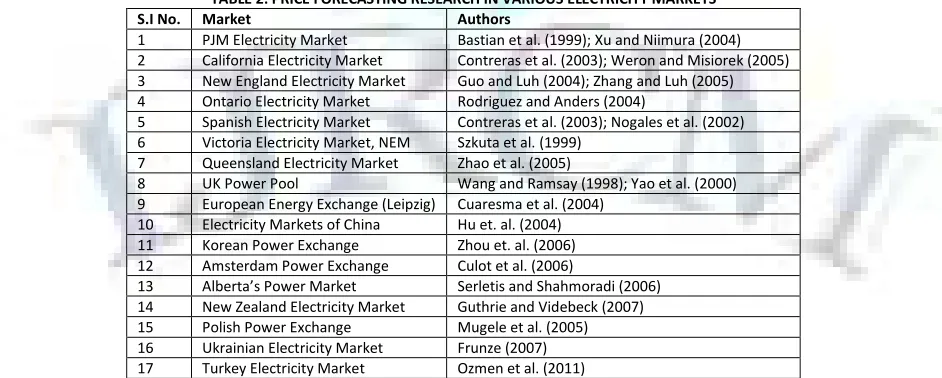
Electricity spot price modeling and forecasting is very crucial for power market participants. A Generator/firm/Individual Power Producer (IPP) which is able to forecast spot prices correctly can adjust its own production schedule, buy/sell power from the market and end up maximizing its profits. Spot electricity price modeling and forecasting is of prime importance in day-to-day market operations for these power market participants. Electricity Spot prices have been modelled for many electricity markets around the world. (See Girish, 2012; Girish et al. 2013)
TABLE 2: PRICE FORECASTING RESEARCH IN VARIOUS ELECTRICITY MARKETS S.I No. Market Authors
1 PJM Electricity Market Bastian et al. (1999); Xu and Niimura (2004) 2 California Electricity Market Contreras et al. (2003); Weron and Misiorek (2005) 3 New England Electricity Market Guo and Luh (2004); Zhang and Luh (2005) 4 Ontario Electricity Market Rodriguez and Anders (2004)
5 Spanish Electricity Market Contreras et al. (2003); Nogales et al. (2002) 6 Victoria Electricity Market, NEM Szkuta et al. (1999)
7 Queensland Electricity Market Zhao et al. (2005)
8 UK Power Pool Wang and Ramsay (1998); Yao et al. (2000) 9 European Energy Exchange (Leipzig) Cuaresma et al. (2004)
10 Electricity Markets of China Hu et. al. (2004) 11 Korean Power Exchange Zhou et. al. (2006) 12 Amsterdam Power Exchange Culot et al. (2006)
13 Alberta’s Power Market Serletis and Shahmoradi (2006) 14 New Zealand Electricity Market Guthrie and Videbeck (2007) 15 Polish Power Exchange Mugele et al. (2005) 16 Ukrainian Electricity Market Frunze (2007) 17 Turkey Electricity Market Ozmen et al. (2011)
markets), Term-Ahead Market and Renewable Energy Certificates (Solar and Non-Solar). Electricity price spike forecasting is another direction for further research.
ACKNOWLEDGEMENTS
I would like to thank Dr. Ajaya Panda, Dr. Subrata Sarkar, Dr. Sashikala P, Dr. Badri Narayan Rath and Dr. Ban Sharma for all their valuable comments and feedback.
REFERENCES
1. Amjady, N. and Daraeepour, A. (2009), “Design of input vector for day-ahead price forecasting of electricity markets”, Expert Systems with Applications,
Vol. 36, pp. 12281-12294.
2. Bastian, J., Zhu, J., Banunaryanan, V., and Mukherji, R. (1999), “Forecasting energy prices in a competitive market”, Computer Application Power, pp.40–45. 3. Bowden, N., and Payne, J.E. (2008), “Short term forecasting of electricity prices for MISO hubs: Evidence from ARIMA-EGARCH models”, Energy Economics,
Vol. 30, pp. 3186-3197.
4. Bunn, D.W. (2000), “Forecasting loads and prices in competitive power markets”, Proceedings of the IEEE, Vol. 88, No. 2, pp. 163-169.
5. Carnero, M. A., Koopman, Siem, J., and Ooms, M. (2003), “Periodic HeteroskedasticRegARFIMA Models for Daily Electricity Spot Prices”, No 03-071/4, Tinbergen Institute Discussion Papers, Tinbergen Institute.
6. Conejo, A.J., Contreras, J., Espinola, R. and Plazas, M.A., “Forecasting electricity prices for a day-ahead pool-based electric energy market”, International Journal of Forecasting, Vol. 21, No. 3, July-September 2005, pp. 435-462.
7. Contreras, J., Espınola, R., Nogales, F.J., and Conejo, A.J. (2003), “ARIMA models to predict next-day electricity prices”, IEEE Trans. Power Systems, Vol. 18, No. 3, pp. 1014-1020.
8. Cuaresma, J.C., Hlouskova, J., Kossmeier, S., and Obersteiner, M. (2004), “Forecasting electricity spot-prices using linear univariate time-series models”, Applied Energy, Vol. 77, pp. 87-106.
9. Culot, M., Goffin, V., Lawford, S., de Menten, S., &Smeers, Y. (2006), “An affine jump diffusion model for electricity”, In Seminars, Groupement de Recherche en Economie Quantitative d’Aix-Marseille.
10. De Jong, C., and Huisman, R. (2002), “Option formulas for mean-reverting power prices with spikes”, Energy Global Research Paper.
11. Ethier, R., and Mount, T. (1998), “Estimating the volatility of spot prices in restructured electricity markets and the implications for option values”, Cornell University Working Paper.
12. Frunze, S. (2007), “Modeling Spot Prices in Ukrainian Wholesale Electricity Market”, Economics Education and Research Consortium, National University, Kyiv-Mohyla Academy.
13. Garcia, R.C., Contreras, J., Akkeren, M., and Garcia, J.B.C. (2005), “A GARCH Forecasting Model to Predict Day-Ahead Electricity Prices”, IEEE Transactions on Power Systems, Vol. 20, No. 2, pp. 867-874.
14. Gianfreda, A., and Grossi, L. (2012), “Forecasting Italian Electricity Zonal Prices with Exogenous Variables”, Energy Economics, Vol. 34, No. 6, pp. 2228– 2239.
15. Girish, G.P. (2012), “Modeling and forecasting day-ahead hourly electricity prices: A review”, International Journal of Academic Conference Proceedings, Vol.1, No.1, pp. 66-72.
16. Girish, G.P., Panda, A.K., and Rath, B.N. (2013), “Indian Electricity Market”, Global Business Economics Anthology, vol. 1.
17. Guo, J.J., and Luh, P.B. (2004), “Improving Market Clearing Price Prediction by Using a Committee Machine of Neural Networks”, IEEE Trans Power Systems, Vol. 19, No. 4, pp. 1867-1876.
18. Guthrie, G. and Videbeck, S. (2007), “Electricity Spot Price Dynamics: Beyond Financial Models”, Energy Policy, Vol. 35, No. 11, pp. 5614–5621.
19. Haldrup, N., and Nielsen, M.O. (2006), “A Regime Switching Long Memory Model for Electricity Prices”, Journal of Econometrics, Vol. 135, No. 1–2, pp. 349–376.
20. Huisman, R., and Mahieu, R. (2003), “Regime Jumps in Electricity Prices”, Energy Economics, Vol. 25, pp. 425-434.
21. Johnson, B., and Barz, G. (1999), ”Selecting Stochastic Processes for Modeling Electricity Prices”, In Energy Modelling and the Management of Uncertainty, (Ed.; pp. 3-21; Risk Books).
22. Karakatsani, N.V., and Bunn, D.W. (2004), “Modelling the volatility of spot electricity prices”, 2nd Energy Risk Management Seminar.
23. Karakatsani, N.V., and Bunn, D.W. (2008), “Forecasting Electricity Prices: The Impact of Fundamentals and Time-Varying Coefficients”, International Journal of Forecasting, Vol. 24, No. 4, pp. 764-785.
24. Knittel, C.R., and Roberts, M.R. (2005), “An Empirical Examination of Restructured Electricity Prices”, Energy Economics, Vol. 27, No. 5, pp. 791-817. 25. Li, G., Liu, C.–C., Mattson, C. and Lawarree, J. (2007), “Day-Ahead Electricity Price Forecasting in a Grid Environment”, IEEE Transactions on Power Systems,
Vol. 2, pp. 266-274.
26. Lora, A., Santos, J., Santos, J., Exposito, A., and Ramos, J. (2002), “A Comparison of Two Techniques for Next-Day Electricity Price Forecasting”, Lecture Notes in Computer Science, pp. 384-390.
27. Misiorek, A., Trueck, S., and Weron, R. (2006), “Point and Interval Forecasting of Spot Electricity Prices: Linear vs. Non-Linear Time Series Models”, Nonlinear Analysis of Electricity Prices, Vol. 10, No. 3, pp. ISSN (Online) 1558-3708.
28. Mugele, C., Rachev, S.T., and Truck, S. (2005), “Stable Modeling of Different European Power Markets”, Investment Management and Financial Innovations, Vol. 3, pp. 65-85.
29. Nogales, F.J, Contreras, J., Conejo, A.J., and Espinola, R. (2002), “Forecasting Next-Day Electricity Prices by Time Series Models”, IEEE Trans. Power Systems, Vol. 17, pp. 342-348.
30. Ozmen, M.H., Miray, A., Bayrak, O.T., and Wilhelm, G. (2011), “Electricity Price Modelling for Turkey”, Institute of Applied Mathematics, Middle East Technical University, Ankara.
31. Pilipovic, D. (1997), “Energy Risk: Valuing and Managing Energy Derivatives”, McGraw-Hill.
32. Rodriguez, C.P., and Anders, G.J., “Energy Price Forecasting in the Ontario Competitive Power System Market”, IEEE Trans Power Systems, Vol. 19, No. 3, February 2004, pp. 366-374.
33. Schmutz, A., and Elkuch, P. (2004), “Electricity Price Forecasting: Application and Experience in the European Power Markets”, Proceedings of the 6th IAEE European Conference, Zurich.
34. Serletis, A., and Shahmoradi, A. (2006), “Measuring and Testing Natural Gas and Electricity Markets Volatility: Evidence from Alberta’s Deregulated Markets”, Studies in Nonlinear Dynamics and Econometrics, Nonlinear Analysis Of Electricity Prices, Vol. 10, No. 3, pp. ISSN (Online) 1558-3708.
35. Skantze, P., and Illic, M. (2000), “The Joint Dynamics of Electricity Spot and Forward Markets: Implications of Formulating Dynamic Hedging Strategies”, Energy Laboratory Report No. MIT-EL 00-005.
36. Szkuta, B.R., Sanabria, L.A., and Dillon, T.S. (1999), “Electricity Price Short-Term Forecasting Using Artificial Neural Networks”, IEEE Trans Power Systems, Vol. 14, No. 3, pp. 851-857.
37. Wang, A.J., and Ramsay, B. (1998), “A Neural Network Based Estimator for Electricity Spot Pricing with Particular Reference to Weekend and Public Holidays”, Neurocomputing, Vol. 23, pp. 47-57.
VOLUME NO.3(2013),ISSUE NO.02(FEBRUARY) ISSN2231-5756
INTERNATIONAL JOURNAL OF RESEARCH IN COMMERCE, IT & MANAGEMENT
39. Weron, R., and Misiorek, A. (2005), “Forecasting Spot Electricity Prices with Time Series Models”, Proceedings of the European Electricity Market, EEM-05 Conference, Lodz, pp. 133-141.
40. Weron, R., Bierbrauer, M., and Truck, S. (2004), “Modeling Electricity Prices: Jump Diffusion and Regime Switching”, Physica, pp. 39-48.
41. Xu, H., and Niimura, T. (2004), “Short-Term Electricity Price Modeling and Forecasting Using Wavelets and Multivariate Time Series”, IEEE Power Systems Conference and Exposition PES, Vol. 1, pp. 208-212.
42. Yao, S.J., Song, Y.H., Zhang, L.Z., and Cheng, X.Y. (2000), “Prediction of System Marginal Price by Wavelet Transform and Neural Network”, Electric Mach Power Systems, Vol. 28, pp. 983-993.
43. Zhang, L., and Luh, P.B. (2005), “Neural Network-Based Market Clearing Price Prediction and Confidence Interval Estimation with an Improved Extended Kalman Filter Method”, IEEE Trans Power Systems, Vol. 20, No. 1, pp. 59-66.
44. Zhao, J.H., Dong, Z.Y., Li, X., and Wong, K.P. (2005), “A General Method for Electricity Market Price Spike Analysis”, IEEE Power Engineering Society General Meeting, IEEE, Vol. 1, pp. 1286-1293.
45. Zhou, M., Yan, Z., Ni, Y., and Li, G. (2004), “An ARIMA Approach to Forecasting Electricity Price with Accuracy Improvement by Predicted Errors”, Proceedings of the IEEE Power Engineering Society General Meeting, pp. 233-238.
REQUEST FOR FEEDBACK
Dear Readers
At the very outset, International Journal of Research in Commerce, IT and Management (IJRCM)
acknowledges & appreciates your efforts in showing interest in our present issue under your kind perusal.
I would like to request you to supply your critical comments and suggestions about the material published
in this issue as well as on the journal as a whole, on our E-mail i.e.
for further
improvements in the interest of research.
If you have any queries please feel free to contact us on our E-mail
.
I am sure that your feedback and deliberations would make future issues better – a result of our joint
effort.
Looking forward an appropriate consideration.
With sincere regards
Thanking you profoundly
Academically yours
Sd/-
VOLUME NO.3(2013),ISSUE NO.02(FEBRUARY) ISSN2231-5756