Improving Productivity by Using Extra Mechanical
Automation on Different Sewing Machine
Israt Zebin Ansari1,*, Zulfa Ferdous1, Israt Zerin1, Syed Fuad Irfan1, Sujan Sharkar2
1Department of Textile Engineering, Southeast University, Dhaka, Bangladesh
2
Soorty Denim Enterprise
Abstract
Apparel sector is the most promising and rapid growing sector of Bangladesh. To sustain and survive in the global competition, machine automation is becoming the demand of time. Now-a-days apparel manufacturing industries are trying to improve their production efficiency to cope with the emerging challenges of this sector. The aim of this research is to improve productivity of sewing line by using extra mechanical automation on sewing machine in affordable cost. These reduce the cycle time, increase productivity in SMV wise 73.81 to 83.1 and manpower wise from 21.42 to 24.19. Which saves a remarkable cost and helps to beat the lead time successfully as well.Keywords
Apparel, Productivity, SMV, Lead time1. Introduction
Bangladesh has already occupied the 2nd position in RMG export in the world [1]. In the financial year 2016-2017 the RMG industry generated US$28.14 billion, which was 81.23% of the total export earnings in exports and 12.36% of the GDP [2]. To retain this growth & safeguard our position in world RMG market there is no alternative to increased productivity [3]. Productivity is evaluated by achievement toward established goals based on relationships between inputs and outputs of industry [4].
In project management, productivity is the process by which resources are optimized in order to achieve the desired outcomes of the project. There are various components that are involved in the productivity of a workplace which are human resources (labor), machinery, and the working condition of the workplace [5].
Many people think of automation on a large scale; But automation can be added to machine tools in many other, more affordable ways as well [6]. A study showed increase of productivity of garment industry with their existing industry set up. It has been observed that there is scope to improve the productivity with improving the flap design. With regular flap design only one pocket flap can be manufacture, but with change in flap design, the double flap can be produced at less time. [7]
* Corresponding author:
[email protected] (Israt Zebin Ansari) Published online at http://journal.sapub.org/textile
Copyright©2019The Author(s).PublishedbyScientific&AcademicPublishing This work is licensed under the Creative Commons Attribution International License (CC BY). http://creativecommons.org/licenses/by/4.0/
Technological advancements like high speed sewing machine, CAD and computer- aided manufacturing (CAM) applications, new techniques in cutting, fusing and pressing, and application of robotics on the process of garment production, a substantial increase in productivity can be achieved [8].
In this research we try to increase productivity by reducing sewing time. We develop some self-made automation through air cylinder commonly known as Pneumatic cylinder.
2. Material and Methodology
2.1. Product Specification
Item: Short Pant Buyer: Primark
Fabric construction: 100% cotton Order quantity: 108400pcs Color: Black, dark blue, indigo
Sewing data:
Sewing SMV: 20.32 Working hour: 10 Manpower required: 70 Daily target: 1500pcs
Operation 1:Auto Disposer Process:Zipper Attach to single fly
Machine: Double needle lock stitch machine Machine parts:
Air Cylinder
Compressed air
Rubber pad
Air trigger
Figure 2. Added automation on double needle lock stitch machine
For adding zipper at fly position at first zipper needs to attach in single fly. Here requirement was used single needle machine earlier but we replace this machine with double needle lock stitch machine as 2 stitches with ¼ gap needs to give in zipper fly. Here we are adding one auto disposer also, so that operator doesn’t need to dispose zipper by hand.
Operation 2: Auto thread cutter Process: Waist belt attach Machine: KANSAI Machine parts:
Air Cylinder
Compressed air
Scissor
Steel Base
Air Pipe
Air trigger
Figure 3. Adding auto thread Cutter on a Kansai machine
After attaching waist band by kansai machine loose threads comes, though Kansai machine doesn’t have auto thread cutting system that’s why after joining waist band loose threads needs to cut by hand. Operator dose this by hand cutter before. We are adding here one auto thread cutting automation, so that we can reduce the thread cutting time.
Operation 3: Auto mouth cutter Process: Waist belt mouth close Machine: Self-made cutter
Machine parts:
Air Cylinder
Compressed air
Steel Base
Air Pipe
Air trigger
Figure 4. Auto Mouth Cutter
For doing Waist band mouth close operation extra fabric piece needs to cut by hand cutter. We are added automation here to increase the helper capacity, also easier the process and savings the cutting time.
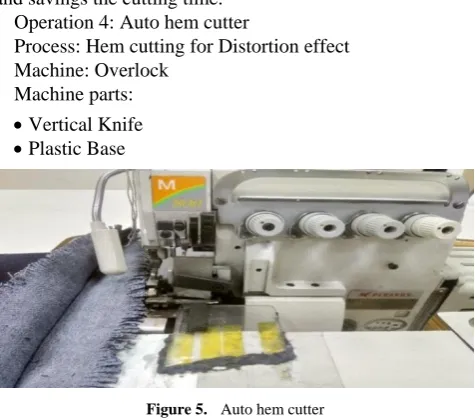
Operation 4: Auto hem cutter
Process: Hem cutting for Distortion effect Machine: Overlock
Machine parts:
Vertical Knife
Plastic Base
Figure 5. Auto hem cutter
Buyer requirement was to bring distortion effect in bottom hem by wash, but at first hem needs to cut so that it creates a distortion effect after washing. This process is too slow, a lot of manpower needed. We are innovating a easier way to cut it by overlock machine including a vertical knife.
Operation 5: Auto Pocket hem folding Process: Back Pocket Hem
Machine: Single Needle Chain Stitch machine Machine parts:
Air Cylinder
Compressed air
Steel Base plate
Air Pipe
Figure 6. Auto pocket turner
For attaching back pocket, at first back pocket mouth position have to fold by hand thus it consumes time. So we are adding a automation to fold the pocket automatically.
2.2. Methodology (Working Flow Chart)
Selecting machines and processes
Studying the machine capacity without automation
Adding automation on the selected machine
Studying the machine capacity after adding automation
Calculating the unassigned time
Eliminating extra machine and men power
Calculating efficiency, productivity and others
3. Data Analysis
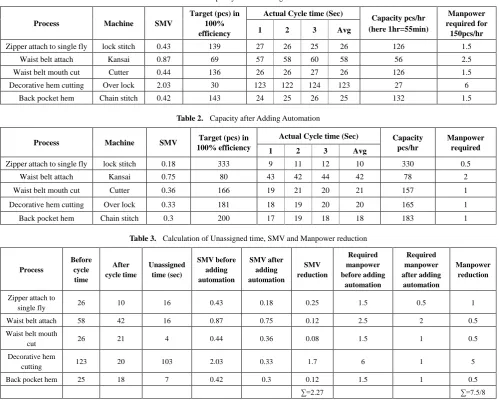
Daily Production target 150pcs/hr needed to beat the lead time Target in 100% efficiency=60/SMV
Capacity=3300/Actual cycle time (5mins was allowance time)
Table 1. Capacity before Adding Automation
Process Machine SMV
Target (pcs) in 100% efficiency
Actual Cycle time (Sec)
Capacity pcs/hr (here 1hr=55min)
Manpower required for
150pcs/hr
1 2 3 Avg
Zipper attach to single fly lock stitch 0.43 139 27 26 25 26 126 1.5 Waist belt attach Kansai 0.87 69 57 58 60 58 56 2.5 Waist belt mouth cut Cutter 0.44 136 26 26 27 26 126 1.5 Decorative hem cutting Over lock 2.03 30 123 122 124 123 27 6
Back pocket hem Chain stitch 0.42 143 24 25 26 25 132 1.5
Table 2. Capacity after Adding Automation
Process Machine SMV Target (pcs) in
100% efficiency
Actual Cycle time (Sec) Capacity pcs/hr
Manpower required
1 2 3 Avg
Zipper attach to single fly lock stitch 0.18 333 9 11 12 10 330 0.5 Waist belt attach Kansai 0.75 80 43 42 44 42 78 2 Waist belt mouth cut Cutter 0.36 166 19 21 20 21 157 1 Decorative hem cutting Over lock 0.33 181 18 19 20 20 165 1 Back pocket hem Chain stitch 0.3 200 17 19 18 18 183 1
Table 3. Calculation of Unassigned time, SMV and Manpower reduction
Process
Before cycle time
After cycle time
Unassigned time (sec)
SMV before adding automation
SMV after adding automation
SMV reduction
Required manpower before adding
automation
Required manpower after adding
automation
Manpower reduction
Zipper attach to
single fly 26 10 16 0.43 0.18 0.25 1.5 0.5 1 Waist belt attach 58 42 16 0.87 0.75 0.12 2.5 2 0.5 Waist belt mouth
cut 26 21 4 0.44 0.36 0.08 1.5 1 0.5
Decorative hem
cutting 123 20 103 2.03 0.33 1.7 6 1 5
Back pocket hem 25 18 7 0.42 0.3 0.12 1.5 1 0.5
4. Results and Discussions
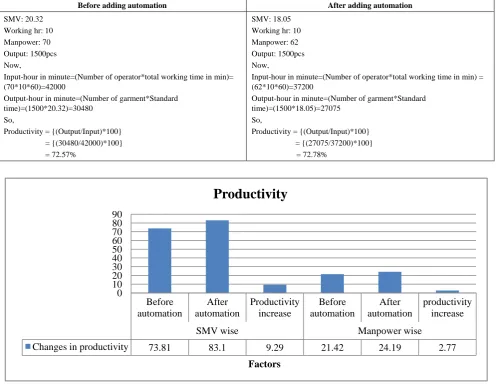
Before adding automation After adding automation
SMV: 20.32 Working hr: 10 Manpower: 70 Output: 1500pcs Now,
Input-hour in minute=(Number of operator*total working time in min)= (70*10*60)=42000
Output-hour in minute=(Number of garment*Standard time)=(1500*20.32)=30480
So,
Productivity = {(Output/Input)*100} = {(30480/42000)*100} = 72.57%
SMV: 18.05 Working hr: 10 Manpower: 62 Output: 1500pcs Now,
Input-hour in minute=(Number of operator*total working time in min) = (62*10*60)=37200
Output-hour in minute=(Number of garment*Standard time)=(1500*18.05)=27075
So,
Productivity = {(Output/Input)*100} = {(27075/37200)*100} = 72.78%
Figure 7. Productivity changes in SMV wise and manpower wise
Figure 7 shows productivity changes in SMV wise and manpower wise before and after adding automation. Productivity increase 9.29 in SMV wise and 2.77 in manpower wise.
5. Conclusions
To meet and beat the buyer’s lead time, machine automation has no alternate. In our country, the order quantity is increasing day by day but the lead time and price of the product are decreasing. So, it’s high time to introduce and implement lean manufacturing and machine automation as well.
In this part we want to summarize our work and also point out our findings;
We implement different automation in five operations in this work these are-i. Auto disposer to attach zipper with single ply, ii. Auto thread cutter in waist belt attachment, iii. Auto mouth cutter in waist belt mouth cut, iv. Auto hem
cutter in hem cutting for distortion effect, v. auto pocket hem folding for back pocket hem joining. All these effort increase the productivity by reducing the cycle time and ultimately saves huge cost in respect of by reducing SMV and operator. Our findings are:
- Sewing SMV reduces to produce primark short pant from 20.32 to 18.05.
- The number of operators is reduced from 70 to 62 after adding automation.
- Line productivity increases from 72.57% to 72.78% after adopting automation.
- The effect of automation is also considered in terms of productivity in SMV wise and Manpower wise. The productivity in terms of SMV is increased from 73.81 to 83.1 which is about 12.6% and in respect of manpower, the productivity reaches from 21.42 to 24.19 which is also about 12.93%.
Thereby we can conclude that there is a remarkable improvement in cost and productivity by introducing very Before
automation
After automation
Productivity increase
Before automation
After automation
productivity increase
SMV wise Manpower wise
Changes in productivity 73.81 83.1 9.29 21.42 24.19 2.77
0 10 20 30 40 50 60 70 80 90
Factors
simple existing technology and locally available equipment. Our main focus is to increasing the productivity by existing technique and parts without purchasing a full automatic machine.
6. Limitations
- We cannot provide actual costing of automation because of company privacy.
- Further research can be done in this respect.
ACKNOWLEDGEMENTS
We acknowledge to all the members of IE and maintenance & mechanical department of Soorty denim enterprise for their kind co-operation.
REFERENCES
[1] Kabeer, N., & Mahmud, S. (2004). Rags, riches and women workers: export-oriented garment manufacturing in Bangladesh. Chains of fortune: Linking women producers and workers with global markets, 133-164.
[2] http://www.bgmea.com.bd/home/pages/tradeinformation. [3] Ahmed, N. (2009). Sustaining ready-made garment exports
from Bangladesh. Journal of Contemporary Asia, 39(4), 597-618.
[4] Mustafa A., Locating defects on shirt collars using image processing, International Journal of Clothing Science & Technology, Vol.10, 1998, 365– 378.
[5] Key Factors Affecting Productivity in Workplace, https://www.sinnaps.com/en/project-management-blog/facto rs-affecting-productivity.
[6] https://www.productionmachining.com/columns/the-effects-of-automation-on-manufacturing.
[7] Suprit Borse, Venkatesh Shrinivasan, V.S. Shivankar; Improving the Garment Productivity by Using New Designs of Folder;International Journal on Textile Engineering and Processes ISSN 2395-3578 Vol. 2, Issue 2; April 2016.
[8] Global Scenario of Automation in Garment Industry; http://fashion2apparel.blogspot.com/2018/02/automation-gar ment-industry.html.
[9] Md. Monirul Islam (Rajib), ATM Adnan (2016). Improving Ready-Made Garment Productivity by Changing Worker Attitude. European Scientific Journal, vol.12, No.4 ISSN: 1857 – 7881 (Print) e - ISSN 1857- 7431.
[10] Dhanashree Rajput, Madhuri Kakde, Pranjali Chandurkar, P. P. Raichurkar. Enhancing Efficiency and Productivity of Garment Industry by Using Different Techniques. International Journal on Textile Engineering and Processes Vol. 4, Issue 1.