CrossMark
Published by DiscoverSys
ABSTRACT
Background: Hand hygiene is a noncomplex and a cost-effective way to prevent hospital-acquired infection (HAI). The incidence of hospital acquired MRSA (HA-MRSA) cross-infection is an indicator directly measure the hand hygiene practice at the point of care.
Objective: Our study aimed to evaluate the impact of hand hygiene compliance on HA-MRSA cross transmission in the intensive tertiary care of Dr. Sardjito General Hospital, Gadjah Mada University teaching hospital, Yogyakarta, Indonesia.
Methods: A quasi-experimental before-after design was conducted to evaluate the implementation of the WHO multimodal hand hygiene improvement strategy which was adjusted to the local needs, based on the qualitative study result from the intensive care from June 2014 to April 2016. All workers who have frequent contact with patients
were observed for their hand hygiene compliance by trained observers. The incidence of HA-MRSA was recorded through active surveillance accompanied by microbiology data.
Results: There were 92 healthcare workers (18 medical doctors, 45 nurses, 29 other staffs) and 5,280 patients involved throughout the study period. There were 16,313 hand hygiene opportunity observations which resulted in a significantly improved practical accuracy-consistency-sustainability, after intervention in the initial and end-evaluations. There was a significant decrease in the HA-MRSA rate from 12.6% before intervention to 1.2% and 0.3% at the initial and end-evaluations, respectively. Conclusion: Increasing hand hygiene compliance in intensive care reduced HA-MRSA significantly. It suggested cross-infection can be used as an indicator of hand hygiene compliance.
Keywords: compliance, hand hygiene, intensive care, MRSA cross transmission
Cite This Article: Dahesihdewi, A., Dwiprahasto, I., Wimbarti, S., Mulyono, B. 2018. Reducing Methicillin-Resistant Staphylococcus Aureus (MRSA) cross-infection through hand hygiene improvement in Indonesian intensive tertiary care hospital. Bali Medical Journal 7(1): 227-233. DOI:10.15562/bmj.v7i1.782
Reducing
Methicillin-Resistant Staphylococcus
Aureus
(MRSA) cross-infection through hand
hygiene improvement in Indonesian intensive
tertiary care hospital
Andaru Dahesihdewi,1,2* Iwan Dwiprahasto,2,3 Supra Wimbarti,2,4 Budi Mulyono1
INTRODUCTION
Hospital-acquired infection (HAI) is the most adverse event in patient safety incident in the hospital that can cause a worsening of the patients’ clinical outcomes.1,2 It increased the mortality rates by 18.7 to 75.1%, extended the length of stay (LOS) by 3.9 to 12 days, and increased health costs by $593 to $40,000 per case.3,4,5 Multidrug-resistant organisms (MDRO) infection is a critical global problem related to the antimicrobial resistant issue that can cause the difficulties in the choice of treat-ment and with its impact on the failure of patients cured. Infections by MDRO and HAI are caused by multiple factors, but one of the most important reasons is the poor practice of clean care in health-care facilities.6,7
Hand hygiene by all healthcare workers, includ-ing patients and their relatives, is the key factor in clean care. It is the simple and cost-effective method to prevent HAI and MDRO transmission. Although hand hygiene is not the only element measured in infection control, there is much evidence to prove that improvements to hand hygiene are a
strategic element in reducing the incidence of HAI. Multi-modal hand hygiene improvement strat-egy (MHHIS) is developed by WHO to promote practical development for several decades in most hospitals worldwide.8,9,10 However, the healthcare workers’ hand hygiene practices at the point of care, in many developing country hospitals including Indonesia, are still at varying levels.11
Hospital acquired (HA) cross infection by the methicillin-resistant Staphylococcus aureus (MRSA) pathogen is predicted to be a more direct indicator of hand transmission due to the pathogen being normally transient flora on the body’s skin. The pathogen could be eradicated by proper hand hygiene during patients care.
METHODS
Study Design
We conducted a quasi-experimental with before and after analysis to evaluate the implementation of the WHO MHHIS which had been adjusted to the local hospital’s needs based on a qualitative study. The prospective study was conducted from June 1Department of Clinical Pathology
and Laboratory Medicine, Faculty of Medicine,
2Clinical Epidemiology and Bio Statistic Unit, Faculty of Medicine, 3Department of Pharmacology and Therapy, Faculty of Medicine, 4Faculty of Psychology,
Gadjah Mada University, Yogyakarta, Indonesia
*Correspondence to:
Andaru Dahesihdewi, Department of Clinical Pathology and Laboratory Medicine, Clinical Epidemiology and Bio Statistic Unit, Faculty of Medicine, Gadjah Mada University/ Dr. Sardjito General Hospital, Yogyakarta, Indonesia
Received: 2017-07-29 Accepted: 2017-12-6 Published: 2017-12-12
Volume No.: 7
Issue: 1
First page No.: 227
P-ISSN.2089-1180
E-ISSN.2302-2914
2014 to April 2016, in the Intensive Care Unit (ICU), Intensive Cardiac Care Unit (ICCU) and Pediatric Intensive Care Unit (PICU) of Dr. Sardjito General Hospital, a public hospital providing tertiary care in Yogyakarta, Indonesia.
In the first seven months, we collected the pre-intervention data. The next five months was the implementation period. We conducted the initial post-intervention evaluation in the next seven months and the end post-intervention assessment in the last four months. The integrative adjusted MHHIS was intensively implemented in January to May 2015. Hand hygiene compliance and MRSA cross-transmission incidence were measured throughout the study period.
Study Population
The subjects consisted of healthcare workers and patients in the targeted units. The healthcare work-ers were medical staff, nurses, nurse assistants, and other employees including dieticians, physiother-apists, administration staff, and cleaning service staff who had a frequent contact with the patients. Patients who were admitted to the targeted units and found to have no MRSA infection were included as study subjects, consecutively. All subjects were explained the study and voluntarily agreed to participate by signing an informed consent form.
Hand Hygiene Observation
All of the healthcare workers were monitored for their hand hygiene practice for one hour during their routine morning care activities by nine trained observers (3 for each unit). It resulted in at least 204 observations per month in each unit. Our observa-tion targeted the accuracy of the practices relating to hand hygiene indications and opportunities.
Among the subjects, some doctors (18) and nurses (36) were monitored for the consistency of their hand hygiene practices. Therefore, there was a minimum of 30 observations in each study period (pre-intervention, initial evaluation, and end evaluation).
The results were recorded in the hospital’s standardized hand hygiene observation checklist, which was created from the WHO hand hygiene monitoring checklist, each specific for accuracy and consistency of the practice.
The observers (infection control nurses and link-nurses) were professionals who had a basic training and experiences in patient care, had a clear understanding of the logic care-sequence and observation methodology. Re-education, training and the validation of the observers were performed twice (in May 2014 before the study began and in May 2015 before the initial evaluation period) to
gain a correct understanding of the hand hygiene indication of 5 moments of hand hygiene and its observation method. A validation testing was carried out after each training session using a hand hygiene simulation slide to target 100% accurate observations. Inter-observer variation was tested monthly among the three observers in each unit during half an hourly period of care activities to ensure an inter observer agreement of >0.8. We performed re-education sessions to discuss and solve the non-satisfactory test results. Finally, to provide independent observations in each unit, we randomly monthly selected and replaced 1/3 of the data collected by two link nurse observers with similar data from infection control nurse (ICN). The data was input weekly into the International Patient Safety Goals (IPSG) computer program.
The accuracy of the hand hygiene practices was measured by the healthcare worker adherence to the recommended indications and procedure (5 moments and six steps of hand hygiene, based on WHO’s guidelines). The accuracy is defined as the number of hand hygiene correctly performed divided by the number of recommended oppor-tunities observed during specific care activity periods. The consistency of hand hygiene practices was defined by the accuracy rate achieved by an individual doctor or nurse with at least 30 oppor-tunities for observation during a particular period. The sustainability of the hand hygiene practices was the trend of the hand hygiene accuracy or its consistency rate between periods. Positive sustain-ability was achieved when the accuracy or consis-tency of the hand hygiene practice rate increased or remained stable for all level of the accomplishment rate or decreased for level rate > 90%, but should still be at the more than acceptable level targeted of (90%) between the initial and the end-evaluation period.
MRSA detection method and hospital cross transmission measurements
The subject patients had swabs taken from their nostrils, armpits, and groin for MRSA coloniza-tion deteccoloniza-tion upon admission (within 24 hours). Detection of the pathogen was performed in Sub-Microbiology Clinical Laboratory, Dr. Sardjito General Hospital, using the rapid screening method (MRSA Chrom-IDR). Infectious disease laboratory
expert verified the result. This approach has 96.4% and 98.2% sensitivity and specificity, respectively, compared to PCR method.12
the pathogens. MRSA infection detected during the admission of the patient without MRSA-colonization was defined as HA-MRSA cross transmission. It was reviewed and recorded by ICN using a surveillance form. The incidence of MRSA hospital cross-transmission was expressed as some new cases per 100 patients with a positive culture for the same period in Intensive Care.
Intervention
We implemented the hospital’s adjusted WHO MHHIS, which consisted of the managerial compo-nent, mindfulness education, structuring the avail-ability of supporting facilities by developing the actual plan based on real care activities and needs at the place, developing participated hand hygiene reminder on ‘moment-1’ and video, hand hygiene monitoring and real time feedback supporting.8,11 Interventions were performed from January to May 2015 by the ICN and health promotion team who had the mindfulness training.
Statistical analysis
We used a repeated ANOVA to compare the numeric data between periods, chi-square to compare the categorical data before and after the intervention, and an interrupted time series analysis to evaluate data trends over time. The confounder variables such as age, sex, gender, education and professional background, etc., were assessed using multivariate statistic logistic regres-sion. The statistical analysis was performed using IBM SPSS statistic 22, α=0.05.
This research was approved by the Medical and Health Research Ethics Committee (MHREC) Faculty of Medicine, Gadjah Mada University, in conjunction with the teaching hospital Dr. Sardjito General Hospital (Ref: KE/FK/343/EC/2014).
RESULTS
There were 92 healthcare workers (18 medical doctors, 45 nurses and 29 other staffs consisted of pharmacists, physiotherapists, nurses’ assistants, dieticians, administrative, and cleaning service offi-cers) and 5,280 patients involved in the study. All of the healthcare workers were monitored for the accuracy of their hand hygiene practices. Among them, there were 18 doctors and 36 nurses who were observed for the consistency of their hand hygiene practice.
Most of the subjects healthcare workers were less than 55 years old (95.7%), had an education background higher than diploma degree (73.9%) and had received training within the last three years on WHO hand hygiene recommendation (91.3%). There was no significant difference in age (≤ 35 vs. >35 years old, p=0.840), or in how long they had worked in their units (p=0.215). There was more female than male (64.1% vs. 35.9%).
Evaluation of hand hygiene compliance
The assessment of hand hygiene compliance consisted of the accuracy, consistency, and sustain-ability of the practice which were compared between the study’s periods. There were 16,313 hand hygiene opportunity observations, which consisted of 6,126 opportunities in the pre-intervention period, 7,078 opportunities in the initial post-intervention evaluation period and 3,109 opportunities during the end evaluation.
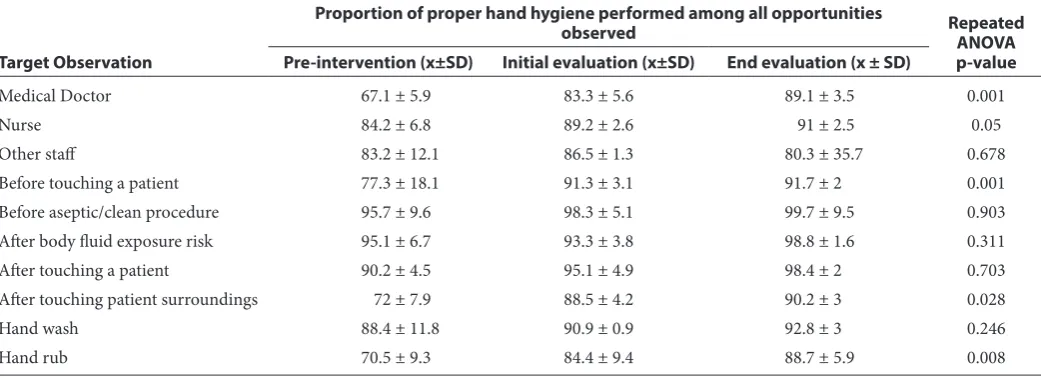
Overall, there was an increase in the accuracy of hand hygiene practice after intervention as shown in Table 1. A significant increased was seen in the accu-racy of the doctors, for the indication of Moment-1 (before touching a patient) and Moment-5 (after touching patients’ surroundings) and for the hand
Table 1 Accuracy level of hand hygiene practices pre-post intervention (%)
Target Observation
Proportion of proper hand hygiene performed among all opportunities
observed Repeated ANOVA
p-value Pre-intervention (x±SD) Initial evaluation (x±SD) End evaluation (x ± SD)
Medical Doctor 67.1 ± 5.9 83.3 ± 5.6 89.1 ± 3.5 0.001
Nurse 84.2 ± 6.8 89.2 ± 2.6 91 ± 2.5 0.05
Other staff 83.2 ± 12.1 86.5 ± 1.3 80.3 ± 35.7 0.678
Before touching a patient 77.3 ± 18.1 91.3 ± 3.1 91.7 ± 2 0.001
Before aseptic/clean procedure 95.7 ± 9.6 98.3 ± 5.1 99.7 ± 9.5 0.903
After body fluid exposure risk 95.1 ± 6.7 93.3 ± 3.8 98.8 ± 1.6 0.311
After touching a patient 90.2 ± 4.5 95.1 ± 4.9 98.4 ± 2 0.703
After touching patient surroundings 72 ± 7.9 88.5 ± 4.2 90.2 ± 3 0.028
Hand wash 88.4 ± 11.8 90.9 ± 0.9 92.8 ± 3 0.246
rub. Some parameter of our observations showed increased levels in the postintervention period, but they were not significant.
The achievement level of consistency of hand hygiene practices showed an overall increase after the intervention as indicated in table 2. However, there was a significant difference of performance level based on the subjects’ professional categories (specialist doctor showed a greater improvement than residence) for their hand rub accuracy and duration of the procedure (20 seconds for hand rub and 40 seconds for hand wash).
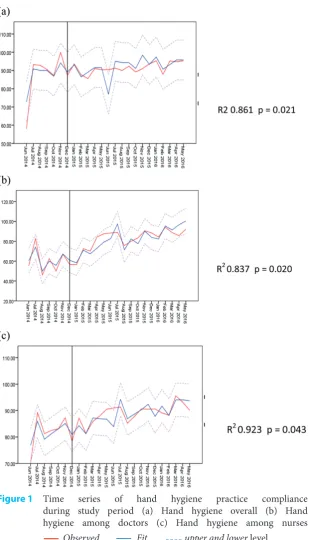
An increasing trend also described the accuracy and consistency of the level of hand hygiene prac-tices over time. Figure 1 shows the trend of hand hygiene compliance rates among overall practices (a), among doctors (b), and among nurses (c) with R2 at the level of 0.861 (p=0.021), 0.837 (p=0.020),
and 0.923 (p=0.043), respectively. The result gives a good impression of a relatively sustainable practice.
Incidence of MRSA cross infection
All of the patients (5,280) gave nostril, armpit and groin swab specimens for MRSA culture detection.
Table 2 The proportion of accomplishment of hand hygiene consistency practices (target threshold of 90%)
The number of subjects who performed ≥90% proper hand hygiene
Fisher-Exact p-value
Pre-intervention Post-intervention
Sex
0.131
- Male 15 (29.4%) 39 (75%)
- Female 21(30.4%) 46 (82.1%)
Age
0.062
- > 35 years old 23 (39.7%) 51 (86.4%)
- ≤ 35 years old 14 (28%) 35 (68.6%)
Staffs’ category
0.059
- Doctor 14 (38.9%) 29 (80.6%)
- Nurse 23 (32.4%) 69 (95.8%)
Doctor
0.031
- Specialist 3 (18.8%) 9 (69.2%)
- Residency 11 (55%) 20 (87%)
Education
0.379
- > Diploma 22 (40.7%) 57 (90.5%)
- Diploma 13 (37.1%) 41 (91.1%)
Hand hygiene method
0.047
- Hand wash 20 (37%) 46 (85.2%)
- Hand rub 30 (55.6%) 52 (96.3%)
Hand hygiene procedure
0.017
- Indication 36 (33.6%) 98 (90.7%)
- 6 steps procedure 9 (8.4%) 95 (88%)
- Duration of practice 6 (5.6%) 88 (81.5%)
Table 3 The MRSA hospital cross-transmission
Pre- During intervention Initial-evaluation End-evaluation p
Number of MRSA among all cultures 12.6% (15/119) 5% (7/141) 1.2% (3/246) 0.3% (1/388) 0.030
Type of infection
Sepsis (n) - 3 -
-CAUTI (n) 2 - 1
-Ulcer (n) 5 1 1
There were 935 (17.7%) patients with S. aureus colonization and 466 (8.8%) patients with MRSA colonization. There was no difference in the patient characteristics for both types of colonization (such as gender, age, principal diagnosis, and antibiotic use). But, there is a significant difference based on the history of hospitalization within the last one year. Patients with more frequent hospitalization had a higher risk of MRSA colonization (p=0.001).
There was a significant decrease in the MRSA hospital cross-infection rate from 12.6% before
intervention to 1.2% during the initial evaluation, and 0.3% at the end assessment (p=0.03). Most of the MRSA hospital cross infection were pneumo-nia, bloodstream infection and wound ulcer, as shown in Table 3.
DISCUSSION
We found in this study that there was an increased in hand hygiene practice among the healthcare workers after the intervention period, resulted in a significant decreasing on HA MRSA cross transmission in Intensive Care. This study showed the increasing levels of the accuracy, consistency, and sustainability of all the healthcare workers hand hygiene practices. A significant increase in the average level of precision in hand hygiene practices were discovered among doctors, hand rub procedures, for all indicated moments except the moment ‘before aseptic or clean procedure’ and ‘after body fluid exposure risk.’ The accuracy of hand wash practices and those two moments did not show any significant improvement after the intervention in the initial and end-evaluation period; this is assumed to be because they already had relatively high levels of compliance at the beginning of the study (88.4% and >90% accuracy, respectively). This level of compliance was accom-plished because of their rational indications were clear, and the healthcare workers already have posi-tive perceptions of them. The consistency of 6 step hand hygiene procedure and the exact duration of its performed were also increased significantly. The accuracy and consistency of the hand hygiene practice among healthcare workers are important for risk management in infection control area.13 The highlighted message for the healthcare workers is how to perform hand hygiene procedure correctly in every opportunity indicated due to its efficacy in reducing the hand transient germs flora fit the hand transmission model. A study in India between March to May 2015, evaluated the number of hand bacteria colonization before and after a proper hand hygiene procedure using alcohol-based hand rub among healthcare workers . This study showed the reducing of hand bacteria colonization up to zero growth after the proper hand hygiene procedure.14 Hospital MRSA cross infection can be an indicator of the accuracy of a hospital’s hand hygiene prac-tices since most of them are transmitted through hand contact. Maintaining the highest level of hand hygiene compliance among healthcare workers needs a sensitive indicator that can describe them directly as real time feedback.8,11
Dr. Sardjito General Hospital has 813 beds with an occupancy rate of 59.33%-74.56%. It was staffed by 3,000 employees consisting of 371 doctors,
Figure 1 Time series of hand hygiene practice compliance during study period (a) Hand hygiene overall (b) Hand hygiene among doctors (c) Hand hygiene among nurses
1,171 nurses, and 564 other healthcare workers (pharmacist, dietitian, public health specialists, physiotherapists, medical technicians), and the rest are non-medical staff. It has been conducting the WHO MHHIS since 2010 and received an award from the Asia Pacific Infection Control Society for hand hygiene excellence in developing countries in 2011. Further monitoring of its hand hygiene prac-tices after the award has continued hospital-wide and poor practice have been identified among its healthcare workers . Although they know that hand hygiene is an important element in the battle to prevent HAIs, and strategies have been in place to promote this, continuous creative and participative efforts are needed to maintain an acceptable level of compliance.15 Our interventions were evaluated for the impact on improving healthcare workers hand hygiene compliance and maintenance. This approach is in line with the national program for hospital quality improvement, infection control, and health promotion. Thus, it is easier to get support from all parties.16,17,18
The hospital has a target accuracy for hand hygiene of 90% by the development of an insti-tutional safety culture and the benchmark for national equivalent hospitals as well as for those classed as international hospitals. Nevertheless, despite having an increasing rate in the accuracy of their practice, some of the variables did not succeed in achieving the targeted threshold. Variables that affected the achievement of the threshold for hand hygiene practices were the intervention, profes-sional background, and five moments indication. For physician, the ‘before touching a patient’ and the ‘after touching patient surroundings’ moments, gave a significantly lower proportion (p < 0.05), indicating the need for more intensive and consis-tent specific strategies.9
The overall consistency of hand hygiene prac-tices at five moments increased significantly in the post-intervention period. The consistency of prac-tice in procedure’s steps and duration, both in the post-initial and end-evaluation period, indicates that changes in the staffs’ practice may sustain over a relatively extended period of time.
We realize that this study was at risk from various biases. We performed three methods to ensure its reliability as the observation of hand hygiene prac-tices in a real point of care setting is very dynamic and cannot be replicated. Observations were done blindingly. This study also has a potential bias from the Hawthorne effect. Long-term observation with a relatively large number of observed opportunities aims to reduce this bias.11 Similar studies into the practice of hand hygiene in developed countries generally used electronic equipment to monitor compliance.19,20
The prevalence rate of patients with either S. aureus or MRSA colonization when admitted to the intensive care in this study showed similar-ity to several studies on the epidemiology of both colonization. The studies reported about 6.5%- 38% of S. aureus colonization and 6.74%-15.4% of MRSA colonization in the admitted patients.21,22,23 The absence of difference in the use of antibiotics in both colonization populations was more likely due to the limited record of its history (recall bias). Similar studies in The United States and Australia reported a major risk factor for MRSA colonization was the use of antibiotics.21,22,23
The incidence rate of MRSA cross infection decreased gradually throughout the study period. The cross infection rate was found to be reduced by 97.6% by at the end-evaluation period. In the hospital, patients with MRSA colonization or infec-tion were placed in the ward in-order to facilitate the consistent implementation of a high standard of contact precaution. In our study, the MRSA infec-tions happened in 70%-90% of the patients who had no prior colonization. It indicates the patho-gen transmission was high. Other patients, the healthcare workers, or the hospital environment could be the source of HA-MRSA transmission to patients who previously did not have any coloni-zation. Therefore, a standard precaution with good compliance with hand hygiene practices, an antibi-otic stewardship policy, and surveillance of MRSA are necessary to reduce MRSA HAIs.20
When compared to other multi-drug resistant pathogen infections, MRSA cross-infection can describe more directly the clean care method at the point of care.6,24 It is because their coloniza-tion on more body surface may be prevented by proper aseptic methods.6 The frequency of MRSA incidences or the days when no MRSA episodes occur in intensive care may describe the consis-tency of the clean care program in place to prevent pathogen transmission, particularly through hand hygiene.6,24,25
A 2005 to 2006 study conducted in hospitals in Australia found that despite significant improve-ments in hand hygiene compliance, two out of the four clinical indicators of MRSA infection remained unchanged. Clinical aspects and infection control practices may influence MRSA infection rates and may modify the effects of hand hygiene compli-ance.9 Evidence of hand hygiene effectiveness to reduce multi-drug resistant organisms transmission and infection in a health-care setting was reported by the WHO.6 Most MHHIS evaluation studies showed a significant reduction in MRSA infections despite of the short follow-up periods.6
transmission. Proper hand hygiene procedure is an important and efficient method. Some suggested more measures to complement the hand hygiene practice are needed to reduce the MRSA incidence. A more direct indicator of hand germ transmis-sion more sensitive to measure the hand hygiene compliance is required. We propose that MRSA free-days can be a better indicator.
REFERENCES
1. World Health Organization. Report on the Burden of Endemic Health-Care-Associated Infection Worldwide, A Systematic review of the literature. WHO Patient Safety Programme, Geneva, Switzerland, 2011
2. Allegranzi B, Nejad SB, Combescure C, Graafmans W, Attar H, Donaldson L, Pittet D. Burden of endemic health-care-associated infection in developing countries: systematic review and meta-analysis. Lancet 2011; 377: 228-41. doi:10.1016/SO140-6736(10)61458-4
3. Chen YY, Chou YC, Chou P. Impact of Nosocomial Infection on Cost of Illness and Length of Stay in Intensive Care Unit. Infect Control Hosp Epidemiol 2005; 26:281-7. DOI:10.1086/502540
4. Taconelli E, Smith G, Hieke K, Lafuma A, Bastide P. Epidemiology, medical outcomes and costs of catheter-re-lated bloodstream infections in intensive care units of four Europian Countries: literature- and registry-based esti-mates 2009;72:97-103. DOI: http://dx.doi.org/10.1016/j. jhin.2010.02.013
5. Madani N, Rosenthal VD, Dendane T, Abidi K, Eggwagh AA, Abouqal R. Healthcare Associated Infection Rates, Length of Stay, and Bacterial Resistance in an Intensive Care Unit of Marocco: Finding of the International Nosocomial Infection Control Consortium (INICC). Int Arch Med 2009,2(29).doi: 10.1186/1755-7682-2-29
6. World Health Organization. Evidence of hand hygiene to reduce transmission and infections by multi-drug resistant organisms in health-care settings. International Resources for Infection Control. Meta Analysis, 2014http://www.who. int/gpsc/5may/MDRO_literature-review.pdf?ua=1
7. World Health Organization. Health care-associated infec-tions, WHO Patient Safety Save lives Fact Sheet, 2011 8. World Health Organization. WHO guideline on hand
hygiene in health care. WHO Library Cataloguing-In-Publication Data, 2009
9. McLaws ML, Pantle AC, Fitzpatrick KR, and Hughes CF. More than hand hygiene is needed to affect methicillin-re-sistant Staphylococcus aureus clinical indicator rates: Clean hands save lives, Part IV. MJA 2009; 191: S26-S31 10. Srianand A, Thomas M. There is more to hand hygiene
than routine training of health workers and display of pro-motional materials. J.Patient Saf Infect Control 2016;4:1-4. DOI: 10.4103/2214-207X.203539
11. Sax H, Allegranzi B, Chraiti MN, Boyce J, Larson E, Pittet D. The World Health Organization hand hygiene observation method. Am J. Infect Control 2009; 37:827-34 doi: 10.1016/j.ajic.2009.07.003
12. Diederen BMW, van Leest ML, van Duijn I, Willemse P, van Keulen Peter HJ. and Kluytmans JAJW. Performance of MRSA, a New Chromogenic Medium for Detection of Methicillin-Resistant Staphylococcus aureus. Journal of Clinical Microbiology 2006. p.586-588. doi: 10.1128/ JCM.44.2.586-588.2006
13. Song X, Stockwell DC, Floyd T, Short BL, Singh N. Improving hand hygiene compliance in health care work-ers: Strategies and impact on patient outcomes. Am J of Inf Control 2013; e1-e5. http://www.ajicjournal.org.
doi:10.1016/j.ajic.2013.01.031
14. Anitha M, Hema Priya J, Swathy S.R, Pavithra G.B. Prevalence of hand hygiene among various categories of healthcare workers in a hospital setting. International Journal of Applied Research 2015; 1: 96-99
15. Vaishnav B, Bamanikar A, Dasgupta S, Reddy A. Aseptic-clinical hand hygiene knowledge survey amongst health care workers in a tertiary care hospital in Western India.
Int J Res Med Sci 2016; 4:4176-4182. DOI: http//dx.doi. org/10.18203/2320-6012.ijrms20162956
16. Departemen Kesehatan Republik Indonesia. Pedoman Manajerial Pencegahan dan Pengendalian Infeksi di Rumah Sakit (Revised), SK Menkes 270/Menkes/SK/ III/2007, 2011
17. Departemen Kesehatan Republik Indonesia. Pedoman Pencegahan dan Pengendalian Infeksi di Rumah Sakit dan Fasilitas Pelayanan Kesehatan (Revised), Jakarta, 2011 18. Komite Akreditasi RS, 2011. Standar Akreditasi Rumah
Sakit. Direktorat Jenderal Bina Upaya Kesehatan Kementerian Kesehatan RI, Jakarta, 2011
19. Fuller C, Michie S, Savage J, McAteer J, Besser S, Charlett A, Hayward A, et al. The Feedback intervention Trial (FIT) – Improving Hand-Hygiene Compliance in UK Healthcare Workers: A Stepped Wedge Cluster Randomised Controlled Trial. PLoS ONE 2012: 7;10,e41617. https://doi. org/10.1371/journal.pone.0041617
20. Pires D and Pittet D. Hand hygiene electronic monitoring: Are we there yet? Editorial. Am J of Infect Control 2017: 45; 464-5. DOI:10.1016/j.ajic.2016.12.019
21. Onanuga A, Temedie TC. Nasal carriage of multi-drug resistant Staphylococcus aureus in healthy inhabitants of Amassoma in Niger delta region of Nigeria. Afr Health Sci
2011; 11: 176-81
22. Thevanesam V, Suraweera HJ, Kannangara P, Weerasekera IKB, Abeywardena HMW, Ekanayake EWMA, Gamage TM, Liyanapathirana LVC. Prospective 18-month surveillance study of MRSA colonization in an Orthopedic Unit Sri Lanka. Sri Lankan Journal of Infectious Disease
2013; 3: 9-14. DOI:10.4038/sljid.v3il.4046
23. Cavalcanti SMM, de Franca ER, Cabral C, Vilela MA, Montenegro F, Menezes D, and Medeiros ACR. Prevalence of Staphylococcus aureus Introduced into Intensive Care Units of a University Hospital. The Brazilian Journal of Infectious Diseases 2005; 9: 56-63. DOI:
10.1590/0037-8682-0071-2014
24. Arunkumar V, Prabagaravarthanan R, Bhaskar M. Prevalence of Methicillin-resistant Staphylococcus aureus
(MRSA) infection among patients admitted to critical care units in a tertiary care hospital. Int J Res Med Sci 2017; 5: 2362-2366. DOI: 10.18203/2320-6012.ijrms20172085
25. Marimuthu K, Pittet D, Harbarth S. The Effect of improved hand hygiene on nosocomial MRSA control. Antimicrobial Resistance and Infection Control 2014; 3:34. DOI:
10.1186/2047-2994-3-34