Available Online at www.ijpret.com
89
INTERNATIONAL JOURNAL OF PURE AND
APPLIED RESEARCH IN ENGINEERING AND
TECHNOLOGY
A PATH FOR HORIZING YOUR INNOVATIVE WORK
FACE EMOTION RECOGNITION USING NEURAL NETWORK
MADHURI V. BHARAD
1. M.E Student, Computer Science & Engg, G. H. Raisoni College of Engg & Management Amravati, Maharashtra.
2. Department of Computer Science & Engg, G. H. Raisoni College of Engg & Management Amravati, Maharashtra.
Accepted Date: 27/02/2014 ; Published Date: 01/05/2014
\
Abstract: In face emotion recognition systems the important part is face emotion detection.
Facial expressions give important clues about emotions. The task of detecting face is complex due to its variability present across human faces including color, pose, expression, position a orientation. Using various modeling techniques it is convenient to recognize various facial expressions. In the field of image processing it is very interesting to recognize the human gesture by observing the different movement of eyes, mouth, and nose. Recognition of face emotion can be carried out, any neural network for recognizing the facial expression. My seminar includes multilayer perceptron techniques of facial emotion recognition systems. An even simpler multi-layer perceptron model is presented with three outputs. Multilayer perceptrons (MLP) has been proven to be very successful in many applications including classification. Multilayer perceptron trains the neuron using the back propagation algorithm.
Keywords: Face emotion recognition, neural network, Multilayer perceptron and Back propagation algorithm
Corresponding Author: MISS. MADHURI V. BHARAD
Access Online On:
www.ijpret.com
How to Cite This Article:
Madhuri Bharad, IJPRET, 2014; Volume 2 (9): 89-98
Available Online at www.ijpret.com
90 INTRODUCTION
In information technology, a network is a series of points or nodes interconnected by communication paths. Networks can interconnect with other networks and contain subnet works. The term neural network was traditionally used to refer to a network or circuit of biological neurons. There are two types of neural network, biological neural network and artificial neural network. Human beings communicate verbally and non-verbally, intentionally or unintentionally through variety of emotions. The interaction between human beings and computer will be more natural if computers are able to perceive and respond human non-verbal communication such as emotions. There are many ways that humans can express their emotions. The most natural way to express emotions is using facial expressions. A human can express his/her emotion through lip and eye. A category of emotions. Which universally developed by Ekmen are: sadness, angry, happy, fear, disgust and surprise without consider natural emotion. The neural network performs the very important role for recognizing the facial expression. The artificial neural network is an information processing paradigm that is inspired by the way of biological nervous system. A neural networking is configured for a specific application such as pattern recognition. The neural network has a multilayer perceptron (MLP).It is the most common and accurate method of face emotion recognition .It consist of three or more layer. Input layer, one or more hidden layer and output layer.
Emotions
An emotion is a mental and physiological state associated with a wide variety of feelings, thoughts, and internal (physical) or external (social) behaviors. While going through vast literature on emotions, it is extremely challenging in several aspects. One of the main difficulties results from the fact that it is difficult to define, what emotion means, in a precise way. According to [Oatley and Jenkins, 1996]:
1) An emotion is usually caused by a person consciously or unconsciously evaluating an event to a concern (goal).
2) An emotion is usually experienced as a distinctive type of mental state, sometimes accompanied or followed by bodily changes, expressions and actions. In general emotions are short-term, whereas moods are long-term. Research in psychology has indicated that at least six expressions of emotions are universally associated with distinct facial expressions. Several other expressions and many other combinations of expressions have been studied but remain unconfirmed as universally distinguishable. The six principal expressions of emotions are: happiness, sadness, surprise, fear, anger and disgust. [4]
Need for emotion recognition
Available Online at www.ijpret.com
91 captain of a military team is an angry or sad, his decisions in the war may prove dangerous for the nation as a whole, rather than the decisions made in happy emotions.
Consider a child being grown up with his parents and family members, where there are no emotions on their faces or in their voice. The family members are just like robots with monotonous voice and no expressions on their faces. They are never angry with the child, even for his serious mistakes, never express happiness through their expressions or speech, even for life time achievements. There is no sadness on their face for any bad incidence happened in their family. In brief they never express any emotions. What is about social growth of the child? Will he survive in the society? Will their family remain intact? We human beings are social only because of our ability to express the emotions and respond them. When a driver of a vehicle is very angry or sad, the chances of accidents or mishaps are increased. Positive emotions through facial expressions, gestures and speech make the one’s personality very impressive and are the keys for achieving success in the life.
I. Material and Method Proposed Approach
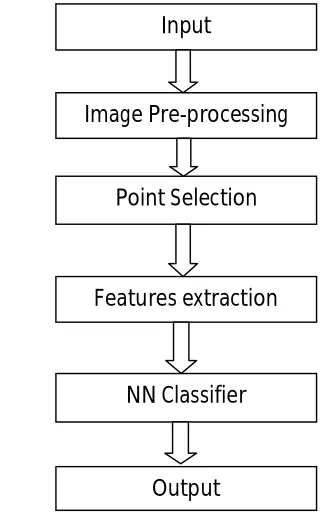
Our proposed approach uses the face expression to detect the emotions through five steps that shows in Figure 1.
Figure 1: A proposed approach Input
Image Pre-processing
Point Selection
Features extraction
NN Classifier
Available Online at www.ijpret.com
92 The Input
The input is an image of frontal human face which means that no bending the face to any angle and no rotated face to any side. Input can be divided into two categories based on the data input. The first one is sequence video and the second is static image. Input may be of different database such as Japanese Female Database and GUK Database. For video sequence and the utilized Optical Flow method that has been used by Yacoob and Davis.
Image Pre-processing
Image processing is the next stage after entering the data into the emotion recognition system. In this stage we apply certain sub processes on the image to achieve a good image with one standard in terms of contrast and size. The most important data that is needed for most emotion recognition methods is face position. There are various techniques for face detection. In addition, some methods require Specific data, for example, mouth position, eye with brows position, eye without brows position, because we depend on Euclidian distances to extract our features, the image size must be standardized. Also we apply a contrast process for each image to make the elements of the face distinguishable from other objects and also to be able to distinguish between background and the face. This will help the user to select all the points clearly. Simple algorithms are applied for resizing and contrast processes .
Point Selection
Available Online at www.ijpret.com
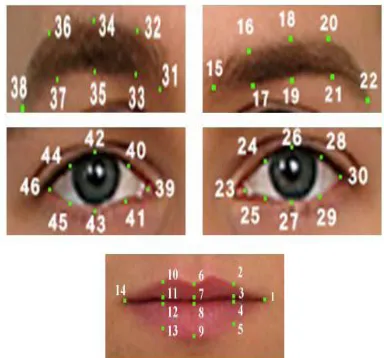
93 Figure 2.: 46 points are selected on face elements to describe the emotions.
Features Extraction
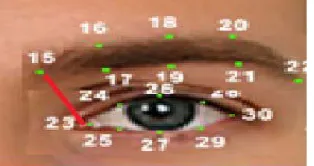
Feature extraction stage is the most significant stage that develops a successful emotion recognition system. There are a huge raw data on the facial image and we need to analyse them and limit these data to a small set of information called a feature space. While human emotion is changing, face expression is also changing. This means that, properties of face elements do change when face expression is being changed. As a consequence of this, the distances between points are changing. The distances between certain points as will be shown later describe the human emotion.
Available Online at www.ijpret.com
94 Figure 3: Distance between eyebrow and eye.
Classifier
For classification purpose of the emotions, we use NN of supervised learning based on back propagation algorithm. Back propagation neural network architecture is used with its standards learning function with 28 inputs representing the extracted features and 6 outputs representing 6 emotions, happy, sad, angry, fear, surprise and disgust. the emotions. We have also a hidden layer with 16 nodes selected after various trails to obtain the best results. [7]
Facial Expression Database
Facial expression database in six universally recognized basic emotions and neutral one, is collected from Japanese female database. Ten expressers posed 3 to 4 examples of each of the six emotions along with neutral one for a total of 219 images of facial expressions. This data was prepared when expresser looked into the semi reflective plastic sheet towards camera. Hairs were tied away to expose all expressive zones of the face.
Available Online at www.ijpret.com
95 Figure: 4 Sample Images from Japanese Female Database.
Multi-layer Perceptrons (MLP)
The Multilayer Perceptron (MLP) is one type of an artificial neural network model. This network model is composed of an input layer, an output layer and several hidden layers. Each layer consists of many units that correspond to the number of the data vectors, which associate each other by synapses. All synapses carry a specific weight value Wij. Where i denotes the number of output units from the previous layer and j denotes the number of input units in the next layer. Each unit in the hidden layer and the output layer has two computations. The first one calculates their input, and then passes the input value through the activation function to obtain the units’ output.[9] Multilayer Perceptrons have been applied successfully to solve some challenging and miscellaneous problems by training them in a supervised manner with a well known algorithm known as the back-propagation algorithm. This algorithm is based on the error-correction learning rule. As such, it may be regarded as a generalization of a popular adaptive filtering algorithm: the well known least-mean-square (LMS) algorithm for the special case of a single linear neuron. Error back-propagation learning consists of two passes through the different layers of the network: a forward pass and a backward pass. In the forward pass, an activity pattern (input vector) is applied to the sensory nodes of the network, and its effect propagates through the network layer by layer. Finally, a set of outputs is obtained as the actual response of the network. During the forward pass the synaptic weights of the networks are all fixed. During the backward pass, on the other hand, the synaptic weights are all adjusted according to error-correction rule. The actual response of the network is deducted from a
Angry Dis gus t
Fear Happ y
Available Online at www.ijpret.com
96 desired response to obtain an error signal. This error signal is then propagated backward through the network, against the direction of synaptic connections, hence called as “error back-propagation.” The synaptic weights are adjusted to make the actual response of the network move in the vicinity of the desired response in a statistical sense. The error back-propagation algorithm is also referred in the literature as the back-propagation algorithm, or simply back- prop. The learning process performed with the algorithm is called back-propagation learning.
Multilayer Perceptron has three principal characteristics:
1. The model of each neuron in the network includes a nonlinear activation function. The vital point is that the nonlinearity is smooth), unlike to the hard-limiting used in Rosenblatt’s Perceptron. A most common form of nonlinearity that satisfies this requirement is a sigmoidal nonlinearity defined by the logistic function:
) exp( 1
1
j j
V Y
4.13
Where Vj is the induced local field (i.e., the weighted sum of all synaptic inputs including the biases) of neuron j, and Yj is the output of the neuron. The nonlinearities is important because the input-output relation of the network could be reduced to that of a single-layer Perceptron. Moreover, the use of the logistic function is biologically motivated, since it attempts to account for the refractory phase of real neurons.
2. The network has one or more layers of hidden neurons that are not part of the input or output of the network. These hidden neurons support the network to learn difficult tasks by extracting progressively more meaningful features from the input patterns (vectors).
3. The network has high degrees of connectivity, attained by the synapses of the network. A change in the connectivity of the network demands a change in the population of synaptic connections or their weights.
Available Online at www.ijpret.com
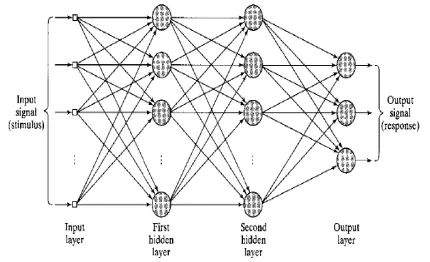
97 Figure 5:Architectural Graph of a Multilayer Perceptron with two hidden layers
There are two kinds of signals in MLP:
1. Function Signals: A function signal is an input signal (stimulus) that comes in at the input end of the network; travels forward (neuron by neuron) through the network, and come out at the output end of the network as an output signal. Such a signal is referred as a “function signal” for two reasons. First, it is supposed to undertake a useful function at the output of the network. Second, at each neuron of the network through which a function signal passes, the signal is calculated as a function of the inputs and associated weights applied to that neuron. The function signal is also described as the input signal.
Figure 6:Two basic signal flows in a MLP: Forward propagation of a function signals and Back Propagation of Error signal
2. Error Signals: An error signal generated at an output neuron of the network, and propagates backward (layer by layer) through the network. It is called as an “error signal” because its computation by every neuron of the network involves an error-dependent function in one form or another.
Available Online at www.ijpret.com
98
units are not part of the output or input of the network hence referred as “hidden.” The first hidden layer is presented from the input layer made up of sensory units (source nodes); the resulting outputs of the first hidden layer are in turn applied to the next hidden layer; and so on for the rest of the network. Each hidden or output neuron of a multilayer perceptron performs two computations:
1. The calculation of the function signal appearing at the output of a neuron, which is expressed as a continuous nonlinear function of the input signal and synaptic weights associated with that neuron.
2. The computation of the gradient vector (i.e., the gradients of the error surface with respect to the weights connected to the inputs of a neuron), which is required for the backward pass through the network.
I. CONCLUSION
Human emotions are recognized from facial expressions using Japanese female database and GUK-Database. In my seminar order to recognize the six principal emotions namely angry, disgust, fear, happy, sad and surprise from facial expressions is done using the multilayer perceptron neural network.In multilayer perceptreon neuron is train by using the backpropagation algorithm. The emotion recognition system is one of the important fields in human-computer interaction and computer vision. It is concerned with increasing interaction between humans and the machine.
REFERENCES
1. Jitendra R Raol and Sunilkumar S Mankame, “Artificial Neural Networks A Brief Introduction”
2. Pushpaja V. Saudagare, D.S. Chaudhari “Facial Expression Recognition using Neural Network - An Overview”
3. Jasmina Novakovica,_, Milomir Minica, Alempije Veljovic “Classification Accuracy of Neural Networks with PCA in Emotion Recognition”
4. W. A. Fellenz, J. G. Taylor, N. Tsapatsoulis and S. Kollias “Comparing Template-based, Feature-based and Supervised Classification of Facial Expressions from Static Images”
5. G.U. Kharat “Neural Network Based Emotion State Recognition System”