RESEARCH ARTICLE
Comparative study of phenolic
compounds, vitamin E, and fatty acids
compositional profiles in black seed-coated
soybeans (
Glycine Max
(L.) Merrill) depending
on pickling period in brewed vinegar
Ill‑Min Chung, Jin‑Young Oh and Seung‑Hyun Kim
*Abstract
Background: Pickled soybeans or vinegar beans have long been used as a folk remedy and also a supplemental nutritional source in Korea. In general the pickling process in vinegar improves the digestibility of soybeans as well as increases the availability of various (non‑)nutrients in soybeans. However, detailed information about the changes in functional substances such as (poly)phenolic compounds, vitamin E, and fatty acids (FAs) in soybeans during the pickling process is quite limited. Therefore, this study aims to investigate the changes in the selected phenolic com‑ pounds, vitamin E, and FAs in soybeans as a function of the pickling time.
Results: The sum of the total phenolics in both the pickled soybeans and the pickling solutions increased by as much as 47% after pickling. Naringenin, vanillin, and catechin were the major phenolics observed in the pickled soybeans and pickling solutions. The total vitamin E content in the pickled soybeans decreased by 23% after pickling, although no vitamin E molecules were found in the pickling solution. γ–Tocopherol was abundant in the untreated soybeans, but decreased by ~29% after pickling. Both the total and major FA contents varied by less than 1% dur‑ ing the pickling period. In this study, a 10–20 day pickling period may be considered suitable in terms of retention of functional substances in the pickled soybeans, such as selected phenolics, vitamin E, and FAs.
Conclusions: Our findings provide basic information and insight into the production of functional compounds in soybeans upon immersing in brewed vinegar, and also may be helpful toward improving the health‑functionality of soybean‑based foods in the food industry.
Keywords: Pickled soybeans, Phenolic compounds, Vitamin E, Fatty acids, Vinegar pickling
© The Author(s) 2017. This article is distributed under the terms of the Creative Commons Attribution 4.0 International License (http://creativecommons.org/licenses/by/4.0/), which permits unrestricted use, distribution, and reproduction in any medium, provided you give appropriate credit to the original author(s) and the source, provide a link to the Creative Commons license, and indicate if changes were made. The Creative Commons Public Domain Dedication waiver (http://creativecommons.org/ publicdomain/zero/1.0/) applies to the data made available in this article, unless otherwise stated.
Background
Soybeans are widely consumed as a dietary source of high quality proteins as well as lipids. A number of nutrition-ally functional substances found in soybeans, such as isoflavones, saponins, phytic acid, anthocyanins, phy-tosterols, and dietary fiber, are known to have various
health-promoting benefits [1, 2]. For example, soy iso-flavones have been reported to have both antioxidant and hormonal activities, which may act to decrease the incidence of certain cancers, cardiovascular disease, and osteoporosis [3, 4]. However, despite the various health benefits of soybeans, the consumption of raw soybeans is limited because of their unpleasant bean flavor, bitter taste, and interference with digestion/absorption caused by anti-nutritional factors such as trypsin inhibitors. Therefore, soybeans have been converted into various
Open Access
*Correspondence: [email protected]
soy-based foods after processing or cooking by methods such as heating, fermentation, and germination [1, 5, 6].
Pickled soybeans, or vinegar beans, have long been used as a folk remedy in Korea. They are prepared by immersing soybeans in vinegar for certain periods (pick-ling). In particular, monks who eat raw foods usually consume pickled soybeans as a supplemental nutritional source [7]. According to prior studies [8–11], the pick-led soybean exerts various physiological functions that include relieving fatigue and preventing high blood pres-sure, and demonstrates hypoglycemic, anticancer, anti-proliferative, antiobesity, and antioxidant activities.
Because the pickling process inactivates the anti-nutri-tional factors (i.e., the trypsin inhibitor) in soybeans, the digestibility of pickled soybeans is usually improved com-pared to that of raw soybeans. Moreover, because acid hydrolysis during pickling increases the availability of various (non-)nutrients in soybeans, the intake of pickled soybeans significantly improves the digestion/absorption rate in vivo or in vitro. In comparison to raw soybeans, the free amino acids in pickled soybeans increase three-fold, and the in vitro digestibility of the soybean protein increases by 22% after pickling [1].
The pickling process simultaneously alters the compo-sition and content of the functional substances in soy-beans. Several prior studies [12–14] have described the changes in the isoflavones content and antioxidant activ-ity of soybeans during the pickling process. The total isoflavones, particularly the aglucone types, in soybeans increase significantly as a result of pickling. Likewise, the antioxidant activity, nitrate-scavenging ability, and elec-tron-donation ability also increase upon pickling, rela-tive to raw soybeans [15, 16]. However, to our knowledge, detailed information about the changes in other func-tional substances such as (poly)phenolic compounds, vitamin E, and fatty acids (FAs) in soybeans during the pickling process is quite limited. Therefore, this study aims to investigate the changes in a selection of 23 phe-nolic compounds, the vitamin E group including 4 toco-pherols and 4 tocotrienols, and 37 FAs in soybeans as a function of the pickling time (0–30 days). These results provide basic information about the changes in func-tional substance contents in soybeans during the pickling process, and may also be helpful toward improving the health-functionality of soybean-based foods in the food industry.
Methods
Soybeans, vinegar, and chemicals
The soybean cultivar, seoritae, used in this study was obtained from the Rural Development Administration in Korea. The seoritae has a black seed coat and yel-low cotyledon color, and the weight of 100 seeds was
11.75 ± 0.13 g. A common brewed, fermented, malt-type vinegar with a total acidity of 6–7% (Ottogi Foods Industries Ltd., Gyeonggi-Do, Korea) was bought from a local market in Seoul, Korea, and was then used for pickled soybean production. All solvents used for extrac-tion and instrumental analysis of phenolic compounds, vitamin E, and FAs were of HPLC or analytical grade. Methanol, ethanol, and isooctane were purchased from Fisher Scientific Korea, Ltd. (Seoul, Korea), and ace-tonitrile was purchased from Merch KGaA (Darmstadt, German). Acetic acid and hexane were purchased from J. T. Baker (HPLC grade, Phillipsburg, NJ, USA), and ben-zene, heptane, and potassium hydroxide were purchased from Junsei (Tokyo, Japan). Ascorbic acid was purchased from Sanchun Chemical Co. (Gyeonggi-Do, Korea), and 0.1 N hydrochloric acid, sulfuric acid, and sodium sulfate (anhydrous) were from Daejung Chemical & Materials Co., Ltd. (Gyeonggi-Do, Korea). The 2,2-dimethoxypro-pane (DMP) and dichloromethane were received from Sigma-Aldrich Corp. (Seoul, Korea). All chemical stand-ards (STDs) used in this study were obtained from Sigma-Aldrich Corp. Phenolic STDs were normally dis-solved in methanol. Those that were sparingly soluble in methanol were first dissolved in dimethyl sulfoxide and then diluted with methanol. Each tocopherol and tocot-rienol STD was dissolved in isooctane. The 37 fatty acid methyl esters (FAME) standard mixtures and caproic (C6:0), pentadecanoic (C15:0), oleic (C18:1, n9, cis), lin-oleic (C18:2 n6), arachidonic (C20:4 n6), heneicosanoic (C21:0), and docosahexaenoic (C22:6 n3) acids were dissolved in dichloromethane. The C15:0 was used as an internal standard (IS), and other FA STDs were used for the identification of individual FAs in the prepared samples.
Pickled soybean preparation
The detailed preparation of pickled soybeans was described in our prior study [12]. Soybeans (10 g) were pickled in the brewed vinegar (30 mL) for 1, 5, 10, 20, and 30 days (n = 3, each day), and raw soybeans were used as the control. All specimens were stored at room tempera-ture. In each pickling treatment, the pickled soybeans were first separated from the pickling solution, lyophi-lized (−45 °C, 3 days), and pulverized before analysis. After each pickling treatment, the pickling solution vol-ume was restored to 30 mL using the same vinegar used for pickled soybean production. All samples were stored in a freezer at −70 °C until analysis.
Extraction and analysis of phenolic compounds
for 2 h at room temperature using a shaker (Green-SSeriker, Vision Scientific Co., Ltd., Gyeonggi-Do, Korea). After shaking, the extracted samples were filtered through Whatman filter paper (No. 42, 110 mm diame-ter, GE Healthcare Co., Little Chalfont, UK), and the fil-trates were evaporated via vacuum rotary evaporator at 35 °C (EYELA SB-1200, Tokyo Rikakikai Co., Ltd., Tokyo, Japan). The concentrated samples were reconstituted with 80% methanol (5 mL) and filtered through a 0.22-μm membrane syringe filter (CHOICE 13 mm, PTFE, Thermo Scientific, Waltham, MA, USA). For the analysis of the phenolic compounds in the pickling solution, each pickling solution was diluted fivefold with 80% methanol and then filtered through the syringe filter after centrifu-gation to remove soybean matrix particles produced by the pickling process (4 °C, ~2200×g, 10 min, VS-6000CFi, Vision Scientific Co., Ltd.) [17]. An Agilent 1290 Infinity Binary UHPLC system coupled with a diode array detec-tor (Agilent Co., Ltd., Seoul, Korea) was used for the phenolic compound analysis. A reverse-phase column (Accucore C18, 100 mm × 2.1 mm, 2.6 μm, Thermo Sci-entific, USA) was used to separate the phenolics in each sample. The injection volume was 1 μL, and the flow rate was 0.5 mL min−1. The mobile phase consisted of 0.1% glacial acetic acid in water (solvent A) and 0.1% glacial acetic acid in acetonitrile (solvent B). The gradient condi-tion of the mobile phase was as follows: 0 min: 98% A, 2% B; 0.5 min: 95% A, 5% B; 2.2 min: 90% A, 10% B; 5 min: 85% A, 15% B; 7.5 min: 84.3% A, 15.7% B; 8 min: 83.4% A, 16.6% B; 9 min: 82.2% A, 17.8% B; 9.5 min: 76.1% A, 23.9% B; 14 min: 55% A, 45% B; 15 min: 0% A, 100% B; 15.5 min: 0% A, 100% B; 16 min: 98% A, 2% B; 22 min: 98% A, 2% B. The total analysis time was 25 min. The UV wavelength was set at 280 nm [18]. The representative chromatograms of phenolic compounds in samples of interest are shown in Additional file 1: Figures S1 and S2. Extraction and analysis of vitamin E
Vitamin E molecules, including 4 tocopherols and 4 tocotrienols, were extracted by a previously reported method [17]. For the purpose of vitamin E extraction, the sample (1 g) and ascorbic acid (0.1 g) were gently agitated in ethanol (20 mL) using a water bath/shaker (80 °C, 160 rpm, 10 min). Then, saturated potassium hydroxide solution (300 µL) was added to the extract and agitation was continued in the water bath/shaker (80 °C, 160 rpm, 18 min) to ensure saponification. After-ward, a sample aliquot was cooled on crushed ice for 15 min. Hexane and water (10 mL each) were added to the sample aliquot, centrifuged at 4 °C, ~2000×g for 5 min, and then the supernatant (hexane layer) was collected. Additional hexane (10 mL) was added to the
residual sample, which was similarly processed and col-lected after centrifugation. This process was performed a total of 3 times. The collected hexane layer (~30 mL) was washed twice with distilled water (10 mL) and centri-fuged at 4 °C, ~2200×g for 10 min. Then, the water layer was separated and removed. The remaining hexane layer was filtered through a pad of anhydrous sodium sulfate before concentration on a vacuum rotary evaporator at 35 °C. Finally, the residue was reconstituted in isooc-tane (1 mL) and stored in an amber vial. The extraction of vitamin E from the pickling solution (1 mL) was per-formed using the same extraction procedure as for the untreated and pickled soybeans. Vitamin E analysis was accomplished with an Agilent 7890B GC-flame ioni-zation detector (GC-FID) system. A capillary column (CP-SIL 8 CB, 50 m × 0.32 mm, 0.25 μm) was used to separate vitamin E molecules in the samples. The injec-tion volume was 1 μL at a ratio of 1:20 in split mode. The nitrogen carrier gas was set at 25 mL min−1, and the flame gas was comprised of hydrogen (25 mL min−1) and air (400 mL min−1). Both the inlet and detector temper-atures were set at 290 °C. The initial oven temperature was 220 °C for 2 min, and was increased to 290 °C at a rate of 5 °C min−1, then was kept for 14 min. Finally, the oven temperature was increased to 300 °C at a rate of 10 °C min−1 and held for 10 min so that the total analy-sis time was 41 min [17]. The representative chromato-grams of vitamin E in samples of interest are shown in Additional file 1: Figures S3 and S4.
Derivatization, extraction, and analysis of fatty acids Prior to the GC-FID measurements, the FAs in the pre-pared samples were derivatized as FAMEs and simulta-neously extracted [19]. The pulverized pickled soybeans (50 mg) were placed in a 2 mL amber vial, and pen-tadecanoic acid (0.2 mg) was added as an IS. Next, the solvent mixture for FA derivatization and extrac-tion, consisting of heptane (400 μL), and the methyla-tion mixture (680 μL, methanol:benzene:DMP:sulfuric acid = 39:20:5:2, by vol) was added to the amber vial, which was then placed in a water bath/shaker (BF-45SB, Biofree Co., Ltd., Seoul, Korea) for 2 h at 80 °C. There-after, the mixture was cooled to room temperature, and the supernatant was transferred into a microcentrifuge tube and centrifuged at ~45×g for 2 min. The FA profiles of the untreated and pickled soybeans in the final super-natants were analyzed by GC-FID. The pickling solution (50 µL) was extracted in the same way as described above for the untreated and pickled soybeans.
The FAME analysis was performed with an Agi-lent 7890B GC-FID system. An AgiAgi-lent J&W capillary column (HP-INNOWax 19091 N, 30 m × 0.25 mm, 0.25 μm) was used to separate the 37 FAs in the FAME STDs mixture and the samples. The injection volume was 1 μL in the split mode (1:50). Helium carrier gas was set at 10 mL min−1, and the flame gas consisted of both hydrogen (35 mL min−1) and air (300 mL min−1). The initial oven temperature was set at 100 °C for 2 min and increased to 150 °C at a rate of 5 °C min−1, then kept for 2 min. Subsequently, the oven temperature was increased to 240 °C at a rate of 5 °C min−1 and then kept for 5 min. The inlet and FID temperatures were 230 and 250 °C, respectively, and the total analysis time was 64 min [19]. The representative chromatograms of FAs in the samples of interest are shown in Additional file 1: Figure S5. Quantification of fatty acids
The mixture of 37 FAME STDs (1 mL) was dissolved in dichloromethane (9 mL). Each FA in a sample aliquot was identified by comparing its retention time against the FAME STDs mixture. Certain FA standards, such as C6:0, C18:1n-9, C18:2n-6, C20:4n-6, C21:0, and/or C22:6n-3, were added to sample aliquots to check the accuracy of the peak assignments. The FA content (mg g−1, dry basis) in each sample was calculated using the method in the Korean Food Standards Codex issued by the Ministry of Food and Drug Safety while considering the conversion and response factors of the individual FA [20].
Statistical analysis
In this study, the pickled soybeans were prepared in trip-licate, and sample extractions and instrumental analyses were conducted in duplicate. The statistical analysis was
performed with SAS software (version 9.3, SAS Insti-tute, Inc.) using the general linear model procedure. In addition, the least significant difference (LSD) test was conducted at the 0.05 probability level to determine the differences between the means among the samples.
Results and discussion
Changes in the phenolics content in soybeans during pickling
Table 1 shows the changes in the phenolics content in the untreated soybeans, pickled soybeans, and pickling solutions, depending on the pickling period. The total phenolic compounds content in the untreated soybeans was 261.7 μg g−1. Among the 23 phenolic compounds tested in this study, only eight (protocatechuic acid, m-coumaric acid, t-cinnamic acid, catechin, naringin, quercetin, naringenin, and vanillin) were found in the untreated soybeans. Vanillin was the most abundant phe-nolic compound (144.3 μg g−1) found in the untreated soybeans, accounting for 55% of the total, and catechin (53.0 μg g−1) and naringin (38.6 μg g−1) were the next most abundant. With respect to the phenolic compound type, the phenolic acids and flavonoid groups represented 61 and 39%, respectively, of the total phenolics content in the untreated soybeans.
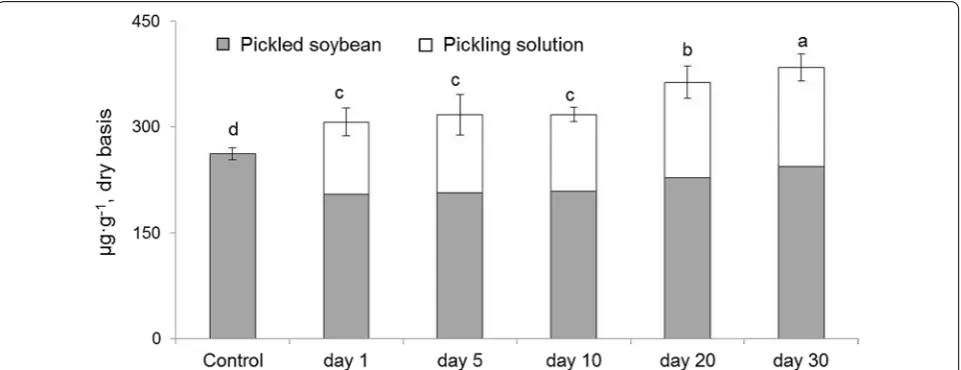
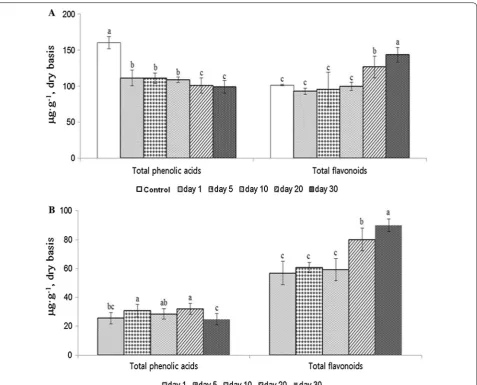
During the pickling process, the sum of the total phe-nolics in the pickled soybeans and the pickling solution increased as the pickling period was prolonged. The sum of the total phenolics increased by 47% (from 261.7 to 383.8 μg g−1) after 30 days of pickling (Fig. 1). For the pickled soybeans, the phenolic composition was the same as in the untreated soybeans; however, the phenolic con-tent changed significantly with respect to the pickling period (Table 1). The total phenolics content in the led soybeans decreased by 7–22% after 30 days of pick-ling, in comparison to that of the untreated soybeans. Furthermore, the total phenolic acids were decreased by 35%, whereas the total flavonoids were increased by 42% compared to those in the untreated soybeans over the 30-day period (Fig. 2). Naringenin, vanillin, and catechin were the most abundant phenolics found in pickled soy-beans. In particular, the naringenin content in the pickled soybeans significantly increased from 2.5 to 60.3 μg g−1, whereas the vanillin content decreased by about 50% from 144.3 to 72.3 μg g−1 after 30 days (Table 1, P < 0.05).
in this study. The total flavonoids in the pickling solu-tion accounted for 26–41% of the total phenolics in the untreated soybeans, and these amounts continually increased with respect to the pickling period over the 30 days. In contrast, the total phenolic acids in the pick-ing solutions were not influenced by the picklpick-ing period; these accounted for ≤15% of the total phenolics in untreated soybeans (Table 1; Fig. 2). In addition, catechin was the predominant phenolic type found in the pickling solution for the entire pickling period, and its content was 55–66% of the total phenolics found in the pickling solutions (Table 1).
Certain food processing or cooking conditions, includ-ing soakinclud-ing, heatinclud-ing, pressure, fermentinclud-ing, acidifyinclud-ing, or deforming, affect the content and composition of nutrients and nutraceuticals in soybeans and soy foods
[12, 17]. For example, the total isoflavones content, as well-known nutraceuticals in soybeans, was unchanged during fermentation; however, their composition was significantly altered (e.g., the aglucone types increased) [21]. In another study, the contents of the phenolic com-pounds (–8%), vitamin E (–3%), and amino acids (+10%) in soybeans were changed during soybean-rice cooking in an electric pressurized rice cooker (heating + pres-sure) [17]. In addition, vitamin E and isoflavones in soy-beans increased to 32.4 and 27.9%, respectively, after germination for 24 h [22].
Pickled soybeans are prepared by immersion in vin-egar for several days (usually ~10 days) to remove their undesirable bean flavor and the bitter taste of raw soy-beans, and to increase the in vivo digestion/absorption of soy proteins with high molecular weights [1]. Hence, the Table 1 Change in phenolic compounds content in soybeans during the 30-day pickling process (μg g−1, dry basis,
P < 0.05, n = 6)
ND not detected, TR trace level concentrations, PA phenolic acid, F flavonoid, PR protocatechuic acid, mC m-coumaric acid, tC t-cinnamic acid, CA catechin, NA
naringin, QU quercetin, NG naringenin, VA vanillin
a–f Values with different superscripts differ significantly according to pickling period (P< 0.05)
Untreated soybean (control) Pickled soybean LSD (0.05)
Day 1 Day 5 Day 10 Day 20 Day 30
Phenolic acid
PR 12.1 ± 1.5d 11.7 ± 1.2d 14.6 ± 1.9c 15.3 ± 2.3c 19.4 ± 1.3a 17.6 ± 2.5b 1.6
mC 1.9 ± 0.2a 1.5 ± 0.2c 1.7 ± 0.2b 1.5 ± 0.1c 1.4 ± 0.1cd 1.3 ± 0.2d 0.1
tC 2.1 ± 0.3f 3.5 ± 0.5e 4.7 ± 0.6d 5.5 ± 0.5c 6.9 ± 0.9b 7.9 ± 0.9a 0.6 VA 144.3 ± 6.4a 94.6 ± 9.7b 90.0 ± 6.0bc 86.4 ± 3.3c 73.2 ± 10.8d 72.3 ± 7.5d 6.5 Flavonoid
CA 53.0 ± 1.7a 39.6 ± 3.5b 37.3 ± 18.7b 36.2 ± 5.1b 48.5 ± 14.0a 49.3 ± 3.7a 8.5 NA 38.6 ± 2.4a 35.3 ± 2.2ab 32.5 ± 4.3bc 31.3 ± 2.5 cd 27.9 ± 4.2d 26.3 ± 5.2d 4.0
QU 7.2 ± 1.6b 7.6 ± 1.4ab 7.4 ± 1.7b 7.3 ± 2.1b 8.9 ± 1.0a 8.0 ± 2.3ab 1.5
NG 2.5 ± 0.5f 10.3 ± 0.9e 18.1 ± 1.3d 25.0 ± 2.3c 41.4 ± 2.6b 60.3 ± 5.8a 2.4
Total phenolics
261.7 ± 8.1a 204.1 ± 10.0d 206.2 ± 24.2d 208.4 ± 4.4d 227.5 ± 19.2c 242.8 ± 17.5b 13.3
Vinegar (control) Pickling solution
Day 1 Day 5 Day 10 Day 20 Day 30 LSD (0.05)
Phenolic acid
PR ND 13.1 ± 1.6bc 15.3 ± 1.2ab 14.3 ± 2.4ab 17.3 ± 4.5a 11.8 ± 2.3c 1.7
mC ND 0.9 ± 0.0c 1.1 ± 0.2b 1.2 ± 0.3ab 1.3 ± 0.2a 1.3 ± 0.3a 0.1
tC ND 1.8 ± 0.1c 1.9 ± 0.2bc 2.0 ± 0.2b 2.3 ± 0.3a 2.3 ± 0.3a 0.1
VA ND 14.8 ± 3.6b 18.7 ± 4.2a 16.7 ± 2.1ab 17.6 ± 3.0a 14.5 ± 2.7b 2.0
Flavonoid
CA ND 62.4 ± 9.4 cd 66.3 ± 3.7c 60.1 ± 8.5d 82.5 ± 8.4b 93.4 ± 4.8a 4.7
NA ND 4.1 ± 0.4b 4.8 ± 1.1a 4.7 ± 0.6a 5.1 ± 0.5a 5.0 ± 0.4a 0.4
QU ND TR TR 4.3 ± 0.2 5.6 ± 0.7 5.9 ± 0.2 –
NG ND 1.8 ± 0.9c 1.8 ± 0.1c 2.0 ± 0.2c 3.0 ± 0.1b 3.6 ± 0.2a 0.3
Total phenolics
acidic condition of the pickling process affects the con-tent and composition of various nutrients and nutraceu-ticals in the pickled soybeans and the pickling solution. In a prior study [15], the total phenols content in pickled soybeans was preserved at 63–66% of the total phenols present in the raw soybeans. In addition, the total phe-nols content in soybeans pickled for more than 4 days was increased due to the acid hydrolysis of complicated polyphenols in the pickled soybeans. Compared to the level in untreated soybeans, the total flavonoids content decreased by ~50% after pickling for 24 h; thereafter, its variation was insignificant over two additional weeks of pickling [16]. The decrease in the total flavonoids content in pickled soybeans may be influenced by the decrease in the content of anthocyanins, which are abundant in black-coated soybeans [15]. However, unlike the total flavonoids content in pickled soybeans, the isoflavones (in particular, the aglucone types)—another representa-tive class of soy flavonoids—in pickled soybeans increase over time while pickling in vinegar [1, 7, 12, 15]. The total isoflavones in both the pickled soybeans and the pick-ling solution after 30 days of pickpick-ling peaked at 93%, an increase compared to those in the untreated soybeans. Furthermore, although aglucone-type isoflavones are not found in untreated soybeans, aglucones were found at a maximum level of 154.6 μg g−1 in the pickled soybeans after 30 days immersion. However, malonyl and acetyl glucoside-types decreased by 17–41% after the pickling process [7].
Hitherto, to our knowledge, there has been no com-prehensive report concerning the changes in the levels of individual phenolic compounds during the pickling
process. In this study, the sum of the total phenolic con-tents in the pickled soybeans and the pickling solu-tion also increased by as much as 47% after pickling for 30 days (Fig. 1), which is consistent with a prior study that reported an increase in the total phenol content in pickled soybeans as a function of the pickling period. In this study, the increase in the total phenolics content was associated with an increase in the total flavonoids con-tent (in particular, naringenin and catechin) in both the pickled soybeans (r2 = 0.931, P < 0.0001) and the pickling solutions (r2 = 0.561, P < 0.0001). In contrast, the total phenolic acids content in the pickled soybeans decreased as the pickling period was extended, and the vanillin content was highly associated with the decrease in the total phenolic acids in the pickled soybeans (r2 = 0.986, P < 0.0001).
The variation of phenolics content during the pickling process may be associated with the change in soybean texture under the acidic conditions and/or incomplete germination (or sprouting). In prior studies [1, 7], the acidity of the pickling solution was kept low (pH ≤ 4.0) during the pickling period. In fact, in comparison to untreated soybeans, the pickled soybeans were ten times softer, and their strength was reduced after pickling [1,
flavonoids, and ferulic acid contents in wheat germinated for 5 days were increased by 9.9, 30.7, and 21.6%, respec-tively. Also, the content of vitamin E was increased more than twofold in germinated wheat [24].
In the present study, the mean acidity of all pickling solutions was approximately pH 4.0. In addition, the soy-beans were incompletely germinated (signified by the appearance of hypocotyls of ~0.5 mm) during the 30-day pickling process. These factors may have caused the soy-bean texture to soften. In this way, the improved extrac-tion efficiency and/or de novo biosynthesis caused by the incomplete sprouting may have altered the total abun-dance of phenolic compounds in the pickled soybeans and pickling solutions. Also, acid hydrolysis during the pickling process may have affected the content of phe-nolic compounds in the pickled soybeans [14].
In the case of detailing vitamin E variations during pickling, there are no comprehensive reports to date. Only one prior study reported that the vitamin B1 and C contents in soybeans declined during pickling [16]. In this study, the vitamin E compositions and the major vitamin E in (pickled) soybeans are similar to the prior report [22].
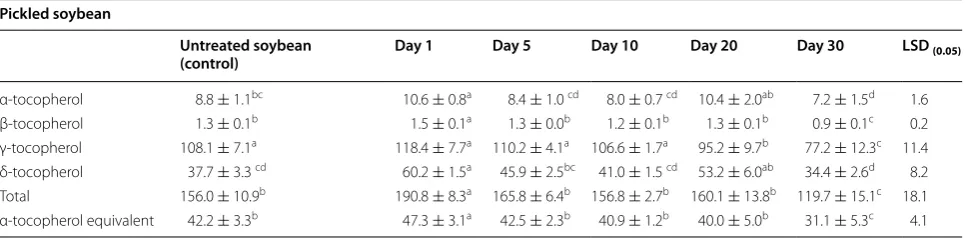
Table 2 shows the variations in the vitamin E content depending on the soybean pickling period. α-, β-, γ-, and δ-Tocopherols were found in the untreated soybeans, with a total vitamin E content of 156.0 μg g−1, which can be expressed as 42.2 μg g−1 of α-tocopherol equivalents. In the untreated soybeans, γ-tocopherol is the most abun-dant type, accounting for 69% of the total vitamin E. After pickling for 1 day, the total vitamin E increases in the soy-beans by ~22%; however, after pickling for 30 days, the total vitamin E in the pickled soybeans decreases by 23% (Table 2). γ-Tocopherol is also the most abundant type in pickled soybeans, accounting for 59–67% of the total vitamin E, although the γ-tocopherol content decreases by ~29% during the pickling period. No vitamin E mol-ecules were present in either the brewed vinegar or any of the pickling solutions in this study. γ-Tocopherol was only detected below the LOD in certain pickling solu-tions (see Additional file 1: Figure S4).
The vitamin E content is also influenced by germina-tion. The total vitamin E content increases by more than double in soy germs and wheat sprouts after germination. Among the vitamin E molecules, the α–tocopherol, in particular, significantly increases after germination [22,
24, 29]. In this study, the change in soybean texture and/ or incomplete germination during the pickling period may have affected the increase in the total vitamin E in the pickled soybeans after pickling for 1 day. In addition, the decrease in the total vitamin E in the pickled soy-beans may be associated with the decomposition of the γ-tocopherol (r = 0.91, P < 0.0001) caused by (acetic) acid
hydrolysis during pickling. According to a prior study [27], the α-tocopherol is more stable toward degradation by bleaching, whereas the α-tocopherol in oils is less sta-ble to microwave heating. In this study, the γ-tocopherol was the most sensitive to the pickling process by vinegar, whereas the α-tocopherol was relatively stable. Hence, on the basis of our findings, a pickling period of more than 10 days may reduce the antioxidant activity of the vita-min E in the pickled soybeans.
Changes in the fatty acids content in soybeans during pickling
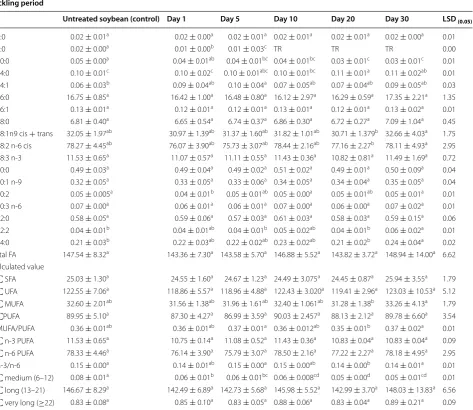
Table 3 shows the variation in the FAs profile in the untreated and pickled soybeans depending on the pick-ling period. In both sample groups, linoleic acid was the major FA, accounting for approximately 53% of the total FAs. Oleic, palmitic, α-linolenic, and stearic acids were the next most abundant, comprising ~22, 11, 8, and 5% of the total FA content, respectively. During the soybean pickling period, both the total and major FA contents varied by less than 1%, which was not statistically signifi-cant with respect to the pickling period. In addition, in the untreated soybeans and all pickled soybeans, the total unsaturated FA content was ~fivefold larger than the total saturated FA content, and the polyunsaturated fatty acid (PUFA) content was about threefold higher than the monounsaturated fatty acid (MUFA) content (P < 0.05). In particular, the n-6 FA content was about sevenfold higher than the n-3 FA content. Also, long chain FAs consisting of 13–21 carbons were the most predominant FA types present in the untreated and pickled soybeans. Finally, no FAs were detected in any of the pickling solu-tions in this study (Table 3).
Soybeans are crucial sources of dietary calories and oil. Their lipid content are ~20%, which are mostly present in the form of triglycerides (~90%) [30]. Palmitic, oleic, and linoleic acids are the major FAs found in soybeans,
Table 2 Change in vitamin E content in soybeans during the 30-day pickling process (μg g−1, dry basis, P < 0.05, n = 6)
α-tocopherol equivalent is based on the biological activity of vitamin E vitamers and is calculated as follows: α-tocopherol equivalent = sum of α-tocopherol + (β-tocopherol × 0.4) + (γ-tocopherol × 0.3) + (δ-tocopherol × 0.01)
a–d Values with different superscripts differ significantly according to pickling period (P< 0.05)
Pickled soybean
Untreated soybean
(control) Day 1 Day 5 Day 10 Day 20 Day 30 LSD (0.05)
and linoleic acid, in particular, is the most abundant FA, accounting for ~55% of the total [31]. In general, food processing methods such as heating are known to decrease the nutritional value of foods, although digest-ibility and the bioavailability of nutrients and nutraceu-ticals are increased [32]. For example, depending on the soybean heating conditions, the content of linolenic acid was found to decrease by 14–38%, and that of linoleic acid decreased by as much as 8.5% [33]. Germination also affects the FA profiles in soybeans. In a prior study [22], after germinating for 24 h, the saturated FA contents in
soybeans were slightly decreased, whereas unsaturated FAs (particularly linolenic acid) were increased from 8 to 21%. Another study [16] showed that pickling did not affect the FA composition and content in soybeans. Lin-oleic and Lin-oleic acids were found as the major FAs in both untreated and pickled soybeans, and their contents var-ied by ~1% over a 10-day period. In this study, the major FA types were also linoleic and oleic acids, accounting for 53 and 22% of the total FAs, respectively, in both the untreated and pickled soybeans. Furthermore, the major FA contents measured in this study also varied by less Table 3 Change in fatty acid content in soybeans during the 30-day pickling process (mg g−1, dry basis, P < 0.05, n = 6)
∑SFA sum of saturated fatty acids, ∑UFA sum of unsaturated fatty acids, ∑MUFA sum of monounsaturated fatty acids, ∑PUFA sum of polyunsaturated fatty acids,
MUFA/PUFA sum of monounsaturated fatty acids/sum of polyunsaturated fatty acids, ∑n-3 PUFA sum of omega-3 fatty acids, ∑n-6 PUFA sum of omega-6 fatty acids,
n-3/n-6 sum or omega-3 fatty acids/sum of omega-6 fatty acids, ∑ medium sum of medium chain fatty acids including 6–12 carbons, ∑long sum of long chain fatty acids including 13–21 carbons, ∑very long sum of long chain fatty acids including more than 22 carbons, TR trace level
a–d Values with different superscripts differ significantly according to pickling period (P< 0.05)
Pickling period
Untreated soybean (control) Day 1 Day 5 Day 10 Day 20 Day 30 LSD (0.05)
C6:0 0.02 ± 0.01a 0.02 ± 0.00a 0.02 ± 0.01a 0.02 ± 0.01a 0.02 ± 0.01a 0.02 ± 0.00a 0.01
C8:0 0.02 ± 0.00a 0.01 ± 0.00b 0.01 ± 0.03c TR TR TR 0.00
C10:0 0.05 ± 0.00a 0.04 ± 0.01ab 0.04 ± 0.01bc 0.04 ± 0.01bc 0.03 ± 0.01c 0.03 ± 0.01c 0.01 C14:0 0.10 ± 0.01c 0.10 ± 0.02c 0.10 ± 0.01abc 0.10 ± 0.01bc 0.11 ± 0.01a 0.11 ± 0.02ab 0.01 C14:1 0.06 ± 0.03b 0.09 ± 0.04ab 0.10 ± 0.04a 0.07 ± 0.05ab 0.07 ± 0.04ab 0.09 ± 0.05ab 0.03 C16:0 16.75 ± 0.85a 16.42 ± 1.00a 16.48 ± 0.80a 16.12 ± 2.97a 16.29 ± 0.59a 17.35 ± 2.21a 1.35 C16:1 0.13 ± 0.01a 0.12 ± 0.01a 0.12 ± 0.01a 0.13 ± 0.01a 0.12 ± 0.01a 0.13 ± 0.02a 0.01 C18:0 6.81 ± 0.40a 6.65 ± 0.54a 6.74 ± 0.37a 6.86 ± 0.30a 6.72 ± 0.27a 7.09 ± 1.04a 0.45 C18:1n9 cis + trans 32.05 ± 1.97ab 30.97 ± 1.39ab 31.37 ± 1.60ab 31.82 ± 1.01ab 30.71 ± 1.379b 32.66 ± 4.03a 1.75 C18:2 n‑6 cis 78.27 ± 4.45ab 76.07 ± 3.90ab 75.73 ± 3.07ab 78.44 ± 2.16ab 77.16 ± 2.27b 78.11 ± 4.93a 2.95 C18:3 n‑3 11.53 ± 0.65a 11.07 ± 0.57a 11.11 ± 0.55a 11.43 ± 0.36a 10.82 ± 0.81a 11.49 ± 1.69a 0.72 C20:0 0.49 ± 0.03a 0.49 ± 0.04a 0.49 ± 0.02a 0.51 ± 0.02a 0.49 ± 0.01a 0.50 ± 0.09a 0.04 C20:1 n‑9 0.32 ± 0.05a 0.33 ± 0.05a 0.33 ± 0.06a 0.34 ± 0.05a 0.34 ± 0.04a 0.35 ± 0.05a 0.04 C20:2 0.05 ± 0.005a 0.04 ± 0.01b 0.05 ± 0.01ab 0.05 ± 0.00a 0.05 ± 0.01ab 0.05 ± 0.01a 0.01 C20:3 n‑6 0.07 ± 0.00a 0.06 ± 0.01a 0.06 ± 0.01a 0.07 ± 0.00a 0.06 ± 0.00a 0.07 ± 0.02a 0.01 C22:0 0.58 ± 0.05a 0.59 ± 0.06a 0.57 ± 0.03a 0.61 ± 0.03a 0.58 ± 0.03a 0.59 ± 0.15a 0.06 C22:2 0.04 ± 0.01b 0.04 ± 0.01ab 0.04 ± 0.01b 0.05 ± 0.02ab 0.04 ± 0.01b 0.06 ± 0.02a 0.01 C24:0 0.21 ± 0.03b 0.22 ± 0.03ab 0.22 ± 0.02ab 0.23 ± 0.02ab 0.21 ± 0.02b 0.24 ± 0.04a 0.02 Total FA 147.54 ± 8.32a 143.36 ± 7.30a 143.58 ± 5.70a 146.88 ± 5.52a 143.82 ± 3.72a 148.94 ± 14.00a 6.62 Calculated value
than 1% and were statistically independent of the pickling period.
In general, the intake of essential FAs (n-3 and n-6 types) has many health-promoting benefits, having been related to delays in the onset or progress of cardiovas-cular disease, hypertension, type 2 diabetes, and cer-tain cancers, and to immune system enhancements [34,
35]. For example, n-6 FAs like linoleic acid can serve as precursors to powerful hormone-like compounds that enhance the transport of bioactive compounds [36]. The increase of n-3 FA intake from plant or fish sources is known to decrease the risk of cardiovascular mortality. However, although FAs are essential nutrients, a larger intake of n-6 FAs relative to n-3 FAs is less desirable for human health, because high n-6 FA consumption pro-motes certain cancers, as well as cardiovascular, inflam-matory, and autoimmune diseases [37]. In this study, the n-3/n-6 FA ratio in both the untreated and pickled soy-beans was ~1:7 over the entire pickling period, and this ratio was at least twofold lower than the recommended dietary level of 1:1–1:4 [37]. Hence, for the purpose of a desirable nutritional balance, the intake of n-3 FA-rich foods with the pickled soybeans may be required for bet-ter human health.
Conclusions
The vinegar pickling process changes the content and composition of functional substances in soybeans. After the 30-day pickling process, the sum of the total pheno-lics in the pickled soybeans and the pickling solutions increased by 47%, whereas the total vitamin E content in the pickled soybeans decreased by 23%. The pickling period did not affect the total FA content in the pick-led soybeans. Besides, in this study, the saturated FAs (r = −0.27, P < 0.05) and the n3/n6 ratio (r = −0.37, P < 0.01) were negatively correlated with the total vitamin E content. The total vitamin E content in the pickled soy-beans was associated with the total phenolics in the pick-led soybeans (r = −0.34, P < 0.01) and pickling solution (r = −0.49, P < 0.0001). A longer pickling period tended to decrease the total vitamin E content (r = −0.55, P < 0.0001) in the pickled soybeans, whereas it increased the sum of total phenolics (r = 0.85, P < 0.0001) in both the pickled soybeans and the pickling solution. Therefore, a 10–20 day pickling period may be considered suitable in terms of functional substances in the pickled soybeans, such as selected phenolics, vitamin E molecules, and FAs. The present study may provide insight into the produc-tion of the funcproduc-tional compounds measured in pickled soybeans.
Abbreviations
DMP: 2,2‑dimethoxy propane; FA: fatty acid; FAME: fatty acid methyl ester; FID: flame ionization detector; IS: internal standard; LOD: limit of detection; LOQ: limit of quantification; LSD: least significant difference; MUFA: monounsatu‑ rated fatty acid; PUFA: polyunsaturated fatty acid; STD: standard.
Authors’ contributions
IMC and SHK conceived and designed the study, and wrote, reviewed, and edited the manuscript for submission. JYO performed the experimental stud‑ ies and wrote part of the draft manuscript. All authors read and approved the final manuscript.
Competing interests
The authors declare that they have no competing interests, except for the domestic patent applying in Republic of Korea. The contents related to this manuscript have been currently applying for the domestic patent in Republic of Korea on May 04 2016 as entitled “Method for controlling functional com‑ ponents content of pickled soybean or pickling solution (Patent Application#: 10‑2016‑0055104)”.
Funding
This research was supported by Basic Science Research Program through the National Research Foundation of Korea (NRF) funded by the Ministry of Science, ICT and Future Planning (NRF‑2014R1A2A2A01002202). Also this work was carried out with the support of “Cooperative Research Program for Agriculture Science and Technology Development (Project No. PJ01183302)” Rural Development Administration, Republic of Korea.
Publisher’s Note
Springer Nature remains neutral with regard to jurisdictional claims in pub‑ lished maps and institutional affiliations.
Received: 28 October 2016 Accepted: 14 July 2017
References
1. Jo Y‑J, Jeong Y‑J, Jang S‑Y, Seo J‑H (2010) Physicochemical characteristics of chokong and soaking solution on soaking period. J Kor Soc Food Sci Nutr 39:281–286
2. Messina MJ (1999) Legumes and soybeans: overview of their nutritional profiles and health effects. Am J Clin Nutr 70:439s–450s
3. Tikkanen MJ, Adlercreutz H (2000) Dietary soy‑derived isoflavone phy‑ toestrogens: could they have a role in coronary heart disease prevention? Biochem Pharmacol 60:1–5
4. Fonseca D, Ward WE (2004) Daidzein together with high calcium preserve bone mass and biomechanical strength at multiple sites in ovariecto‑ mized mice. Bone 35:489–497
5. Rosenthal A, Deliza R, Cabral LMC, Cabral LC, Farias CAA, Domingues AM (2003) Effect of enzymatic treatment and filtration on sensory character‑ istics and physical stability of soymilk. Food Con 14:187–192
6. Wang W, De Mejia EG (2005) A new frontier in soy bioactive peptides that may prevent age‑related chronic diseases. Compr Rev Food Sci Food Saf 4:63–78
Additional file
7. Eom KY, Kim JS, Choi HS, Cha BS, Kim WJ (2006) Changes in isoflavone and some characteristics of choking of germinated soybeans during pickling in vinegar. J Kor Soc Food Sci Nutr 35:359–365
8. Oh CH, Kim EJ, Lee KH, Moon MK, Cho MG, Kim JH, Oh SH, Lee TK, Shin TY, Kim DK (2006) Antiproliferative constituents from the vinegar treated small black soybean (Glycine max Merr.). Nat Prod Sci 12:109–112 9. Park C‑S, Kim D‑H, Kim M‑L, Suk JM, Kim MR (2007) Effects of mixed pills
of chokong (pickled black soybeans) with medicinal herbs on body weight gain and lipid profiles in rats fed high‑fat diet. Kor J Herbol 22:127–135
10. Shin J‑Y, Park L‑Y, Oh Y‑S, Lee SH, Youn K‑S, Kim SJ (2008) Inhibition of lipid accumulation in 3T3‑L1 adipocytes by extract of chokong, Rhynchosia nolubilis seeds pickled in vinegar. Food Sci Biotechnol 17:425–429 11. Lee DH, Kwak DH, Kim SM, Ju EJ, Choi HG, Jung KY, Choo YK, Kim OH,
Hwang JB, Bae NG, Han JC, Park HD (2004) Effect of small black soybean powder on blood glucose and insulin sensitivity in streptozotocin‑ induced diabetic rats. J Kor Soc Food Sci Nutr 33:1618–1625 12. Kim S‑H, Yang Y‑S, Chung I‑M (2016) Effect of acetic acid treatment on
isoflavones and carbohydrates in pickled soybean. Food Res Int 81:58–65 13. Han JS, Hong HD, Kim SR (2007) Changes in isoflavone content and mass
balance during soybean processing. Food Sci Biotechnol 16:426–433 14. Kim J‑S, Kim J‑G, Kim W‑JK (2004) Change of isoflavone contents in
soybean cultivars pickled in persimmon vinegar. Kor J Food Sci Technol 36:833–836
15. Seo J‑H, Jeong Y‑J (2011) Comparison of functional properties of black soybean pickled in vinegar (Chokong). J Kor Soc Food Sci Nutr 40:171–176 16. Bang H‑P, Choi O‑K, Cho G‑S, Son J‑Y, Ryu G‑H (2006) The change of
compositions and antioxidant effect in soybean cultivars pickled in persimmon vinegar. Kor J Food Nutr 19:398–409
17. Kim S‑H, Yu B‑R, Chung I‑M (2015) Changes in the contents and profiles of selected phenolics, soyasapogenols, tocopherols, and amino acids during soybean–rice mixture cooking: electric rice cooker vs electric pressure rice cooker. Food Chem 176:45–53
18. Chung I‑M, Lim J‑J, Ahn M‑S, Jeong H‑N, An T‑J, Kim S‑H (2016) Compara‑ tive phenolic compounds profiles and antioxidative activity of the fruit, leaves, and roots of Korean ginseng (Panax ginseng Meyer) according to cultivation years. J Ginseng Res 40:68–75
19. Chung I‑M, Kim J‑K, Park I, Oh J‑Y, Kim S‑H (2016) Effects of milk type, production month, and brand on fatty acid composition: a case study in Korea. Food Chem 196:138–147
20. Korea Food and Drug Administration (KFDA), 2015. Food Code 1.1.5.4. Analysis of fatty acid
21. Chung IM, Seo SH, Park IM, Ahn JK, Kim EH, Kim MY, Kim SH (2012) Changes in isoflavone composition of soya seeds, soya curd and soya paste at different processing conditions. J Food Nutr Res 51:40–51 22. Kim S‑L, Lee J‑E, Kwon Y‑U, Kim W‑H, Jung G‑H, Kim D‑W, Lee C‑K, Lee
Y‑Y, Kim M‑J, Kim Y‑H, Hwang T‑Y, Chung I‑M (2013) Introduction and nutritional evaluation of germinated soy germ. Food Chem 136:491–500
23. Chiarello MD, Guerroue JLL, Chagas C, Franco OL, Bianchini E, Joao MJ (2006) Influence of heat treatment and grain germination on the isofla‑ vone profile of soy milk. J Food Biochem 30:234–247
24. Žilić S, Basić Z, Hadži‑Tašković Šukalović V, Maksimović V, Janković M, Filipović M (2014) Can the sprouting process applied to wheat improve the contents of vitamins and phenolic compounds and antioxidant capacity of the flour? Int J Food Sci Technol 49:1040–1047
25. Lin P‑Y, Lai H‑M (2006) Bioactive compounds in legumes and their germi‑ nated products. J Agric Food Chem 54:3807–3814
26. Munné‑Bosch S, Alegre L (2002) The function of tocopherols and tocot‑ rienols in plants. Crit Rev Plant Sci 21:31–57
27. Bramley PM, Elmadfa I, Kafatos A, Kelly FJ, Manios Y, Roxborough HE, Schuch W, Sheehy PJA, Wagner KH (2000) Vitamin E. J Sci Food Agric 80:913–938
28. Yoshida H, Kajimoto G (1989) Effects of microwave energy on the toco‑ pherols of soybean seeds. J Food Sci 54:1596–1600
29. Shi H, Nam PK, Ma Y (2010) Comprehensive profiling of isoflavones, phytosterols, tocopherols, minerals, crude protein, lipid, and sugar during soybean (Glycine max) germination. J Agric Food Chem 58:4970–4976 30. Yoon TH, Im KJ, Kim DH (1984) Fatty acid composition of lipids obtained
from Korean soybean varieties. Kor J Food Sci Technol 16:375–382 31. Kom J‑G, Kim S‑K, Lee J‑S (1988) Fatty acid composition and electro‑
phoretic patterns of protein of Korean soybeans. Kor J Food Sci Technol 20:263–271
32. Slavin JL, Jacobs D, Marquart L (2000) Grain processing and nutrition. Crit Rev Food Sci Nutr 40:309–326
33. Žilić SM, Šobajić SS, Mladenović‑Drinić SD, Kresović BJ, Vasić MG (2010) Effects of heat processing on soya bean fatty acids content and the lipoxygenase activity. J Agric Sci 55:55–64
34. Simopoulos AP (1999) Essential fatty acids in health and chronic disease. Am J Clin Nutr 70:560–569
35. Salmerón J, Hu FB, Manson JE, Stampfer MJ, Colditz GA, Rimm EB, Willett WC (2001) Dietary fat intake and risk of type 2 diabetes in women. Am J Clin Nutr 73:1019–1026
36. Benatti P, Peluso G, Nicolai R, Calvani M (2004) Polyunsaturated fatty acids: biochemical, nutritional and epigenetic properties. J Am Coll Nutr 23:281–302