IRRIGATION SCHEDULING WITH SOIL INSTRUMENTS: ERROR LEVELS AND MIGROPROCESSING DESIGN CRITERIA
J. W. Cary 1/
Two criteria for deciding when a crop should be irrigated are: (1) the depletion of water in the root zone to some predetermined amount, or (2) the
decrease of water potential
at some given depth to apredetermined level. The
value one chooses for either of these criteria to indicate that irrigation is needed willdepend on soil properties, crop
rootingcharacteristics and stage
of plant growth. Functional relations between these
two criteria and produc-tion arenot yet known quantitatively,
thus one cannot say that either ap-proach is inherently better than the other. The effective application of either requires experience and judgment.Recent years have seen significant
progress inscheduling irrigation using
meteorological data to calculate the depletion of water in the root zone. The daily potential evaporation from afull cover reference crop can be calculated
within
a few
percent using
measurements of air temperature, humidity, solar radiation and wind run. • Given an appropriate cropcoefficient curve,
theevapotranspiration can also be
estimate and the soil water depletion known with varying degrees of accuracy. As an alternative, therate of soil water
depletion maybe
directlymeasured with
a neutron meter or by gravimetric soil sampling. Gear at al. (1977) used a neutron meter to measure soil water on successive dates and projected soil water depletion witha
straight line to
a
level where replenishment would be needed. This
gave estimates of the number
of days until irrigation.Tensiometers, resistance blocks, thermoconductivity sensors, psychrometers and related
instruments
have been occasionally used or proposed for use in auto-matically starting irrigation at some given water potential.Tensiometers and
gypsum resistance blocks have been available for many years
to help decide when the soil should beirrigated. Fischback (1978)
reported results of scheduling the irrigation of corn by several different methodsincluding
resistance blocks anda
meteorological approach. Hetended to favor the
blocks.
At the present time, a farm manager may schedule irrigation
with soil
water potential instruments. Based on experience, he will extrapolate the soil water change expected in the next fewdays, and
arrive at a projected date for irrigation. The recentevolution of
microprocessors suggests thata
system might be designed that would automatically read soil water potential instru-ments and predict the day to irrigate using anappropriate
algorithm. Thiscould lead to a
level of sophistication for predicting irrigation frequencies comparable to that developing for computerscheduling with microclimate
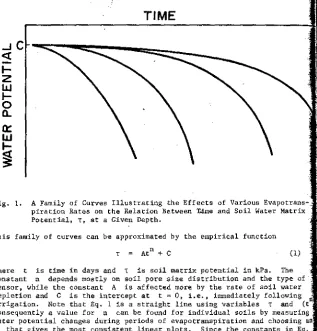
data (Wright and Jensen, 1978).The general patterns of change in
soil water potential with
time at a given depth are shown in Fig. 1.1/ Soil Scientist,
Agriculture Research Service, U. S. Department ofAgricul-ture, Snake River Conservation Research Center, Kimberly, Idaho 83341.
TIME
C
1
=0_
Fig. 1. A Family of Curves Illustrating the Effects of Various
Evapotrans-piration Rates on the Relation Between time and Soil
Water Matrix Potential, T, at a Given Depth.This family of curves can
be approximated by the empirical function T=
At n + Cwhere
t is time in days andT
is soil matrix potential in kPa. The constant n depends mostly on soil pore size distribution and the type of sensor, while theconstant A is affected more by the rate
of soil water depletion andC is the
intercept at t 0, i.e., immediately following nirrigation. Note that Eq. 1 is a straight line using variables
Tand (t
Consequently a value for n can be found for individual soils by measuring waterpotential changes during periods of evapotranspiration and choosing an
n that gives the most consistentlinear plots. Since the constants
in Eq. can be calculated fromappropriate data, a microprocessor could be programme
to project irrigation by extrapolating time to some
predeterminedwater pote
tial.The feasibility of such an
undertaking requires an analysis of the inherenterrors with
respectto the errors
encountered in scheduling with microclimate data and with respect to the level of error that is practical f the grower. Specifically, it comesdown to questions on the applicability o
Eq. 1, the accuracy and reliability of
soil
water potential sensors, and the
spatial variability of soil water in the field.
EXPERIMENTAL PROCEDURES
Data were collected
during two growing seasons on four plots of Portneuf silloam soil described in detail by Cary and Rasmussen (1979). Each plot was 2
meters
long and 9 meters wide. Corn,
beans,sugarbeets
and grass weregrown
the
first year; beans and sugarbeets followed thesecond year. The plots
weirrigated
with corrugates
(except the grass which was borderflooded). Each
plot was sampled
and instrumented onboth ends such
that data collection sit were about 170 meters apart.There were 8 data collection sites the first season. Each had two permanent
tensiometers at the 30-cm
depth. There were commercial units with 45-cm lonplastic cylinders connecting the ceramic cups to vacuum gauges. Three gypsum
resistance blocks2/ were also installed in the rows at the 30-cm depth within a 2-m radius. The resistance of each block was measured five days a week with a 1K Hertz electrical conductivity bridge. Soil
temperatures around each set
of blocks were also measured. Gravimetric soil water measurements at depths of 15, 30, and 45 cm were made from two cores taken about 2 m apart twice weekly at random locations in the rows near the blocks and tensiometers. In the second season, the blockswere placed at both 15- and 30-cm depths and
their
resistances weremeasured twice a week. Three portable rapid response
tensiometers3/ were also inserted twice weekly to measure water
potentialat
the 30-cm depth. These tensiometers were placed at random
not fartherthan
2 m apart incrop rows near the blocks.
-Care was taken to
irrigate
the plotsas uniformly as possible.
Fertility andcultural practices were in accord
with localrecommendations and
practices.At the end of the growing season, 4 sites, 2 at each end of the field, were
sampled, taking four undisturbed cores from
each site. Sliceswere
taken fromthese cores at the
26- to 34-cm depths andindividual
moisture desorption curves measured for each core.These data were used to calculate pore size
distribution indexes by the method of Cary and Hayden (1974).
RESULTS
The gravimetric soil water measurements
were used to assessthe spatial
vari-ability within the plotsand to compare the variability shown
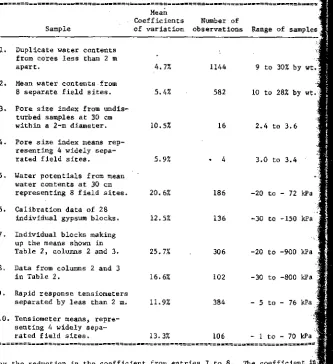
by the tensi-ometers and blocks. Methods of characterizing soil spatial variability arenot
yet
very well developed,
though this is being addressed by a number of soil scientists(Rao
et al., 1979 and 'Western Regional Research Committee155). In this case, the standard deviation was calculated for two or more
observations that should
have been identical. This value was divided by the
mean of the observations to get the coefficient of variation. The average of all the coefficients of variation was then used to characterize the vari-ability (Table 1). This approach reduces the dependence of standard deviationon the range of the data
observationssince the standard
deviation of waterpotential increases rapidly as
thepotential becomes more negative.
The standard deviation of
the water content increases asthe
water content increases, but as pointed out by Ben-Asher (1979),standard deviation in
general for uniform soils is about 10%of the water content. Nielson et al.
(1973) found average standard deviation of volumetric watercontents
between 5and 7% in a field study, indicating
a coefficient of variation range
of 13 to 20%. Cassel and Nelsen (1979) also reported the coefficients of variation ofvolumetric water contents ranged from 8 to 25% in an intensive field study.
Entries 1, 3, 7 and 9 in Table 1 are measures
of
the short distancespatial
variability of soil in the test strips. Average values of water potential from each of these local observation sites were averaged and their means usedto characterize the overall spatial
variability of the studyarea, i.e.,
entries 2, 4, 5, 8 and 10.Averaging
several localizedmeasurements
to get means forcharacterizing the overall spatial variability reduces
the error caused by the inherentvariability of the measuring instrument as
demonstrated2/ Beckman
Instrument Company, Cedar
Grove, NewJersey.
3/ Soil moisture probe Model 2900, Soil Moisture Equipment Corporation, Santa Barbara, California.
Trade names
and company names are
included for the benefit of the reader
and do notimply any endorsement or preferential
treatment of the product by the
U. S. Department of Agriculture.
4.7%
1144
5.4%
582
10.5%
16
5.9%
• 4
20.6%
186
/2.5%
136
25.7%
306
16.6%
102
11.9%
384
9
to 30% by wt.
10 to 28% by wt.
2.4 to 3.6
3.0 to 3.4
- 20 to - 72 kPa
-30 to -150 kFa
- 20 to -900 kPa
- 30 to -800 kPa
- 5 to - 76 kPa
13.3%
106 - 1 to - 70 kPa Table 1. Coefficients of Variation Associated with Measured Values of SoilWater Potential,
Water Contents on a Weight
Basis,and
Soil Pore
Size Distribution Indexes.
...
Mean
Coefficients
Number of
Sample of variation observations Range
of samples
1. Duplicate
water contentsfrom cores less than 2 m
apart.
2. Mean water contents from
8 separate field sites.
3. Pore size index from
undis-turbed samples at 30 cm
within
a2-m diameter.
4.
Pore size index means
rep-resenting 4 widely
sepa-rated field sites.
5. Water potentials from mean
water contents at 30 cm
representing 8 field sites.
6.
Calibration data of 28
individual gypsum blocks.
7. Individual blocks making
up the means shown in
Table 2, columns 2 and 3.
8. Data from columns 2 and 3
in Table 2.
9. Rapid response tensiometers
separated by leas than 2 m.
10. Tensiometer means,
repre-senting 4 widely
sepa-rated field sites.
.--.=
..
.
...
by the reduction in the coefficient from entries 7 to 8. The coefficient in
entry 7 came from 12 blocks, 3 each at 4
widely separated sites in the study area. The coefficient in entry 8 was based on the means of 3 localized blocat
each of the 4 separated sites.
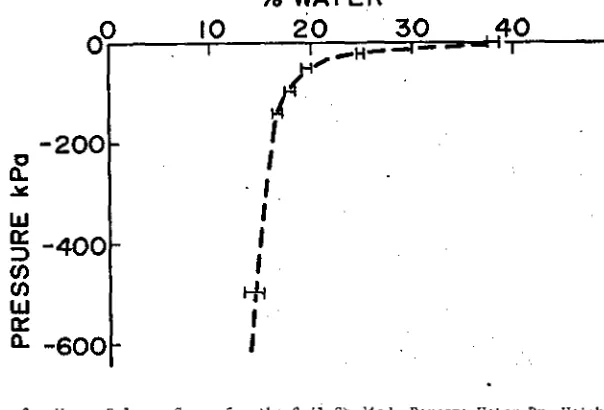
Water potential was estimated.
from the gravimetric water content at the
30-depth, assuming a single water desorption function, Fig. 2, for all four plo
(entry 5, Table 1). The coefficient of variation of these potentials
was 20.6% which was greater
than the coefficient of
variations ofthe poten
tials measured with
blocks
or tensiometers (entries 8 and 10). Consequen tly
it appears the inherent
inaccuracies
in measuring soil metric potential
with
gypsum resistance
blocks or tensiometers may be no greater than the inhe rent
spatial
variability in the field.
Particularlywith blocks, the average
resistance
of
several placed near one
another may be used to reducethe
effectof their inherent variability.
% WATER
1
1
0
20
30
40
1-14
-200
a.
-400
ix
a-
-600
Fig. 2. Water Release Curve for the Soil Studied, Percent Water Dry Weight Basis as a Function of
Pressure in
the DesorptionChamber. Brackets
Show the Spread of Mean Water Contents from the Four. Sampling Sites. The Pore Size Distribution Indexes Associated With These Data are Given in Table 1.DISCUSSION
Several problems associated with automating the tensiometers and blocks with
a microprocessor to read out projected irrigation dates were noted during the
experiment and analysis of data. The permanent plastic tube tensiometers were
unsatisfactory for automation because they required weekly service and were sluggish when the soil was drier than -60 kPa. They had to be placed 30 cm
deep• to remain operative for at least the first two-thirds
of some irrigationcycles. The rapid response tensiometers were better, but even they had to be
recharged once or twice during the
season.Their effective range was only
down to a bit less than -70 kfa (elevation 1,130 m). Their mobility and rapidresponse time were
advantagesinsofar as characterizing conditions
in thefield, but considerable
care was required to install them, particularly when the soil surface was dry and slaked into the access holes.The gypsum resistance blocks also have several inherent problems. They are
temperature dependent. The empirical
equationR22 == ((T0.011 -1) (T-22) -1- 1] R
(2)
was found from measurements made in a controlled temperature room. It
was
used to correct the observed resistance to the 22°C calibration temperature. A second empirical equation was then developed for the soil water potential
T q.0217 R
22
+ 69.84 In R22
-3.245AT---
22 -310.5 (3) where Ris
the measured resistance in ohms, T isthe temperature of the
block °C and R 22 is resistance corrected to 22°C.
Gypsum blocks also have some wetting and drying hysteresis that may be signif
icant under transient soil water conditions.
Problems were noted at the 30-cmdepth
when irrigation did not quiteincrease the
potential to -30 kPa beforerapidly falling again due to soil water extraction. In essence, the blocks
did not always rewet to the level
indicated by gravimetric samples. This problem was less at the15-cm depth because the soil water content rises
higher following rainand light
irrigations allowing a more complete blockresponse. As a consequence, blocks at the 15-cm depth passed through a wider
range of water potentials during each drying cycle than blocks at the 30-cmdepth or tensiometers
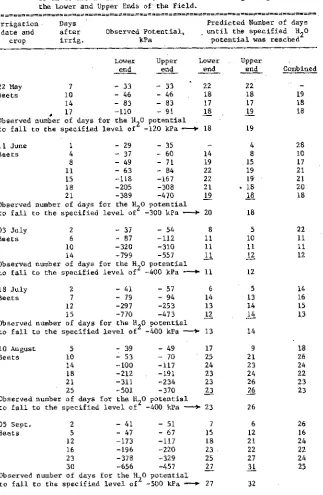
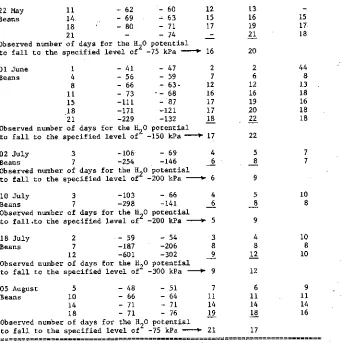
at any depth. This is an advantage for automation and data reduction with a microprocessor.The mean water potentials from the three temperature corrected blocks at the
15-cm depth are shown in Table 2 for the upper andlower ends of
the beet and bean plots during the second season,The predicted lengths of the
drying cycles are also shown at various times during each cyclefor the lower
andupper ends (columns 4 and 5). The predictions are from Eq. 1 taking n == 3, C
(i.e., field capacity) as -30 kPa and using the average water potential from
the
three blocks on day, t, to find the value of A. With exception of thefirst few days following irrigation, this method predicted the
length ofdrying cycles within one or two days of those
observed, even thoughthe
cycles ranged from five to 25 days. This method requires only a portable nonpolarizing meterto
measure the resistance of the blocks and a simple hand held programmable calculator. The manager 'mist enter the resistance, numberof days since irrigation,
an estimate of the soil temperature at 15 cm, the field capacity, C, and the potential atwhich he wishes to irrigate. He
will then receive the projected number of
days
until irrigation. This simple
predictive method using only the current day block reading may
encounter problems following a light rain that lowers the resistancebut does not bring
the blocks all the way back to field capacity. In this case some judgment will beneeded by the operator concerning the appropriate
value of A and t. With respect to the data in Table 2, the onlysignificant rainfall
during thegrowing season was 0.7 cm on May 23, 0.9 cm on June 18, and 1,9 cm on August 13-15. Irrigation can also
be scheduled with a
programmable hand held calcu-latorusing
weather data (Kanemasu et al., 1978). However, daily weatherrecords are needed for input as well as specific information on crop and soil
conditions.
The last column in Table 2 gives
the dryiig cycle length calculated from a linear regression of Eq. 1 using Tand (t )
as
variables. This method gives
values for both A and C. Input data for each day was the mean potential of all six resistance blocks in the irrigation strip,in this case
not corrected for temperature.Regression
analysis was started after each irrigation. Forfewer than five days, the length of the cycle was calculated from Eq. 1 taking
timeequal to one day, the
current mean block resistance as C, and using the slope A from the previous cycle. Again, afterthe first few days, the
regression method gave cycle lengths in good agreement
with the observedvalues; i.e., the calculated values were generally
within the limits of uncer-tainty due to spatial variation between the ends of the plot. Neglecting the temperature correction made no significant difference until September when the predicted cycle becameseveral
daystoo short. Soil temperatures had fallen
to 12-14°C compared to 20-22°C throughout most of the
summer. Possibly auto-mation and storage of the daily blockresistances
for use in regression analysis would reduce the prediction error during the first few days following irrigation. In any case, using the regression analysis in a microprocessor that receives daily data input eliminates the need for operator judgment following a rain or'light irrigation where the blocks donot go all the way
back to a field capacity reading. The processor would treat any significant
drop in resistance as the start of a new irrigation cycle and use the slope A from the previous cycle to project irrigation dates until a few days pass and provide a more current data base for regression.Table 2. Predicted and Observed Lengths of Time Required for the Soil at
15 cm to Reach Various Water Potentials Following Irrigations for
the Lower and Upper Ends of the Field.
._= ...
Irrigation
Days
date and
after
crop
irrig.
Observed Potential,
kPa
Predicted Number of days
until the specified H 2 O
potential was reached
Lower
Upper
Lower
end
end
end
Upper
end
Combined
22 Hay
7
- 33
- 33
22
22
-Beets
10- 46
- 46
18
18
19
14
- 83
- 83
17
17
18
17
-110
- 91
18
19
18
Observed number of days for the H 2O potential
19
to fall co the specified level of
-120 kPa --k 18
11 June
1
-29
-35
4
28
Beets
4
- 37
- 60
14
8
10
8
-49
- 71
19
15
17
11
- 61
- 84
22
19
21
15
-118
-167
22
19
21
18
-205
-308
21
• 18
20
21
-389
-470
19
18
18
Observed number of days for the H 2 O potential
20
18
to fall to the specified level. of
-300 kPa ---r
03 July
2
-37
-54
8
5
22
Beets
6
- 87
-112
11
10
11
10
-320
-310
11
11
11
14
-799
-557
11
12
12
Observed number of days for the H 2O potential
to
tall to the specified level of
-400 kPa ---r 11
12
18 July
2
-41
-57
6
5
14
Beets
7
-79
-94
14
13
16
12
-297
-253
13
14
15
15
-770
-473
12
14
13
Observed number of days for the H 2O potential
14
to fall to the specified level of
-400 kPa ---r 13
10 August
5
- 39
- 49
17
9
18
Beets
10
- 53
- 70
25
21
26
14
-100
-117
24
23
24
18
-212
-191
23
24
22
21
-311
-234
23
26
23
25
-501
-370
23
26
23
Observed number of
daysfor the H 2 O potential
26
to fall to the specified level
of
-400 kPa --"). 23
05 Sept.
2
- 41
- 51
7
6
26
Beets
5
- 47
- 67
15
12
16
12
-173
-117
18
21
24
16
-196
-220
23
22
22
23
-378
-329
25
27
24
30
-656
-457
27
31
25
Observed number of days for the H 2 O potential
to fall to the specified level of
-500 kPa ---r 27
32
(continued)
Table 2.
(continued)
22 May
11
- 62
- 60
12
13
-Beans 14 - 69 - 63 15 16 15
18 - 80 - 71 17 19 17
21 - - 74 21 18
Observed number of days for the H
2
O potentialto fall to the specified level of
-75 kPa —. 16
20
01 June 1 - 41 - 47 2 2 44
Beans 4 -56 -59 7 6 8
8 - 66 -63• 12 12 13
11 - 73 -- 68 16 16 18
15 -111 - 87 17 19 16
-171 -121 17
_18 20 18
21 -229 -132 18 22 18
Observed number of days for the H
2
O potentialto fall to the specified level of -150 kPa
—PP
17 2202 July 3 -106 - 69 4 5
7
Beans
7
-254
-146
6
8
7
Observed number of days for the H 2 O potential
9
to fall to the specified level of
-200 kPa —I- 6
10 July
3
-103
- 66
4
5
10
Beans
7
-298
-141
6
8
8
Observed number of days for the H 2O potential
9
to fall.to the specified level of
-200 kPa --,r. 5
18 July
2
- 59
- 54
3
Beans
7
-187
-206
8
4
8
10
8
12
-601
-302
9
12
10
Observed number of days for the H 2
O potential12
to fall to the specified level of
-300 kPa ---)". 9
05 August
5
- 48
- 51
7
6
9
Beans
10
- 66
-64
11
11
11
14
- 71
- 71
14
14
14
18
- 71
- 76
19
18
16
Observed number of days for the H 2O potential
17
to fall to the specified level of
-75 kPa
21
==. = ..
Z.C•3 n 2 2.
The error of one or two days in predicting cycle lengths compares favorably
with the errors encountered in scheduling irrigation from daily climatic
measurements. Jensen and Wright (1978) show prediction confidence limits of
± 1 day for irrigating alfalfa when the soil water content in the root zone
is measured just after the irrigation cycle starts. If the soil water is
not measured during the cycle, the confidence limits may be ± several days due to uncertainty of how wellthe
soil
profile was wetted.
Ultimately, the
uncertainty of all predictionmethods must be at least as
great as the spatial variation of soil water on
a
field basis.
Jensen andWright (1978) reported using the neutron meter and measuring soil water to
a
depth of 75 cm with a standard deviation ranging from 0.7 to 1.1 cm of water.
If this range of standard deviation represented the spatial variation in the field, the leastuncertainty one might ultimately achieve in predicting
irri-gation would be ± 1 day, and then only during the midpart of the growing
season when transpiration is high. If the
soil water was measuredgravimet-rically as on the plots studied here that had a coefficient of variation of
5.4% and thevolumetric water content was 25%, the uncertainty in 75 cm of
soil would be 1 cm of water, also giving a minimum uncertainty of at least
f 1 day, and this was a uniform land area. In most practical cases the
vari-ability will be greater, indicating there is little to be
gained from moreaccurate individual soil water measurements.
Automation of the gypsum resistance block method offers several potential
advantages in predicting
irrigation dates when compared to microclimate methods: (1) the block methodconverges to the correct prediction as time for
irrigation nears, (2) it does not require a local crop calibration curve, (3)
the amount of water added by irrigation and rain
need not be known, (4) theblock method appears to be adaptable
to some areas where themicroclimate
approach is difficult to use, such
as ashallow water table supplying part of
the water for transpiration, and (5) the field truthdata could be
automati-cally collected and transmitted from the field making the block method lesslabor intensive. On the other hand
themicroclimate approach is well suited
for estimating
evapotranspiration from large land areas and so is a valuabletool for managing other problems related to soil water evapotranspiration.
A sensor whose resistance is more responsive to water potentials in the -10
to -30 kPa range may be needed in sandy soils. There are also potentialinstrument problems associated with saline soils
thatwere
not studied here. It is possible deeper placement of blocks mightbe better for some perennial
crops having long irrigation cycles due to deep soil and root systems.Never-theless,
the 15-cm depth represents the surface soil zone with the greatestdensity of crop
roots. Most ofthe nutrients
arein
this zone and in general,it is this sail volume that
mustreceive optimum
management if maximum produc-tion is to be achieved. Therecommendations
forthe relatively shallow
place-ment of the blocks
aswell as
the preference for blocks over other soil water instruments forinterfacing to
amicroprocessor are in agreement with the
results reported by Shull and Dylla (1980).
CONCLUSIONS
Irrigation
dates can be projected using Eq. 1 with gypsum resistance blocks ,placed in silt loam soil at the 15-cm depth. The
accuracy of thismethod
compares favorably with the present scheduling of irrigationfrom microclimate'
data. Technology exists to develop a
fully automated system. Representativefield sites would be instrumented
with three tofour blocks
connected in series to a resistancemeasuring device that could, upon demand,
transmit by wire or radio the resistance to a microprocessor in the manager's office. Themicroprocessor would interrogate
each site daily and store its resistance.Upon demand, this
informationwould be processed
through Eqs. 1, 2,and 3
using the linear regression analysis for each irrigation cycle as demonstrated in the last column of Table 2. The only input required by the manager would be an estimate, ± 3°C, of thesoil temperature and
thewater potential at
which he wished to irrigate. The microprocessor would keep its
own time, referenced to the abrupt decrease in block resistance that occurs during irrigation or rainfall. This typeof system should be essentially
mainten-ance free, requiring
no labor other than installation of the resistance blocksafter planting.
REFERENCES
1. Ben-Asher, J. 1979. Errors in determination of the water content of a trickle irrigated soil volume. Soil Sci. Soc. Am. J. 43:665-668.
2.
Cary, J. W. and C. W. Hayden. 1974. Soil strength and porosities
associ-ated with cropping sequences. Soil Sci. Soc. of Am. Proc. 38:840-843.
•
3. Cary, J. W. and W. W. Rasmussen. 1979. Response of three irrigated crops
to deep tillage of a semiarid silt loam soil. Soil Sci. Soc. Am. J. 43:
574-577.
4. Cassel, D. K. and L. A. Nelson. 1979. Measurement and statistical analysis of soil water content in field experiments. Agronomy Abstracts, Am. Soc. Agron., Madison, WI. p. 136.
5. Fischbach, P. E. 1978. Basic irrigation scheduling procedures. Irr. Age. April 1978, p. 66 and 70.
6. Gear, R. D., A. S. Dransfield and M. D. Campbell. 1977. Irrigation scheduling with neutron probe. J. of Irr. and Drainage Div., Sept. 1977, Paper No. 13174, p. 291-298.
7. Jensen, M. E. and J. L. Wright. 1978. The role of evapotranspiration models in irrigation scheduling. TRANS. of the - ASAE. 21:82-87.
8. Kanemasu, E. T., V. P. Rasmussen and J. Bagley. 1978. Estimating water requirements for corn with a "pocket" calculator. Bul. 615, Agric. Exp. Stat., Kansas State Univ., 24 p.
9. Nielsen, D. R., 3. W. Biggar and K. T. Erh. 1973. Spatial variability
of field-measured soil water properties.
Hilgardia. 42:215-260.10.
Rao, P. V., P. S. C. Rao, J. M. Davidson and L. C. Hammond. 1979.
Use of goodness-of-fit tests for characterizing the spatial variability
of soil properties. Soil Sci. Soc. Am. 3. 43:274-278.11. Shull, H. and A. S. Dylla. 1980. Irrigation automation with a soil moisture sensing system. TRANS. of the ASAE 23:649-51, 65.
12. Wright J. L. and M. E. Jensen. 1978. Development and evaluation of