721
Copyright © 2011-15. Vandana Publications. All Rights Reserved.
Volume-5, Issue-3, June-2015
International Journal of Engineering and Management Research
Page Number: 721-725
Review of Task Scheduling in Cloud Computing Environment
Mandeep Singh1, Sikander Singh2
1
UCOE, Punjabi University, Patiala, INDIA
2
Assistant Professor, UCOE, Punjabi University, Patiala, INDIA
ABSTRACT
Cloud Computing is an evolving area of efficient utilization of computing resources. Data centers accommodating Cloud applications ingest massive quantities of energy, contributing to high functioning expenditures and carbon footprints to the atmosphere. Hence, Green Cloud computing resolutions are required not only to save energy for the environment but also to decrease operating charges. In this paper we will investigate all possible areas in a typical cloud infrastructure that are responsible for substantial amount of energy consumption and we will address the methodologies by which resource utilization can be decreased without compromising Quality of Services and overall performance with scheduling algorithms.Cloud is developing day by day and faces many challenges, one of them is scheduling. Scheduling is a technique which is used to improve the overall execution time of the job. Scheduling in cloud is responsible for selection of best suitable resources for task execution, by taking some parameters into consideration. In this paper scheduling algorithms are reviewed
We also discuss the implication of these solutions for future research directions to enable green Cloud computing.
Keywords— Green Cloud, resource, scheduling
algorithms.
I.
INTRODUCTION
Recently, the emerging cloud computing offers new computing models wherever resources i.e. online applications, computing control, storage and network infrastructure can be shared as services through the internet.The popular utility computing model adopted by most cloud computing providers (e.g., Amazon EC2, Rack space) is moving features for those customers whose demand on fundamental resources be different by means of occasion. Energy utilization is the input concern in content
division system and most of the distributed systems. They demand the gathering of computing resources network from one or several providers on data centers which are extending over the world. So this consumption is critical design parameter in modern data center and cloud computing systems. The power and energy which is used by the computer equipment and the linked cooling system is a major element of these energy price and higher carbon emission
.
The main purpose of this work is to present a new energy usage models which gives detailed explanation on energy usage in virtualized data centers so that cloud computing can be more ecofriendly and sustainable technology to force technical, profitable and engineering advancement for the future .
II.
NEED OF GREEN CLOUD
COMPUTING
Green Cloud computing is envisioned to attain not only competent processing and consumption of computing communications, but also reducing energy consumption. This is essential for ensuring that the future expansion of Cloud computing is sustainable. Otherwise, Cloud computing with increasingly more enveloping front-end client devices interacting with back-front-end data Centre’s will cause an enormous escalation of energy usage. To tackle this problem, data Centre assets need to be managed in an energy-efficient manner to drive Green Cloud computing. In particular, Cloud assets need to be billed not only to satisfy QoS requirements particular by users via Service Level Agreements, but also to reduce energy usage. These are below benefits:
722
Copyright © 2011-15. Vandana Publications. All Rights Reserved.
software. This moves towards perceptibly more energy capable than multiple copies of software installed on different communications. In adding, business have highly variable demand patterns in general, and hence multi occupancy on the same server allows the flattening of the overall peak demand which can minimize the need for extra infrastructure. The smaller variation in demand results in better calculation and results in greater energy reserves.
Server operation: In common, on premise infrastructure run with extremely low use, from time to time it goes downwards up to 5 to 10 percent of average use. Using virtualization technology, many application can be hosted and executed on the same attendant in separation, thus lead to use the levels for up to 70%. Thus, it dramatically reduces the number of active servers. Even though high use of servers results in more power usage, server running at higher utilization can process more workload with same power usage.
Datacenter Efficiency: As already stated, the power efficiency of data centers has major impact on the total energy usage of Cloud computing. By the most energy efficient technologies, the providers which provide cloud can significantly recover the PUEof their datacenters. Big Cloud service providers can achieve PUE levels as low as 1.1 to 1.2, which is in relation to 40% more power efficiency than the usual datacenters. The server design in the type of modular containers, water or air based cooling, or superior power managing through power supply optimization, are all approach that have considerably improved PUE in datacenters. In adding, the Cloud computes that allows services to be moved between multiple datacenter which are running with better PUE standards. This is achieving by elevated rate network, virtualized military and amount, and monitor and secretarial of datacenter.
III. PRIORITY SCHEDULING
In Priority Scheduling [16], each development is prearranged a priority, and higher priority methods are executed first, while equal priorities are executed either internally or externally.
Within defined priorities use some assessable quantity or quantities to compute the priority of a process. For example, time limits, reminiscence needs, the amount of unbolt files, and the ratio of average Input Output burst to average Central processing unit burst have been used in computing priorities.
External priorities are placed by criterion outside the OS, such as the significance of the procedure, the type and amount of funds being paid for computer use, the branch sponsor the work, and other, often opinionated, factors.
Priority scheduling can be either defensive or non preventative. When a procedure arrives at the ready line, its priority is compared with the priority currently running process priority.
A pre-emptive priority scheduling algorithm will anticipate the CPU if the newly arrived process priority is higher than the currently running process priority.
A non-pre-emptive priority scheduling algorithm will basically put the new procedure at the beginning of the ready queue.
A main problem with priority preparation or scheduling algorithms is imprecise blocking, or starvation. Aprocess that is prepared to run but to come for the CPU can be measured blocked-up.
• A priority scheduling algorithm can depart some low priority procedures waiting without letting up.
723
Copyright © 2011-15. Vandana Publications. All Rights Reserved.
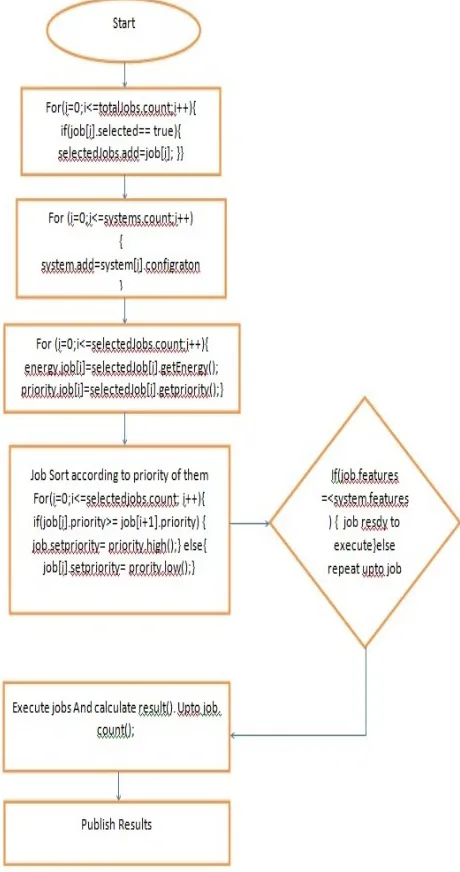
Figure 1: Priority Algorithm
Description: Step 1 Start
Step 2.In this step select the jobs from the selection part of the system and from the database
Step 3 Get all the system features from the database for the jobs execution without get the features of system you
can't execute the jobs then you move to the next system.
Step 4.In this step gets the all features of selected jobs from the database for the execution of the jobs. When you get the features then you move to the next step.
Step 5 This is the main step of the execution, in this step Sort all the jobs from their priority. Which job has high priority it will be execute first because we executed the jobs with their priority? We also sort the all feature form their priority.
Step 6 When you will sort the all jobs then you come on this step. In this step compare the selected job features with the system feature. Which job has less feature from the system that job will be executed rest of the jobs will not be execute because that jobs configuration is more than the system configuration.
Step 7 Then you come on this step, in this step Execution of jobs is start when the jobs are executed then hold move to next step and that is the last step
Step 8 In this step you will get the result.
Step 9 End
IV.
MULTILEVEL FEEDBACK QUEUE
SCHEDULING
Multilevel feedback queue scheduling allows a process to shift between queues. This movement is facilitated by the characteristic of the CPU rupture of the process. If a procedure uses too much CPU time, it will be motivated to a lower priority line. This scheme leaves Input output bound and interactive procedures in the upper precedence queues. In totalling, a procedure that waits too lengthy in a minor priority queue shall be moved to a higher priority queue. This form of preven
Multipl
of certain lower priority processes.
1. A new process is inserted at the end (tail) of the top-level
queues are used and the operation is as follows
:
2. At some stage the process reaches the head of the queue and is assigned the
queue.
3. If the process is completed within th
4. If the process willingly relinquishes control of the CPU, it plants the queuing network, and when the process becomes ready again it is inserted in the tail of same line which it relinquishes earlier.
of the given queue, it leaves the system.
5. If the process uses all the quantum time, it is
6. This scheme will continuing until the process completes.
level queue. This next lower level line will have a time which is more than that of the previous higher level queue.
• At the base level queue the processes circulate in run off the system. Processes in the base level queue can also be planned on a
724
Copyright © 2011-15. Vandana Publications. All Rights Reserved.
For scheduling, the user always start picking up procedures from the starting of the top level queue. If the top level queue has become equal to zero or empty, then only will the user take up a procedure from the next down level queue. The same policy is designed for picking up in the succeeding lower level queues. In the meantime, if a process comes into any of the higher level queues, it will pre empt a process in the lower level queue.
Also, there is a new procedure for all time inserted at the leg of the top level queue with the statement that it would be a short time consuming process. Long processes will automatically sink to lower level queues based on their time expenditure and interactivity level. In the queue which has multilevel, a procedure is given only one chance to complete at a given queue level before it is forced down to a lower level queue.
IV.
RELATED WORK
Scheduling of task in cloud computing is of prime concern in the performance and problem of mapping task on distributed services i.e. scheduling is a N-P problem in dynamic environment. Traditional scheduling strategies are FCFS, SJF, round robin are not beneficial because waiting times of these algorithms are very large so affecting on the performance of the cloud data centre which leads to high resource utilization, wastage of power and less efficiency. Also in this method the wastage of resources is more and disappointment for user on QoS parameters. In Round-robin scheduling, like other first-come, first-served methods, doesn't give special priority to more important tasks. This means an urgent request doesn't get handled any faster than other requests in queue. Round robin algorithm works accordingly its fixed intervals of time. Here waiting time is more than all because after a fixed time interval the next task will execute. So problem faced when one task is very heavy and other one is with very simple and small calculations In Shorts Job First long jobs may wait longer because it has to wait not only for jobs that are in the system at the time of its arrival, but also for all short jobs that are in the system at the time of its arrival. In Priority Algorithm only higher priority jobs get chance to execute. This describes that there is a need to propose a new scheme which achieves all the objectives and as well as provide better performance.
The proposed priority and multilevel feedback algorithm addresses major challenges of scheduling in cloud computing environment such as: resource utilization, maximum profit, minimum execution cost etc. In this scheduling algorithm users first select their method on the basis of application requirements and then prioritized. Priority job scheduling algorithm considers priority at three levels: scheduling level, resources level, and job level. In priority job scheduling, every job that is required to schedule has a pre-determined priority and scheduling is done on the basis of that priority and multilevel feedback
queue scheduling allows a process to shift between queues. Considering all such issues we are attempting to design an algorithm which can provides better results than the existing strategies.
V.
PROPOSED WORK
This work encompasses a set of objectives that is associated with a set of objectives that is associated with milestone of this procedure. The objectives are mentioned below.
1. To study various algorithm for energy reduction in green cloud computing.
2. To apply Priority and multi-level feedback queue scheduling algorithm.
3. To check the performance of the proposed method using energy parameter.
The flow diagram suggests that there could be multiple READY QUEUE which could be taken into consideration depending upon the jobs since the variation of jobs have either I/O operation taking the CPU BURST or CPU time taking the time duration of the CPU Processing. This way, if efficiency has to be maintained such that I/O Operations are given the highest priority, the multiple READY QUEUE would have (for an example) 1 READY QUEUE divided into 3 READY QUEUE, there should be:
1. Q1 2. Q2 3. Q3
Here are the Jobs that would be as per the main concern of execution (Round Robin Scheduling Implementation does not use Priority, here we are only giving the job prioritizing the jobs in the READY QUEUE not in the Scheduling Algorithm).
1. Q1 – Handles the I/O Bound Jobs which require more I/O CPU BURST time duration.
2. Q2 – Handles the moderate CPU Requirement time duration.
3. Q3 – Handles the CPU Bound Jobs which require more CPU time duration.
Now the implementation of such jobs is in the format as below:
1. Q1- any jobs which are here must be executed at first preference.
2. Q2 – only after Q1 is empty, the jobs in Q2 are taken. That is all Input/Output Bound jobs have to be completed first.
725
Copyright © 2011-15. Vandana Publications. All Rights Reserved.
V.
CONCLUSION AND FUTURE
WORK
Task scheduling in cloud computing is highly challenging in cloud computing. To meet the needs of thousands requests by making best possible use of cloud resources is a challenge for task manager. Traditional methods of scheduling lead to high response time and low Throughput. Many algorithms make use of priority scheduling and suffer from long waiting queues. Our proposed algorithm makes use of multilevel feedback queue as well as priority and it will definitely meet all the challenges and will provide efficient results than the traditional scheduling approaches.
REFERENCES
[1] D. Cavdar and F. Alagoz, (Eds.), “A Survey of Research on Greening Data Centers”, Proceedings of the IEEE Global Communications Conference (GLOBECOM), (2012) December 3-7; Anaheim, CA.
[2] A. Jain, M. Mishra, S. Kumar Peddoju and N. Jain, (Eds.), “Energy Efficient Computing-Green Cloud Computing”, Proceedings of the International Conference of the Energy Efficient Technologies for Sustainability (ICEETS), (2013) April 10-122; Nagercoil.
[3] C. Belady, (Ed.), “How to Minimize Data Centre Utility Bills”, US (2006
).
[4] T. Kgil, D. Roberts and T. Mudge, “Pico Server: Using 3D Stacking Technology to Build Energy Efficient Servers”, vol. 4, no. 16, (2006).
[5] N. Rassmussen, (Ed.), “Electrical Efficiency Modelling of Data Centres”, American Power Conversion (APC) White Paper #113, (2007) October, pp.1-18.
[6] B. Priya, E. S. Pilli and R. C. Joshi, (Eds.), “A Survey on Energy and Power Consumption Models for Greener Cloud”, Proceeding of the IEEE 3rd International Advance Computing Conference (IACC), (2013), February 22-23; Ghaziabad.
[7] M. Kaur and P. Singh, (Eds.), “Energy Efficient Green Cloud: Underlying Structure”, Proceeding of the IEEE international conference of theEnergy Efficient