Volume 3, Issue 4, April 2014
Page 241
Abstract
Mobile ad hoc network (MANET) is an autonomous system of mobile nodes connected by wireless links. Each node operates not only as an end system, but also as a router to forward packets. The nodes are free to move about and organize themselves into a network. These nodes change position frequently. The main classes of routing protocols are Proactive, Reactive and Hybrid. A Reactive (on-demand) routing strategy is a popular routing category for wireless ad hoc routing. It is a relatively new routing philosophy that provides a scalable solution to relatively large network topologies. The design follows the idea that each node tries to reduce routing overhead by sending routing packets whenever a communication is requested. In this work an attempt has been made to compare the performance of two prominent on demand reactive routing protocols for MANET: - Ad hoc On Demand Distance Vector (AODV), Dynamic Source Routing (DSR) protocols. As per our findings the differences in the protocol mechanics lead to significant performance differentials for both of these protocols. The performance differentials are analyzed using various metrics. These simulations are carried out using the ns-2 network simulator. The results presented in this work illustrate the importance in carefully evaluating and implementing routing protocols in an ad hoc environment.
Keywords: Reactive protocols, AODV, DSR, Performance metrics.
1.
I
NTRODUCTIONWireless cellular systems have been in use since 1980s. We have seen their evolutions to first, second and third generation's wireless systems. These systems work with the support of a centralized supporting structure such as an access point. The wireless users can be connected with the wireless system by the help of these access points, when they roam from one place to the other. The adaptability of wireless systems is limited by the presence of a fixed supporting coordinate. It means that the technology cannot work efficiently in that places where there is no permanent infrastructure. Easy and fast deployment of wireless networks will be expected by the future generation wireless systems. This fast network deployment is not possible with the existing structure of present wireless systems. Recent advancements such as Bluetooth introduced a fresh type of wireless systems which is frequently known as mobile hoc networks. Mobile ad-hoc networks or "short live" networks control in the nonexistence of permanent infrastructure. Mobile ad ad-hoc network offers quick and horizontal network deployment in conditions where it is not possible otherwise. Ad-hoc is a Latin word, which means "for this or for this only."
Mobile ad hoc network is an autonomous system of mobile nodes connected by wireless links; each node operates as an end system and a router for all other nodes in the network. A wireless network is a growing new technology that will allow users to access services and information electronically, irrespective of their geographic position. Wireless networks can be classified in two types: - infrastructure network and infrastructure less (ad hoc) networks. Infrastructure network consists of a network with fixed and wired gateways. A mobile host interacts with a bridge in the network (called base station) within its communication radius. The mobile unit can move geographically while it is communicating. When it goes out of range of one base station, it connects with new base station and starts communicating through it. This is called handoff. In this approach the base stations are fixed. A Mobile ad hoc network is a group of wireless mobile computers (or nodes); in which nodes collaborate by forwarding packets for each other to allow them to communicate outside range of direct wireless transmission. Ad hoc networks require no centralized administration or fixed network infrastructure such as base stations or access points, and can be quickly and inexpensively set up as needed. A MANET is an autonomous group of mobile users that communicate over reasonably slow wireless links. The network topology may vary rapidly and unpredictably over time, because the nodes are mobile. The network is decentralized, where all network activity, including discovering the topology and delivering messages must be executed by the nodes themselves. Hence routing functionality will have to be incorporated into the mobile nodes. MANET is a kind of wireless ad-hoc network and it is a self-configuring network of mobile routers (and associated hosts) connected by wireless links – the union of which forms an arbitrary topology. The routers, the participating nodes act as router, are free to move randomly and
Performance Evaluation of AODV and DSR
Routing Protocols for Random Speed Mobility
and Intensity Model in MANET Using NS2
Mangeshkumar S. Shegokar1, Prof.Ms.R.R.Tuteja2
1
Dept of Computer Science and Engineering
Prof. Ram Meghe institute of Technology and Research Badnera, Amravati Maharashtra.
2
Associate Professor, Dept of Computer Science and Engineering
Volume 3, Issue 4, April 2014
Page 242
manage themselves arbitrarily; thus, the network's wireless topology may change rapidly and unpredictably. Such a network may operate in a standalone fashion, or may be connected to the larger Internet. Mobile ad hoc network is a collection of independent mobile nodes that can communicate to each other via radio waves. The mobile nodes can directly communicate to those nodes that are in radio range of each other, whereas others nodes need the help of intermediate nodes to route their packets. These networks are fully distributed, and can work at any place without the aid of any infrastructure. This property makes these networks highly robust.
1.1 CHARACTERISTICS OF MANET
Mobile ad hoc network nodes are furnished with wireless transmitters and receivers using antennas, which may be highly directional (point-to-point), omnidirectional (broadcast), probably steerable, or some combination thereof. At a given point in time, depending on positions of nodes, their transmitter and receiver coverage patterns, communication power levels and co-channel interference levels, a wireless connectivity in the form of a random, multihop graph or "ad hoc" network exists among the nodes. This ad hoc topology may modify with time as the nodes move or adjust their transmission and reception parameters.
The characteristics of these networks are summarized as follows:
Communication via wireless means.
Nodes can perform the roles of both hosts and routers.
Bandwidth-constrained, variable capacity links.
Energy-constrained Operation.
Limited Physical Security.
Dynamic network topology.
Frequent routing updates.
1.2 APPLICATION OF MANET
Some of the applications of MANETs are as follows:
Military or police exercises.
Disaster relief operations.
Mine cite operations.
Urgent Business meetings.
2.
P
ROTOCOLSI
NA
D-
HOCN
ETWORKS2.1AD-HOC ON DEMAND DISTANCE VECTOR
Volume 3, Issue 4, April 2014
Page 243
that states for how many hops this message should be forwarded. This value is set to a predefined value at the first transmission and increased at retransmissions. Retransmissions occur if no replies are received. Data packets waiting to be transmitted (i.e. the packets that initiated the (RREQ). Every node maintains two separate counters: a node sequence number and a broadcast_ id. The RREQ contains the following fields.
source address
broadcast ID
source sequence no.
destination address
destination sequence no.
Hop count
2.2.DYNAMIC SOURCE ROUTING
Dynamic Source Routing (DSR) is a routing protocol for wireless mesh networks. It is similar to AODV in that it establishes a route on-demand when a transmitting mobile node requests one. However, it uses source routing instead of relying on the routing table at each intermediate device. Dynamic source routing protocol (DSR) is an on-demand, source routing protocol, whereby all the routing information is maintained (continually updated) at mobile nodes. DSR allows the network to be completely self-organizing and self-configuring, without the need for any existing network infrastructure or administration. The protocol is composed of the two main mechanisms of "Route Discovery" and "Route Maintenance", which work together to allow nodes to discover and maintain routes to arbitrary destinations in the ad hoc network. An optimum path for a communication between a source node and target node is determined by Route Discovery process. Route Maintenance ensures that the communication path remains optimum and loop-free according the change in network conditions, even if this requires altering the route during a transmission. Route Reply would only be generated if the message has reached the projected destination node (route record which is firstly contained in Route Request would be inserted into the Route Reply). To return the Route Reply, the destination node must have a route to the source node. If the route is in the route cache of target node, the route would be used. Otherwise, the node will reverse the route based on the route record in the Route Reply message header (symmetric links). In the event of fatal transmission, the Route Maintenance Phase is initiated whereby the Route Error packets are generated at a node. The incorrect hop will be detached from the node's route cache; all routes containing the hop are reduced at that point. Again, the Route Discovery Phase is initiated to determine the most viable route. It is beacon-less and hence it does not have need of periodic hello packet (beacon) transmissions, which are used by a node to inform its neighbors of its presence. The fundamental approach of this protocol during the route creation phase is to launch a route by flooding RouteRequest packets in the network. The destination node, on getting a Route Request packet, responds by transferring a RouteReply packet back to the source, which carries the route traversed by the Route Request packet received.
3. P
ERFORMANCEM
ETRICSSome important performance metrics can be evaluated
3.1 RANDOM SPEED MOBILITY WITH LOW INTENSITY
:
In this we can measure the performance of AODV and DSR routing protocols by taking random speed mobility and low intensity that small number of nodes.
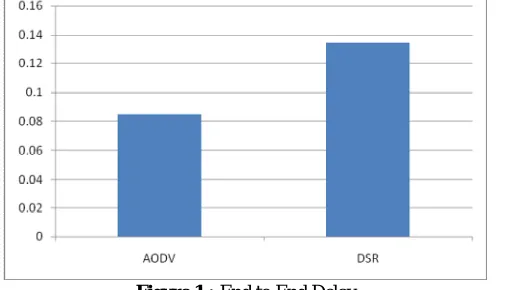
3.1.1 End to End Delay
End-to-end delay refers to the time taken for a packet to be transmitted across a network from source to destination.
Figure 1 : End to End Delay From above graph is found that End to End Delay is high in DSR.
3.1.2. Packet Loss
Volume 3, Issue 4, April 2014
Page 244
Figure 2 Packet Loss From above graph is found that packet loss are more in AODV.
3.1.3 Packet Delivery Percentage
It is the ratio between the numbers of packets received by the application layer of destination nodes to the number of packets sent by the application layer of source nodes.
Figure 3 Packet Delivery Percentage From the above graph is found that DSR can give good packet delivery.
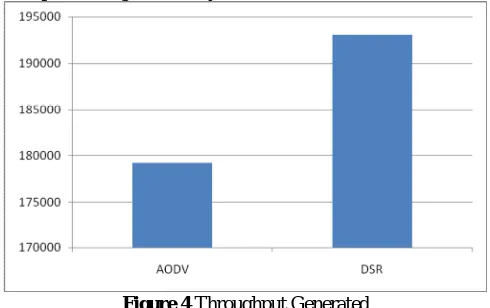
3.1.4 Throughput Generated
It is the average rate of successful packets is generated by source node.
Figure 4 Throughput Generated From above graph is found that DSR can generate more throughputs.
3.1.5 Throughput Delivered:
Volume 3, Issue 4, April 2014
Page 245
Figure 5 Throughput Delivered From above graph it is found that DSR can give good throughput delivery.
3.2 RANDOM MOBILITY WITH HIGH INTENSITY:
In this we can measure the performance of AODV and DSR routing protocols by taking random speed mobility and high intensity that is large number of nodes.
3.2.1 End to End Delay
Figure 6 End to End Delay From the above graph it’s observed that DSR can give less end to end delay.
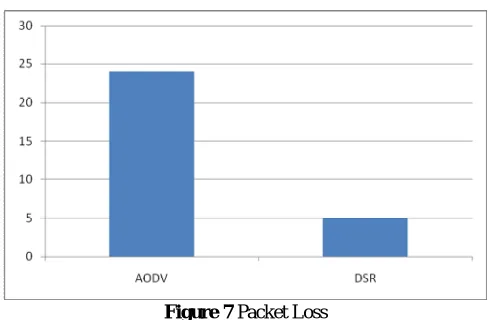
3.2.2 Packet Loss
Figure 7 Packet Loss From the above graph it is found that in DSR packet loss is less.
Volume 3, Issue 4, April 2014
Page 246
Figure 8 Packet Delivery Percentage From the above graph it is found that DSR can give good packet delivery.
3.2.4 Throughput Generated:
Figure 9 Throughput Generated From the above graph it is found that throughput generated in DSR is more.
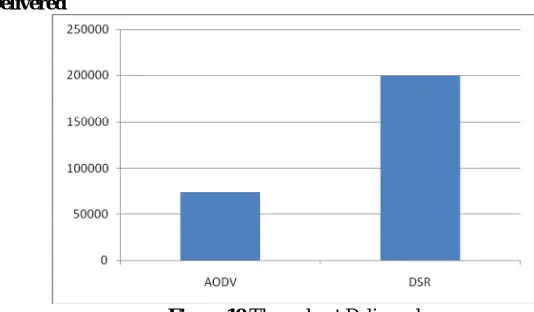
3.2.5 Throughput Delivered
Figure 10 Throughput Delivered From the above graph it is found that DSR can give good throughput delivery.
4.
R
ESULTA
NDA
NALYSISVolume 3, Issue 4, April 2014
Page 247
It is observed that for random speed mobility and high intensity model end to end delay is high in AODV, Packet loss is more in AODV, Packet delivery percentage is more in DSR, Throughput generated is more in DSR and Throughput deliverd is more in DSR than AODV.
5.
C
ONCLUSIONThe performance of routing protocols AODV and DSR depends heavily on much kind of design scenarios. One of these designs is shown here. We use NS2 to show the performance of AODV and DSR protocols during data communication. This study was conducted to evaluate two of MANET routing protocols which are AODV and DSR. These routing protocols are compared in term of end to end delay, Packet loss, Packet delivery percentage, Throughput generated and Throughput delivery using NS2 Simulator on the Ubuntu platform. And in average it is conclude that DSR can perform better that AODV routing protocols.
A
CKNOWLEDGMENTThe completion of the research paper on “Performance Evaluation of AODV and DSR Routing Protocol for Random Speed Mobility and Intensity Model in MANET Using NS2” has given me profound knowledge. I am sincerely thankful to Dr.G.B.Bamnote [Head of Department M.E Compuer Science & Engineering], and guide Prof.Ms.R.R.Tuteja, to get valued depth knowledge during the preparation of this research paper. My sincere thanks to all.
References
[1] Shiva Prakash, J. P. Saini and S. C. Gupta “ Methodologies and Applications of Wireless Mobile Ad-hoc Networks Routing Protocols “IJAIS Volume 1– No.6, February 2012.
[2] Sunil Taneja and Ashwani Kush, “A Survey of Routing Protocols in Mobile Ad Hoc Networks”, International Journal of Innovation, Management and Technology, Vol. 1, No. 3, August 2010.
[3] Neha Singh, Prof. Rajeshwar Lal Dua, Vinita Mathur “Network Simulator NS2-2.35”IJARCSSE Volume 2, Issue 5, May 2012.
[4] Dr.S.S.Dhenakaran , A.Parvathavarthini “An Overview of Routing Protocols in Mobile Ad-Hoc Network” IJARCSSE Volume 3, Issue 2, February 2013.
[5] Dr. Aditya Goel, Ajaii Sharma “Performance Analysis of Mobile Ad-hoc Network Using AODV Protocol” IJCSS, Volume (3): Issue (5) 2009.
[6] Mrs. Saba Siraj, Mr. Ajay Kumar Gupta and Mrs Rinku-Badgujar “Network Simulation Tools Survey” IJARCCE Vol. 1, Issue 4, June 2012.
[7] Longowal, Sangrur “Performance Comparison of DSR and AODV Routing Protocols with Efficient Mobility Model in Mobile Ad-Hoc Network” IJCST Vol. 2, Iss ue 2, June 2011.