The Thirty-Third AAAI Conference on Artificial Intelligence (AAAI-19)
Robust Multi-Agent Reinforcement Learning
via Minimax Deep Deterministic Policy Gradient
Shihui Li,
†Yi Wu,
‡Xinyue Cui,
§Honghua Dong,
§Fei Fang,
†Stuart Russell
‡†Carnegie Mellon University,{shihuil,feifang}@cmu.edu ‡University of California, Berkeley,{jxwuyi,russell}@eecs.berkeley.edu
§Tsinghua University,{cuixy14,dhh14}@mails.tsinghua.edu.cn
Abstract
Despite the recent advances of deep reinforcement learning (DRL), agents trained by DRL tend to be brittle and sensitive to the training environment, especially in the multi-agent sce-narios. In the multi-agent setting, a DRL agent’s policy can easily get stuck in a poor local optima w.r.t. its training part-ners – the learned policy may be only locally optimal to other agents’ current policies. In this paper, we focus on the problem of training robust DRL agents with continuous actions in the multi-agent learning setting so that the trained agents can still generalize when its opponents’ policies alter. To tackle this problem, we proposed a new algorithm,MiniMax Multi-agent Deep Deterministic Policy Gradient (M3DDPG)with the fol-lowing contributions: (1) we introduce a minimax extension of the popular multi-agent deep deterministic policy gradient al-gorithm (MADDPG), for robust policy learning; (2) since the continuous action space leads to computational intractability in our minimax learning objective, we proposeMulti-Agent Ad-versarial Learning (MAAL)to efficiently solve our proposed formulation. We empirically evaluate our M3DDPG algorithm in four mixed cooperative and competitive multi-agent envi-ronments and the agents trained by our method significantly outperforms existing baselines.
1. Introduction
Most real-world problems involve interactions between mul-tiple agents and the complexity of problem increases sig-nificantly when the agents co-evolve together. Thanks to the recent advances of deep reinforcement learing (DRL) on single agent scenarios, which led to successes in play-ing Atari game (Mnih et al. 2015), playplay-ing go (Silver et al. 2016) and robotics control (Levine et al. 2016), it has been a rising trend to adapt single agent DRL algo-rithms to multi-agent learning scenarios and many works have shown great successes on a variety of problems, in-cluding automatic discovery of communication and lan-guage (Sukhbaatar, Fergus, and others 2016; Mordatch and Abbeel 2017), multiplayer games (Peng et al. 2017a; OpenAI 2018), traffic control (Wu et al. 2017) and the analy-sis of social dilemmas (Leibo et al. 2017).
The critical challenge when adapting classical single agent DRL algorithms to multi-agent setting is the training instabil-Copyright c2019, Association for the Advancement of Artificial Intelligence (www.aaai.org). All rights reserved.
ity issue: as training progresses, each agent’s policy is chang-ing and therefore the environment becomes non-stationary from the perspective of any individual agent (in a way that is not explainable by changes in the agent’s own policy). This non-stationary problem can cause significant problems when directly applying the single agent DRL algorithms, for exam-ple, the variance of the policy gradient can be exponentially large when the number of agents increases (Lowe et al. 2017). To handle this instability issue, recent works, such as the counterfactual multi-agent policy gradients (Foerster et al. 2017) and the Multi-Agent Deep Deterministic Policy Gra-dient (MADDPG) (Lowe et al. 2017), proposed to utilized a
centralized criticwithin the actor-critic learning framework to reduce the variance of policy gradient.
Despite the fact that using a centralized critic stabilizes training, the learned policies can still be brittle and sensi-tive to its training partners and converge to a poor local mode. This is particularly severe for competitive environ-ments: when the opponents alter their policies during testing, the performance of the learned policies can be drastically worse (Lazaridou, Peysakhovich, and Baroni 2016). Hence, arobustpolicy becomes desirable in multi-agent setting: a well-trained agent should be able behave well in testing when competing against opponents even with strategies different from its training partners.
In this work, we focus on robust multi-agent reinforcement learning with continuous action spaces and propose a novel algorithm,MiniMax Multi-agent Deep Deterministic Policy
Gradient (M3DDPG). M3DDPG is a minimax extension1of
the MADDPG algorithm (Lowe et al. 2017). Its core idea is that during training, we force each agent to behave well even when its training opponents response in the worst way.
Our major contributions are summarized as follow: • We introduce the minimax approach to robust multi-agent
DRL and propose a novel minimax learning objective based on the MADDPG algorithm;
• In order to efficiently optimize the minimax learning objec-tive, we propose an end-to-end learning approach, Multi-agent Adversarial Learning (MAAL), which is inspired by
1
theadversarial training(Goodfellow, Shlens, and Szegedy 2014) technique.
• We empirically evaluate our proposed M3DDPG algorithm on four mixed cooperative and competitive environments and the agents trained by M3DDPG outperform baseline policies on all these environments.
In the rest of the paper, we will firstly present related works in section 2. Notations and standard algorithms are described in section 3. Our main algorithm, M3DDPG, is introduced in section 4. Experimental results are in section 5.
2. Related Work
Multi-agent reinforcement learning (Littman 1994) has been a long-standing field in AI (Hu, Wellman, and others 1998; Busoniu, Babuska, and De Schutter 2008). Recent works in DRL use deep neural networks to approximately represent policy and value functions. Inspired by the success of DRL in single-agent settings, many DRL-based multi-agent learn-ing algorithms have been proposed. Forester et al. (2016b) and He et al. (2016) extended the deep Q-learning to multi-agent setting; Peng et al. (2017a) proposed a centralized pol-icy learning algorithm based on actor-critic polpol-icy gradient; Forester et al. (2016a) developed a decentralized multi-agent policy gradient algorithm with centralized baseline; Lowe et al. (2017) extended DDPG to multi-agent setting with a cen-tralized Q function; Wei et al. (2018) and Grau-Moya (2018) proposed multi-agent variants of the soft-Q-learning algo-rithm (Haarnoja et al. 2017); Yang et al. (2018) focused on multi-agent reinforcement learning on a very large population of agents. Our M3DDPG algorithm is built on top of MAD-DPG and inherits the decentralized policy and centralized critic framework.
Minimax is a fundamental concept in game theory and can be applied to general decision-making under uncertainty, prescribing a strategy that minimizes the possible loss for a worst case scenario (Osborne and others 2004). Minimax was firstly introduced to multi-agent reinforcement learning as minimax Q-learning by Littman (1994). More recently, some works combine the minimax framework and the DRL techniques to find Nash equilibrium in two player zero-sum games (Foerster et al. 2018; P´erolat et al. 2016; Grau-Moya, Leibfried, and Bou-Ammar 2018). In our work, we utilize the minimax idea for the purpose of robust policy learning.
Robust reinforcement learning was originally introduced by Morimoto et al. (2005) considering the generalization ability of the learned policy in the single-agent setting. This problem is also studied recently with deep neural networks, such as adding random noise to input (Tobin et al. 2017) or dynamics (Peng et al. 2017b) during training. Besides adding random noise, some other works implicitly adopt the mini-max idea by utilizing the “worst noise” (Pinto et al. 2017; Mandlekar et al. 2017). These works force the learned pol-icy to work well even under the worst case perturbations and are typically under the name of “adversarial reinforce-ment learning”, despite the fact that the original adversarial reinforcement learning problem was introduced in the set-ting of multi-agent learning (Uther and Veloso 1997). In our
M3DDPG algorithm, we focus on the problem of learning polices that is robust to opponents with different strategies.
Within the minimax framework, finding the worst case scenario is a critical component. Lanctot et al. (2017) pro-posed an iterative approach that alternatively computes the best response policy while fixes the other. Gao et al. (Gao, Mueller, and Hayward 2018) replace “mean” in the tempo-ral difference learning rule with “minimum”. In our work, we proposed MAAL, which is a general, efficient and fully end-to-end learning approach. MAAL is motivated by ad-versarial training (Goodfellow, Shlens, and Szegedy 2014) and suitable for arbitrary number of agents. The core idea of MAAL is approximating the minimization in our min-max objective by a single gradient descent step. The idea of one-step-gradient approximation was also explored in meta-learning (Finn, Abbeel, and Levine 2017).
3. Background and Preliminary
In this section, we describe our problem setting and the stan-dard algorithms. Most of the definitions and notations follow the original MADDPG paper (Lowe et al. 2017).
Markov Games
We consider a multi-agent extension of Markov decision pro-cesses (MDPs) called partially observable Markov games (Littman 1994). A Markov game forNagents is defined by a set of statesSdescribing the possible configurations of all agents, a set of actionsA1, ...,AN and a set of observations
O1, ...,ON for each agent. To choose actions, each agent
i uses a stochastic policyπππθi : Oi× Ai 7→ [0,1]
param-eterized byθi, which produces the next state according to
the state transition functionT :S × A1×...× AN 7→ S.
Each agentiobtains rewards as a function of the state and agent’s action ri : S × Ai 7→ R, and receives a private
observation correlated with the stateoi :S 7→ Oi. The
ini-tial states are determined by a distributionρ : S 7→ [0,1]. Each agentiaims to maximize its own total expected return
Ri =PTt=0γtrti whereγis a discount factor andT is the
time horizon.
To minimize notation, in the following discussion we will often omitθfrom the subscript ofπππ.
Q-Learning and Deep Q-Networks (DQN)
Q-Learning and DQN (Mnih et al. 2015) are popular methods in reinforcement learning and have been previously applied to multi-agent settings (Foerster et al. 2016a; Tesauro 2004). Q-Learning makes use of an action-value function for policy
π π
π asQπππ(s, a) =
E[R|st = s, at = a]. This Q function
can be recursively rewritten as Qπππ(s, a) = Es0[r(s, a) +
γEa0∼πππ[Qπππ(s0, a0)]]. DQN learns the action-value function
Q∗corresponding to the optimal policy by minimizing: L(θ) =Es,a,r,s0[(Q∗(s, a|θ)−y)2], (1)
where y=r+γmax
a0
¯
Q∗(s0, a0).
¯
an experience replay bufferDcontaining tuples(s, a, r, s0). Q-learning algorithm is most suitable for DRL agents with discrete action spaces.
Policy Gradient (PG) Algorithms
Policy gradient methods is another popular choice for a va-riety of RL tasks. Letρπdenote discounted state visitation
distribution for a policyπ. The main idea of PG is to directly adjust the parametersθof the policy in order to maximize the objectiveJ(θ) =Es∼ρπππ,a∼πππθ[R]by taking steps in the
direc-tion of∇θJ(θ). Using the Q function defined previously, the
gradient of the policy can be written as (Sutton et al. 2000): ∇θJ(θ) =Es∼ρπππ,a∼πππθ[∇θlogπππθ(a|s)Q
π π π(s, a)],
(2) wherepπππis the state distribution. The policy gradient theorem has given rise to several practical algorithms, which often differ in how they estimateQπππ. For example, one can simply
use a sample returnRt=PT
i=tγi−tri, which leads to the
REINFORCE algorithm (Williams 1992). Alternatively, one could learn an approximation of the true action-value function
Qπππ(s, a)called thecriticand leads to a variety ofactor-critic
algorithms (Sutton and Barto 1998).
Deterministic Policy Gradient (DPG) Algorithms
DPG algorithms extends the policy gradient algorithm to deterministic policiesµµµθ :S 7→ A(Silver et al. 2014). In
particular, under certain conditions we can write the gradient of the objectiveJ(θ) =Es∼ρµµµ[R(s, a)]as:
∇θJ(θ) =Es∼D[∇θµµµθ(s)∇aQµµµ(s, a)|a=µµµθ(s)], (3)
where Dis the replay buffer. Since this theorem relies on ∇aQµµµ(s, a), it requires the action space A(and thus the
policyµµµ) be continuous.
Deep deterministic policy gradient(DDPG) (Lillicrap et
al. 2015) is a variant of DPG where the policyµµµand critic
Qµµµ are approximated with deep neural networks. DDPG is an off-policy algorithm, and samples trajectories from a replay buffer of experiences that are stored throughout training. DDPG also makes use of a target network, as in DQN (Mnih et al. 2015).
Multi-Agent Deep Deterministic Policy Gradient
Directly applying single-agent RL algorithms to the multi-agent setting by treating other multi-agents as part of the envi-ronment is problematic as the envienvi-ronment appears non-stationary from the view of any one agent, violating Markov assumptions required for convergence. This non-stationary issue is more severe in the case of DRL with neural networks as function approximators. The core idea of the MADDPG algorithm (Lowe et al. 2017) is learning a centralized Q func-tion for each agent which condifunc-tions on global informafunc-tion to alleviate the non-stationary problem and stabilize training. More concretely, consider a game with N agents with policies parameterized byθθθ = {θ1, ..., θN}, and letµµµ =
{µµµ1, ..., µµµN}be the set of all agents’ policies. Then we can
write the gradient of the expected return for agent i with
policyµµµi,J(θi) =E[Ri]as:
∇θiJ(θi) =
Ex,a∼D[∇θiµµµi(oi)∇aiQ
µ µµ
i(x, a1, ..., aN)|ai=µµµi(oi)] ,
(4) HereQπππ
i(x, a1, ..., aN)is a centralized action-value
func-tionthat takes as input the actions of all agents,a1, . . . , aN,
in addition to some state information x (i.e., x = (o1, ..., oN)) , and outputs the Q-value for agent i. Let
x0 denote the next state from x after taking actions
a1, . . . , aN. The experience replay bufferDcontains the
tu-ples(x,x0, a1, . . . , aN, r1, . . . , rN), recording experiences
of all agents. The centralized action-value functionQµµµi is updated as:
L(θi) =Ex,a,r,x0[(Qµiµµ(x, a1, . . . , aN)−y)2], (5)
y=ri+γ Q µ µ µ0 i (x
0, a0
1, . . . , a0N)
a0
j=µµµ
0
j(oj),
whereµµµ0 ={µµµθ0
1, ..., µµµθN0 }is the set of target policies with
delayed parametersθ0i.
Note that the centralized Q function is only used during training. During decentralized execution, each policyµµµθi
only takes local informationoito produce an action.
4. Minimax Multi-Agent Deep Deterministic
Policy Gradient (M3DDPG)
In this section, we introduce our proposed new algorithm,
Minimax Multi-agent Deep Deterministic Policy Gradient
(M3DDPG), which is built on top of the MADDPG
algo-rithm and particularly designed to improve therobustness
of learned policies. Our M3DDPG algorithm contains two major novel components:
Minimax Optimization Motivated by the minimax concept in game theory, we introduce minimax optimization into the learning objective;
Multi-Agent Adversarial Learning The continuous action space results in computational intractability issue when op-timizing our proposed minimax objective. Hence, we
pro-poseMulti-Agent Adversarial Learning (MAAL)to solve
this optimization problem.
Minimax Optimization
In multi-agent RL, the agents’ policies can be very sensitive to their learning partner’s policy. Particularly in competitive environments, the learned policies can be brittle when the opponents alter their strategies. For the purpose of learning robust policies, we propose to update policies considering theworst situation: during training, we optimize the accu-mulative reward for each agentiunder the assumption that all other agents acts adversarially. This yields the minimax learning objectivemaxθiJM(θi)where
JM(θi) =Es∼ρµµµ[Ri]
= min
at j6=i
Es∼ρµµµ
" T
X
t=0
γtri(st, at1, . . . , a
t N)
at
i=µµµ(oti)
#
(6)
=Es0∼ρ
"
min
a0
j6=i
QµµµM,i(s0, a01, . . . , a0N)
a0
i=µµµ(o0i)
#
Critically, in Eq. 6, statest+1at timet+ 1depends not only on the dynamicsρµµµand the actionµµµ
i(oti)but also on all the
previous adversarial actionsat0
j6=iwitht0 ≤t. In Eq. 7, we
derive the modified Q functionQµµµM(s, a1, . . . , aN), which is
naturally centralized and can be rewritten in a recursive form
QµµµM,i(s, a1, . . . , aN) =ri(s, a1, . . . , aN)+
γEs0
"
min
a0
j6=i
QµµµM,i(s0, a01, . . . , a0N) a0
i=µµµi(s0)
#
. (8)
Importantly,QµµµM(s, a1, . . . , aN)conditions on the current
statesas well as thecurrent actionsa1, . . . , aN and
repre-sents the current reward plus the discounted worst case future return starting from thenext state,s0. This definition brings the benefits that we can naturally apply off-policy temporal difference learning later to derive the update rule forQµµµM.
Note that for each agenti, none of the adversarial actions depend on its parameterθi, so we can directly apply the
deter-ministic policy gradient theorem to compute∇θiJM(θi)and
use off-policy temporal difference to update the Q function. Thanks to thecentralized Q functionin MADDPG (Eq. 4), which takes in the actions from all the agents, our derivation naturally applies and is perfectly aligned with the MADDPG formulation (Eq. 4) by injecting aminimizationover other agents’ actions as follows:
∇θiJM(θi) =
Ex∼D
∇θiµµµi(oi)∇aiQ
µµµ
M,i(x, a?1, . . . , ai, . . . a?N)
ai=µµµi(oi)
a?
j6=i= arg minaj6=iQ µ µ µ
M,i(x, a1, . . . , aN)
,
(9) whereDdenotes the replay buffer andxdenotes the state information.
Correspondingly, we obtain the new Q function update rule by adding another minimization to Eq. 5 when computing the target Q value:
L(θi) =Ex,a,r,x0∼D[(Qµµµ
M,i(x, a1, . . . , aN)−y)2], (10)
y=ri+γ Q µ µµ0
M,i(x
0, a0?
1, . . . , a0i, . . . , a0 ?
N)
a0i=µµµ0i(oi),
a0?j6=i= arg min a0
j6=i
QµµµM0,i(x0, a01, . . . , a0N),
whereµµµ0i denotes the target policy of agentiwith delayed parametersθ0
i, andQ µ µµ0
M,i denotes the target Q network for
agenti. Combining Eq. 9 and Eq. 10 yields our proposed minimax learning framework.
Multi-Agent Adversarial Learning
The critical challenge in our proposed minimax learning framework is how to handle the embedded minimization in Eq. 9 and Eq. 10. Due to the continuous action space as well as the non-linearity of Q function, directly optimizing the minimization problem is computationally intractable. A naive approximate solution can be performing an inner-loop gradi-ent descgradi-ent whenever performing an update step of Eq. 9 or Eq. 10, but this is too computationally expensive for practical use. Here we introduce an efficient and end-to-end solution, multi-agent adversarial learning (MAAL). The main ideas
of MAAL can be summarized in two steps: (1) approximate the non-linear Q function by a locally linear function; (2) replace the inner-loop minimization with a 1-step gradient descent. Note the core idea of MAAL, locally linearizing the Q function, is adapted from the recentadversarial training
technique originally developed for supervised learning. We will discuss the connection between adversarial training and MAAL in the end of this section.
For conciseness, we first consider Eq. 10 and rewrite it into the following form with auxiliary variables:
y=ri+γ Q µµµ0
M,i(x
0, a0?
1, . . . , a0i, . . . , a0 ?
N) (11)
a0k=µµµ0k(ok), ∀1≤k≤N
a0?j=a0j+j, ∀j6=i
j6=i= arg min j6=i
QµµµM0,i(x0, a01+1, . . . , a0i, . . . , a0N +N).
Eq. 11 can be interpreted as we are now seeking for a set of perturbations such that the perturbed actions
a0?decrease Q value the most. By linearizing the Q func-tion at QµµµM,i(x, a01, . . . , a0N), the desired perturbation j
can be locally approximated by the gradient direction at
QµµµM,i(x, a0
1, . . . , a0N)w.r.t.a0j. Then we use this local to
de-rive an approximationˆjto the worst case perturbation by
taking a small gradient step: ∀j6=i, ˆj=−α∇ajQ
µ µµ0
M,i(x
0, a0
1, . . . , aj, . . . , a0N), (12)
whereαis a tunable coefficient representing the perturbation rate. It can be also interpreted as the step size of the gradient descent step: whenαis too small, the local approximation er-ror will be small but due to the small perturbation, the learned policy can be far from the optimal solution of the minimax objective we proposed; whenαis too large, the approxima-tion error may incur too much trouble for the overall learning process and the agents may fail to learn good policies.
We can apply this technique to Eq. 9 as well and eventually derive the following formulation:
∇θiJ(θi) =
Ex,a∼D
∇θiµµµi(oi)∇aiQ µ
µµ
M,i(x, a?1, . . . , ai, . . . a?N)
ai=µµµi(oi)
a?
j=aj+ ˆj, ∀j6=i
ˆ
j=−αj∇ajQ µ µ µ
M,i(x, a1, . . . , aN)
, (13) and
L(θi) =Ex,a,r,x0[(QµµµM,i(x, a1, . . . , aN)−y)2], (14)
y=ri+γ Qµµµ
0
M,i(x
0, a0?
1, . . . , a0i, . . . , a
0? N)
a0k =µµµ0k(ok), ∀1≤k≤N
a0?j =a0j+ ˆ
0
j, ∀j6=i
ˆ
0j =−αj∇a0
jQ
µµµ0
M,i(x, a
0
1, . . . , a0N),
whereα1, . . . , αN are additional parameters. MAAL only
Algorithm 1:Minimax Multi-Agent Deep Deterministic Policy Gradient (M3DDPG) forNagents
forepisode= 1toM do
Initialize a random processN for action exploration, and receive initial state informationx fort= 1to max-episode-lengthdo
for each agenti, select actionai=µµµθi(oi) +Ntw.r.t. the current policy and exploration
Execute actionsa= (a1, . . . , aN)and observe rewardrand new state informationx0
Store(x, a, r,x0)in replay bufferD, and setx←x0 foragenti= 1toNdo
Sample a random minibatch ofSsamples(xk, ak, rk,x0k)fromD
Setyk =rk i +γ Q
µ µ µ0
M,i(x0 k, a0
1, . . . , a0N)|a0
i=µµµ
0
i(oki),a
0
j6=i=µµµ
0
j(okj)+ˆ
0
j withˆ 0
jdefined in Eq. 14
Update critic by minimizing the lossL(θi) = S1Pk
yk−Qµµµ
M,i(xk, ak1, . . . , akN)
2
Update actor using the sampled policy gradient withˆjdefined in Eq. 13:
∇θiJ≈
1 S
X
k
∇θiµµµi(o
k i)∇aiQ
µ µ µ
M,i(x k, a?
1, . . . , ai, . . . , a?N)
ai=µµµi(oki),a?j6=i=akj+ˆj
end for
Update target network parameters for each agenti:θi0 ←τ θi+ (1−τ)θ0i
end for end for
Discussion
Connection to Adversarial Training Adversarial train-ingis a robust training approach for deep neural networks on supervised learning (Goodfellow et al. 2014). The core idea is to force the classifier to predict correctly even when given
adversarial examples, which are obtained by adding a small adversarial perturbation to the original input data such that the classification loss can be decreased the most. Formally, sup-pose the classification loss function isL(θ) =Ex,y[fθ(x;y)]
with input dataxand labely. Adversarial training aims to optimize the following adversarial loss instead
Ladv(θ) = Ex,y[fθ(x+?;y)] (15)
? = arg max
kk≤αfθ(x+;y).
The core technique to efficiently optimizeLadv(θ)is to locally
linearize the loss function atfθ(x;y)and approximate?by
the scaled gradient.
Thanks to the centralized Q function, which takes the ac-tions from all the agents as part of the input, we are able to easily inject the minimax optimization (Eq. 11) and represent it in a similar way to adversarial training (Eq. 15) so that we can adopt the similar technique to effectively solve our minimax optimization in a fully end-to-end fashion.
Connection to Single Agent Robust RL M3DDPG with
MAAL can be also viewed as the special case of robust reinforcement learning (RRL) (Morimoto and Doya 2005) in the single agent setting, which aims to bridge the gap between training in simulation and testing in the real world by adding adversarial perturbations to the transition dynamics during training. Here, we consider the multi-agent setting and add worst case perturbations toactionsof opponent agents during training. Note that in the perspective of a single agent,
perturbations on opponents’ actions can be also considered as a special adversarial noise on the dynamics.
Choice ofα In the extreme case ofα= 0, M3DDPG de-generates to the original MADDPG algorithm while asα
increases, the policy learning tends to be more robust but the optimization becomes harder. In practice, using a fixed
α throughout training can lead to very unstable learning behavior due to the changing scale of the gradients. The original adversarial training paper (Goodfellow, Shlens, and Szegedy 2014) suggests to compute with a fixed norm, namelyg=∇xfθ(x;y),ˆ=αkggk, wherexdenotes the
in-put data to the classifier andydenotes the label. In M3DDPG, we can adaptively compute the perturbationˆjby
g=∇ajQ
µ µ µ
M,i(x, a1, . . . , aN), ˆj=−αj
g
kgk. (16) Eq. 16 generally works fine in practice but in some hard multi-agent learning environments, unstable training behav-ior can be still observed. We suspect that it is because the changing norm of actions in these situations. Different from the supervised learning setting where the norm of the input dataxis typically stable, in reinforcement learning the norm of actions can drastically change even in a single episode. Therefore, it is possible to see cases that even a perturbation with a small fixed norm overwhelms the actionaj, which
may potentially lead to computational stability issue. There-fore, we also introduce the following alternative for adaptive perturbation computation:
g=∇ajQ
µ µµ
M,i(x, a1, . . . , aN), ˆj =−αjkajk
g
speaker
listener “green”
agent 1
agent 3 landmark
landmark
landmark p
v c
agent 2
predator 1
prey
predator 2
predator 3
agent 1
agent 2
agent 3
agent 1 agent 2
adversary
? speaker
listener “green”
agent 1
agent 3 landmark
landmark
landmark p
v c
agent 2
predator 1
prey
predator 2
predator 3
agent 1
agent 2
agent 3
agent 1 agent 2
adversary
?
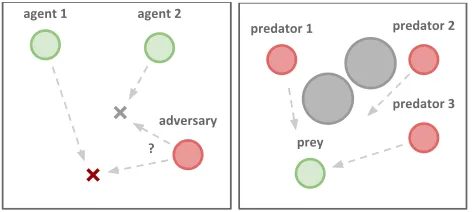
Figure 1: Illustrations of some environments we consider, in-cludingPhysical Deception(left) andPredator-Prey(right).
adding (smaller) perturbations to collaborators can further improve the quality of learned policies.
5. Experiments
We adopt the sameparticle-worldenvironments as the MAD-DPG paper (Lowe et al. 2017) as well as the training con-figurations.αis selected from a grid search over0.1,0.01
and0.001. For testing, we generate a fixed set of 2500 envi-ronment configurations (i.e., landmarks and birthplaces) and evaluate on this fixed set for a fair comparison.
Environments
The particle world environment consists ofN cooperative agents, M adversarial agents andL landmarks in a two-dimensional world with continuous space. We focus on the four mixed cooperative and competitive scenarios to best examine the effectiveness of our minimax formulation.
Covert communication This is an adversarial communi-cation environment, where a speaker agent (‘Alice’) must communicate a message to a listener agent (‘Bob’) (N = 2), who must reconstruct the message at the other end. However, an adversarial agent (‘Eve’) (M = 1) is also observing the channel, and wants to reconstruct the message — Alice and Bob are penalized based on Eve’s reconstruction, and thus Alice must encode her message using a randomly generated
key, known only to Alice and Bob.
Keep-away This scenario consists ofL = 1target land-mark,N = 2cooperative agents andM = 1adversarial agent. Cooperating agents need to reach the landmark and keep the adversarial agent away from the landmark by push-ing it while the adversarial agent must stay at the landmark to occupy it.
Physical deception Here,N = 2agents cooperate to reach a single target landmark from a total ofL = 2landmarks. They are rewarded based on the minimum distance of any agent to the target (so only one agent needs to reach the target landmark). However, a lone adversary (M = 1) also desires to reach the target landmark; the catch is that the adversary does not know which of the landmarks is the correct one. Thus the cooperating agents, who are penalized based on the adversary distance to the target, learn to spread out and cover all landmarks so as to deceive the adversary.
0 0.3 0.6 0.9
MA vs MA MA vs Minimax Minimax vs MA Minimax vs Minimax
No
rmal
ized A
gen
t S
co
re
Comparison between MADDPG (MA) and M3DDPG (Minimax)
Covert communication Keep-away Physical deception Predator-prey
Figure 2: Comparison between M3DDPG (Minimax) and classical MADDPG (MA) on the four mixed competitive environments. Each bar cluster shows the 0-1 normalized score for a set of competing policies in different roles (agent vs adversary), where a higher score is better for the agent. In all cases, M3DDPG outperforms MADDPG when directly pitted against it.
Predator-prey In this variant of the classic predator-prey game,N= 3slower cooperating agents must chase the faster adversary (M = 1) around a randomly generated environ-ment withL= 2large landmarks impeding the way. Each time the cooperative agents collide with an adversary, the agents are rewarded while the adversary is penalized.
Comparison to MADDPG
To evaluate the quality of learned policies trained by dif-ferent algorithms in competitive scenarios, we measure the performance of agents trained by our M3DDPG and agents by classical MADDPG in the roles of both normal agent and adversary in each environment.
The results are in Figure 2, where we measure the rewards of the normal agents in different scenarios and normalize them to 0-1. We notice that in all the environments, the high-est score is achieved when the M3DDPG agents play as the normal agents against the MADDPG adversary (Minimax vs MA); while the lowest score is when the MADDPG agents act as normal agents against the M3DDPG adversary (MA vs Minimax). This indicates that policies trained by M3DDPG have much higher quality than original MADDPG.
Evaluation with Disruptive Adversaries
Instead of M3DDPG and MADDPG directly competing against each other, now we consider their performances in the
worstpossible situations through their individual competi-tions againstdisruptive adversaries. We construct disruptive adversaries by (1) fixing the trained normal agents (M3DDPG or MADDPG); (2) setting the reward of the disruptive adver-sary as the negative value of normal agents’ reward (so that the problem becomes zero-sum); and then (3) using DDPG to train the disruptive adversary from scratch under the zero-sum reward setting.
Figure 3: Performances of M3DDPG (Minimax, red) and MADDPG (MA, blue) under theworst situation, i.e., against the
disruptive adversaries, on convert communication, keep-away, physical deception and predator-pray from left to right. The y-axis denotes the reward of normal agents (fixed) and x-axis denotes the training episodes performed of the disruptive adversaries. Higher reward implies a more robust policy. Agents trained by M3DDPG (Minimax) perform better on all the scenarios.
agents. So, in order to evaluate the effectiveness our minimax optimization in the worst situation, we convert every prob-lems into a zero-sum form and compare the performances of our M3DDPG agents as well as the MADDPG agents against this artificially constructed adversaries. Moreover, since each of our four environments has only 1 adversary, after fixing the normal agents, the learning problem degenerates to the single agent setting and classical DDPG is sufficient to stably train a disruptive adversary.
The results are shown in Figure 3, where we plot the re-ward of the fixed normal agents of different algorithms as the training of the disruptive adversaries progresses until con-vergence. Note that due to the different environment designs, the difficulty for the disruptive agents to break the strategy of normal agents varies: for example, inconvert communication, since the private key is not accessible to the adversary agent, breaking the encrypted communication will be very hard; while inphysical deception, since we do not allow communi-cation and fix the normal agents, a smart enough adversary may easily infer the target landmark by observing the initial behavior of the two cooperative agents. Nevertheless, despite these intrinsic properties, the M3DDPG agents (Minimax) achieves higher reward in all the scenarios, which implies better robustness even in the worst situation.
6. Conclusion
In this paper, we propose a novel algorithm, minimax mulit-agent deep deterministic policy gradient (M3DDPG), for robust multi-agent reinforcement learning, which leverages the minimax concept and introduces a minimax learning ob-jective. To efficiently optimize the minimax objective, we pro-pose MAAL, which approximates the inner-loop minimiza-tion by a single gradient descent step. Empirically, M3DDPG outperforms the benchmark methods on four mixed coopera-tive and competicoopera-tive scenarios.
Nevertheless, due to the single step gradient approximation in MAAL, which is efficient in computation, an M3DDPG agent can only explore locally worst situation during the evolving process at training, which can still lead to unsatisfy-ing behavior when testunsatisfy-ing opponents have drastically differ-ent strategies. It will be an interesting direction to re-examine the robustness-efficiency trade-off in MAAL and further im-prove policy learning by placing more computations on the minimax optimization. We leave this as our future work.
References
Busoniu, L.; Babuska, R.; and De Schutter, B. 2008. A comprehensive survey of multiagent reinforcement learning.
IEEE Transactions on Systems Man and Cybernetics Part C
Applications and Reviews38(2):156.
Finn, C.; Abbeel, P.; and Levine, S. 2017. Model-agnostic meta-learning for fast adaptation of deep networks. arXiv preprint arXiv:1703.03400.
Foerster, J. N.; Assael, Y. M.; de Freitas, N.; and Whiteson, S. 2016a. Learning to communicate with deep multi-agent reinforcement learning. CoRRabs/1605.06676.
Foerster, J. N.; Assael1, Y. M.; de Freitas, N.; and Whiteson, S. 2016b. Learning to Communicate to Solve Riddles with Deep Distributed Recurrent Q-Networks.
Foerster, J.; Farquhar, G.; Afouras, T.; Nardelli, N.; and Whiteson, S. 2017. Counterfactual multi-agent policy gradi-ents.arXiv preprint arXiv:1705.08926.
Foerster, J.; Chen, R. Y.; Al-Shedivat, M.; Whiteson, S.; Abbeel, P.; and Mordatch, I. 2018. Learning with opponent-learning awareness. InProceedings of the 17th International
Conference on Autonomous Agents and MultiAgent Systems,
122–130. International Foundation for Autonomous Agents and Multiagent Systems.
Gao, C.; Mueller, M.; and Hayward, R. 2018. Adversarial policy gradient for alternating markov games.
Goodfellow, I.; Pouget-Abadie, J.; Mirza, M.; Xu, B.; Warde-Farley, D.; Ozair, S.; Courville, A.; and Bengio, Y. 2014. Generative adversarial nets. InAdvances in neural informa-tion processing systems, 2672–2680.
Goodfellow, I. J.; Shlens, J.; and Szegedy, C. 2014. Ex-plaining and harnessing adversarial examples.arXiv preprint arXiv:1412.6572.
Grau-Moya, J.; Leibfried, F.; and Bou-Ammar, H. 2018. Balancing two-player stochastic games with soft q-learning.
arXiv preprint arXiv:1802.03216.
Haarnoja, T.; Tang, H.; Abbeel, P.; and Levine, S. 2017. Re-inforcement learning with deep energy-based policies.arXiv preprint arXiv:1702.08165.
He, H.; Boyd-Graber, J.; Kwok, K.; and Daum´e III, H. 2016. Opponent modeling in deep reinforcement learning. In
Hu, J.; Wellman, M. P.; et al. 1998. Multiagent reinforcement learning: theoretical framework and an algorithm. InICML, volume 98, 242–250. Citeseer.
Lanctot, M.; Zambaldi, V.; Gruslys, A.; Lazaridou, A.; Pero-lat, J.; Silver, D.; Graepel, T.; et al. 2017. A unified game-theoretic approach to multiagent reinforcement learning. In
Advances in Neural Information Processing Systems, 4190–
4203.
Lazaridou, A.; Peysakhovich, A.; and Baroni, M. 2016. Multi-agent cooperation and the emergence of (natural) language.
arXiv preprint arXiv:1612.07182.
Leibo, J. Z.; Zambaldi, V. F.; Lanctot, M.; Marecki, J.; and Graepel, T. 2017. Multi-agent reinforcement learning in sequential social dilemmas.CoRRabs/1702.03037.
Levine, S.; Finn, C.; Darrell, T.; and Abbeel, P. 2016. End-to-end training of deep visuomotor policies. The Journal of
Machine Learning Research17(1):1334–1373.
Lillicrap, T. P.; Hunt, J. J.; Pritzel, A.; Heess, N.; Erez, T.; Tassa, Y.; Silver, D.; and Wierstra, D. 2015. Continuous control with deep reinforcement learning. arXiv preprint
arXiv:1509.02971.
Littman, M. L. 1994. Markov games as a framework for multi-agent reinforcement learning. InProceedings of the eleventh international conference on machine learning, vol-ume 157, 157–163.
Lowe, R.; Wu, Y.; Tamar, A.; Harb, J.; Abbeel, O. P.; and Mor-datch, I. 2017. Multi-agent actor-critic for mixed cooperative-competitive environments. InAdvances in Neural Informa-tion Processing Systems, 6379–6390.
Mandlekar, A.; Zhu, Y.; Garg, A.; Fei-Fei, L.; and Savarese, S. 2017. Adversarially robust policy learning: Active con-struction of physically-plausible perturbations. InIntelligent Robots and Systems (IROS), 2017 IEEE/RSJ International
Conference on, 3932–3939. IEEE.
Mnih, V.; Kavukcuoglu, K.; Silver, D.; Rusu, A. A.; Veness, J.; Bellemare, M. G.; Graves, A.; Riedmiller, M.; Fidjeland, A. K.; Ostrovski, G.; et al. 2015. Human-level control through deep reinforcement learning.Nature518(7540):529– 533.
Mordatch, I., and Abbeel, P. 2017. Emergence of grounded compositional language in multi-agent populations. arXiv preprint arXiv:1703.04908.
Morimoto, J., and Doya, K. 2005. Robust reinforcement learning.Neural computation17(2):335–359.
OpenAI. 2018. OpenAI Five. https://blog.openai.com/openai-five/. Accessed: 2018-09-03.
Osborne, M. J., et al. 2004.An introduction to game theory, volume 3. Oxford university press New York.
Peng, P.; Yuan, Q.; Wen, Y.; Yang, Y.; Tang, Z.; Long, H.; and Wang, J. 2017a. Multiagent bidirectionally-coordinated nets for learning to play starcraft combat games. CoRR
abs/1703.10069.
Peng, X. B.; Andrychowicz, M.; Zaremba, W.; and Abbeel, P. 2017b. Sim-to-real transfer of robotic control with dynamics randomization.arXiv preprint arXiv:1710.06537.
P´erolat, J.; Strub, F.; Piot, B.; and Pietquin, O. 2016. Learning nash equilibrium for general-sum markov games from batch data.arXiv preprint arXiv:1606.08718.
Pinto, L.; Davidson, J.; Sukthankar, R.; and Gupta, A. 2017. Robust adversarial reinforcement learning. arXiv preprint
arXiv:1703.02702.
Silver, D.; Lever, G.; Heess, N.; Degris, T.; Wierstra, D.; and Riedmiller, M. 2014. Deterministic policy gradient algo-rithms. InProceedings of the 31st International Conference
on Machine Learning, 387–395.
Silver, D.; Huang, A.; Maddison, C. J.; Guez, A.; Sifre, L.; Van Den Driessche, G.; Schrittwieser, J.; Antonoglou, I.; Panneershelvam, V.; Lanctot, M.; et al. 2016. Mastering the game of go with deep neural networks and tree search.
Nature529(7587):484–489.
Sukhbaatar, S.; Fergus, R.; et al. 2016. Learning multiagent communication with backpropagation. InAdvances in Neural
Information Processing Systems, 2244–2252.
Sutton, R. S., and Barto, A. G. 1998.Reinforcement learning:
An introduction, volume 1. MIT press Cambridge.
Sutton, R. S.; McAllester, D. A.; Singh, S. P.; and Mansour, Y. 2000. Policy gradient methods for reinforcement learn-ing with function approximation. In Advances in neural information processing systems, 1057–1063.
Tesauro, G. 2004. Extending q-learning to general adaptive multi-agent systems. In Advances in neural information processing systems, 871–878.
Tobin, J.; Fong, R.; Ray, A.; Schneider, J.; Zaremba, W.; and Abbeel, P. 2017. Domain randomization for transfer-ring deep neural networks from simulation to the real world.
InIntelligent Robots and Systems (IROS), 2017 IEEE/RSJ
International Conference on, 23–30. IEEE.
Uther, W. T., and Veloso, M. M. 1997. Generalizing adversar-ial reinforcement learning. InProceedings of the AAAI Fall
Symposium on Model Directed Autonomous Systems, 206.
Citeseer.
Wei, E.; Wicke, D.; Freelan, D.; and Luke, S. 2018. Multia-gent soft q-learning.arXiv preprint arXiv:1804.09817. Williams, R. J. 1992. Simple statistical gradient-following algorithms for connectionist reinforcement learning.Machine
learning8(3-4):229–256.
Wu, C.; Kreidieh, A.; Parvate, K.; Vinitsky, E.; and Bayen, A. M. 2017. Flow: Architecture and benchmarking for reinforcement learning in traffic control. arXiv preprint
arXiv:1710.05465.