The Thirty-Third AAAI Conference on Artificial Intelligence (AAAI-19)
MLVCNN: Multi-Loop-View
Convolutional Neural Network for 3D Shape Retrieval
Jianwen Jiang, Di Bao, Ziqiang Chen, Xibin Zhao,
∗Yue Gao
∗BNRist, KLISS, School of Software, Tsinghua University, China.
{jjw17, bd17, czq18}@mails.tsinghua.edu.cn,{zxb, gaoyue}@tsinghua.edu.cn
Abstract
3D shape retrieval has attracted much attention and become a hot topic in computer vision field recently.With the develop-ment of deep learning, 3D shape retrieval has also made great progress and many view-based methods have been introduced in recent years. However, how to represent 3D shapes better is still a challenging problem. At the same time, the intrin-sic hierarchical associations among views still have not been well utilized. In order to tackle these problems, in this pa-per, we propose a multi-loop-view convolutional neural net-work (MLVCNN) framenet-work for 3D shape retrieval. In this method, multiple groups of views are extracted from differ-ent loop directions first. Given these multiple loop views, the proposed MLVCNN framework introduces a hierarchi-cal view-loop-shape architecture, i.e., the view level, the loop level, and the shape level, to conduct 3D shape represen-tation from different scales. In the view-level, a convolu-tional neural network is first trained to extract view features. Then, the proposed Loop Normalization and LSTM are uti-lized for each loop of view to generate the loop-level fea-tures, which considering the intrinsic associations of the dif-ferent views in the same loop. Finally, all the loop-level de-scriptors are combined into a shape-level descriptor for 3D shape representation, which is used for 3D shape retrieval. Our proposed method has been evaluated on the public 3D shape benchmark, i.e., ModelNet40. Experiments and com-parisons with the state-of-the-art methods show that the pro-posed MLVCNN method can achieve significant performance improvement on 3D shape retrieval tasks. Our MLVCNN out-performs the state-of-the-art methods by the mAP of 4.84% in 3D shape retrieval task. We have also evaluated the per-formance of the proposed method on the 3D shape classifi-cation task where MLVCNN also achieves superior perfor-mance compared with recent methods.
Introduction
Recently, the 3D shape retrieval problem has gradually be-come an important issue in computer vision due to the wide use of 3D shapes in different areas such as automatic driving, 3D printing and gaming. The task of 3D shape retrieval tar-gets on finding the most similar 3D models from the dataset given the query, and the retrieval is conducted based on the shape similarities.
∗
Corresponding authors
Copyright c2019, Association for the Advancement of Artificial Intelligence (www.aaai.org). All rights reserved.
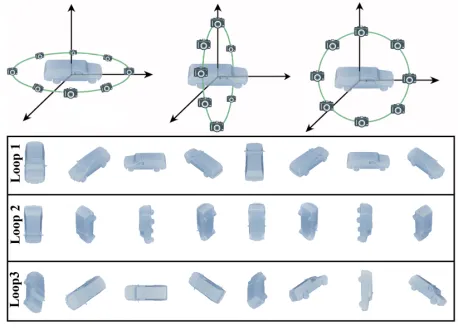
Figure 1: Demonstration of multiple loop views. In this ex-ample, 3 loops of views are provided, in which each loop is perpendicular to an axis in the three-dimensional coordinate system separately. The bottom of this figure shows the views from the 3 loops for the ’car’ shape.
Generally, 3D shapes have complex geometries and vari-ations, and thus it is very difficult to represent 3D shapes well, leading it a challenging task to retrieve 3D shapes ac-curately. There have been plenty of works concentrated on 3D shape retrieval in the last decade. Within the prolifera-tion of deep learning in recent years, various deep networks have been investigated for 3D shape analysis, such as 3D ShapeNets (Wu et al. 2015), PointNet (Qi et al. 2017a) and VoxNet (Maturana and Scherer 2015). Among these meth-ods, view-based method has shown better performance in many works. It is noted that it is not an easy task to repre-sent 3D shapes well using multiple views. Existing methods may employ a group of views generated by a loop of virtual cameras (Su et al. 2015; Feng et al. 2018), a dense-sampled camera dome or just several predefined directions. However, existing methods have not taken the intra-view relationships into consideration, simply treating all these views indepen-dently. Under such circumstances, it is important to investi-gate more robust view generation and representation method for 3D shape retrieval.
neural network (MLVCNN) framework for 3D shape re-trieval. In this method, multiple groups of views are ex-tracted from different loop directions first. Figure 1 demon-strates 3 orthogonal loops, in which each loop contains 8 views for multiple views generation. Given these multiple loop views, the proposed MLVCNN framework introduces a hierarchical view-loop-shape architecture, i.e., the view level, the loop level, and the shape level, to conduct 3D shape representation from different scales. In the view-level, a convolutional neural network is first trained to extract view features. Then, Loop Normalization and LSTM are utilized for the views in each loop to generate the loop-level fea-tures by considering the intrinsic associations of the differ-ent views in the same loop. Finally, all the loop-level de-scriptors are combined into a shape-level descriptor for 3D shape representation, which is later used for 3D shape re-trieval. Our proposed method has been evaluated on the pub-lic 3D shape benchmark, i.e., ModelNet40. Experiments and comparisons with the state-of-the-art methods show that the proposed MLVCNN method can achieve significant perfor-mance improvement on 3D shape retrieval tasks. We have also evaluated the performance of the proposed method on the 3D shape classification task where MLVCNN also achieves superior performance compared with recent meth-ods.
The contributions of this paper are as follows:
• We introduce a multi-loop-view 3D shape representation scheme, and more specifically, it is a new hierarchical fea-ture representation method. In this method, the intra-view relationships are taken into consideration for 3D shape de-scription. In this way, 3D shapes can be represented better from different scales.
• We introduce Loop Normalization (LN), which can be re-garded as a local normalization in the loop dimension. LN can represent information better for each loop of views by keeping local discriminativeness from being weakened by global normalization.
• We have conducted experiments on the ModelNet40 dataset. Experiments results reveal the proposed multi-loop-view structure can represent 3D shapes better compared with traditional view-based methods. Our MLVCNN outperforms the state-of-the-art methods by the mAP of 4.84% in retrieval task and also achieves su-perior performance with recent methods in classification task.
The rest of the paper is organized as follows. We first introduce the related work. Then we present our proposed MLVCNN method. After that, the experiments and discus-sions are provided. Finally, we conclude this paper in Con-clusions.
Related Work
3D shape retrieval have been investigated in recent years. In this section, we briefly review recent works for 3D shape retrieval. There are plenty of handcraft 3D descriptors, and early methods can be mainly divided into two categories, i.e., model-based methods (Osada et al. 2002) and view-based methods(Chen et al. 2003).
Traditional model-based methods utilize shape distribu-tions to measure the similarity among 3D shapes based on distance, angle, area and volume of random surface points. In (Akg¨ul et al. 2009), Akgul et al. proposed a probabilis-tic generative descriptor which can use local shape prop-erties for 3D shape retrieval. Some other methods employ voxel grid (Wu et al. 2015), polygon mesh (Bronstein et al. 2011) or local shape diameters measured at densely sampled surface points (Chaudhuri and Koltun 2010) for 3D shape retrieval. In (Gao et al. 2012), the similarity between two 3D objects was measured by the comparison between two groups of views.
In recent years, the method of deep learning has been widely used in 3D shape retrieval. Su et al. (Su et al. 2015) proposed a multi-view convolutional neural network (MVCNN). In this approach, convolutional neural networks are first used to generate the feature for each view individ-ually and then multi-view features are fused by a pooling procedure. A low-rank Mahalanobis metric is employed in MVCNN to improve the retrieval performance. Qi et al. (Qi et al. 2016) further investigated view-based descriptor and volumetric-based descriptor in 3D shape retrieval. In (Xie et al. 2017), a progressive shape distribution encoder is intro-duced to generate 3D shape representation. Feng et al. (Feng et al. 2018) introduced a hierarchical view-group architec-ture to exploit the distinctions among views. Dai et al. (Dai, Xie, and Fang 2018) introduced BiLSTM in 3D shape re-trieval. He et al. (He et al. 2018) improved center loss(Wen et al. 2016) and proposed a triplet-center loss (TCL) for 3D shape retrieval.
Although deep learning methods have shown superior performance compared with traditional methods in the task of 3D shape retrieval, it still suffers from the limitation of missing mining intra-view relationship and the hierarchical nature of 3D shape representations. In this paper, the pro-posed MLVCNN framework targets on handling these chal-lenging issues by its multi-loop-view structure and hierar-chical representation scheme.
The Proposed MLVCNN Method
In this section, the proposed MLVCNN method is intro-duced. In MLVCNN, we first provide the view-loop-shape 3D shape representation structure, which can represent 3D shape in a hierarchical way. Given the multi-loop-view data, view features are first extracted. Then a Loop Normalization (LN) method together with LSTM is introduced to gener-ate loop-level features by exploring the relationship among views in each loop. Later, a shape-level feature is generated by combining the loop-level features. Finally, 3D shape re-trieval is based on the comparison using the shape-level fea-tures.
Multi-Loop-View Hierarchical Framework
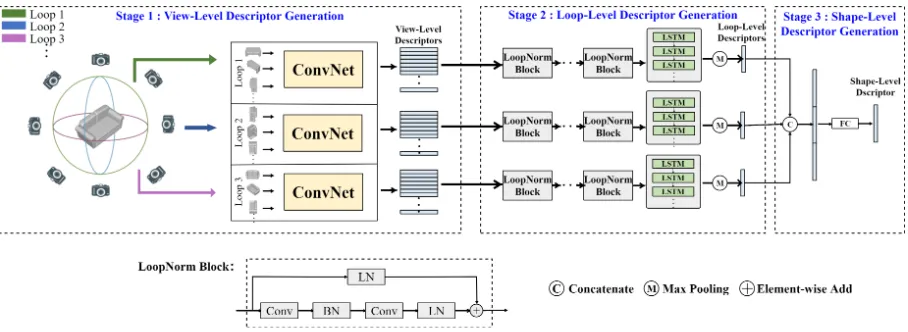
Figure 2: The Multi-Loop-View CNN framework for 3D shape retrieval. LN in LoopNorm Block denotes Loop Normaliza-tion and BN denotes Batch NormalizaNormaliza-tion. The proposed MLVCNN contains 3 stages, during which it gradually obtains the descriptor from local descriptor of view-level, to more global descriptor of loop-level and shape-level.
is used to extracted features from these views to obtain view-level descriptors. In the second stage, the view-view-level descrip-tors are fed into stacked LoopNorm Blocks and LSTM block sequentially to generate loop-level descriptors. In the last stage, the loop level descriptors are aggregated to obtain a global shape-level representation.
View-level feature extraction
In order to obtain comprehensive information of a 3D shape, orthogonal loops projection are introduced for a better view-projection method. In our method, we set the number of loops to three as a default setting. Each loop of the three loops is perpendicular to an axis in a three-dimensional co-ordinate system as Figure 1 shows. Because of the orthog-onality, the three loops projection method will increase the diversity of sequence information. Based on the three or-thogonal loops, we rotate these oror-thogonal loops to generate more loops, which forms our multi-loop projection method. In each loop, we generate view projections like the method proposed in (Su et al. 2015).
With the help of multi-loop projection method, more dis-criminative views are employed, which is very important for the retrieval task. As Figure 1 shows, in loop 1, such a pro-jection method yields eight views of the sides of the car. Nonetheless, the information from the top and bottom of the car are missing. Views in loop 2 and loop 3 provide comple-mentary perspectives helping to capture the crucial informa-tion of the object for better 3D shape representainforma-tion.
We employ a full convolutional network as our basic fea-ture extractor. Given such views from different loops, we feed them into the basic CNN which shares the same pa-rameters to obtain view-level descriptors. In the stage, CNN treats views separately without considering of the relation-ship among them.
Loop-level feature extraction
In the loop-level feature extraction, the given view-level de-scriptors are fed into stacked LoopNorm Blocks to obtain
better view-level features which consider the statistic dif-ference among loops. Then we employ the long short-term memory(LSTM) network on these features to generate loop-level descriptors.
Normalization methods like Batch Normalization (BN) are widely used in deep learning. In our MLVCNN frame-work, we propose a more suitable normalization method named Loop Normalization (LN).
In our MLVCNN, the input data is represented by a 6D tensor of (N,C,L,V,H,W), where N denotes the batch dimen-sion, L denotes the loop dimendimen-sion, V denotes the view di-mension, C denotes the channel didi-mension, H denotes the height dimension and W denotes the width dimension.Xiis
the pixel before normalization, andX˜iis the value after
nor-malization.iis the index for each pixel in (N,C,L,V,H,W) order. µandσdenote a mean and a standard deviation re-spectively. For a general feature normalization, we have
˜
Xi=γ
Xi−µi p
σ2 i +
+β (1)
where γ is a scale, β is a shift parameter. is a small constant for numerically stability. Equation (1) shows that each value in feature map is normalized by usingµandσ, and thenγ andβ are applied to increase the flexibility of representation capability. Forµandσ, we have
µi=
1
|K| X
p∈Si
Xi (2)
σ2i = 1
|K| X
p∈Si
(Xi−µi)2 (3)
where |K| is the number of the selected pixel. Let Si be
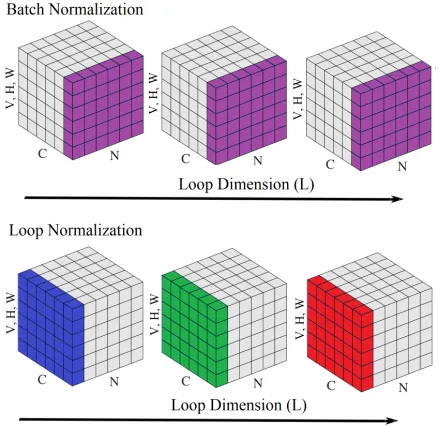
the set of pixels to be normalized. As shown in Figure 3, in Batch Normalization, theSiare all pixels sharing the same
channel index. Different from BN, in Loop Normalization, theSi are all pixels sharing the same batch index and loop
Figure 3: Batch Normalization(Top) and Loop Normaliza-tion(Bottom). In each row, cubes represent the input 6D tensor of (N,C,L,V,H,W) and each cube represents the sub-tensor sharing the same loop index in the input feature map tensor. In BN, pixels sharing the same channel(marked in purple) are normalized together. In LN, only pixels sharing the same channel and loop(marked in blue, green and red, respectively) are normalized together.
As shown in Figure 2, based on Loop Normalization, We design our LoopNorm Block (LN Block) like residual blocks in ResNet18 (He et al. 2016). In our LN Block, we add Loop Normalization(LN) to the block after last convo-lutional layer and the identity path. There are two reasons to do so. Firstly, in residual path, we add LN after last convo-lutional layer in order to maintain the content discrimination in loop dimension. Secondly, we add LN in identity path in order to avoid misalignment between residual path and iden-tity path.
After employing LN Block, we treat the features of each view in the same loop as each element in the input sequence. Then we feed the sequence to a LSTM network. After that, we apply maxpool to the outputs from all hidden layers in the LSTM to obtain loop-level descriptors. By employ-ing LSTM, our proposed method considers the relationship among views in the same loop. For each view in the loop, LSTM is used to obtain its relationship among all previous views. LN block maintains the difference in statistics among loops and LSTM is applied in each loop separately, which strengthens the relationship of the features within the same loop and is helpful for enhancing the discrimination of loop-level features.
Shape-level feature extraction and retrieval
In shape-level, we concat features from each loop to form a global feature. Then we feed these features to a fully con-nected layer to obtain compact shape-level representation
which is more suitable for retrieval task. The process can be represented by
f eatg =Concat(f eatl1, ..., f eatli, ..., f eatln) (4)
wheref eatlidenotes the feature of loop i,f eatgdenotes the
global feature of the object.
Then, we use the global feature to obtain the shape-level descriptor by
embedding=W ·f eatg+σ (5)
where W denotes weight matrix,σdenotes a bias term and
embeddingdenotes the shape-level descriptor.
In MLVCNN, we directly use shape-level descriptor for 3D shape retrieval and use L2 distance between two 3D shapes as similarity measure in retrieval task. The distance metric formula is defined in Equation 6.
d(fa, fb) =||fa−fb||2 (6)
Based on the L2 distance, we can rank the distance be-tween query object and object in our dataset to generate the retrieval result.
Experiments
In this section, we first provide the experiments on 3D shape retrieval. Then we discuss the results and comparisons with the state-of-the-art methods. After that, the impact of our proposed Loop Normalization method and the influence of the number of views and loops on the 3D shape retrieval performance are investigated. In the last part, we evaluate the proposed method on 3D shape classification task.
Method Training Config. Data Representation. Retrieval
Pre train Fine tune (mAP)
(1)SPH(Kazhdan, Funkhouser, and Rusinkiewicz 2003) - - - 33.3%
(2)LFD(Chen et al. 2003) - - - 40.9%
(3)MVCNN (Su et al. 2015) ImageNet1K ModelNet40 View 80.2%
(4)GIFT(Bai et al. 2016) - ModelNet40 View 81.9%
(5)DeepPano(Shi et al. 2015) - ModelNet40 View 76.8%
(6)GVCNN(Feng et al. 2018) - ModelNet40 View 85.7%
(7)MVCNN with TCL(He et al. 2018) - ModelNet40 View 88.0%
(8)3D ShapeNets(Wu et al. 2015) ModelNet40 ModelNet40 Voxel 49.2%
(9)DLAN(Furuya and Ohbuchi 2016) - ModelNet40 - 85.0%
(10)RED(Bai et al. 2017) - ModelNet40 Multi-Modality 86.3%
(11)MLVCNN(without LN), 3x8 ImageNet1K ModelNet40 View 88.55%
(12)MLVCNN(without LN), 3x12 ImageNet1K ModelNet40 View 89.05%
(13)MLVCNN(with LN), 3x8 ImageNet1K ModelNet40 View 91.07%
(14)MLVCNN(with LN), 3x12 ImageNet1K ModelNet40 View 91.15%
(15)MLVCNN(with LN) + Center Loss, 3x8 ImageNet1K ModelNet40 View 92.22%
(16)MLVCNN(with LN) + Center Loss, 3x12 ImageNet1K ModelNet40 View 92.84%
Table 1: Retrieval results on the ModelNet40 dataset. In experiments, our proposed MLVCNN method is compared with the state-of-the-art methods that use different representations of 3D shapes. Noted that, ’3x8’ indicates the number of loops is 3 and the number of views in each loop is 8. So is ’3x12’.
3D Shape Retrieval Results
To evaluate the effectiveness of the proposed MLVCNN method, we have conducted 3D shape retrieval experiments on the Princeton ModelNet dataset. ModelNet dataset con-tains 127,915 3D CAD models from 622 object categories. A subset of 40-common classes (ModelNet40) including 12311 3D shapes is used in our experiments. We follow the same training and testing split setting in (Su et al. 2015). To evaluate the performance of 3D shape retrieval, the widely used retrieval mAP is employed here. Different from origi-nal MVCNN, We adopt ResNet18, a CNN model with sim-ilar performance to VGG on imagenet classification task, as our backbone due to the limitation of GPU memory. In the next sub-section, in order to demonstrate the effective-ness of MLVCNN, ResNet18 is chosen to be base model for MVCNN and MLVCNN to do ablation studies.
To evaluate the performance of the proposed method, the following methods are selected for comparison, including hand-craft descriptors, deep learning models and ensemble methods. More specifically, in hand-craft descriptors, Ro-tation Invariant Spherical Harmonic RepresenRo-tation (SPH) (Kazhdan, Funkhouser, and Rusinkiewicz 2003) and Light-ing Field Descriptor (LFD) (Chen et al. 2003) are employed. In deep learning models, Multi-View CNN (MVCNN) (Su et al. 2015), GIFT (Bai et al. 2016), DeepPano (Shi et al. 2015), Group-View CNN (Feng et al. 2018), MVCNN with Triplet Center Loss (He et al. 2018)), 3D shapeNets (Wu et al. 2015) and Deep Local feature Aggregation Network(DLAN) (Fu-ruya and Ohbuchi 2016) are chosen. A typical ensemble method Regularized Ensemble Diffusion (RED) (Bai et al. 2017) is also selected for comparison.
The experimental results and comparisons among all methods are demonstrated in Table 1. The precision-recall curves are provided in Fig.4. As shown in these results,
our proposed MLVCNN outperforms all other compared methods with an mAP of 91.15%. Compared to original MVCNN, we obtain the gains of 10.95%, simply with soft-max loss.
Compared with the recent state-of-the-art 3D shape re-trieval methods, i.e., MVCNN with TCL, the proposed method without metric learning loss achieves a gain of 3.15% on mAP. With metric learning loss like Center Loss, our method can further achieve a gain of 4.84% on mAP.
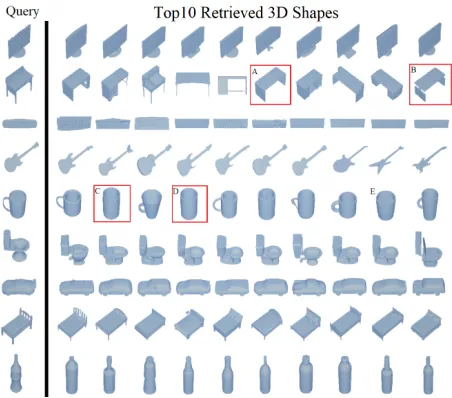
Figure 5: Retrieval examples on ModelNet40 dataset. Top10 retrieval results are shown for each query. Incorrect retrieved objects are marked with red box
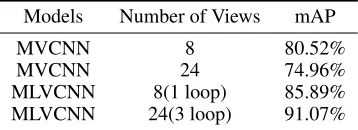
Models Number of Views mAP
MVCNN 8 80.52%
MVCNN 24 74.96%
MLVCNN 8(1 loop) 85.89% MLVCNN 24(3 loop) 91.07%
Table 2: The performance comparison with MVCNN
reasons.
First, The 3-tier architecture can represents 3D shape ef-fectively, which forms a hierarchical representation of view, loop, and shape, providing a compact representation of the 3D shape. Second, compared with the previous single loop or dense sampling methods, because the relationship be-tween views is taken into consideration in the feature ex-traction process, MLVCNN has more space-preserving per-formance. Last, Loop Normalization (LN) added in our net-work normalizes features in loop dimension. LN exploits the loop independence and maintains the difference in statistics among different loops, which further enhances the represen-tation capacity of our MLVCNN.
Fig.5 shows some retrieved examples of our method on the ModelNet40 dataset. The query shapes are listed at the left column, which are from 8 categories including monitor, desk, keyboard, guitar, cup, toilet, car, bed, and bottle. The top 10 retrieved results are listed on the right side. In these results, the incorrect retrieval results are marked with red box. As shown in these results, most of mistakes come from 3D shapes with very similar appearance, which are challeng-ing even for human. For example, in the retrieval task of a desk, shape A and shape B is from class ’table’. It is difficult to identify a desk from a table by using just the model itself. Another example is from the cup and vase. Shape C and D are from class ’vase’, but shape E, which looks the same as C and D, is from class ’cup’.
Ablation Studies
In MLVCNN, the proposed Multi-Loop-View framework plays an important role. In this sub-section, we further in-vestigate the multi-loop framework in details. In this part, we set the number of the views in each loop to 8 as a default setting which is common in multi-view based methods.
In multi-view based method, rendering 3D shape along horizontal plane is a typical method, as shown in Fig-ure 1(like loop 1). Our proposed rendering method is also demonstrated in Figure 1. It is obvious that our proposed multi-loop can observe more distinguishing views, which is helpful for 3D shape representation.
We then evaluate the performance of our proposed method on different rendering settings and demonstrate the results in Table 2. To conduct fair comparison and evaluation, in this part of experiments, the MVCNN in Table 2 denotes our im-plementation according to (Su et al. 2015) and MLVCNN denotes our proposed method. Noted that, all the views are regarded as the same contribution in MVCNN and the view relationship has not been taken into consideration, the num-ber of views in MVCNN only means the difference of
in-put scale. For MLVCNN, views are generated from differ-ent loop structures. For example, 24 views in Table 2 are equivalent to that there are 3 loops and each loop contains 8 views. As shown in the comparison, we can observe that MVCNN with 8 views outperforms MVCNN with 24 views. It means that it is hard for MVCNN to integrate information from views when the number of views increases. But for MLVCNN, with the increasing of the number of views, the performance raises accordingly. We also show the results of MVCNN and MLVCNN under the same views setting in Ta-ble 2. We can find that under one loop setting, MLVCNN can still outperform MVCNN by 5.37% on mAP, which means the sequence modeling of views in one loop is beneficial for retrieval. Under the three loops setting, our MLVCNN out-performs MVCNN by 16.11% in terms of mAP. The results indicate that such hierarchical representation structure can exploit information of views and describe 3D shapes better compared with traditional multi-view methods.
Compared with original MVCNN, when extracting fea-tures from loops, MLVCNN assumes the independence among loops and finally fuses feature of all loops to ob-tain global representation. In this way, the view-loop-shape structure leads to a local-to-global 3D shape representa-tion approach. Through this from local to global approach, MLVCNN makes it possible to employ the local features of views in one loop better and take global feature representa-tion into account meanwhile.
On Loop Normalization
To demonstrate effectiveness of Loop Normalization(LN) better, we further investigate LN in this sub-section. We evaluate the performance of the proposed method with LN and without LN in Table 3. We also apply LN to the model with different numbers of loops and demonstrate them in Ta-ble 3. We fix the number of views to 8 and vary the number of loops from 1 to 6 in this part experiments.
As shown in the results, we can find that the model with LN outperforms the model without LN in the case of the same number of loops. When the number of loop is 5, the performance of using LN on the model can achieve a gain of 2.04% on mAP.
Number of Loops mAP (w/o LN) mAP (w/t LN)
1 84.38% 85.89%
2 88.34% 88.85%
3 88.55% 91.07%
4 89.68% 90.91%
5 89.19% 91.26%
6 89.90% 91.33%
Table 3: The comparison of different numbers of loops for Loop Normalization.
become apparent, and global batch normalization will pay less attention to local differences and even weaken the dis-criminative information. LN provides local normalization, which leads to performance improvement.
On the number of Views and Loops
In this sub-section, we focus on a critical issue about the robustness of our framework, i.e., the number of views and loops. We quantitatively investigate the influence of different numbers of views and loops on retrieval performance.
Num. of Loop Num. of View mAP mAP(+CL)
3 4 88.85% 91.49%
3 6 90.18% 92.03%
3 8 91.07% 92.22%
3 12 91.15% 92.84%
2 8 88.85% 90.59%
3 8 91.07% 92.22%
4 8 90.91% 92.26%
5 8 91.26% 92.32%
6 8 91.33% 92.36%
Table 4: The comparison of different numbers of views and loops. mAP(+CL) denotes MLVCNN with Center Loss.
First, we fix the number of loops to 3 and vary the number of views. The number of employed views for each loop is se-lected as 4, 6, 8 and 12, respectively. The retrieval results are shown in Table 4. As shown in these results, we can observe that the increase of views can improve the retrieval perfor-mance. It is worth noted that even with 4 views in each loop (12 views in total), which is a common number of views in MVCNN based method, our MLVCNN still achieves the best performance compared with other methods.
Second, we fix the number of views to 8 and vary the num-ber of loops. The numnum-ber of employed loops is selected as 2, 3, 4, 5 and 6, respectively. The retrieval results are shown in Table 4. The increase of loops brings performance improve-ments, which can be attributed to the more effective infor-mation provided by more loops. Because MLVCNN ensures the independence of each loop, the local-global fusion ap-proach makes the feature representation more compact than MVCNN. Therefore, the increasing of redundant informa-tion by using more views has little influence on the proposed MLVCNN method. We can find from the results that when the number of loop is 6, MLVCNN achieves an mAP of 91.33%, which further indicates the validity of MLVCNN.
We also apply Center Loss to MLVCNN in the retrieval task. The results show that MLVCNN with Center Loss can obtain a little gain. When the number of loops increases, the gain of center loss does increase simultaneously. However, it is obvious that the gain from added views are more than that from added loop, which reveals that better use of multi-view sequence information is more important than simply adding views.
3D Shape Classification
In this sub-section, we further investigate our method in the classification task, and the experimental results are demon-strated in Table 5. We compare our method with the state-of-the-art methods, including MVCNN (Su et al. 2015), VoxNet (Maturana and Scherer 2015), MVCNN-MultiRes (Qi et al. 2016), 3D shapeNets (Wu et al. 2015), VRN (Brock et al. 2016),PointNet (Qi et al. 2017a), PointNet++ (Qi et al. 2017b), KD-Network (Klokov and Lempitsky 2017), GVCNN (Feng et al. 2018), PointCNN (Li et al. 2018), DGCNN (Wang et al. 2018) and SO-Net (Li, Chen, and Lee 2018).
Method Modality Classification
(1)3D ShapeNets Voxel 77.3%
(2)VoxNet Voxel 83.0%
(3)VRN Voxel 91.3%
(4)MVCNN View 89.9%
(5)MVCNN-MultiRes View 91.4%
(6)GVCNN View 93.1%
(7)FusionNet Voxel and View 90.8%
(8)PointNet Point Cloud 89.2%
(9)PointNet++ Point Cloud 90.7%
(10)KD-Network Point Cloud 91.8%
(11)PointCNN Point Cloud 91.8%
(12)DGCNN Point Cloud 92.2%
(13)SO-Net Point Cloud 93.4%
(14)MLVCNN View 94.16%
Table 5: Classification results on the ModelNet40 dataset.
In the results, we can find that our proposed MLVCNN also performs better compared with other methods. MLVCNN obtains the competitive performance on classi-fication with an accuracy of 94.16%. This shows that our model has competitive representation ability and has strong ability of the robustness and generalization, which make it available for being applied to different tasks.
Conclusions
In this paper, we present the MLVCNN framework for 3D shape retrieval.
In this method, a hierarchical view-loop-shape architec-ture is introduced to obtain better 3D shape representation. In view-level, we propose a multi-loop projection method. In loop-level, we propose Loop Normalization (LN). LN to-gether with LSTM utilizes intrinsic associations in each loop to generate loop-level descriptors. Last, all loop-level de-scriptors are aggregated to obtain the shape-level represen-tation. We evaluate MLVCNN on 3D shape benchmark, i.e., ModelNet40. The results show that MLVCNN can achieve significant performance improvement on 3D shape retrieval and classification.
Acknowledgments
National Science and Technology Major Project (No. 2016ZX01038101), MIIT IT funds (Research and applica-tion of TCN key technologies) of China, and The Naapplica-tional Key Technology R&D Program (No. 2015BAG14B01-02).
References
Akg¨ul, C. B.; Sankur, B.; Yemez, Y.; and Schmitt, F. 2009. 3D model retrieval using probability density-based shape descriptors.IEEE Transactions on Pattern Analysis and Ma-chine Intelligence31(6):1117–1133.
Bai, S.; Bai, X.; Zhou, Z.; Zhang, Z.; and Jan Latecki, L. 2016. Gift: A real-time and scalable 3D shape search engine. InProceedings of the IEEE Conference on Computer Vision and Pattern Recognition, 5023–5032.
Bai, S.; Zhou, Z.; Wang, J.; Bai, X.; Latecki, L. J.; and Tian, Q. 2017. Ensemble diffusion for retrieval. In Proceed-ings of the IEEE Conference on Computer Vision and Pat-tern Recognition, 774–783.
Brock, A.; Lim, T.; Ritchie, J. M.; and Weston, N. 2016. Generative and discriminative voxel modeling with convo-lutional neural networks. corr abs/1608.04236 (2016). Bronstein, A. M.; Bronstein, M. M.; Guibas, L. J.; and Ovs-janikov, M. 2011. Shape google: Geometric words and ex-pressions for invariant shape retrieval.ACM Transactions on Graphics30(1):1.
Chaudhuri, S., and Koltun, V. 2010. Data-driven suggestions for creativity support in 3D modeling.ACM Transactions on Graphics29(6):183.
Chen, D.-Y.; Tian, X.-P.; Shen, Y.-T.; and Ouhyoung, M. 2003. On visual similarity based 3D model retrieval. In
Computer Graphics Forum, volume 22, 223–232. Wiley On-line Library.
Dai, G.; Xie, J.; and Fang, Y. 2018. Siamese CNN-BiLSTM Architecture for 3D Shape Representation Learning. In IJ-CAI, 670–676.
Feng, Y.; Zhang, Z.; Zhao, X.; Ji, R.; and Gao, Y. 2018. GVCNN: Group-View Convolutional Neural Networks for 3D Shape Recognition. InProceedings of the IEEE Confer-ence on Computer Vision and Pattern Recognition, 264–272. Furuya, T., and Ohbuchi, R. 2016. Deep Aggregation of Local 3D Geometric Features for 3D Model Retrieval. In
BMVC.
Gao, Y.; Tang, J.; Hong, R.; Yan, S.; Dai, Q.; Zhang, N.; and Chua, T.-S. 2012. Camera constraint-free view-based 3D object retrieval.IEEE Transactions on Image Processing
21(4):2269–2281.
He, K.; Zhang, X.; Ren, S.; and Sun, J. 2016. Deep residual learning for image recognition. InProceedings of the IEEE Conference on Computer Vision and Pattern Recognition, 770–778.
He, X.; Zhou, Y.; Zhou, Z.; Bai, S.; and Bai, X. 2018. Triplet-Center Loss for Multi-View 3D Object Retrieval. In
Proceedings of the IEEE Conference on Computer Vision and Pattern Recognition.
Kazhdan, M.; Funkhouser, T.; and Rusinkiewicz, S. 2003. Rotation invariant spherical harmonic representation of 3D
shape descriptors. InSymposium on Geometry Processing, volume 6, 156–164.
Klokov, R., and Lempitsky, V. 2017. Escape from cells: Deep kd-networks for the recognition of 3D point cloud models. InProceedings of the IEEE International Confer-ence on Computer Vision, 863–872. IEEE.
Li, Y.; Bu, R.; Sun, M.; and Chen, B. 2018. PointCNN: Convolution On X-Transformed Points. arXiv preprint arXiv:1801.07791.
Li, J.; Chen, B. M.; and Lee, G. H. 2018. SO-Net: Self-Organizing Network for Point Cloud Analysis. In Proceed-ings of the IEEE Conference on Computer Vision and Pat-tern Recognition, 9397–9406.
Maturana, D., and Scherer, S. 2015. Voxnet: A 3D con-volutional neural network for real-time object recognition. InIEEE International Conference on Intelligent Robots and Systems, 922–928. IEEE.
Osada, R.; Funkhouser, T.; Chazelle, B.; and Dobkin, D. 2002. Shape distributions. ACM Transactions on Graph-ics21(4):807–832.
Qi, C. R.; Su, H.; Nießner, M.; Dai, A.; Yan, M.; and Guibas, L. J. 2016. Volumetric and multi-view cnns for object classi-fication on 3D data. InProceedings of the IEEE Conference on Computer Vision and Pattern Recognition, 5648–5656. Qi, C. R.; Su, H.; Mo, K.; and Guibas, L. J. 2017a. Point-Net: Deep Learning on Point Sets for 3D Classification and Segmentation. InProceedings of the IEEE Conference on Computer Vision and Pattern Recognition, 77–85.
Qi, C. R.; Yi, L.; Su, H.; and Guibas, L. J. 2017b. Point-net++: Deep hierarchical feature learning on point sets in a metric space. InAdvances in Neural Information Processing Systems, 5105–5114.
Shi, B.; Bai, S.; Zhou, Z.; and Bai, X. 2015. Deeppano: Deep panoramic representation for 3-d shape recognition.
IEEE Signal Processing Letters22(12):2339–2343. Su, H.; Maji, S.; Kalogerakis, E.; and Learned-Miller, E. 2015. Multi-view convolutional neural networks for 3D shape recognition. InProceedings of the IEEE International Conference on Computer Vision, 945–953.
Wang, Y.; Sun, Y.; Liu, Z.; Sarma, S. E.; Bronstein, M. M.; and Solomon, J. M. 2018. Dynamic Graph CNN for Learn-ing on Point Clouds. arXiv preprint arXiv:1801.07829. Wen, Y.; Zhang, K.; Li, Z.; and Qiao, Y. 2016. A dis-criminative feature learning approach for deep face recog-nition. InEuropean Conference on Computer Vision, 499– 515. Springer.
Wu, Z.; Song, S.; Khosla, A.; Yu, F.; Zhang, L.; Tang, X.; and Xiao, J. 2015. 3D shapenets: A deep representation for volumetric shapes. InProceedings of the IEEE Conference on Computer Vision and Pattern Recognition, 1912–1920. Xie, J.; Zhu, F.; Dai, G.; Shao, L.; and Fang, Y. 2017. Pro-gressive shape-distribution-encoder for learning 3D shape representation. IEEE Transactions on Image Processing