Comparison of
in vitro
and
in situ
techniques for estimating protein
degradability of selected feedstuffs
H. Abdi benemar
*and A. Sobhani senjabod
Department of Animal Science, College of Agricultural Sciences, University of Mohaghegh Ardabili, Ardabil, Iran.
* Corresponding author, E-mail address: [email protected]
Abstract The objective of this study was to estimate the protein degradability parameters of 6
common ruminant feedstuff using the nylon bags (in situ) and the innovative in vitro method-the DaisyII incubator. Significant differences were observed between the in situ and in vitro methods in estimation of the rapidly soluble (a) fraction (P<0.01), except for soybean meal. The estimation method significantly affected the potentially degradable protein (b) fraction of barley grain, corn grain, alfalfa hay, and corn silage (P<0.05). The fractional rate constant (parameter c) for the disap-pearance of fraction b (/h) was not affected by the degradability determination method. The estimated b fraction, parameter c, potential of degradability (PD) and effective degradability (ED) in the in vitro method were highly correlated with the estimated values by the in situ method (P<0.01). In conclusion, results showed that the in vitro DaisyII method can be used for estimating some protein degradability parameters such as parameter c, PD and ED but not for others (a, b and lag time). In addition, the ability of DaisyII method to estimate some parameters was better for some feeds (soy-bean meal, canola meal and corn grain) than for others (barley grain, alfalfa hay and corn silage).
Keywords: ruminants, nutritive evaluation, nylon bag method, Daisy apparatus
Received: 29 Oct. 2015, accepted: 20 Jan. 2016, published online: 04 May. 2016
Introduction
Feed protein is, to a large extent, degraded in the rumen and ruminal protein degradability is one of the most im-portant qualitative factors determining the protein value of a feed (Hvelplund and Weisbjerg, 2000). The in situ
technique is one of the most practical methods for eval-uation of ruminant feed proteins. This technique allows the estimation of feed protein degradability in the rumen and involves suspending the bags containing feeds in the rumen and measuring nutrient disappearance at var-ious time intervals (Stern et al., 1997). Besides protein degradability, the method has been used to determine rumen degradability of dry matter (DM), organic matter, neutral detergent fiber (NDF) (Stensig et al., 1997) and starch (Tamminga et al., 1990).
Current feeding systems recognize the need to select feeds based on the supply of ruminal degradable and undegradable protein (AFRC, 1993; NRC, 2001; Van Amburghet al., 2015) and most systems have used in situ data to develop feed tables. Determination of pro-tein degradation in the rumen using this technique is ex-pensive, labor intensive and time-consuming for indus-try and field application (Calsamiglia et al., 2000). This technique involves the use of ruminally fistulated ani-malsthat, in additionto the costs of surgical operation,
it entails removing the animals from the production cy-cle and thus greater costs. Therefore, any attempts at de-veloping an alternative method for the in situ technique that eliminates the use of fistulated animals will be val-uable.
It has been shown that there is substantial variation among and within laboratories on estimates of protein degradation obtained with in situ technique (Madsen and Hvelplund, 1994; Wilkerson et al., 1995) and the lack of standardization of the in situ protocol is the ma-jor source of variation (Vanzant et al., 1998). To take full practical advantage of the new feeding systems, it is necessary to develop techniques that allow fast, afford-able, reliable and accurate measurements of ruminal degradation and intestinal digestion of proteins. These techniques need to be validated with true estimates of protein degradability and digestibility, but these meas-urements are difficult to obtain in vivo (Stern et al., 1997). Therefore, the use of values obtained with the in situ technique provides the most valuable data to vali-date the in vitro degradability data (Calsamiglia et al., 2000; Belanche et al., 2014).
26
situ nylon bag technique (Graham and Aman, 1984; Aufrère et al., 1991; Susmel et al., 1993; Varel and Kreikemeier, 1995). These studies were mostly based on the use of pure commercial enzymes especially pro-tease enzymes of Streptomyces griseus (Aufrère et al., 1991 and Susmel et al., 1993), buffers such as phosphate buffer (Susmel et al., 1993), buffered ruminal fluid by the method of Tilly and Terry (Varel and Kreikemeier, 1995), using whole or centrifuged rumen fluid (Susmel et al., 1993) and by in vitro gas production technique (Karlsson et al., 2009; Krizsan et al., 2013).
Varel and Kreikemeier (1995), using the method of Tilly and Terry, estimated the degradability parameters of alfalfa and bromegrass NDF. Their results indicated that the lag time was 3.5 ± 0.3 h less, rate was 0.03 ± 0.002 /h faster, and the extent of degradation was 6.0 ± 0.5% greater for the in situ than for the in vitro method. Trujillo et al. (2010) used the DaisyII method to estimate DM and NDF degradation kinetics of some fibrous feedstuffs. To our knowledge, no study has attempted to estimate protein degradability parameters by the DaisyII apparatus. Therefore, the objective of this study was to estimate the degradability of several feeds by using the DaisyII apparatus as an in vitro alternative method and compare the estimates with the in situ values.
Materials and methods
The experiment was conducted using six common rumi-nant feeds including soybean meal, canola meal (as rep-resentatives of plant protein sources), barley and corn grain (as representatives of grain sources), and alfalfa hay and corn silage (as representatives of forage sources). A sample of each feed was ground through a Wiley mill (1-mm screen) and analyzed for dry matter (DM, method 930.15), ash (method 924.05), crude pro-tein (CP, Kjeldahl N×6.25, method 984.13), and ether extract (EE, method 920.39) according to the proce-dures of AOAC (1990). Neutral detergent fiber (NDF) and acid detergent fiber (ADF) were analyzed by the procedure of Van Soest et al. (1991). The NDF content was assayed without a heat stable amylase and sodium sulfite. Both NDF and ADF were expressed as inclusive residual ash (Table 1).
In situ experiment
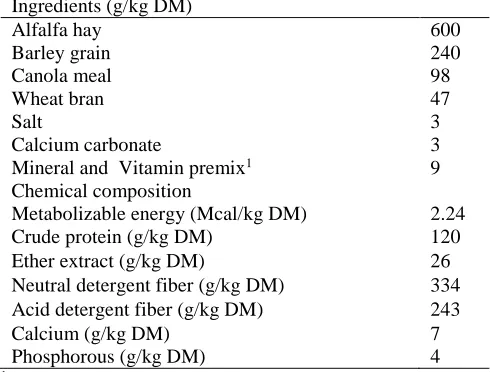
Ruminal degradability of feed protein was measured us-ing three rumen-fistulated Moghani rams (55 ± 4 kg body weight). Rams were fed a total mixed ration with forage to concentrate ratio of 60:40 that was balanced by sheep CNCPS software (version 1.0.21) for 10 per-cent above maintenance requirements (AFRC, 1992; Vanzant et al., 1998). The ingredients and chemical co-
mposition of the diet are presented in Table 1 and 2, re-spectively. Rams were housed in individual pens (2.0 × 1.2 m) and fed twice daily at 0800 and 1800. For the in situ experiment, feed samples were ground through a Willey mill (2-mm screen) and triplicate sub-samples (3 g per bag) were incubated in heat-sealed polyester bags (7 × 10 cm, 52 ± 5 µm pore size, Gol Pooneh Safahan, Isfahan, Iran) for 0, 2, 4, 8, 16, 24 and 48 h in the case of concentrate feeds, and for 0, 8, 16, 24, 48 and 72 h in the case of forage feeds (AFRC, 1992).The bags were simultaneously inserted in the rumen immediately after the morning meal for three consecutive periods and re-moved sequentially at end of each incubation time. The ratio of sample size to bag surface area was about 21 mg per cm2. After incubation, the bags were immediately rinsed in cold water and washed in a commercial wash-ing machine for 21 minutes with two gaps (three 7 minutes cycles). The 0 h bags were not incubated in the rumen but followed the same washing procedure. The bags were then dried in a forced-air oven at 65 °C for 48 h to determine DM disappearance and the residues were analyzed for crude protein content (AOAC, 1990; Kjeldahl N×6.25, method 984.13).
In vitro experiment
The in vitro degradability was determined by using the ruminal digestion stage (first stage) of in vitro DM di-gestibility determination by DaisyII apparatus (Holden, 1999). For removing any variation from sample prepa-rations, the procedure was the same as that used for the
in situ experiment. Ruminal fluid was collected from
Table 1. Ingredients and chemical composition of the diet Ingredients (g/kg DM)
Alfalfa hay 600
Barley grain 240
Canola meal 98
Wheat bran 47
Salt 3
Calcium carbonate 3
Mineral and Vitamin premix1 9 Chemical composition
Metabolizable energy (Mcal/kg DM) 2.24 Crude protein (g/kg DM) 120 Ether extract (g/kg DM) 26 Neutral detergent fiber (g/kg DM) 334 Acid detergent fiber (g/kg DM) 243
Calcium (g/kg DM) 7
Phosphorous (g/kg DM) 4
1Contained 195 g/kg calcium, 80 g/Kg phosphorous, 21 g/Kg
27 Table 2. Chemical composition of test feedstuffs (g/kg DM)
Soybean meal Canola meal Barley grain Corn grain Alfalfa hay Corn silage
DM 918 905 878 859 895 308
CP 485 366 112 89 137 82
EE 19 17 21 36 23 31
NDF 175 270 195 103 552 600
Ash 69 78 43 35 105 85
three rams immediately after slaughtering (slaughter-house of Ardebil city, Iran), mixed and approximately 2 liters of pooled ruminal fluid and 300 g of ruminal par-ticulate matter per DaisyII digestion bottle were trans-ported to the laboratory in a pre-warmed container. Preparation of the inocula included blending the ruminal fluid and particulate matter for 2 min in a blender, fol-lowed by filtering through four-layer cheesecloth with constant purging with CO2. Buffered ruminal fluid was prepared as described by Holden (1999). The buffer so-lution was made just prior to each digestion run by warming solutions A and B to 39 °C and adding 20 mL of solution B to 1 L of solution A. The pH of the buffer solution was adjusted to 6.8 (if needed) by adding small additional amounts (1 to 2 mL) of solution B. The rea-gents used were: solution A (10 g of KH2PO4, 0.5 g of MgSO4.7H2O, 0.5 g of NaCl, 0.1 g of CaCl2·H2O and 0.5 g of urea in 1 L of deionized water) and solution B (15 g of Na2CO3 and 1 g of Na2S.9H2O in 100 ml of deionized water) (Holden, 1999). Overall, each diges-tion bottle was filled with 1440 mL buffer soludiges-tion and 360 mL rumen fluid (1800 mL in total).
For each incubation time, 5 polyester bags (4 × 6 cm; 52 ± 5 µm pore size, Gol Pooneh Safahan, Isfahan, Iran) were filled with 1 g of each of the 6 feed samples, heat sealed, placed in 2 L digestion bottles that were filled with buffered ruminal fluid and incubated in the DaisyII apparatus at 39°C for incubation times similar to the in situ method. A thread was used for attaching bags to each other at approximately 5-cm distance between them. Thereafter, the bags were inserted and hanged in the digestion bottles with the end of each thread remain-ing out of the bottles. For simulatremain-ing ruminal condition, the feeds samples were placed in each digestion bottle because Holden (1999) showed that there were no sig-nificant differences in using the DaisyII method either with the same feeds or with different feeds in a digestion bottle. The number of bags in each digestion bottle was not more than 20 bags per bottle. At each incubation time, the door of the digestion bottle was opened, the threaded bags of that incubation time were taken out and the door of the digestion bottle was closed again. These procedures were conducted under constant purging with CO2. The bags of three incubation timeswere inserted
in each bottle, and the opening and reclosing cycles for each bottle were not more than two occasions. Overall digestion process of in vitro method for the test feeds was performed in two runs by two DaisyII apparatuses at the same time. The 0 h bags were not incubated in the bottles, but the same washing procedure similar to the
in situ experiment was used. After incubation, the bags were immediately rinsed, dried, weighed and analyzed for CP content.
Statistical analysis
The kinetic parameters of protein disappearance were estimated by the Fitcurve software for both methods (Chen, 1995) by fitting the modified model of Orskov and McDonald (1979) by McDonald (1981): P = a + b
(1– e–c (t-L)), if t ≥ L, Where P is the proportion of protein
that disappears at time t, a is the fraction of rapidly sol-ubilized protein, b is the fraction of potentially degrada-ble protein , c is the fractional rate constant for the dis-appearance of fraction b (/h), t is the time of incubation (h) and L is the lag time.
Data were analyzed by the GLM procedure of SAS (2003) according to the completely randomized com-plete design using the following model: yij = µ + Ti + e, where y was the dependent variable, µ was overall mean, Ti was the estimation method effect and e was random error. Comparison between methods for each parameter was done by LSMEANS and the significant differences were declared at P<0.05. Also, the Pearson correlation coefficients between in situ and in vitro
methods for estimating the degradability parameters were calculated by the CORR procedure of SAS (2003) and P<0.05 was considered as the significance level.
Results
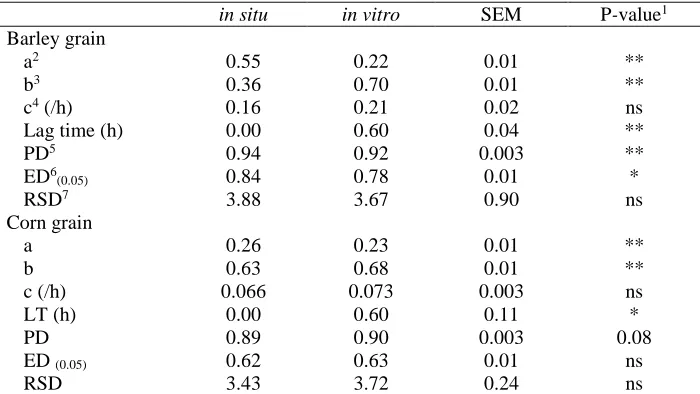
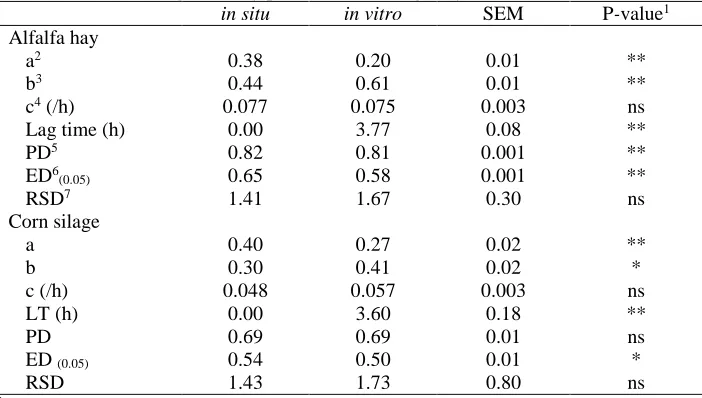
Significant differences were observed between the in situ and in vitro methods in the estimation of the rapidly soluble (a) fraction for all feeds (P<0.01), except for soybean meal (Tables3, 4 and 5). The estimation method significantly affected the potentially degradable protein (b) fraction of barley grain, corn grain, alfalfa hay (P<0.01) and corn silage (P<0.05), with the in situ
28
Table 3. Estimated degradability parameters of plant protein sources by in situ and in vitro methods 1 value -P SEM in vitro in situ Soybean meal ns 0.02 0.20 0.21 a2 ns 0.02 0.80 0.77 b3 ns 0.001 0.063 0.059
c4 (/h)
ns 0.39
2.27 2.20
Lag time (h)
ns 0.01 1.0 0.99 PD5 ns 0.01 0.65 0.64 ED6 (0.05) ** 0.01 7.34 3.39 RSD7 Canola meal ** 0.01 0.22 0.28 a ns 0.02 0.66 0.61 b ns 0.002 0.060 0.058 c (/h) * 0.002 1.33 0.00 LT (h) ns 0.01 0.88 0.89 PD * 0.01 0.58 0.60
ED (0.05)
* 0.51
4.85 2.44
RSD
1ns: not significant, *P≤0.05, **P≤0.01. 2 the fraction of rapidly solubilized protein. 3 the fraction of potentially degradable protein.
4 the fractional rate constant for the disappearance of fraction b (/h) with the time, t. 5 potential of degradability.
6 effective degradability at the passage rate 0.05 (/h), respectively. 7residual standard deviation.
Table 4. Estimated degradability parameters of grain concentrates by in situ and in vitro methods 1 value -P SEM in vitro in situ Barley grain ** 0.01 0.22 0.55 a2 ** 0.01 0.70 0.36 b3 ns 0.02 0.21 0.16
c4 (/h)
** 0.04
0.60 0.00
Lag time (h)
** 0.003 0.92 0.94 PD5 * 0.01 0.78 0.84 ED6 (0.05) ns 0.90 3.67 3.88 RSD7 Corn grain ** 0.01 0.23 0.26 a ** 0.01 0.68 0.63 b ns 0.003 0.073 0.066 c (/h) * 0.11 0.60 0.00 LT (h) 0.08 0.003 0.90 0.89 PD ns 0.01 0.63 0.62
ED (0.05)
ns 0.24
3.72 3.43
RSD
1 ns: not significant, *P≤0.05, **P≤0.01. 2 the fraction of rapidly solubilized protein. 3 the fraction of potentially degradable protein.
4 the fractional rate constant for the disappearance of fraction b (/h) with the time, t. 5 potential of degradability.
29 Table 5. Estimated degradability parameters of forages by in situ and in vitro methods
1 value -P SEM
in vitro in situ
Alfalfa hay
** 0.01
0.20 0.38
a2
** 0.01
0.61 0.44
b3
ns 0.003
0.075 0.077
c4 (/h)
** 0.08
3.77 0.00
Lag time (h)
** 0.001
0.81 0.82
PD5
** 0.001
0.58 0.65
ED6 (0.05)
ns 0.30
1.67 1.41
RSD7 Corn silage
** 0.02
0.27 0.40
a
* 0.02
0.41 0.30
b
ns 0.003
0.057 0.048
c (/h)
** 0.18
3.60 0.00
LT (h)
ns 0.01
0.69 0.69
PD
* 0.01
0.50 0.54
ED (0.05)
ns 0.80
1.73 1.43
RSD
1 ns: not significant, *P≤0.05, **P≤0.01. 2 the fraction of rapidly solubilized protein. 3 the fraction of potentially degradable protein.
4 the fractional rate constant for the disappearance of fraction b (/h) with the time, t. 5 potential of degradability.
6 effective degradability at the passage rate 0.05 (/h), respectively. 7 residual standard deviation
affected by the method. For all feeds, the fractional rate constant (parameter c) for the disappearance of fraction b (/h) was not affected by the degradability determina-tion method.
Excepting soybean meal, the incubation of feeds by
in vitro method resulted in longer lag time than the in situ method (P<0.01). The method of degradability de-termination had significant effect on the estimation of degradability potential (PD) of barley grain and alfalfa hay (P<0.01), but not for other feeds. The in situ method gave significantly higher values for effective degrada-bility (ED) at the passage rate of 0.05 h-1 than in vitro method for canola meal, barley grain, corn silage (P<0.05) and alfalfa hay (P<0.01).
When data for all feeds were pooled, there were sig-nificant differences between in situ and in vitro methods in estimated a fraction, lag time (P<0.01) and the b frac-tion (P<0.05). The methods did not affect other param-eters (Table 6).
The estimated b fraction, parameter c, PD and ED by the
in vitro method were highly correlated with the esti-mated values by the in situ method (P<0.01). But, the correlation coefficient between the two methods for the estimation of fraction a, lag time and RSD was low and non-significant (Table 7).
Discussion
In the present study, ruminal fluid for invitro
method
was taken from slaughterhouse materials to estimate degradation parameters but not from fistulated animals. In most feeds, the in vitro method resulted in a lower a
fraction and longer lag time than the in situ method. These results indicated slow start of degradation process in the in vitro method that was predictable because of lower concentration of microorganisms in the in vitro
30
Table 6. Pooled estimates of the degradability parameters of feedstuffs by in situ and in vitro methods
1 value -P SEM
in vitro in situ
** 0.02
0.21 0.35
a2
* 0.03
0.64 0.52
b3
ns 0.02
0.090 0.078
c4 (/h)
** 0.27
2.03 0.37
Lag time (h)
ns 0.02
0.86 0.87
PD5
ns 0.02
0.62 0.65
ED6 (0.05)
0.06 0.42
3.85 2.66
RSD7
1 ns: not significant, *P≤0.05, **P≤0.01. 2 the fraction of rapidly solubilized protein. 3 the fraction of potentially degradable protein.
4 the fractional rate constant for the disappearance of fraction b (/h) with the time, t. 5 potential of degradability.
6 effective degradability at the passage rate 0.05 (/h), respectively. 7 residual standard deviation.
Table 7. Correlation coefficients between estimated degradability parameters by in situ and in vitro methods
a1 b2 c3 Lag time PD4 ED5
(0.05) RSD6 0.22 0.78** 0.89** 0.10 0.98** 0.94** 0.29 1 the fraction of rapidly solubilized protein.
2 the fraction of potentially degradable protein.
3 the fractional rate constant for the disappearance of fraction b (/h) with the time, t. 4 potential of degradability.
5 effective degradability at the passage rate 0.05 (/h), respectively. 6 residual standard deviation.
*P≤0.05, **P≤0.01.
coefficient was improved (r=0.47) and tended to be sig-nificant (P=0.07). Among the test feeds, close estima-tions of the a value by in vitro method compared to in situ results were observed for soybean meal, canola meal and corn grain. Based on the present results, it seems that the in vitro DaisyII method was not a suitable method for estimating the a value in feeds with very fast (barley grain) or very low (forages) degradability in the rumen. Terramoccia et al. (1992) estimated the protein degradability parameters of 8 feeds using the protease enzyme of Streptomyces griseus and reported that the estimates obtained from the in vitro method, except for the 2 full fat samples (full fat soybean and maize germ), were close to the in situ data.
The higher b parameter estimated by the in vitro
method can be explained by compensatory microbial di-gestion. So, the in vitro method had lower disappear-ance values in short incubation times and higher disap-pearance values in long incubation times compared to in situ. This may be supported by the closeness of the esti-mated values for PD by two methods and similar disap-pearances at final incubation times between methods (unpublished data). Similar estimations of PD by the in vitro method compared to the in situ could indicate the digestion ability of the ruminal microorganisms under
31
Conclusion
Based on the present results, close estimations with high correlation coefficients between in situ and in vitro
methods were observed in the estimation of parameters of c, PD and ED. The DaisyII method underestimated the rapidly degradable fraction of protein for all test feeds. In addition, the ability of the method in estimating some parameters was better for some raw materials (soybean meal, canola meal and corn grain) than for others (bar-ley grain, alfalfa hay and corn silage). The results sug-gested that if one is interested in estimating the protein degradability parameters by an in vitro method, the in vitro DaisyII procedure can be a useful method for esti-mating fractional degradation rate, degradation poten-tial and effective degradability of protein of feedstuffs.
References
AFRC. 1992. Estimation of protein degradability: A standard method for in situ measurement of nitrogen disappearance from dacron bags suspended in the rumen. Nutrition Ab-stracts and Reviews (series B) 62, 834-835.
AFRC. 1993. Agricultural and Food Research Council: En-ergy and protein requirements of ruminants. An advisory manual prepared by the ARC technical Committee on re-sponse to nutrients. CAB International, Wallingford, UK.
AOAC. 1990. Official Methods of Analysis. 15th edition. As-sociation of Official Analytical Chemists, .Arlington, VA, USA.
Aufrère, J., Graviou, D., Demarquilly, C., Vérité, R., Micha-let-Doreau, B., Chapoutot, P., 1991. Predicting in situ de-gradability of feed proteins in the rumen by two laboratory methods (solubility and enzymatic degradation). Animal Feed Science and Technology 33, 97–116.
Belanche,A., Weisbjerg, M.R., Allison, G.G., Newbold,C.J. Moorby, J.M., 2014. Measurement of rumen dry matter and neutral detergent fiber degradability of feeds by Fourier-transform infrared spectroscopy. Journal of Dairy Science 97, 2361-2375.
Calsamiglia, S., Stern, M.D., Bach, A., 2000. Enzymatic and microbial-cell preparation techniques for predicting rumen degradation and postruminal availability of protein. In: Giv-ens, D.I., Owen, E., Axford, R.F.E., Omed, H.H., (Eds). Forage Evaluation in Ruminant Nutrition. CABI Publish-ing, Wallingford, UK, pp: 259-279.
Chen, X.B., 1995. "Fitcurve" macro, IFRU, The Macaulay In-stitute, Aberdeen, UK.
Holden, L.A., 1999. Comparison of methods of in vitro dry matter digestibility for ten feeds. Journal of Dairy Science 82, 1791–1794.
Hvelplund, T., Weisbjerg, M.R., 2000. In situ techniques for the estimation of protein degradability and postrumen avail-ability. In: Givens, D.I., Owen, E., Axford, R.F.E., Omed, H.H., (Eds). Forage Evaluation in Ruminant Nutrition. CABI Publishing, Wallingford, UK, pp: 223-258.
Karlsson, L., Hetta, M., Udén, P., Martinsson, K., 2009. New methodology for estimating rumen protein degradation us-ing the in vitro gas production technique. Animal Feed Sci-ence and Technology 153, 193-202.
Krizsan, S.J., Jančík, F., Ramin, M., Huhtanen, P., 2013. Comparison of some aspects of the in situ and in vitro meth-ods in evaluation of neutral detergent fiber digestion. Jour-nal of Animal Science 91, 838–847.
Madsen, J., Hvelplund, T., 1994. Prediction of in situ protein degradability in the rumen: results of a European ring test. Livestock Production Science 39, 201–212.
McDonald, I., 1981. A revised model for the estimation of protein degradability in the rumen. Journal of Agriculture Science 96, 251-252.
NRC. 2001. Nutrient Requirements of Dairy Cattle. 7th re-vised edition. National Research Council, National Acad-emy of Sciences, Washington, DC.
Orskov, E.R., Deb Hovell, F.D., Mould, F., 1980. The use of the nylon bag technique for the evaluation of feedstuffs. Tropical Animal Production 5, 195-213.
Orskov, E.R., McDonald, I., 1979. The estimation of protein degradability in the rumen from incubation measurements weighted according to rate of passage. Journal of Agricul-ture Science 92, 499-503.
SAS Institute. 2003. SAS User’s Guide: Statistics, Release 9.1. SAS Inst. Inc., Cary, NC.
Stensig, T., Weisbjerg, M.R., Hvelplund, T., 1997. Evalua-tion of different methods for the determinaEvalua-tion of digesEvalua-tion and passage rates of fiber in the rumen of dairy cows. Acta Agriculturae Scandinavica, Section A, Animal Science 48, 141–154.
Stern, M.D., Bach, A., Calsamiglia, S., 1997. Alternative techniques for measuring nutrient digestion in ruminants. Journal of Animal Science 75, 2256–2276.
Susmel, P., Mills, C.R., Colitti, M., Stefanon, B., 1993. In vitro solubility and degradability of nitrogen in concentrate feeds. Animal Feed Science and Technology 42, 1–13.
32
Terramoccia, S., Puppo, S., Rizzi, L., Martillotti, F., 1992. Comparison between in sacco and in vitro protein rumen degradability. Annales de zootechnie, 41, 20-20.
Tilley, J.M.A., Terry, R.A., 1963. A two-stage technique for the digestion of forage crops. Journal of British Grassland Society 18, 104–111.
Trujillo, A.I., Marichal, M.de J., Carriquiry, M., 2010. Com-parison of dry matter and neutral detergent fiber degradation of fibrous feedstuffs as determined with in situ and in vitro gravimetric procedures. Animal Feed Science Technology 161, 49-57.
Van Amburgh, M.E., Collao-Saenz, E.A., Higgs, R.J., Ross, D.A., Recktenwald, E.B., Raffrenato, E., Chase, L.E., Over-ton, T.R., Mills, J.K., Foskolos, A., 2015. The Cornell Net Carbohydrate and Protein System: Updates to the model and evaluation of version 6.5. Journal of Dairy Science 98: 6361–6380.
Van Soest, P.J., Robertson, J.B., Lewis, B.A., 1991. Methods for dietary fiber, neutral detergent fiber and non starch pol-ysaccharide in relation to animal nutrition. Journal of Dairy Science 74, 3583-3597.
Vanzant, E.S., Cochran R.C., Titgemeyer, E.C., 1998. Stand-ardization of in situ techniques for ruminant feedstuff eval-uation. Journal of Animal Science 76, 2717–2729.
Varel, V.H., Kreikemeier, K.K., 1995. Technical Note: Com-parison of in vitro and in situ digestibility methods. Journal of Animal Science 73, 578-582.
Wilkerson, V.A., Klopfenstein, T.J., Stroup, W.W., 1995. A collaborative study of in situ forage protein degradation. Journal of Animal Science 73, 583–588.
Communicating editor: Mehdi Dehghan-banadaky
هسیاقم
هجنسارف دروآرب رد یهاگشیامزآ و ینولیان هسیک یاهشور
هیزجت یاه
ب نیئتورپ یریذپ
یخر
یکاروخ داوم
رامنب یدبع .ح
*
دبجنس یناحبس .ع و
یلیبدرا ققحم هاگشناد یماد مولع هورگ یبرم و رایداتسا ،بیترت هب .ناریا ،لیبدرا ،
:کینورتکلا تسپ ،لوئسم هدنسیون
هدیکچ
ن نورپ جرییپ ای هی جته اه نننسارف دروآرب شهوژپ نیا زا فده 6
تب ات د کراورنننشن جیار یکاروخ هدتم
اس ک شور زا هدتفتسا ( ینولیتن جته
in situ
هتگتسد زا هدتفتسا تب یعادبا یهتگشیتمزآ شور و ) II
Daisy الته ک هب .دوب
شور ود ن ب جراد ی یم جته هوتفی تتیوننس
in situ
و
in vitro
اه ننسارف( (یرننس رییپ ای هی شرب دروآرب رد
a
)
( دنن هدهتننشم 01
/ 0 >
P
اه ننسارف( د ک رییپ ای هی شرب جراد ی یم روط اب دروآرب شور .)
b
) تهرذ اناد توج اناد
( داد رارق ر ثتی تحی ار هد ول س هرذ افولع و کش خ اهنوی 05
/ 0 >
P
ای هی خرن .) اه س ارف( جرییپ
c
دیدپتن جارب )
شرب اد
b
شرب هد دروآرب ریدتقم .تفرگن رارق ر ثتی تحی جرییپ ای هی ن یی شور ال سو اب )تعتس رد دصرد(
b
ت اه ننسارف
c
ت ( جرییپ ای هی ت ننسنتتپ PD
) ( رثوم جرییپ ای هی و ED
شور رد )
in vitro
ریدتقم تب جدتیز اا م اب
شور طسوی هد دروآرب
in situ
اد یگتسبمه ای هی ت سنتتپ .ت
ای هی و جرییپ شور طسوی هد دروآرب رثوم جرییپ
in vitro
شور جتهدروآرب تب جدتیز اا م اب
in situ
( تننن اد یگتنننسبمه 01
/ 0 >
P
شور اک داد اتنننشن جیتتن .)
هتگتسد زا هدتفتسا تب یهتگشیتمزآ II
Daisy اه سارف یخرب دروآرب جارب اه سارف د نتم جرییپ ای هی جته
c
ت
PD و ED
شور ییتناوی .در گب رارق هدتفتسا دروم دناوی یم II
Daisy تلاونتک الته ک( یکاروخ داوم یخرب دروم رد ته اه سارف یخرب