R E S E A R C H
Open Access
Distributed user selection scheme for uplink
multiuser MIMO systems in a multicell
environment
Byong Ok Lee
1, Oh-Soon Shin
2*and Kwang Bok Lee
3Abstract
We propose an interference-aware user selection scheme for uplink multiuser multiple-input multiple-output systems in a multicell environment. The proposed scheme works in a distributed manner. Each mobile station determines its transmit beamforming vector based on the locally available channel state information, and informs the associated base station (BS) of the amount of potential interference caused to adjacent cells along with the resulting beamforming vector. Then, the BS selects a set of users to be served simultaneously with consideration of intercell interference. The user selection scheme is devised either to maximize the sum rate or to achieve
proportional fairness among users. For each case, we derive an optimal user selection criterion and propose a suboptimal distributed user selection algorithm with low complexity. Simulation results confirm that the proposed scheme offers significant throughput enhancement due to reduction of the intercell interference in a multicell environment.
Introduction
Multiuser multiple-input multiple-output (MU-MIMO) is widely accepted as a key technology for enabling high-speed wireless access. In the uplink MU-MIMO systems, multiple mobile stations (MSs) are allowed to simultan-eously transmit their signals to the base station (BS) to increase the system capacity. Under this scenario, the system performance may depend on the set of transmit-ting users and their transmit beamforming vectors [1-3]. In [1], a general framework for transmit beamforming and user selection was developed based upon general convex utility functions. In [2], successive user selection algorithms were proposed along with optimization of transmit beamforming vectors. In [3], various low-complexity beamforming and user selection schemes were proposed. All these works, however, have dealt with only a single cell environment where the intercell inter-ference does not exist.
Intercell interference is one of the most critical factors that limit the performance of cellular systems, especially for low-frequency reuse factor. There have been several
works on MIMO that account for the intercell interfer-ence in a multicell environment [4-7]. In [4], it was reported that the performance of spatial multiplexing MIMO scheme is significantly degraded in an interference-limited multicell environment. In [5], an optimal MIMO transmission strategy was studied when the channel state information (CSI) is not available at the transmitter. For the case when the CSI is available at the transmitter, a centralized precoding scheme that maximizes the total sum rate was proposed in [6]. In [7], a precoding scheme was proposed to maximize the total sum rate in a distributed manner. However, these works have been based on a single user MIMO system where only one MS is served at a time. MU-MIMO systems were only recently investigated in a multicell environ-ment [8-10]. In [8], downlink multicell MU-MIMO sys-tems were discussed from the aspects of tradeoffs, overhead, and interference control. In [9], scheduling schemes were developed for the downlink multicell MIMO systems. Uplink MU-MIMO systems were ana-lyzed in [10] in the case that the adjacent BS’s are allowed to cooperate.
In this article, we develop an interference-aware user selection scheme for uplink MU-MIMO systems in a * Correspondence:[email protected]
2
School of Electronic Engineering, Soongsil University, Seoul 156-743, South Korea
Full list of author information is available at the end of the article
multicell environment. The scheme comprises of two steps and works in a distributed manner. In the first step, each MS determines its transmit beamforming vec-tor. By utilizing the previous result on the interference-aware beamforming proposed in [7], we can effectively reduce the interference caused to adjacent cells. In the second step, each BS selects a set of users to be served simultaneously to realize multiuser diversity with consid-eration of interference caused to adjacent cells as well as the desired link performance. The user selection scheme is developed so to maximize the sum rate or to achieve proportional fairness among users. For each objective, we derive an optimal user selection criterion and propose a suboptimal distributed user selection algo-rithm with low complexity. Simulation results are pro-vided to show the throughput enhancement of the proposed scheme.
The rest of this article is organized as follows. Section 2 describes the system model. In Section 3, we explain distributed beamforming schemes. In Section 4, we propose an uplink user selection algorithm based on the beamforming vectors. Simulation results are presented in Section 5, and conclusions are drawn in Section 6.
We define here some notation used throughout this article. We use boldface capital letters and boldface small letters to denote matrices and vectors, respectively, ()T and ()H
to denote transpose and conjugate trans-pose, respectively, det() to denote determinant of a matrix, tr() to denote trace of a matrix, ()−1
to denote matrix inversion, |||| to denote Euclidean norm of a vector,INto denote theN×Nidentity matrix.
System model
We consider the uplink of an MU-MIMO system com-prised ofLcells where there areKusers in each cell. Each MS and each BS are equipped withNttransmit antennas and Nrreceive antennas, respectively. Thekth MS in the ith cell is assumed to communicate with the BS in theith cell by using a transmit beamforming vectorwð Þik.
The received signal vector yi at the BS in theith cell can be expressed as
yi¼X
where Si denotes the set of selected users to be simul-taneously served in the ith cell. We assume that the maximum number of selected users per cell is Nr. xð Þik denotes the input symbol transmitted from the kth MS in the ith cell, Hð Þi;jk denotes anNr ×Ntchannel matrix
between thekth MS in thejth cell and the BS in theith cell. We assume a flat fading channel in both time and frequency. The elements ofHð Þi;jk andxð Þik are assumed to be independent and identically distributed (i.i.d.) circu-larly symmetric complex Gaussian random variables with zero mean and unit variance. In (1),nidenotes the additive white Gaussian noise (AWGN) vector at the BS in the ith cell with each element having unit variance,
ρð Þk
i denotes the signal-to-noise ratio (SNR) of the kth MS in the ith cell, and ηð Þi;jk denotes the interference-to-noise ratio (INR) for the interference that thekth MS in thejth cell causes to the BS in theith cell.
We assume that each BS performs a linear minimum mean-square error (MMSE) detection to suppress the residual interference and detect the desired signal. The MMSE combining vector gð Þik used in receiving thekth MS’s signal in theith cell is expressed as
where Kð ÞNIi;k denotes the covariance matrix of the noise plus received interference signal which is given as
Kð ÞNIi;k ¼INr ond and third terms represent the intracell interference and intercell interference, respectively. The post proces-sing SINR of the kth MS’s signal in theith cell is
repre-Then, the achievable rate of the kth MS in the ith cell is calculated as
rið Þk ¼ log 1þSINRð Þik
: ð5Þ
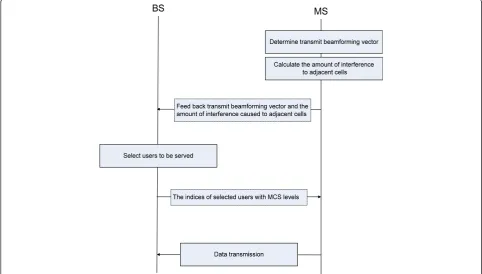
distributed approach for determining transmit beam-forming vectors and the corresponding set of users, as illustrated in Figure 1. In the first step, each MS deter-mines its transmit beamforming vector based on the lo-cally available CSI and calculates the amount of potential interference caused to adjacent cells. Then, each MS informs the associated BS of the amount of interference to adjacent cells along with the determined beamforming vector. In the second step, each BS selects a set of users to be simultaneously served based on the information received from MSs. The BS then broadcasts the indices of selected users with appropriate modula-tion and coding schemes level. Finally, the selected users transmit their own data to the BS. It must be noted that the proposed approach based on the local CSI will pro-vide a more practical solution than the centralized optimization from the viewpoint of feedback overhead and computational complexity, although it may not guarantee the optimality. We explain details of the trans-mit beamforming and user selection scheme in the fol-lowing two sections.
Transmit beamforming
In this section, we explain transmit beamforming schemes that were proposed in [7] for the case of single user MIMO in a multicell environment. We assume that each MS independently determines its transmit beamforming vector based on the locally available CSI.
We define the desired channel Hð ÞDi;k and interference generating channelHð ÞGIi;k for thekth MS in theith cell as
Hð ÞDi;k ¼ ffiffiffiffiffiffiffiρð Þk i q
Hð Þk
i;i; ð6Þ
Hð ÞGIi;k ¼
ffiffiffiffiffiffiffiffi
ηð Þk
1;i q
Hð Þk 1;i ... ffiffiffiffiffiffiffiffiffiffi
ηð Þk
i1;i q
Hð Þk i1;i ffiffiffiffiffiffiffiffiffiffi
ηð Þk
iþ1;i q
Hð Þk iþ1;i ... ffiffiffiffiffiffiffiffi
ηð Þk
L;i q
Hð Þk L;i 2
6 6 6 6 6 6 6 6 6 6 6 6 6 4
3 7 7 7 7 7 7 7 7 7 7 7 7 7 5
: ð7Þ
We assume that the kth MS can obtain Hð ÞDi;k and
Hð ÞGIi;kHHð Þi;k
GI by exploiting the channel reciprocity. This
is possible for time division duplex systems. For example, the MS in theith cell can estimateHð ÞDi;k through downlink signal that comes from the BS in theith cell. Similarly, the MS can determine Hð ÞGIi;kHHð Þi;k
GI by estimating the
covari-ance matrix of aggregate interference signals that come from adjacent cells during the downlink period. Based on the above assumptions, we introduce two distributed trans-mit beamforming schemes proposed in [7]: MAX-SNR beamforming and MAX-SGINR beamforming.
MAX-SNR beamforming
The MAX-SNR beamforming vector is constructed to maximize the desired signal power without consideration on the intercell interference. The MAX-SNR beamforming vector of thekth MS in theith cell can be expressed as
The solution of (8) can be obtained as the eigenvector corresponding to the largest eigenvalue ofHð ÞDi;kHHð Þi;k
D .
MAX-SGINR beamforming
The MAX-SGINR beamforming vector is determined considering not only the desired signal power, but also the intercell interference caused to adjacent cells. The metric called signal to generated interference plus noise ratio(SGINR) at thekth MS in theith cell is defined as
where the numerator corresponds to the desired signal power and the denominator represents the noise plus interference caused to adjacent cells by the kth MS in theith cell. The MAX-SGINR beamforming vector max-imizes the SGINR at each MS as
wð Þk
The solution of (10) can be obtained as the eigen-vector corresponding to the largest eigenvalue of
INtþH
D . The MAX-SGINR
beamforming effectively reduces the interference to adja-cent cells while maintaining the desired signal power. It is shown in [7] that the MAX-SGINR beamforming ap-proximately maximizes the total sum rate for multiple-input single-output systems in a two-cell environment.
After determining a transmit beamforming vector, each MS calculates the amount of interference caused to adjacent cells as
βð Þk
whereβð Þik denotes the amount of interference caused to adjacent cell by thekth MS in theith cell. Note thatβð Þik depends on the transmit beamforming vector. Each MS
informs the associated BS of wð Þik and βð Þik for user selection.
User selection
In this section, we develop user selection schemes with two different objectives: sum rate maximization, and proportional fairness (PF). For each objective, we first derive an optimal user selection criterion and then propose a suboptimal distributed algorithm with low complexity.
Sum rate maximization
We begin with a conventional user selection algorithm for sum rate maximization, which was proposed for a single cell environment. In this case, each BS selects users to maximize only the sum rate of its own cell as
SCONVi¼ arg max Si
X
k2Si
rð Þik fori¼1;2;. . .;L: ð12Þ
However, this solution is not optimal in a multicell en-vironment due to the intercell interference. In order to maximize the total sum rate of the L cells, we modify the formulation of (12) as
Sopt1;Sopt2;. . .;SoptL
The solution of (13) can only be obtained through centralized optimization among cells, which requires perfect CSI, a lot of signaling overhead among cells, and very high computational complexity. As a more practical solution, we propose a suboptimal distributed user selec-tion algorithm with low complexity. The algorithm is described as in the following steps.
Step 1. Initialization:Si¼ fg: Step 2.knew ¼ arg maxkΔC kð Þ.
Step 3. IfΔC kð newÞ>0, thenSi¼Si[fknewgand go
back to the Step 2; otherwise terminate the algorithm.
Each BS independently selects users to be served by using the above algorithm. In Step 1, the set Si of selected users is initialized. In Step 2, the BS chooses one user among the users not in Si so as to maximize the amount of the change in the total sum rate. Note that ΔC kð Þ denotes the amount of the change in the total sum rate when thekth user is added to Si. In Step 3, if the addition of the selected user in Step 2 increases the total sum rate, then the BS adds the user to Si and goes back to Step 2. Otherwise, the algorithm terminates and the final set of selected users is given by Si.
neighboring cells. We can split ΔC kð Þ into two compo-nents as
ΔC kð Þ ¼ΔCgainð Þ k ΔClossð Þk ; ð14Þ
where ΔCgainð Þk denotes the sum rate increment in the
ith cell by adding the kth user to Si, and ΔClossð Þk
denotes the sum rate decrement in adjacent cells by add-ing the kth user to Sidue to the increased interference. The BS can easily calculateΔCgainð Þk as
However, it is difficult to calculateΔClossð Þk in the
dis-tributed manner, since ΔClossð Þk is dependent on the set
of selected users in adjacent cells. Instead of directly cal-culating ΔClossð Þk , we propose to estimate ΔClossð Þk
based on βð Þik which is fed back from thekth MS in the ith cell. Note thatβð Þik represents the amount of interfer-ence caused toadjacent cellsby selecting thekth user in the ith cell. The main idea is to estimate ΔClossð Þk by
calculating the sum rate decrement in the ith cell to which the BS belongs, with additional interference with the power βð Þik . Then the estimated sum rate decrement ΔC~lossð Þk in adjacent cell can be expressed as
denotes the achievable rate of thek′th
user in the ith cell with additional interference of the powerβð Þik, and it can be calculated as
The proposed algorithm requires at most KNr compu-tations of ΔC k~ð Þ per cell, since users are successively selected.
Proportional fairness
The proportional fairness (PF) scheduling effectively provides a trade-off between the average throughput and fairness among users [11]. The conventional PF schedul-ing was originally proposed for a sschedul-ingle cell environ-ment. In this case, each BS selects users as
SCONVi¼ arg max
where Rð Þik denotes the average throughput estimate of thekth user in theith cell. We assume thatRð Þik is
calcu-whereTcis the time constant of the averaging window. The solution of (21), however, does not guarantee the system-wide PF due to the intercell interference.
We consider an optimal user selection criterion for the system-wide PF, which can be expressed as
Sopt1;Sopt2;. . .;SoptL
¼ arg max S1;S2; ::SL
ð Þð ÞU1 ; ð23Þ
whereU1is the system-wide PF utility function expressed as
As in (13), the optimal solution of (23) needs centra-lized optimization among cells. Here, we also propose a suboptimal distributed algorithm. Instead of U1 in (23), we use another utility functionU2given as
As provided in the Appendix, the optimization prob-lem (23) remains the same even though U1 is replaced with U2. The use ofU2 enables the user selection algo-rithm to work in a distributed fashion with low compu-tational complexity. Based on the newly defined utility functionU2, the proposed algorithm works as follows.
Step 1. Initialization:Si¼ fg. Step 2.knew ¼ arg maxkΔU2ð Þk .
Step 3. IfΔU2ðknewÞ>0, thenSi¼Si[fknewgand go
back to the Step 2, otherwise terminate the algorithm.
Note that the above algorithm is the same as the dis-tributed algorithm developed in Section 4.1, except that ΔC kð Þis replaced byΔU2ð Þ, which denotes the amountk
of the change inU2when thekth user is added to Si. As in (14),ΔU2ð Þk can be expressed as
ΔU2ð Þ ¼k ΔU2gainð Þ k ΔU2lossð Þk ; ð26Þ
whereΔU2gainð Þk denotes the increment ofU2in theith
cell by adding thekth user to Si, which can be expressed as
cent cells by adding the kth user to Si due to the increased interference. Like the approach used for the total sum rate maximization, we propose to estimate ΔU2lossð Þk as
can be found as
ΔU~2ð Þ ¼k
This algorithm also requires at most KNr computa-tions ofΔU~2ð Þk per cell.
Simulation results
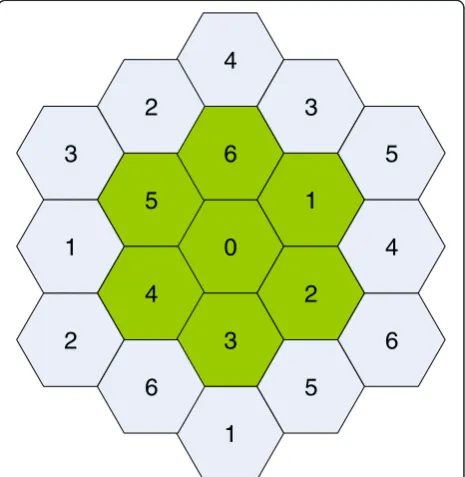
In this section, we evaluate the performance of the transmit beamforming and user selection algorithms dis-cussed in Sections 3 and 4 using computer simulations. We consider a wrap-around hexagonal model with seven cells as shown in Figure 2. There are K users per cell who are assumed to be uniformly distributed over the cell. Each channel between the MS and BS is assumed to experience an independent long-term fading comprised of the path loss and log-normal shadow fading. Corres-pondingly,ρð Þik andηð Þi;jk in (1) can be expressed as nent, and sð Þi;ik is a zero-mean Gaussian random variable that stands for the shadow fading. It is assumed that the long-term power control perfectly compensates for the long-term fading so that a given target SNR is satisfied at the BS. In the following simulation, the path loss ex-ponent, log standard deviation of the shadow fading, and the target SNR are set to 3.7, 8 dB, and 10 dB, respectively.
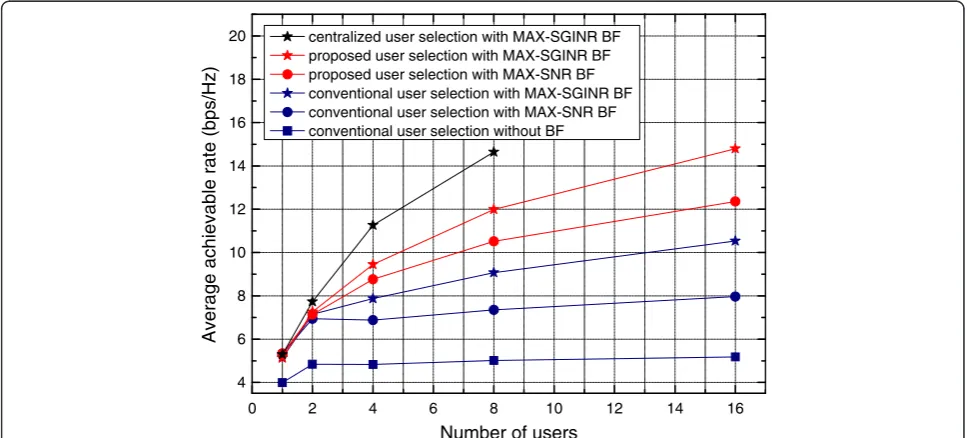
We first consider user selection for the sum rate maximization. Figures 3 and 4 depict the average achiev-able sum rate per cell versus the number of users for
0
Nt=Nr= 2 andNt=Nr= 4, respectively. The performance of the centralized user selection derived from an ex-haustive search is plotted together as an upper bound. However, the results are provided only up to eight users due to very high computational complexity. It is shown that the MAX-SGINR beamforming outperforms the MAX-SNR beamforming, and the proposed user selec-tion scheme outperforms the convenselec-tional one. It must
be noted that the proposed user selection gain increases with the number of users, and that the gain is more dis-tinguished than the beamforming gain. For the case of K= 16 and Nt=Nr= 2, for example, the proposed user selection scheme is shown to provide as much as 2.72 bps/Hz improvement over the conventional user se-lection scheme, when the MAX-SGINR beamforming is adopted. Under the same conditions, the gain of the
2 4 6 8 10 12 14 16
3 4 5 6 7 8 9 10 11
Average achievable rate (bps/Hz)
Number of users
centralized user selection with MAX-SGINR BF proposed user selection with MAX-SGINR BF proposed user selection with MAX-SNR BF conventional user selection with MAX-SGINR BF conventional user selection with MAX-SNR BF conventional user selection without BF
Figure 3The average achievable sum rate per cell versus the number of users forNt=Nr= 2.
0 2 4 6 8 10 12 14 16
4 6 8 10 12 14 16 18 20
Average achievable rate (bps/Hz)
Number of users
centralized user selection with MAX-SGINR BF proposed user selection with MAX-SGINR BF proposed user selection with MAX-SNR BF conventional user selection with MAX-SGINR BF conventional user selection with MAX-SNR BF conventional user selection without BF
MAX-SGINR beamforming over the MAX-SNR beam-forming is 0.65 bps/Hz, when the proposed user selec-tion scheme is applied. Figure 5 depicts the average amount of generated interference per cell forNt=Nr= 2. It is shown that the proposed user selection scheme con-siderably reduces the generated interference especially for a large number of users.
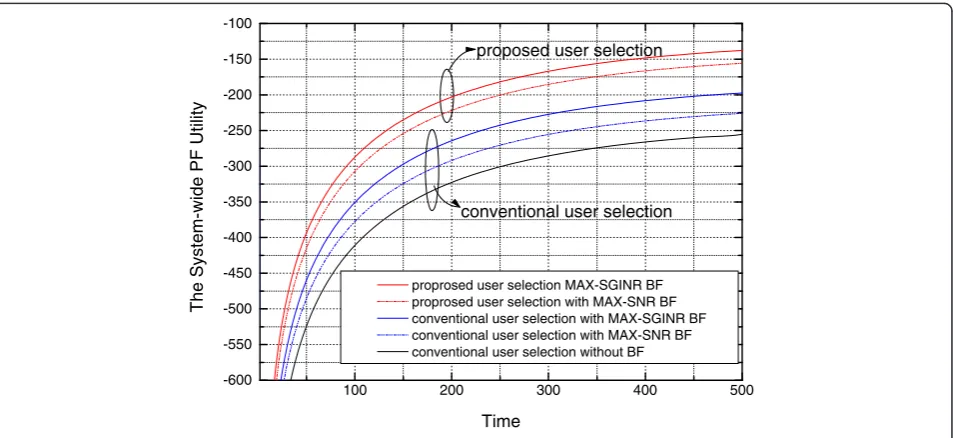
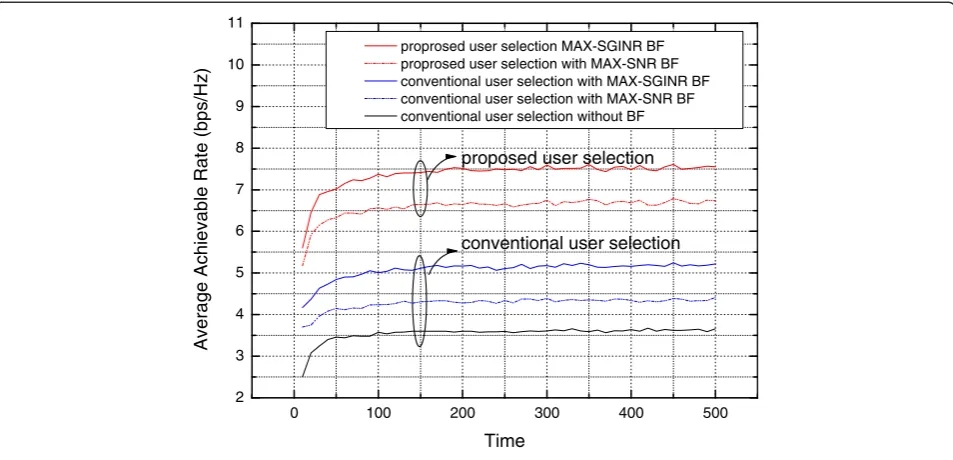
Now we consider the case of the PF utility. Figures 6 and 7 depict the system-wide PF utility U1 and the
average achievable sum rate per cell, respectively, versus time for K= 16,Nt=Nr= 2, andTc= 200 slots. As in the case of the sum rate maximization, the MAX-SGINR beamforming outperforms the MAX-SNR beamforming, and the proposed user selection scheme outperforms the conventional one. The results in Figure 6 also imply that the proposed scheme improves the fairness among users as compared to the conventional scheme. Correspondingly, the proposed user selection scheme
2 4 6 8 10 12 14 16
5 10 15 20 25 30
Average amount of generated interference (dB)
Number of users
proposed user selection with MAX-SGINR BF proposed user selection with MAX-SNR BF conventional user selection with MAX-SGINR BF conventional user selection with MAX-SNR BF conventional user selection without BF
Figure 5The average amount of generated interference per cell versus the number of users forNt=Nr= 2.
100 200 300 400 500
-600 -550 -500 -450 -400 -350 -300 -250 -200 -150 -100
conventional user selection
The System-wide PF Utility
Time
proprosed user selection MAX-SGINR BF proprosed user selection with MAX-SNR BF conventional user selection with MAX-SGINR BF conventional user selection with MAX-SNR BF conventional user selection without BF
proposed user selection
with the MAX-SGINR beamforming provides the best performance.
Conclusion
In this article, we have developed an interference-aware distributed user selection scheme for uplink MU-MIMO systems in a multicell environment. Multiple transmit antennas at each MS are utilized for transmit beamform-ing to reduce the interference caused to adjacent cells. Multiple receive antennas at each BS are utilized for re-ceiving the signals from the selected users and suppres-sing intercell interference. We have derived system-wide optimal user selection criteria and proposed distributed user selection algorithms with low complexity. Simulation results have shown that the proposed user selection
scheme provides significant performance improvement in a multicell environment.
Appendix
conventional user selection proposed user selection
Average Achievable Rate (bps/Hz)
Time
proprosed user selection MAX-SGINR BF proprosed user selection with MAX-SNR BF conventional user selection with MAX-SGINR BF conventional user selection with MAX-SNR BF conventional user selection without BF
¼ arg max S1;S2; ::SL
ð Þ
XL
i¼1 X
k2Si
log 1þ 1
Tc1
rið Þk
Rð Þikðt1Þ
!
¼ arg max S1;S2; ::SL
ð Þ
YL
i¼1 Y
k2Si
1þ 1
Tc1
rið Þk
Rð Þikðt1Þ
!
¼ arg max S1;S2; ::SL
ð Þ
U2
ð Þ:
Competing interests
The authors declare that they have no competing interests.
Acknowledgment
This work was supported in part by the National Research Foundation of Korea (NRF) grant funded by the Korea government (MEST) (No. 2009– 0085604), and in part by the KCC (Korea Communications Commission), Korea, under the R&D program supervised by the KCA (Korea Communications Agency) (KCA-2011-08911-04003).
Author details 1
Modem System Lab, Samsung Electronics, Suwon 443-742, South Korea. 2School of Electronic Engineering, Soongsil University, Seoul 156-743,
South Korea.
3School of Electrical Engineering & Computer Science, Seoul National
University, Seoul 151-742, South Korea.
Received: 4 February 2012 Accepted: 12 May 2012 Published: 21 June 2012
References
1. K.N. Lau, Analytical framework for multiuser uplink MIMO space-time scheduling design with convex utility functions. IEEE Trans. Wirel. Commun.
3(9), 1832–1843 (2004)
2. Y. Hara, L. Brunel, K. Oshima, Uplink spatial scheduling with adaptive transmit beamforming in multiuser MIMO systems, inProceeding of IEEE International Symposium on Personal, Indoor and Mobile Radio Communications,Helsinki, Finland, September 2006.. doi:10.1109/ PIMRC.2006.254006
3. S. Serbetli, A. Yener, Beamforming and scheduling strategies for time slotted multiuser MIMO systems, inProceeding of Asilomar Conference on Signals, Systems, and Computers, Pacific Grove, CA USA, 1st edn., 2004, pp. 1227–1231 4. S. Catreux, P.F. Driessen, L.J. Greenstein, Simulation results for an
interference-limited multiple-input multiple-output cellular system. IEEE Commun. Lett.4(11), 334–336 (2000)
5. R.S. Blum, MIMO capacity with interference. IEEE J. Sel. Areas Commun.21
(6), 793–801 (2003)
6. S. Ye, R.S. Blum, Optimized signaling for MIMO interference systems with feedback. IEEE Trans. Signal Process.51(11), 2939–2848 (2003) 7. B.O. Lee, H.W. Je, O.S. Shin, K.B. Lee, A novel uplink MIMO transmission
scheme in a multicell environment. IEEE Trans. Wirel. Commun.8(10), 4981– 4987 (2009)
8. S.A. Ramprashad, H.C. Papadopoulos, A. Benjebbour, Y. Kishiyama, N. Jindal, G. Caire, Cooperative cellular networks using multi-user MIMO: tradeoffs, overheads, and interference control across architectures. IEEE Commun. Mag.49(5), 70–77 (2011)
9. M. Kobayashi, M. Debbah, J. Belfiore, Outage efficient strategies for network MIMO with partial CSIT, inProceeding of IEEE International Symposium on Information Theory(, Seoul, Korea, 2009), pp. 249–253. doi:10.1109/ ISIT.2009.5206071
10. J. Hoydis, M. Kobayashi, M. Debbah, Optimal channel training in uplink network MIMO systems. IEEE Trans. Signal Process.59(6), 2824–2833 (2011)
11. A. Jalali, R. Padovani, R. Pankaj, Data throughput of CDMA-HDR a high efficiency-high data rate personal communication wireless system, in Proceeding of IEEE Vehicular Technology Conference-Spring(, Tokyo, Japan, 2000), pp. 1854–1858. vol. 3
doi:10.1186/1687-1499-2012-202
Cite this article as:Leeet al.:Distributed user selection scheme for
uplink multiuser MIMO systems in a multicell environment.EURASIP Journal on Wireless Communications and Networking20122012:202.
Submit your manuscript to a
journal and benefi t from:
7Convenient online submission 7Rigorous peer review
7Immediate publication on acceptance 7Open access: articles freely available online 7High visibility within the fi eld
7Retaining the copyright to your article