Please cite this article as: Z. Aslipour, A. Yazdizadeh , Identification of Wind Turbine using Fractional Order Dynamic Neural Network and Optimization Algorithm, International Journal of Engineering (IJE), IJE TRANSACTIONS B: Applications Vol. 33, No. 2, (February 2020) 277-284
International Journal of Engineering
J o u r n a l H o m e p a g e : w w w . i j e . i rIdentification of Wind Turbine using Fractional Order Dynamic Neural Network and
Optimization Algorithm
Z. Aslipour, A. Yazdizadeh*
Department of Electrical Egineering, Shahid Beheshti University, Tehran, Iran
P A P E R I N F O
Paper history: Received 06 October 2019
Received in revised form 30 November 2017 Accepted 16 Januray 2020
Keywords:
Dynamic Neural Network Fractional Order System Identification Particle Swarm Optimization Wind Energy System
A B S T R A C T
In this paper, an efficient technique is presented to identify a 2500 KW wind turbine operating in Kahak wind farm, Qazvin province, Iran. This complicated system dealing with wind behavior is identified by using a proposed fractional order dynamic neural network (FODNN) optimized with evolutionary computation. In the proposed method, some parameters of FODNN are unknown during the process of identification, so a particle swarm optimization (PSO) algorithm is employed to determine the optimal values by which a fractional order nonlinear system can be completely identified with a high degree of accuracy. These parameters are very effective to achieve high performance of FODNN identifier and they include fractional order, initial values of states and weights of FODNN, and numerical algorithm step size for solving FODNN equation. Simulation results confirm the efficiency of the proposed scheme in term of accuracy. Furthermore, comparison of the results achieved by the proposed method and those of the integer order dynamic neural network (IODNN) depicts higher accuracy of the proposed FODNN.
doi: 10.5829/ije.2020.33.02b.12
1. INTRODUCTION1
The idea of fractional calculus was expressed by Leibniz and L’ Hopital in 1965 for the first time and its concepts have been theoretically developed by other researchers. This subject is an extension of the traditional calculus and it has been under extensive studies as a mathematical topic that deals with non-integer order derivatives. It has been used in physics and engineering applications for decades. Recently researchers have shown that fractional order equations can perform better in modeling different processes with complicated dynamic characteristics. That is basically because fractional order derivatives are not local and they benefit from infinite memory. For example, hydro-turbine modeling [1], modeling biological tissues [2], modeling of diffusion phenomena [3], Viscoelasticity [4], modeling of plasma behavior [5] and numerous of other examples in various fields are found in the
*Corresponding Author Email: [email protected] (A. Yazdizadeh)
literature.
dynamic neural networks. It is simple to implement Hopfield neural network by an electronic circuit and so has been studied in many research works. In literature [9-12], an Integer-Order Dynamic Neural Network (IODNN) using Hopfield structure has been proposed to identify and control various systems.
On the other hand, dynamic neural networks can be generalized to FODNN by using fractional order derivative definition. The capability of neural networks to adapt different environmental conditions enables them to model many complex systems by training, without important a priori knowledge about their structures and parameters. This advantage encourages us to incorporate it with fractional calculus [13]. In FODNN, the conventional capacitor in a Hopfield integer order neural network was replaced by a generalized capacitor based on the derived differential equation in literature [14]. The formulation and the numerical simulations of FODNN have been carried out by many researchers [14-17]. The study of dynamic behaviors of FODNN such as bifurcation [18], stability [19], stabilization [20], synchronization [21], robust stability [22], etc., are important topics which have recently been studied and the references are cited therein.
The use of fractional calculus in system identification was initiated by Lay [23], Lin [24], Cois [25] and Aoun [26] with two main methods called Equation-error-based-model and Output-error-based-model. In the Equation-error-based-model, the fractional orders are assumed to be fixed or to be commensurate, and in the other one fractional orders are simultaneously identified with model's parameters. A survey of published papers about fractional system identification was investigated in literature [27]. In addition, there are different techniques that have used several tools to identify fractional order system: subspace identification methods [28, 29], evolutionary algorithm [30, 31], neuro-fractional order Hammerstein model [32, 33], static neural network [34-36] and fractional order dynamic neural network (FODNN) [5, 37, 38]. In literature [28, 29] a fractional order linear system is identified using a subspace-based identification method. The authors in literature [30] introduced an evolutionary algorithm called composite differential evolution (CoDE) for the fractional order chaotic systems identification, and González-Olvera et al. in literature [31] employed genetic algorithm to find parameters of the fractional order system. In literature [32, 33] identification of nonlinear dynamic systems using neuro-fractional Hammerstein model are presented. The authors of this paper considered a model that consists of the integer order static neural networks as the nonlinear subsystem and the fractional-order system as the linear subsystem. In literature [34-36] nonlinear fractional order system identification using
the integer order static neural network is studied. In literature [5] a nonlinear system is identified by FODNN. The authors in literature [37, 38] investigated linear and nonlinear fractional order system identification by a FODNN model. All the parameters of FODNN model are assumed known except its weights that is updated during the learning phase.
Today, wind energy as a pollution-free renewable source has attracted a lot of attention. The nonlinear and stochastic behavior of wind causes to be great challenges for the accuracy of power system. On the other hand, with considering simplified assumptions in the mathematical modeling of a wind turbine, the derived model has many uncertainties that cannot be ignored. Achieving an accurate model of a wind turbine in a wind farm is important for predicting power injected into electrical grid. A suitable model can help the grid operator that predicts the required power output. This advantage is helpful in system planning, economic scheduling and storage capacity optimization. The neural networks as a flexible and powerful tool allow us to model complicated systems without prior knowledge of the system. A review of published papers about neural network applications in wind energy is given in literature [39].
Motivated by the above literature, in this paper, we aimed to benefit all advantages of several concepts: fractional calculus, the neural network, and optimization approach. Therefore, we propose a scheme using FODNN and the particle swarm optimization (PSO) algorithm by which a fractional order nonlinear system can be completely identified with a high degree of accuracy. PSO from the family of the evolutionary algorithm is a biologically-inspired technique proposed in literature [40]. The PSO algorithm will optimize the FODNN model based on a defined fitness function. It is worth nothing that the proposed structure of FODNN is different from other introduced structures in the literature. We select a wind turbine system for employing the proposed method because this plant has a dynamic complicated nature, and it demonstrates the effectiveness of our method. Identified wind turbine in this paper is 2500 kW operating in Kahak wind farm, Qazvin province, Iran that is equipped with a doubly-fed induction generator (DFIG). The wind turbine system is made from different parts including wind, aerodynamic, tower, generator, converter, gearbox, pitch actuator and converters [41].
2. PRELIMINARIES and MODEL DESCRIPTION
There are several commonly definitions for fractional order derivatives of functions. We use the Caputo definitions for fractional derivatives in this paper because in the fractional order differential equations with Caputo derivatives, the initial conditions appear the same forms as those for integer order differentiation, which are more understandable in terms of physical expressions. Therefore, the fractional order Caputo derivative is often more relevant in engineering applications [42].
2. 1. Fractional Calculus In this subsection, the main definitions of fractional calculus are briefly described along with the formulation used to FODNN model.
Definition 1: The gamma function is defined as [42]:
10
Γ z t z .
e t dt
(1)Definition 2: Riemann-Liouville integral [42]:
1 1 , ( ) . t a q t qI t f d q R
q
f t
(2)Definition 3: Caputo derivative [42]:
11 , () n q t n a t q f d D n q t t
f
(3)where n 1 q n N, and Γ (.) are the fractional order and gamma function, respectively.
A Predictor-Corrector (PC) approach as a useful approximate numerical technique is introduced to solve the FODNN equation under Caputo definition [43]. The step size in this numerical approach is h.
2. 2. Fractional Order Dynamic Neural Network (FODNN) To use FODNN for modeling and identification problems, it would be more effective to select a FODNN structure that belongs to a wide enough class of nonlinear dynamic systems [12]. Therefore, in this paper, an effective structure for the FODNN identifier (4) is proposed that is different from other structures introduced in the literature because of the nonlinearity
ut .The mathematical equations of the introduced FODNN are derived as follows:
1 2 ,
ˆ ˆ ˆ ˆ
q
t t t t t t t
D x Ax W
x W
x
u (4)where q
D is the Caputo derivative operator with
0,1q , ˆ n
t
x R corresponds to the state vector at time
t; m
t
u R is external input and
1
1
0 0n
t t m mt
u u u R
. The matrix
1, 2, ,
n n n
Adiag a a a R is a Hurwitz matrix.
1
n n t
W R and 2 n n
t
W R are the weights of the fractional order dynamic neural network. The vector function
ˆ nt
x R
contains the elements that increase monotonically and the matrix function
ˆ n nt
x R
is
diagonal which is presented in Equation (5).
xˆt diag
xˆ1t , ,
xˆnt
. (5)
It is worth mentioning that the IODNN structure is the same as FODNN when q 1.
Considering the Assumptions 1 and 2 as follows: Assumption 1: The nonlinear function γ (.) is selected as
2γ ut u .
Assumption 2: The activation functions and are Lipschitz continuous, that is to say, there exist positive constants Ljand Qj for j 1,2,...,n such that:
,
.
j j j
j j j
u v L u v
u v Q u v
(6)
The elements i
. and i(.)are chosen as sigmoidfunctions, the Assumption 2 is fulfilled.
1 i i .
i
i i b x i
a
x c
e
(7)
Here FODNN weights are updated using learning rule and some of the effective parameters are optimized by PSO.
2. 3. Particle Swarm Optimization PSO is one
of the most popular algorithms of the Swarm intelligence proposed by Kennedy and Eberhart [40]. This algorithm is inspired by the natural process of group communication that it was used to model and control many physical and engineering applications [44, 45].
The swarm in PSO made up of an initial population of random solutions including N particle. The particles move around in a d-dimensional search space to find an optimum solution. Each particle is initialized with a random position and a velocity within pre-defined ranges. The position in d-dimensional search space represents an optimization problem solution, and the velocity of an individual particle determines the direction and step of search. Every particle adjusts its treatment by its own moving and companions experience at every iteration. In this algorithm, equation velocity guarantees that the particle arrives at the best position in the search space.
1, 2, ,
.i i i id
X x x x (8)
Previous best solution (pbest) for each individual is
described as:
1, 2, ,
.i i i id
P p p p (9)
Current velocity of each individual is denoted by:
1, 2, ,
.i i i id
V v v v (10)
Finally, the best solution of the whole swarm (gbest) is represented as:
1, 2, ,
.g g i gd
P p p p (11)
At each time step, any particle goes towards pbestand
best
g locations. A suitable fitness function evaluates the performance of particles to conclude if the best fitting solution is achieved. At each iteration, the velocity and position of particles are updated as:
1 1
2 2
1
,
id id id id
gd id
v t w v t c r p t x t
c r p t x t
1
1 ,
id id id
x t x t v t
(12)
where c1and c2are two positive constants, called
cognitive and social learning rate respectively, r1 and
2
r are two random functions in the range of [0, 1]. w is the time decreasing inertia weight. This factor determines the effect of the previous velocity in the current velocity.
best
p and gbest values are updated based on the defined fitness function to be minimized. Finally, a pre-defined certain condition causes the algorithm to be stopped.
3. IDENTIFICATION using FODNN BASED on PSO
3. 1. Problem Formulation This paper discussed on the identification problem of complicated nonlinear systems with unknown order and parameters, as well as with unknown initial values of weights and states, and th step size of the numerical approach to solve the FODNN equation. Consider the n-dimensional nonlinear system to be identified as:
, , ,
t t t
x f x u t (13)
where xt Rn and
m t
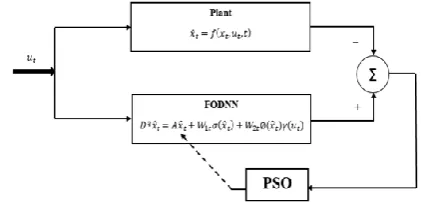
u R are state vector and input vector, respectively. The identified model can be described as (4). The block diagram of the identification process is shown in Figure 1.
Figure 1. The block diagram of the identification process
The ssed fitness function in this paper is defined as:
21
ˆ , 1 N
k k
k
F x x
N
(14)where xk and xˆk are the real and estimated states of the system at each moment respectively; N is the
number of data used for the identification. The PSO algorithm tries to minimize F .
3. 2. Identification Process The learning rule to update weights of the FODNN is given as [5]:
1 1
2 2
ˆ ,
ˆ .
T
t t t
T T
t t t t
W K Px x
W K Px u x
(15)
where xt is the identification error and P is a symmetric positive definite matrix.
Generally, the identification process can also be formulated as an optimization problem. The main step of the optimization process is to encode the proposed method into individuals or a population of certain solutions. In this research, a solution is feasible if it can determine the order, the step size of the PC approach, and the parameters including FODNN weights and initial values; therefore, each individual is divided into four parts. Figure 2 shows the encoding of the individual. Part A indicates the unknown fractional order of the FODNN model and the length of Part A equals 1, assuming that the model is commensurate. Part B denotes the unknown step size of the PC algorithm; the length of Part B is 1. Part C represents the initial values of the states, and the length of Part C is to equal n, same as the dimension size of the system. Part D shows the initial values of the weights of the FODNN model, which is 2n2based on the defined dimension; that is ,n2for W10and n2 for W20 . Therefore, the dimension size of the individual 2
2n n 2and the solution space is 2
2n n 2 dimensional.
Figure 2. Encoding of the individual in the PSO algorithm
4. EXPERIMENTS and ANALYSIS of RESULTS
In this section, we perform the experiments for identification of 2500 kW wind turbine operating in Kahak wind farm, Qazvin province, Iran.
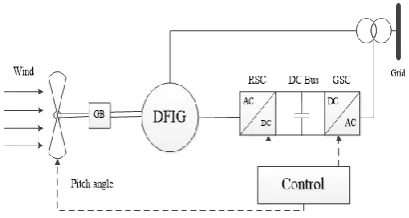
4. 1. Wind Turbine The wind turbine generator used in this paper is a 2500 kW complex wind turbine. It includes many mechanical and electrical components like aero dynamic turbine, a complicated gear box, a DFIG type generator, electronic interfaces, and on top of all the wind dynamic. The wind speed is random and changes very quickly over the time. The complicated behavior of the whole wind turbine and the inaccuracy of the simple methods motivated us to employ a FODNN for identification of this plant. Its schematic is shown in Figure 3.
4. 2. Setting Known Parameters of FODNN and PSO To investigate the proposed scheme performance about the wind turbine identification, first, we should select some of the known parameters of FODNN. Clearly, these parameters must satisfy some of the assumptions in Section 2-2 to guarantee that the identification error remains bounded. Therefore, the activation functions are selected as sigmoid functions and the diagonal matrix A is selected in such a way that is Hurwitz. Also K1 and K2can be any positive matrix.
( 15 )
( 2 )
3 2 1
( ) 15 / (1 ) 0.5,
( ) 2 / (1 ) 0.05,
100 0 0
0 100 0 ,
0 0 100
10 .
i
i x i
x i
x e
x e
A
K K I
(16)
The fractional order, the PC algorithm step size, and initial values are assumed to be unknown during the identification, and their optimal values are achieved by the PSO algorithm.
We consider the value of fractional order within
[0,1] according to (4), and the step size value of the PC
algorithm is within [10 ,10 ]6 4 . The weights initial
values and states initial values are within [0,1] as all of
Figure 3. The wind turbine with DFIG
the data are normalized during the identification process. The PSO parameters are: the inertia weight which decreases from 1 to 0.4, the cognitive and social
learning rate c12 and c2 2[46]. The
initialpopulation is considered 40 and the PSO algorithm is stopped after 100 iterations.
4. 3. Simulation Results The Kahak wind turbine identification via the proposed structure has been performed using Matlab/Simulink and Python. The wind speed and pitch angle were used as FODNN input data. The generator speed and wind turbine power were used as the target for identification. The experimental data gathered with a sampling rate of one second. The proposed procedure of identification is summarized as follows:
Step 1: the individual’s bits are initialized based on pre-defined intervals.
Step 2: the FODNN is trained with experimental data using (11), then the fitness function is calculated. Step 3: the velocity and position particles, and the PSO algorithm memory are updated.
Step 4: if the termination conditions are fulfilled then the most suitable fitness function will be selected as the optimal solution. Otherwise, back to Step 2.
The convergence graph of the fitness function (14) of the proposed FODNN along with the PSO algorithm are shown in Figure 4.The results of the identification process are presented in Figure 5. In this figure, the speed of generator and the power, following the FODNN and the IODNN model, are zoomed for a time interval. Then the value of the fitness function is calculated for the IODNN and the proposed FODNN. The value of fitness function (14) is calculated for all of the methods in the time literature. The results are given in Table 1.
Figure 4. Convergence process of the proposed method using PSO algorithm with the experimental data
Figure 5. Simulation results of the wind turbine by the proposed model and the IODNN model
TABLE 1. Fitness function for identification methods of wind turbine.
Identification Method
Proposed identifier
FODNN in literature[14]
IODNN in literature[12]
Fitness Function 0.005 0.012 0.2
5. CONCLUSION
In this paper, the FODNN optimized with the PSO algorithm has been presented. The proposed structure can be used to accurately model systems with complicated nature, that’s why a wind turbine has been selected as a case study. Then some of the parameters of FODNN and PSO algorithm are initialized and the optimal value of other parameters are found in the next steps. As a database, data of 2500 kW wind turbine operating in KAHAK wind farm with a sampling rate of one second are collected and an accurate fractional order nonlinear model is identified for it without prior knowledge of system parameters. The inputs are considered wind speed and pitch angle. The generator speed and power are used as target outputs. By comparing simulation results with real data and the IODNN model, we show the proposed scheme is very
effective in process modeling. It has been demonstrated that a FODNN model optimized via the PSO approach is a valuable tool that produces best results compared to an integer order model.
5. REFERENCES
1. Xu, B., Chen, D., Zhang, H., Wang, F., Zhang, X. and Wu, Y., "Hamiltonian model and dynamic analyses for a hydro-turbine governing system with fractional item and time-lag", Communications in Nonlinear Science and Numerical Simulation, Vol. 47, No., (2017), 35-47.
2. Magin, R.L., "Fractional calculus models of complex dynamics in biological tissues", Computers & Mathematics with Applications, Vol. 59, No. 5, (2010), 1586-1593.
3. Pintelon, R., Schoukens, J., Pauwels, L. and Van Gheem, E., "Diffusion systems: Stability, modeling, and identification", IEEE Transactions on Instrumentation and Measurement, Vol. 54, No. 5, (2005), 2061-2067.
4. Soczkiewicz, E., "Application of fractional calculus in the theory of viscoelasticity", Molecular and Quantum Acoustics, Vol. 23, No., (2002), 397-404.
5. Aslipour, Z. and Yazdizadeh, A., "Identification of damavand tokamak using fractional order dynamic neural network", Transactions of the Institute of Measurement and Control, Vol., No., (2018), 0142331218784108.
6. Fateh, M., Ahmadi, S.M. and Khorashadizadeh, S., "Adaptive rbf network control for robot manipulators", Journal of AI and Data Mining, Vol. 2, No. 2, (2014), 159-166.
7. Yazdizadeh, A. and Khorasani, K., "Adaptive time delay neural network structures for nonlinear system identification", Neurocomputing, Vol. 47, No. 1–4, (2002), 207-240.
8. Goleijani, S. and Ameli, M.T., "Neural network-based power system dynamic state estimation using hybrid data from scada and phasor measurement units", International Transactions on Electrical Energy Systems, Vol. 28, No. 2, (2018), e2481. 9. Albertini, F. and Sontag, E.D., "State observability in recurrent
neural networks", Systems & Control Letters, Vol. 22, No. 4, (1994), 235-244.
10. Rovithakis, G.A. and Christodoulou, M.A., "Adaptive control of unknown plants using dynamical neural networks", IEEE Transactions on Systems, Man and Cybernetics, Vol. 24, No. 3, (1994), 400-412.
11. Poznyak, A. and Sanchez, E., "Nonlinear system approximation by neural networks: Error stability analysis", Intelligent Automation & Soft Computing, Vol. 1, No. 3, (1995), 247-257. 12. Poznyak, A., Sanchez, E. and Yu, W., "Differential neural networks for robust nonlinear control: Identification, state estimation and trajectory tracking, Singapore, World Scientific, (2001).
13. Nejadmorad Moghanloo, F., Yazdizadeh, A. and Pouresmael Janbaz Fomani, A., A new modified elman neural network with stable learning algorithms for identification of nonlinear systems, in Computer and Information Science, R. Lee, Editor. 2015, Springer International Publishing: Cham.171-193. 14. Boroomand, A. and Menhaj, M., Fractional-order hopfield
neural networks, in Advances in Neuro-information Processing, M. Köppen, N. Kasabov, and G. Coghill, Editors. 2009, Springer Berlin Heidelberg.883-890.
16. Matsuzaki, T. and Nakagawa, M., "A chaos neuron model with fractional differential equation", Journal of the Physical Society of Japan, Vol. 72, No. 10, (2003), 2678-2684.
17. Arena, P., Fortuna, L. and Porto, D., "Chaotic behavior in noninteger-order cellular neural networks", Physical Review E, Vol. 61, No. 1, (2000), 776-781.
18. Huang, C.-d., Cao, J.-d., Xiao, M., Alsaedi, A., Alsaadi, F.E. and Hayat, T., "Dynamical analysis of a tri-neuron fractional network", Asian Journal of Control, Vol., No., (2017). 19. Liu, P., Zeng, Z. and Wang, J., "Multiple mittag leffler stability
of fractional-order recurrent neural networks", IEEE Transactions on Systems, Man, and Cybernetics: Systems, Vol. 47, No. 8, (2017), 2279-2288.
20. Wu, A. and Zeng, Z., "Global mittag leffler stabilization of fractional-order memristive neural networks", IEEE Transactions on Neural Networks and Learning Systems, Vol. 28, No. 1, (2017), 206-217.
21. Wu, H., Wang, L., Niu, P. and Wang, Y., "Global projective synchronization in finite time of nonidentical fractional-order neural networks based on sliding mode control strategy", Neurocomputing, Vol. 235, No., (2017), 264-273.
22. Zhang, S., Yu, Y. and Hu, W., "Robust stability analysis of fractional-order hopfield neural networks with parameter uncertainties", Mathematical Problems in Engineering, Vol., No., (2014).
23. Le Lay, L., "Identification fréquentielle et temporelle par modèle non entier", (1998),
24. Lin, J., "Modélisation et identification des systèmes d'ordre non entier", Université de Poitiers. UFR des sciences fondamentales et appliquées, (2001),
25. Cois, O., "Systèmes linéaires non entiers et identification par modèle non entier: Application en thermique", PhD Thesis, University ofBordeaux 1, (2002),
26. Aoun, M., "Systemes linéaires non entiers et identification par bases orthogonales non entieres", PhD Thesis, University of Bordeaux 1, (2005),
27. Tepljakov, A., Fractional-order modeling and control of dynamic systems, Springer, (2017).
28. Cui, R., Sheng, D., Wei, Y. and Wang, Y., "Modulating function-based subspace identification for continuous-time fractional order systems", in 32nd Youth Academic Annual Conference of Chinese Association of Automation (YAC), Hefei, China. Vol., No. Issue, (2017), 618-623.
29. Hu, Y., Fan, Y., Wei, Y., Wang, Y. and Liang, Q., "Subspace-based continuous-time identification of fractional order systems from non-uniformly sampled data", International Journal of Systems Science, Vol. 47, No. 1, (2016), 122-134.
30. Du, W., Miao, Q., Tong, L. and Tang, Y., "Identification of fractional-order systems with unknown initial values and structure", Physics Letters A, Vol. 381, No. 23, (2017), 1943-1949.
31. González-Olvera, M.A., Tang, Y. and Navarro-Guerrero, G., "Fractional order system identification by a genetic algorithm", in Memorias del Congreso Nacional de Control Automático 2015, Cuernavaca, Morelos. Vol., No. Issue, (2015), 304-308.
32. Rahmani, M.-R. and Farrokhi, M., "Nonlinear dynamic system identification using neuro-fractional-order hammerstein model", Transactions of the Institute of Measurement and Control, Vol. 40, No. 13, (2018), 3872-3883.
33. Rahmani, M.-R. and Farrokhi, M., "Identification of neuro-fractional hammerstein systems: A hybrid frequency-/time-domain approach", Soft Computing, Vol., No., (2017). 34. Sierociuk, D., Sarwas, G. and Dzieliński, A., "Discrete fractional
order artificial neural network", acta mechanica et automatica, Vol. Vol. 5, no. 2 No., (2011), 128-132
35. Sierociuk, D. and Petras, I., "Modeling of heat transfer process by using discrete fractional-order neural networks", in 16th International Conference on Methods and Models in Automation and Robotics (MMAR). Vol., No. Issue, (2011), 146-150. 36. Benoit-Marand, F., Signac, L., Poinot, T. and Trigeassou, J.-C.,
"Identification of nonlinear fractional systems using continuous time neural networks", in lFAC Workshop on Fractional Differentiation and its Applications, The Institute of Engineering of Porto (ISEP), Portugal. Vol. 2, No. Issue, (2006 of Conference), 402-407.
37. Boroomand, A. and Menhaj, M.B., "On-line nonlinear systems identification of coupled tanks via fractional differential neural networks", in Chinese Control and Decision Conference (CCDC '09), Guilin, China. Vol., No. Issue, (2009), 2185-2189. 38. Boroomand, A. and Menhaj, M.B., "Fractional-based approach
in neural networks for identification problem", in Chinese Control and Decision Conference (CCDC '09) Guilin, China. Vol., No. Issue, (2009), 2319-2322.
39. Ata, R., "Artificial neural networks applications in wind energy systems: A review", Renewable and Sustainable Energy Reviews, Vol. 49, No., (2015), 534-562.
40. Kennedy, J. and Eberhart, R., "Particle swarm optimization", in Proceedings of IEEE International Conference on Neural Networks, Vol. 4, No. Issue, (1995), 1942-1948
41. Asgari, S. and Yazdizadeh, A., "Robust model-based fault diagnosis of mechanical drive train in v47/660 kw wind turbine", Energy Systems, Vol. 9, No. 4, (2018), 921-952. 42. Diethelm, K., The analysis of fractional differential equations,
Lecture notes in mathematics Springer, (2010).
43. Diethelm, K., Ford, N. and Freed, A., "A predictor-corrector approach for the numerical solution of fractional differential equations", Nonlinear Dynamics, Vol. 29, No. 1-4, (2002), 3-22.
44. Gholipour, R., Khosravi, A. and Mojallali, H., "Suppression of chaotic behavior in duffing-holmes system using back-stepping controller optimized by unified particle swarm optimization algorithm", International Journal of Engineering Vol. 26, No. 11, (2013), 1299-1306.
45. Fateh, M.M. and Khorashadizadeh, S., "Optimal robust voltage control of electrically driven robot manipulators", Nonlinear Dynamics, Vol. 70, No. 2, (2012), 1445-1458.
Identification of Wind Turbine using Fractional Order Dynamic Neural Network and
Optimization Algorithm
Z. Aslipour, A. Yazdizadeh
Department of Electrical Egineering, Shahid Beheshti University, Tehran, Iran
P A P E R I N F O
Paper history: Received 06 October 2019
Received in revised form 30 November 2017 Accepted 16 Januray 2020
Keywords:
Dynamic Neural Network Fractional Order System Identification Particle Swarm Optimization Wind Energy System
هدیکچ
،هلاقم نیا رد یداب نیبروت ییاسانش یارب دمآراک رازبا کی
2500 نیوزق ناتسا رد کهک یداب هعرزم رد عقاو تاوولیک
یرسک هبترم یکیمانید یبصع هکبش زا هدافتسا اب ،تسا داب راتفر اب طبترم هک هدیچیپ متسیس نیا .تسا هدش یفرعم (
FODNN
هک ) متیروگلا اب یم هنیهب یتابساحم یاه یم ییاسانش ،دوش
زا یخرب هنیهب ریداقم ،یداهنشیپ شور رد .ددرگ
یاهرتماراپ
FODNN
یم لوهجم هک یم نییعت تارذ ماحدزا متیروگلا هلیسو هب دنشاب
متسیس ،لکش نیا هب و ددرگ
یم ییاسانش لااب تقد اب و لماک تروص هب یرسک هبترم یطخریغ .ددرگ
ا رد لااب درکلمع هب یبایتسد یارب اهرتماراپ نی
رگاسانش
FODNN
یم رثؤم رایسب نزو هیلوا ریداقم ،یرسک هبترم لماش و دنشاب
تلاح و اه یاه
FODNN
ینامز ماگ و
هب یددع متیروگلا هتفرگراک
هیبش جیاتن .تسا یرسک هبترم لیسنارفید هلداعم لح یارب هدش داهنشیپ متیروگلا ییاراک یزاس
ی
یم ناشن حیحص هبترم یکیمانید یبصع هکبش اب هسیاقم رد تقد صخاش بسح رب ار .دهد
doi: 10.5829/ije.2020.33.02b.12