Journal of Industrial Engineering and Management Studies
Vol. 6, No. 2, 2019, pp. 78-102 DOI: 10.22116/JIEMS.2019.92259
www.jiems.icms.ac.ir
A new approach for solving fuzzy multi-objective quadratic
programming of water resource allocation problem
Seyed Hadi Nasseri1, Abdollah Baghban1,*, Iraj Mahdavi2
Abstract
This paper describes an application of fuzzy multi-objective quadratic model with flexible constraints for optimal allocation of limited available water resources among different water-user sectors. Due to the fact that, water resource allocation problem is one of the practical and essential subjects in real world and many of the parameters may be faced by uncertainty. In this paper, we present α - cut approach for transforming fuzzy multi-objective quadratic programming model with flexible constraints into a crisp form. By using this approach a multi-parametric multi-objective programming model corresponding to α and parameters of flexible constraints is obtained. One of the advantages of this model is that the α - cut level is not determined by the decision makers. Actually, this model itself can calculate the α - cut level. In order to achieve a desired Pareto optimal value of multi-parametric multi-objective model, we use goal programming method for illustration of water resource allocation with sensitivity analysis of lower bound of parameters in flexible constraints. To illustrate the efficiency of the proposed approach, we apply it for a real case problem of water resource allocation.
Keywords: Fuzzy multi-objective quadratic programming; Water resource allocation; Flexible constraints; α- cut approach; Sensitivity analysis.
Received: November 2018-20 Revised: February 2019-08 Accepted: February 2019-16
1. Introduction
Today, one of the most important issues for humans is access to fresh and clean water. As long as water demand is less than available, we are not facing the problem of allocating water resources. But with the growing population, development of industry and expansion of agriculture in arid and semi-arid areas, safe water supply has become one of the main challenges of the present century. Achieving a relative balance in the supply and use of water is a fundamental principle which is achieved through establishment of a comprehensive water management system. Therefore, scientists emphasize on the management of optimal water resources allocation (Archibald and Marshall, 2018). Actually, efficiently allocation of limited water resources is a critical problem for managers (Brown, Cochrane and Krom,
* Corresponding author; [email protected]
2010). Generally, maximizing the net economic benefit is a common objective for water resources allocation. However, water shortage has not been fully considered, thereby affecting the results of optimal water resource allocation. So, how to allocate optimal water from limited resources with the goal of increasing net economic benefit and reducing the water shortage is one of the most important problems that need to be solved (Wang, Zhang and Guo, 2018).
The development and application of mathematical science enable managers to formulate water resource allocation problems as mathematical optimization models. For example: Roozbahani et al. (Roozbahani, Schreider and Abbasi, 2013) modeled the problem of optimal water resource allocation to the agricultural sector in Sefidrood Basin in northern Iran as a linear programming model with net economic benefit objective. Babel et al. (Babel, Das Gupta and Nayak, 2005) modeled a bi-objective programming to optimal water resource allocation problem. In this model, two objectives are considered as maximizing the level of satisfaction and maximizing the net economic benefit. In solving this model, they used the weighted sum method to transform the multi-objective programming into single objective programming. Also, Rojanee Khummongkol et al. (Khummongkol, Sutivong and Kuntanakulwong, 2007) proposed an integrated multi-objective programming model for optimal water resource allocation to three main sectors: agricultural, domestic and industrial sector areas in the Rayong Province of Thailand. In this model, two objective functions are considered for maximizing net economic benefit and minimizing water shortage. They used a weighted sum method to solve his multi-objective programming model. Ijaz Ahmad et al. (Ijaz and Deshan, 2016) developed a deterministic water resource allocation model to optimally allocate limited available water resources among different water-use sectors. This model applied to the Hingol River basin in the Baluchistan Province of Pakistan. Two objective functions of the problem include maximizing the level of satisfaction and maximizing net economic benefit. They used of weighted sum method to solve multi-objective programming model.
In real world practical problems, since it's impossible to have access to complete and accurate information, uncertainty is considered as a very important factor in the water resource allocation. For example, Climate change, seasonal variations, water quality, demand, unexpected events, and so on (Archibald and Marshall, 2018). Hence, using uncertain parameters in these situations helps the associated manager to obtain more reasonable and realistic solutions. Hang Wang et al. (Wang, Zhang and Guo, 2018) developed an interval quadratic fuzzy dependent-chance programming model for optimal irrigation water allocation under uncertainty in the Minqin Oasis, the Wuwei city, northwest China with credibility level of the system revenue objective. Hamideh Hosseini Safa et al. (Hosseini Safa, Morid and Moghaddasi, 2012) presented a methodology that combine the uncertainty of both river flow forecasting and economic parameters for agricultural water allocation.
It is necessary to differentiate between flexibility in constraints and goal and uncertainty of the data. Flexibility is modeled by fuzzy sets and may reflect the fact that constraints or goal are
linguistically formulated. Their satisfaction is a matter of tolerance and degrees or fuzziness (Bellman and Zadeh, 1970). On the other hand, there is ambiguity corresponding to an objective variability in the model parameters (Randomness), or a lack of knowledge of the parameter values (epistemic uncertainty). Randomness originates from the random nature of events and it is about uncertainty regarding to the membership or non-membership of an element in a set. Epistemic uncertainty deals with ill-known parameters modeled by fuzzy intervals in the setting of possibility theory (Dubois, 1980; Zadeh, 1987). Also, Verdegay (Verdegay, 1982) proposed a parametric linear programming model with single parameter using α -cuts to achieve an equivalent model for the fuzzy linear programming with flexible constraints. Then he used duality results to solve the original fuzzy linear programming (Verdegay, 1984). Werner’s in (Werner’s, 1987) introduced an interactive multiple objective programming model subject to its constraint are flexible and proposed a special approach for solving multiple objective programming model basing on fuzzy sets theory. In the mentioned work, the classical model is extended by integration flexible constraints. After that, Delgado et al. (Delgado, Verdegay and Vila, 1989) a general model for fuzzy linear programming problem proposed. In particular, they suggested a resolution method for the mentioned problem. Campos et al. (Compose and Verdegay, 1989) considered a linear programming problem with fuzzy constraints including fuzzy coefficients in both matrix and right hand side. They dealt with an auxiliary model resulting from the embedding constraints in the main model. After that, Nasseri et al. (Nasseri and Ebrahimnejad, 2010) introduced an equivalent fuzzy linear model for the flexible linear programming problems and proposed a fuzzy primal Simplex algorithm to solve these problems.
In this paper, we present an approach based on α - cut for a fuzzy multi-objective quadratic programming model with flexible constraints. Using α - cut for each fuzzy parameters in objective functions, we transform these parameters into an interval number corresponding to
α. Then, fuzzy parameters are replaced with a convex linear combination of its corresponding interval. Also, each flexible constraint is replaced with a deterministic constraint, which some new parameters depend on. Furthermore, a multi-parametric multi-objective programming model is obtained. We propose goal programming method for solving this model. Finally, to illustrate the efficiency of the proposed method, we apply this method to the water resource allocation problem.
The main advantage of the proposed approach is flexibility in the obtained optimal solution so that it is associated to the minimum degree membership of the flexibility of the constraints. Also, the model is eligible to determine the optimal values of α - cut levels and convex linear combination coefficients in the fuzzy parameters of the objective functions, itself.
2. Preliminaries
In this section, we state some notions related to the considered problem. This following concept can be found in (Mansoori, Effati and Eshaghnezhad, 2018).
Definition 2.1 (Fuzzy set). Let X represents the universal set. Thus, the membership function of a fuzzy set Ais defined as A:X [0,1].
To each member of x X , the membership function A( )x attributes a real number in the range [0,1]and showing the membership degree of the member x in the set A. Each fuzzy set A with the membership function A( )x can be shown as A
x,A
x
x X
. We show the set of all fuzzy numbers with E1.Definition 2.2 (normal fuzzy set): The fuzzy set Ais normal if we have for at least one x X , A
x 1.Definition 2.3 (convex fuzzy set): A fuzzy set A is called convex if and only if for each
1, 2
x x X and
0,1 , we have A
x1
1
x2
minA
x1 ,A
x2 .Definition 2.4 (𝜶-cut set): For each [0,1], 𝛼 -cut set from a fuzzy set Ais defined as A
with components x so that the values of the membership function A( )x are not lower than
𝛼, which means A
x A
x
.Definition 2.5 (fuzzy number): A fuzzy number is a normal and convex fuzzy set whose membership function is continuous in fragmentation. Indeed, a fuzzy number A is a fuzzy set on the real numbers line, so that its membership function i.e. A( )x , with conditions
1 2 3 4
a a a a
has the following features:
1
1 2
2 3
3 4
4
0, , ( ) 1,
, 0,
L
A
R
x a
x a x a
x a x a
x a x a
x a
(1)
Where, L
x :a a1, 2
0,1 is an increasing and continuous function and
3 4
: , 0,1
R x a a
is a decreasing and continuous function.
Definition 2.6 (Trapezoidal Fuzzy Numbers): Each trapezoidal fuzzy number can be represented by quadruple A
a a a a1, 2, 3, 4
so that its membership function is defined as1 1
1 2
2 1
2 3
4
3 4
4 3
4 0,
,
( ) 1, (2)
,
0,
A
x a
x a
a x a
a a
x a x a
a x
a x a
a a
x a
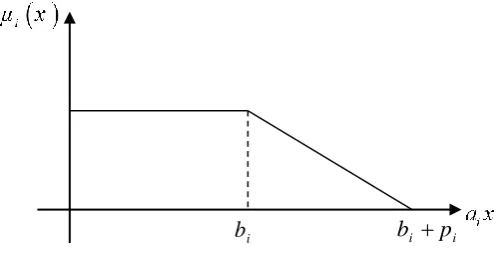
The schema of a trapezoidal fuzzy number defined in (2) is shown in Figure 1.
Figure 1. The schema of a trapezoidal fuzzy number defined in the Definition 2.6
According to Definition 2.4, the 𝛼-cut set for a trapezoidal fuzzy number
1 2 3 4
, , ,
A a a a a
can be shown with the following interval:
,
L U
A a a (3)
where,
1 1 2 1
L x a
a
a a
and
1 4
4 3
U a x
a
a a
. We note that by considering a2 a3,
the trapezoidal fuzzy number Awill change into a triangular fuzzy number; and if a1a2and
3 4
a a , to an interval number; and if a1 a2 a3a4, into a definite real number, which is a special case of a trapezoidal fuzzy number.
Definition 2.7 (arithmetic operations on 𝜶-cut sets): we assume that A aL,aU and
,
L U
B b b are 𝛼-cut set of two fuzzy numbers AandB, respectively. The symmetry of
the fuzzy number A is the fuzzy number A . Thus, if A a aL, U then
,
U L
A a a
and,
1. kA min kaL,kaU , max kaL,kaU , k ,
2. AB aL bL,aU bU,
3. AB aL bU,aU bL,
4. AB ab L, ab U
,
Where,
ab L min
a b U L,a b U U,a b L L,a b L U
and
ab U max
a b U L,a b U U,a b L L,a b L U
., ,
L U L U
a a b b
if and only if aL bL,aU bU.
Definition 2.8 (flexible linear constraint): Consider a DM faced with a programming problem with linear constraints in which he /she can endure violation in completion at the constraints, that is he /she allow the constraints to be hold as well as possible. For each constraints in the constraints set, this assumption can be denoted by flexible linear constraint
F
i i
a x b and for eachi 1, 2,...,m modeled by use of a membership function:
1, , 0,
i i
i i i i i i
i i i
a x b μ x f x b a x b p
a x b p
(4)
Where, fi
. is strictly decreasing and continuous for a xi , fi
bi 1 and fi
bi pi
0. The figure of the membership function defined in (4)is shown in Figure 2.Figure 2. The figure of the membership function defined in (4)
This membership function expresses that the DM tolerates violation in the accomplishment of the constraints i up the value bi pi. The function μ xi
gives the degree of satisfaction of the i -th constrains for x n.3. Fuzzy multi-objective quadratic programming model with flexible
constraint
Consider a Fuzzy Multi-objective Quadratic Programming Model (FMOQPM) with flexible constraints as follow:
1 2
1
min , ,..., , , 1, 2,..., ,
. . , 1, 2,..., ,
0,
T T
K k k k
n
F ij j i j
F x F x F x F x x Q x C x k K
s t a x b i m
x
(5)Where,
1, 2,...,
T n
x x x x is a n-dimensional decision variable, each Qk qijk n n ,
1, 2,...,
k K are fuzzy n n - dimensional positive definite hessian matrix in the k -th objective function and
1 2
, ,..., n
k k k k
C c c c , k 1, 2,...,K are n- dimensional linear section of objective function with fuzzy components. Also, A aij m n is a real m n -dimensional
i
matrix of technical coefficients. The notation
F represents a fuzzy extension of
on real line which is applied to compare the left side of fuzzy constraints with the right hand side (Nasseri and Ramzannia-Keshteli, 2018) .In general, model (5) in not well-defined due to the following reasons: 1. The constraints
1
n
F
ij j i
j
a x b
, i 1, 2,...,m do not result in a deterministic feasible set. 2. Due to the existence of fuzzy values in each objective functionsFk
x ,k 1, 2,...,K , there is no deterministic objective space.If we want to define a deterministic feasible set, an idea is to provide confidence level βi at which it is desired that the corresponding i -th fuzzy constraint hold. Therefore, in order to remove the first mentioned restriction, the following model can be introduced.
1 2
1
min , ,..., ,
. . , 1, 2,..., ,
0, , 0 1, 1, 2,...,
K
n
F
i ij j i i
j
D
i i i
F x F x F x
s t μ a x b β i m
x β β β i m
(6)To drive for a meaningful choice of membership function for each fuzzy constraint, it is disputed that if
1
n
ij j i j
a x b
, then i -th constraint is fully satisfied. If1
n
i j j i i
j
a x b p
,where pi is the predefined maximum tolerance from zero as determined by the DM, then the i -th constraint is perfectly violated. For
1
,
n
ij j i i i
j
a x b b p
, the membership function ismonotonically decreasing. If this decrease is along with a linear function then it is sensible to select the membership function of the i -th constraint as:
1,
, 0,
i i
i i i
i i i i i
i
i i i
a x b b p a x
μ x b a x b p
p
a x b p
(7)
We rewrite the model (6) as follows:
1 2
min , ,..., ,
. . 1 , 1, 2,..., ,
0, , 0 1, 1, 2,...,
K
i i i i
D
i i i
F x F x F x
s t a x b p β i m
x β β β i m
(8)
Now, we are going to give the concept of feasible solution to the fuzzy multi-objective quadratic programming model in form (8).
Definition 3.1. Let β
β β1, 2,...,βm
0,1mbe a vector, and
n| 0, 1 , D, 1, 2,...,
β i i i i i i
A vector x Xβis called β - feasible solution to the model (8).
Following proposition allows us to define the feasible set for the model (8) as an intersection of all β -cutcorresponding to flexible constraints.
Proposition 3.1. Let β
β β1, 2,...,βm
0,1m then1
i
m i
β β
i
X X
, where
| 0, 1 ,
i
i n D
β i i i i i i
X x x a x b p β β β (10) For i 1, 2,...,m. Actually,
i
i β
X is the βi -cut of the i -th fuzzy constraint.
Proof. For any
1, 2,...,
0,1m m
β β β β , let x Xβ , therefor βi βiDand
1
i i i i
a x b p β . Now from (10), we have
i
i β
x X ,i 1, 2,...,m.Therefor,
1
i
m i β i
x X
.
On the other hand, if
1
i
m i β i
x X
, we have
i
i β
x X for all i 1, 2,...,m.Therefor,
1
i i i i
a x b p β ,βi βiD and x 0. Hence, x Xβ .
Proposition 3.2. Let β
β β1 , 2,...,βm
and β
β β1 , 2,...,βm
, where βiβi for all1, 2,...,
i m then β-feasibility of x implies the β-feasibility of it.
Proof. Let x X β is a β- feasible solution of the model (8). We have x 0,
1
i i i i
a x b p β and βi βiD for i 1, 2,...,m. from βiβi, we have
1
i i i i
a x b p β and βi βiD. So, x Xβ.
Remark 3.1. If the model (6) is not infeasible then Xβ is not empty. Proof. For a given β
0,1 , let nx be a β - feasible solution to (8) (a solution with the same degrees of satisfaction in all of constraints). This means that x satisfy the equations
1
i i i i
a x b p β , 0βi 1, βi βiDand x 0 or equivalently, x Xβ.
3.1. Proposed approach
In order to overcome the second mentioned restriction in model (5), we present a new approach based on the definition of α - cut for a fuzzy number. Definition 3.2 (Panigrahi, Panda and Nanda, 2008). Suppose F: n E1is a fuzzy function where is an open subset of n. The 𝛼-cut set F at u is shown as
( , ) ,L
,
UF u f u f u that is a closed and bounded interval. Here, f u( , ) L and ( , )U
Theorem 3.1. A fuzzy function F C: E1 defined on a convex subset C in is convex, if and only if, F
1
x y
1
F x F y
for every x and y in C and
0,1 . A fuzzy function F C: E1 defined on a convex subset C in is called strictly convex if
1
1
F x y F x F y for each
0,1 and for every x and y in C such that x y (Wang and Wu, 2003).Theorem 3.2. Suppose that C is a convex subset in and 1 :
F C E is a fuzzy function then F is convex if and only if for each given
0,1 ,
f
x
Land
f
x
U are convex functions in x (Wang and Wu, 2003).Proof. See (Wang and Wu, 2003).
Using the concept of the -cut in Definition 2.4, Definition 2.6 and Definition 3.2, for each fuzzy objective function in the model (5), we have:
k
L,
k
U T
k αL, k αU T
k αL, k Uα , 1, 2,...,α α
f x f x x q q x x c c k K
(11)
Where,
k Lα
ijk Lα n n
q q ,
U U kk α ij α
n n
q q
,
1L
L i
k α k α
n
c c
,
1U
U i
k α k α
n c c and,
, 1, 2,..., , 1, 2,...,
L T L T L
k α k α k α
U T U T U
k α k α k α
f x x q x x c k K
f x x q x x c k K
(12)
In equations (12), the values of
k
Lα
f x and
k
Uα
f x are called the optimistic and pessimistic values for each objective function Fk
x , respectively.Remark 3.2. In the objective function of the maximizing type, conversely minimization type, the values of
fk
x
αL and
U
k α
f x are called the pessimistic and optimistic values for each objective function Fk
x , respectively.By placing equations (11) and (12) in the model (8), we have:
1 1 2 2
min , , , ,..., , ,
. . 1 , 1, 2,..., ,
0, , 0 1, 1, 2,...,
L U L U L U
K K
α α α α α α
i i i i
D
i i i
f x f x f x f x f x f x
s t a x b p β i m
x β β β i m
(13)
We consider a convex linear combination from
fk( )x
L and
fk( )x
U for each1, 2,...,
1 1 2 2
min , , , , , ,..., , , ,
. . , , 1 , 1, 2,..., ,
1 , 1, 2,..., ,
0, , 0 1, 1, 2,..., ,
0 1, 1, 2,..., .
K K
L U
k k k k α k k α
i i i i
D
i i i
k
f x α t f x α t f x α t
s t f x α t t f x t f x k K
a x b p β i m
x β β β i m
t k K
(14)
We identify the model (14) as Multi-Parametric Multi-objective Programming Model (MPMOPM).
Actually, determining the amount of and linear combination coefficients will be responsibility of the model and will be considered as a decision variable in the model.
In the next, we are going to give the concept of efficient solution to the MPMOPM in form (14).
Proposition 3.3. If x X be a β - feasible solution to the model (5), then there are at least one
0,1 and t
0,1K such that
x α t, ,
n K 1is a β - feasible solution to the model (14) and
x α t, ,
Xβ.Proof. It is clear.
Definition 3.3.The β - feasible solution
x α t, ,
n
0,1K1 is called a weakly efficient solution for the model (14) if there is no β- feasible solution
x α tˆ, ,ˆ ˆ
n
0,1K1, so that for each k 1, 2,...,K , fk
x α tˆ, ,ˆ ˆk
fk
x α t, , k
. Additionally, if there is no
ˆ
1ˆ
ˆ, , n 0,1K
x α t , so that for each k 1, 2,...,K , fk
x α tˆ, ,ˆ ˆk
fk
x α t, , k
, then
x α t, ,
is called an efficient solution to the model (14).Pay attention that any efficient solution to the model (14) is an efficient solution to the model (5). In the following theorem, we represent the necessary and sufficient condition for an efficient solution to the model (5).
Theorem 3.3. Let
1, 2,...,
0,1m T
m
β β β β , and x X be a β - feasible solution to the model (5). Then, x is an efficient solution to the model (5), if and only if there is at least one
0,1 and t
0,1Ksuch that
x α t, ,
be an efficient solution to the model (14).Proof. Assume that x X is an efficient solution to the model (5), then for all xˆX concludes that Fk
x Fk
xˆ for any k 1, 2,...,K . According to equation (12), for any
ˆ, 0,1
and k 1, 2,...,K , Fk
x
fk
x
αL,
fk
x
Uα and
ˆ
ˆ
Lˆ,
ˆ
Uˆk k α k α
F x f x f x
. So,
,
ˆ
ˆ,
ˆ
ˆL U L U
k α k α k α k α
f x f x f x f x
L
1
U ˆ
ˆ
Lˆ
1 ˆ
ˆ
Uˆk α k α k α k α
t f x t f x t f x t f x
Then fk
x α t, ,
fk
x α tˆ, ,ˆ ˆ
for all k 1, 2,...,K . That's mean
x α t, ,
is an efficient solution to the model (14).On the contrary, assume that
x α t, ,
is an efficient solution to the model (14). According to Definition 3.3, for each k 1, 2,...,K and
x α tˆ, ,ˆ ˆ
Xβ, we have:
ˆ, ,ˆ ˆ
, ,
k k k k
f x α t f x α t . Then,
L
1
U ˆ
ˆ
Lˆ
1 ˆ
ˆ
Uˆk α k α k α k α
t f x t f x t f x t f x
Since, according to equation (12), for all k 1, 2,...,K , k
k
L,
k
Uα α
F x f x f x
and k
ˆ
k
ˆ
Lˆ,
k
ˆ
Uˆα α
F x f x f x
, hence Fk
x Fk
xˆ . That's mean x is an efficientsolution to the model (5).
In Theorem 3.3, we have provided a computational method to solve multi-objective quadratic programming with flexible linear constraint (5). Thus by assigning a specific β by DM, we may replace the βi in the corresponding constraint of (14), and solve the resulted model to compute the efficient solution to the model (14). An efficient solution to (14) has three characteristics:
1. The solution has various satisfaction degrees corresponding to each constraint. 2. The acquired solution is efficient solution to the model (5).
3. The amount of α for computing α -cut of fuzzy values in the model is obtained by solving model, without judgment of the DMs.
This solution permits DM to obtain a more flexible and more compatibility by assigning desired preferences, especially, in online optimization in more noticeable.
Actually, In Theorem 3.3, a method for solving fuzzy multi-objective quadratic programming model with flexible linear constraints is introduced for obtaining an efficient solution.
Now, we are going to introduce our algorithm steps for solving a fuzzy multi-objective quadratic programming with flexible linear constraint.
Algorithm I. (Algorithm steps for solving a model in form (5)) Step1. The βiD- level to each βi is determined by the DM.
Step2. Obtain the corresponding α -cut interval based on equation (3) for each fuzzy value in the model.
Step3. Create the corresponding MPMOPM similar to the model (14).
In the next section, we introduce a classical method for obtaining an efficient solution to the model (14).
3.2 Goal programming method for solving MPMOPM
This method is used to solve multi-objective decision making problems to find efficient solutions. Generally, a multi-objective programming model can be shown as follows:
1 , 2 ,...,
. .
k
Min F x F x F x
s t x X
(15)
where, Fk
x is k -th objective function of this model and X represents the feasible set. Goal programming is an one of the most powerful multi-objective technique which is based on the distance function where the DM looks for the solution that minimize the absolute deviation between the achievement level of the objective and its aspiration level. It can be stated in the following program (Charnes and Cooper, 1959):
1
. .
K
aspiration
k k
i
Min F x f
s t x X
(16)where, fkaspiration is the aspiration level of the k - th objective Fk
x for any k 1, 2,...,K . In goal programming method, the distance between Fk
x and fkaspiration, that's mean( ) aspiration
k k
F x f , is expressed by the deviational variable yk and yk for any
1, 2,...,
k K , where yk is the positive deviational variable,
max 0, aspiration
k k k
y F x f and yk is the negative deviational variable,
max 0, aspiration
k k k
y f F x . When our objective function is a maximization type, we want Fk
x fkaspiration, so, minimize the yk. Also, when our objective is a minimization type, we want Fk
x fkaspiration, so, minimize the yk. Furthermore, when we want to have
aspirationk k
F x f , we need to minimize ykyk. In this case, the goal programming model according to model (15) is as follows:
1
. . , 1, 2,..., ,
0, 0, 1, 2,..., ,
K
k k
i
aspiration
k k k k
k k
Min y y
s t F x y y f k K
x X
y y k K
(17)
One of the challenges of the goal programming method is to choice the aspiration level to each objective function. There are several ways to choice the aspiration level, for example, by DMs or can be equal to the ideal value of each objective function which, we define in the next.
Definition 3.3. (Ideal value): The value of fkI is the ideal value of Fk
x in model (15) and is calculated as follows (Ehrgott and Wiecek, 2005):
min . .
I
k k
f F x
s t x X
(18)
By solving the single objective model (18) for any k 1, 2,...,K , the ideal values fkI are obtained.
Theorem 3.4. Every optimal solution to the model (16) is an efficient solution to the model (15) (Gandibleux, 2002).
By using goal programming method for solving MPMOPM (10), we have:
1 min
. . , , , 1, 2,..., ,
, , 1 , 1, 2,..., ,
1 , 1, 2,..., ,
0, , 0 1, 1, 2,..., ,
0 1, 1, 2,..., ,
0, 0, 1, 2,..., .
K
k k
k
aspiration
k k k k k
L U
k k k k α k k α
i i i i
D
i i i
k
k k
y y
s t f x α t y y f k K
f x α t t f x t f x k K
a x b p β i m
x β β β i m
t k K
y y k K
(19)
We identify the model (19) as Multi Parametric Goal Programming Model (MPGPM). Remark 3.4. In the MPGPM, we consider the value of fkaspirationequal to the ideal value fkI . In the following algorithm, we summarize presented method to solve the fuzzy multi-objective quadratic programming with flexible constraints.
Algorithm II (proposed algorithm)
Step1. We use the Algorithm I to achieve the MPMOPM.
Step2. Solve the model (18) corresponding to MPMOPM for obtaining the ideal value of each objective function.
Step3. Solve the MPGPM corresponding to MPMOPM. Then, obtain the optimal solutions
x , α , t , β and the optimal value of each objective function fk
x α t, ,
, for every 1, 2,...,Step4. If the DMs accept the optimal value of each objective function, STOP. Else, go to Step1 and change the value of βiD- level to each βi .
4. Water resource allocation problem
In this section, we present a multi-objective quadratic programming model with flexible constraint to water resource allocation problem. This model is an extension of the presented model by (Babel, Das Gupta and Nayak, 2005). The presented model by them is modeled in certain environment. We extend this model to uncertainty environment. Also, we consider the flexible constraints for this model.
Assume that the water resource problem is to find the amount of water allocation to each three sector; domestic, industrial and agriculture from one resource. For this propose, two objective
functions are considered: the first objective is to minimize shortage and the second objective is to maximize the net economic return.
In order to minimize the amount of shortage and maintain justice, we consider the first objective function as follows:
2
1 2
1 min
n
i i
i
i
d x
F
d
(20)Where nis the number of irrigation area, xi is decision variable and represents the allocated water for area i(1000m3)and diis the demand of water in area i(1000m3).
The allocation of water should be in such a way as to have economic justification. The second objective function models net economic returns and it is represented as follow;
1
2
max max
n
i i
i
x NER
F
Q R NER
(21)
where NERiis the net economic return per one unit of water in area
3
$ 1000i US m , Q is
the amount of water in resource
3
1000m and R is the amount of water that must remain in the resource
1000m3
so,
Q R
is available water
1000m3
, and NERmax is the maximum net economic return among considered areas
US$ 1000m3
.The 2n1constraints are considered to this problem as follows:
1
n F i i
x Q R
(22), 1, 2,...,
F
i i
x d i n (23)
0, 1, 2,...,
i
The constraint expressed in (22) models the amount of available water which is considered as a flexible constraint. The constraints (23) show the maximum water supply. These constraints are considered as flexible constraint too. The constraint (24) shows the non-negative constraint for allocated water.
This problem is formulated as fuzzy bi-objective quadratic programming model with
n1
flexible constraints. We solve this model with the proposed algorithm and the results are presented in the next section.5. Numerical results
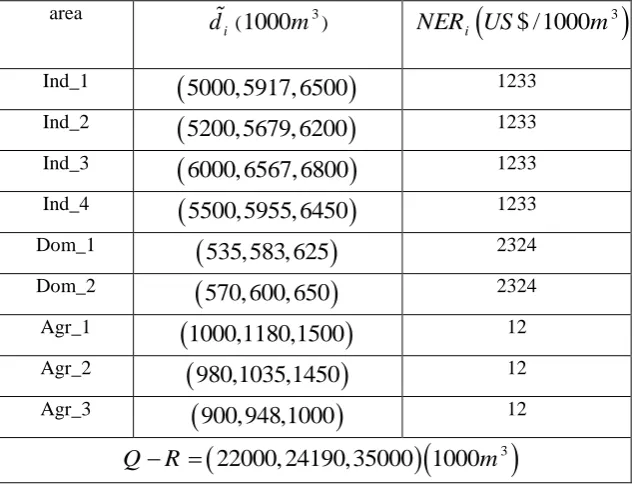
The example is built on the available data and information is for the Nong Pla Lai Reservoir in Chonburi Province in Eastern Thailand (Babel, Das Gupta and Nayak, 2005). In this paper, we
consider some of the crisp values as fuzzy values, such as demand and available water. The required inputs for application in the optimization process are provided in Table 1.
Table 1. Required inputs for water resource allocation
area
i
d (1000m3) NER USi
$ /1000m3
Ind_1
5000,5917, 6500
1233 Ind_2
5200,5679, 6200
1233 Ind_3
6000, 6567, 6800
1233 Ind_4
5500,5955, 6450
1233 Dom_1
535,583, 625
2324 Dom_2
570, 600, 650
2324 Agr_1
1000,1180,1500
12 Agr_2
980,1035,1450
12 Agr_3
900,948,1000
12 Q R
22000, 24190,35000 1000
m3
Now, we are going to obtain the optimal solution of the water resource allocation which is given in equations (20)-(24). The steps of the algorithm II are given in details.
Step1. The βiD- level for i 1, 2,...,n1 are determined by the DM as shown in Table 2. Table 2. The value of D
i
β for each flexible constraint
1
D
β 2
D
β 3
D
β 4
D
β 5
D
β 6
D
β 7
D
β 8
D
β 9
D
β 10
D
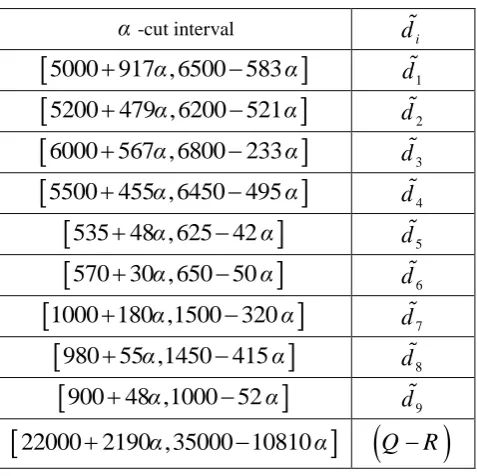
Step2. Obtain the corresponding α -cut interval based on equation (3) for each fuzzy number in this model as shown in Table 3.
Table 3. The α-cut interval for each fuzzy values
α -cut interval di
5000 917 , 6500 583 α α
d1
5200 479 , 6200 521 α α
d2
6000 567 , 6800 233 α α
d3
5500 455 , 6450 495 α α
d4
535 48 , 625 42 α α
d5
570 30 , 650 50 α α
d6
1000 180 ,1500 320 α α
d7
980 55 ,1450 415 α α
d8
900 48 ,1000 52 α α
d9
22000 2190 ,35000 10810 α α
Q R
Step3. Obtain the corresponding MPMOPM for water resource allocation problem as follows:
2 9
1 2
1
9
1 2
10 10 max
10 10 10 10
1
1 min , ,
1
max , ,
1
. . 1 1 , 1, 2,...,9,
1 1 ,
L U i i α i i α i
L U i
i i α i i α i i i
L U
α α
L U
i i i α i i α i i n
L U
i α α
i
t d t d x
f x α t
t d t d
x NER f x α t
t Q R t Q R NER
s t x t d t d β p i
x t Q R t Q R β p
(25)
10 10
0, D 1, D 1, 0 1, 0 1, 1, 2,...,9.
i i i i
x β β β β t α i
The values of pi are selected by the DMs. In this model, the selected values of pi are shown in Table 4.
Table 4. The value of pi for each flexible constraint
1
p p2 p3 p4 p5 p6 p7 p8 p9 p10
Step4. Obtain the ideal value of each objective function. The ideal value of each objective function for water resource allocation model is
1I, 2I
0,1.0682
f f .
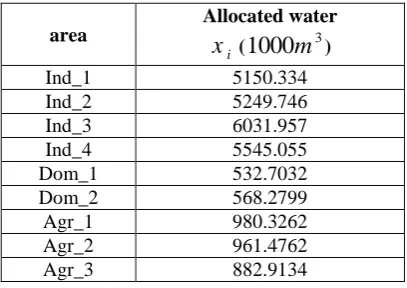
Step5. We solve the MPGPM corresponding to MPMOPM (25). Table 5 illustrate the allocated water to industrial areas (Ind_i), domestic areas (Dom_i) and agriculture areas (Agr_i) from solving the MPGPM using algorithm II by LINGO 17.0 software.
Table 5. The allocated water to each area from solving MPGPM using algorithm II
area
Allocated water
i
x (1000m3)
Ind_1 5150.334 Ind_2 5249.746 Ind_3 6031.957 Ind_4 5545.055 Dom_1 532.7032 Dom_2 568.2799
Agr_1 980.3262 Agr_2 961.4762 Agr_3 882.9134
The Pareto optimal values obtained for each objective function are
f f1, 2
0.0011, 0.9250
.One of the important parameters that affects the Pareto optimal value is the value of βiD . In the next subsection, we are going to analyze the sensitivity of this model to the βiD.
5.1 Sensitivity Analysis
We solved a multi-objective quadratic programming model with flexible constraints for water resource allocation problem using algorithm II. Now, we are going to evaluate sensitivity analysis for the Pareto optimal value by changing of some known parameters in Right-Hand-Sides such as βi. Actually, the value of βi determines the amount of deviation from demand and available water resource. According to model (25), when the value of βi is closer to one, the amount of deviation from demand and available water resource decreases. That is, the DMs always want to bring the value of βito one.
In the following, we examine the sensitivity of the Pareto optimal values to variations of βiD.
5.1.1 The sensitivity analyze for β1D
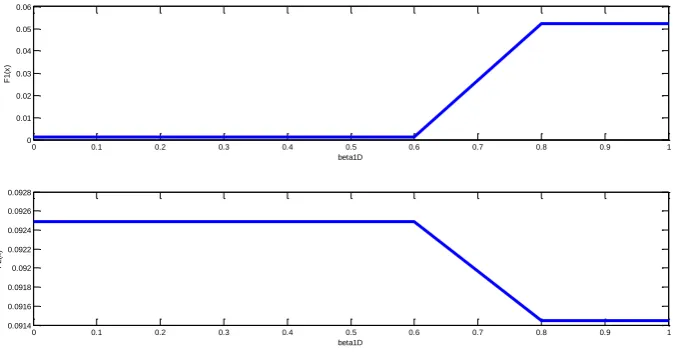
As seen in Figure 3, the Pareto optimal value of f1and f2 for β1Dfrom 0.0 to 0.6 are fixed and in their best values. By increasing the value of β1D from 0.6 to 0.8, the Pareto optimal values f1and f2 to become worse. Also, for β1Dfrom 0.8 to 1.0 the Pareto optimal values are fixed and in their worst values. So, the best value for β1Dis in interval
0.0, 0.6 . Since, the
DMs want to close the value of β1D to one, the best value for β1Dis 0.6.Figure 3. The sensitivity chart of each objective function based on changing β1D from 0.0 to 1.0 5.1.2 The sensitivity analyze for β2D
We change the value of β2D from 0.0 to 1.0 as β2D 0.0, 0.2, 0.4, 0.6, 0.8,1.0and solve the model (25). The obtained results of Pareto optimal value for each objective are shown in Figure 4. Corresponding to Figure 4, the results are similar to subsection 5.1.1. So, the best value for β2Dis 0.6.
5.1.3 The sensitivity analyze for β3D
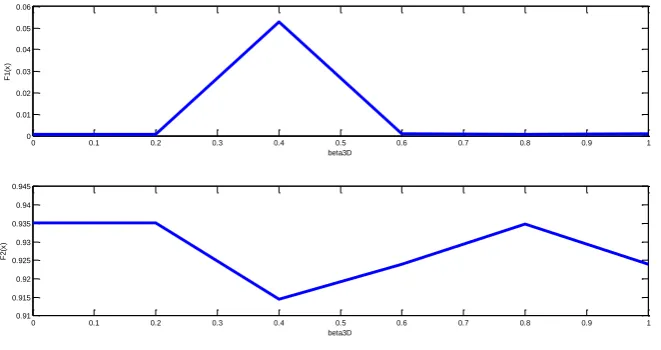
Now, we examine the effect of β3Don Pareto optimal value in the model (25). To do this, we consider β3D 0.0, 0.2, 0.4, 0.6, 0.8,1.0and solve the model (25). The variations of Pareto optimal values for changing β3D from 0.0 to 1.0 are shown in Figure 5. As shown in Figure 5, the Pareto optimal value of f1 are fixed in
0.0, 0.2 and
0.6,1.0 . Also, by increasing the
value of β3D from 0.2 to 0.4, the value of Pareto optimal of first objective function increases and gets worse. When β3D rises from 0.4 to 0.6, the value of f1 is reduced again. So, the best value of β3D for first objective function is in
0.0, 0.2 and
0.6,1.0 .
0 0.1 0.2 0.3 0.4 0.5 0.6 0.7 0.8 0.9 1
0 0.01 0.02 0.03 0.04 0.05 0.06
beta1D
F
1
(x
)
0 0.1 0.2 0.3 0.4 0.5 0.6 0.7 0.8 0.9 1
0.0914 0.0916 0.0918 0.092 0.0922 0.0924 0.0926 0.0928
beta1D
F
2
(x
Given that the second objective function is maximization, the best value of β3Dfor second objective function is in
0.0, 0.2 and 0.8. By intersection of the best value of
β3D for f1 and2
f , the best and largest value for β3Dis 0.8.
Figure 4. The sensitivity chart of each objective function based on changing β2D from 0.0 to 1.0
Figure 5. The sensitivity chart of each objective function based on changing β3D from 0.0 to 1.0 5.1.4 The sensitivity analyze for β4D
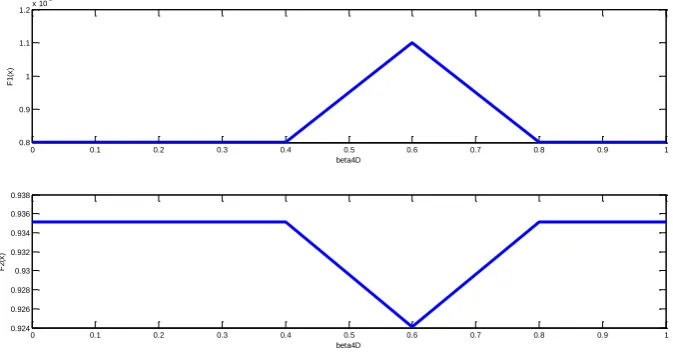
We change the value of β4D from 0.0 to 1.0 asβ4D 0.0, 0.2, 0.4, 0.6, 0.8,1.0. Figure 6 shown that the values of f1 and f2 are fixed in
0.0, 0.4 and
0.8,1.0 that are the best values of
them. Also, these functions get the worst their values for β4D 0.6. According to Figure 6, the best value for β4Dis 1.0.0 0.1 0.2 0.3 0.4 0.5 0.6 0.7 0.8 0.9 1
0 0.01 0.02 0.03 0.04 0.05 0.06
beta2D
F
1
(x
)
0 0.1 0.2 0.3 0.4 0.5 0.6 0.7 0.8 0.9 1
0.0914 0.0916 0.0918 0.092 0.0922 0.0924 0.0926 0.0928
beta2D
F
2
(x
)
0 0.1 0.2 0.3 0.4 0.5 0.6 0.7 0.8 0.9 1
0 0.01 0.02 0.03 0.04 0.05 0.06
beta3D
F
1
(x
)
0 0.1 0.2 0.3 0.4 0.5 0.6 0.7 0.8 0.9 1
0.91 0.915 0.92 0.925 0.93 0.935 0.94 0.945
beta3D
F
2
(x
5.1.5 The sensitivity analyze for β5D
By changing the value of β5Dfrom 0.0 to 1.0 and solving the model (25), we obtain the results which are shown in Figure 7. By looking to Figure 6 and Figure 7, we observe that the obtained results are adverse. The best value for β5D is 0.6 which is the worst value for β4D.
Figure 6. The sensitivity chart of each objective function based on changing β4Dfrom 0.0 to 1.0
Figure 7. The sensitivity chart of each objective function based on changing β5D from 0.0 to 1.0 5.1.6 The sensitivity analyze for β6D
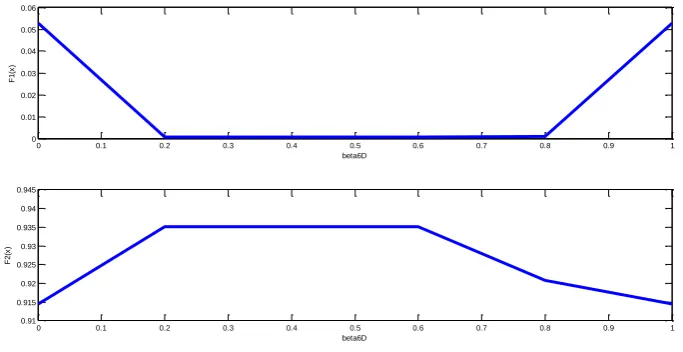
To show the effect of the value of β6Don the Pareto optimal values of f1 and f2, we change the value of β6D from 0.0 to 1.0. The changes in objective functions f1 and f2 are shown in Figure 8. When β6Dis in interval
0.2, 0.7 , the first objective has the best value respect to
0 0.1 0.2 0.3 0.4 0.5 0.6 0.7 0.8 0.9 1
0.8 0.9 1 1.1 1.2x 10
-3
beta4D
F
1
(x
)
0 0.1 0.2 0.3 0.4 0.5 0.6 0.7 0.8 0.9 1
0.924 0.926 0.928 0.93 0.932 0.934 0.936 0.938
beta4D
F
2
(x
)
0 0.1 0.2 0.3 0.4 0.5 0.6 0.7 0.8 0.9 1
0 0.01 0.02 0.03 0.04 0.05 0.06
beta5D
F
1
(x
)
0 0.1 0.2 0.3 0.4 0.5 0.6 0.7 0.8 0.9 1
0.914 0.916 0.918 0.92 0.922
beta5D
F
2
(x
other value of β6D. Also, the best value of β6D for the second objective is in interval
0.2, 0.6 . Hence, the best value for
β6D is 0.6.Figure 8. The sensitivity chart of each objective function based on changing β6D from 0.0 to 1.0 5.1.7 The sensitivity analyze for β7D , β8Dand β9D
By changing the value of β7Dfrom 0.0 to 1.0, we did not see any changes in the Pareto optimal value of objective functions. This result satisfy for β8Dandβ9D, too. In fact, the values ofβ7D , β8D and β9D have no effect on the Pareto optimal value. Since the DMs are willing to increasing the value of βi, we consider β7D β8D β9D 1.
5.1.8 The sensitivity analyze for β10D
The process of changing the values of f1 and f2 for different value of β10D from 0.0 to 1.0 is shown in Figure 9. When β10Drises from 0.0 to 0.8, the value of f1 increases, unlike the value of f2 . Also, when β10D rises from 0.8 to 1.0, the values of f1 and f2decrease and increase, respectively and the desired value for β10Dis zero.
0 0.1 0.2 0.3 0.4 0.5 0.6 0.7 0.8 0.9 1
0 0.01 0.02 0.03 0.04 0.05 0.06
beta6D
F
1
(x
)
0 0.1 0.2 0.3 0.4 0.5 0.6 0.7 0.8 0.9 1
0.91 0.915 0.92 0.925 0.93 0.935 0.94 0.945
beta6D
F
2
(x