https://doi.org/10.5194/wes-3-409-2018
© Author(s) 2018. This work is distributed under the Creative Commons Attribution 4.0 License.
Towards practical dynamic induction control of wind
farms: analysis of optimally controlled wind-farm
boundary layers and sinusoidal induction control of
first-row turbines
Wim Munters and Johan Meyers
Department of Mechanical Engineering, KU Leuven, Celestijnenlaan 300A, 3001 Leuven, Belgium
Correspondence:Wim Munters ([email protected])
Received: 14 February 2018 – Discussion started: 27 February 2018 Revised: 23 May 2018 – Accepted: 5 June 2018 – Published: 18 June 2018
Abstract. Wake interactions between wind turbines in wind farms lead to reduced energy extraction in down-stream rows. In recent work, optimization and large-eddy simulation were combined with the optimal dynamic induction control of wind farms to study the mitigation of these effects, showing potential power gains of up to 20 % (Munters and Meyers, 2017, Phil. Trans. R. Soc. A, 375, 20160100, https://doi.org/10.1098/rsta.2016.010). However, the computational cost associated with these optimal control simulations impedes the practical imple-mentation of this approach. Furthermore, the resulting control signals optimally react to the specific instanta-neous turbulent flow realizations in the simulations so that they cannot be simply used in general. The current work focuses on the detailed analysis of the optimization results of Munters and Meyers, with the aim to identify simplified control strategies that mimic the optimal control results and can be used in practice. The analysis shows that wind-farm controls are optimized in a parabolic manner with little upstream propagation of informa-tion. Moreover, turbines can be classified into first-row, intermediate-row, and last-row turbines based on their optimal control dynamics. At the moment, the control mechanisms for intermediate-row turbines remain unclear, but for first-row turbines we find that the optimal controls increase wake mixing through the periodic shedding of vortex rings. This behavior can be mimicked with a simple sinusoidal thrust control strategy for first-row turbines, resulting in robust power gains for turbines in the entrance region of the farm.
1 Introduction
Wake interactions between turbines within a wind farm cause reduced power extraction and increased turbine loading in downstream rows. The current control paradigm in such farms optimizes performance at the wind turbine level and does not account for these interactions, resulting in sub-optimal wind-farm efficiency. In contrast, control strategies at the farm level allow the wake interaction to be influenced and promise to improve overall wind-farm performance by improving wind conditions for downstream turbines. This can be achieved by redirecting propagating wakes (yaw con-trol; see, e.g., Fleming et al., 2014; Gebraad et al., 2016; Campagnolo et al., 2016) or by affecting the induced wake
velocity deficits (axial induction control; see, e.g., Nilsson et al., 2015; Annoni et al., 2016; Bartl and Sætran, 2016). A more exhaustive survey of wind-farm control in a broader context can be found in Knudsen et al. (2015) and Boersma et al. (2017).
strategies that can be applied in practice.
Recently, the methodology of Goit and Meyers (2015) was generalized to include dynamic yaw control in Munters and Meyers (2018). In this study, induction control and yaw con-trol were compared for a relatively small aligned wind farm, and yaw control was found to yield higher power gains for this setup. Furthermore, the high potential of combined in-duction and yaw control was quantified, and analysis of the yaw control signals allowed for the identification of practi-cal simplified dynamic yaw control strategies. The search for similar practical control strategies for induction control has remained unsuccessful to date.
The current paper presents efforts on understanding op-timal control dynamics observed in the opop-timal induction control simulations by Munters and Meyers (2017) (further denoted as MM17). The outline of the paper is as follows: first, Sect. 2 discusses the numerical setup and optimal con-trol simulations of MM17 that will be further analyzed in the current paper. Section 3 presents an analysis of the control and thrust force dynamics and performs some numerical ex-periments to elucidate the characteristics of the optimal con-trols. It will be shown that the coherent behavior of turbines situated in the first row of the wind farm stands out from their downstream counterparts. Thereafter, Sect. 4 identifies the shedding of vortex rings from the first row based on a flow visualization. Further, a simple sinusoidal thrust control approach is presented that successfully mimics this process with a robust increase in power extraction in the second row. Next, Sect. 5 shortly discusses the behavior of the interme-diate rows, i.e., turbines that have both upstream and down-stream neighbors, for which similar simple control strategies remain elusive thus far. In conclusion, Sect. 6 summarizes the main findings of this paper.
2 Description of optimal control simulations in MM17
The current section describes the optimal control simulations performed by MM17, the results of which are further ana-lyzed in the current paper. First, the methodology is intro-duced. Then, the numerical setup is detailed. Afterwards, the optimization results on power extraction and time-averaged flow field features are discussed.
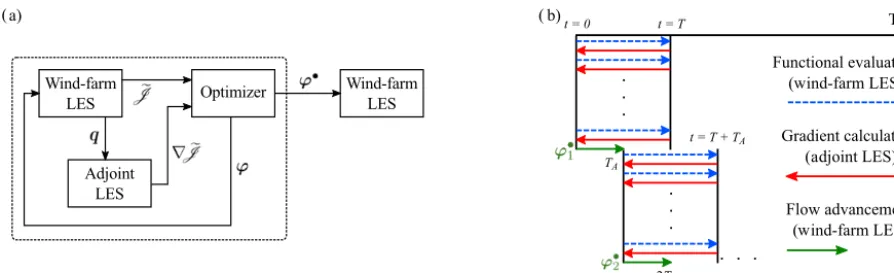
to the turbulent boundary layer and wake representation are avoided as much as possible, and the control signals are de-signed in a such a way that turbines actively tap into the dy-namics of the turbulent flow. The optimization is performed using a receding-horizon control framework, as illustrated in Fig. 1b. In this framework, wind-farm controlsϕ(t) are opti-mized for a finite time horizonT, involving a sequential set of LES and adjoint LES simulations. Upon convergence of the optimization, optimized control signals are applied in a flow advancement simulation for a timeTA< T, after which
a new optimization window is initiated.
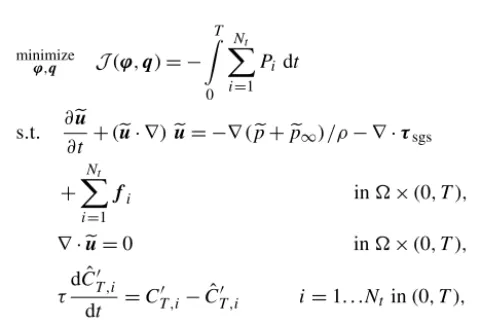
Within each optimization window, the total wind-farm power is optimized by solving the following optimization problem constrained by partial differential equations.
minimize
ϕ,q J(ϕ,q)= − T
Z
0 Nt
X
i=1
Pidt (1)
s.t. ∂eu
∂t +(eu· ∇)eu= −∇(pe+pe∞)/ρ− ∇ ·τsgs +
Nt
X
i=1
fi in×(0, T), (2)
∇ ·
eu=0 in×(0, T), (3)
τd
ˆ
CT ,i0
dt =C
0 T ,i− ˆC
0
T ,i i=1. . .Nt in (0, T), (4)
0≤ CT ,i0 ≤C0T ,max i=1. . .Nt in (0, T), (5)
The cost functional that is optimized in Eq. (1) is the to-tal wind-farm energy extraction over time horizonT. The control variables are the time-dependent thrust coefficient set points C0T ,i of every turbine i (=1. . .Nt), i.e., ϕ=
[CT ,10 (t), . . ., CT ,Nt0 (t)], and the state variables are denoted as
q= [
eu(x, t);pe(x, t); ˆC 0
T ,1(t), . . .,Cˆ 0
T ,Nt(t)], witheu the fil-tered velocity,pethe filtered pressure, and CˆT ,i0 the (time-filtered) thrust coefficient for turbinei(see below).
Figure 1.Schematic overview of wind-farm optimal control methodology from MM17.(a)Control block diagram with adjoint gradient-based optimization and LES flow models illustrating data flow of (optimal) controlsϕ(q), system stateq, cost functionalJ, and its gradient ∇J.(b)Receding-horizon framework subdividing time into discrete flow advancement windows of lengthTAwith prediction horizonT.
Each arrow represents a forward or adjoint LES. Every window consists of an optimization stage (blue and red lines) followed by a flow advancement stage with optimal controlsϕq(green lines).
timescale τ (Munters and Meyers, 2016). Finally, the box constraints in Eq. (5) limit the variations in the turbine thrust coefficients to technically feasible values.
The forces exerted by turbine i on the boundary layer flow are parameterized using a standard nonrotating actua-tor disk model asfi(x, t)= −(1/2)CˆT ,i0 (t)Vi(t)2Ri(x)e⊥,i,
whereRiis a smoothed representation of the geometric
foot-print of the turbine on the LES grid and e⊥,i is the
rotor-perpendicular vector. Further, the disk-averaged velocity is defined as Vi=(1/Ai)RRi(x)eu·e⊥,i dx, with Ai the ro-tor disk area. Mechanical power captured by the wind tur-bine is calculated asPi =(1/2)CP ,i0 (t)Vi(t)3Ai, withCP ,i0 =
0.9CT ,i0 , resulting from a fit of LES results to momentum the-ory, eliminating the overprediction of wind turbine power on typical wind-farm LES grid resolutions (Munters and Mey-ers, 2017).
2.2 Case setup
The wind farm considered in MM17 has an aligned pattern of 12 rows by 6 columns. The wind turbines have a hub height
zh=100 m with a rotor diameterD=100 m and are spaced
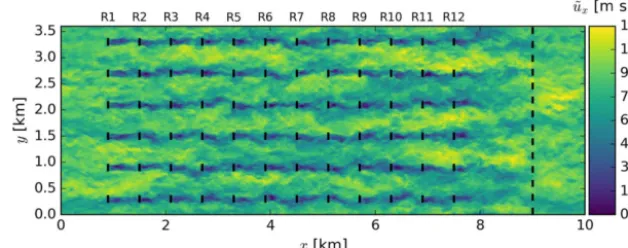
apart by 6Din both the axial and transversal directions. The flow is simulated on a domain of 10×3.6×1 km3discretized on a simulation grid of 384×192×144 grid points. A snap-shot of the streamwise velocity field is shown in Fig. 2. The wind farm was controlled over a total ofNA=15 time
win-dows with a prediction horizon T =240 s (i.e., the time it takes for the flow to pass four rows of turbines) and a flow advancement time of TA=T /2=120 s, resulting in a total
control timeTtot=NATA=30 min.
A conventionally (greedily) controlled wind farm with steadyCT0 =2 was defined as a reference case. Note that this would correspond to a farm with ideal turbines for which generator torque is being controlled dynamically to track the maximum power point at the Betz limit perfectly. In a
real turbine controller this may, e.g., be achieved with the extremum-seeking control proposed by Ciri et al. (2017). Several different optimal control cases were defined based on the wind turbine response timeτ =0, 5, or 30 s (instan-taneous, fast, or slow response; see Eq. 4) and the maximal thrust coefficientCT ,max0 =2 or 3, with thrust forces that can respectively only be reduced (underinductive) or increased (overinductive) compared to the Betz optimum at CT0 =2 (see Eq. 5). Cases are denoted asC < X > t < Y >, where
X andY represent CT ,max0 andτ, respectively, e.g., C3t30 for the case withCT ,max0 =3 and τ =30 s. The choice of (and sensitivity to) setup parameters is further elaborated in MM17.
2.3 Simulation results
Figure 3 illustrates the energy extraction of the optimally controlled wind-farm cases normalized by the greedy ref-erence control case. Figure 3a shows that the adjoint LES-based control approaches achieve energy gains ranging from a minor 2 % in the most restrictive C2t30 case to over 20 % in the C3t0 case. From Fig. 3b it can be seen that, for all cases except C3t30, power is curtailed in the first row to a limited degree, whereas the downstream rows compensate for this loss by extracting significantly more energy. Furthermore, not taking into account the first row, the last row achieves the highest energy extraction in every case, as it can act greed-ily without compromising power extraction in downstream neighbors.
Figure 2.Instantaneous streamwise velocityeuxfor the 12×6 aligned wind farm considered in MM17. Black lines indicate wind turbine locations. The black dashed line near the end of the domain indicates a buffer region used for the imposition of inflow boundary conditions. Figure originally published in Munters and Meyers (2017) under a CC-BY 4.0 license.
Figure 3.Energy extractionEOof optimally controlled wind-farm cases from MM17 normalized by a greedy reference caseER.(a)Total
energy extraction. Error bars indicate confidence intervals of±2 standard deviations.(b)Energy extraction by row normalized by first-row reference power. C3t0, red line; C3t5, yellow line; C3t30, blue line; C2t0, red dashed line; C2t5, yellow dashed line; C2t30, blue dashed line. Figure originally published in Munters and Meyers (2017) under a CC-BY 4.0 license.
are decomposed into mean and fluctuating components as
e
u= eu+eu
0≡ e
U+ eu
0. Figure 4 illustrates the time-averaged
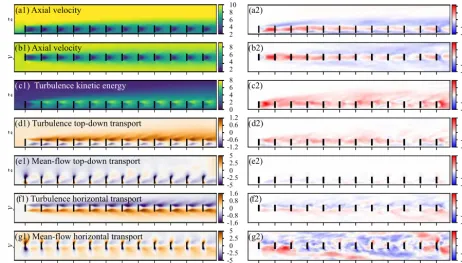
flow field quantities of the reference case (left panels, a1–g1) and the differences between the optimized C3t5 case and the reference case (right panels, a2–g2). Simulation results are averaged over the different columns and are shown as either top views at hub height (Fig. 4b, f, g) or side views through a turbine column (Fig. 4a, c, d, e).
Figure 4a and b illustrate side views and top views of the axial velocity throughout the wind farm. It can be seen that downstream turbines in the controlled case experience con-sistently higher incoming velocities, which explains the in-creased energy extraction discussed above. Furthermore, a larger drop in streamwise velocity over the turbine disk can be observed, most notably in the first-row turbines, indicat-ing deeper wakes with enhanced recovery before hittindicat-ing the next row of turbines. Furthermore, it can be observed that the axial velocity in the flow above and beside the wind turbine column is reduced, indicating that the mean flow kinetic en-ergy is depleted in these regions to the benefit of the flow passing through the wind turbines.
Figure 4c shows side views of turbulence kinetic energy
k. The figure shows an increase in turbulence throughout the entire wind farm, spreading to the internal boundary layer above the turbines. Note specifically the sharp increase in turbulence in the core wake region behind the first-row tur-bine, for which an enhanced recovery was found as discussed above. The turbulence intensityT I≡(2k/3)1/2/U∞at hub height (not shown in the figure) is 10 % at the inlet for both the reference case and the controlled case. The combination of reduced near-wake mean velocities and increased velocity fluctuations in the controlled case increase localT I in the turbine wakes (ranging from ≈2 % points in the wakes of the middle rows to≈12 % points in the first and last rows). This increase in turbulence intensity dissipates to below a 1 % point difference at 10Ddownstream of the last row.
Figure 4d and e show side views through the rotor center-line of top-down turbulence and mean flow transport of ax-ial momentum, i.e.,−
eu 0 xeu
0
z and−UexUez, respectively. It can
wakes, indicating increased turbulent mixing with the inter-nal boundary layer above the wind-farm canopy. The effect is somewhat more pronounced in the wake behind the first row of turbines, for which a slight increase in the upwards trans-port of momentum can also be observed in the lower part of the wake.
Figure 4f and g show plan views at hub height of the transversal turbulence and mean flow transport of axial mo-mentum, i.e., eu0
xeu 0
y and UexUey, respectively. The sign
con-vention is such that positive values correspond to transport in the positiveydirection in the figure. A slight increase in tur-bulent transversal transport towards the wake centerline can be observed behind every row. The mean flow transversal momentum transport into the wake region is increased sig-nificantly behind the first two turbine rows. Downstream of these rows, the difference between these cases and the refer-ence case is far less coherent. The latter can be explained by the fact thatUexin the inter-column channels starts to deviate
significantly from the reference case as shown in Fig. 4b. The analysis of flow features given above indicates that the optimal controls in case C3t5 influence the wind-farm flow field in such a way as to provide better flow conditions for downstream turbines. Increased axial velocities are ob-served for all downstream turbines, and enhanced momen-tum transport towards the turbine region is achieved. Further-more, many of the observed flow features are most salient for the first-row turbines. In the following section, the optimized thrust coefficients themselves will be investigated. It will be shown that, also from a controls perspective, first-row tur-bines stand out from their downstream counterparts.
3 Thrust coefficient analysis and numerical experiments
The current section focuses on the optimal thrust coefficients generated by the optimal control simulations in MM17 and performs numerical experiments to uncover some of the char-acteristics of these control signals. Note that the conclusions drawn within this section should be interpreted as observa-tions of the current C3t5 optimal control cases given specific wind-farm layout and flow conditions, and hence cannot just be generalized for any wind-farm control in general.
First, the thrust coefficient signals themselves are analyzed in Sect. 3.1. Second, the optimized thrust coefficients are ap-plied only to subsets of turbine rows in Sect. 3.2. In this way, the interdependency of optimized thrust coefficients in dif-ferent rows can be evaluated. Third, additional optimal con-trol simulations, in which only one single active row is op-timized, are discussed in Sect. 3.3. These optimizations pro-vide an indication of how increased power potential is dis-tributed among the rows and allows us to compare the re-sulting single-row optimized thrust coefficients with the fully cooperative coefficients from case MM17. Fourth, Sect. 3.4 evaluates the dependency of optimized thrust coefficients on
the actual turbulent flow realization. Finally, Sect. 3.5 dis-cusses the main conclusions from the abovementioned sec-tions and summarizes the lessons learned.
3.1 Analysis of thrust coefficient signals
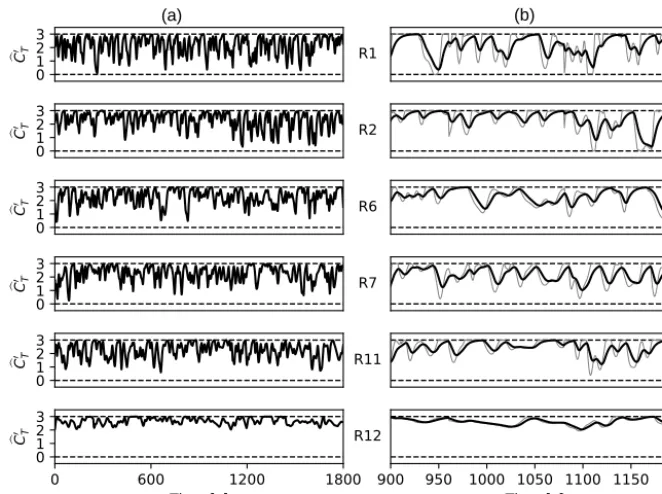
Figure 5 illustrates the time evolution of some of the thrust coefficientsCˆT0 in the C3t5 case. The figure shows that, for all rows but the last one (i.e., R12),CˆT0 varies significantly in time and that the amplitudes and frequencies of these varia-tions are somewhat higher in the upstream rows of the farm. In contrast, row 12 features only minor unsteadiness at lower frequencies and has an increased mean value ofCˆT0. This rel-atively steady behavior of the last row can be explained by the fact that there are no further downstream turbines that can benefit from row 12 actively influencing local flow con-ditions; hence, the row optimizes its own power only. The increase in meanCˆT0 in row 12 can be explained based on Fig. 6, which shows the power extraction as a function of steadyCˆT0 for unwaked turbines, subject to identical turbu-lent inlet as in case C3t5. Although momentum theory pre-dicts maximal power extraction for steady uniform inflow at
ˆ
CT0 =2, the actual optimal steady value for the ADM at the current spatial resolution lies somewhat higher atCˆT0 ≈2.4, for which power extraction is about 1.4 % higher than at
ˆ
CT0 =2. This behavior is related to the overprediction in ADM power due to the diffuse turbine representation on typ-ical simulation grids: the mass flow through the rotor disk atCˆ0T >2 is slightly too high compared to momentum the-ory, resulting in a shift of optimal CˆT0 towards somewhat higher values. Although the linear fitCP0 =aCˆT0 introduced in Munters and Meyers (2017), Appendix A, eliminates the error in maximal power extraction, it does not correct the value of the optimal CˆT0 (note that this could be achieved through a more complex relation betweenCP0 andCˆT0). Re-turning to the more complex thrust coefficients in the other rows, it is worth noting that based on the current dataset no statistically significant correlations between the thrust coef-ficients of different turbines could be found. Furthermore, attempts towards linking thrust coefficient dynamics to up-stream flow measurements (e.g., velocities, shear or kinetic energy) through linear regression models and random forest regressors have been unsuccessful to date.
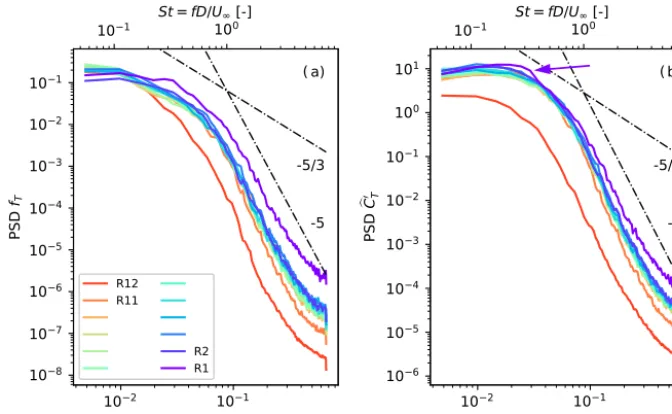
Figure 7a and b show row-averaged power spectral densi-ties of the thrust forces and thrust coefficients, respectively. The figure shows that the variances of both the thrust co-efficients and their resulting forces are highest in row 1. Further downstream, rows 2 to 11 have very similar spec-tral behavior, and row 12 shows significantly lower vari-ability. The high-frequency slopes of around−5 observed both forfT andCˆT0 indicate that force variability on short
un-Figure 4.Time-averaged flow field quantities of simulation results from MM17. Left: time averages of reference simulations withCT0 =2 for all turbines. Right: difference1between reference and optimal control (C3t5) simulation, defined as1=XC3t5−XREFfor any variable X.(a)Axial velocityUx(plan view at hub height).(b)Axial velocityUx(side view through turbine column).(c)Turbulence kinetic energy k=(1/2)(eu0xeu
0 x+eu
0 yeu
0 y+eu
0 zeu
0
z) (side view).(d)Turbulence top-down transport−eu 0 xeu
0
z.(e)Mean flow top-down transport−UexUez(side
view).(f)Turbulence horizontal transporteu 0 xeu
0
y(plan view).(g) Mean flow horizontal transportUexUey(plan view). Black lines indicate wind turbine locations. Simulation results are averaged over the six different wind turbine columns.
steadiness in the turbulence instead. Note that, even though the spectra for all rows except row 12 collapse at frequencies below 0.05 Hz, the first-row spectrum shows a small peak at f ≈0.02. . .0.03 Hz (f D/U∞≈0.2. . .0.3) as indicated by the purple arrow. It will be shown later in this paper that variations in the thrust coefficient around this frequency are directly related to increased power extraction.
3.2 Application of optimal thrust coefficients to subsets of turbine rows
In order to further study how the optimal controls increase overall wind-farm power, Fig. 8 shows power extraction re-sulting from applying a subset of the optimal controls to spe-cific turbine rows only. Figure 8a depicts simulation results for which the optimized controls are applied only to one spe-cific row, with the thrust coefficient in all other rows kept at the reference value ofCˆT0 =2. From the figure it can be seen that only for the controls of the first row (R1) does this result in a significant power increase in rows 2 and 3. This indicates that the optimal controls, as generated by the op-timization at the wind-farm level, react to the precise flow conditions caused by upstream control actions and can hence
only be applied independently for the first row, which has no upstream dependence on other controls.
Figure 8b shows results from simulations in which the con-trols are applied for all rows up to a certain row; i.e., R1–R3 indicates the application of optimized controls generated by case C3t5 to rows 1, 2, and 3. An interesting observation from this figure is that for any rowiexcept the last one, the power potential as observed in case C3t5 is almost fully recovered by only applying the optimal controls up to rowi−1. This suggests that self-optimization is very limited: the optimal controls for a given turbine are designed to create favorable flow conditions in the downstream rows instead of increas-ing local power. Furthermore, although the discussion in the previous paragraph has shown that downstream controls are optimized with the upstream actions in mind, the converse is not true: upstream control actions do not require a spe-cific downstream response in order to increase power in that downstream row.
3.3 Optimization of single active turbine rows
(a) (b)
Figure 5.Time evolution of the thrust coefficientCˆ0
T for a selection of optimally controlled turbines in case C3t5.(a)Total time horizon.
(b)Zoomed view including set pointCT0 in gray.
Figure 6. Normalized power extraction as a function of steady thrust coefficient Cˆ0
T for wind turbines subject to the same
free-stream turbulent inflow as in case C3t5. Every dot corresponds to one LES.
work for the downstream rows. To further quantify the poten-tial for increasing wind-farm power in each row of turbines, the current section considers a set of additional optimal con-trol cases in which only a single active row is optimized, with all other rows remaining passive. Furthermore, by comparing the optimized controls of these cases with the full-farm op-timization case C3t5, the degree of cooperation between tur-bines can be assessed. Note that the current single-row opti-mal control is not equivalent to greedy control: the optimizer still aims to increase aggregate farm power by taking into ac-count wake interactions with downstream turbines. Further-more, in contrast to the single-row control simulations from the previous section (i.e., in Fig. 8a), the current optimiza-tions will yield controls that are explicitly designed to in-crease power given that all other rows are passive. To limit
computational costs, the additional optimizations are only performed for a single time window.
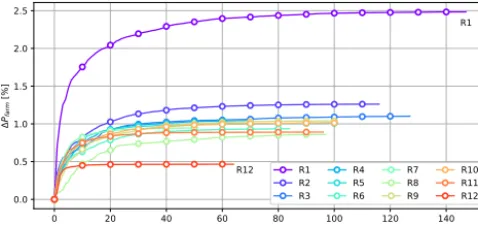
Figure 9 shows the relative increase in wind-farm power extraction for each of the 12 individually optimized control cases. The optimization is run until the continuous adjoint gradient accuracy prevents further progress in the optimiza-tion. Upon interpreting the actual values from the figure, it is important to note that the reported power gain covers the full optimization horizonT and is hence affected by finite-horizon effects. Furthermore, the first window of an opti-mal control simulation as considered here contains an initial dead zone corresponding to the wake advection lag before upstream turbines start influencing their downstream neigh-bors. This tends to reduce gains compared to later time win-dows. Nevertheless, the relative order of the different cases still provides information that can be generalized to full op-timal control studies with multiple windows and longer time horizons.
Figure 7.Power spectral density (PSD) estimates of the row-averaged thrust forcefT (a)and thrust coefficientCˆT0 (b)as a function of
frequencyf (bottom axis) and nondimensional Strouhal numberSt(top axis).
Figure 8.Normalized row-averaged power extraction for the reference case, optimal control case C3t5, and subset control cases up to optimization window 3.(a)Subset control cases with optimal controls applied only in one specific row.(b)Subset control cases with optimal controls applied for all rows up to specific row.
Figure 10 illustrates the row-wise relative power increase matrix for each of the single-row optimization cases. The figure indicates that, for each of the optimization cases, the largest power increase is observed in the first row down-stream of the active turbine (i.e.,Ri+1) and that the influence
on rowRi+3is limited. This is explained by the fact that the
finite optimization horizon used in MM17 (i.e., T =240 s) allows for more interactions with directly neighboring tur-bines than with those located further downstream. Further-more, except for the optimal control case of the last row (R12), self-optimization is virtually nonexistent: power gains are achieved by modifying the flow to yield more favorable conditions for downstream rows.
3.4 Modification of thrust coefficient signals
The observations from previous sections illustrate that, at least to some degree, the optimized thrust coefficients are tuned to local flow conditions. In the current section, the pos-sibility of whether the coefficients contain traits that are in-dependent of flow conditions is investigated. To this end, the optimized thrust coefficients are modified in such a way that correlations between them and specific flow events are elim-inated. This is done in two independent test cases.
Figure 9.Increase in wind-farm power extraction for the first (and only) time window of the optimal control cases in which only a single row is optimized.
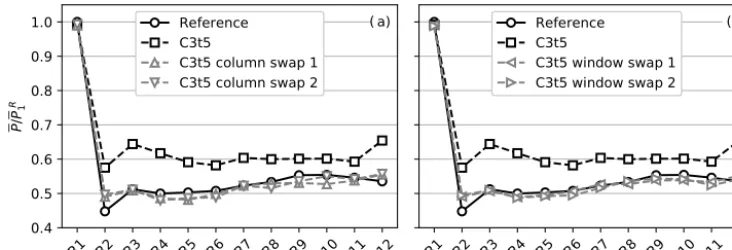
the column swap is performed in two random independent ways. The variability of flow conditions for different columns can be qualitatively observed in Fig. 2. To further strengthen the hypothesis of the current experiment, we verified that the correlation between flow conditions in different columns is small, i.e., with an average Pearson correlation coefficient of 0.12 between columns for the incoming velocity fluctuations 6D upstream of the first row. The row-averaged power for these cases is shown in Fig. 11a.
In the second case, controls remain assigned to their orig-inal turbines, but are shuffled in time by randomly swap-ping optimal controls generated for different control win-dows. In this way, the spectral thrust characteristics for timescales smaller than the control horizon TA=120 s
re-main unchanged, whereas the time synchronization of con-trol actions to specific flow events is eliminated. Similar to the first case, this is done in two random ways, and the limited correlation between velocity fluctuations in different time windows was quantified at 0.07. Figure 11b illustrates the row-averaged power for these cases.
The figure shows similar behavior for each of the modi-fied control cases: only in the second row (R2) can a consis-tent (though small) increase in power extraction be observed. This suggests the presence of flow-invariant features in the control signals of the first row. Note, however, that the full power gain in the second row is only partially attained, indi-cating that the first turbine row also reacts to the specific flow conditions.
3.5 Discussion
The observations and experiments from previous sections have revealed information that increases the understanding of the optimized thrust coefficients and can be used as a starting point towards designing practical wind-farm controllers that do not require computationally expensive LES-based optimal control simulations.
A first conclusion is that wind turbines can be classified into three distinct categories based on their position within
Figure 10.Relative power increase matrix for downstream rows in the single-row optimization case for rowRi, indicated in the
hor-izontal axis. N/A indicates nonexisting downstream rows. Finite-horizon effects are eliminated by only reporting a power increase up tot=TAfor the active rowRi.
the farm: first-row turbines, last-row turbines, and intermedi-ate turbines. The most salient behavior can be found in the first-row turbines (R1). It was shown that these turbines ex-hibit the largest variability in thrust forces and hold the great-est potential for power optimization. Furthermore, they are not influenced by upstream turbine control action and are the only turbines that retain part of the power gains after eliminating possible correlation between controls and spe-cific flow events. The characteristics of the last-row turbines (R12) also stand out from the rest due to the fact that by def-inition the last row has no downstream turbines and hence holds no further potential for coordinated control. The re-maining intermediate rows (R2–R11) have similar spectral thrust characteristics and potential for power increase, as they are situated between but clearly separated from the first- and last-row turbines. Further, it is worth noting that the behavior and analysis of control actions in these turbines is most com-plex: not only do they influence downstream turbines, but they in turn are also dependent on the controls of upstream turbines.
Figure 11.Normalized row-averaged power extraction for the reference case, optimal control case C3t5, and modified control cases.(a) Mod-ified control cases with controls swapped between wind turbine columns.(b)Modified control cases with controls swapped randomly by time window.
4 First-row turbine behavior
The current section further focuses on the analysis of the first-row turbines. First, a qualitative analysis of the instanta-neous flow field is performed in Sect. 4.1, resulting in the observation of vortex rings being shed from first-row tur-bines. Thereafter, this mechanism is mimicked by imposing sinusoidally varying thrust coefficients in these turbines in Sect. 4.2, with the aim of increasing power through simi-lar mechanisms as in the computationally expensive optimal control cases.
4.1 Flow field visualization
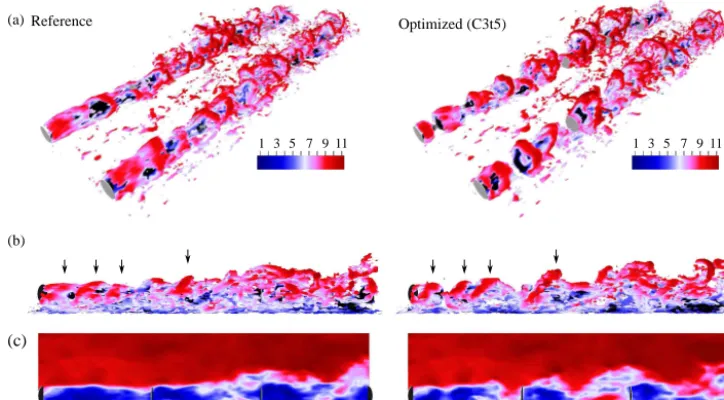
Figure 12 shows snapshots of the vorticity and velocity fields att=300 s for the reference case (left) and the optimal con-trol case C3t5 (right). Figure 12a and b show isosurfaces of vorticity magnitude colored by streamwise velocityeux.
Fig-ure 12a shows that in the reference case the first-row turbines shed relatively stable vortex sheets that demarcate the wake from the free-stream flow. The sheets destabilize and break up as they are advected downstream, resulting in complex three-dimensional vortical structures. Furthermore, as also shown in Fig. 12c, wake mixing is limited, and downstream turbines experience reduced velocities. In contrast, the op-timized case shows coherent vortex rings being shed from the first-row turbine. As indicated by the black arrows in Fig. 12b, the locations of the rings in the controlled case co-incide with naturally occurring bulges in the vortex sheet of the reference case: the controlled turbines further destabilize the sheet through well-timed temporal variations in its thrust coefficient. Figure 12c shows that this results in smaller ve-locity deficits in the wake region. Note that downstream of the second turbine the vorticity field becomes much more complex and differences in the flow fields are less coherent.
The observed shedding of ring vortices seems to occur at specific flow-synchronized times to exploit the natural insta-bilities in the original vortex sheets. Therefore, the
remain-der of this paper will attempt to accomplish the same effect through simple sinusoidal thrust variations.
4.2 Sinusoidal thrust variations
The aim of the current section is to mimic the quasi-periodic shedding of vortex rings by upstream turbines as observed above through the use of simple periodic variations in the thrust coefficient. Instead of optimizing a high-dimensional control signal that can evolve freely in time as in MM17, we impose a sinusoidal perturbation on the Betz-optimal co-efficientCˆ0T =2, parameterized by its amplitudeA, and its frequency in the form of a nondimensional Strouhal num-berSt=f D/U∞, withf the dimensional frequency,Dthe turbine diameter, andU∞the unperturbed time-averaged up-stream velocity:
ˆ
CT0(t)=2+Asin
2πStt U∞
D
. (6)
4.2.1 Parameter sweep
1 3 5 7 9 11
Reference Optimized (C3t5)
1 3 5 7 9 11 (a)
(b)
(c)
Figure 12.Instantaneous snapshots att=300 s of a portion of the wind-farm flow field for the reference (left) and optimized (right) case. (a, b)Isosurface of vorticity magnitude colored by streamwise velocityeux. Deep-wake regions (witheux<4.5 m s
−1) are rendered in black.
Black arrows indicate the naturally occurring unstable bulges in the reference case and the accompanying vortex rings in the optimized case. (c)Contours of streamwise velocityeux. Coloring is in units of m s−1. Wind turbines are represented as gray disks.
Figure 13. Reduced 4×4 wind-farm simulation setup for sinu-soidal variation parameter study showing instantaneous contours of streamwise velocityeux. Coloring is in units of m s
−1. The dashed
line indicates the start of the fringe region for the imposition of un-waked inflow conditions.
z0=10−1m is used. A set of wind-farm flow simulations is
advanced in time by 30 min, during which the front row is controlled using a sinusoidally varying thrust coefficientCˆT0, as defined in Eq. (6). Within this set, the amplitudeAis var-ied between 0.5 and 2, with increments of 0.5. Furthermore, the Strouhal numberStis varied between 0.05 and 0.6, with increments of 0.05. In total, this leads to 48 LES cases within the set.
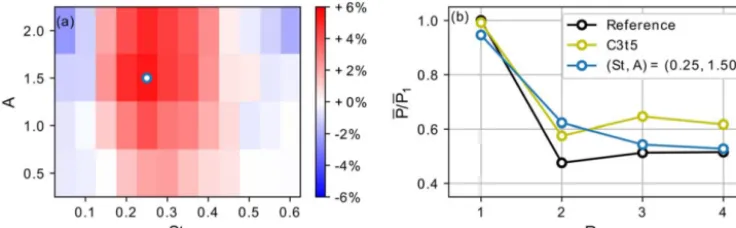
Figure 14 illustrates the power extraction for all cases con-sidered. Figure 14a illustrates the relative power gains over the reference case. From the figure it can be seen that there is a well-defined range of values forAandStfor which wind-farm power can be increased substantially through upstream sinusoidal thrust variations, with a maximal power increase of≈5 % at (St∗, A∗)=(0.25,1.5). For instance, a Strouhal numberSt=0.25 corresponds here to a sine wave period of ≈50 s for a turbine with diameterD=100 m and a free-stream velocityU∞=8.5 m s−1. For instance, considering the NREL 5MW blade profiles, the maximum thrust coef-ficient of 3.5 can be attained by slightly changing the rotor design, e.g., using a 50 % increase in blade chord length and an operational tip speed ratio 25 % higher than the original design value (see Appendix A in Goit and Meyers, 2015). Furthermore, given such redesign, dynamic reductions from this value could be realized through blade pitch control, for which actuation rates of the order of 10◦s−1 are possible (see, e.g., Jonkman et al., 2009). Figure 14b illustrates nor-malized power extraction by row for the reference case, the best sinusoidal case, and the first four rows of the optimal control case C3t5 from MM17. The figure shows that the power gain in the sinusoidal cases originates mostly from the second row and that power in the first row is decreased by approximately 5 %. In contrast, optimal control case C3t5, in which all rows are active, also increases power in rows 3 and 4 and reduces first-row power by only 1 %.
Figure 14.Power extraction of baseline sinusoidal thrust case (S=6D,z0=10−1m).(a)Relative gain in mean wind-farm power extraction
over reference case as a function of sine amplitudeAand frequencySt.(b)Row-averaged mean power extraction for the best sinusoidal case, the optimal control case C3t5 from MM17, and the reference case normalized by first-row reference power.
(St∗, A∗)=(0.25,1.5) (b), and a sinusoidal case that does not lead to increased power extraction with (St, A)=(0.6,2) (c). The figure illustrates the fact that sinusoidal variations in the first-row thrust coefficient indeed cause the periodic shedding of vortex rings. Figure 15b shows that at the opti-mal frequency this leads to increased wake mixing, providing the second-row turbine with a higher incoming velocity. In contrast, Fig. 15c shows that even though higher-frequency thrust oscillations also result in the periodic shedding of vor-tex rings, this does not automatically lead to more favorable flow conditions for downstream turbines. Therefore, it can be concluded that the correct timing and spacing of vortex rings is essential for increased wake mixing.
In order to assess whether the same strategy can be used in the downstream turbines as well, Fig. 16 illustrates the re-sults from an identical parameter sweep as discussed above, except that here the second turbine row is controlled using a sinusoidal thrust coefficient. Figure 16a indicates that the sinusoidal actuation of the second row invariably leads to losses in wind-farm power. Figure 16b shows that, for the optimal combination of parameters of (St, A)=(0.25,1.5) as reported for first-row actuation above, the minor power increase in the third row does not compensate for additional losses in the second and fourth row. This shows that the pro-posed simple control strategy does not work when applied to waked turbines and that more elaborate control strategies are required to harness the gains achieved by the optimal control simulation in the downstream regions of the farm.
It is interesting to note that, even though the current param-eter sweep is performed using different initial and inlet con-ditions than those applied in MM17, the optimal frequency of sinusoidal variations inCˆT0 atSt∗=f D/U∞=0.25 cor-responds to the location of the peak in the first-row thrust coefficient spectrum of C3t5 in Fig. 7. In the following para-graphs, the robustness of the best parameter pair for first-row thrust variations, i.e., (St, A)=(0.25,1.5), is investi-gated with the aim of assessing the general applicability of this control strategy. To this end, similar parameter sweeps
are performed for cases with varying turbine spacings and turbulence intensities.
4.2.2 Robustness with respect to turbine spacing and turbulence intensity
Figure 17 shows the power extraction resulting from two parameter sweeps with streamwise turbine spacings of 5D
and 7D. The results are promising: for the given cases,St∗
andA∗ do not depend on streamwise turbine spacing. Fur-thermore, even in the 7D spacing case (Fig. 17c–d), which naturally features lower overall power losses in downstream rows, power extraction in the second row can be significantly increased through sinusoidal variations in the first-row thrust coefficient.
Figure 18 depicts the power extraction results from a pa-rameter sweep with the same wind-farm layout as in the base-line case, but with a 10-fold increase in roughness length, i.e.,
z0=1 m. This results in a turbulence intensity of
approxi-mately 16 % compared to 10 % in the baseline case. Again, the best parameter combination of (St∗, A∗)=(0.25,1.5) re-mains unchanged. Further, even for this higher turbulence case, in which downstream losses are lower due to naturally better wake mixing, power is increased in the second row, leading to a relative gain in wind-farm power of around 2 %. As evidenced above, periodic sinusoidal variations in first-row thrust coefficients substantially increase power extrac-tion in the second row, resulting in a net gain in total power for the considered 4×4 wind farm. Moreover, different simu-lation sets indicate that, at least for the range considered here, the best values for the Strouhal number and the amplitude of these variations, i.e., (St∗, A∗)=(0.25,1.5), are robust with respect to turbine spacing and turbulence intensity.
4.2.3 Full-scale wind-farm LES
(
(
(
Figure 15.Snapshots of wind-farm flow fields att=1800 s. Left: isocontours of vorticity colored by streamwise velocity. Right: contours of streamwise velocity.(a)Reference.(b)Best sinusoidal case with (St, A)=(St∗, A∗)=(0.25,1.5).(c)Sinusoidal case with (St, A)=(0.6,2).
Figure 16.Power extraction of second-row sinusoidal thrust case.(a)Relative gain in mean wind-farm power extraction over reference case as a function of sine amplitudeAand frequencySt.(b)Row-averaged mean power extraction for the sinusoidal case with the optimal parameters as for row 1 sinusoidal thrust and the reference case normalized by first-row reference power.
Strouhal numbers corresponding to the most favorable region identified in the parameter sweeps above. In order to increase statistical convergence, the time horizon for each simulation is extended to a physical time of 10 h.
Figure 19 shows the power extraction of the full-scale LES. Figure 19a shows the relative power gains over the ref-erence case for the full wind farm. It can be seen that the total power gain or loss is below 0.5 % for each of the sinusoidal control cases. Figure 19b shows the row-wise power extrac-tion for the reference case, the sinusoidal thrust case with (St, A)=(0.25,1.5), and the optimal control case C3t5. It is shown that, although the second row of the sinusoidal thrust case achieves similar power gains as those observed above, from the fifth row onwards power is slightly reduced in the sinusoidal case.
The top panel of Fig. 20 shows cross sections of time-averaged axial velocitiesUexat the rotor disk locations for the
reference case. Further, the middle and bottom panels illus-trate deviations from the reference velocity for the (St∗, A∗) sinusoidal case and the optimal control case C3t5,
Figure 17.Power extraction of sinusoidal thrust cases with varying streamwise spacing.(a, b)Decreased spacing atS=5D.(c, d)Increased spacing atS=7D. (a, c)Relative gain in mean wind-farm power extraction over reference case as a function of sine amplitudeAand frequencySt.(b, d)Row-averaged mean power extraction for the best sinusoidal case and the reference case normalized by first-row reference power.
Figure 18.Power extraction of sinusoidal thrust case with increased wall roughnessz0=1 m.(a)Relative gain in mean wind-farm power
extraction over reference case as a function of sine amplitudeAand frequencySt.(b)Row-averaged mean power extraction for the best sinusoidal case and the reference case normalized by first-row reference power.
As shown throughout the current section, a qualitative analysis of instantaneous flow features in the optimal induc-tion control wind farm from MM17 has led to the identifica-tion of a sinusoidal thrust control strategy for first-row tur-bines, resulting in increased power extraction in the second row. However, important comments should be made. First, sustained sinusoidal thrust variations with a large amplitude could contribute significantly to turbine fatigue loading of the first-row turbines. Furthermore, partial wake alleviation and unsteady passing of the abovementioned vortex rings could also increase fatigue loading in downstream rows. Hence, structural aspects should be taken into account upon
Figure 19.Power extraction of full-scale sinusoidal thrust case (S=6D,z0=10−1m).(a)Relative gain in mean wind-farm power
extrac-tion over reference case as a funcextrac-tion of sine amplitudeAand frequencySt.(b)Row-averaged mean power extraction for the sinusoidal case with parameters from previous sections, the optimal control case C3t5 from MM17, and the reference case normalized by first-row reference power.
(a)
(b)
(c)
Figure 20.Cross section of time-averaged axial velocityUexat rotor locations in rows 1, 2, 3, 4, 5, and 12.(a)Reference case.(b)Difference
between best sinusoidal perturbation case (withA=1.5,St=0.25) and reference case.(c)Difference between optimal control case C3t5 and reference case. Coloring is in units of m s−1.
5 Intermediate-row turbine behavior
The current section discusses the intermediate rows. It was shown that, without active participation in these rows, up-stream gains are lost in downup-stream rows, and only full opti-mal control succeeds in achieving significant gains in down-stream rows as well (see Figs. 19, 20). It was already men-tioned that the analysis and behavior of turbines within in-termediate rows is more complex than in the first row: they aim to influence the flow to the benefit of downstream rows but are also dependent on the actions of upstream rows. The remainder of the current section aims to illustrate the addi-tional difficulty of power increase in downstream rows and
speculates on possible future paths for the identification of simplified control strategies as found for the first row.
rela-ding mechanism constitutes only part of the power increase caused by the first row. Figure 8 illustrates that the first-row optimized thrust coefficient also results in a significant power increase in the third row, which is not observed using the sinusoidal thrust strategy. Furthermore, the analysis of the modified control cases in Fig. 11 proves that the first-row controls are also partially synchronized with the flow. This shows that other mechanisms, dependent on specific flow events for increasing wind-farm power, are at play as well. Even though the application of regression algorithms in an attempt to link turbine actions to low-dimensional flow mea-surements (e.g., local velocity, shear and kinetic energy) has been unsuccessful thus far, similar analysis based upon more complex flow features (e.g., vorticity structures, high-speed turbulent streaks, or downdrafts) might be more promising. This requires further optimal control simulations over an ex-tended time, as the total control time horizon of 30 min in the current dataset is insufficient for robust statistics in this kind of analysis. This is an important remaining challenge to be addressed in future research.
6 Conclusions
The current paper provided an analysis of the thrust coeffi-cient control characteristics for the C3t5 optimal control case featured in Munters and Meyers (2017).
Analysis of the thrust coefficients and numerical experi-ments have shown a clear distinction between first-row tur-bines, last-row turtur-bines, and intermediate turbines. Further-more, observations strongly suggest that the optimization works in a unidirectional way: upstream turbines influence the flow field, resulting in favorable conditions for their downstream neighbors, yet information on the possibility of active response and cooperation in the latter has no influence on upstream control actions.
Qualitative analysis of instantaneous flow fields led to the observation of the quasi-periodic shedding of vortex rings from first-row turbines in the optimal control case. This flow feature was successfully mimicked using simple sinusoidal thrust actuation of the first row. The best parameter set for these sinusoidal variations proved robust to both wind turbine spacing and turbulence intensity, with an amplitudeA∗=1.5 and a nondimensional frequency atSt∗=0.25. Interestingly,
remark that all current simulations were performed using a standard nonrotating actuator disk model without the inclu-sion of mechanical turbine loading. Therefore, wind tunnel testing and/or simulations with more advanced turbine mod-els (such as the actuator line model) including the assessment of turbine loading are essential to evaluate the real-life appli-cability of the sinusoidal thrust strategy.
Data availability. Datasets supporting this article can be found in a figshare repository. These datasets include time-averaged flow fields, optimized controls and optimized wind-farm power extraction for the case reported in this paper (Munters and Meyers, 2016, Figshare data collection repository, https://doi.org/10.6084/m9.figshare.c.3520113).
Competing interests. The authors declare that they have no con-flict of interest.
Acknowledgements. The authors received funding from the European Union’s Horizon 2020 research and innovation program under grant agreement no. 727680 (TotalControl). The authors also acknowledge funding by the European Research Council under grant agreement no. 306471 (ActiveWindFarms). The computational resources and services used in this work were provided by the VSC (Flemish Supercomputer Center), funded by the Research Foundation – Flanders (FWO) and the Flemish Government, department EWI.
Edited by: Sandrine Aubrun
Reviewed by: two anonymous referees
References
Annoni, J., Gebraad, P. M. O., Scholbrock, A. K., Flem-ing, P. A., and van Wingerden, J.-W.: Analysis of axial-induction-based wind plant control using an engineering and a high-order wind plant model, Wind Energy, 19, 1135–1150, https://doi.org/10.1002/we.1891, 2016.
Boersma, S., Doekemeijer, B., Gebraad, P., Fleming, P., An-noni, J., Scholbrock, A., Frederik, J., and van Wingerden, J.: A tutorial on control-oriented modeling and control of wind farms, in: American Control Conference (ACC), 1–18, https://doi.org/10.23919/ACC.2017.7962923, 2017.
Calaf, M., Meneveau, C., and Meyers, J.: Large eddy simula-tion study of fully developed wind-turbine array boundary lay-ers, Phys. Fluids, 22, 015110, https://doi.org/10.1063/1.3291077, 2010.
Campagnolo, F., Petrovi´c, V., Bottasso, C. L., and Croce, A.: Wind tunnel testing of wake control strategies, in: American Control Conference (ACC), 513–518, 2016.
Ciri, U., Rotea, M., Santoni, C., and Leonardi, S.: Large-eddy sim-ulations with extremum-seeking control for individual wind tur-bine power optimization, Wind Energy, 20, 1617–1634, 2017. Fleming, P. A., Gebraad, P. M., Lee, S., van Wingerden, J.-W.,
John-son, K., Churchfield, M., Michalakes, J., Spalart, P., and Mori-arty, P.: Evaluating techniques for redirecting turbine wakes us-ing SOWFA, Renew. Energ., 70, 211–218, 2014.
Gebraad, P., Teeuwisse, F., Wingerden, J., Fleming, P. A., Ruben, S., Marden, J., and Pao, L.: Wind plant power optimization through yaw control using a parametric model for wake effects - a CFD simulation study, Wind Energy, 19, 95–114, 2016.
Goit, J. P. and Meyers, J.: Optimal control of energy extraction in wind-farm boundary layers, J. Fluid Mech., 768, 5–50, 2015. Goit, J. P., Munters, W., and Meyers, J.: Optimal Coordinated
Con-trol of Power Extraction in LES of a Wind Farm with Entrance Effects, Energies, 9, 29, https://doi.org/10.1017/jfm.2015.70, 2016.
Jonkman, J., Butterfield, S., Musial, W., and Scott, G.: Definition of a 5-MW reference wind turbine for offshore system develop-ment., Tech. Rep. Technical Report NREL/TP-500-38060, Na-tional Renewable Energy Laboratory, Golden, CO, USA, 2009.
Knudsen, T., Bak, T., and Svenstrup, M.: Survey of wind farm con-trol - power and fatigue optimization, Wind Energy, 18, 1333– 1351, 2015.
Medici, D. and Alfredsson, P. H.: Measurements on a wind turbine wake: 3D effects and bluff body vortex shedding, Wind Energy, 9, 219–236, https://doi.org/10.1002/we.156, 2006.
Meyers, J. and Meneveau, C.: Large eddy simulations of large wind-turbine arrays in the atmospheric boundary layer, AIAA Paper, 827, https://doi.org/10.1017/jfm.2015.70, 2010.
Munters, W. and Meyers, J.: Effect of wind turbine response time on optimal dynamic induction control of wind farms, J. Phys. Conf. Ser., 753, 052007, https://doi.org/10.3390/en11010177, 2016. Munters, W. and Meyers, J.: An optimal control framework for
dy-namic induction control of wind farms and their interaction with the atmospheric boundary layer, Philos. T. Roy. Soc. A, 375, 20160100, https://doi.org/10.1098/rsta.2016.0100 2017. Munters, W. and Meyers, J.: Dynamic Strategies for Yaw and
In-duction Control of Wind Farms Based on Large-Eddy Simulation and Optimization, Energies, 11, 177 pp., 2018.
Nilsson, K., Ivanell, S., Hansen, K. S., Mikkelsen, R., Sørensen, J. N., Breton, S.-P., and Henningson, D.: Large-eddy simulations of the Lillgrund wind farm, Wind Energy, 18, 449–467, 2015. Porté-Agel, F., Wu, Y.-T., and Chen, C.-H.: A Numerical Study
of the Effects of Wind Direction on Turbine Wakes and Power Losses in a Large Wind Farm, Energies, 6, 5297–5313, 2013. Stevens, R. J., Gayme, D. F., and Meneveau, C.: Effects of turbine
spacing on the power output of extended wind-farms, Wind En-ergy, 19, 359–370, https://doi.org/10.1002/we.1835, 2016. Wang, Q., Hu, R., and Blonigan, P.: Least squares shadowing