Volume 02, No. 4, April 2016
P
age
49
Review of Recent Nature-Inspired Optimization Techniques for
Fuzzy Controller Parameters
Soumya Chauhan
Department of Electrical Engineering, Deenbandhu Chhotu Ram University of Science and Technology, Murthal, Sonepat (Haryana) India
ABSTRACT:
This paper embodies an up-to-date review of all major nature inspired metaheuristic algorithms employed till date for optimization of fuzzy controller parameters. Fuzzy Logic Controllers (FLCs) have been engaging the attention of control engineers for quite some time now. The enormous variety of parameters that can be tuned in an FLC give it an edge over several other controllers. The field of optimization too has witnessed a spurt in various newer techniques, especially the nature-inspired techniques have, of late, added a lot of variety in optimization methodologies, with ever increasing benefits.
KEYWORDS: Fuzzy logic controller, Membership function, metaheuristics algorithm
I. INTRODUCTION
Volume 02, No. 4, April 2016
P
age
50
This paper presents an in-depth review of nature-inspired metaheuristic optimization algorithms used for fuzzy control parameters design. Fuzzy Logic is a technique that incorporates heuristics developed by practicing engineers and process operators into automatic control. It is used to control highly nonlinear, complex systems or systems whose mathematical model is not known. Also in the situations where classical control methods are available, fuzzy logic is introduced to improve the controller performance and in some cases to simplify the control algorithm. It is verified experimentally that the fuzzy controllers perform better than or as good as a PID controller [16]. In control systems, there are a number of generic systems and methods which are encountered in all areas of industry and technology. From the dozens of ways to control any system, it turns out that fuzzy control is often the very best way. One of the successful applications that used fuzzy control is liquid tank level control. The purpose of this paper is to design a simulation system of fuzzy logic controller parameters by using simulation package which is Fuzzy Logic Toolbox and Simulink in MATLAB software. For a long time, the choice and definition of the parameters of PID are very difficult. There must be a bad effect if that you do not choose nicely parameters. To strictly limit the overshoot, using Fuzzy Control can achieve great control effect. Many researchers [14] [16] [17] [18] take the liquid level water tank, and use MATLAB to design a Fuzzy control parameters. For designing an FLC, the MFs should be selected in such a manner that it exhibits desired control behaviour. Hence the MFs tuned to achieve more desired control behaviour. However, iterative approach [15] for selecting MF is a very much time consuming task. Due to change in MF parameters, i.e., for different shapes of the membership functions, the performance of FLC also changes. This work uses any metaheuristics search strategy based on natural selection and optimizes MFs.
Volume 02, No. 4, April 2016
P
age
51
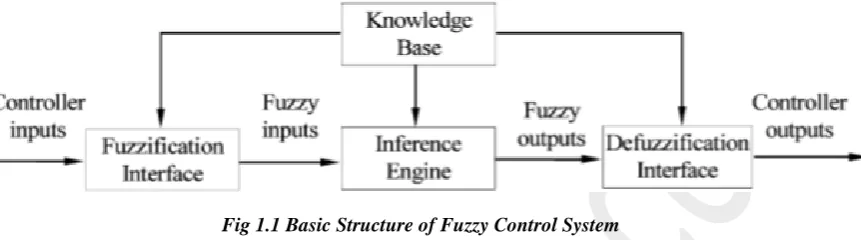
engine is a reasoning mechanism which performs inference procedure upon the fuzzy control rules and given conditions to derive reasonable control actions. It is the central part of a fuzzy control system. The fuzzification interface (or fuzzifier) defines a mapping from a real-valued space to a fuzzy space, and the defuzzification interface (or defuzzifier) defines a mapping from a fuzzy space defined over an output universe of discourse to a real-valued space. The fuzzifier converts a crisp value to a fuzzy number while defuzzifier converts the inferred fuzzy conclusion to a crisp value.
Fig 1.1 Basic Structure of Fuzzy Control System
Based on the differences of fuzzy control rules and their generation methods, approaches to fuzzy logic control can be roughly classified into the following categories. (i)Takagi–Sugeno (T–S) model-based fuzzy control; (ii) Mamdani model-based fuzzy control. Therefore, the main purpose of this paper is to survey of recent optimization techniques of fuzzy controller parameters. The rest of the paper is organized as follows. Briefly reviews the general approaches to fuzzy logic control in Section II. Liquid level monitoring and control discusses in section III. Section IV shows tabular summary of optimization methods. Concluding remarks, perspectives and challenges of optimization techniques of fuzzy controller parameters in future are discussed in Section V.
II.BRIEF REVIEW OF FUZZY LOGIC CONTROL
A. Conventional Fuzzy Control (Mamdani Type Fuzzy Control)[14]
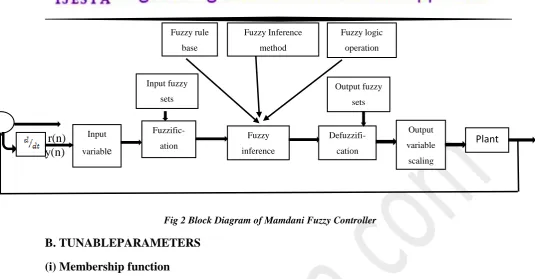
Mamdani and Assilian‘s fuzzy control which is classified as Type-I fuzzy control systems by Sugeno, has been replicated for many different control processes. The Block diagram of Mamdani Fuzzy Controller as shown in fig.2. For example, the authors in [38] develop a fuzzy control algorithm for a warm water plant. There are many other applications of conventional fuzzy control, including Liquid level control[13] [14][16], Temperature control [21] [30] [35], stirred tank reactor[37]etc.
Volume 02, No. 4, April 2016
P
age
52
r(n) y(n)
Fig 2 Block Diagram of Mamdani Fuzzy Controller
B. TUNABLEPARAMETERS (i) Membership function
A fuzzy set is represented by its MF; this means that a MF contains the pairs of the fuzzy set. Because membership functions are important for fine-tuning a fuzzy inference system to achieve a desired input/output mapping we need to be accurate and precise in define the correct type and parameters that form a MF. We refer to type of membership function, as the shape that a membership function can take. There are four main classes of parameterized MF of one dimension: triangular, trapezoidal, Gaussian and generalized bell.
(ii) Developing Fuzzy Control Rules
Many research papers have been written on how to create fuzzy rule sets. The main motivation for fuzzy logic is that by simply writing down common sense rules, it is possible to build a reasonable control strategy without deep theoretical knowledge of control. This means that we will have no knowledge of the stability properties of the controller, and so the scope of applications is restricted to fairly simple solution.
A fuzzy control system is obtained by writing a set of rules of the form:
IF {situation} THEN {action}
The procedure is to write down the basic rules and add and refine them based upon experience. In the example of the coupled tanks system, a fuzzy rule which forms part of a control system might be:
IF {error small} AND {change in error large positive}
THEN {control signal small} #1
The Fuzzy levels ‗error small‘ and ‗control signal large positive‘ would be obtained by using the error, e, and control signal, u, as input signals to two separate five level fuzzifiers and selecting outputs S and LP respectively. The fuzzy levels are then fed through a fuzzy AND
Input variable scaling
Fuzzy inference
Fuzzific-ation Input fuzzy
sets
Output variable
scaling
Defuzzifi-cation
Plant Fuzzy rule
base
Fuzzy logic operation Fuzzy Inference
method
Volume 02, No. 4, April 2016
P
age
53
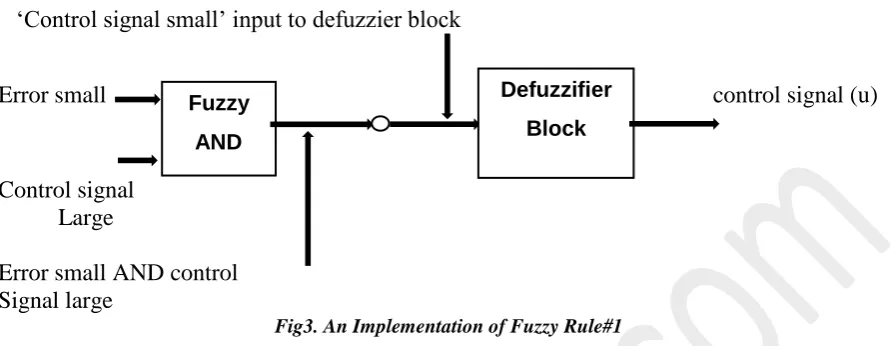
block to obtain a fuzzy value that gives the membership value corresponding to the situation. A fuzzy system which implements the fuzzy control rule #1 is shown in Figure
‗Control signal small‘ input to defuzzier block
Error small control signal (u)
Control signal Large
Error small AND control Signal large
Fig3. An Implementation of Fuzzy Rule#1
In most fuzzy logic control systems the set of fuzzy actions is a simple list of rules for an open loop sequence. A simple example, consider the case of the Coupled Tanks System, where the input pumpcannot be driven backwards to pump water out of the tank (e.g. the minimum control input is 0V) and the pump input signal amplifier will not accept more than a maximum of 10V. These practical limits on the working range of a control systems actuator are normal, and it is easy to adapt fuzzy controller to account for them. A fuzzy proportional controller which incorporates the constraint that minimum input signal is 0V is:
Rule 1: IF {error LN} OR {error MN} OR {error S} THEN {control S} Rule 2: IF {error MP} THEN {control MP}
Rule 3: IF {error LP} THEN {control LP}
Here the level S is 0v and Rule 1 ensures that the pump does not receive negative signals. Figure 4 is an implementation of this rule set.
Fig 4. Implementation of Fuzzy Rule Set
III. LIQUID LEVEL MOINTORING AND CONTROL
Many earlier works dealt with various techniques of monitoring and controlling of liquid levels in industrial and domestic applications. Broadly this automatic control problem can be achieved under two means: mechanical methods and electrical methods. Float ball type liquid level control is a popular method of control still used in practice for normal applications such as overhead tank overflow restrictors etc. The electrical methods of control include a microcontroller-based circuit which automatically predict the liquid levels and accordingly
Fuzzy
AND
Defuzzifier
Volume 02, No. 4, April 2016
P
age
54
active the circuit to operate motors. In spite of several such available methods, still there are new techniques in this application so as to avoid dangerous operating conditions in industrial boilers.
A. Liquid Level Optimization
Liquid Level optimization is the process whereby a selected design variable is varied automatically by anature-inspired algorithm in order to achieve desired outputs. These outputs typically represent the variation from a target, minimal cost and maximal performance. The FLC has as an objective to regulate the speed of the tank valve to maintain the lower liquid level L, and upper liquid level U according to a reference R. The plant consists of two interacting tanks, at different heights from the datum, with coupling between the pump tank1 also. The objective is to control tank 2 level by manipulating inflow to tank1. The FLC must respond, varying the water level; giving as output, the velocity of the valve opening. The corresponding fuzzy system has 3 inputs and 1 output (valve). The required number of membership functions, are 5 per input and 13 at the output. On the basis of experiments, the default water tank model and the default fuzzy system that MATLAB provides. To allow better performance of the algorithm, the proposed optimization has been sequentially structured as follows: the optimization of membership function type would be performed firstly, and continue with the optimization of the membership function parameters next. This is, because the parameter optimization is based on the type of membership function.
Let the objective be to control the level2' by controlling inflow to tank 1. Let four accessible variables be L1, the level of tank1: d , the change in : d , the change in , and E‘ the
error in viz. ( -SP ), where SP is the set point for . Simplifications can the done
taking only three variables via. E, d and d .
The following steps can be followed in inferring control action for a typical rule such as: If E=+ve, =-ve, d =+ve then control action?
a) Since E=+ve, it implies must be decreased
b) Since d =-ve, this competing influence, on its own, tends to decrease E to zero:
c) Now since d =+ve, inflow to tank 1 must be decreased so that +ve influence of dL1 is
countered. Hence the control action is to close the valve [8]
Volume 02, No. 4, April 2016
P
age
55
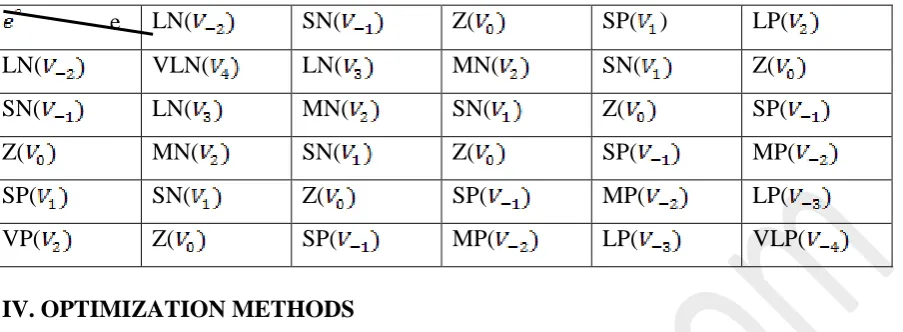
Table 3.2 Indices
e LN( SN( Z( SP( ) LP(
LN( VLN( LN( MN( SN( Z(
SN( LN( MN( SN( Z( SP(
Z( MN( SN( Z( SP( MP(
SP( SN( Z( SP( MP( LP(
VP( Z( SP( MP( LP( VLP(
IV. OPTIMIZATION METHODS
The main focus of this paper is to discuss optimization of fuzzy controller parameter by using various nature-inspired algorithm. By using fuzzy logic, designers can realize lower development costs, superior features, and better end product performance.
Table 4: Tabular Summary of Optimization Methods
S.NO Author Title Description
1. Dharamniwas,Aziz Ahmad,
Varun Redhu, Umesh gupta[14]
Liquid Level Control by using Fuzzy Logic Controller
The FLC simulated on a level control problem with promising results can be applied to an entirely different industrial level controlling apparatus. The result shows significant improvement in maintaining performance over the widely used PID design method in terms of oscillations produced and overshoot
2. W.Tan [20] Water Level Control for a Nuclear Steam Generator
This method proposed a water level control system for nuclear steam generator. The control system consisted of a feedback controller and a feedforward controller. The robustness and performance of both the controllers are analysed and tuning of the 2 parameter of the controllers. It was shown that the proposed gain scheduled controller can achieve good performance at high and low power levels.
3. Shome ,Ashok [21] Fuzzy Logic Approach for Boiler Temperature and Water level control
Volume 02, No. 4, April 2016
P age
56
and water level.
4. O.Safarzadeh, A.Kahki Sedigh , A.S.Shiran[22]
Identification and robust water level control of horizontal steam generator using quantitative feedback theory
This method proposed a design a robust QFT controller for the nonlinear uncertain SG, control oriented linear models are identified. The robust designed controller is applied to the nonlinear plant model .the nonlinear model is based on locally linear neuro-fuzzy model.
5. M.S das gupta[23] Fuzzy and ANN controller design and implementation on a level control setup
This method discusses successful implementation of fuzzy and ANN based controller for a level control setup, which has a rather narrow region due to wear and tear of prior usage. A fine-tuning is also designed to able effectively control the disturbances.
6. Majid Joshani, Rubiyah Yusof, Marzuki Khalid, A. Imam Cahyadi [24]
Swarm Intelligence Based Fuzzy Controller –A Design for Nonlinear Water Level Tank
A fuzzy direct controller is optimized in rule base using Particle Swarm Optimization algorithm. The optimization was performed subjected to minimize the output error surface of a nonlinear water level tank process. An offline Sugeno-Fuzzy system identifier is employed to prepare the evaluation function for particle swarm algorithm. Results show that the proposed controller performance was much better than simple human knowledge tuned controller.
7. Namrata Dey, Ria Mandal, M Monica Subashini [25]
Design and
Implementation of a Water Level Controller using Fuzzy Logic
This method analysed the effectiveness of water level control using fuzzy logic. The water level in the tank is sensed using transistor switching principle. The level sensed was fed to the PIC16 microcontroller. The user provides the set point to the microcontroller through serial communication using the COM development port software.
8. J.S.Saini, Y.P.Singh[19]
Use of causal knowledge in a real-time fuzzy logic controller
Volume 02, No. 4, April 2016
P
age
57
study, a real-time fuzzy rule-based controller employing causal knowledge was designed for the control of liquid level in a pilot plant. It was tested for closed -loop operation under different conditions, viz., set point change, noise disturbance, and structural (parametric) change.
9. M.S.M Aras, M.F. Basar, N. Hasim, M.N. Kamaruddin, H.I. Jaafar[26]
Development and Modelling of Water Tank System Using System Identification Method
This method presents the development and modelling of Water Tank System (WTS) for temperature control using system identification technique. The WTS was tested on an open loop system to obtain measured input-output signals. Input and output signals from the system are recorded and analysed to infer a model. The objective of this paper is to reduce or eliminate the overshoot of system response from temperature setting. The conventional controller PID and Fuzzy Logic Controller (FLC) were used to control the temperature to maintain its desired value.
10. ZHAO Taoyan, LI Ping and CAO Jiangtao[27]
Study of Interval Type-2 Fuzzy Controller for the Twin-tank Water Level System
This method proposed a novel interval type-2 fuzzy control system which dealing with large static error due to poor immunity of the traditional fuzzy control. The proposed control system can efficiently reduce the uncertain disturbance from real environment without increasing the design complexity.The proposed method succeeded in better static and dynamic control with stronger robust performance than the traditional fuzzy control method.
11. K.Govinda, Sreekar.ch ,Sandilya .k[28]
Reservoir Water Level Indicator using UM66 Microcontroller
Volume 02, No. 4, April 2016
P
age
58
level by providing an indicator system.
12. Daniel Wu, Fakhreddine Karray, Insop Song[29]
Water Level Control by Fuzzy Logic and Neural Networks
This method investigated and find a solution by designing the intelligent controllers for controlling water level system, such as fuzzy logic and neural network. The controllers also can be specifically run under the circumstance of system disturbances. To achieve these objectives, a prototype of water level control system has been built and implementations of both fuzzy logic and neural network control algorithms are performed.
13 P. Singhala, D. N. Shah, B. Patel[30]
Temperature Control using Fuzzy Logic
The aim of the temperature control is to heat the system up to delimitated temperature, afterward hold it at that temperature in insured manner. Fuzzy Logic Controller (FLC) is best way in which this type of precision control can be accomplished by controller. During past twenty years significant amount of research using fuzzy logic has done in this field of control of non-linear dynamical system. Here they had developed temperature control system using fuzzy logic. Control theory techniques are the root from which convention controllers were deducted. The desired response of the output can be guaranteed by the feedback controller.
14 Saeed Balochian, Eshagh Ebrahimi [31]
Parameter Optimization
via Cuckoo
Optimization
Algorithm of Fuzzy Controller for Liquid Level Control
Volume 02, No. 4, April 2016
P
age
59
used to achieve the optimal parameters of the membership functions. The results showed clearly that the optimized FLC using COA has better performance compared to manually adjustments of the system parameters for different datasets.
15 Naa Ju Na, Zeugnam Bien [32]
A Fuzzy Controller for the Steam Generator Water Level Control and its Practical Self-Tuning Based on Performance
The water level control system of the steam generator in a pressurized water reactor and its control problem are analysed. In this work, a stable control strategy particularly during low power operation based on the fuzzy control method has studied. The Control strategy employs substitutional information using the bypass valve opening instead of incorrectly measured signal at the low flow rate as the fuzzy variable of the flow rate during low power operation, and includes the flexible scale adjusting method for fast response at a large transient. A self-tuning algorithm based on the control performance and the descent method is also suggested for tuning the membership function scale. It gives a practical way to tune the controller under real operation. Simulation was carried out on the Compact Nuclear Simulator set up at Korea Atomic Energy Research Institute and its results showed the good performance of the controller and effectiveness of its tuning.
16 Surachai Panich [33]
Development of Fuzzy Controller for Water Level in Stream Boiler Tank
Volume 02, No. 4, April 2016
P
age
60
temperature and pressure in boiler tank measured by sensor. For fuzzy system of water level control, the algorithm is basically implemented in form of the MATLAB code. In the experiment, they assumed that the water level would not effect to the temperature and pressure. Conclusion: The research for the development of the fuzzy logic and the model was tested with the step inputs and the changing of the inputs. The whole simulation process was built to test the behavior of the system when the inputs change.
17. ChulHwan Jung, Kee-Choon Kwon [34]
A fuzzy controller with a real-time tuning algorithm and its application to a steam generator water level control
It is necessary to tune the fuzzy rules and the scaling factors in real-time control of a large scale system, the steam generator of a nuclear power plant, as it is related to safety and availability of the plant. A novel real-time tuning algorithm of fuzzy controller based on the scaling factors is proposed and applied to the steam generator water level control system of the nuclear power plant. The new real-time tuning algorithm adopts a variable reference tuning index for a good system tuning response and an instantaneous system fuzzy performance for scaling factor tuning. For the fuzzy steam generator controller, an image signal of feed water flow error at low power has proposed and pressure compensation rules and a gain scheduler of feed water temperature arc designed also. The fuzzy controller of the steam generator water level was simulated by the proposed method. The simulation results showed that the improved performance of the steam generator ·water level controller by the proposed method.
18 Isizoh A. N., Okide S. O, Anazia A.E., Ogu C.D [35]
Temperature Control System Using Fuzzy Logic Technique
Volume 02, No. 4, April 2016
P
age
61
control strategy. As a result, it delivers solutions faster than the conventional control design techniques. This paper thus presents a fuzzy logic based temperature control system, which consists of a microcontroller, temperature sensor, and operational amplifier, Analogue to Digital Converter, display interface circuit and output interface circuit. It contains a design approach that uses fuzzy logic technique to achieve a controlled temperature output function.
19 Seyed Kamaleddin Mousavi Mashhadi, Elham Sareban, Amir Aminian [36]
Design Fuzzy
Controller for Synthesis Water Level
The purpose of this paper is the design of fuzzy control for the synthesis water level control system. At first, they design classical PID controller and then compared with Sugeno and Mamdani type of new investigated fuzzy logic controller (FLC). Finally, used regression analysis for implementation of designed fuzzy controller in practice. Simulation results show the ability of designed controller and regression analysis as practical method for implementation of this controller
Thus, we can see optimization of fuzzy controller parameter for a water level control by using various nature-inspired algorithm have been proposed till now. Every optimization method has its own advantages and limitations. Certain assessment criteria have also been proposed by many researchers to choose an efficient optimization method.
V. CONCLUSION AND FUTURE WORK
Volume 02, No. 4, April 2016
P
age
62
REFERENCES
i. X. S. Yang, Nature-Inspired Metaheuristic Algorithm, Luniver Press, Beckington, UK, 2nd edition, 2010.
ii. J.H. Holland, Adaptation in Natural and Artificial Systems, University of Michigan Press, 1975, ISBN 9780262581110.
iii. S. Kirkpatrick, C.D. Gelatt, M.P. Vecchi, Optimization by simulated annealing, Science 220 (4598) (1983) 671–680.
iv. K. Price, R. Storn, J. Lampinen, Differential Evolution—a Practical Approach to global optimization, springer, Berlin,2005
v. X.S. Yang, S. Deb, Cuckoo search via Levy flights, in: IEEE World Congress on Nature and Biologically Inspired Computing, 2009, pp. 210–21
vi. X.S. Yang, A new metaheuristic Bat-Inspired algorithm, in: Nature Inspired Cooperative Strategies for Optimization, Studies in Computational Intelligence, vol. 284, Springer, Berlin, 2010, pp. 65–74.
vii. Evelia Lizárraga Olivas, Oscar Castillo, Fevrier Valdez and José Soria, ―Ant Colony Optimization for Membership Function Design for a Water Tank Fuzzy Logic Controller” IEEE Transaction, 2013
viii. Majid Joshani, Rubiyah Yusof, Marzuki Khalid, A. Imam Cahyadi, ―Swarm Intelligence Based Fuzzy Controller – A Design for Nonlinear Water Level Tank‖, International Conference on Intelligent Systems Modelling and Simulation, 2012
ix. K. Price, R. Storn, J. Lampinen, Differential Evolution-A Practical Approach to Global Optimization, Springer, Berlin, 2005.
x. J.R. Koza, Genetic Programming: On the Programming of Computers by Natural Selection, MIT Press, Cambridge, 1990
xi. P. Moscato, on evolution, search, optimization, genetic algorithms and martial arts: towards Memetic Algorithms, Caltech Concurrent Computation Program Report 826, 1989.
xii. Z.W. Geem, J.H. Kim, G.V. Loganathan, A new heuristic optimization algorithm: Harmony search, Simulation 76(2)(2001)60-68
xiii. J.H. Holland, Adaptation in Natural and Artificial Systems, University of Michigan Press, 1975, ISBN 9780262581110
xiv. Dharamniwas, Aziz Ahmad, Varun Redhu and Umesh Gupta, ―Liquid Level Control by Using Fuzzy Logic Controller”July 2012, pp. 537-549.
xv. PROCYK, T. J AND MAMDANI, E. H. ―A Linguistic self-organizing process controller‖, Automatica, 1979, Vol. 15. pp. 15-30
xvi. B. SUBUDHI AND A. K. SWAIN, ―Optimization of Membership Functions of Fuzzy Logic Controller for Controlling Liquid Level Using Genetic Algorithm” Jan.—Feb. 1997, pp.77.
Volume 02, No. 4, April 2016
P
age
63
xviii. Harshdeep Singh, ―Design of Water Level Controller Using Fuzzy Logic System‖,National Institute of Technology Rourkela, Department of Mechanical Engineering.
xix. J.S.Saini and Y.P.Singh, ―Use of Causal Knowledge in a Real-time Fuzzy Logic Controller”, IEEE Transaction, 1995
xx. W.Tan, ‗Water level control for a nuclear steam generator‘, Nuclear Engineering and Design, vol.241, pp.1873-1880, 2011
xxi. A. Shome and D. Ashok, ‗Fuzzy Logic Approach for Boiler Temperature and Water level Control‘, International Journal of Scientific and Engineering Research, vol.3, pp. 1-6, 2012
xxii. O. Safarzadeh, A.Kahki Sedigh and A.S. Shirani, ―Identification and robust water level Control of horizontal steam generators using quantitative feedback theory‖, Energy Conversion and Management, vol.52, pp.3103-3111, 2011
xxiii. M.S das gupta, ―Fuzzy and ANN Controller Design and Implementation on a level control setup‖, UGC National Conference on advances on industrial automation, vol.2, March 2004.
xxiv. Majid Joshani, Rubiyah Yusof, Marzuki Khalid, A. Imam Cahyadi, ―Swarm Intelligence Based Fuzzy Controller – A Design for Nonlinear Water Level Tank‖, International Conference on Intelligent Systems Modelling and Simulation, 2012
xxv. Namrata Dey, Ria Mandal, M Monica Subashini, ―Design and Implementation of a Water Level Controller using Fuzzy Logic‖, International Journal, Vol 5 No 3, Jun-Jul 2013
xxvi. M.S.M Aras, M.F. Basar, N. Hasim, M.N. Kamaruddin, H.I. Jaafar, ―Development and Modeling of Water Tank System Using System Identification Method‖ ,International Journal, Volume-2, August 2013.
xxvii. ZHAO Taoyan, LI Ping and CAO Jiangtao, ―Study of Interval Type-2 Fuzzy Controller for the Twin-tank Water Level System‖,Chinese Journal of Chemical Engineering, Vol. 20, Dec 2012.
xxviii. K. Govinda, Sreekar.ch, Sandilya .k, ―Reservoir Water Level Indicator using UM66 Micro-controller‖,International Journal for Scientific Research & Development, Vol. 2, 2014
xxix. Daniel Wu, Fakhreddine Karray, Insop Song, ―Water Level Control by Fuzzy Logic and Neural Networks‖, University of Waterloo
xxx. P. Singhala, D. N. Shah, B. Patel, ―Temperature Control using Fuzzy Logic‖, International Journal of Instrumentation and Control Systems (IJICS) Vol.4, No.1, January 2014.
xxxi. Saeed Balochian, Eshagh Ebrahimi, ―Parameter Optimization via Cuckoo Optimization Algorithm of Fuzzy Controller for Liquid Level Control‖, Hindawi Publishing Corporation Journal of Engineering Volume, 2013
Volume 02, No. 4, April 2016
P
age
64
xxxiii. Surachai Panich, ―Development of Fuzzy Controller for Water Level in Stream Boiler Tank”, Journal of Computer Science 6 (11): 1233-1236, 2010.
xxxiv. ChulHwan Jung, Kee-Choon Kwon, ―A fuzzy controller with a real-time tuning algorithm and its application to a steam generator water level control‖, Control and Cybernetics vol. 27, No. 4, 1998.
xxxv. Isizoh A. N., Okide S. O, Anazia A.E., Ogu C.D, ―Temperature Control System Using Fuzzy Logic Technique‖, (IJARAI) International Journal of Advanced Research in Artificial Intelligence, Vol. 1, No. 3, 2012.
xxxvi. Seyed Kamaleddin Mousavi Mashhadi, Elham Sareban, Amir Aminian, ―Design Fuzzy Controller for Synthesis Water Level”,Journal of mathematics and computer Science ,vol.9 ,2014.
xxxvii. P. J. King and E. H. Mamdani, ―The application of fuzzy control systems to industrial process,‖ Automatica, vol. 13, pp. 235–242, 1977