World Maritime University
The Maritime Commons: Digital Repository of the World
Maritime University
World Maritime University Dissertations Dissertations
2000
Privatisation of shipping agency services in
Tanzania : a case study of an economic policy
problem
Pilly Saidi
World Maritime University
Follow this and additional works at:http://commons.wmu.se/all_dissertations Part of theEconomic Policy Commons
This Dissertation is brought to you courtesy of Maritime Commons. Open Access items may be downloaded for non-commercial, fair use academic Recommended Citation
Saidi, Pilly, "Privatisation of shipping agency services in Tanzania : a case study of an economic policy problem" (2000).World Maritime University Dissertations. 43.
WORLD MARITIME UNIVERSITY
Malmö, Sweden
PRIVATISATION OF SHIPPING AGENCY
SERVICES IN TANZANIA
A case study of an economic policy problem
By
PILLY N.B. SAIDI
TanzaniaA dissertation submitted to the World Maritime University in partial fulfillment of the requirement for the award of the degree of
MASTERS OF SCIENCE
in
SHIPPING MANAGEMENT
DECLARATION
I certify that all material in this dissertation that is not my own work has been identified, and that no material is included for which a degree has previously been conferred on me.
The contents of this dissertation reflect my own personal views, and are not necessarily endorsed by the University.
………(Signature)
……….(date)
Supervised by:
Name: Professor JRF.[Dick] Hodgson Office: Associate Professor.
World Maritime University
Assessor:
Name: Professor Bernard Francou
Office: Associate professor, Port Management World Maritime University
Co-assessor:
ACKNOWLWDGEMENT:
I would like to express my sincere gratitude to all parties who have, in one way or another, facilitated this study.
First and foremost, I would like to convey my special thanks to my supervisor Professor D. Hodgson and my assessor Professor B.Francou for the guidance they have given me during this study
Secondly, I would like to express my appreciation to the management of the National Shipping Agencies Company, for encouraging me to take this course and for the moral support they have given during my stay at WMU.
Thirdly, I would like to convey my gratitude to my sponsors: IMO Technical
Co-operation and NORAD for granting me a scholarship and especially for their efforts to promote the women participation in the maritime industry.
Fourthly, I owe special thanks to my friends Mr. S.M.Mbwana and Mrs Vicky Mtefu for supporting me and for taking care of my family. I also thank my daughters Limi and Mhindi, and my son Unguma for the moral support and encouragement they have given me while l was away from them
ABSTRACT:
Tittle of dissertation: PRIVATISATION OF SHIPPING AGENCY SERVICES IN TANZANIA.
A case study of an economic policy problem. DEGREE: MSC.
This dissertation is a study of the privatisation of shipping agency sector in Tanzania. The study addresses the factors that led to privatisation, how privatisation was carried out, and its impact on the national economy.
A brief review is made of the portfolio and performance of the shipping agency functions under the state owned company “The National Shipping Agencies Company (NASACO)” before privatisation, in order to examine the strengths and weaknesses of such public enterprises. The structure of the Tanzanian Privatisation Policy is described, and the respective program for privatising the shipping agency is explained so as to give a clear understanding of privatisation and its objectives. The study identifies the primary objectives of privatising shipping agency sector as to remove the monopoly of NASACO, to promote efficiency by encouraging competition, and to increase the contribution of shipping agency services (as private sector) in the economy. The study analyses results of privatisation in order to assess the success and the failure of privatisation excise. The success was evidenced by customer satisfaction and by increased efficiency and quality of services rendered by new agency companies. On the other hand privatisation resulted in unfair competition between the players, concentration of powers by foreign shipping lines and elimination of local agency companies from the market. The concluding chapter offers several recommendations that need to be considered and implemented to rectify the present situation in the shipping agency sector.
TABLE OF CONTENTS
Declaration ii
Acknowledgement iii
Abstract iv
Table of content v
List of tables vi
List of Abbreviations viii
1 Introduction 1
2 The Policy of Privatisation in Tanzania 6
2.1 A Description of the Policy 7
2.1.1 Primary objectives of privatisation 7
2.1.2 Secondary objectives of privatisation 7
2.2 Operating policies and principles-Privatisation 8
2.2.1 Transparency 8
2.2.2 Consumer interests 8
2.2.3 Safety net 9
2.2.4 Debt settlement and reorganisation 9
2.2.5 Valuation 9
2.2.6 Monitoring 10
2.3 Operating principles and policies-Reforms 10
2.3.1 Equality and treatment 10
2.3.2 Accountability of company boards and management10
2.3.3 Subsidies 11
2.4 Implementation of Privatisation Policy 11
2.4.1 Privatisation methods 11
2.4.1.1 Feasibility study 11
2.4.1.2 Preparation for privatisation 12
2.4.3 Restructuring method 13
2.5 The performance of NASACO before liberalisation 14
2.5.1 physical performance 15
2.5.1.1 ship calls 15
2.5.1.2 Import cargo 15
2.5.1.3 export cargo 15
2.5.1.4 transit cargo 16
2.5.2 Financial performance 16
2.5.2.1 Revenue 16
2.5.2.2 Expenses 16
2.5.3 Operational problems 17
2.5.3.1 Port performance 17
2.5.3.2 Customs procedures 18
2.5.3.3 Railways and road services 18
2.5.3.4 Communication facilities 18
2.5.3.5 Storage facilities 19
2.5.3.6 Container monitoring 19
2.6 Liberalisation of shipping agency services 20
2.6.1 Restructuring of NASACO 22
2.6.2 Privatisation 22
2.6.3 Liberalisation 22
3 The consequences 24
3.1 The collapse of NASACO 25
3.1.1 Dar-es-Salaam branch 25
3.1.1.1Azania Shipping Agency Company 26
3.1.1.2Oceanic Shipping Agency Company 26
3.1.1.3Victoria Shipping Agency company 26
3.1.1.4 World wide Shipping Company 27
3.1.1.5 Summary of Performance impact 28
3.1.3 Mtwara branch 29
3.1.4 Tramp shipping and other services 29
3.2 In-house agencies 29
3.3 Unfair competition 31
3.4 Lack of control 32
3.4.1 Entry regulations - restructuring phase 33
3.4.2 Company structure and ownership 33
3.4.3 Entry regulations – liberalisation phase 33
3.4.4 Other regulations 33
4 Critical analysis of Privatisation Policy and its implications 37
4.1 The correctness of the policy 37
4.1.1 To raise additional revenue to state 38
4.1.2 To promote economic efficiency 40
4.1.3 To develop capital market 41
4.1.4 To introduce competition 42
4.1.5 To gain social benefits 42
4.2 Fair Trade Practices Act 49
4.3 A Code of conduct and its purpose 52
5 Conclusion and recommendations 57
LIST OF TABLES:
Table 1 Five-year physical performance - 1991/92 – 1995/96 16
Table 2 five-year financial performance – 1991/92 – 1995/96 17
Table 3 Transit dray cargo through ports of Dar-es-Salaam and
Mombasa. 20
Table 4 Top ten African countries in sales value 40
Table 5 Post privatisation performance: Key results for 79
LIST OF ABBREVIATION
AVE Average
BESTA Baltic East Africa line
DSM Dar-es-Salaam
DSR Deutfrancht Sereederei Rostock
GCL Global Container Line
IMF International Monetary fund
KNSL Kenya National Shipping Line
LT Lloyd Triestino line
LTD Limited
LNL Laurel Navigator Line
MOL Mitsui OSK Line
MSC Meditterenean Shipping Line
NASACO National Shipping Agencies Company
PARASTATAL A state owned enterprise
PE Public Enterprise
PIL Pacific International Line
P& OCL P&O Container Line
POL Polish Line
PSRC Parastatal Sector Reforms Commission
SCI Shipping Corporation of India
SOE State Owned Enterprise
TAZARA Tanzania – Zambia Railway Authority.
UNCTAD United Nations Conference on Trade and Development
WEC West European Container Line
CHAPTER ONE:
1.0 INTRODUCTION:
After independence in 1961, Tanzania decided to adopt a policy of socialism for its economic development. The first step was to nationalise the means of production by transferring the ownership of all economic activities from private hands to the government, aimed at collective production and consumption. The government put more emphasis on social services such as health, education, housing, water and employment.
After nationalisation, the national economy development was dominated by the State with centralised planning, corrective intervention in resource allocation and controlled foreign exchange as part of the government’s strategies.
1.1 Creation of the state owned enterprises:
In order to run the nationalised activities and property; the government created State owned enterprises ( SOEs) or public enterprises ( PEs), which were mainly administered by local Tanzanians. The public enterprises were expected to generate public savings for investments and economic growth in order to achieve social and economical goals. Employment generation, subsidisation of goods and services and regional equalisation were among the State’s objectives on public enterprises.
1.2. Failure of the public enterprises:
enterprises, a situation that forced the government to subsidise production. Poorly trained managers, who lacked direction and vision, managed most of the public enterprises.
The enterprises were characterised by overstaffing, insufficient financial control systems and political interference. Employees’ lack of business consciousness, insensitivity to customer demand, poor quality of goods and services, and lack of accountability were serious problems for those enterprises. Consequently the companies were unprofitable and had a poor return on investment.
Loss making enterprises have been a significant burden on the government budgets Due to various problems faced by the public enterprises, most of them failed to generate an investible surplus and instead they created a budgetary burden on the public sector. No government objectives for establishing public enterprises were attained as planned.
An overall impact of the poor performance on the public sector was the widening of the vicious circle, whose slow and low economic growth resulted in low investment and general poverty of the nation.
1.3. The remedial action:
The public sector became a heavy burden on the government; debts were accumulated, productivity was poor and there was an increasing trend towards money swindling, contrary to the government’s expectations. The situation illustrated the failure of the policy and therefore, raised the need to reverse it. Promoting and encouraging private investment through privatisation of the public sector was seen as the key to the way ahead.
The study will focus on liberalisation of the shipping agency services in the country. At the time when State-owned enterprises were established, all shipping agency services were placed under the State enterprise named the National Shipping Agencies Company Limited (NASACO). As the sole shipping agent, the company enjoyed a State of monopoly and hence its performance was very good for its entire life up to the year 1992 when the performance started to decline. There were various problems that contributed to the poor performance, including unfavourable weather for agricultural production which resulted in a decline in agricultural products as the main exports of Tanzania. Civil war in the neighbouring countries of Rwanda and Burundi hampered the transit cargo to/from those landlocked countries that used the port of Dar-es-Salaam for their sea borne trade. Acute inflation that decreased the value of the Tanzanian shilling (Tsh.) made imports more costly and hence decreased the quantity of import cargo. However the privatisation of NASACO was not due to inefficiency, it was due to the government’s decision to withdraw itself from commercial activities in order to let market forces play their role in economic development. NASACO was first listed for restructuring to promote efficiency before full liberalisation of agency services when the company would have to compete with other agency companies.
1.4. Problem definition.
without a proper legal framework as guidance to the new structure. The government Act on the Fair Trade Practices and a Code of Conduct for shipping agents was still under preparation.
1.5. The significance of the problem:
The significance of the problem was derived from the fear that the benefits of privatisation may not be gained due to the wrong implementation of the privatisation program. The government, through the Minister of Trade and Industries, acted against its own policies regarding the restructuring program of NASACO. The government had objectives for restructuring and obviously the program was set according to those objectives. If the program was not followed, then the objectives would not be attained. Chapter Two will look at the policy of privatisation in Tanzania and how it was implemented in liberalising shipping agency services.
Privatisation was accepted as a way of economic revival. The success of privatisation depended not only on how the program was formulated, but also on its implementation and the achievement of the objectives. Unless privatisation took place under favourable conditions without adverse consequences then its very credibility would be affected. For this reason therefore, a privatisation strategy was needed, that would address the concerns of the affected groups, build consensus about the key privatisation objectives and obtain public support for the program. The consequences of liberalisation of the agency sector will be discussed in Chapter Three.
1.6 The purpose of this study.
The purpose of this study is to examine the liberalisation of shipping agency services in Tanzania, the consequences of that liberalisation and its implications for the national economy and for society in general.
Research methodology:
The study involved discovery through literature reviews of published and unpublished materials relating to shipping. It also involved reports from NASACO, the Tanzania Harbours Authority, and the Ministry of Trade and Industries, publications from the WMU library, information from internet sources and information obtained from shipping companies during our field trips. Various shipping lines were visited (in Tanzania) to obtain their views on the changes. Potential shippers and major freight forwarders were also contacted.
Limitation of the study.
CHAPTER TWO.
2.0 A POLICY OF PRIVATISATION IN TANZANIA.
2.1 A DESCRIPTION OF THE POLICY:
Privatisation means transferring publicly owned assets to the private sector either by the sale of assets, by deregulating the whole public sector and opening up state monopoly to greater competition, or by joint capital projects. The thrust of the reform in Tanzania was necessitated by the need for improvement in economic growth rates and enhancement of investment levels. The government withdrew from running the business, and assumed the role of policy co-ordination and regulation. It encouraged the establishment and expansion of the private sector, which the government recognised as the engine of economic development and sustainability.
This Chapter is divided in two parts. Part One will describe the privatisation policy and Part Two will look at liberalisation of shipping agency services.
The government outlined its primary and secondary objectives of privatising the public sector as follows:
-2.1.1. Primary objectives of Privatisation:
(i) To improve the operational efficiency of public enterprises and their contribution to the national economy.
(ii) To reduce the burden of public enterprises on the government budget. (iii) To expand the role of the private sector in the economy so as to permit the
government to concentrate on its role as a provider of basic public utilities such as education, health and infrastructure.
(iv) To encourage wider participation by private individuals in the ownership through the purchase of company shares.
The above objectives were to be achieved through commercialisation, restructuring and divestiture of the activities of all significant enterprises in the public sector.
2.1.2. Secondary objectives:
(i) To create a more market-oriented economy. (ii) To secure access to foreign markets.
(iii) To promote the development of a capital market .
The public enterprises were divided into three categories: (i) Social services institutions.
(ii) Public utilities.
(ii) Commercial enterprises.
The government decided on the following methods for divestiture. (i) Public share offering
(iv) Management buyout
(v) Management contracts or lease of assets. (vi) Liquidation.
The author’s area of concentration will be on the commercial enterprise category. Commercial enterprises were to become available to foreign and local participation. Those unprofitable enterprises that could not attract private investors were to be closed and liquidated. Certain commercial enterprises were to be subject to restructuring prior to sale. (NASACO as the Model Company was in this category).
2.2. OPERATING POLICIES AND PRINCIPLES: PRIVATISATION: The work of the Parastatal Sector Reform Commission was to be guided by the following principles (as per Parastatal Privatisation and Reform Master Plan).
2.2.1. Transparency:
The overall reform process (i.e. individual divestitures and reforms) was to be carried out with a maximum degree of transparency and public accountability consistent with commercial confidentiality. The intention was to divest individual enterprises. Information on their financial performance, bidding procedures, criteria for bid evaluation and the results were all to be publicised. The associated ministries and firms were to be represented in decision-making committees to provide checks and balances.
2.2.2 Consumer interests:
power supply would be subject to regulations that balanced the long-term interests of both consumers and suppliers.
2.2.3 Safety net:
The individual employees who accepted or were required to accept redundancy from enterprises that were sold or restructured, would be entitled to statutory benefits and might also receive supplementary compensation. Early retirement without loss of benefits was also considered. Redundancy costs would be borne by government in order to avoid discouragement of potential buyers. Those who would be victims of the whole exercise would be assisted, and advice would be provided on retraining, relocation and establishment of small businesses.
2.2.4 Debt settlement and reorganisation:
More than half of the public enterprises were burdened with huge debts to treasury and banks and were therefore partly or wholly unserviceable, which severely constrained the privatisation option, future profitability and investments. The government, on a case by case basis, adopted a flexible approach to the cancellation of such debts or conversion into equity at a discount; such equity could be sold to the public at a later date. New expenditures on enterprises to be divested within a year were discouraged.
2.2.5 Valuation:
2.2.6 Monitoring:
PSRC was to monitor the conditions in the agreements entered into by the buyers as well as the performance under suitable agreements of enterprises still in public ownership. It was also to monitor the progress of the public enterprise reform program as a whole and the results achieved. The results were to be published annually.
As noted in the previous Chapter, other enterprises were to be reformed before full liberalisation of the related sector. The following discussion will look at policies and principles governing reforms of public enterprises.
2.3 OPERATING POLICIES AND PRINCIPLES: REFORMS:
Some of the public enterprises were chosen for reform and restructuring prior to sale or were retained in public ownership. The purpose of the restructuring was to allow a gradual transition from government ownership to private ownership of economic activities. For the retained enterprises the following principles applied:
-2.3.1 Equality of treatment:
The government would continue to pursue policies designed to give public enterprises the same access as the private sector to resources, inputs and markets, as well as price, tax and regulatory policies designed to improve business environment. Preference for public enterprises would be withdrawn.
2.3.2 Accountability of company boards and management:
It also indicated the limit of the management authority, planning and budget approval procedure. The role of the government, board of directors and that of the management were to be clarified.
2.3.3 Subsidies:
Direct and indirect subsidies were to be phased out. Limited transitional assistance was seen as possibly necessary within the context of an agreed plan for each firm and performance targets. If a turn around was not possible within an agreed period, the enterprise was to be closed.
A privatisation policy should also include different methods of implementing it depending on the type and performance of enterprises. The following section describes the implementation steps taken by the government for both divestiture and reforms of enterprises.
2.4 IMPLEMENTATION OF THE PRIVATISATION POLICY:
The process of implementing government strategy for the public sector reform was to be either by privatisation or by restructuring.
2.4.1 Privatisation methods:
The privatisation process was to be considered in three stages i.e. feasibility study on individual enterprises, preparation and implementation of the divestiture.
2.4.1.1 Feasibility study:
(i) The nature of the industry, the existing technology involved and the need for new technology, or market access.
(ii) The expected type and level of investor interest.
(iii) The need, if any, to preserve the past public ownership. (iv) Short and long term impact on employment.
(v) The need to maximise the proceeds of privatisation. (vi) The need to maximise the eventual returns to Treasury. (vii) The constraints of privatisation.
2.4.1.2 Preparation for privatisation:
Preparation was to include the following functions:
(i) Carrying out financial, commercial and technical appraisal, assessment of the products, markets and competition, resources requirement and future prospect
(ii) Review of the corporate structure to determine necessary changes needed to facilitate the divestiture
(iii) A legal review of the enterprise and the regulatory environment in which it operated to identify possible drawbacks.
(iv) Preparation of initial valuation of the enterprises.
The scope of work to be carried would depend on the privatisation option selected. For example a public offering would need more time for preparation than a direct sale, while liquidation would require a different approach.
2.4.2 Implementation of the divestiture:
-(i) Marketing the offer by advertising and trade searches to identify potential buyers.
(ii) Invitations to bid. (iii) Assessment of the bids.
(iv) Negotiations with potential buyers. (v) Obtaining government approval for sale. (vi) Preparation of a contractual document. (vii) Completion of the sale
2.4.3 Reform and restructuring methods.
The reform and restructuring process was to be applied to those public enterprises which were to be retained under the public sector either transitionally or for a longer term, largely in public utilities such as telecommunications, power supply and water supply. The government decision to retain an enterprise was to be subject to an improvement in efficiency assessed by reduction in the cost of production, enforcement of hard budget constraints by removal of direct and indirect subsidies, enforcement of tax payments and removal of preferential access to finance and foreign exchange. An increase in enterprise autonomy was also expected through price control, wages distribution and marketing. Board and ministerial powers were to be redefined and there was to be a reduction or elimination of holding corporations and improved accountability. The government role in relation to the retained enterprises was to set up objectives, to monitor performance, to reward success and penalise shortfalls.
Sections 2.1 to 2.4 described the structure of privatisation policy in Tanzania and the procedures for its implementation. The success of any privatisation depends on how the policy is formulated and the achievement of the objectives of the privatisation program.
2.5 THE PERFORMANCE OF NASACO BEFORE RESTRUCTURING: NASACO was established in 1973 primarily as a liner agent. Its mission was to service and facilitate the transportation of Tanzania’s seaborne trade. The main objective was to provide ship owners and their clients with satisfactory agency services at a reasonable cost. The company enjoyed monopoly advantages through State protection of its market, this was in conformity with the policy of socialism and self-reliance, which was adopted after independence. Under that protection, the company operated successfully for the first twenty-five years of its existence. Despite its inefficiency, it employed about 700 employees, generated revenue of about $ 10 million (about Tsh. 50 to 1$ in 1973) annually. The company paid between Tsh. 500 to 750 million in direct taxes every year paid annual dividends of about Tsh.100 million to a sole shareholder (the Treasury) and owned fixed assets worth Tsh. 10 billion in Dar-es-salaam, Tanga and Mtwara branches.
The profile of NASACO services was as follows. (i) Ship husbandry.
Arrangement for pilotage and tug services.
Ensuring the availability of berths and working equipment Clearing ships in and out of the port.
(ii) Cargo canvassing, cargo booking and documentation. (iii) Transhipment services for overlanded or shortlanded cargo
(iv) Processing and settlement of marine claims on behalf of principals. (v) Collection of freight money.
(vi) Tallying of cargo
(vii) Container stuffing and stripping
(viii) Container tracing, retrieval and storage. (ix) Freight forwarding
NASACO, as a sole shipping agent, rendered the above services to all shipping lines calling at the main ports in the country i.e. Dar-es-Salaam. Tanga and Mtwara. The performance of the company may be looked at through two-dimensions: physical performance and financial performance. The performance and factors that contributed to it will be discussed as follows:
-2.5.1 Physical performance
On looking at physical performance, attention should be focused on the number of ships handled, tons discharged and loaded, and transit cargo handled during the period under review.
2.5.1.1 Ship calls
The company handled 760 ships in 1991/92, the number increased to 857 in the following year. From 1993/94 a steady decrease was recorded in subsequent years as per Table 01.
2.5.1.2 Import cargo.
Import cargo handled was 3.1 million tons in 1991/92 and increased to 4.2 million tons in 1992/3. There was a decrease from year 1993/94 to 1995/96 whereby 3.44mil tons. 3.38 mil tons and 3.28 mil tons were recorded respectively.
2.5.1.3 Export cargo.
Table. 01. Five-year physical performance: 1991/92-1995/96.
1991/92 1992/93 1993/94 1994/95 1995/6
Ship calls 760 857 778 772 753
Imports- ton (mil.) 3.1 4.2 3.4 3.38 3.28
Exports-tons (mil.) 2.8 1.7 0.9 0.8 0.92
Total tons (mil.) 5.9 5.9 4.3 4.18 4.28
Source.NASACO’s annual report 1995/96
2.5.1.4 Transit cargo
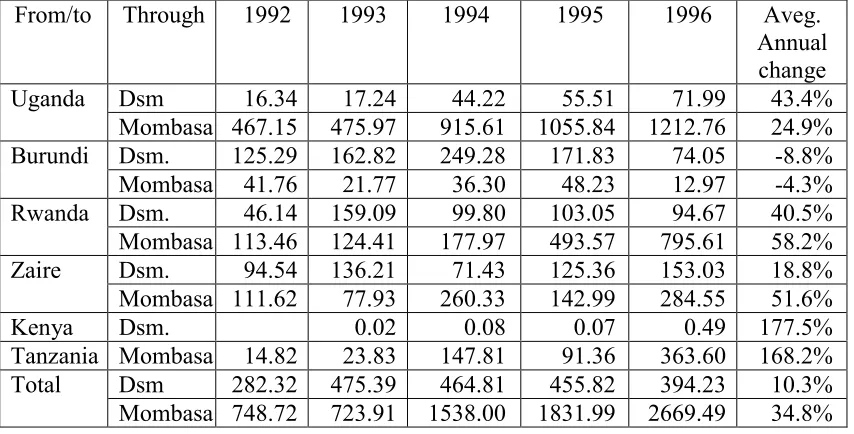
Due to various economical problems Tanzania ports lost market share of transit cargo as shown in the comparative dry cargo transit trade statistics in the two competing ports of Dar-es-Salaam and Mombasa. For that reason, NASACO had been losing its revenue to the neighbouring agencies. Transit cargo through Tanzania increased by 112,000 tons i.e. from 282,000 tons in 1992 to 394,000 tons in 1996 while the port of Mombassa handled 750,000 tons in 1992 and 2,700,0000 tons in 1996, an increase of 1,950,000 tons.
2.5.2 Financial performance.
2.5.2.1 Revenue.
The performance of NASACO financially was satisfactory from 1991/92 period and reached its peak in 1994/95 when a total of Tanzanian shillings (Tsh). 4,688.5billion was recorded and dropped to Tsh. 4,242.7billion 1995/96. The steady growth up to 1994/95 was achieved by an increase in trade up to 1993/94 and depreciation of the Tsh. due to inflation that increased the income figure in local currency. The rate of exchange was Tsh. 234 to one USD in 1991/92, which increased to Tsh 530 to one USD in 1994/95.
2.5.2.2 Expenses.
result of a government directive to increase wages and partly due to inflation that increased operational costs. For these reasons a loss was an obvious outcome.
Table 02. Five-year financial performance: 1991/92-1995/96.
1991/92 1992/93 1993/94 1994/95 1995/96
Revenue (Tsh. bil.) 2.22 4.12 4.40 4.70 4.24
Expenses (Tsh. Bil.) 1.36 2.29 3.40 4.04 4.63
Profit (Tsh. Bil.) 0.86 1.83 1.00 0.66 -0.39
Source: NASACO’s annual report 1995/96
2.5.3Operational problems:
During the period under review i.e. 1991-1996 the company’s performance was poor. Both internal and external factors played a big role in the undesirable performance of the company. By 1995 NASACO lost about 2% of its income from commission due to closure of services of some shipping lines such as the Zambia National Line (ZNL), the Shipping Corporation of India (SCI), Lloyd Triestino (LT) and Baltic East Africa (BESTA).
Among the factors that contributed to the closure, was competition among the shipping lines, slow growth of foreign trade in the region due to bad weather for agricultural activities, and political instability in Rwanda and Burundi.
NASACO’s activities depended upon the performance of other transport intermediaries such as ports, customs, railways and road transport. Inefficiency of these intermediaries had a direct impact on the company’s performance as discussed hereunder:
2.5.3.1 Port performanceand competition:
tons per day at Mombasa port, the situation which made the users from the neighbouring landlocked countries opt for Mombasa port.
2.5.3.2 Customs Procedures.
The bureaucracy in customs procedures was a bottleneck to the activities of the company as a shipping agent. It had been noted that customs bond requirements for transit cargo at Dar-es-Salaam port was 25% of cargo value, while it was 20% at Mombasa port. High bond rates together with unnecessary complications and delays in cargo clearance discouraged shippers, especially those from Uganda, Rwanda, Burundi, Zambia and Zaire who decided to use other alternative ports such as Mombassa. Maputo and Durban.
2.5.3.3 Railways and road transport facilities.
A shortage of railway wagons and high transport rates decreased the number of users. It cost $2250 for one 20´/loaded container to be transferred from Dar-es-Salaam to Kampala in Uganda while it cost $1850 for the same container from Mombasa to the same destination. Most of the roads were in a poor condition, a condition that extended the transit time. Roads, which were good, were not able to handle heavy loads of more than 40 tons of containerised cargo.
The company like any other public enterprise had its own weaknesses, which contributed to its poor performance namely:
-2.5.3.4 Poor communication facilities.
2.5.3.5 Insufficient storage facilities.
NASACO has a container depot, which can handle 2000 boxes only, and eleven warehouses with a total area of 3960 sq.meters. The facilities have not been sufficient to accommodate both incoming and outgoing cargo and the storage of empty containers. As a result some of the shipping lines opened their own depots, and other lines rented private container depots and warehouses.
2.5.3.6 Container monitoring and retrieval.
The company as the shipping agent was responsible for monitoring and retrieval of all containers on behalf of its principals. It was very difficult to monitor containers in an effective way because the company was still applying manual methods of monitoring boxes. Insufficient numbers of railway wagons and high trucking costs resulted in an increasing number of abandoned empty containers, which were destined for the hinterland stations. An increasing number of un-returned containers forced the shipping lines to charge a container deposit payable before clearance of the box from the port. Container deposits ranged from $500 to $1000 per one 20’ container. The container deposit was refundable upon return of the unit within the time limit given and demurrage was charged for overstayed containers. Payment of demurrage to principals was a burden to the nation because it was a drain on foreign currency.
Table 03: Comparative statistics for dry cargo transit trade through Dar-es-Salaam and Mombasa ports. 1992-1996.
From/to Through 1992 1993 1994 1995 1996 Aveg.
Annual change
Dsm 16.34 17.24 44.22 55.51 71.99 43.4%
Uganda
Mombasa 467.15 475.97 915.61 1055.84 1212.76 24.9%
Dsm. 125.29 162.82 249.28 171.83 74.05 -8.8%
Burundi
Mombasa 41.76 21.77 36.30 48.23 12.97 -4.3%
Dsm. 46.14 159.09 99.80 103.05 94.67 40.5%
Rwanda
Mombasa 113.46 124.41 177.97 493.57 795.61 58.2%
Dsm. 94.54 136.21 71.43 125.36 153.03 18.8%
Zaire
Mombasa 111.62 77.93 260.33 142.99 284.55 51.6%
Kenya Dsm. 0.02 0.08 0.07 0.49 177.5%
Tanzania Mombasa 14.82 23.83 147.81 91.36 363.60 168.2%
Dsm 282.32 475.39 464.81 455.82 394.23 10.3%
Total
Mombasa 748.72 723.91 1538.00 1831.99 2669.49 34.8%
Source: Dar-Es-Salaam port’s report on transit cargo 1997.
In this section we have seen that there were various problems which contributed to the poor performance of NASACO. The performance of these services clearly needed to be improved for the success of shipping agencies.
The following section discusses how liberalisation of the agency sector was undertaken.
2.6 LIBERIZATION OF SHIPPING AGENCY SERVICES
In 1994 the former Minister of Trade and Industries, commissioned a study on restructuring the shipping agency industry in the country. The study was undertaken by a team of four members namely, Dr. Y. Kilindaga from the United Nations Conference on Trade and Development (UNCTAD), Mr. A.R. Ngemere and Mr. B.Lyimo (Ministry of Industries and Trade) and Mr.S.I.Mushi (NASACO).
Sudan (Khartoum). Malaysia (Kuala Lumpur and the port of Kelang), Singapore, Sri Lanka (Colombo) and the United Arabs Emirates (Dubai). The visits were aimed at studying the institutional set up and operations of shipping agency enterprises in those countries.
After the study, the team came up with recommendations on how the National Shipping Agencies Company was to be restructured. The following was recommended:
A Company structure, ownership and management.
The company was to be restructured as a holding company. The government was to be the sole shareholder of the holding company while the head office of the company was to manage and operate the real estate, tramps agency, Mbeya branch office, Burundi office (Burundi was later closed and Kampala office was opened), Tanga and Mtwara branches and ship brokerage.
In May 1997 the government approved the programme of liberalising the shipping agency sector. The programme was to be implemented in three phases in sequential order namely, (i) Restructuring (ii) Privatisation (iii) Liberalisation.
In the restructuring phase the government was to establish the subsidiary companies and manage its operations through the holding company.
With regard to non-agency subsidiaries, the holding company was to allocate shares to all major cargo interests in accordance with their level of involvement in the activity concerned and the requirements of the capital and technical know how.
2.6.1 RESTRUCTURING OF NASACO.
The liner agency services were assigned to four autonomous divisions which provided the foundation for four subsidiary companies which were meant to render the services more competitively and efficiently. The companies were officially launched on 1st July 1998 and commenced full-fledged operations on 1st November 1998 under the names of:
-Azania Shipping Agency Company Ltd. Oceanic Shipping Agency Company Ltd. Victoria Shipping Agency Company Ltd. Worldwide Shipping Agency Company Ltd.
The companies were under NASACO as a temporary holding company for the duration of one year.
2.6.2 Privatisation.
The Parastatal Sector Reform Commission was to privatise the four companies by sale of their respective majority shares to local and foreign interests after becoming fully restructured. Out of the total government shares, 25% were to be sold to shipping companies and 35% to Tanzanian nationals. 40% of the total shares were to be retained for a short term to enable the Commission to determine the best way to divest the services, based on government interest in the sector, and to ensure protection of the national interest.
2.6.3 Liberalisation of agency services.
However, before completion of the first phase, i.e. restructuring, the Minister suddenly made a decision in January 1999 to freely issue shipping agency licences to any interested person or firm. Issuance of a licence was supposed to be the last phase of liberalisation of shipping agency services. By doing it earlier than planned, the objective of the whole exercise in restructuring the company, which had already incurred a huge amount of money was defeated.
Summary of Chapter Two:
From this Chapter it has been seen that, the liberalisation of agency services was not undertaken according to the approved program. NASACO needed time to restructure its operation so as to become more responsive to the market, and to satisfy client/needs. Time was also needed to improve the competitiveness of agency services and prepare for competition. It was a mistake to open competition before strengthening NASACO. Restructuring cannot be successful unless a number of preliminary conditions are satisfied and proper strategies and procedures are implemented. After all, the agency market in Tanzania is too small to justify the need for many agency companies.
CHAPTER THREE
3.0 THE CONSEQUENCES:
One of the principles of trade liberalisation is to increase competition where possible and to impose regulations where necessary. The objective of economic efficiency was most likely to be achieved when a healthy competitive market could be created, while appropriate regulations had a vital role to play when competition was not feasible. It had to be through a competitive market only, that neutral, non-political but binding procedures could be created which exclude the lazy and the inefficient, and enforced the best practices and the adoption of new technology. Uncertain outcomes had been foreseen in relation to phasing and integration of different deregulation measures in a comprehensive liberalisation programme. It was the government’s role therefore, to ensure a successful liberalisation through the adoption of appropriate stabilisation policies.
government share could be sold once the companies had secured market position and become reasonably profitable.
The government also wanted to spread and democratise share ownership by allocating a proportion of the shares to small investors and to employees so as to create a new group of stakeholders for the wellbeing of the national economy. By so doing this would have helped in:
-(i) Mobilising domestic resources for investments, which might otherwise have been held in non-productive forms.
(ii) Gaining political support for privatisation by spreading the benefits of privatisation.
(iii) Demonstrating that privatisation did not benefit large foreign companies only.
(iv) Changing employees’ attitudes, improving management/labour relations and enhancing productivity through share ownership of their company
The government’s plan was contradicted by an abrupt decision made by the Minister of Trade and Industries, to issue licences to the country’s customers (foreign shipping lines), to set up their own agencies and therefore serve themselves. It meant that they were not obliged to employ locally owned agencies such as NASACO or others. The collapse of NASACO and its newly formed subsidiaries was certain, the government intention of promoting share ownership failed and a very serious labour problem was created.
3.1. THE COLLAPSE OF NASACO.
3.1.1. Dar-es-Salaam branch.
lost their principal business, the other subsidiary company (Oceanic) was on the brink of loosing its principal shipping lines leaving it with only 35% of its principal business. Thereafter the income kept on dropping as the shipping lines terminated their contracts with the established companies
3.1.1.1 Azania Shipping Agency Company:
The major foreign shipping lines served by Azania Shipping Agency were the Mediterranean Shipping Company (MSC), Mitsui OSK Line (MOL), Global Container Line (GCL) and Kenya National Shipping Line (KNSL)
MSC was the first line to terminate its contract with Azania in October 1999. MSC was the most important customer to the company; its contract termination resulted in a decrease in company income from an average of $100,000 per month in 1998/99 to $14,000 1n October 1999.
MOL tendered its termination notice in November 1999; resulting in a further drop in income from $14,000 in October to $380 earned in December. The company had totally collapsed in December in the same year when KNSL issued its contract termination notice.
3.1.1.2 Oceanic Shipping Agency Company:
The company was previously serving P&O Container Line (P&OCL), Pacific International Lines (PIL), West European Container Line (WEC) as its major clients plus Ellerman and Harrison. Among the shipping lines served by Oceanic, it was PIL only, which established its in-house agency; other lines opted to use in-house agencies of other shipping lines after terminating their contracts with Oceanic. The company suffered a reduction in income from an average of $150,000 per month in 1998/99 to $56,437 earned in February 2000.
3.1.1.3 Victoria Shipping Agency Company:
Ocean Line (POL), Deutfrancht Sereederei Rostock (DSR), and Jadroplov line. The named important clients that contributed to about 90% of the company’s income all withdrew from using the company agency services by establishing in-house agency organisations. The company was badly financially affected; its income dropped from an average of $90,000 per month in 1998/99 to $1058 recorded as an income for the month of February 2000.
3.1.1.4 World wide Shipping Agency Company:
The Worldwide Shipping Agency company was serving the shipping lines of Maersk, CMBT/DOAL, NYK, DAL and K- line.
The company’s performance was very good; it was earning an average of US$ 400,000 per month. In December 1998, the company realised an income of US$ 518,835, while in February 1999 the income was US$ 415,313.
Maersk line was the first shipping line to terminate its contract with the Worldwide Shipping Agency Company in May 1999. The termination resulted in a decrease of income to US$ 240,888 in the month of June.
CMBT/DOAL (as one line) shipping line terminated its contract in September 1999, a situation that resulted in the company realising an income of US$ 109,342 for the month of October.
3.1.1.5 Summary of the performance impact:
The financial performance of four subsidiary companies, kept on deteriorating to an extent of failing to pay salaries timely. Both companies resolved to downsize their workforce by an average range of 85%. Unfortunately the decision could not be implemented to date because of insufficient funds to finance the redundancy. This would suggest that the government was not well prepared for liberalisation.
The performance of the four subsidiary companies is reflected in (Fig 1) below.
Fig 1.
Source: Operation reports of the four companies: Dec 1998 –Feb. 2000.
3.1.2. Tanga branch:
The main liner callers to Tanga port were Mediterranean Shipping Company (MSC), P&O Nedlloyd and Mitsui OSK, however the latter operated on slots of P&O Nedlloyd. MSC and P&O Nedlloyd obtained their own shipping agency licences during the first half of 1999. MSC tendered an agency termination notice with
INCOME OF FOUR SUBSIDIARY COMPANIES DEC. 1998 - FEB.2000.
0 20,000 40,000 60,000 80,000 100,000 120,000 140,000 160,000 180,000 200,000 Dec-9 8 Ja n-99 febr
uaryMarch April MayJune July Augus t Septe mber Octo ber Nove mbe r Dece mbe r
P&O Nedlloyd tendered its notice late September 1999 and started operations on 14th December 1999. These development dictated the closure of NASACO- Tanga agency business.
3.1.3. Mtwara branch:
The branch depended mostly on chartered vessels, which called at the port during the crop-picking season; this is between the months of August to December every year. P&O Nedlloyd and Mitsui OSK started operating at Mtwara during the 1999 crop season and received agency services rendered by NASACO. The two companies projected more future shipments as the result of the projected cargo for the Mchuchuma coalmines and the Mtwara corridor development. It was strongly felt that Mtwara had potential for doing business competitively at least until the next crop season.
3.1.4. Tramp shipping and other services:
A considerable volume of tramp shipping agency business was taken up by other licensed competitors leaving NASACO with only 15% of the tramp business. However, the company still has a container depot which is being used by the shipping lines and 13 warehouses rented to exporters and importers. The company has a clearing and forwarding department, which handles cargo not only for Tanzania but also for Uganda, Burundi, Rwanda and Republic of Congo.
It has to be noted that, the shipping lines used NASACO container depot as part of their respective agency agreements between the two parties. In the absence of such agreements and in the presence of privately owned depots around the area, the shipping lines are no longer obliged to use these services. NASACO’s container depot business therefore, is also facing a dilemma.
3.2. IN-HOUSE AGENCIES:
Mediterranean Shipping Company, CMBT/ Surfmarine and others all established in-house agencies in the country. Among the objectives of having their own agencies, was to ensure dedication to one principal, which gave them better control, unlike NASACO which, as a sole agent, was serving all shipping lines and tramp ships under one roof. Within one year of in-house agency operations commencing, among other developments, shippers and ship owners had observed the following:
The shipping lines were now able to offer their customers consistent and better quality services. As commented by Tanzania branch manager of Seaforth, a Kenya based company that, “The level of competency has increased substantially. A strong competition between the agents is now focused on how fast the agent is able to get the access of the dilapidated port equipment to work on their vessels. In the past the sense of urgency was not evident”. (Lloyds’ list 2000).
The customers were satisfied with the quick and effective response to problems, as the result of the speed and ability to pass on relevant information, and instant decision-making. The focus on customer care increased so as to create strong customer relations, unlike an independent agent (NASACO) who spent little time on customer care and contact, and too much time and money, focusing on back-office related matters. Sometimes they were more loyal to local clients than to ship owners.
By having in-house agencies, they solved the problem of delays in freight transfers and in disbursement submissions to principals.
able to pay 2.5% to 5% for commission plus container handling charges to their independent agents. As Danny Rees of Quadrant container lines said “ We use the in-house subsidiary of the group, it allows us to keep the profit within the group”. (The Ship’s Agent, 1998).
Some of the shipping lines argue that by having their own organisations, they have direct control, and can hire and fire as they wish. But it was further argued that the closer they get to Europe, the harder it becomes, because of the employment rules on that continent. In case of Tanzania this was not an obstacle to them, recognising that issuance of the licences was unconditional.
3.3. UNFAIR COMPETITION:
The decision to liberalise shipping agency sector was inevitable and it was accepted as a viable approach to improve efficiency through a fair competition. The problem was in the way the liberalisation exercise was undertaken. It was, and will continue to be quite impossible for an independent agency company, to compete with a ship owner operating his own agency, taking into account that the market had been dominated by liner vessels.
The entrance of the multinational shipping lines in a small market was to kill small operators. Up to December 1999, out of thirty-five newly licensed companies, about half of them had never handled a single ship. Natural deaths of those companies had been foreseen.
An example of unfair competition was reported by the chairman of Uganda Clearing and Forwarding Association that, small freight forwarders have already closed down while others were forced to merge with big firms, following the entrance into the market of three multinational shipping firms ( Maersk Shipping Line, Mackenzie Forwarders and Transami ). The chairman of the Association of Clearing, Warehousing and Freight Forwarders of Kenya also claimed that, the survival of local freight forwarders companies was threatened by the government’s move to allow international shipping lines operating in Kenya, to start freight divisions. (Ouma, 2000). Both parties appealed to their respective governments to come up with new legislation to curb unfair competition by multinational shipping lines. .
3.4. LACK OF CONTROL:
The liberalisation of the shipping agency sector was mainly based on the study mentioned in the previous chapter on restructuring of NASACO. Apart from the proposed new structure, the team recommended regulations through which the agency services had to be rendered. The team recommended regulations to be used in each restructuring phase of the shipping agency services in the country as follows:
3.4.1. Entry regulations – restructuring phase:
3.4.2. Company structure and ownership – privatisation phase:
The company structure and ownership would have remained as in the first phase, but the government would have allocated more of its shares in the subsidiary companies to indigenous Tanzanian nationals up to the total of 49%.
3.4.3. Entry regulations – liberalisation phase:
Entry restrictions into the shipping agency business were to be liberalised, to allow enterprises to be licensed, subject to:
(i) The enterprise allowing a minimum ownership participation of 75% by Tanzanian nationals.
(ii) The enterprise demonstrating its ability to render good agency services
It was the government’s intention to impose entry restrictions to limit the number of the players because of the size of the market itself. 75% local participation in agency companies was proposed by study group, but this was not be possible, because a foreign investor would not accept to invest where he would have no voting power.
3.4.4. Other regulations:
(i) The government was to initiate measures for the establishment of a code of conduct for shipping agents, to ensure that certain internationally accepted professional standards were met and incidents of maritime fraud were minimised.
(ii) The government was to set up a tariff board responsible for determining the tariff for the shipping agency.
Before the second phase the Minister of Transport and Communication was to put in place a code of conduct and competition rules for shipping sector. Non of the recommended regulations was taken into account in liberalising agency services.
The role of government in a free market system is to formulate laws so as to enforce contracts and safeguard properties. Without a legal framework to enforce contracts, private business activity will not work. A stronger private sector and stronger markets cannot be attained without certain fundamentals related to the administrative system, such as adherence to the rule of law, maintenance of competition and preventing the emergence of monopolies. A desirable economic reform therefore is that which opens opportunities for private entries into a closed sector of the economy, but if that entry is left to the discretion of public officials rather than allowing an open competitive process, enormous scope for corruption is created. For example, Guinea privatised 158 public enterprises between 1985 and 1992, but the change proceeded without a clear programme or legal framework or procedures for competition. Bidding and accounting procedures were not made clear, assets were sold for much less than their value, and the successful bidders were offered terms, which sometimes included monopoly licences. (World Bank, 1995).
In developing countries like Tanzania, participation of foreign investors has been allowed in their privatisation programmes, this was partly due to the limited availability of domestic financial resources to finance privatisation. Another important policy consideration was that, foreign participation would bring not only capital, but also management skills, new technology and global or international linkages.
example in Argentina, 60% of the assets sold up to the year 1995, were bought by foreign investors, while in Niger all privatised companies were sold to domestic investors (United Nations Conference on Trade and Development [UNCTAD], 1995).
In general, the limits for foreign investment, could only be exceeded where expertise needed to improve efficiency was not available locally, where foreign participation was required to improve exports, where the supply of local capital was insufficient to absorb shares offered and where the nature of the business required global linkages and international exposure.
There are also special conditions attached to privatisation of public enterprises, which differ from one country to another. For example, retention of a special, or “golden” share by the government in order to protect the business from unwelcome take over or to provide an opportunity for the management to adjust themselves to a private sector culture.
In the Republic of Korea, in order to prevent foreign investors from monopolising the financial sector, a ceiling was placed on the ownership of shares in the privatised banks, whereby a maximum of 5% for firms and a maximum of 500 shares for individual investors were agreed. In New Zealand, in order to promote wide spread ownership and to avoid the situations where minority shareholders of companies would object to sales, new owners were required to float shares within a given period of time as a condition of sale. In Sri Lanka, foreign investors were not allowed to transfer a recently acquired enterprise to another foreign investor without government approval. (UNCTAD, 1995).
The priority of the whole exercise was to increase competition, not to transfer the productive activities to foreign participants. Deregulation, in the sense of removal of market entry restrictions, needed to be accompanied by a regulatory mechanism to control anti-competitive behaviour, because deregulation could work well if there was no concentration of power or unfair trade practices. A good example is of Microsoft of the United States. Even though there is free trade in USA, but the expansion of Microsoft is so enormous to an extent of dominating the market and undermines other players, this needs a government law to handle such cases. In case of Tanzania therefore, foreign investment should have been subject to closer scrutiny by the public and be handled with greater attention to national interests and concerns. The issuance of unconditional shipping agency licenses was totally against the recommendations made by the study team
Summary of Chapter Three:
We have seen that liberalisation of agency services had both positive and negative results. Positive results were an increased efficiency in performance especially in new agency companies operated by shipping lines, which resulted in fast cargo clearance from ports for the benefit of Tanzanian shippers. On the other hand, the process was not in favour of local companies dependant on shipping lines as their principals. The Chapter makes clear that, if the shipping lines decide to merge and use one agent, one company will dominate the market. Liberalisation of shipping agency services therefore will mean a transfer of a state monopoly to the private hands.
CHAPTER FOUR:
4.0. CRITICAL ANALYSIS OF THE POLICY AND ITS IMPLICATION.
As discussed in Chapter One, the government originally decided to put all strategic commercial activities and key sectors of the economy into the public sector through a policy of socialism and nationalisation. That situation led to the establishment of State-owned enterprises in all sectors of the economy. These enterprises faced various problems with time and it turned out to be impossible for the government to manage its investments in these enterprises without both financial and managerial difficulties. The situation resulted in a major Government Issue and a decision to make a change in the policy.
The concerns that had originally justified the creation of the large public enterprises did not vanish. The restructuring of the public sector was to ensure that the same objectives were achieved through a market based economy. The reform was intended to step up economic growth, to reduce the large number of non-performing public enterprises and to eliminate any budgetary support being extended to them. A meaningful reform was vital, and was at the core of macro-economic adjustment. This Chapter will analyse the policy and its implementation by looking at how the government’ objectives of liberalising agency sector were achieved.
4.1. THE CORRECTNESS OF THE POLICY.
principles in formulating into privatisation policy, and, in so doing, demonstrated its commitment to implementing the Policy. The government devised a program, prepared the legal framework and set up the institutional environment i.e. privatisation agencies (PSRC). Enterprises identified for privatisation were listed, stakeholders were identified and the method to be used was prescribed. The government through the PSRC established a dialogue to seek national consensus on the program.
In support of this approach, the government published a master plan as an official blue print of the Parastatal Reform and Privatisation Program. The master plan was explained in simple language so that everybody could understand the objectives and targets of the program. In theory, the conditions for a successful privatisation process were in place.
In order to be able to assess the success of the liberalisation initiative we have to remind ourselves as to what were government’ expectations from the exercise.
The general expectations from any privatisation process are:
(i) To raise additional revenue for the state.
(ii) To promote economic efficiency.
(iii) To develop national capital markets.
(iv) To introduce competition through economic liberalisation.
(v) To gain social benefits for society.
These will be discussed in turn.
4.1.1. To raise additional revenue for the state.
where the investments are coupled with changes in management and labour practices, there can be a rise in turn over, lower operating costs and better financial outcomes.
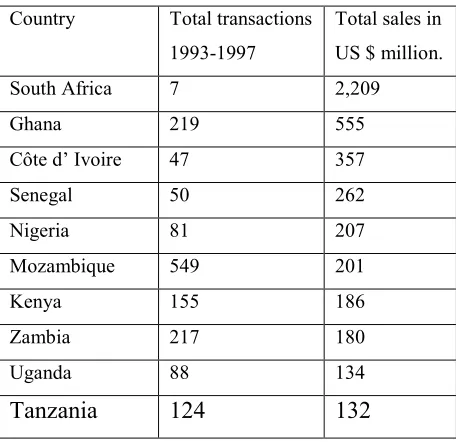
In 1990, 270 public enterprises were processed for privatisation out of the government target of 395 enterprises. $300 million in revenue was raised from more than 100 outright sales. The industrial sector contribution to the GDP increased from 10.6% in 1996 to 12.3 % in 1997. The manufacturing sector which accounts for 23% and 35% of the government revenue and employment in the sector respectively, increased by 2% (Kyaruzi, 2000).
Economic reform in Tanzania has succeeded in reducing the inflation rate to 6.3 per cent as of February 2000, from double digits only a few years ago. The Gross Domestic Product has grown at an average real rate of 4.2% and the annual per capita income has risen to $210 from $180 (Chege, W. Reuters. 2000).
Table 4
Ten top African countries in sales value
Country Total transactions
1993-1997
Total sales in US $ million.
South Africa 7 2,209
Ghana 219 555
Côte d’ Ivoire 47 357
Senegal 50 262
Nigeria 81 207
Mozambique 549 201
Kenya 155 186
Zambia 217 180
Uganda 88 134
Tanzania 124 132
Source: The World Bank, African Development Indicators 1998/1999
4.1.2. To promote economic efficiency:
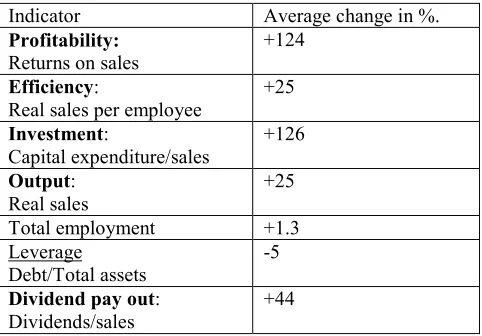
Table 5.
Post privatisation performance: key results for 79 privatised. enterprises in 21 developing countries 1980-1992.
Indicator Average change in %.
Profitability: Returns on sales
+124
Efficiency:
Real sales per employee +25
Investment:
Capital expenditure/sales +126
Output:
Real sales +25
Total employment +1.3
Leverage
Debt/Total assets -5
Dividend pay out: Dividends/sales
+44
Source: Narjess Baukari and Jean Claude Cosset. The financial and Operating Performance of Newly privatised firms.
4.1.3. Capital market development:
At the beginning, a large percentage of privatisation transactions took place outside
the formal capital markets. More recently, the privatisation of State enterprises
Experience has shown that transfer of ownership is the most difficult decision to be taken by the government. The government may decide to retain majority ownership through share dilution, joint venture and management contracts. The government may also decide to own a minority share in a privatised enterprise, in most cases for political reasons. Broadening of ownership has been politically and socially popular, it may be used to create desire and expectation among the management and employees for better productivity in the privatised enterprise, even though it may not provide new blood in the form of investment, know-how, new products and extension of the markets. Foe example in 1983, ABP (19 UK ports) were privatised with most employees owning at least 1000 shares, since then labour productivity increased by 40% (Alderton. 2000).
4.1.4. To introduce competition:
Stimulating competition is an attractive aspect of the liberalisation process. Competition can provide a powerful incentive to reduce and stabilise prices. In a competitive market, the public enterprise that does not operate in accordance with consumer demand, or overprices its products can easily loose its customers, while failure to match the performance of its competitors may result in a loss of market share and a deteriorating financial performance. Competition can be achieved either through out-right sale or through deregulation to allow the entry of new competitors.
4.1.5 To gain social benefits:
Apart from employment, social objectives of privatisation also include consumer interests and welfare considerations such as -:
(i) Privatisation is expected to raise economic welfare by improving efficiency
and thus raising the rate of economic growth for the benefit of the entire society.
(ii) Privatisation is expected to achieve a more equitable distribution of the
(iii) There are specific distribution objectives of privatisation which include widening and deepening share ownership and control of productive sectors, promoting decentralisation, regional and rural development, improving employment and improving social services and infrastructure,
(iv) There are participatory objectives. These allow employees to actively
participate and engage in the economy as entrepreneurs or share-owning employees in the enterprise they work for, and this can help to prevent labour opposition to privatisation. The equity participation can also lead to efficiency gains.
When the government decided to pursue its reforms in shipping agency sector, it had the same objectives, namely to boost up the national economy through a free market environment. Unfortunately the results have not been as good as expected even though there is an improvement in the performance. The problem is not in the policy itself, but its implementation. The actual implementation was totally against what was stipulated in the government directive. The following discussion will look at the results of the liberalisation of agency sector.
Positive impact:
Container demurrage was one of the problems faced by NASACO as an agent. Poor container monitoring and tracking resulted in an increased number of overdue containers used by local shippers and those from neighbouring land locked countries. Overdue containers attracted a huge amount of money as demurrage charges paid to shipping lines in foreign currency. By the end of 1999, a total of US $ 13,264,039 accumulated as outstanding demurrage charges payable to shipping lines. Liberalisation of agency services solves this problem because most of the shipping lines have computerised container-monitoring activities.
In the new structure where the carrier is also an agent, there is direct contact between the shipper and the carrier. This provides an opportunity for the shipper to negotiate directly with the carrier for better transport terms especially the freight rate. If a shipper can get lower freight rates the total cost of his products will be lower and as a result he will sell it at a competitive price, the final beneficiary of the entire transaction will be the final consumer. Liberalisation of agency services therefore may contribute to the competitiveness of Tanzanian shippers and consignees.
There were costs which shipping lines were charged by NASACO apart from commission, namely car hire (for crew), boat hire and medical facilities, the costs which were eventually considered in freight calculations payable by shippers. For in-house agency organisations, shippers can be relieved from these costs because the costs will be part of normal office running expenses and not directly attached to cargo.
the ports, customs and inland infrastructure. This was also reported in the Lloyds special report, namely that working on bulk cargo in Dar-es-Salaam port was not too problematic, as long as the documentation preceded the cargo arrival. However getting the cargo out of the port and to its inland destination often presented a significant headache. Neither the Tanzania Railway Corporation nor its sister operation under Tazara, which runs between Dar-es-Salaam and Zambia, had sufficient rail wagons. Good performance of the shipping agency alone cannot have a marked impact on the economy.
Negative impact:
NASACO was one of the public enterprises whose financial performance for the past twenty years was very good, making it one of the principal sources of the State income. So far the government has gained nothing forthcoming from the process because NASACO was neither sold nor entered into joint venture, which means that there was nothing as sale proceeds. In the new structure where the shipping lines are operating their own in-house shipping agency organisations, it means they are now producers and consumers of the agency services. It further implies that the transactions between the principal and the agent have become an internal matter, and also an opportunity for them to understate revenue and inflate expenses to minimise profits. Taking into account of the intensity of corruption that has weakened tax enforcement, it is a conducive environment for tax evasion by the shipping lines.
If so far as the shipping lines were investors, there was nothing the government could benefit out of it. The basic investments needed to start a shipping agency business are no more than a couple of offices, furniture, a telephone, fax machine, a computer and a company car, a cost that a Tanzanian national could afford. After all these are facilities that most of the lines already have through their local representatives.