World Maritime University
The Maritime Commons: Digital Repository of the World
Maritime University
World Maritime University Dissertations Dissertations
2001
Emerging trends in marine insurance : is there a
trend towards demutualisation of mutual clubs?
Ramasamy RavichandranWorld Maritime University
Follow this and additional works at:http://commons.wmu.se/all_dissertations Part of theInsurance Commons
This Dissertation is brought to you courtesy of Maritime Commons. Open Access items may be downloaded for non-commercial, fair use academic purposes. No items may be hosted on another server or web site without express written permission from the World Maritime University. For more
Recommended Citation
Ravichandran, Ramasamy, "Emerging trends in marine insurance : is there a trend towards demutualisation of mutual clubs?" (2001).
World Maritime University Dissertations. 220.
WORLD MARITIME UNIVERSITY
Malmö, Sweden
EMERGING TRENDS IN MARINE INSURANCE
Is there a trend towards demutualisation of mutual clubs?
By
RAVICHANDRAN R.
IndiaA dissertation submitted to the World Maritime University in partial fulfillment of the requirements for the award of the degree of
MASTER OF SCIENCE
In
MARITIME AFFAIRS (Shipping Management)
DECLARATION
I Certify that all the material in this dissertation that is not part of my own work has been identified and that no material is included for which a degree has previously been conferred on me.
The contents of this dissertation reflect my own personal views, and are not necessarily endorsed by the University.
………
……….
Supervised by:
Name: Patrick Donner
Office: Associate Professor Shipping Management
Institution: World Maritime University
Assessor:
Name: Tor Wergeland
Office: Associate Professor Shipping Management
Institution: World Maritime University
Co-assessor:
Name: John Mc Phail
Office: Manager
ACKNOWLEGEMENTS
I would like to thank the following for their assistance in preparing this dissertation:
Associate Professor Patrick Donner, my supervisor who encouraged me to do this
research and supervised the work of this dissertation. His constant encouragement,
providing valuable materials, dynamic ideas, practical suggestions and constructive
advice kept me concentrated and progress smoothly through to completion.
Professor Shuo Ma, my course professor, who gave me advice in selection of topic for
dissertation and motivated me to complete this task.
Professor Tor Wergeland who advised me on gathering of information from insurance
brokers and qualitative analysis of data collected from various sources.
Mr. Claes Lindh of Swedish Club, Gothenburg, Mr. Phil Mitchell of United Insurance
brokers, London, Mr. Roger Ingles of Elysian Insurance Services Limited, London, Mr.
Bjorn Dahlstrom and Mr. Bengst Andersson of Marsh Marine & Energy AB, Gothenburg,
Sweden and Mr. Rod Lingard of Thomas Miller & Co Ltd (who provided me material
during my field visit to their office in London) for their valuable support in providing me
the required information and data without which the analysis would not have been
possible.
Ms.Susan Wangeci-Eklow and Ms.Cecilia Denne, WMU’s library staff who provided me
enthusiastic and ever-ready co-operation and concern in searching the requisite material
and information for the work.
Also I would like to take this opportunity to thank and appreciate the following for their
support in helping me to pursue MSc programme.
Mr.M.P.Pinto,I.A.S., Secretary, Ministry of Shipping and Ports, New Delhi,
Mr.D.T.Joseph,I.A.S., Director General of Shipping, Mumbai, Mr.N.Rangachari, I.R.S.,
Chairman. Insurance Regulatory Authority, New Delhi and Mr.A.Balasubramanium,
Mr. Bruce Browne, Registrar, WMU and Ms. Susan Jackson who helped me in the
admission and fellowship to complete this course.
My parents and all my friends, relatives, brothers and sister who supported me in every
way and who silently for my safety and success in studying.
Finally, Mrs.Geetha Ravichandran, my wife and Master Vasuman and Master Aditya my
sons who bore the hardship of isolation and loneliness back home and supported me in
everyway, encouraged me and prayed for my safety, determination and success in
completing this course.
ABSTRACT
Title of Dissertation: Emerging Trends in Marine Insurance
Degree: MSc
This dissertation analyses the emerging trends in the marine insurance industry with
specific reference to the structural changes in the mutual P&I Clubs. The marine
insurance industry as a service industry is subject to pressures sometimes under estimated
but they exist and they are increasing. The impact of such changes specially the changes
in the general insurance industry that has influence on the mutual clubs in the marine
insurance industry is examined. Recently, the mutual P&I clubs has witnessed the
pressure of a review by the European Commission of International Group Agreement and
competition from fixed premium providers. The mutual clubs are responding to these
challenges by providing range of services including one-stop- shop service through Joint
ventures or alliances with the corporate players. The development of information
technology, the commoditisation of insurance services and competition by products on
the basis of price rather than historical relationships are undermining the insurance
relationship, which continues to be at the heart of the most marine mutual insurers. The
above aspect raises the question on the survival of concept of mutuality. The concluding
chapter analyses the impact of various factors which influences the demtualisation of
mutual clubs such as cash flow, free reserves, access to capital, size of the insurer,
management and administrative expenses, underwriting losses, rate of investment income
and ratings from specialised rating agencies. Analysis of results show that the P&I clubs
Skuld and Steamship mutual have strong tendency towards demutualisation, the clubs
London and Japan have a weak tendency towards structural changes and the other clubs
are favourably positioned towards structural changes. The recommendations emphasise
the challenges and trends and the need for reorientation of mutual clubs.
KEYWORDS: Marine insurance, Demutualisation, Structural changes, P&I clubs, Fixed
vi
TABLE OF CONTENTS
Declaration ii
Acknowledgements iii
Abstract v
Table of Contents vi
Appendices x
List of Tables xi
List of Abbreviations xiii
1. Introduction
1.1 Do these changes in the general insurance industry create 1
any impact in the marine insurance industry?
1.2 What is the impact of the entry of fixed premium providers in P&I? 3
1.3 Impact of information technology 3
1.4 Emerging force in marine insurance industry - E-commerce 4
1.5 Is there any trend towards demutualisation of mutual clubs? 5
2 Dynamics of Marine insurance market
2.1 Legal regime for marine insurance 8
2.2 Types of marine insurance 8
2.3 Application of various International conventions 9
2.3.1 Impact of Implementation of ISM code 10
2.4 Economic aspects of the marine insurance market 11
2.5 Main players in the marine insurance market 13
2.6 Cost of marine insurance on the ship operational cost 15
2.7 Analysis of data of various types of claims and identifying 16
vii
3 Mutual insurers in the Marine insurance market
3.1 Background of the concept of mutual insurance 19
3.2 Sharing of risks in mutual club 21
3.3 Legal status of operation of mutual clubs 23
3.4 Management of P&I clubs 24
3.5 Basis of operation of various players in the mutual insurance 25
market
3.5.1 Underwriters 25
3.5.2 Agents and Brokers 26
3.5.3 Reinsurers 27
3.6 Marine risks covered by P&I clubs under Club rules 28
3.7 Current problems in the mutual insurance market 29
3.7.1 Losses 29
3.7.2 Survival of pooling agreement 29
3.7.3 Competition within IGA 30
3.7.4 Competition from fixed premium insurers 30
3.7.5 Changing needs of shipowners 31
3.7.6 Investigation by regulatory authorities 31
3.8 Emerging trends in the mutual insurance 32
3.8.1 Mergers, alliances and acquisitions 32
3.8.2 Can the P&I mutual insurers survive? 34
4 Fixed premium insurers in marine insurance
4.1 Concept of fixed premium insurance 36
4.2 Basis of operation of fixed premium insurers 37
viii
4.3.1 Underwriters 38
4.3.2 Reinsurers 38
4.3.3 Agents 39
4.4 Interrelationship between Hull and P&I insurance 39
4.5 Consolidation of syndicates in the Lloyd’s market 41
4.6 Comparative analysis of fixed premium providers 42
and mutual P&I clubs
4.7 Major players in the fixed premium segment 43
4.8 Points for consideration by the shipowner 45
4.9 Deficiencies and weaknesses of the fixed premium market 46
4.10 Major changes in the mutual P&I clubs, which are of 47
significance to the FPP’s
4.11 Failure of Fixed premium insurers in P&I segment 48
5 Demutualisation of mutual clubs
5.1 Is there a trend towards demutualisation of mutual insurance 49
companies?
5.2 What are the circumstances that influence the demutualisation 50
of mutual insurance companies?
5.3 How the mutual insurance companies respond to the competition 51
from other players specially the stock insurance companies?
5.4 What are the critical factors that would tell us whether a mutual 52
insurer is likely to demutulaise?
5.5 Factors which influence demutualisation of mutual clubs in 53
maritime industry
5.5.1 Cashflow 54
5.5.1.1 Excess supplementary call 54
5.5.1.2 Cost of cover as percentage of ETC 56
ix
5.5.2 Free reserves 58
5.5.2.1 Free reserves per owners’ GT entered 59
in the clubs
5.5.2.2.Free reserves as a percentage of call income 60
5.5.2.3 Ratio of free reserves to outstanding claims 61
5.5.2.4 Ratio of claims recoverable to gross 61
Claims outstanding
5.5.3 Access to capital 62
5.5.4 Size of the insurer 69
5.5.5 Management and administrative expenses 65
5.5.6 Underwriting Losses 66
5.5.7 Investment income 67
5.5.8 Ratings given by specialized rating agency 69
5.6 Summary of analysis and result 70
6 Conclusions and recommendations
6.1 Challenges faced by marine mutuals 74
6.2 Changes in the marine insurance industry 75
6.3 Why fixed premium providers failed in their effort? 75
6.4 Is the concept of mutuality relevant in marine insurance today? 76
6.5 Is demutualisation a viable option to mutual clubs? 77
6.6 What does demutualisation mean for the mutual marine industry 78
and what are the critical factors that influence demutualisation?
6.7 Recommendations 79
x
Appendices
Appendix A Volume of Business of P&I Mutual Clubs 85
(in terms of number of vessels)
Appendix B Volume of Business of P&I Mutual Clubs 86 (In terms of Entered Tonnage in million GT)
Appendix C Analysis of factors that influence structural changes 87 in mutual clubs.
xi
List of Tables
Table 1 Market Share of London Market (Figures In US$ billion) 12
Table 2 Market Share of different types of insurance (1998) 12
Table 3 Proportion of Premium revenue in 1997 13
Table 4 Indicative Ship’s insurance cost 15
Table 5 Principal risk groups by value of claims 17
Table 6 The IGA Clubs 20
Table 7 The Non-IGA P&I Insurers 21
Table 8 Development of General excess of loss insurance limits 22
and costs (in US$)
Table 9 Consolidation of players in Mutual marine insurance 33
Table 10 Capacity trends at Lloyd’s market 41
Table 11 Comparison of fixed premium insurance providers 42 and mutual P&I clubs
Table 12 Fixed Premium Insurers in the Marine Market 43
Table 13 Largest insurance companies in the world 49
Table 14 Market shares of mutual insurers in major insurance markets 50 Table 15 Excess Supplementary call /overspill claims 55
(Including the recharged cost of group excess reinsurance programme)
Table16 Cost of cover as Percentage of Estimated Total Call (ETC) 56 (25-year average since 1976)
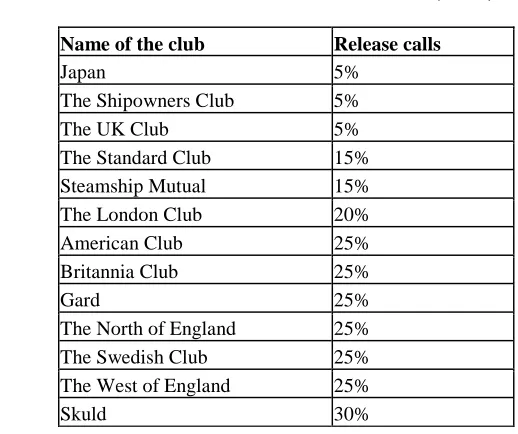
Table 17 Release calls of Clubs (2000) 57
Table 18 Total free reserves per owners’ GT entered in the clubs (in US $) 59
Table 19 Free reserves as a percentage of call income 60
xii
Table 21 Ratio of claims recoverable to gross claims outstanding 62
Table 22 Size of the club (based on entered tonnage (million GT) 64
Table 23 Average Expense Ratio (5Years ) 65
Table 24 Underwriting result of IGA (in US$ ´000) 67
Table 25 Investment Income 68
xiii
LIST OF ABBREVIATIONS
AER Average Expense Ratio
ART Alternate risk Transfer
BMM British Marine Mutual
CLC Civil Liability Convention
CMI Comite Maritime International
DGIV Directorate General Competition(EC)
EC European Commission
ETC Estimated Total Calls
FD&D Freight Demurrage and Defence
FP Fixed Premium segment
FPP Fixed Premium Provider
GT Gross Tonnage
H&M Hull and Machinery
HNS Hazardous and Noxious Substances
HSBC HSBC Insurance Brokers Limited
IACS International Association of Classification Societies
IGA International Group Agreement
ILO International Labour Organisation
ILU Institute of London Underwriters
IMO International Maritime Organisation
ISM International Safety Management Code
ITC Institute Time Clauses
IUA International Underwriting Association
IUMI International Union of Marine Underwriters
LIRMA London International Insurance and Reinsurance
Organisation
xiv
LNG Liquefied Natural Gas
LPG Liquefied Petroleum Gases
LUC London Underwriting Committee
MOU Memorandum Of Understanding
MARPOL Marine Pollution
OPA90 Oil Pollution Act, 1990
P&I Protection and Indemnity
RDC Running Down Clause
S&P Standard and Poor’s
SOLAS Safety of Life at Sea
STCW Standards of Training Certification and Watch keeping
UK United Kingdom
UNCTAD United Nations Commission on Trade and Development
CHAPTER 1
INTRODUCTION
As the marine insurance companies stand on the brink of a new millennium they are
facing tougher competition than would have seemed possible a few decades ago. And
the state of the marine insurance industry today is the direct result of the incredible
transformation of the overall financial services industry and in particular the general
insurance industry. Over the past 20 years staggering changes have taken place in the
global general insurance environment. Companies in the insurance industry are currently
facing a number of challenges and trends inter-alia globalisation of markets,
consolidation and specialisation, increased competition from new competitors, new
products and alternative distribution channels, changes in customer needs, changes in the
security perception of vessel operation, reducing margins and increasing costs,
increasing sophistication and complexity of information technology including
e-commerce and increased risk requiring innovative risk transfer vehicles. (Geib Gerd,
2001.p.1)
1.1 Do these changes in the general insurance industry create any impact in the
marine insurance industry?
Shipping being a specialised industry has so far insulated itself from the developments
marine insurance market have taken knowledge from other industries and applied it to
the marine sector. This includes knowledge on customer behaviour, distribution, brands,
perception and service. The brand values of mutual clubs, which relied on shipowner’s
trust and reliability, which seemed to belong to the marine insurance industry for so long,
are no longer enough to provide sustainable competitive advantage for the traditional
players. Thus the changes that are taking place in the general insurance industry are
relevant to shipping. Shipping is an international industry subject to unique
environmental, political, and commercial considerations. Marine insurance as a service
industry, which exists to provide the ship owner the cover that he needs has to operate
on a global basis and is subject to all pressures sometimes under- estimated but they
exist and they are increasing (Taylor, 2000.p.22).
The events of the past few years, the review by the European Commission (EC) of the
International Group Agreement (IGA), the decision to limit the amount of cover under
P&I by the mutual clubs and the incredible interest in P&I shown by commercial
insurers have sparked considerable debate about the functioning of mutual clubs. In June
1999 the DGIV of the EC granted a ten-year exemption to the IGA until February 2009
subject to the condition that there should be competition among clubs who are members
of the IGA and all the clubs should publish their Average Expense Ratios. With the
increasing transparency and changes in the reporting standards consequent to the EC
investigation, S&P developed a full rating process for the P&I clubs and many clubs
voluntarily opted for interactive ratings (made with the cooperation of the insurer) which
was first published in 1999. The mutual clubs went through a process of review that
resulted in the merger of the Liverpool & London and Newcastle Club with North of
England Club and the demutualisation of British Marine Mutual, London. The mutual
clubs also started examining their weaknesses in comparison to the commercial insurers,
namely the unbudgeted supplementary calls. Consequently the UK Club announced a
without the need for unbudgeted calls, which is the new trend evolving among other
mutual clubs (Sydenham, 2000.pp.4-5).
1.2 What is the impact of the entry of fixed premium providers in P&I?
The other development that has been noticed in recent years is the increased retention of
risk by the clubs both individually and collectively through the group pool system. The
group clubs have repeatedly indicated their readiness to increase the pool’s retention of
risk should reinsurance rates rise and it is a major benefit of the pool and it’s spread of
risk that the clubs have this flexibility. The S&P report identified that the major issues
facing the marine mutual insurance market is consolidation, diversification and
demutualisation. If consolidation of mutual clubs takes place the International Group
could end up with far fewer members resulting in lack of choice for the shipowners,
which may drive more business to the fixed premium market. The mutual clubs are
combating the threats from the fixed premium competitors by providing a range of
services through joint ventures or alliances with the corporate players. This may pose a
danger to the clubs since the corporate players who are entering into joint ventures may
desire to have a firm hold on the mutual clubs affecting their freedom and possibly
resulting in a take over.
1.3 Impact of information technology
The impact of technological development, especially information technology, on the
insurance industry is phenomenal. Delivery systems for insurance products have become
much more sophisticated. In contrast to the personal one to one approach of brokers with
underwriters nowadays the shipowners have direct access to information on availability
of insurance cover and terms and conditions of cover from all over the world and decide
disadvantage in such a system would be testing the reliability of the insurer but looking
into the credit ratings given by the reputed credit rating agencies can solve this tricky
issue. The technological development, therefore, constitutes a direct attack on the
relationship insurance, which continues to be at the heart of the most marine mutual
insurers. The technology therefore contributes to the commoditisation of insurance
services, which in turn encourages competition by products on the basis of price rather
than historical relationships. The individual shipowners who are members of the mutual
club are aware of the alternatives and they may refuse to cross-subsidise other members
of the mutual clubs who contribute less to the bottom line (Wilderman, 2001. pp.2-5)
1.4 Emerging force in marine insurance industry –E-commerce
Another area where competition seems set to increase is electronic payments processing
and provision of insurance services over the Internet. This is a global phenomenon that
will certainly affect the marine mutual industry. Non- financial firms which means the
non-marine insurance providers, who control communication networks and the gateways
could set themselves up as brokers directing customers to the best product. (Brinson,
2000. p.15). The loyalty of the customer would increasingly be to the broker rather than
the producer of the product or the one who actually provides the insurance service. What
is the immediate impact of such a development? At the very least this process will
squeeze the margins of traditional insurance providers. It is also highly likely that there
are non-financial firms offering such services who would be in a position to design a
new product by using the information available to them through data mining technology.
Whether such a product will start competing with the traditional product offered by
segmented insurance service providers is important. Let us say a popular web portal can
offer an integrated service of P&I, Hull, Cargo and FD&D cover from various insurers
product. In such a case the brand value of the original segmented product, namely the
insurer of P&I or Hull or cargo loses it’s importance.
1.5
Is there any trend towards demutualisation of mutual clubs?
The world wide insurance industry was dominated by mutuals only a decade ago. Since
then there has been a trend towards demutualisation, which saw many mutual insurance
companies in the life insurance sector demutualising in the last decade. A report from
Reuters (2000) observes that the mutual insurance companies reforming as joint stock
companies may be a mistake, and the current trend to demutualise may stop, or even
reverse. The report noted that some mutuals planning to convert to stock ownership,
such as Metropolitan Life in the U.S., did just the reverse earlier this century, and said
the trend may yet swing back to favour mutual ownership.
One of the biggest reinsurers Swiss Re also said in its latest report (Sigma report,
1999.p.34) that mutual insurers have some fundamental advantages over joint-stock
competitors and should reconsider the decision of rushing to demutualise. The current
trend would show up to 10 large insurers abandoning mutual status over the next three
years. Among the big names slated to demutualise are the U.S.'s two largest life insurers,
Prudential and Metropolitan Life, and the four largest Canadian life insurers. In the UK,
life insurers NPI and Scottish Widows are in the process of demutualising after being
acquired by other companies. The trend was set by Swiss Life, Norwich Union and
AMP, which demutualised in 1997 and 1998. Sigma report said life insurers were
demutualising to make capital access and acquisitions easier, but warned that this meant
losing the mutual's cost advantage of having no customer-owner conflicts. The report
observed that the mutuals, without any short-term shareholders to please have the
advantage of flexible pricing and long-term investment. The demutuality is an option
open to mutual clubs to expand their business and accessing capital by becoming joint
culture. A move to fixed premium inherently points to a shareholder’s interest approach
as opposed to the mutually beneficial concept. There are considerable differences
between the financial structure of mutual and corporate organisations. Demutualised
clubs will no longer be able to make supplementary calls to members to cover greater
than expected losses so they will have to back their underwriting with appropriate capital.
The demutualised corporate entity cannot rely entirely on providing P&I insurance cover
since this may result in a narrow business review of concentrating on one type of
business sourced from one industry. This is primarily due to the fact that shipping being
a cyclical industry, a slump in the shipping industry will affect the bottom line of the
insurance business. The clubs that demutualised in the last three years were British
Marine Mutual (BMM) providing P&I cover, Charterers’ Mutual providing cover for
charterers and Transmarine providing cover for strike and disruption. The increasingly
competitive nature of the P&I market might influence mutual clubs to opt for merger
rather than demutualisation as in the case of two big P&I clubs Britannia and Standard,
who negotiated for a merger last year, which, however, finally fell through. Mr.Todd of
syndicate 329 observed that ‘the rush to demutualise may be pushed to one side while
merger mania sweeps through the market. Consolidation is easier than
demutualisation’(Beatty,1990.p.19).
Apart from demutualisation, there are certain considerations that are driving
merger and acquisition activity across the insurance industry for the purpose of capital
allocation, competitive positioning and pressures for global presence. Many insurance
companies are seeking mergers and acquisitions to gain benefits of scale and hoping that
they benefit from lower costs, improved time to market, greater flexibility and more
attractive positioning to investors. In this project I propose to analyse what these
changes mean for marine insurance companies and what the industry will look like in
the coming years.
The topic, emerging trends in marine insurance industry - demutualisation of
taking place in the general insurance industry which are likely to have influence in the
marine insurance industry. The author, having a financial and maritime administration
background, believes that the trends in general insurance industry need to be thoroughly
analysed for the cause that may contribute to the mutual clubs. This belief, indeed
influences author’s decision for choosing this topic.
Many books have been written about P&I clubs but not many have been formally
written about emerging trends or demutualisation of mutual clubs in the marine
insurance industry. The material that influences this work is obtained through different
sources such as books from the WMU library, (Stephen Hazelwood, Gaskell, Phil
Anderson, Christopher Hill, Drewry Insurance report …), texts from technical seminars,
conferences (Mare Forum,2000, IUMI,2000… ), P&I review reports (Elysian, Marsh
HSBC …), Personal e-mail enquiries to various P&I clubs, discussion with shipowners,
insurance brokers and managers of insurance clubs during field visits (Greece, London,
Bremen…), personal discussion with visiting Lecturers (Mr.Claes Lindh, Mr.Svensson,
Dr.Harlambides…) and a variety of marine periodicals, websites and lecture notes. The
topic is difficult, to the author of course because of the availability of limited research
material. However, it is interesting. His passion for the subject is motivation behind this
work.
CHAPTER 2
DYNAMICS OF MARINE INSURANCE
2.1 Legal regime for marine insurance
The Marine insurance was practiced as the early as twelfth century by Lombards
and the members of the Hanseatic League introduced it to England. The institution
for providing marine insurance in the UK started with the Lloyds coffee house in
the seventeenth century. Lloyd’s developed the standard marine policy called the
Lloyd’s S.G (Ship &Goods) in 1779 and it remained in use until 1982.The S.G
form is given as the sample of form of policy in the First Schedule to the Marine
Insurance Act, 1906. During 1982 a new simplified policy document evolved
called MAR form keeping in view the changing needs of the industry.
(Gaskell,1987,p.500).
2.2 Types of Marine Insurance
The most important types of insurance in the marine insurance market are Hull and
Machinery (H&M), Protection & Indemnity (P&I), Freight, demurrage and
defence (FD&D), War risk, and Strike insurance. The H&M covers the ship, the
equipments on board the ship including the propulsion and auxiliary machinery,
cargo handling and navigation equipments and similar items of plant. H&M also
to the other vessel in collision. The P&I insurance cover the ship owner against the
third party liabilities, which are covered under other insurance policy (Wijnost and
Wergeland, 1997.p.216). FD&D insurance provides insurance for legal costs and
technical support and assistance to defend or prosecute a wide range of uninsured
claims and disputes. P&I clubs offer this type of insurance as an additional class of
insurance. The War Risks insurance provides cover if the vessel finds itself in a
war zone or other areas of hostilities since the normal H&M and P&I insurance are
likely to be suspended. Strike insurance covers insurance of losses, which are
consequent to strike at the ports or during the performance of a voyage. A ship
owner or manager usually buys cover for financial consequences of damage to his
own ship, damage to other people’s property or death or injury to people. A
charterer specifically a time charterer, has insurance similar to the ship owner.
Cargo owners requirements are usually confined to loss or damage to cargo.
2.3 Application of various International conventions
For the shipping industry, being international in character, the operational
requirements of a ship in international trade are primarily governed by various
International conventions mainly the conventions of the International Maritime
Organisation (IMO), International Labour Organisation (ILO), UNCTAD, Comite
Maritime International (CMI) and the port state regulations where the ship is likely
to trade. IMO is entrusted with the responsibility of maritime safety including
prevention of pollution of the marine environment. The important conventions of
IMO in this respect are SOLAS1974, MARPOL1973/78, STCW 1978/95,
CLC1969/92, LLMC1976/96, FUND1971/1992, and HNS1996. These
conventions impose certain minimum standards on the operation and maintenance
efficient management of risk (Donner, 2000). The application of ISM, which has
direct implications on marine insurance, is discussed here under.
2.3.1 Impact of Implementation of ISM code
This code has come into partial operation from 1st July 1998 for certain types of
ship and it is fully applicable from 1st July 2002 for all types of ships. The ISM
code focuses on improving and establishing sound management standards so as to
provide safeguards against accidents caused by errors on the part of the shipboard
and shore management. Therefore the implementation of the ISM code has a wide
range of implications on the parties who are connected with the operation of a ship,
namely charterers, cargo owners, insurance companies, financiers, ship brokers,
underwriters and the classification societies. The UK P&I club’s recently
published study of major claims has identified the causes of such major claims
which include deck officer error (25%), crew error (17%), equipment failure (9%),
structural failure (9%), shore error (9%), pilot error (5%), mechanical failures (5%)
and engineer officer error (2%) (UK P&I Club, 2000, p.19). If we look at the
above findings we can conclude that the majority of the identified errors were
human errors and following the safe practices laid down under the ISM code could
minimize human error. In support of this statement, the statistics on voluntary
compliance show a reduction of 10% in liability insurance, 7-8% in P&I premium,
40% in lost man hours, 40% in pollution fines and the damage to container claim
has fallen from $2million to $20,000 (Skuld, 1998) (Mary Bond, 1999). Proper
implementation of international conventions would help in reducing the losses and
would consequently reduce claims. In the competitive environment the mutual
clubs are required to find ways and means of reducing their cost and any effort to
minimize the loss would improve their bottom line. Mr. Frederick Kruse of the
conference 2000 in London, stated that he is of the view that the competitive
factors in future take many forms and one of them is loss prevention. The Swedish
club made an analysis of the impact of ISM and found that the hull claims record
of ships subject to the ISM code’s first dateline (July, 1,1998) is some 30% better
than that of vessels subject to the Phase II deadline (July, 1,2002).
2.4 Economic aspects of the marine insurance
The marine insurance market is one of the largest segments in the shipping market
apart from shipping finance and freight. The International Trade Reports from
WTO (WTO report, 2001) have quantified the volume of world trade for the year
1999-2000 at 5.3 billion tonnes and the value of the trade for the year 1999-2000
to cost US$ 5473 billion for exports and US$5729 billion for imports. The cost of
the transportation process is estimated to be 4-5% that works out to around
US$250 billion and of this the cost of marine insurance is estimated to be
US$8.8.Billion. The cost of marine insurance forms an important component of
ship operation costs (around 5 %-10% of the cost of transportation) and therefore
the extent of the insurance cover and obtaining competitive rate for obtaining such
cover from various service providers is important for the ship owner (Drewry,
1998.pp.7-8). The global marine insurance market could be divided into two major
markets, one in London and the other forming the rest of the world. The London
marine insurance market is estimated to be around 30% of the global market due to
the legacy inherited by London that many international insurance companies used
to conduct their business from London.
The major players in the London insurance market could be divided into
three categories, namely Lloyd’s, other insurance companies and the Mutual club
operators. The shares of business of different markets in 1998 are as under
Table 1 Market share of London market(1998) (Figures in US$ billion)
London market Rest of the world
Lloyd’s 2.52 Japan 2.38 Other companies 1.95 USA 1.26
Mutual clubs 1.11 Other countries 6.02
Mutual clubs 0.70
Total 5.58 10.36
Percentage 30% 70%
Source: Modified from Drewry report on Marine Insurance, 1998(p.8).
The above table clearly shows the dominance of the London market in
marine insurance with other big markets in the USA and Japan.
If we look at the global figures estimated for different types of marine insurance,
the details are as follows
Table 2 Market share of different types of insurance (1998)
Source: Modified from Drewry report on Marine Insurance, 1998(p.8)
The above table clearly shows that the major share of the marine insurance market
is towards cargo insurance followed by hull and P&I cover.
Type of Insurance Volume(US$ bn) Market share
1 Marine cargo 7.27 45%
2 Hull 4.34 27%
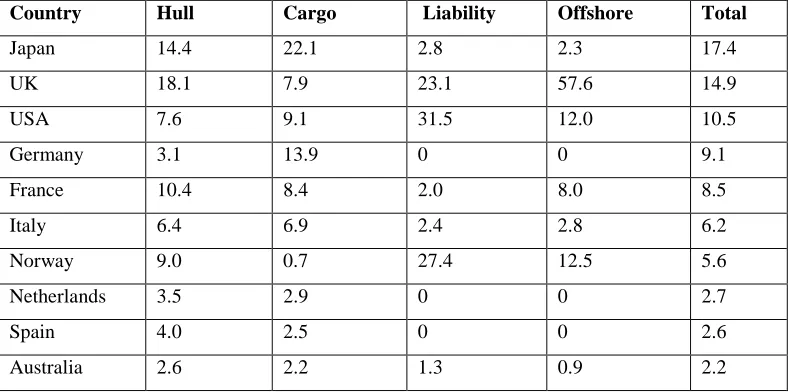
In addition the share of major countries that are involved in the marine insurance is
given below. The Table 3 shows that Japan is leading the overall marine insurance
market with market share on premium of about 17% followed by UK. If we look at
the sectoral analysis UK has predominant position in hull and offshore market with
market share of about 18% and 57% respectively. In the case of marine liabilities
market more than three fourth of the market is held by USA, UK and Norway.
This clearly shows the declining role of UK and shift of concentration from UK
market to Japan market.
Table 3 Proportion of premium revenue in 1997 (in percentage)
Country Hull Cargo Liability Offshore Total
Japan 14.4 22.1 2.8 2.3 17.4 UK 18.1 7.9 23.1 57.6 14.9 USA 7.6 9.1 31.5 12.0 10.5 Germany 3.1 13.9 0 0 9.1 France 10.4 8.4 2.0 8.0 8.5 Italy 6.4 6.9 2.4 2.8 6.2 Norway 9.0 0.7 27.4 12.5 5.6 Netherlands 3.5 2.9 0 0 2.7 Spain 4.0 2.5 0 0 2.6 Australia 2.6 2.2 1.3 0.9 2.2 Source: IUMI Report, 1999
2.5 Main Players in the Marine Insurance market
The oldest marine insurance market, Lloyd’s in London is not an insurer and
individuals who operate syndicate on their own account place the insurance at
Lloyd’s. Only Lloyd’s authorised brokers can conduct the business at Lloyd’s and
marine underwriting activity. The International Underwriting Association (IUA)
(IUMI, 1999) explains the importance of the London insurance market in the
following terms.
‘’The market includes virtually all the world's top international insurance and
reinsurance companies, which conduct business worldwide from their London
operations. Currently there are 108 Syndicates, about 100 insurance and
reinsurance companies, 39 Marine Protection and Indemnity Clubs and 127
brokers operating in the market. London writes an estimated 25% of the world's
international reinsurance, at least 30% of marine insurance and 42% of aviation.
Lloyd's London is the world's second largest commercial insurer and eighth largest
reinsurer ’’.
During 2001, London markets have the capacity to accept premiums worth
around £11 billion, and have licenses to trade in 64 territories around the world.
The market has an A+ rating from Standard & Poor's.’’
Apart from above, there are other major organizations, which operate as
companies, and they are classified into 3 groups (Drewry, 1998 p.20)
1. Institute of London Underwriters (ILU) & London International Insurance
and Reinsurance Market Organisation (LIRMA). ILU provides insurance and
reinsurance services and LIRMA provides insurance to non-marine activities.
ILU had 46 member companies writing hull and cargo liability insurance at
the time of merger with LIRMA.
2. Joint Committees:
A number of individual syndicates, which underwrite both at Lloyd’s and
ILU, form these committees and they play technical, educational and
advisory roles.
3. London Underwriting Committee (LUC) & International Union of Marine
LUC has a relatively small part of the marine insurance market in London. IUMI
acts as an association of Underwriters, who organizes annual meetings and offers a
forum for a number of marine insurers to lobby their views and try to reach some
consensus in the marine underwriting practice. Apart from the London markets
there are other markets primarily for Hull in western Europe (Norway, Germany,
Switzerland, & France) and Eastern Europe (relatively small). A significant
portion of the marine insurance market is operated by the Mutual insurers who
provide insurance for P&I, Hull and Transport (ISL, 2000.pp.7-15).
2.6 Cost of marine insurance on the ship operational cost
The marine insurance cost forms approximately 5-10% of the operational cost of a
ship. The cost of Hull and P&I insurance vary from ship to ship depending on the
reputation and experience of owner or manager, claims record, size of fleet,
voyage pattern, nature of cargo, type of vessels, value of the vessel, flag, year of
build, tonnage, main machinery, class, compliance with international conventions
namely ISM, OPA90, CLC, HNS…etc and nationality of crew (Drewry, 1998
pp.74-76). The cargo insurers and insurers of marine liabilities also seek similar
information but with special emphasis on cargo details. The indicative ship
insurance cost obtained by M/S Ensign Marine Consultancy Ltd for the year 1998
is given in Table 4.
Table 4 Indicative Ship Insurance Cost (in US$)
VESSEL TYPE DECLARED VALUE
HULL/IV WAR RISKS
P&I TOTAL
GeneralCargo(5000GT) 5,000,000 40,000 2,500 25,000 67,500
LPG/LNG(30,000GT) 50,000,000 1,75,000 20,000 50,000 245,000 Bulk (35,000GT) 15,000,000 70,000 7,500 60,000 137,500 Container(50,000GT) 80,000,000 250,000 30,000 75,000 355,000 Tanker(100,000GT) 60,000,000 150,000 22,500 90,000 262,500 Passenger(60,000GT) 200,000,000 500,000 60,000 250,000 810,000
Source: Modified from Drewry report on Marine Insurance, 1998(p.8)
The analysis of the figures shows that there is a wide variation in insurance cost
depending on type of ships namely the passenger ships, tankers, LPG/LNG vessels
and container vessels having higher cost for insurance in comparison to general
cargo and bulk carriers. The figures in the table depend on following assumptions
1. Reputable manager and flag
2. Vessels are not singleton but part of large entity
3. Classed with IACS member
4. Less than 15 years old, well maintained and recently surveyed
5. ITC clauses include ¾ RDC with Hull and ¼ RDC with P&I
6. Increased value and disbursements about 10% of Hull value
7. Values in US$
The cost of insurance varies depending on the following factors. In the case of a
20-year-old vessel the insurance cost may go up by 20%. Similarly, if the vessel
insured were singleton the cost would be up by 10%. The claims record also
influences the cost of insurance varying from 5% to 60% depending on the level
above break-even loss ratio.
2.7 Analysis of data of various types of claims and identifying major risk
areas in the operation of ships
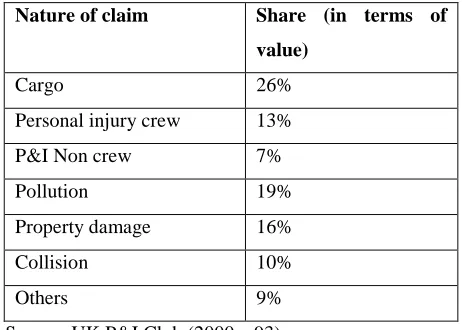
1987 to 1997 identified the following principal risk groups by value of claims
Table 5 Principal risk groups by value of claims
Nature of claim Share (in terms of
value)
Cargo 26% Personal injury crew 13%
P&I Non crew 7%
Pollution 19% Property damage 16%
Collision 10% Others 9% Source: UK P&I Club (2000.p.93)
From the above it may be seen that the cargo claims constitute the largest major
share of claims followed by claims for pollution damage and property damage.The
above analysis also identified the factors namely deck officer error (30%),
structural failure (20%), shore personnel error (15%), equipment failure (10%) and
Others (25%) as the major causes of damage.The above findings clearly show that
the majority of the insurance claims occur due to human error, which could be
minimized by following safe practices on board ship. The implementation of ISM
and STCW in true spirit will greatly help in reducing such claims, which will be
beneficial to both shipowners and insurers in minimizing the cost of insurance.The
above analysis by the UK P&I Club (UK P&I Club, 2000.pp.1-93) also provides
the following trends in respect of insurance claims
1. The number of claims is declining but the average value per claim has been
2. The incidence of major cargo claims is declining. However on the other hand
the average value per claim is increasing.
3. Similarly the numbers of pollution incidents are declining but their average
value is far higher than the general average value of a claim since the
pollution claims are expensive.
4. The number of third party claims and personal injury claims also follow the
above trend and their average value is showing an increasing trend. Among
the personal injury claims the study reveals that the crew error injury claims
are much smaller than the non-crew injury claims viz. passengers, pilots,
stevedorers and other third parties.
The above findings clearly establish that in future the claims, even though fewer in
number are going to be substantial in value terms, which is a major concern to the
insurers. The insurers should find ways and means to avoid major claims, which
CHAPTER 3
MUTUAL INSURERS IN THE MARINE MARKET
3.1 Background of the concept of mutual insurance
The concept of mutuality for sharing the risk existed among the tribes in the early
civilizations of China, India, Babylon and Egypt. The formation of societies,
guilds, clubs and associations during the Greek and Roman civilizations
established the concept of mutuality for sharing the risks. The concept of mutuality
in marine insurance originated in UK with the formation of hull clubs in the early
part of the 18th century to guard against exorbitant insurance premia charged by the
monopolistic companies established by virtue of the Bubble Act of 1720 (UK).
Even though the Bubble Act restricted the operation of partnerships for insuring
marine risks, the mutual clubs operated as associations, which were considered to
be different from the partnership. (Hazelwood, 2000 p.2). The repeal of the Bubble
Act, 1720 (as amended in 1824) and the introduction of the Companies Act in
1862(UK) provided the legal framework for the operation of mutual clubs.
The mutual clubs for P&I insurance evolved in the mid 19th century on the
lines of mutual hull clubs, which had been in existence since the beginning of
eighteenth century. The necessity for P&I mutual clubs arose to meet the growing
needs of the shipowners who needed protection against the liabilities for loss of
not covered by the ordinary marine insurance. The number of collision accidents
also increased in number raising the concern of the shipowners. The Lloyds
statistical committee studied the reason for increase in the collision claims and
they gave findings that the number of collisions at sea increased after the
introduction of steamers. (Young, 1995, p.4). Traditionally the shipowner’s
liabilities were restricted to the value of the ship and freight and the liabilities,
which were in excess of them needed cover as in the case of one fourth of the
collision liabilities, which were not covered by the London under writers under the
Running Down Clause (RDC).
Table 6 THE IGA CLUBS
NAME OF THE CLUB LOCATION SHORT NAME
1. American Steamship Owners Mutual P&I Association. Inc
New York American Club
2. Assurance Foreningen Gard Oslo Gard 3. Assurance Foreningen Skuld Oslo Skuld 4. The Britannia Steam Ship Insurance Association
Limited
London Britannia Club
5. The Japan Shipowners Mutual P&I Association Tokyo Japan Club 6. The London Steamship Owners Mutual Insurance
Association Ltd
London London Club
7. *The North Of England P&I Association New Castle N Of E Club 8. The Shipowners Mutual P&I Association London Shipowners Club 9. The Standard Steamship Owners P&I Association
Ltd
London Standard Club
10. The Steamship Mutual Underwriting Association (Bermuda) Ltd
London Steamship Mutual
11 Sveriges Angfartygs Assurans Forening Gothenburg Swedish Club 12. The United Kingdom Mutual Steamship Assurance
Association (Bermuda) Ltd
London UK Club
13. The West Of England Shipowners Mutual Insurance Association (Luxembourg)
London W Of E Club
*Merged with the New Castle P&I association & Liverpool & London club
Source: Drewry Report on Marine Insurance,1998.p.47.
was established in 1855. This was followed by the other associations who also started
offering P&I cover to their members. The members shared the risks of claims in
proportion to the tonnage of their ship. The concept of P&I expanded when the
shipowners required an indemnity for loss or damage to cargo when they were made
liable under the Act as in the case of ‘Western Hope’. There are about 16 mutual clubs
in existence out of which 13 are members of International club Group Agreement (IGA)
and the rest are non-IGA members. (Drewry, 1998.p.47). The list of clubs who are
members of the IGA may be seen above. The list of P&I insurers who are not members
of IGA are given below
Table 7 The Non-IGA P&I Insurers
Name Location Fixed/
Mutual
1 British Marine Mutual Association Limited
London Mutual*
2. The Charterers Mutual Assurance Association Limited
London Mutual*
3. Deutche Versicherungs-Und Ruckversicherungs –AG(Darag) With Gerling –Konzern AG
Rostock Fixed
4. Dragon Protection And Indemnity London Fixed 5. HIH Marine Insurance Services London Fixed 6. Lloyds And Companies (Various Markets) London Fixed 7. Ocean Marine Mutual P&I Association
Limited
Brussels Mutual*
8. Osprey Underwriting Agency London Fixed 9. Southern Seas Agencies Limited Florida Fixed 10. Terranova Insurance Company Limited London Fixed
Source: Drewry Report on Marine Insurance, 1998 p.47.
* Demutualised in 1998 & 1999 and have become fixed premium operator.
3.2 Sharing of risk in mutual Club
The arrangement of sharing the risk for members in the clubs who are members of
1. Retention: The members of the pooling arrangement each bear their own
claims up to a maximum of US$ 5 million for each claim.
2. Pooling agreement: Claims in excess of retention and up to US$30 million are
shared by pooling in accordance with a percentage contribution allocated to
each club which is worked out based on premium income, entered tonnage and
pool recovery record.
3. Excess reinsurance contract: In order to reduce the possibility of unexpected calls on members the clubs developed a system of reinsurance and clubs used
to pool their claims for reinsurance in excess of a specified figure. This
arrangement helped sharing of heavy claims made against one club by other
members of the other clubs who are under the reinsurance pooling arrangement.
The first pooling agreement was concluded among 6 clubs based in London in
1899 called the London Group, which later became the International Group.
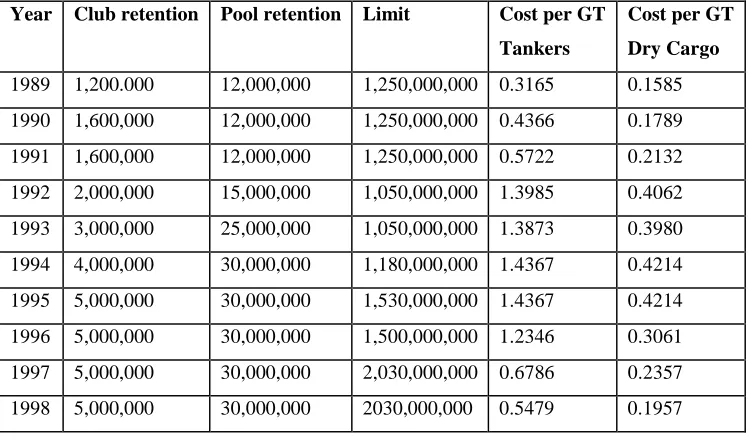
Table 8. Development of General excess of loss insurance limits and costs (in US$)
Source: Drewry Report on Marine Insurance, 1998.p.67
Year Club retention Pool retention Limit Cost per GT
Tankers
Cost per GT
Dry Cargo
Claims in excess of US$ 30 million and up to a maximum of US$ 500 million
(now raised to US$1 billion) for pollution claims and US$ 2 billion per claim
for other categories are covered by this reinsurance contract. The clubs also
share the reinsurance premium according to the tonnage entered in the club.
The rates vary according to the type of the tonnage with the oil tankers having
the highest rates per ton compared to bulk.
4. Overspill claims layer: The P&I clubs operated with unlimited liability till
recently but in 1996 a decision was made to introduce an upper limit based on
a percentage (2.5%) of the tonnage limitation figure (Article 6(1)(b) of
Limitation of Liability on Maritime Claims,1976 (LLMC,1976 convention) of
all the vessels entered in all the International Group clubs. In 1999 this amount
is estimated at US$ 4.25 billion.
The development of general excess of loss reinsurance limits and costs may be
seen in Table above, which shows that the club retention has increased from
US$1.2 million in 1989 to US$ 5 million in 2001 and the pool retention also
increased from US12 million in 1989 to US$ 30 million at present. The overall
limit for reinsurance also has increased from US$1.25 billion to US$2.03.billion.
The trend over the years has been one of gradual increase in the retention limit on
individual clubs and the pooling limit.
3.3 Legal Status of operation of mutual clubs
Most of the P&I mutual clubs are registered under the Companies Act relevant to
their jurisdiction as mutual benefit societies without share capital. (Hazelwood,
2000, p.13). The P&I associations in UK are registered under the Companies Act
as registered companies limited by guarantee with no share capital. Their members
are not shareholders since they do not subscribe to capital or share any profits. In
the mutual responsibility. The members contribute to the damages suffered by
other members by virtue of the obligations provided under the Articles of
Association and Rules of the club, which guarantee each other’s claims. This
arrangement works as network of reciprocal guarantees and it explains the
non-profit making nature of the clubs. The relationship between the members and their
club is laid down in the Articles of Association, which provide for the governance
of the club by the board of directors elected at the general body meetings and the
directors are bound to conduct the business as stipulated in the Articles of
Association. The Articles of Association also cover matters relating to the
qualification for entry into the club, termination and withdrawal of membership,
right to protection and indemnity, liability to contribute in the case winding up and
to pay the calls of the club. In most clubs the directors meet at regular intervals
every two or three months to decide on matters of general policy and to consider
the claims that require their approval. (Hazelwood, 2000, p.14) Many of the P&I
clubs in the UK have transferred their residences abroad and maintain registered
offices offshore. The clubs in the UK moved to offshore destinations not only to
obtain exemption from tax on investment income but also to guard against the
exchange rate fluctuations of the pound sterling since the companies registered in
the UK are bound to maintain their investments in sterling pounds that devalued
by more than 14% against the US Dollar in 1967 (Drewry, 1998). The matter of
fluctuation in currencies was important since most of the members of the mutual
clubs in the UK were non-British and the clubs were required to pay a large
proportion of their claims in currencies other than sterling. The offshore clubs
provided a cushion against the effects of devaluation, inflation fluctuation of
exchange rates and the burden of UK investment taxation (Hazelwood, 2000, p.18).
3.4 Management of P&I clubs
legal entities either limited companies or partnerships who work for fee, based on
the entered tonnage, or by charging working expenses and salaries of their
employees. The management company normally carries out the day-to-day
administration of the club and the claims handling service. The managers are
responsible for the collection of calls, appointment of correspondents, claims
handling, underwriting, investments, signing policies, payment of claims and
maintenance of records and accounts. The powers of the managers are provided in
the Articles of Association of the club and the managers are authorized to enter
into contracts on behalf of the club. Many P&I clubs also have a network of
correspondents all over the world who assist the members of the club in dealing
with the claims. These correspondents act as service providers of the club on a
consultancy basis and they also conduct investigations on behalf of the club for
processing the claims (Hazelwood, 2000, p.23).
3.5 Basis of operation of various players in the mutual insurance
3.5.1 Insurers
The mutual market mainly consists of insurers who deal directly with the
shipowners or their brokers. The underwriters calculate the size of the call based
on the following factors
• Member’s claims within the club’s own retention • Contribution to pool claims
• Proportion of the excess reinsurance premium • Management expenses
• Investments
The underwriter works out the rate for the Estimated Total Call (ETC) by using the
following formula:
The basic rate represents the rate of premium assessed by the underwriter based on
the information collected by him. The club directors determine the proportion of
Advance Call, which is normally payable in two or more instalments throughout
the year. Apart from the above the clubs which are members of the international
group make provision in their rules for catastrophic claims or overspill claims and
these claims are incurred by the members of the club towards the claims of other
clubs in the group under the International Group Pooling Agreement (Hazelwood,
2000).
3.5.2 Role of agents and brokers
The intermediaries such as agents and brokers play a key role in the negotiation
and formation of marine insurance contracts. This practice started since the
beginning of Lloyd's Coffee House, which specialized in the marine insurance
market. The distinctive three-sided nature of marine insurance is that two
commercial parties, insurer and insured deal with one another through the medium
of a third, the broker. Brokers have always served as the intermediary between
insurer and insured, even when both parties are commercial entities that would be
quite capable of finding and negotiating with one another without assistance. From
the very beginning, when "office-keepers" were often traders and insurers
themselves, the broker has been in a uniquely independent position, with strong
legal and commercial links to both sides of the insurance contract. In contrast, an
insurance agent is more closely associated with one side of the insurance contract,
usually the insurers. The difference between an agent and a broker was explained
as follows by Lush J in Norwich Union Fire Insurance Society Ltd v Brennans
(Horsham) Pty Ltd:
‘’[N]either of these is a term of precision but the broad distinction is between a
insurance upon the instructions of clients and whose basic relationship of agency is
with the client, and the insurer's agent whose function is to procure persons to
insure with his principal, the insurer, and whose basic relationship of agency is
therefore with the insurer. In short, a broker usually acts for the insured and an
agent usually acts for the insurer’’. (Hazelwood, 2000,p.45)
3.5.3 Reinsurance
Reinsurance is an arrangement between insurance companies, wherein one
company (the ceding company) cedes a portion of a risk (policy, premium, and
losses) to the other insurance company (the assuming company or reinsurer).
Therefore the risk of loss is spread and a disproportionately large loss under a
single policy does not fall on one company. Reinsurers can be other insurance
companies or companies specializing in reinsurance only. (Hazelwood, 2000,p.110)
There are two types of reinsurance:
1.Facultative - reinsurance of one particular risk (policy) where the reinsurer
retains the right (faculty) to accept or reject each risk offered by the ceding
company.
2.Treaty - reinsurance (usually written on an annual basis) of an entire class of
business consisting of many policies, where the ceding company agrees to cede
and the reinsurer agrees to assume all of the risks (policies) of a particular class of
business.
When a ceding company places either facultative or treaty reinsurance, the
reinsurance is usually placed on one of the following bases:
• Pro-rata or Quota share – reinsurance: The reinsurer shares a pro rata portion of the premium and losses of the ceding company on a fixed percentage basis;
• Excess of Loss Reinsurance: The reinsurer (subject to a specified limit) pays 100% of the losses of the ceding company in excess of a certain agreed limit
(e.g. $30,000,000 retention) either on a per risk basis or in excess of a certain
aggregate of all losses of a particular type (e.g. $10,000,000 for windstorm
losses). It includes various kinds of reinsurance: catastrophe, per risk, per
occurrence, and aggregate excess of loss (Hazelwood, 2000).
In the case of P&I, the International Group of clubs arranges excess loss
reinsurance in the market on behalf of the individual member clubs. The Drewry
Report on Marine Insurance (Drewry, 1998.pp.67-68) states that since 1994 the
excess loss reinsurance cut in at $30 million for each claim and the gradual trend
has been for the P&I clubs to take a greater share of the risk at the lower end and
to extend reinsurance to higher levels at the top end. The above report observed
that the shipowners are critical of the reinsurance programme since over the past
20 years only three cases have shown losses to reinsurance underwriters namely
Amoco Cadiz (1979) and Exxon Valdez (1989) and the reinsurance premium was
as high as US$360 Million in 1994.
3.6 Marine risks covered by P&I Clubs under Club rules
There are two principal forms of insurance covered under P&I namely liability
insurance, which places an obligation on the insurer to pay any damages which the
assured is likely to pay as a result of occurrences which are defined in his
insurance cover, and indemnity insurance, which places an obligation upon an
insurer to reimburse or indemnify an assured only to the extent that the assured has
incurred and discharged his liability. The insurers duty to indemnify does not arise
until the assured has paid damages to the third party. It is not necessary for a
member to have cover against all of the risks covered in a club’s rules and each
wishes to bear deductibles in respect of any such risk. The risks normally covered
are given in the P&I rule book (Hazelwood, 2000, p.153). The information on
coverage of risks would clearly show that the shipowner with full P&I cover is
insured against all the liabilities from catastrophic oil spills, costly collision and
staggering loss of life to feeding stowaways, compensating passengers for loss of
luggage and bailing out drunken crew members from local gaols. (Hazelwood,
2000, p.153)
3.7 Current problems in the mutual insurance market
The major challenges faced by the mutual clubs could be classified as under
3.7.1 Losses
1. Underwriting losses
2. Increase in claims –increase in deficit –falling reserves
3. Increase in administrative cost
3.7.2 Relevance of concept of mutuality – survival of pooling agreement
A. Bilbrough & Co who are managers of the London P&I club (Edminston, 2001)
were of the view that the group unity is important for collective financial strength
and maximum financial security for about 87% of the World’s merchant fleet. The
International Group has real assets totalling about US$6billion to meet claims and
free reserves totalling about US$2 billion. The other advantage of the group
system is that the group has the largest reinsurance contract placed in the Lloyd’s
market that provides them the power to negotiate better rates. The system of club
letters of undertaking has wide acceptance and the group clubs do not default on
3.7.3 Competition within the IGA
Consequent to the investigation by European Commission (EC) and amendment
carried out by the IGA the clubs are allowed to freely quote their rates net of
management cost so that the competing clubs will have to match them in full. This
arrangement forces the clubs to cover their management cost out of their
investment income. This will also facilitate shipowners to enter their fleets in more
than one club and each of his clubs becomes a holding club and they can quote
freely on any of the new purchases of the shipowner. However, the major factor
which discourages the shipowner moving from one club to another is the release
call charged by the clubs to release a member, which is supposed to cover the
liability for future supplementary calls ( Edminston, 2001).
3.7.4 Competition from fixed premium insurers
The entry of fixed premium insurers in the recent years has triggered certain
changes in the P&I mutual market.
• Fall in the rates of insurance premium
• Reduction in average expense ratio of mutual clubs • Reduction in supplementary calls
• Improvement in quality of service
However, the fixed premium insurers are small and offer no apparent advantage
other than the certainty that the clients will not have to pay supplementary calls.
The following fixed players have entered the market and some of them have the
backing of big players.
1. HIH - an Australian insurer (Collapsed recently)
2. Dragon –formed by a manager of mutuals
4. Southern seas – backed by a American insurer
5. AXA - established big player in France
6. British Marine – Based in London
3.7.5 Changing needs of ship owners - One- stop-shop service
The one-stop-shop service means that one club or company that would cover the
comprehensive insurance needs of the shipowners by providing a wide variety of
insurance cover. Phil Mitchell of the United Insurance brokers is of the view that
the ‘’mutual market is moving towards the concept of ‘one stop shop’’, offering
multiple products to suit the customer’s insurance requirements. He pointed out
some recent developments like Thomas Millers & Company Limited, the
managers of the UK P&I club who have worked out a strategic alliance with Swiss
Re and they have positioned themselves similar to Tindall Riley to offer a multiple
product insurance service. The other mutual clubs also follow a similar approach
as in the case of the Steamship Mutual, which provides cover for cargo operators,
transporters, ports and harbours and tugs. The Gard Club provides administrative
services for insuring all marine and energy risks. The Swedish Club already
offered Hull, P&I and associated risk covers for many years. The North of
England Club also runs a hull mutual service. The Standard Club is also expected
to move in the same direction (Mitchell1, 2001).
3.7.6 Investigation by regulatory authorities on the practices
The European Commission (EC) considered the procedure forbidding the
International Group clubs from quoting a rate lower than that of a holding club as