World Maritime University
The Maritime Commons: Digital Repository of the World
Maritime University
World Maritime University Dissertations
Dissertations
2000
Improvement of port operation, service efficiency
and competitiveness, in order to meet the logistical
needs of clients : a case study of Bangkok port
container terminals
Jiravich Klomperee
World Maritime University
Follow this and additional works at:
http://commons.wmu.se/all_dissertations
Part of the
Business Administration, Management, and Operations Commons
This Dissertation is brought to you courtesy of Maritime Commons. Open Access items may be downloaded for non-commercial, fair use academic
Recommended Citation
Klomperee, Jiravich, "Improvement of port operation, service efficiency and competitiveness, in order to meet the logistical needs of clients : a case study of Bangkok port container terminals" (2000).World Maritime University Dissertations. 355.
WORLD MARITIME UNIVERSITY
Malmö, Sweden
IMPROVEMENT OF PORT OPERATION AND
SERVICE EFFICIENCY, AND COMPETITIVENESS
IN ORDER TO MEET THE LOGISTICAL NEEDS OF
THE CLIENTS: A CASE STUDY OF BANGKOK
PORT CONTAINER TERMINALS
By
JIRAVICH KLOMPEREE
The Kingdom of Thailand
A dissertation submitted to the World Maritime University in partial fulfilment of the
requirements for the award of the degree of
MASTER OF SCIENCE
in
PORT MANAGEMENT
2000
To my parents, Charohn and Wasana Klomperee, whose love and support have always been a source of love, inspiration and encouragement as well as
DECLARATION
I certify that all the material in this dissertation that is not my own work has been identified, and that no material is included for which a degree has previously been conferred on me.
The contents of this dissertation reflect my own personal views, and are not necessarily endorsed by the University.
...……… (Signature)
...……… (Date)
Supervised by:
Name: Professor Doctor Bernard Francou Office: Associate Professor, Port Management World Maritime University
Assessor:
Name: Professor Doctor Shuo Ma
Office: Course Professor, Port and Shipping Management World Maritime University
Co-assessor:
Name: Professor Patrick M. Alderton
ACKNOWLEDGEMENTS
I would like to express my deep gratitude to all the parties who in one way or another have facilitated this study.
My special thanks and appreciation to my sponsor, Norway-IMO Technical Co-operation, for granting me the privilege of this scholarship
I also wish to express my deep gratitude to Professor Doctor Shou Ma, Professor of Port and Shipping Management, WMU, Professor Doctor Bernard Francou, Associate Professor of Port Management, WMU and all other professors and lecturers including ESSP teaching team at WMU as well as visiting professors for all their advice, directives and sharing of immense knowledge and experience.
I shall be thankful to the personnel of the Library, the Reception, Secretariat, the Canteen, all the Administrative staff of WMU and all staff of Henrik Smith Hostel for their assistance, co-operation, kindness and politeness. I would also like to express my special thanks to all friends whose views I both formally and informally shared, enriching the results of my study.
Special appreciation to my employer, the Port Authority of Thailand, for allowing me to come and study here in Sweden, and also my colleagues in the Port Authority of Thailand who worked hard in supporting me with all the information needed during my studies at WMU.
I shall express my sincere thanks to the beautiful City of Malmö and Swedish Government for your kind hospitality and all facilities given to me during my stay in this wonderful country.
ABSTRACT
Title of Dissertation: Improvement of port operation and service efficiency, and competitiveness in order to meet the logistical needs
of the clients: A case study of Bangkok Port container
terminals
Degree: MSc
The international trade in Thailand mainly depends upon sea transport mode. The port is the main gateway of the country. As is widely accepted, containerization has risen rapidly; in Thailand Bangkok Port is one of the major ports who plays a very important role as the logistic platform for Thai economy.
According to the government policy to limit the number of container throughput via Bangkok Port at one million TEUs/year, hence, Bangkok Port has to emphasize on the increment of its efficiency of operations and services instead of expansion. Recently, Bangkok Port has improved its performance tremendously. However, the port still has problems creating inefficient operations and service systems.
This dissertation aims to examine the current situation of operation and service systems of Bangkok Port container terminals. Analysis and comparison with some local ports, modern ports and international regime and some recommendations to improve its efficiency and competitiveness in order to meet the needs of the clients will be made.
In accordance with the result of the study, a number of recommendations are made concerning the need for the improvement of the efficiency of Bangkok Port container terminals. The recommendations given include both restructuring of management and operation systems and investment in necessary physical facilities in Bangkok Port. Both of these are indispensable and should be realized simultaneously. Additionally, it is recommended to set as the short-term plan with the target year 2003 of the Port Authority of Thailand Master Plan.
Keywords: Bangkok Port, Competitiveness, Containerization, Efficiency,
TABLE OF CONTENTS
Declaration ii
Acknowledgement iii
Abstract iv
Table of Contents vi
List of Tables xii
List of Figures xiii
List of Abbreviation xiv
1 Introduction 1
1.1 Brief description about Thai economy 3
1.1.1 Economic situation 3
1.1.2 The trade environment 4
1.2 Outline of transport in Thailand 5
1.2.1 Marine transport 5
1.2.2 Railway network 6
1.2.3 Road transport 7
1.2.4 Air transport 8
1.3 Trend of international container transport in Thailand 11
1.3.1 Outline of international container transport 11
1.3.2 Characteristics of the liner services for containers 12
in Thailand 1.4 Conclusion 13
2.2 Location 16
2.2.1 Land area use within the port 16
2.2.2 Water area 16
2.3 Port facilities 16
2.3.1 Mooring facilities 16
2.3.2 Cargo sorting and storage facilities 17
2.3.3 Service crafts and mechanical handling equipment 18
2.3.4 Utilities 19
2.3.5 Operation supporting facilities and port office building 19
2.4 Storage system 19
2.4.1 General cargo 19
2.4.2 Container 20
2.5 Information system 20
2.6 Container operational and service systems 20
2.6.1 Concept of establishing container terminal operation 20
System 2.6.2 Discharging of container 22
2.6.3 Container delivery 23
2.6.4 Receiving of container 23
2.6.5 Loading of container 23
2.6.6 Sub-system 23
2.6.7 EDI (Electronic Data Interchange) 24
2.6.8 Container terminal facilities at Bangkok port 25
2.7 Present conditions impact on container terminals at Bangkok 26
Port 2.7.1 Government policy 26
2.7.2 Transport situation 26
2.7.3 Services 27
2.7.4 Consequences 27
2.8 Container volume handled at Bangkok Port 28
3 Container terminal operation and service system of an
international regime
3.1 Logistics management concept 31
3.2 The impact of containerization on port operations 31
3.3 Container terminal 32
3.4 Area requirement 34
3.5 Container handling systems 36
3.5.1 Trailer storage system (chassis system) 36
3.5.2 Straddle carrier system 37
3.5.3 Gantry crane system 38
3.5.4 Front-end loader system 38
3.5.5 Combination system 39
3.6 Terminal layout 39
3.7 Container terminal operations 40
3.7.1 Terminal operator 40
3.7.2 Shipside operation 41
3.7.3 Container yard operation 42
3.7.4 Container Freight Station (CFS) job 43
3.7.5 Terminal documentation 43
3.8 Maintenance 44
3.8.1 Preventive maintenance 44
3.8.2 Corrective maintenance 45
3.8.3 Designing-out maintenance 45
3.9 Analysis of terminal operating performance 45
3.9.1 Output 45
3.9.2 Worked hour/Service hour ratio 46
3.9.3 Berth occupancy ratio 46
3.9.4 Number of TEUs/Terminal area 46
3.9.5 Vehicle turn-round time 47
3.9.6 Terminal cargo handling charge 47
3.10 Pilotage and mooring time 47
3.11 Port congestion 48
3.11.2 Management 48
3.11.3 Labour 49
3.11.4 Co-ordination 49
3.11.5 Traffic 49
3.11.6 Operation 50
3.11.7 Maintenance 50
3.11.8 Clearance procedures and documentation 50
3.11.9 Dynamic effects 51
3.11.10 Function and location of the port 51
3.12 Information system 51
3.12.1 Storage control 52
3.12.2 Personnel record 52
3.12.3 Wage bills 52
3.12.4 Container control 52
3.12.5 Preparation of bills 52
3.12.6 Berth allocation 52
3.12.7 Documentation 52
3.12.8 Customs clearance 53
3.12.9 Cargo manifest 53
3.12.10 Tariff 53
3.12.11 Management information 53
3.13 Port in the future 53
3.14 Conclusion 54
4 Analysis and comparison of operation and service systems in Bangkok Port container terminals with some local ports and international regime 4.1 Scope of Bangkok port container terminal operation and 55
service systems, which have been implemented 4.1.1 The modernization of Bangkok Port 56
4.1.2 Export container services 56
4.1.3 Reduce the process of services and documentation 57
4.1.5 Flexibility and exception of the tariff at Bangkok Port 57
4.1.6 Marketing promotion 58
4.1.7 Help desk 58
4.2 Analysis of operations and services in Bangkok Port 58
container terminals 4.2.1 Ship operations and services 58
4.2.2 Cargo operations and services 61
4.2.3 Cargo handling equipment 66
4.2.4 Storage operations 74
4.3 Management and operations 76
4.3.1 Container handling equipment drivers are old 77
4.3.2 Lack of knowledge and skills in the new operation 77
systems 4.3.3 Lack of service mind 77
4.3.4 Insufficient security 78
4.4 Conclusion 78
5. Recommendations 79 6. Conclusions 88 References 91 Appendices Appendix 1 Terminal planner’s job 94 Appendix 2 Yard planner’s job 95
Appendix 3 Gate clerk’s job 96
Appendix 5 Import cargo job 99
Appendix 6 Export documentation 100
Appendix 7 Import documentation 101
LIST OF TABLES
Table 1 Length of road network under the responsibility of the Department 7 of Highways
Table 2 Mooring facilities at Bangkok Port 17
Table 3 Storage area at Bangkok Port 17
Table 4 Service crafts at Bangkok Port 18
Table 5 Mechanical handling equipment at Bangkok Port 18
Table 6 Container terminal facilities at Bangkok Port 25
Table 7 Though container at Bangkok Port for the Fiscal Year 1997-1999 28
Table 8 Maximum berth occupancy ratio 46
Table 9 Pilotage and mooring time 47
Table 10 The targets of port performances set up 56
Table 11 Ship operation and service performances 60
Table 12 Percentage of containers in term of container status defined 63 by PAT’s tariff
LIST OF FIGURES
Figure 1 Map of Thailand 2
Figure 2 Domestic freight transportation 8
Figure 3 Foreign trade (imported) in term of value 9
Figure 4 Foreign trade (exported) in term of value 9
Figure 5 Foreign trade (imported) in term of volume 10
Figure 6 Foreign trade (exported) in term of volume 10
Figure 7 Map of Bangkok Port 15
Figure 8 Map of Bangkok Port container terminals 21
Figure 9 Container volume handled at Bangkok Port 29
Figure 10 Ship berthing time at Bangkok Port, LCP and private ports 59
Figure 11 Ship operation and service performances 61
Figure 12 The average distribution of import containers 64
Figure 13 The average distribution of export containers 64
Figure 14 Cargo handling productivity of Bangkok Port compared with 65 other ports
LIST OF ABBREVIATIONS
AAT Airport Authority of Thailand
BIMCO The Baltic and International Maritime Council
BKK Bangkok
BKP Bangkok Port
B/L Bill of Lading
BP Berth Planning
CFS Container Freight Station
CLP Container Load Plan
CY Container Yard
D/O Dispatch Order
D/R Damage Report
E/D Export Declaration
EDI Electronic Data Interchange
E/R Equipment Receipt
ETA Estimate Time of Arrival
FCL Full Container Load
GDP Gross Domestic Product
GM Gravity of a ship (G) and her Metacentre (M)
GNP Gross National Product
GRT Gross Registered Tonnage
HP Horse Power
HR Hour
ICD Inland Container Depot
IMF International Monetary Fund
JIT Just In Time System
JP Job Controlling
KM Kilometre
LCL Less than Container Load
LCP Laem Chabang Port
NO Number
MDT Monitor of Mobile Data Terminal MEA Metropolitan Electricity Authority
M/F Manifest
O/D Origin and Destination
PAT Port Authority of Thailand
RMG Rail Mounted Gantry Crane
RTG Rubber Tired Gantry crane
SQ.M Square Meter
SRT State Railway of Thailand
TEU Twenty –foot Equivalent Unit
TGS Twenty Ground Slots
UNCTAD United Nations Conference on Trade and Development USD United States of America Dollar
US$ United States of America Dollar
UAE United Arab Emirates
VP Vessel Planning
Chapter 1
Introduction
The government’s policy involves limiting the number of container throughput via Bangkok Port to one million TEUs/year in order to decentralize business out of Bangkok Metropolitan area and to promote Laem Chabang Port in the Eastern Seaboard.
The focal point of development of Bangkok Port, therefore, will be emphasized on increment of operation and service efficiency instead of expansion.
This study proposes to examine the current situation of operational and service systems of container terminals in Bangkok Port, analyze and compare with some local ports, modern ports and international regime. Furthermore, the recommendations and conclusions will be drawn and made respectively to overcome any problems in the present situation in order to improve the efficiency of port operations and services and competitiveness.
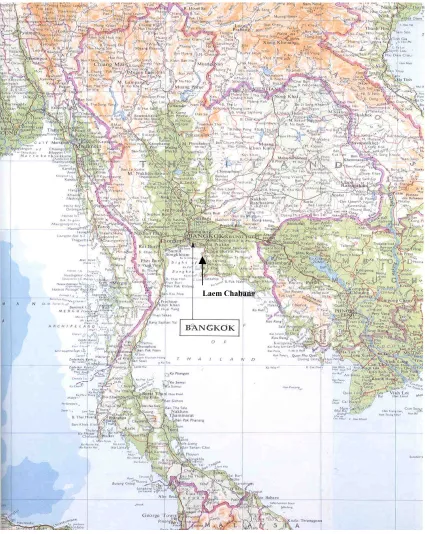
Figure 1: Map of Thailand
Source: Port Authority of Thailand
1.1
Brief description of the Thai economy
Before examining the present situation in Bangkok Port, this chapter will give a brief description of the Thai economy in order to have a better understanding and a general view of Thai economy.
1.1.1 Ecomomic situation
After more than a decade of sustained growth, the Thai economy entered a period of adjustment in 1996, when GDP growth slowed to 5.9 percent. The situation deteriorated in 1997 and then in August of 1997, Thailand was committed to a US$ 17.2 billion rescue package arranged under the umbrella of the International Monetary Fund (IMF).
As part of the economic recovery program, Thailand has increased revenue streams and substantially reduced spending, instituted a wide range of finance sector reforms and initiated a program to privatize state-owned enterprises.
For the entire year of 1997, Thailand experienced a decline of 0.4 percent in GDP, and in 1998 GDP declined by 8.0 percent. However, in 1999, GDP was 4.1 percent growth.
From 1985-1994, Thailand’s economy expanded by leaps and bounds, with GNP per capita averaging 8.2 percent (#1 in the world). In fact, between 1990 and 1996, GNP per capita more than doubled. However, with the devaluation of the Baht in June 1997, and slowdown in economic growth, 1998 per capita dropped to US$ 1,857, and increase to US$ 2,045 for the year 1999.
cover. Economic recovery is expected to steadily continue in 2000 with an economic growth of 4.4 percent, higher than the 4.1 percent growth in 1999. Factors contributing to further recovery in 2000 include export, private investment and private consumption expenditures. Inflation rate is expected to be contained at about 2.0 percent.
1.1.2 The trade environment
On the external front, export growth has traditionally been a major driver of Thai economy and has contributed to the diversification of industrial structure. Since 1991, exports have doubled in value, from US$ 28.2 billion to US$ 56.7 billion in 1997. Though exports declined to US$ 52.9 billion in 1998, they are projected to grow by 7% in 1999. Manufactured export, in particular, has gained importance - accounting for computers and parts, textiles, gems and jewelry, electronic and automotive products, in addition to agricultural products.
Traditionally, imports have also shown strong increases, although they decreased in the wake of the Asian financial crisis, beginning in mid-1997. In 1998, imports fell 33.8 percent in US dollar terms, to US$ 40.6 billion; however, for 1999 they totaled US$ 47.0 billion, a 15.8 percent growth in terms of value. As a result reduced reliance on costly imports, Thailand’s balance of trade showed a US$ 12.2 billion surplus in 1998 and US$ 9.6 billion surplus in 1999.
As a result, Thailand’s current account, which has been in deficit throughout the 1990s, showed a US$ 14.3 billion surplus for full year of 1998 and there was a US$ 11.6 billion surplus in 1999. The balance of payments for 1998 was surplus by US$ 1.7 billion, and in 1999 continued that trend, with a surplus of US$ 4.6 billion.
are forecasted to increase by 14.3 percent, reflecting the steady export performance and expanded investment activities, which together will stimulate the import of capital and raw material goods.
1.2
Outline of transport in Thailand
The transport network is very important for all businesses including maritime transport. In 1.2, the transport modes of Thailand related to the trade of the country will be analyzed.
1.2.1 Marine transport
Ports in Thailand are divided into sea ports which face the Gulf of Thailand or Andaman Sea and river ports which were developed along the Chao Praya River. Principle ports for international trade are Bangkok Port, which is the only river port used for international trade, Laem Chabang Port, Map Ta Phut Port, Songkla Port and Phuket Port.
Among these ports, only Bangkok Port and Laem Chabang Port, which were opened in 1991 as key projects of the Eastern Seaboard Development Plan, have been in operation as a gateway to the country. Laem Chabang Port is expected to become not only the center of maritime trade entering Thailand but also the rest of Indochina.
The ocean transit time between the United States and Thailand varies. From the West Coast, the time is roughly 20 days. From the Gulf of Mexico region, the time is about 30 days. From the East Coast, the estimated time is 40 days. Transit time also varies according to the ship’s itinerary and the point of transhipment in the Far East.
By barge in waterways, it is hard to find any advantage of barge delivery in terms of efficient and economical transportation. Picking up disadvantages of barge transportation, it is less economical because of crane charges on both edges (loading/unloading), taking long transit time with poor reliability and low frequency in addition to non-attractive higher freight.
1.2.2 Railway network
The railway system is managed by the State Railway of Thailand (SRT) roughly 2,300 miles of track throughout the country. With over 600 stations, the SRT is a good form of transportation. The SRT owns 357 cars, of which 30 are for passenger use and 127 are for cargo. SRT also owns 75 diesel locomotives. By 1996, SRT had purchased 30 new 3+0 new locomotives, 270 new passenger cars and 750 new cargo cars.
1.2.3 Road transport
The most important form of transportation in Thailand is the national highway system, which is recognized as one of the best developed in Southeast Asia. Thailand is actively upgrading the highways to help support the rapid economic growth in the regional areas like the Eastern Seaboard. Thailand’s road network has roughly 26,700 miles of the national and provincial highways, and suburb roads. Bangkok is linked directly with all the other major Thai cities. In addition, highways also link Thailand with Laos, Cambodia, Malaysia and Myanmar. In addition, new primary highways are being built that will link the Eastern Seaboard with Northeastern Thailand. These projects will add roughly 3,500 additional miles to the highway network.
By large, truck and passenger transport is dominated by private companies. Transportation by truck can gain an advantage over the railroad service in delivery of cargoes in terms of transit time, flexibility and frequency.
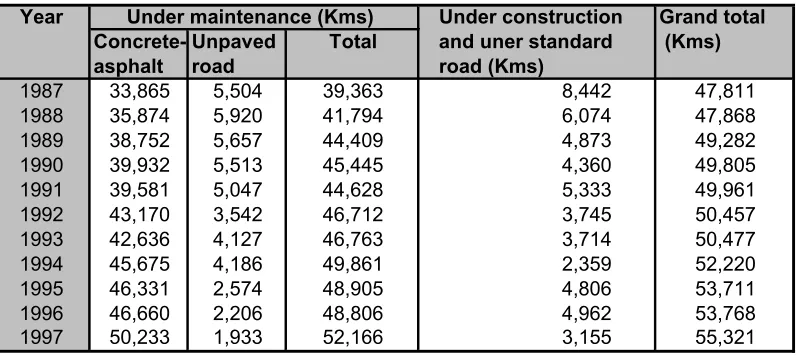
Table 1: Length of road network under the responsibility of the Department of Highways
Year Under maintenance (Kms) Under construction Grand total Concrete- Unpaved Total and uner standard (Kms)
asphalt road road (Kms)
1.2.4 Air transport
The Airports Authority of Thailand (AAT) and the Aviation Department in the Ministry of Transport and Communications are responsible for national and international airport operations. The AAT is a state-owned enterprise that operates Don Muang (Bangkok International Airport), Chiang Mai International Airport and the provincial airports at Hat Yai and Phuket. The Aviation Department is responsible for the remaining airfields and provincial airports. Of the 6 provincial airports, 15 have regularly scheduled traffic. Don Muang is currently the main entry point for international traffic into the country and also serves as the central hub for the majority of domestic air traffic. There are 4 cargo terminal at Bangkok International Airport with a combined of 114,048 sq.m and an annual freight capacity of 1 million tons.
Figure 2: Domestic freight transportation
Source: The Ministry of Transport and Communications of Thailand 0
100,000 200,000 300,000 400,000 500,000
Tonne
1992 1993 1994 1995 1996 1997
year
Transport mode
Road Rail
Figure 3: Foreign trade (imported) in term of value
Source: The Ministry of Transport and Communications of Thailand
Figure 4: Foreign trade (exported) in term of value
Source: The Ministry of Transport and Communications of Thailand
0 500,000 1,000,000 1,500,000 2,000,000
Baht
1994 1995 1996 1997 1998
Year
Foreign trade in value
Air
Land
Sea
0 500,000 1,000,000 1,500,000 2,000,000 2,500,000
Baht
1994 1995 1996 1997 1998
Year
Foreign trade in value
Air
Land
Figure 5: Foreign trade (imported) in term of volume
Source: The Ministry of Transport and Communications of Thailand
Figure 6: Foreign trade (exported) in term of volume
Source: The Ministry of Transport and Communications of Thailand
0 10,000 20,000 30,000 40,000 50,000 60,000 70,000 80,000
Tonne
1994 1995 1996 1997 1998
Year
Foreign trade in volume
Air
Land
Sea
0 10,000 20,000 30,000 40,000 50,000 60,000 70,000
Tonne
1994 1995 1996 1997 1998
Year
Foreign trade in volume
Mail Air Land
1.3
International container transport trends in Thailand
It is obvious that sea transport plays a very important role in international trade of the country, and nowadays most of the cargoes are being containerized. Therefore, the international container transport trends in Thailand will be analyzed as follows:
1.3.1 Outline of international container transport
In 1999, the total foreign trade value of Thailand amounted to 56.6 billion US$ for exports (increase of 7 percent over 1998) and 47.0 billion US$ for imports (increase of 15.8 percent). However, if comparing the figure of 1999 with the year 1996, the total foreign trade value for exports increased just 3.5 percent, and decreased 33.6 percent for imports. This was caused by the slowdown of the Thai economy since 1997.
Due to the slowdown of the Thai economy in 1997 and the government policy to limit container traffic at Bangkok Port to one million TEUs in 1998, the number of ship calls at Bangkok Port went down to 2,694 in 1999 showing a decrease of 164 calls or 6 percent from the year 1998. The container throughput in 1999 was1.052 million TEUs showing a decrease of 0.062 million TEUs or 5 percent from 1998. However, the economic crisis turned out to be a big plus for Laem Chabang Port which enjoyed an 8.2 percent increase of ship calls in 1999. The container thoughput in 1999 was 1.75 million TEUs showing an increase of 0.33 million TEUs or 23 percent from 1998. This is due to the devaluation of the Thai Baht resulting in the increasing demand from foreign countries and the increasing number of imported empty containers for exporting cargoes.
volume of containers will decrease to 1 million TEUs excluding empty containers while those at Laem Chabang Port will be 1.85 million TEUs.
1.3.2 Characteristics of the liner services for containers in Thailand
•
Services with feederMost containers originating from or designated to Thailand are loaded/unloaded at Bangkok Port and Laem Chabang Port at present. After or before being handled, long haul containers from/to the USA and Europe, for example, are transhipped from /to trunk liners at Singapore, Hong Kong, Kaoshung and the ports in Japan, among others liner services with feeder connecting Bangkok Port and Laem Chabang Port and the trunk routes are in operation.
•
Direct liner servicesIn recent years, the number of vessel calls for direct shipping services shows an upward trend, for instance, routes for Japan, Korea, Hong Kong, Taiwan and China, routes for Singapore or routes for other areas comprising Europe, Bangladesh, South Africa, Durban, Cambodia and UAE.
1
.4 Conclusion
Although Thailand is still in the economic crisis situation, it is expected that the economy of the country will slightly recover. According to the economic statistic, basically, the economy in the country is based on foreign trade i.e., import and export. The sea transport mode plays a very important role for the Thai economy. More than 80 percent of goods and commodities are imported and exported by ships, so ports must be the main gateway for the country. Hence, regarding globalization, ports have to improve their efficiency to be competent for serving, facilitating and competing with the others for the benefit of the country as a whole.
Chapter 2
Bangkok Port present situation
As mentioned in the previous chapter, it is obvious that the economy of Thailand highly depends on foreign trade and , furthermore, Bangkok Port plays a significant role as one of the main gateways of the country. The main objective of this study is to discuss how to improve operation and service efficiency and competitiveness of Bangkok Port in order to meet the logistical needs of the clients and to facilitate the foreign trade activities. This chapter, for better understanding, will examine the present situation in Bangkok Port, i.e., identification of the characteristics of operational and service systems and current condition of container movements.
2.1 General background of Bangkok Port
Figure 7: Map of Bangkok Port
Source: Port Authority of Thailand
Chao Phraya River Container terminal 1
Container terminal 2
2.2 Location
Bangkok Port is located on the left side of the Chao Phraya River at km. +26.5, Klongtoey District, Bangkok.
2.2.1 Land area use within the port
The Bangkok Port covers an area of about 930 acres, 340 acres of which are inside the customs fence and are utilized for operational purposes while 51 acres are outside the customs fence, 30 acres are for future expansion, 340 acres are rented for commercial use and housing projects, 100 acres are slum area and 74 acres are for access roads.
2.2.2 Water area use within the port
The offshore area under the jurisdiction of the Port Authority of Thailand (PAT) begins from the Memorial bridge of the Chao Phraya River downstream to the km -18 in the Gulf of Thailand, which is about 66 km long. It is the PAT’s responsibility to conduct dredging operations and maintenance of the bar channel and births to the depth of -8.5 and -10.72 meters below Mean Sea Level respectively including installation of navigation aids and other related facilities and also conducting surveys of the depth of the navigation channel in front of the wharves and in the basins.
2.3 Port
facilities
2.3.1 Mooring facilities
Table 2: Mooring facilities at Bangkok Port
Berth/dolphin/bouy Length No.of berths Max.Size of vessel Capacity (ft.) & mooring points Length/Draught (No.of
(ft.) ships)
East quay 5,012 8 565/27 7
. 300/15 1
West quay 5,445 10 565/27 10
Klong Toey dolphin 4,592 36 565/27 7
Bang Hua Sua dolphin 5,248 25 565/27 8
Mooring bouy at Sathupradit 5,182 5 565/27 4
. 565/27 1
Sources: Port Authority of Thailand
2.3.2 Cargo sorting and storage facilities
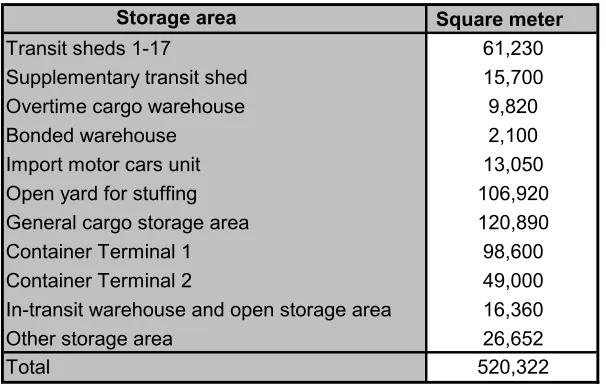
The cargo sorting and storage facilities of Bangkok Port are summarized as shown in Table 3.
Table 3: Storage area at Bangkok Port
Storage area Square meter
Transit sheds 1-17 61,230
Supplementary transit shed 15,700
Overtime cargo warehouse 9,820
Bonded warehouse 2,100
Import motor cars unit 13,050
Open yard for stuffing 106,920
General cargo storage area 120,890
Container Terminal 1 98,600
Container Terminal 2 49,000
In-transit warehouse and open storage area 16,360
Other storage area 26,652
Total 520,322
2.3.3 Service craft and mechanical handling equipment
Bangkok Port provides the facilities for craft services and mechanical handling equipment as shown in Table 4 and Table 5.
Table 4: Service crafts at Bangkok Port
Item . Capacity Quantity
Tug boat 1,125-2,400 hp 11
Garbage boat 160,200 hp 2
Rope boat 74-170 hp 14
Water supplying boat 425 hp 1 Yacht and inspection boat 1,470 hp 1 Trailing suction hopper dredger 2,500 cubic metres 3
Dredger 265-420 metric tons 3
Hopper barge 120 cubic metres 7
Coastal tug 150-350 hp 4
Source: Port Authority of Thailand
Table 5: Mechanical handling equipment at Bangkok port
Equipment Capacity Quantity
Rail Mounted Shoreside Gantry Crane 32.5-40 Tons 14 Rubber Typed Gantry Crane 30-40 Tons 36
Top Loader 40 Tons 33
Empty Container Stacker 7.5 Tons 25
Mobile Crane 10 Tons 3
50 Tons 7
Forklift Truck Various Sizes 223
Tractor for Trailer 30-40 Tons 154
Container Chassis 30-40 Tons 151
Towing Tractor 12,000 Lbs. 14
Trailer 10 Tons 14
Multi Purpose Trailer 5-7 Tons 11
Motor Truck 5-7 Tons 45
2.3.4 Utilities
The water supply system for Bangkok Port consists of the water supply from the municipal water supply system and the water supply from its own well water supply system. The water supply taps for ships are installed on the apron of the west quay and east quay. Furthermore, the electricity for the port is received from the Metropolitan Electricity Authority (MEA). This electricity supply system is supported by an emergency supply system which consists of 4 diesel engine generators.
2.3.5 Operation supporting facilities and port office buildings
The operation supporting facilities, such as repair shops, parking lots, gas stations, stores for maintenance materials, pump houses, substations and canteens, and the port office buildings, such as PAT’s operation building, Bangkok Port operation building, Comptroller’s department, Law division, Container division and Computer center.
2.4 Storage system
The storage operation and services of the Port Authority of Thailand are the following:
2.4.1 General cargo
Private stevedores are assigned to discharge general cargoes to quay side or reload them to trains, trucks or lighters. Cargoes that are kept in transit sheds, right behind the birth, will be alphabetically separated (A-Z) in each bay to make delivery easy.
•
Valuable and damaged goods are stored separately.2.4.2 Containers
LCL containers are hauled to the yard at the East Quay for unstuffing. The cargoes are then stored into sheds, pending delivery by the owners. FCL containers are directly moved to the consignees’ premises or brought to the port’s exporting yard. Stuffed containers waiting for loading on to vessels and empty containers are hauled to the marshalling yard at the East Quay. The storage system is implemented as international standard.
2.5 Information system
The Port Authority of Thailand has developed computer systems in controlling inward and outward container traffic within the customs fence, billing of tariff charge e.g. inward and outward cargo charge, container charge, port dues, and equipment hire including accounting and financial systems. In addition, PAT has implemented the computer system to the services on vessels, containers, billing and supporting program.
2
.6 Container operational and service systems
The Bangkok Port container terminal operational and service systems are the following:
2.6.1 Concept of establishing container terminal operations system
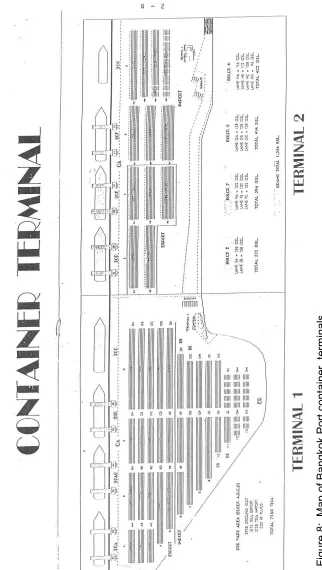
Containers are loaded and discharged at the berths of the East Quay (Container Terminal 1 and 2). The following concept of establishing the system of container terminal operations at Bangkok Port is for the purpose of achieving safe, efficient and reliable operations for the customers.
Figur
e 8:
M
ap o
f Bangkok Po
rt
cont
aine
r
t
er
m
inals
Sourc
e:
Port
Auth
ority
o
f Tha
containers at the terminal by conducting yard planning and inventory control of containers, which is indispensable for a modernized container terminal.
•
Introduction of Closing Time so as to make a loading sequence plan at least 3 hours before ship arrives.•
Increase of container stacking capacity at marshalling yard in the East Quay. It is necessary to demolish Transit Shed No. 11 and No. 12. Actual capacity will be increased from 6,200 TEUs to 10,000 TEUs.All exported containers should arrive at the marshalling yard before ship arrival. Imported containers must be stacked on the marshalling yard after being discharged from the ship (even during peak condition: FCL container must be stacked on the marshalling yard, LCL containers will be delivered to sheds and to the empty container area for empty container). In such case, berthing hours of container ship are expected to be 20 hours instead of 24 hours and generating benefits to the saving of ship staying cost.
2.6.2 Discharging of containers
2.6.3 Container delivery
After the importer has cleared the Customs procedure and paid for the tariffs. he/she will receive a container receipt which will also be shown at sub gate of the container terminal where he/she could handover his/her container. At the sub gate, the container number will be put into the computer by an officer; the system will print out the location of the container and on-line to RTG (MDT).
2.6.4 Receiving of container
Before arrival of a vessel and first container at the container terminal, the booking forecast will be submitted to the terminal. The container terminal will then utilize such data to plan the export yard in order to stack the container by grouping the containers for the vessel.
2.6.5 Loading containers
PAT has announced the closing time system by loading only containers which have reached the port at least 3 hours before the arrival of the vessel. For loading operations, PAT will bring the container to quay side on the request of the stevedoring company. Containers will then be loaded onto the vessel.
2.6.6 Sub-system
In order to develop the container terminal management as above, the sub-function of the computer system consists of:
•
Vessel planning (VP) in the loading plan; the vessel planner receives the lists for a loading plan from the yard planning computer system. These lists are loading container lists, loading summary lists and loading special container lists. After the plan is completed, the loading sequence list and loading bay plan sheets are delivered to yard foreman and tally officer. For vessel planning in the discharging plan, the necessary information requested is number and container No. to be stacked at the marshalling yard, discharging container list, discharging summary list and discharging special container list.•
Yard planning (YP) which provides for the yard allocation both for import and export containers and also do in-yard shift plan.•
Job controlling (JC) takes place at the vessel operation monitor in order to optimize the transtainer operation; the yard operational system will serve this purpose.2.6.7 EDI (Electronic Data Interchange)
2.6.8 Container terminal facilities at Bangkok port
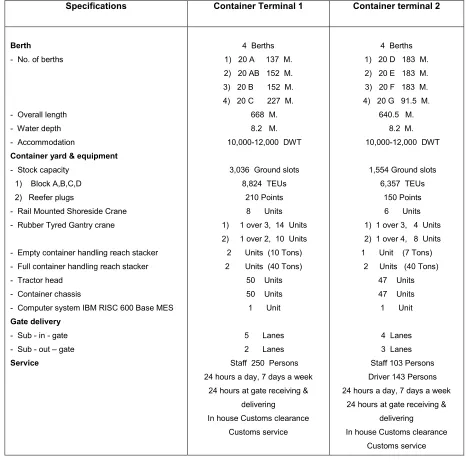
Bangkok Port provides the facilities for container terminal operations and services as shown in Table 6 below.
Table 6: Container terminal facilities at Bangkok port
Specifications Container Terminal 1 Container terminal 2
Berth
- No. of berths
- Overall length - Water depth - Accommodation
Container yard & equipment
- Stock capacity 1) Block A,B,C,D 2) Reefer plugs
- Rail Mounted Shoreside Crane - Rubber Tyred Gantry crane
- Empty container handling reach stacker - Full container handling reach stacker - Tractor head
- Container chassis
- Computer system IBM RISC 600 Base MES
Gate delivery
- Sub - in - gate - Sub - out – gate
Service
4 Berths 1) 20 A 137 M. 2) 20 AB 152 M. 3) 20 B 152 M. 4) 20 C 227 M.
668 M. 8.2 M. 10,000-12,000 DWT
3,036 Ground slots 8,824 TEUs
210 Points 8 Units 1) 1 over 3, 14 Units 2) 1 over 2, 10 Units 2 Units (10 Tons) 2 Units (40 Tons)
50 Units 50 Units 1 Unit
5 Lanes 2 Lanes Staff 250 Persons 24 hours a day, 7 days a week
24 hours at gate receiving & delivering
In house Customs clearance Customs service
4 Berths 1) 20 D 183 M. 2) 20 E 183 M. 3) 20 F 183 M. 4) 20 G 91.5 M.
640.5 M. 8.2 M.
10,000-12,000 DWT
1,554 Ground slots 6,357 TEUs
150 Points 6 Units 1) 1 over 3, 4 Units 2) 1 over 4, 8 Units 1 Unit (7 Tons) 2 Units (40 Tons)
47 Units 47 Units 1 Unit
4 Lanes 3 Lanes Staff 103 Persons Driver 143 Persons 24 hours a day, 7 days a week
24 hours at gate receiving & delivering In house Customs clearance
Customs service
2.7 Present conditions which have an impact on container
terminals at Bangkok Port
Presently, there are many conditions which have an impact on Bangkok Port container terminal operations and services, they are as follows:
2.7.1 Government policy
The government policies which have an impact on container terminal operations at Bangkok Port are:
•
The promotion of export policy.•
The policy to limit the number of container throughput at Bangkok Port at 1 million TEUs per year.•
The policy of reorganization of Bangkok Port to increase the private roles to take part and operate in some activities.2.7.2 Transport situation
According to the changing of transport forms, these can have an impact on the operations and services in Bangkok Port , as follows:
•
The volume of container cargo handled through the port has shown a sharp increase.Consequently, they will change their routes or move to other ports that can accommodate larger ships.
•
Nowadays shipping companies have a policy to merge or set up agroup of co-operation in order to operate in container terminals. Some of them operate ICD or CFS. Therefore, their ships and cargo will be no longer served and operated by Bangkok Port.
2.7.3 Services
A part from the external environment mentioned above, the efficiency of services is highly dependent on the internal conditions which will be analyzed in depth in Chapter 4 and Chapter 5.
2.7.4 Consequences
•
According to the present situations mentioned above, the full container throughputs at Bangkok Port have decreased while empty containers have increased. However, the number of container throughputs at Bangkok port has slightly increased compared with the last two years. It is expected that this situation will continue unless Bangkok Port creates some strategies to solve this problem.•
If empty containers are considered, it is clear that empty containers have sharply increased caused by the imbalance of traffic due to the increasing of demand for export. In 1998 empty containers handled at Bangkok Port increased 89 percent compared with the previous year or increased 0.109 TEUs. For this reason, the revenue from container handling of Bangkok Port containers especially from full import container has sharply decreased.However, if the capacity of container handling at Bangkok Port, which can handle 1.3 million TEUs per year is considered, it is clear that it has not been utilized.
•
In terms of reorganization and privatization, Bangkok Port has to improve its performance and the efficiency of operations and services in order to persuade the private sectors to invest in its business.•
The changing of transport forms could have an impact on the number of ship calls at Bangkok Port. Presently, some companies that used to be the customers of Bangkok Port have changed their port of calls to the port including ICD and CFS operated by themselves. This reduces very much the number of container throughputs at Bangkok Port.2.
8 Container volume handled at Bangkok Port
Container volume handled at Bangkok port is shown in Table 7 and Figure 9.
Table 7: Through container at Bangkok Port for the Fiscal Year 1997 – 1999
Million TEUs
Fiscal Year 1997 1998 1999
Import container 0.44 0.306 0.333 Export container 0.537 0.577 0.548
Empty container 0.122 0.231 0.171
Total 1.099 1.114 1.052
Figure 9: Container volume handled at Bangkok Port
Source: Port Authority of Thailand
2.9 Conclusion
It is self-evident that Bangkok Port has been improved tremendously during the past years. However, in terms of productivity, there is still some distance existing between Bangkok Port and some local ports and other modern ports in the world. Nevertheless, the information and data of Bangkok Port mentioned above could clearly show that Bangkok Port has great potentiality to be improved further by the efforts which focus on increment of operation and service efficiency, which will be discussed in Chapter 4 and Chapter 5.
0 0 . 1 0 . 2 0 . 3 0 . 4 0 . 5 0 . 6
m i l l i o n T E U s
1 9 9 7 1 9 9 8 1 9 9 9
Y e a r
C o n t a i n e r v o l u m e h a n d l e d
I m p o r t c o n t a i n e r
Chapter 3
Container terminal operational and service systems of an
international regime
The scope of this chapter is to provide concept of logistic management, the impact on containerization on port operations and a practical overall understanding of the elements of port operation and management as a means of providing a viable high quality service, competence and efficiency to sustain and expand international trade passing through the port.
This chapter consists of the following aspects of international regime:
•
Logistic management concept•
The impact of containerization on port operations•
Container terminal•
Area requirement•
Container handling systems•
Terminal layout•
Container terminal operations•
Maintenance•
Analysis of terminal operating performance•
Pilotage and mooring time3.1 Logistics management concept
A widely adopted textbook defines logistics management as “the process of planning, implementing and controlling the efficient, effective flow and storage of goods, service, and related information from point of origin to point of consumption for the purpose of conforming to customer requirements” (Lambert, 1998, p.3). As the port is one part of the supply chains which are the network of facilitating and distribution options, the most recent development of logistics and supply chain management describes logistics as an optimization process of the location, movement and storage of resources from the point of origin, through various economic activities, to the final consumer.
Logistics plays a key role in the economy in two significant ways. Firstly, logistics is one of the major expenditures for businesses, thereby affecting and being affected by other economic activities. Thus, by improving the efficiency of logistics operations, logistics makes an important contribution to the economy as a whole. Secondly, logistics supports the movement and flow of many economic transactions; it is an important activity in facilitating the sale of virtually all goods and services, for instance, if goods do not arrive or are delivered on time, in proper place or condition, no sale can be made. Thus, all economic activities throughout the supply chain will suffer. Logistics may be the best source of competitive advantage for a firm, for it is less easily duplicated than other elements of marketing mix: product, price and promotion. The power of logistics, therefore, can achieving an organization’s customer service goals and supporting customer satisfaction. Organization that understand and utilize the potential of logistics as a competitive weapon includes logistics as a key component of its strategic planning process (Lambert, 1998).
3.2 The impact of containerization on port operations
fundamentally; some handling equipment has to be replaced and also big amounts of money will have been invested in terminal construction. Furthermore, far fewer dockers, clerks, supervisors and managers are required than on conventional berths. Men need to be trained to operate equipment worth many millions of dollars, to handle documents and administrative procedures, while supervisors and managers must be of the highest calibre to plan, control and supervise the high speed and complex terminal operations. Cargoes are expected to stay in port for a short time, so streamlined documentation, customs and administrative procedures are needed. Computerized information systems have been introduced widely to monitor and control the movements of containers. Tariffs and contracts have to be changed as have the managerial and organizational structures of the terminals.
However, many ports have responded to containerization, and now they are developing terminals for it. Certainly, Thai ports are not achieving the level of performance that their terminals were designed for and far from successful for several reasons such as lack of appropriate facilities, lack of transport chain, handling performance is below expectation, purchasing wrong types of machines, construction started before a decision on equipment choice has been made, bad layout and design, shortage of handling equipment, inadequate maintenance of machines, inadequate and unreliable tracking and inventory systems, and poor planning.
What strategy should, then, be adopted in planning for container terminal operation? The container trade is very different from conventional trade. Therefore, a completely new approach is needed by management for the introduction of the new container handling technology, carefully thought out plans and policies, and appropriate solutions to the problems (UNCTAD, 1986).
3.3 Container terminal
respective accepted length of 2-unit and 3-unit terminals. Container terminals have a wide area for landing import containers and marshalling export containers prior to loading-wide and free of obstruction, to allow the unimpeded movement of large pieces of equipment.
Behind the marshalling area is an extensive stacking area - the container yard (CY) taking up to 60-70% of the total space of the terminal. The CY is used primarily to stack containers awaiting onward movement, up to 7,500 of them at a time at large terminals. The CY may well be 500 to 750 metres deep, and it is set out in a series of well-marked and numbered blocks for the movement of equipment (the actual layout depends on the type of equipment selected). Some stacking areas are set aside specifically for special containers - refrigerated and controlled atmosphere containers requiring an electricity supply; overheight, overlength and out-of-gauge containers; hazardous- cargo containers. Import and export areas are distinguished, as are areas for empties, to separate these activities as far as possible.
Where a high proportion of LCLs pass through the terminal, a consolidation shed or CFS is commonly provided within the terminal though there are good arguments for moving the CFS out of the terminal area. It is here that import LCLs are unpacked and the separate consignments stacked for collection, and that export consignments are consolidated into empty containers.
Documentary security and container inspection procedures are undertaken at a gate complex. A rail reception/dispatch terminal may also be located in some suitable area of the container terminal. Good access roads and parking areas are needed.
Finally, maintenance and repair workshops, office accommodation and a control tower should be provided where operations can be co-ordinated and controlled. Weighbridges, trailer parks and other miscellaneous facilities take up their space, so that the total surface area of a container terminal is very extensive indeed.
tractor-trailer systems or front-end loaders. Within the CY, and moving containers to and from CFS, interchange point and within the various areas in the CY, are more sets of equipment, including rubber-tyred or rail-mounted yard gantry cranes (UNCTAD, 1986).
It is, therefore, better to consider the space and length of berth and area per gantry crane. From a sample of 20 modern container terminals from ports around the world one can see that a typical container terminal might have 7.4 hectares per gantry crane with a standard deviation of 3 hectares and 170 metres of birth length per gantry crane with a standard deviation of 60 metres.
Labour requirements are in the region of 12-15 men per shift and at many container berths three shifts may be worked a day. Working individual ships 50 containers can be handled per hour per crane, though it is unlikely to be able to sustain this throughput over a long period.
3.4 Area requirement
Containers should not be transferred directly between the quayside and inland transport. A storage yard has to be provided at the terminal for in-transit storage of containers while all the administrative procedures are involved. Up to 70% of the terminal area is assigned to stacking, while the other terminal areas occupy only about 25%. The amount of space needed for handling and storage is not only related to the number of containers throughput but also the time that a container can expect to remain in the stacking area; this is caused the Dwell Time which is obviously a very important factor influencing the land requirement of a CY.
However, all terminals have peaks and troughs in the container flow, so the average value conceals days when demand is lower than the calculated number of TEUs and others when it is higher. To overcome this problem, planners apply a Peaking Factor to cover these routine fluctuations in trade. Normally, some rule-of-thumb is applied, allowing perhaps 20% or 30% TEUs slots above those calculated as the mean daily demand. In practice, containers need to be separated into groups in the CY by type, by size, by ship call, etc, to allow easy access for in-terminal moves and operational flexibility. This extra space is allowed for by applying a Separation Factor. Usually, a figure of 20-30% is allowed as reserve. i.e., a Separation Factor of about 1.25.
After establishing stacking capacity in terms of the number of TEU slots, the space in the CY must be calculated, for containers are not normally spread out one high. The land area actually needed (expressed as Twenty-foot Ground Slots, TGS) will be calculated by dividing the stacking capacity by the stacking height. Thus, TGS required for the container terminal can be calculated by using the formula below:
TEUs X Dwell time X Peaking Factor X Separation Factor 365 X Stacking Height
The average area occupied per TGS depends on the container handling system. Obviously, the higher that containers are stacked in a CY, the greater the number of containers that it can hold, or the smaller the land area that it needs for given daily demand. Yet, it is not to imply that the maximum safe stacking height should necessarily be aimed at. In practice, stacking height is varied according to container categories.
calculation and planning, compromizing between block-stacking and accessibility. However, after getting a net surface area, the calculation of roadways for aisleways between rows, for equipment access, for safety space, offices and other non-stacking areas must be taken into account (UNCTAD, 1986).
3.5 Container handling systems
As mentioned earlier, the stacking height and layout of the stacking blocks are highly dependent on the equipment being used in quay transfer and stacking operations, and choice of equipment is such a significant factor in determining efficiency and cost effectiveness of container terminal operations. There are four main types of equipment used in container handling, i.e., tractor/chassis sets, straddle carriers, yard gantry cranes and front-end loaders.
Different handling systems are reflected in the layouts of the different terminals using them. It can not be generally concluded that any one of these systems is superior to the others. Furthermore, the systems are not necessarily applied in their pure forms; very often mixed system are used. In such mixed systems the most suitable equipment can be used for each particular operation. Mixed systems might become a necessity in case where lo/lo and ro/ro container operations are carried out at the same terminal.
3.5.1 Trailer storage system (chassis system)
by the large number of trailers required. Moreover, the major disadvantage of this system is high demand on land surface needed for manoeuvring.
Four to six tractors are needed per ship-to-shore gantry crane, depending on terminal size. Manning levels for a chassis operation are relatively high: perhaps 16 men for a one-crane operation and 28 for a two-crane terminal, and the average area required for one TGS is 50 sq.m. Therefore, tractor-chassis systems are recommendable for startup operations with low traffic but are not suitable for high throughputs because of their need for a large terminal surface area.
3.5.2 Straddle carrier system
The most commonly used handling system is the straddle carrier system, either in a pure form or combined with tractor-trailer units to perform transfers between quayside and storage areas. Straddle carriers have a theoretical capacity of stacking containers three or even four high although in practice this capacity will not be attained. The main advantages of the straddle carrier system are: good space utilization; high flexibility; ability to meet peak requirements; relatively low expenses for storage area pavement owing to the weight distribution over eight wheels and compensating suspension system. Improving the performance of the equipment can be done by creating a new design and by reducing the excessive use of straddle carriers for transfer operations between quay and storage areas using the combined system.
For relay systems, manning levels are higher than in direct systems - about 16 men for a one-crane operation and 28 men for a two-crane operation. However, less skilled labourers can be employed on the transfer part of the operation. For each working ship-to-shore gantry crane, two or three straddle carriers will be needed on stacking, one on receipt/delivery and one in reserve.
3.5.3 Gantry crane system
The gantry crane system is based either on rubber tired or rail mounted gantries. The basic differences being, first, that rubber tired gantries can serve different areas of the terminal while rail mounted gantries are tied to the location of rails. Secondly, rail mounted gantries are able to serve a wider area under the portal than rubber tired ones. Transfers between quayside and storage area are normally made by tractor-trailer units. The advantages of the system are: good area utilization by high stacking; low maintenance requirements. However, this system is less flexible than the straddle carrier system and is often difficult to operate in developing countries, where import containers constitute the major proportion of the traffic. The main attraction of this system is its economical use of the land area. The average area required for one TGS is 35 sq.m. with average stacking heights of 2.5 for imports and 3.5 for exports and overall 13 sq.m. required for one TGS for 50:50 import/export split.
3.5.4 Front-end loader system
average area required for one TGS is 80 sq.m. Export containers can, however, be stacked 3 high and import containers 1.5 high, so an overall average area required for one TGS is about 36 sq.m. in a 50:50 import/export terminal.
3.5.5 Combination system
The objective of adopting this system is to take the maximum advantages of all the positive features of each type of equipment used in it and to minimize its disadvantages. On the face of it, adopting a combination system is a very sensible and cost effective approach, but it does need well qualified management and labour, more elaborate maintenance schemes and spare parts control, and a very effective communication and supervisory system on the terminal; the opportunities for mismanagement and inefficiency are extensive. The land area required for one TGS is 40 sq.m. (UNCTAD, 1986).
3.6 Terminal layout
There are a number of good layouts to be followed depending on the various facilities and activity areas. First, the stacking areas for import, export, empty and special containers need to be located within the terminal plan. Normally, import stacking areas are located on the landward side while exports on the quay side and empties well to the back of the terminal, where they will cause least obstruction to activities. Specials require their own locations where they can receive the services and attention they need such as electricity and security without interfering with operations. Interchange areas must be provided to the systems where road vehicles do not have access to the CY stacking areas. Locations must be chosen to minimize interference between operations. The size of each interchange area and the number of parking slots are obviously based on estimates of demand.
equipment and vehicles. Non-essential facilities, for example, CFS should be located away from the terminal and maintenance workshops should not be located within the operational area.
Good road and rail communications are essential. The road entrance must not be narrow or constricted or else traffic bottlenecks can too easily build up. Rail terminals must be sensibly located and so should adequate parking areas for vehicles.
3.7 Container terminal operations
Being the hub of the whole transport system, it is charged with the important functions of planning and performing orderly loading of ships and storage, handling and delivery of containers in the terminal, while always collecting all necessary information concerning ships’ schedules, booking position, land transport situation, progress of jobs in the CY and the CFS, demand and supply of containers, delivery schedules, etc., to organize the smooth flow of containers through all segments. Terminal operation work is an integrated manner with large-scale mechanization and limited use of manpower. Accordingly, port operations have been much more rationalized than in the conventional trade, and punctual, rapid and rationalized terminal operations have led to much improved handling efficiency in addition to the all-weather feature of container handling.
3.7.1 Terminal operator
3.7.2 Shipside operation
Shipside operation means loading and unloading containers onto and from ships. In LO-LO ships, the work is done by gantry cranes and with a view to minimizing ships’ time in port. An orderly marshalling plan and onboard stowage plan must be prepared in advance. According to such plan, gantry cranes and other yard handling equipment must be engaged systematically for maximum efficiency.
•
Stowage planBefore the arrival of the ships, the accurate booking position, number and weight of containers, destination of each container among others must be known. Furthermore, the position of containers on board and those being discharged at the port must be fully at hand. The stowage planning must take all information on other calling ports into consideration and has to be very complex. Thus, each terminal usually assigns personnel for planning who prepare stowage plans exclusively, in close touch with shipping lines.
•
RehandlingSome of the containers stowed on board are to be shifted to another position, owing to increase in number of calling ports and containers handled or for the sake of the ship’s stability in navigation; this is called rehandling. One of the terminal operators’ tasks is to minimize, as far as practicable, the number of containers to be rehandled.
•
Lashing•
Gang compositionIn container handling, a gang may be composed of 10 to 20 workers per gantry crane, depending upon the type of equipment employed, each of whom is usually the operator of some equipment, for which he is required to have special skills.
3.7.3 Container yard operation
All the containers loaded on or discharged from the ships must pass through the CY for receipt or delivery from/to consignees or shippers. The CY may be considered an extension of the shipside. It is, therefore, the originating or terminal point of the domestic distribution system and the advantage of the containerization hinge on how smoothly a CY is operated. Moreover, a CY functions not only as the site for handling containers but also as a place for storing them.
•
Yard planThe yard plan is to arrange the storage of containers in the CY and may be called a stowage plan in the CY area. It aims at delivering and receiving import and export containers and storing them efficiently in the limited space of the CY in order to facilitate the process of delivering or loading to the ship smoothly. The yard planners, in close touch with the gate clerk, must ensure smooth receipt and delivery of the containers which are stored and delivered according to the yard plan. The main jobs of a yard planner and gate clerk are shown in Appendix 2 and Appendix 3.
•
Marshalling plan•
Gate jobAll containers are all checked at gate at the CY entrance for confirmation of correct interchange. Interchanging of containers is one of the most important functions of a terminal and, as the boundary between the liabilities of shipping lines and cargo owners. Furthermore, it is the place where the receipts are exchanged between the terminal operator and the forwarder or trucker as agents for the respective parties.
•
Security in CYThe containers are stored in the CY, where they must be kept safe from unforeseen accidents, for instance, by storm or high tide. In addition, they must also be kept and secured carefully from theft. Therefore, the terminal operators must always be attentive to weather and environmental conditions in order to prepare for any disaster or unforeseen circumstances.
3.7.4 Container Freight Station (CFS) job
The CFS operators receive or deliver such Less than Container Load (LCL) cargo, load or unload it to/from a container, and store it in the CFS. The CFS may be located within or adjacent to the terminal, or nearby in the port area. In general, the CFS has an elevated floor so that cargo can be handled on the same level as the floor of containers outside placed on chassis, for ease of packing cargo into or taking it out of the containers. The job descriptions for handling of export/import cargo in the CFS are shown in Appendix 4 and Appendix 5.
3.7.5 Terminal documentation